PURPOSIVE
COMMUNICATION
LESSON 4: TENETS,
FACTORS, AND MODELS
OF COMMUNICATION
TENETS OF
COMMUNICATION
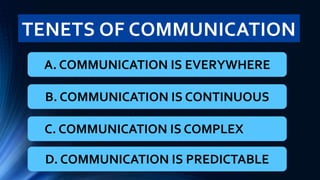
TENETS OF COMMUNICATION
A. COMMUNICATION IS EVERYWHERE
B. COMMUNICATION IS CONTINUOUS
C. COMMUNICATION IS COMPLEX
D. COMMUNICATION IS PREDICTABLE
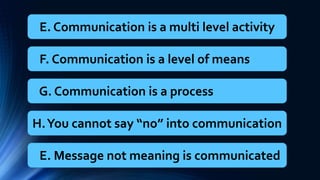
E. Communication is a multi level activity
F. Communication is a level of means
G. Communication is a process
H.You cannot say “no” into communication
E. Message not meaning is communicated
FACTORS IN
COMMUNICATION
(SENDER)
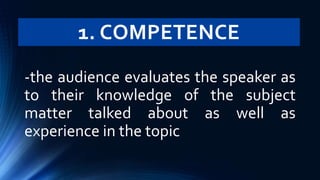
1. COMPETENCE
-the audience evaluates the speaker as
to their knowledge of the subject
matter talked about as well as
experience in the topic
2. TRUSTWORTHINESS
This covers the reliability of the
speaker
3. DYNAMISM
It is an electricity of life. It is similar to
aggressiveness, force, energy; loud or
soft voice
4. POWER
The physical figure standing before and
audience is power. His appearance,
social status, or the title adds factor in
communication
5. GOODWILL
Does he/she speak with sincerity?
Coming from the heart? Is it the truth?
6. IDEALISM
The speaker is emulated as having
values worthy of evaluation
7. EMPATHY
Can his audience put themselves in his
shoes? Does he have emotional
intelligence? Can I relate myself in the
same situation?
MODELS OF
COMMUNICATION
ARISTOTLE’S MODEL
•The first and earliest model of
communication.
•Mainly focused on speaker and speech.
•The Aristotle’s communication model is
a speaker centered model as the speaker
has the most important role in it and is the
only one active.
ARISTOTLE’S MODEL
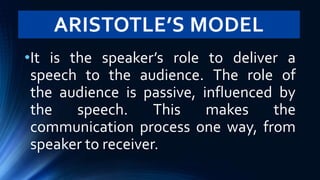
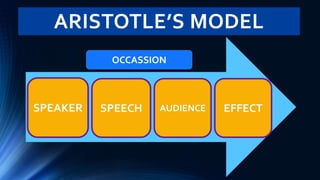
•It is the speaker’s role to deliver a
speech to the audience. The role of
the audience is passive, influenced by
the speech. This makes the
communication process one way, from
speaker to receiver.
ARISTOTLE’S MODEL
SPEAKER SPEECH AUDIENCE EFFECT
OCCASSION
LASWELL’S MODEL
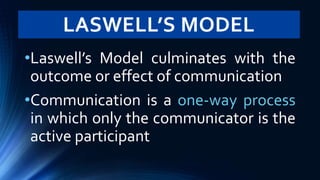
•Laswell’s Model culminates with the
outcome or effect of communication
•Communication is a one-way process
in which only the communicator is the
active participant
LASWELL’S MODEL
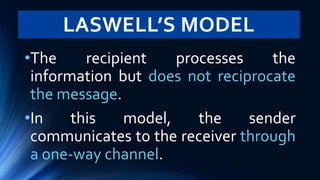
•The recipient processes the
information but does not reciprocate
the message.
•In this model, the sender
communicates to the receiver through
a one-way channel.
LASWELL’S MODEL
•Best examples are radio and television
broadcasting where the listeners
receive the information but there is no
means for immediate feedback
•Other examples: magazines,
newspapers, books
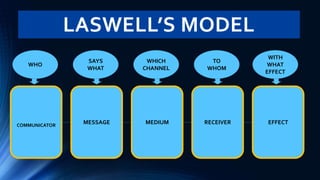
LASWELL’S MODEL
COMMUNICATOR
MESSAGE MEDIUM RECEIVER EFFECT
WHO
SAYS
WHAT
WHICH
CHANNEL
TO
WHOM
WITH
WHAT
EFFECT
SHANNON AND WEAVER’S MODEL
•The model resembles Laswell’s
framework
•Both employees of the Bell Telephone
Laboratory came up with a model that
resembled the transmission of a
telephone message
SHANNON AND WEAVER’S MODEL
•Also known as the Information
Theory/Telephone Model
•Primarily concerned with the
transmission of electronic
information
SHANNON AND WEAVER’S MODEL
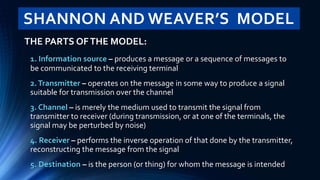
THE PARTS OFTHE MODEL:
1. Information source – produces a message or a sequence of messages to
be communicated to the receiving terminal
2.Transmitter – operates on the message in some way to produce a signal
suitable for transmission over the channel
3. Channel – is merely the medium used to transmit the signal from
transmitter to receiver (during transmission, or at one of the terminals, the
signal may be perturbed by noise)
4. Receiver – performs the inverse operation of that done by the transmitter,
reconstructing the message from the signal
5. Destination – is the person (or thing) for whom the message is intended
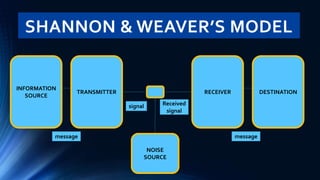
SHANNON & WEAVER’S MODEL
INFORMATION
SOURCE
TRANSMITTER RECEIVER DESTINATION
NOISE
SOURCE
message message
signal Received
signal
SHANNON AND WEAVER’S MODEL
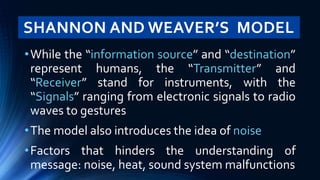
•While the “information source” and “destination”
represent humans, the “Transmitter” and
“Receiver” stand for instruments, with the
“Signals” ranging from electronic signals to radio
waves to gestures
•The model also introduces the idea of noise
•Factors that hinders the understanding of
message: noise, heat, sound system malfunctions
JAKOBSON’S MODEL
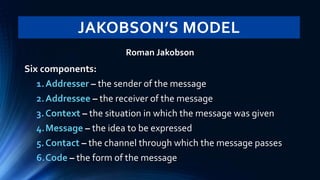
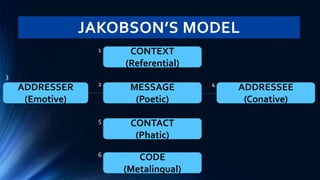
Roman Jakobson
Six components:
1.Addresser – the sender of the message
2.Addressee – the receiver of the message
3.Context – the situation in which the message was given
4.Message – the idea to be expressed
5.Contact – the channel through which the message passes
6.Code – the form of the message
JAKOBSON’S MODEL
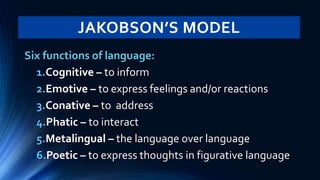
Six functions of language:
1.Cognitive – to inform
2.Emotive – to express feelings and/or reactions
3.Conative – to address
4.Phatic – to interact
5.Metalingual – the language over language
6.Poetic – to express thoughts in figurative language
JAKOBSON’S MODEL
CONTEXT
(Referential)
MESSAGE
(Poetic)
CONTACT
(Phatic)
CODE
(Metalingual)
ADDRESSER
(Emotive)
ADDRESSEE
(Conative)
1
2
3
4
5
6
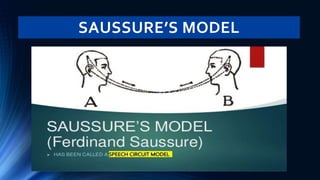
SAUSSURE’S MODEL
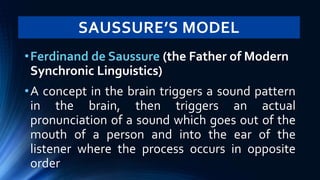
•Ferdinand de Saussure (the Father of Modern
Synchronic Linguistics)
•A concept in the brain triggers a sound pattern
in the brain, then triggers an actual
pronunciation of a sound which goes out of the
mouth of a person and into the ear of the
listener where the process occurs in opposite
order
SAUSSURE’S MODEL
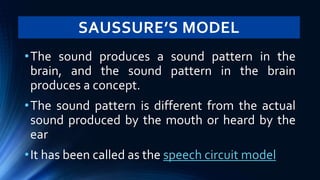
•The sound produces a sound pattern in the
brain, and the sound pattern in the brain
produces a concept.
•The sound pattern is different from the actual
sound produced by the mouth or heard by the
ear
•It has been called as the speech circuit model
SAUSSURE’S MODEL
BERLO’S MODEL
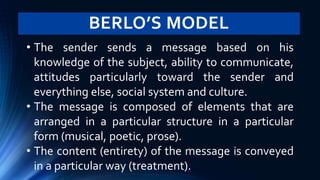
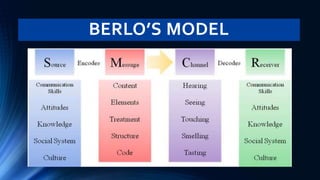
• The sender sends a message based on his
knowledge of the subject, ability to communicate,
attitudes particularly toward the sender and
everything else, social system and culture.
• The message is composed of elements that are
arranged in a particular structure in a particular
form (musical, poetic, prose).
• The content (entirety) of the message is conveyed
in a particular way (treatment).
BERLO’S MODEL
• The channel is the sense used to observe the
message.
• The receiver decodes the message based on
similar personality components as the sender.
• Berlo’s model includes verbal and nonverbal
aspects of communication. It is a linear type
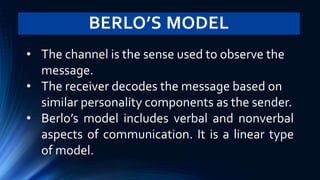
of model.
BERLO’S MODEL
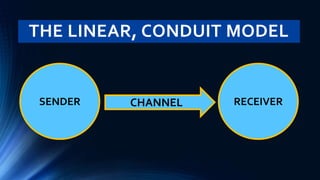
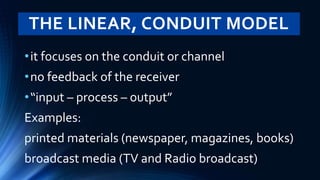
THE LINEAR, CONDUIT MODEL
•it focuses on the conduit or channel
•no feedback of the receiver
•“input – process – output”
Examples:
printed materials (newspaper, magazines, books)
broadcast media (TV and Radio broadcast)
THE LINEAR, CONDUIT MODEL
SENDER RECEIVER
CHANNEL
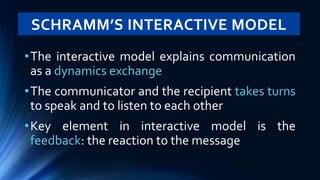
SCHRAMM’S INTERACTIVE MODEL
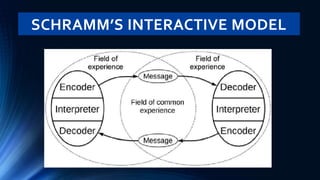
•The interactive model explains communication
as a dynamics exchange
•The communicator and the recipient takes turns
to speak and to listen to each other
•Key element in interactive model is the
feedback: the reaction to the message
SCHRAMM’S INTERACTIVE MODEL
•The message is sent to the receiver
who, in turn, gives a feedback to the
sender. The process is repeated,
making the sender a receiver and the
receiver a sender. (this is called the
interactive process)
SCHRAMM’S INTERACTIVE MODEL
TRANSACTIONAL MODEL
•The model presents an even more
realistic view of communicative process:
a spontaneous rapid flow of ideas.
•The model takes also into account the
personal and professional background of
the participants.
TRANSACTIONAL MODEL
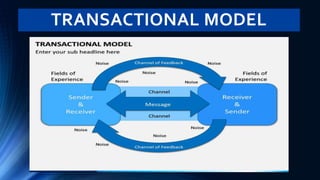
THREE IMPLICATIONS:
1. Implies the communication is on-going, and it
involves also continuing changing process
2. Each element of the transactional process exists
in relation to the other elements.
3. Individual background experiences, attitudes,
cultural beliefs, self-esteem play important role
in the communication process
TRANSACTIONAL MODEL
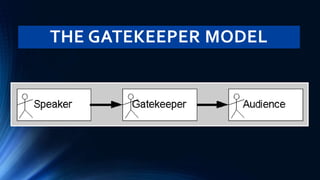
THE GATEKEEPER MODEL
•This model can represent mass communication
•The key players of mass media (newspapers, TV,
radio, internet) have access to information have
control over what is disseminated to the public.
•Media takes the role of the gatekeeper
•The MTRCB takes the function of a gatekeeper
reviewing and classifying movie films and television
programs
THE GATEKEEPER MODEL
END 
Thank you for reading!
-Sir Jiff

LESSON-4-TENETS-AND-MODELS-oF-COmmunicationx

  • 1.
  • 2.
    LESSON 4: TENETS, FACTORS,AND MODELS OF COMMUNICATION
  • 3.
  • 4.
    TENETS OF COMMUNICATION A.COMMUNICATION IS EVERYWHERE B. COMMUNICATION IS CONTINUOUS C. COMMUNICATION IS COMPLEX D. COMMUNICATION IS PREDICTABLE
  • 5.
    E. Communication isa multi level activity F. Communication is a level of means G. Communication is a process H.You cannot say “no” into communication E. Message not meaning is communicated
  • 6.
  • 7.
    1. COMPETENCE -the audienceevaluates the speaker as to their knowledge of the subject matter talked about as well as experience in the topic
  • 8.
    2. TRUSTWORTHINESS This coversthe reliability of the speaker
  • 9.
    3. DYNAMISM It isan electricity of life. It is similar to aggressiveness, force, energy; loud or soft voice
  • 10.
    4. POWER The physicalfigure standing before and audience is power. His appearance, social status, or the title adds factor in communication
  • 11.
    5. GOODWILL Does he/shespeak with sincerity? Coming from the heart? Is it the truth?
  • 12.
    6. IDEALISM The speakeris emulated as having values worthy of evaluation
  • 13.
    7. EMPATHY Can hisaudience put themselves in his shoes? Does he have emotional intelligence? Can I relate myself in the same situation?
  • 14.
  • 15.
    ARISTOTLE’S MODEL •The firstand earliest model of communication. •Mainly focused on speaker and speech. •The Aristotle’s communication model is a speaker centered model as the speaker has the most important role in it and is the only one active.
  • 16.
    ARISTOTLE’S MODEL •It isthe speaker’s role to deliver a speech to the audience. The role of the audience is passive, influenced by the speech. This makes the communication process one way, from speaker to receiver.
  • 17.
    ARISTOTLE’S MODEL SPEAKER SPEECHAUDIENCE EFFECT OCCASSION
  • 18.
    LASWELL’S MODEL •Laswell’s Modelculminates with the outcome or effect of communication •Communication is a one-way process in which only the communicator is the active participant
  • 19.
    LASWELL’S MODEL •The recipientprocesses the information but does not reciprocate the message. •In this model, the sender communicates to the receiver through a one-way channel.
  • 20.
    LASWELL’S MODEL •Best examplesare radio and television broadcasting where the listeners receive the information but there is no means for immediate feedback •Other examples: magazines, newspapers, books
  • 21.
    LASWELL’S MODEL COMMUNICATOR MESSAGE MEDIUMRECEIVER EFFECT WHO SAYS WHAT WHICH CHANNEL TO WHOM WITH WHAT EFFECT
  • 22.
    SHANNON AND WEAVER’SMODEL •The model resembles Laswell’s framework •Both employees of the Bell Telephone Laboratory came up with a model that resembled the transmission of a telephone message
  • 23.
    SHANNON AND WEAVER’SMODEL •Also known as the Information Theory/Telephone Model •Primarily concerned with the transmission of electronic information
  • 24.
    SHANNON AND WEAVER’SMODEL THE PARTS OFTHE MODEL: 1. Information source – produces a message or a sequence of messages to be communicated to the receiving terminal 2.Transmitter – operates on the message in some way to produce a signal suitable for transmission over the channel 3. Channel – is merely the medium used to transmit the signal from transmitter to receiver (during transmission, or at one of the terminals, the signal may be perturbed by noise) 4. Receiver – performs the inverse operation of that done by the transmitter, reconstructing the message from the signal 5. Destination – is the person (or thing) for whom the message is intended
  • 25.
    SHANNON & WEAVER’SMODEL INFORMATION SOURCE TRANSMITTER RECEIVER DESTINATION NOISE SOURCE message message signal Received signal
  • 26.
    SHANNON AND WEAVER’SMODEL •While the “information source” and “destination” represent humans, the “Transmitter” and “Receiver” stand for instruments, with the “Signals” ranging from electronic signals to radio waves to gestures •The model also introduces the idea of noise •Factors that hinders the understanding of message: noise, heat, sound system malfunctions
  • 27.
    JAKOBSON’S MODEL Roman Jakobson Sixcomponents: 1.Addresser – the sender of the message 2.Addressee – the receiver of the message 3.Context – the situation in which the message was given 4.Message – the idea to be expressed 5.Contact – the channel through which the message passes 6.Code – the form of the message
  • 28.
    JAKOBSON’S MODEL Six functionsof language: 1.Cognitive – to inform 2.Emotive – to express feelings and/or reactions 3.Conative – to address 4.Phatic – to interact 5.Metalingual – the language over language 6.Poetic – to express thoughts in figurative language
  • 29.
  • 30.
    SAUSSURE’S MODEL •Ferdinand deSaussure (the Father of Modern Synchronic Linguistics) •A concept in the brain triggers a sound pattern in the brain, then triggers an actual pronunciation of a sound which goes out of the mouth of a person and into the ear of the listener where the process occurs in opposite order
  • 31.
    SAUSSURE’S MODEL •The soundproduces a sound pattern in the brain, and the sound pattern in the brain produces a concept. •The sound pattern is different from the actual sound produced by the mouth or heard by the ear •It has been called as the speech circuit model
  • 32.
  • 33.
    BERLO’S MODEL • Thesender sends a message based on his knowledge of the subject, ability to communicate, attitudes particularly toward the sender and everything else, social system and culture. • The message is composed of elements that are arranged in a particular structure in a particular form (musical, poetic, prose). • The content (entirety) of the message is conveyed in a particular way (treatment).
  • 34.
    BERLO’S MODEL • Thechannel is the sense used to observe the message. • The receiver decodes the message based on similar personality components as the sender. • Berlo’s model includes verbal and nonverbal aspects of communication. It is a linear type of model.
  • 35.
  • 36.
    THE LINEAR, CONDUITMODEL •it focuses on the conduit or channel •no feedback of the receiver •“input – process – output” Examples: printed materials (newspaper, magazines, books) broadcast media (TV and Radio broadcast)
  • 37.
    THE LINEAR, CONDUITMODEL SENDER RECEIVER CHANNEL
  • 38.
    SCHRAMM’S INTERACTIVE MODEL •Theinteractive model explains communication as a dynamics exchange •The communicator and the recipient takes turns to speak and to listen to each other •Key element in interactive model is the feedback: the reaction to the message
  • 39.
    SCHRAMM’S INTERACTIVE MODEL •Themessage is sent to the receiver who, in turn, gives a feedback to the sender. The process is repeated, making the sender a receiver and the receiver a sender. (this is called the interactive process)
  • 40.
  • 41.
    TRANSACTIONAL MODEL •The modelpresents an even more realistic view of communicative process: a spontaneous rapid flow of ideas. •The model takes also into account the personal and professional background of the participants.
  • 42.
    TRANSACTIONAL MODEL THREE IMPLICATIONS: 1.Implies the communication is on-going, and it involves also continuing changing process 2. Each element of the transactional process exists in relation to the other elements. 3. Individual background experiences, attitudes, cultural beliefs, self-esteem play important role in the communication process
  • 43.
  • 44.
    THE GATEKEEPER MODEL •Thismodel can represent mass communication •The key players of mass media (newspapers, TV, radio, internet) have access to information have control over what is disseminated to the public. •Media takes the role of the gatekeeper •The MTRCB takes the function of a gatekeeper reviewing and classifying movie films and television programs
  • 45.
  • 46.
    END  Thank youfor reading! -Sir Jiff