Reading Pictures Signs, Symbols and Visual Codes
Signs, Symbols and Visual Codes From looking at optical illusions it is clear that we can read pictures in several ways. In order to get a similar reading, pictures often contain signs, symbols and visual codes to help us.
Signs, Symbols and Visual Codes Signs can be divided into three types: Symbolic Iconic Indexical
Signs, Symbols and Visual Codes   Symbolic signs are  the ones most difficult to get your head round! Symbolic signs have no obvious connection between between the sign and the object.
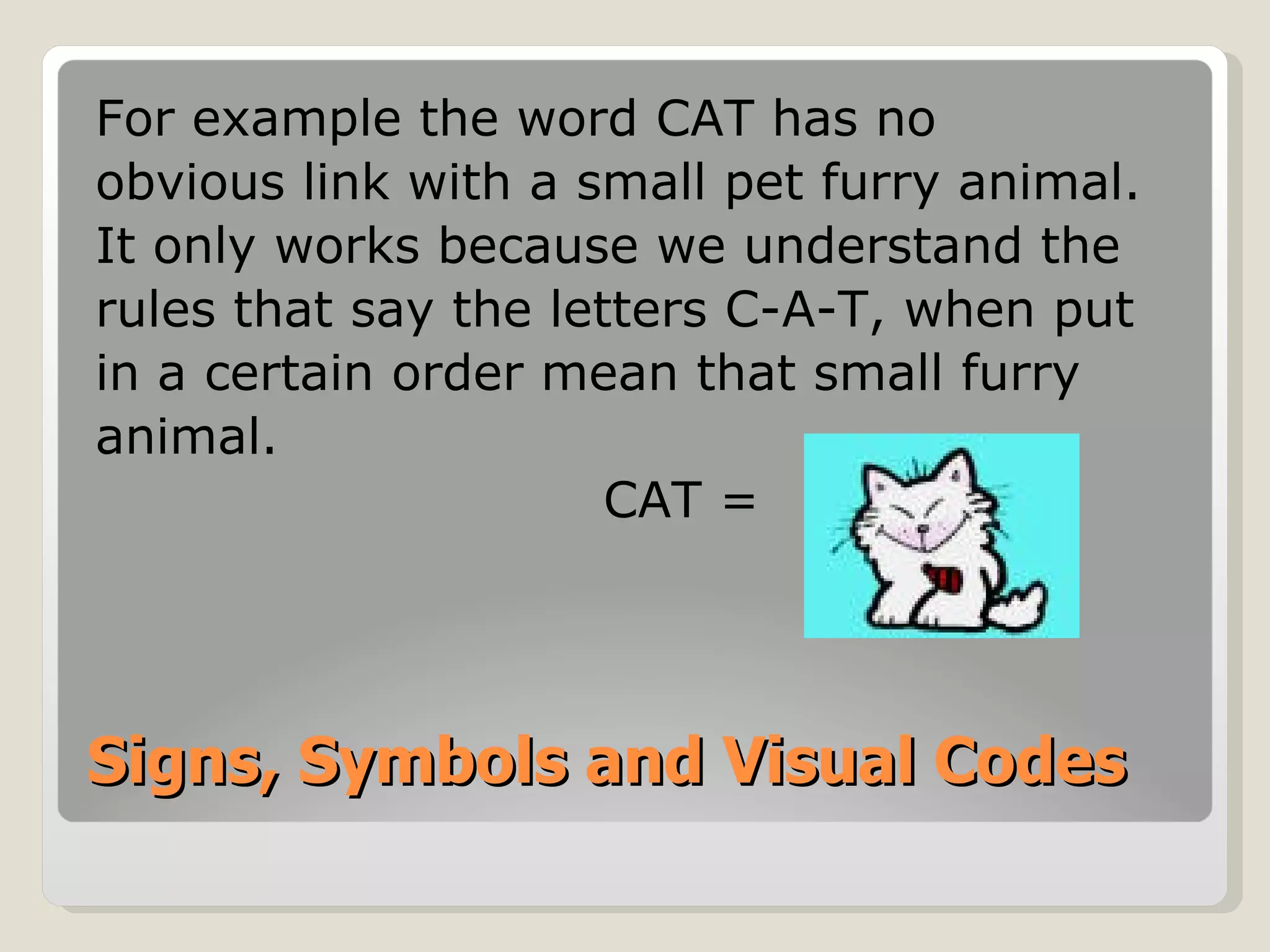
Signs, Symbols and Visual Codes For example the word CAT has no obvious link with a small pet furry animal.  It only works because we understand the rules that say the letters C-A-T, when put in a certain order mean that small furry animal. CAT =
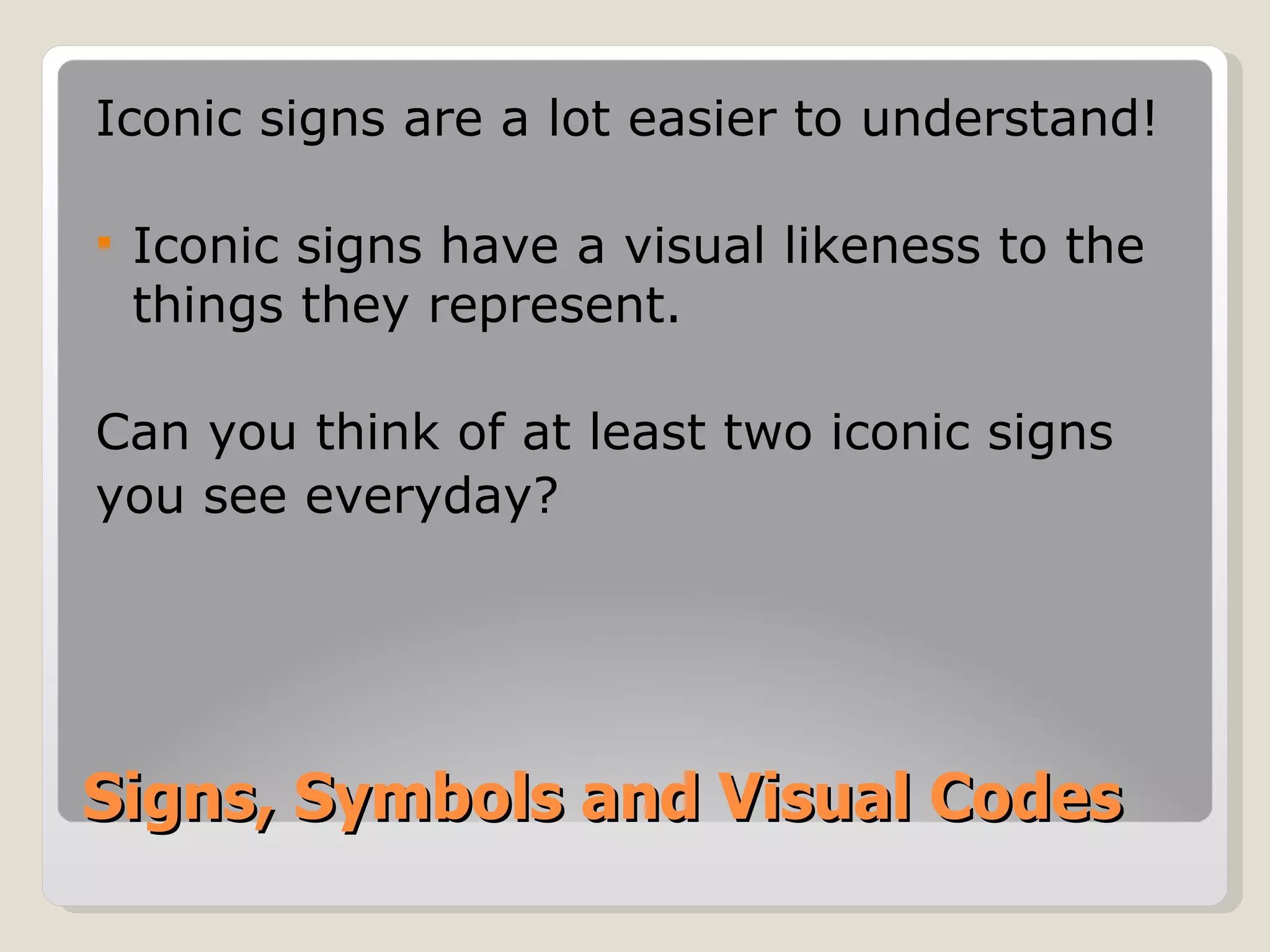
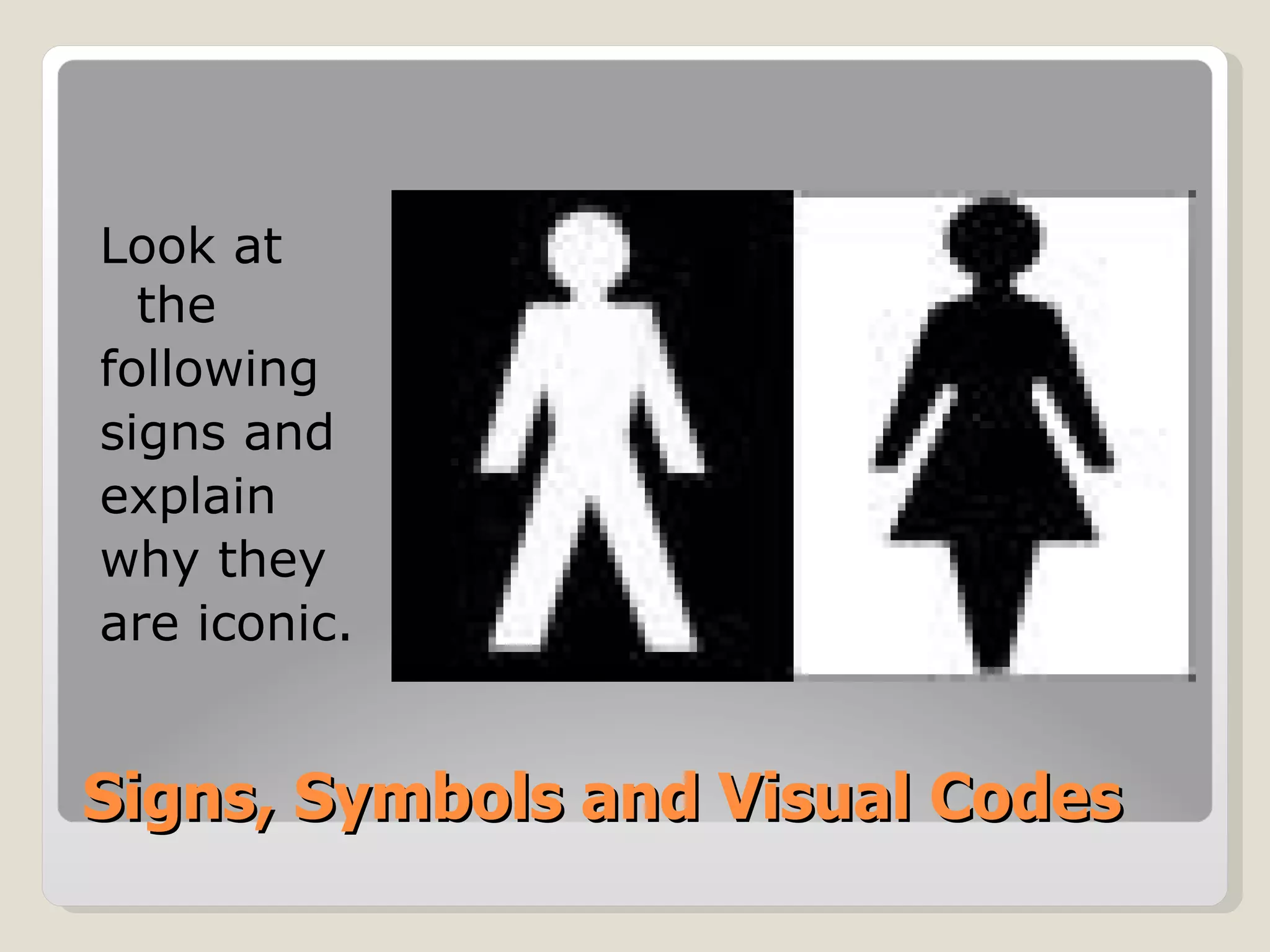
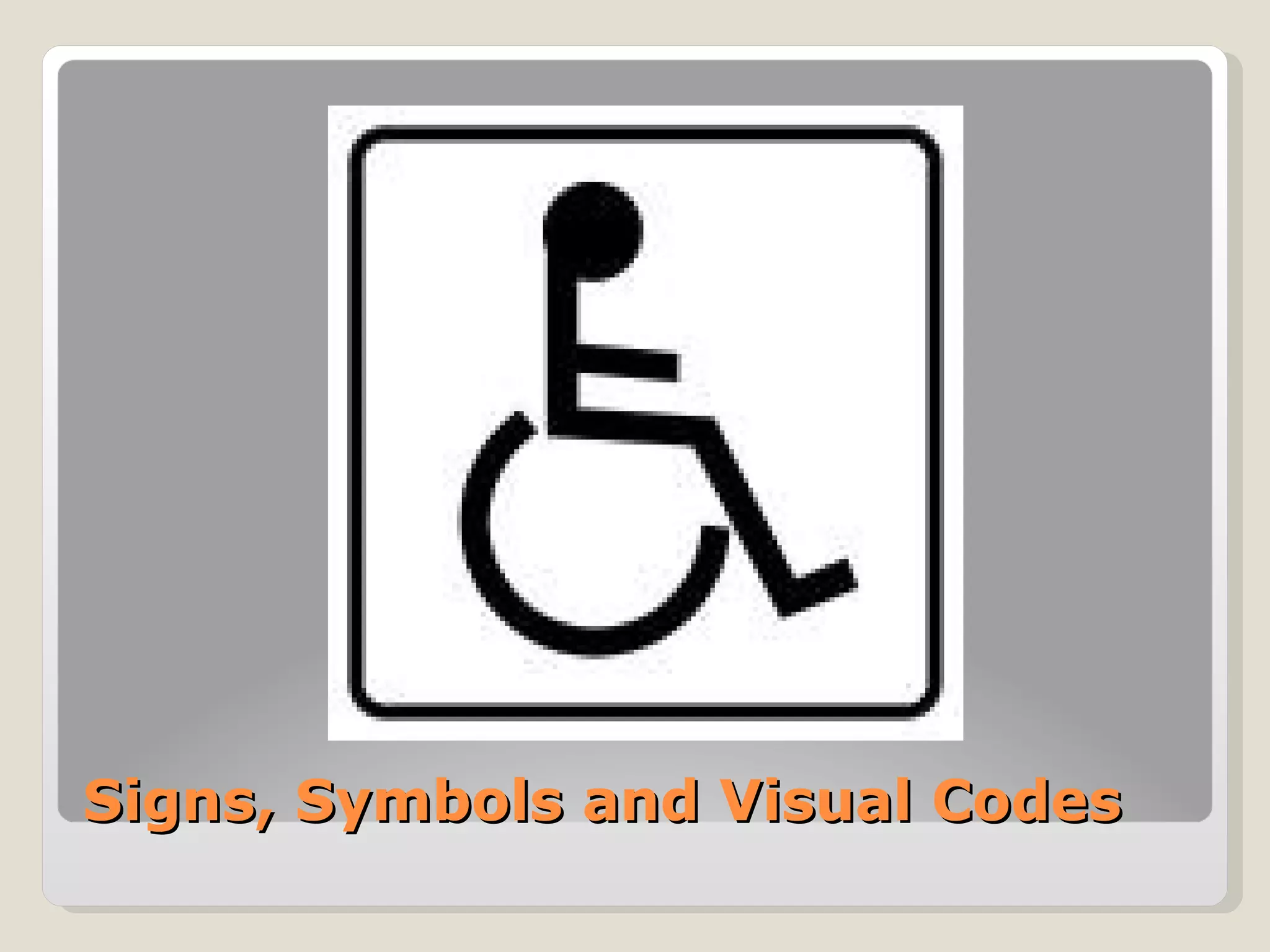
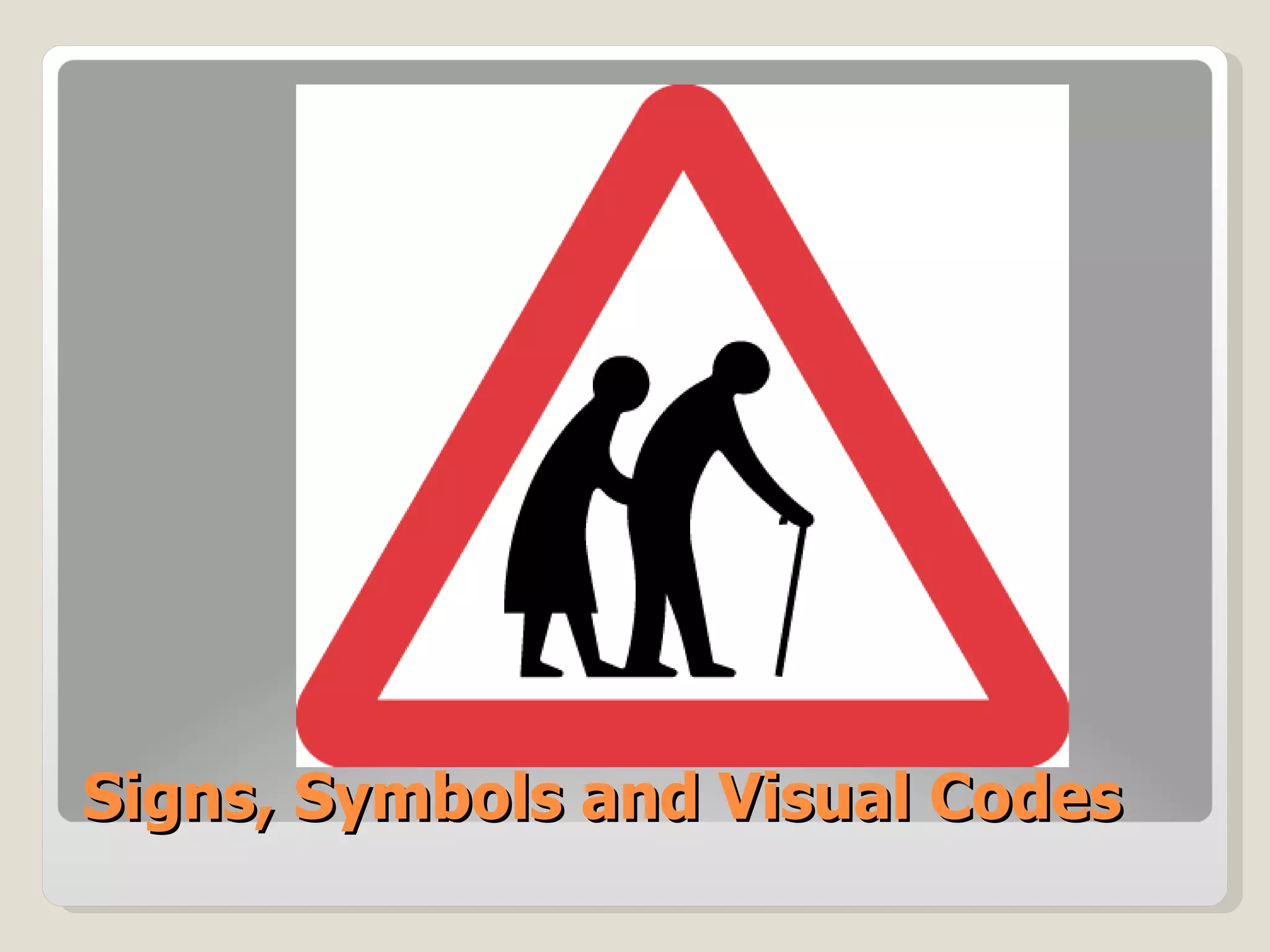
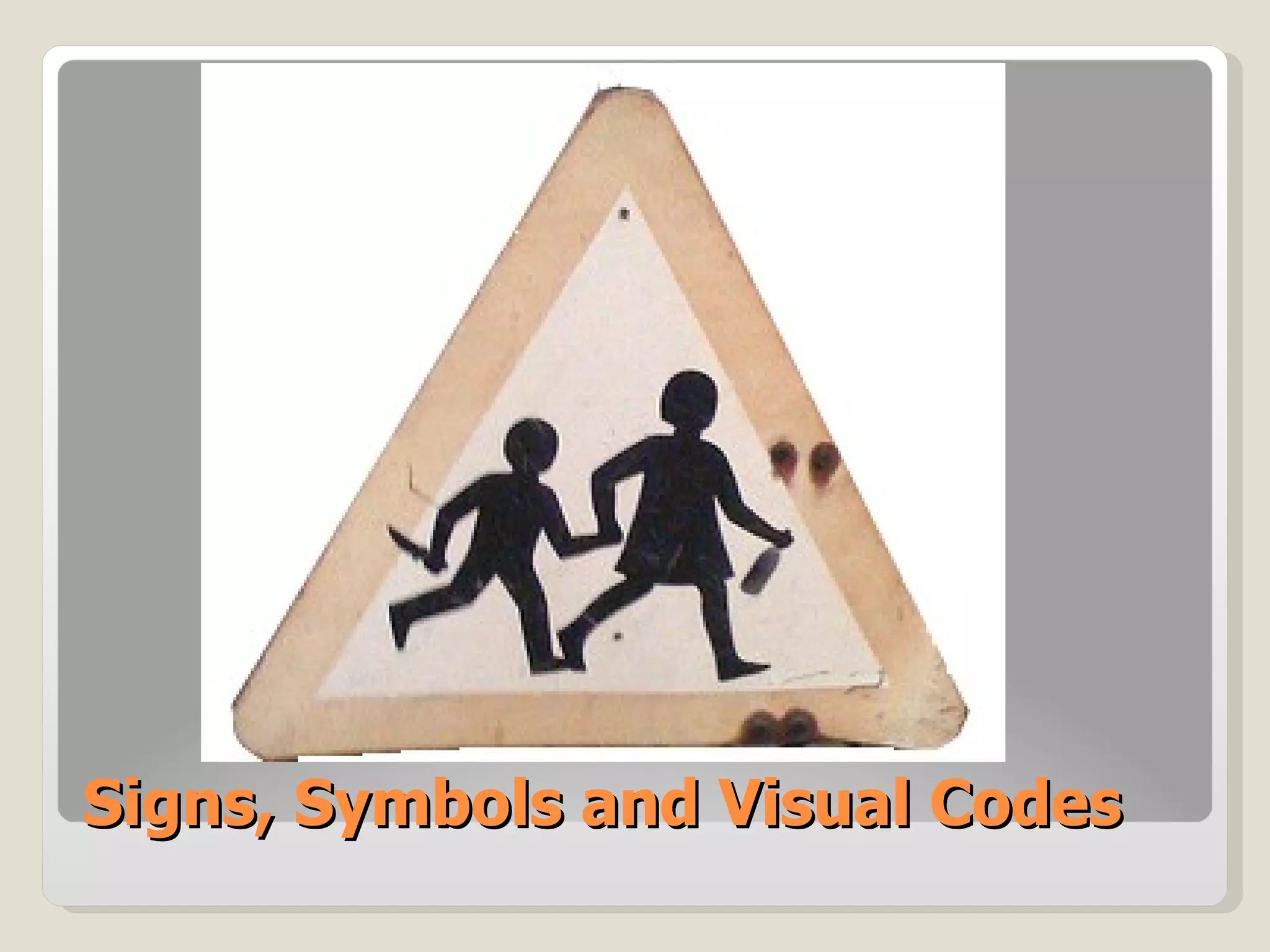
Signs, Symbols and Visual Codes Iconic signs are a lot easier to understand! Iconic signs have a visual likeness to the things they represent. Can you think of at least two iconic signs you see everyday?
Signs, Symbols and Visual Codes Here are some you can see when you use a  computer:
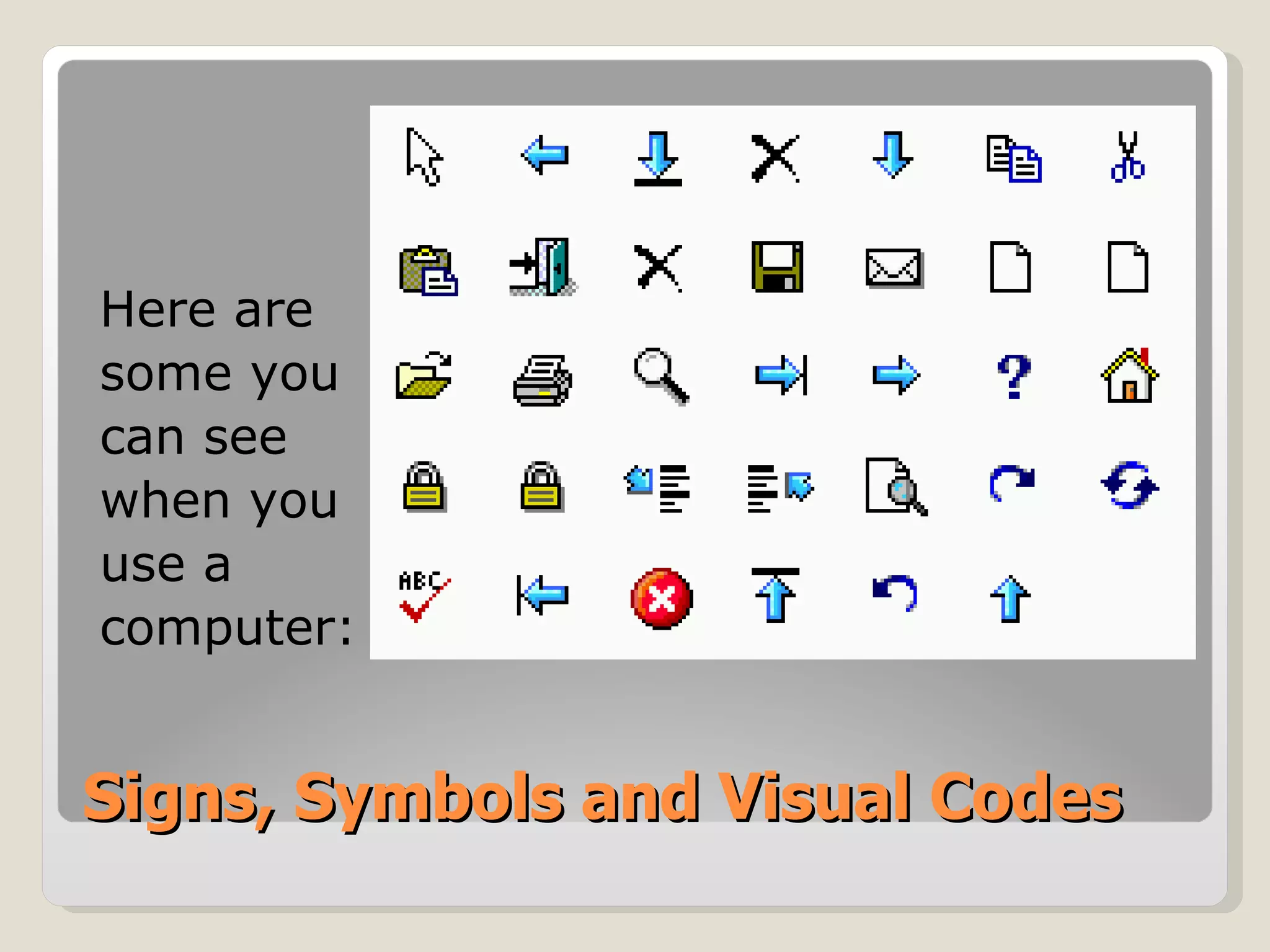
Signs, Symbols and Visual Codes Look at the following signs and explain why they are iconic.
Signs, Symbols and Visual Codes
Signs, Symbols and Visual Codes The only alphabet in the world that contains iconic letters is the one used by Japanese and Chinese people. The letters are called kanji and there are over 2,000 of them compared to our 26! Each kanji looks like the word it represents.
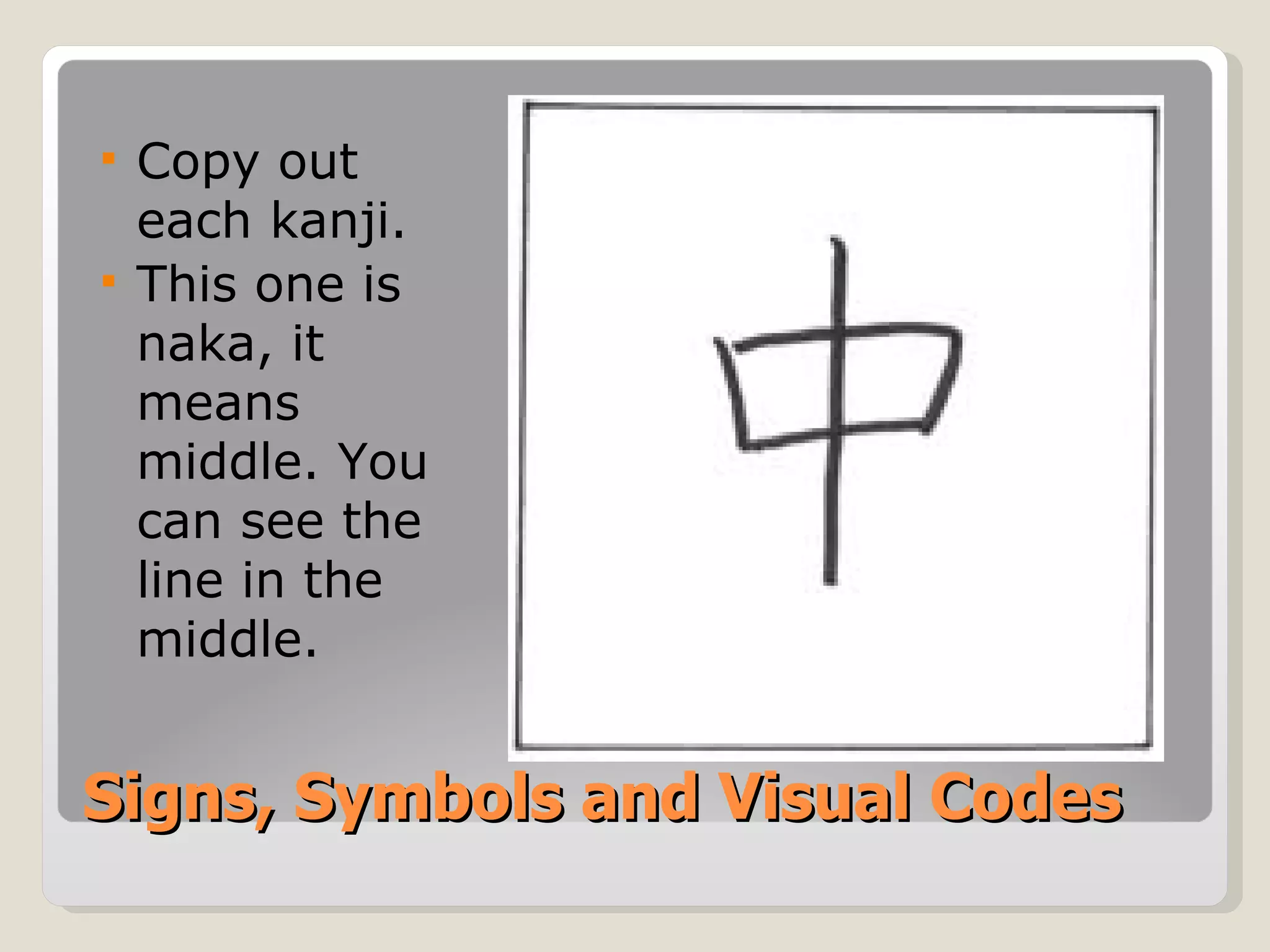
Signs, Symbols and Visual Codes Copy out each kanji. This one is naka, it means middle. You can see the line in the middle.
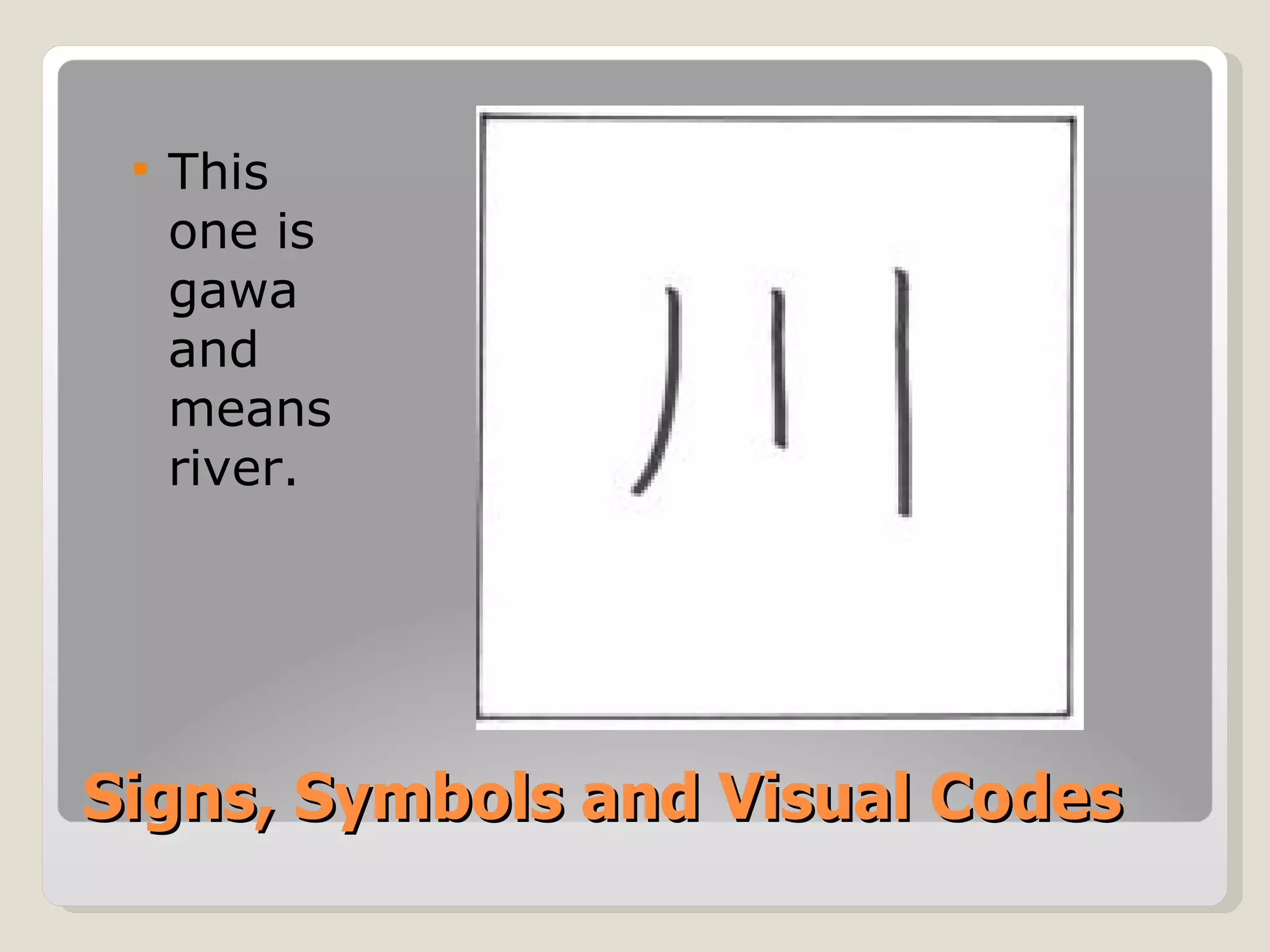
Signs, Symbols and Visual Codes This one is gawa and means river.
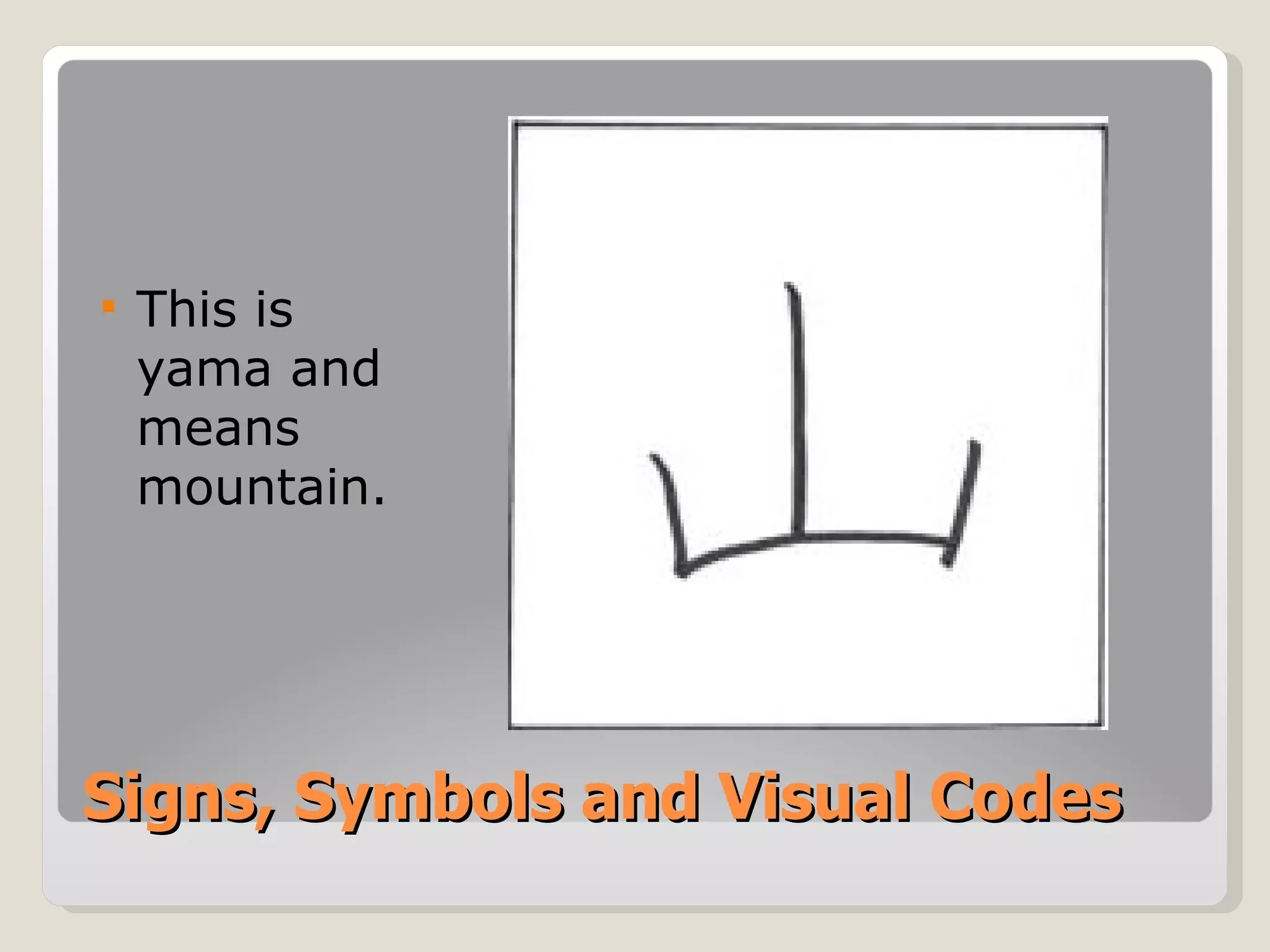
Signs, Symbols and Visual Codes This is yama and means mountain.
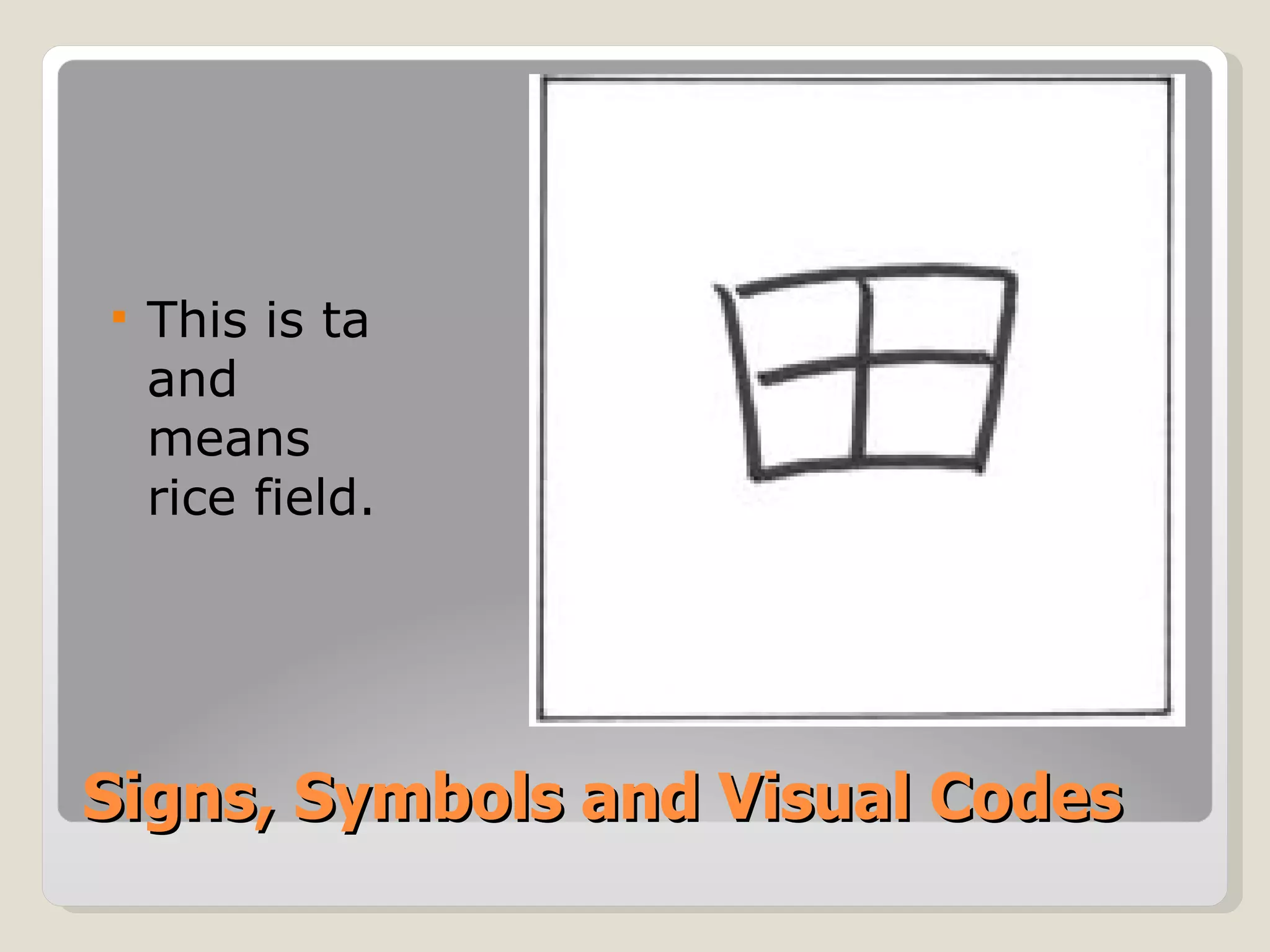
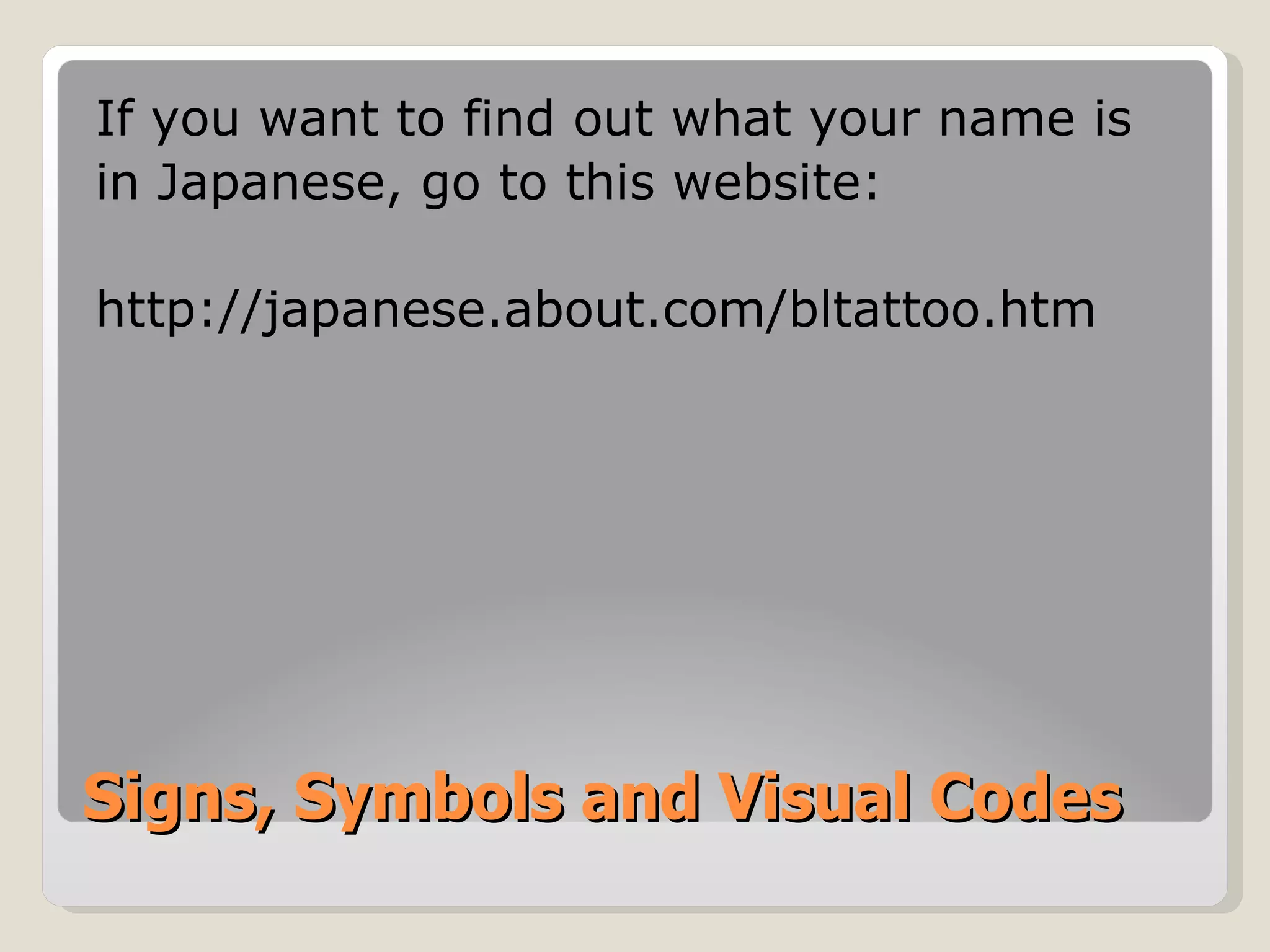
Signs, Symbols and Visual Codes This is ta and means rice field.
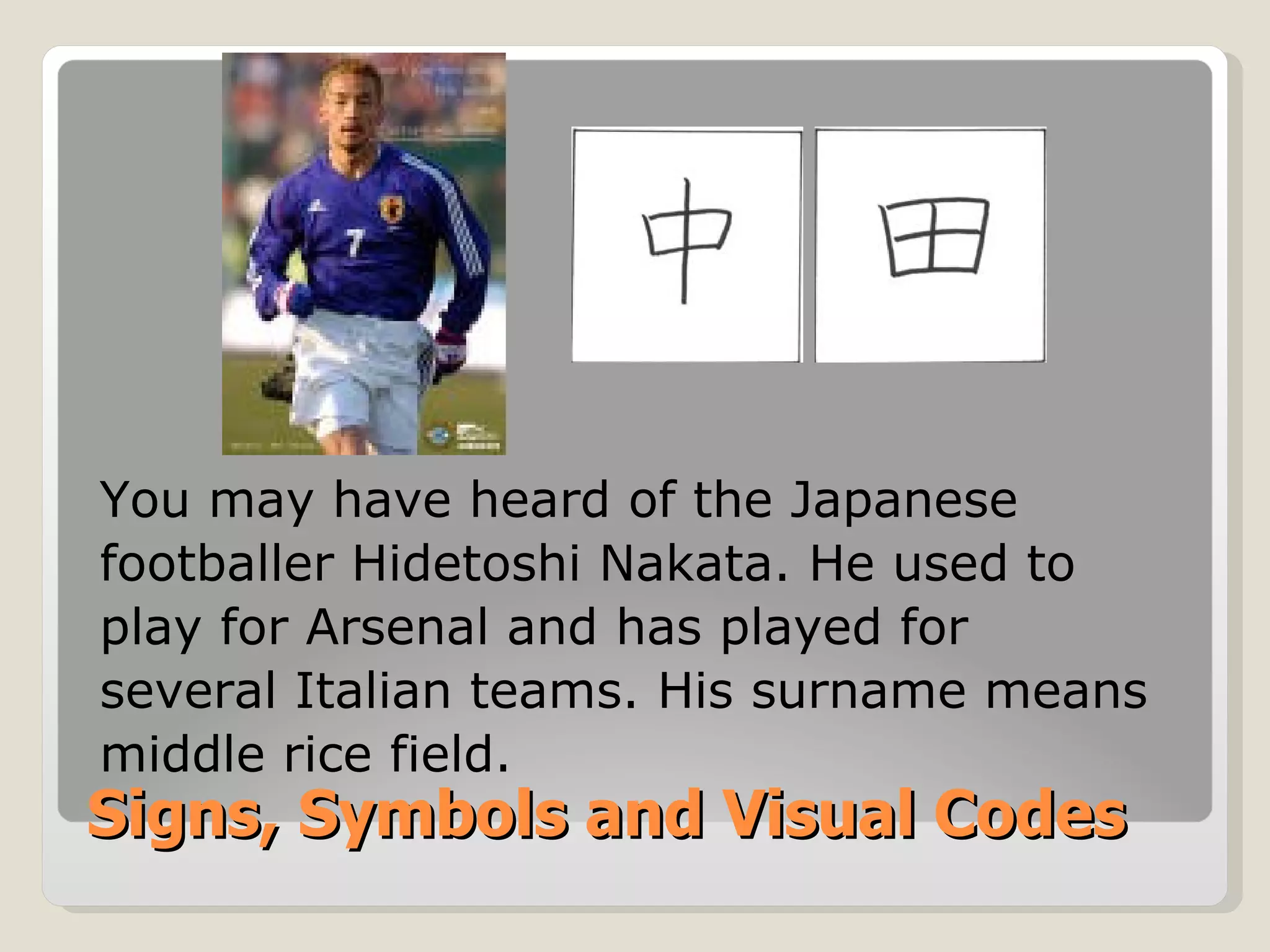
Signs, Symbols and Visual Codes You may have heard of the Japanese footballer Hidetoshi Nakata. He used to play for Arsenal and has played for  several Italian teams. His surname means middle rice field.
Signs, Symbols and Visual Codes If you want to find out what your name is in Japanese, go to this website: http://japanese.about.com/bltattoo.htm
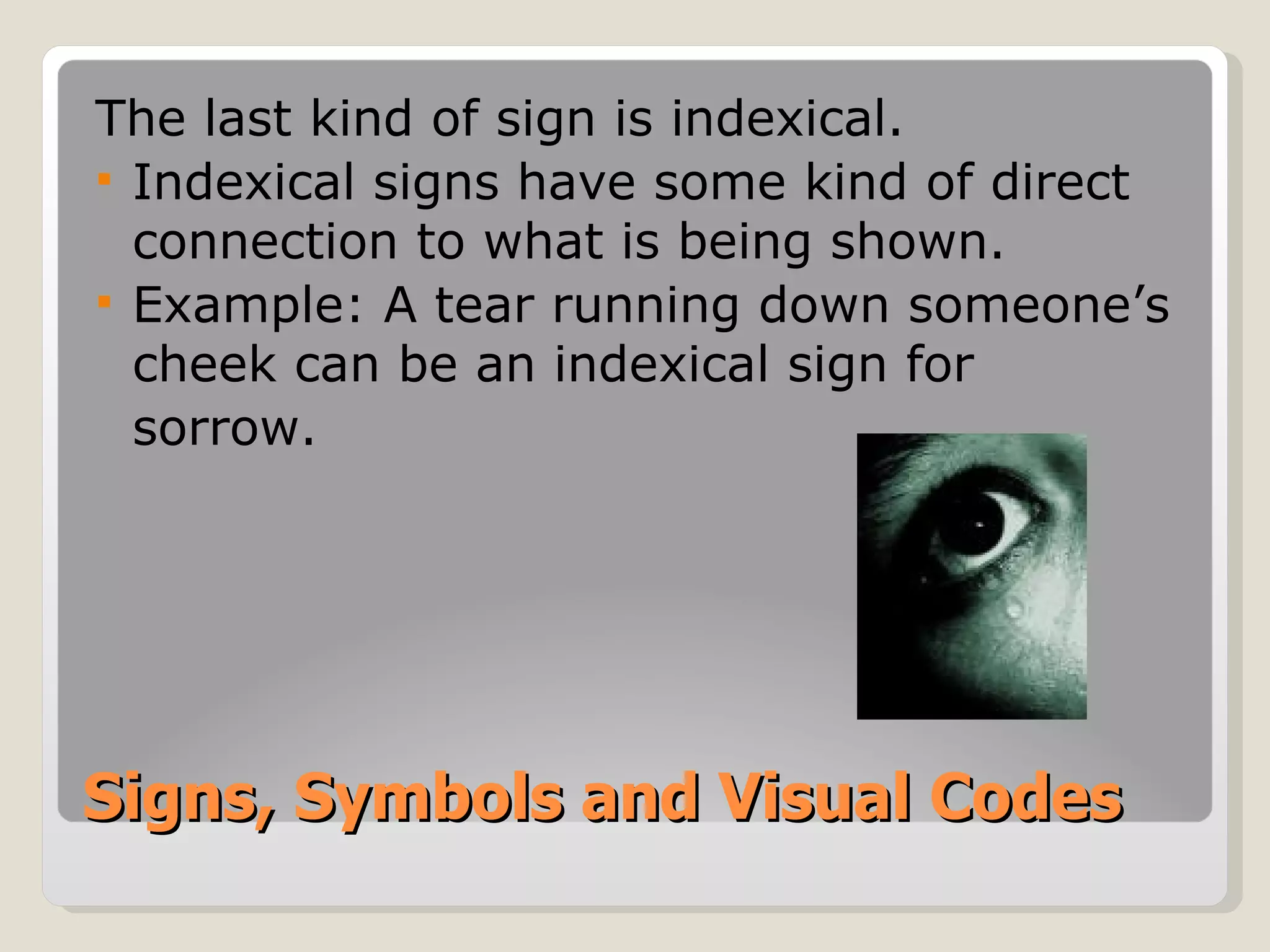
Signs, Symbols and Visual Codes The last kind of sign is indexical. Indexical signs have some kind of direct connection to what is being shown. Example: A tear running down someone’s cheek can be an indexical sign for  sorrow.
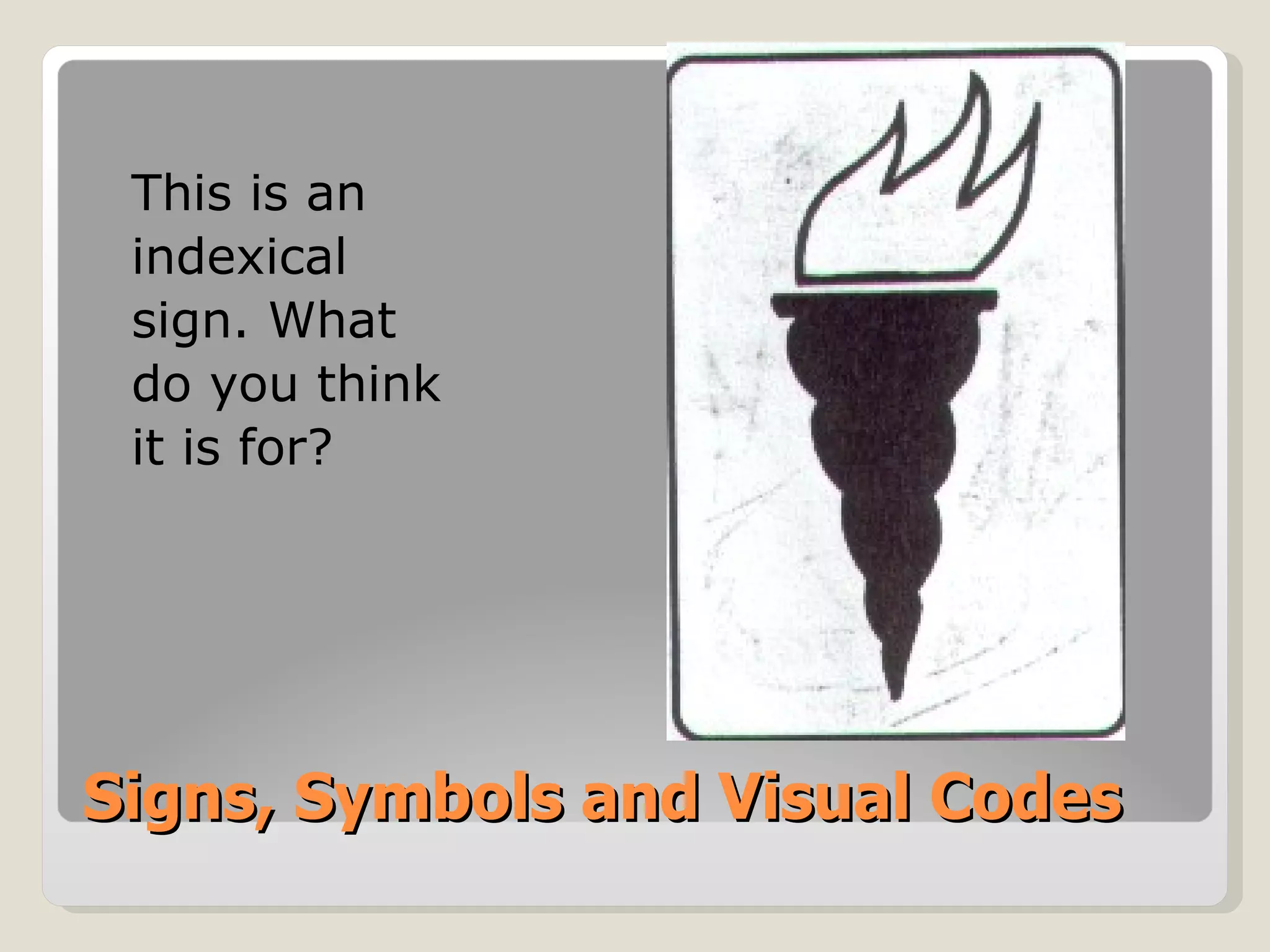
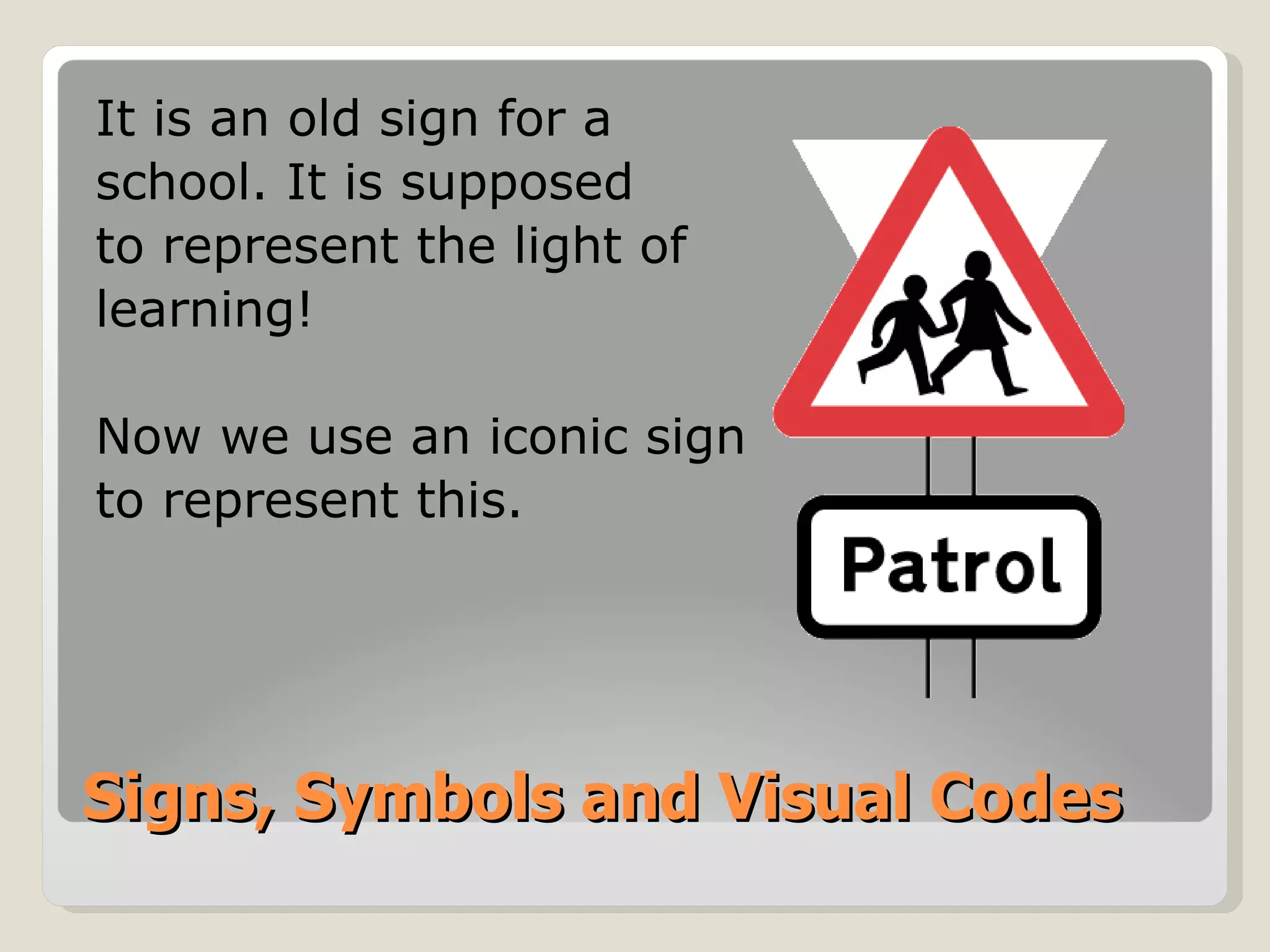
Signs, Symbols and Visual Codes This is an indexical sign. What do you think it is for?
Signs, Symbols and Visual Codes It is an old sign for a  school. It is supposed to represent the light of  learning! Now we use an iconic sign to represent this.
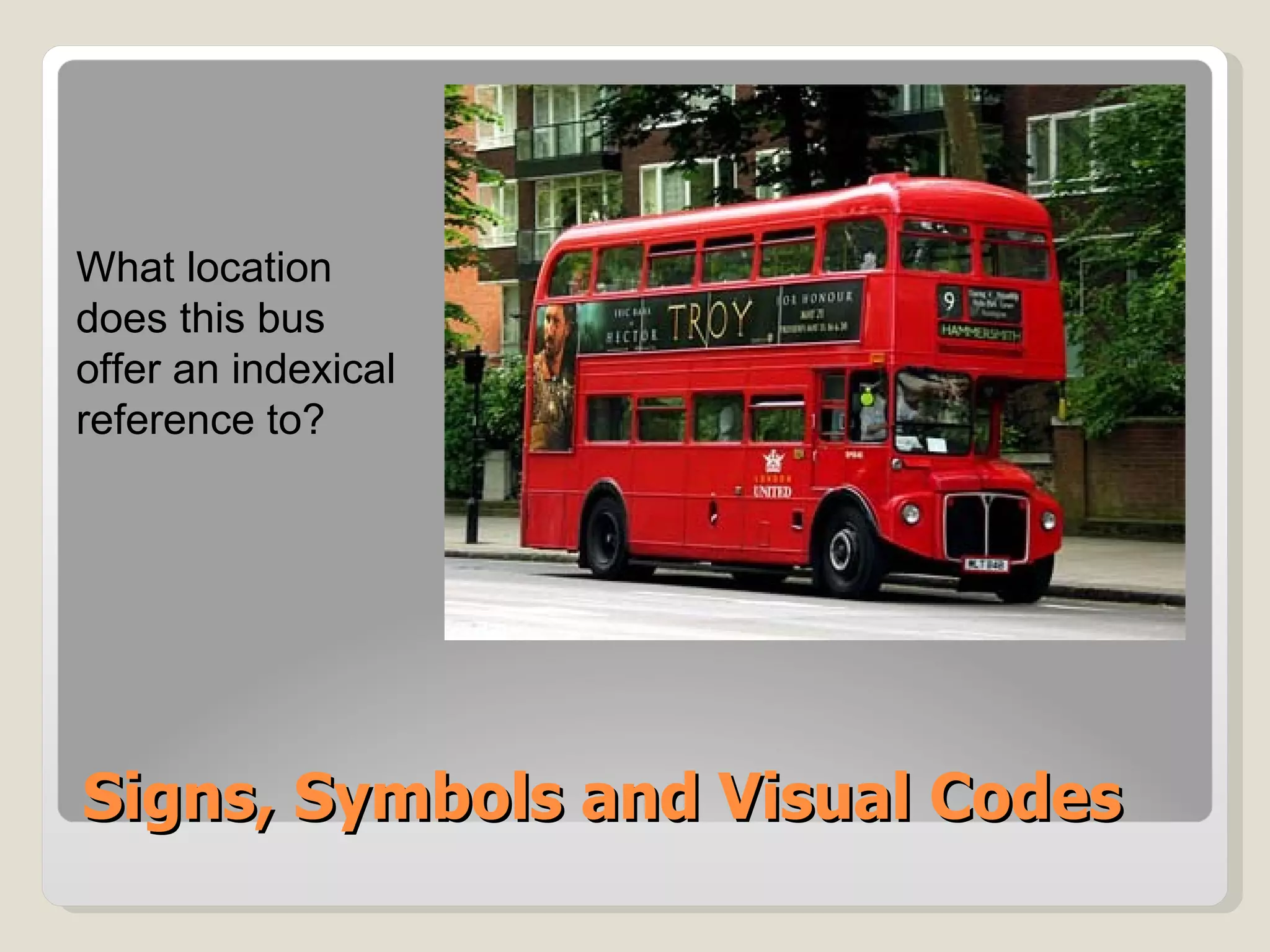
Signs, Symbols and Visual Codes What location does this bus offer an indexical reference to?
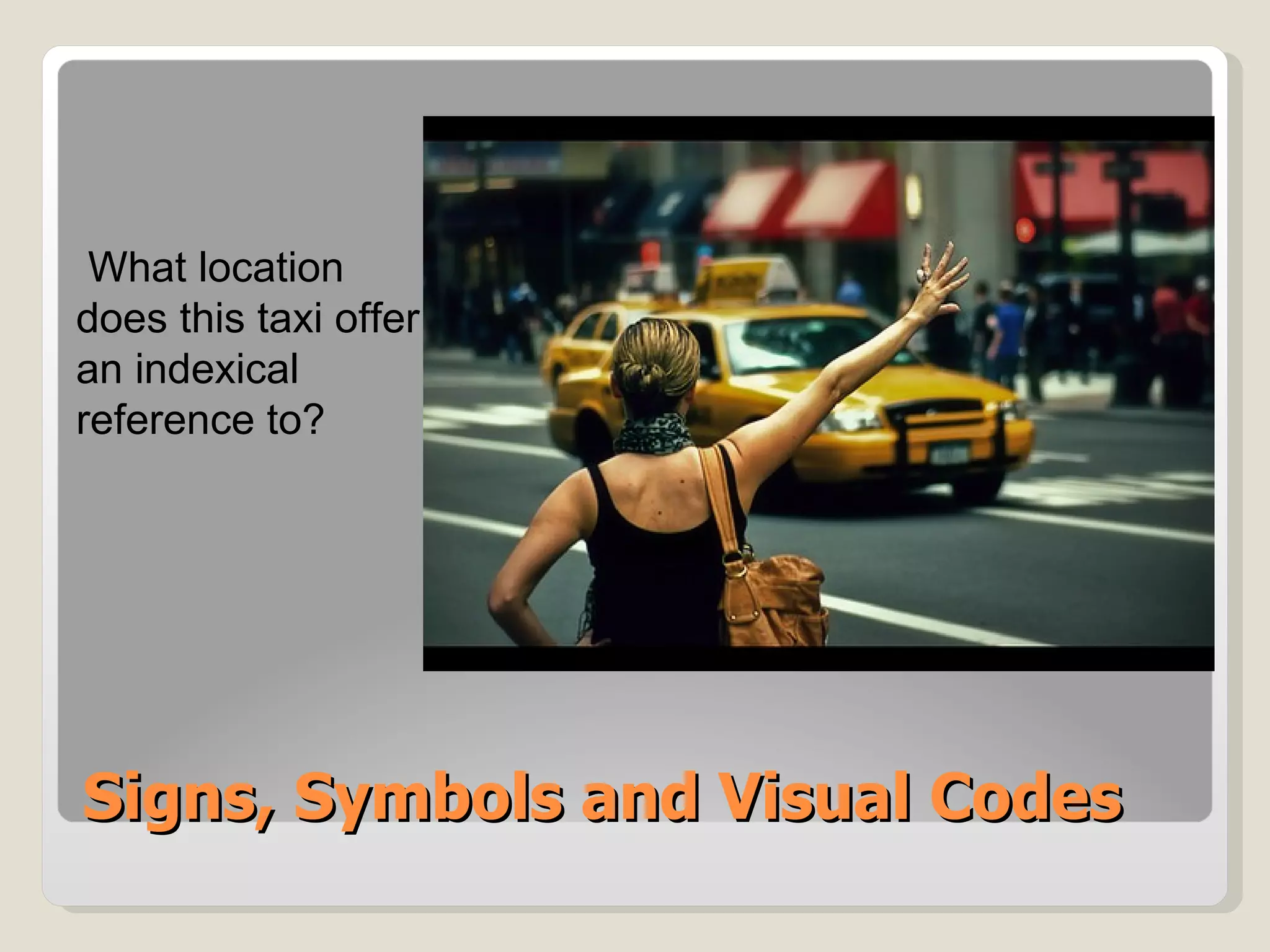
Signs, Symbols and Visual Codes What location does this taxi offer an indexical reference to?
Signs, Symbols and Visual Codes Another way of helping us to read pictures is the use of visual codes.  There are three main visual codes: - Dress Codes - Colour Codes - Non Verbal Communication
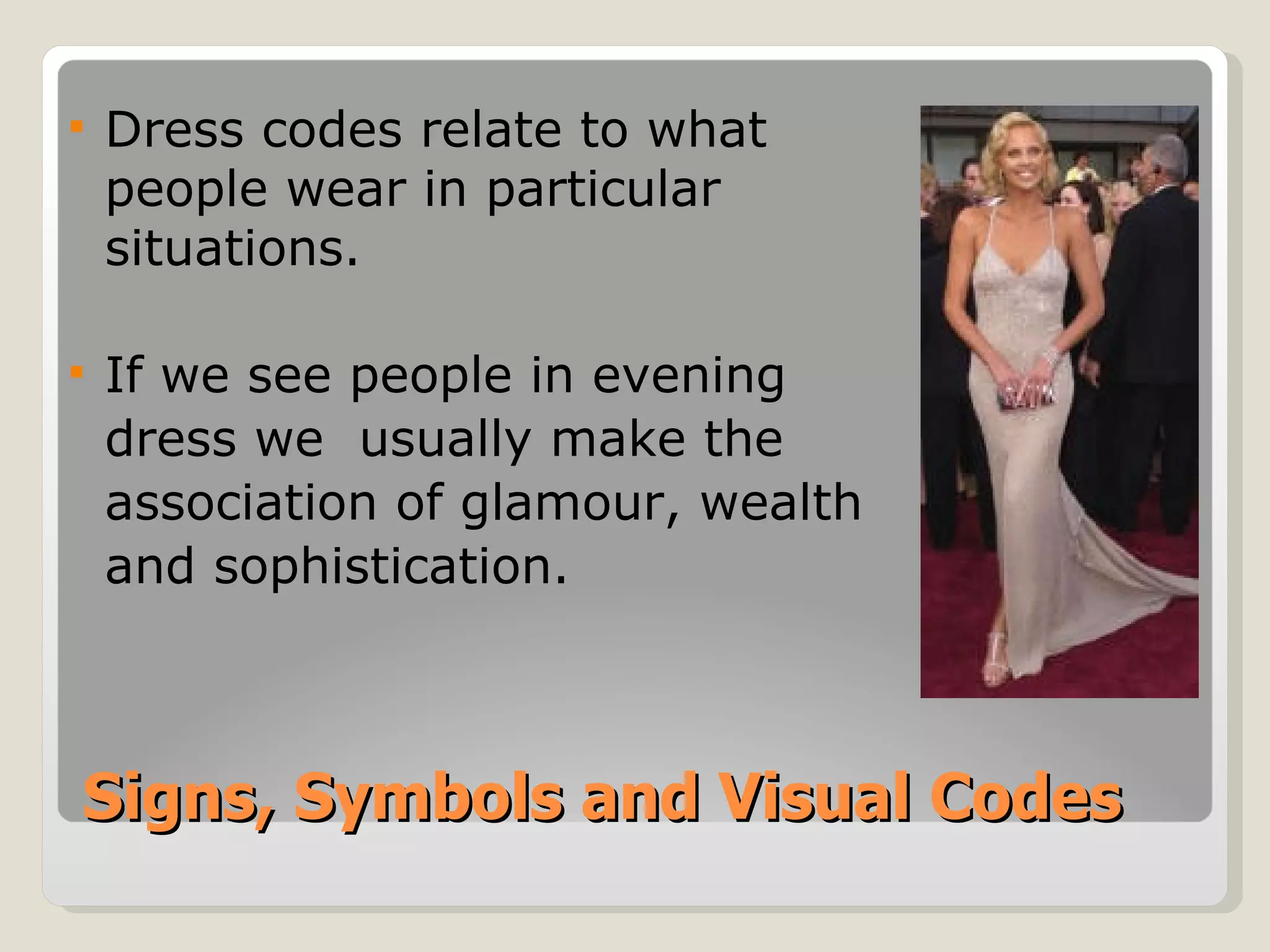
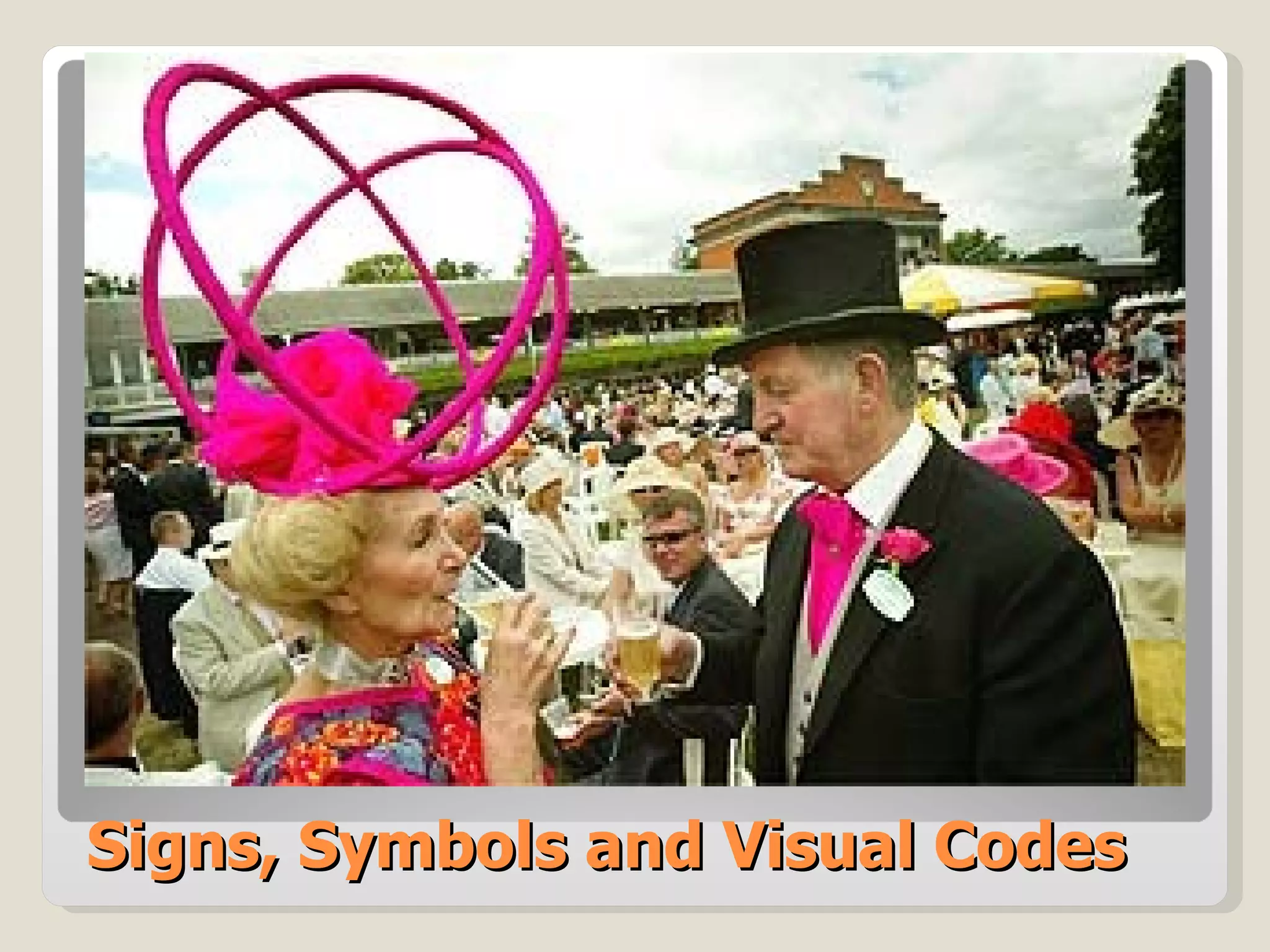
Signs, Symbols and Visual Codes Dress codes relate to what people wear in particular situations. If we see people in evening  dress we  usually make the  association of glamour, wealth  and sophistication.
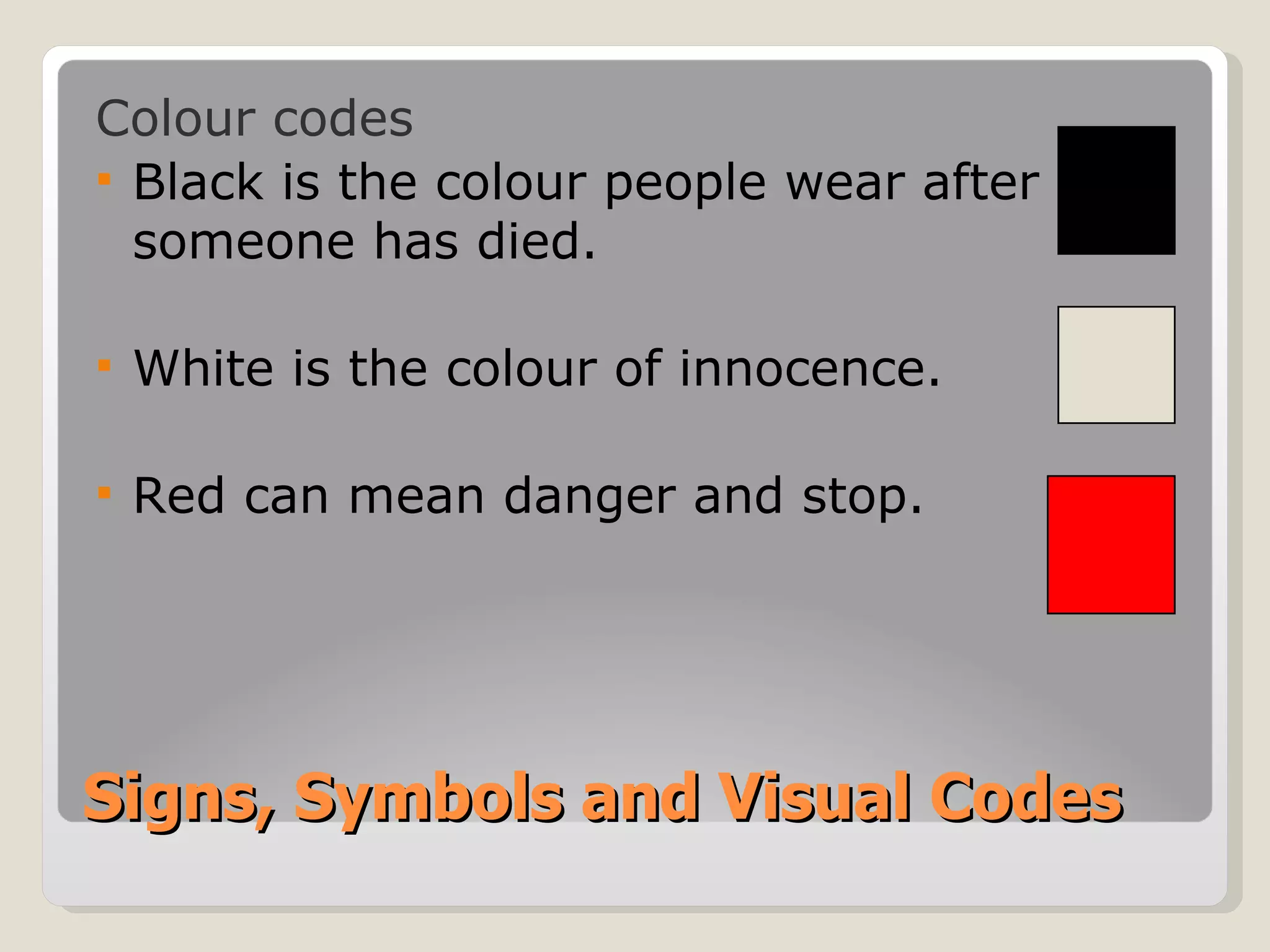
Signs, Symbols and Visual Codes Colour codes Black is the colour people wear after someone has died. White is the colour of innocence. Red can mean danger and stop.
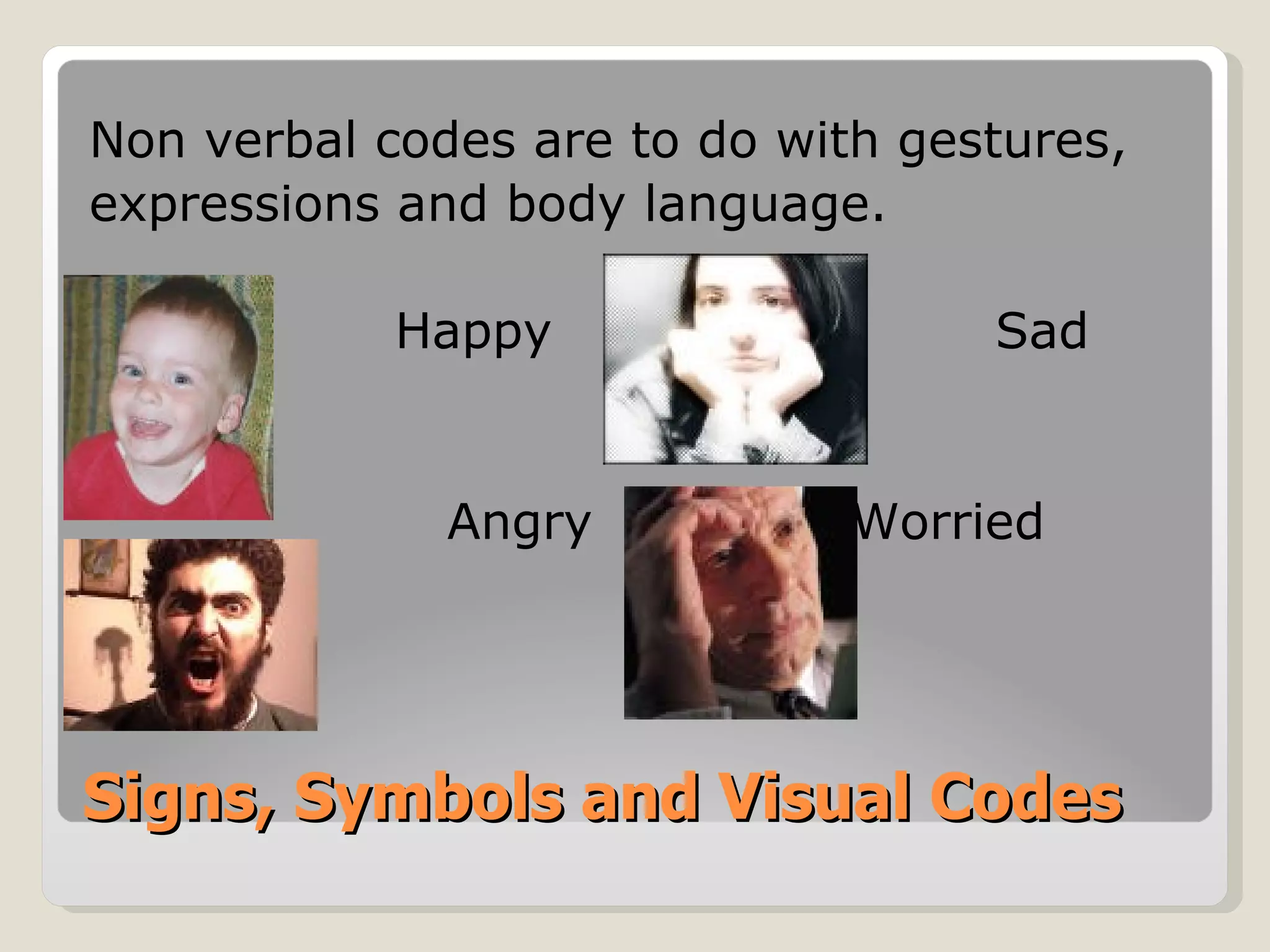
Signs, Symbols and Visual Codes Non verbal codes are to do with gestures, expressions and body language.   Happy  Sad   Angry Worried
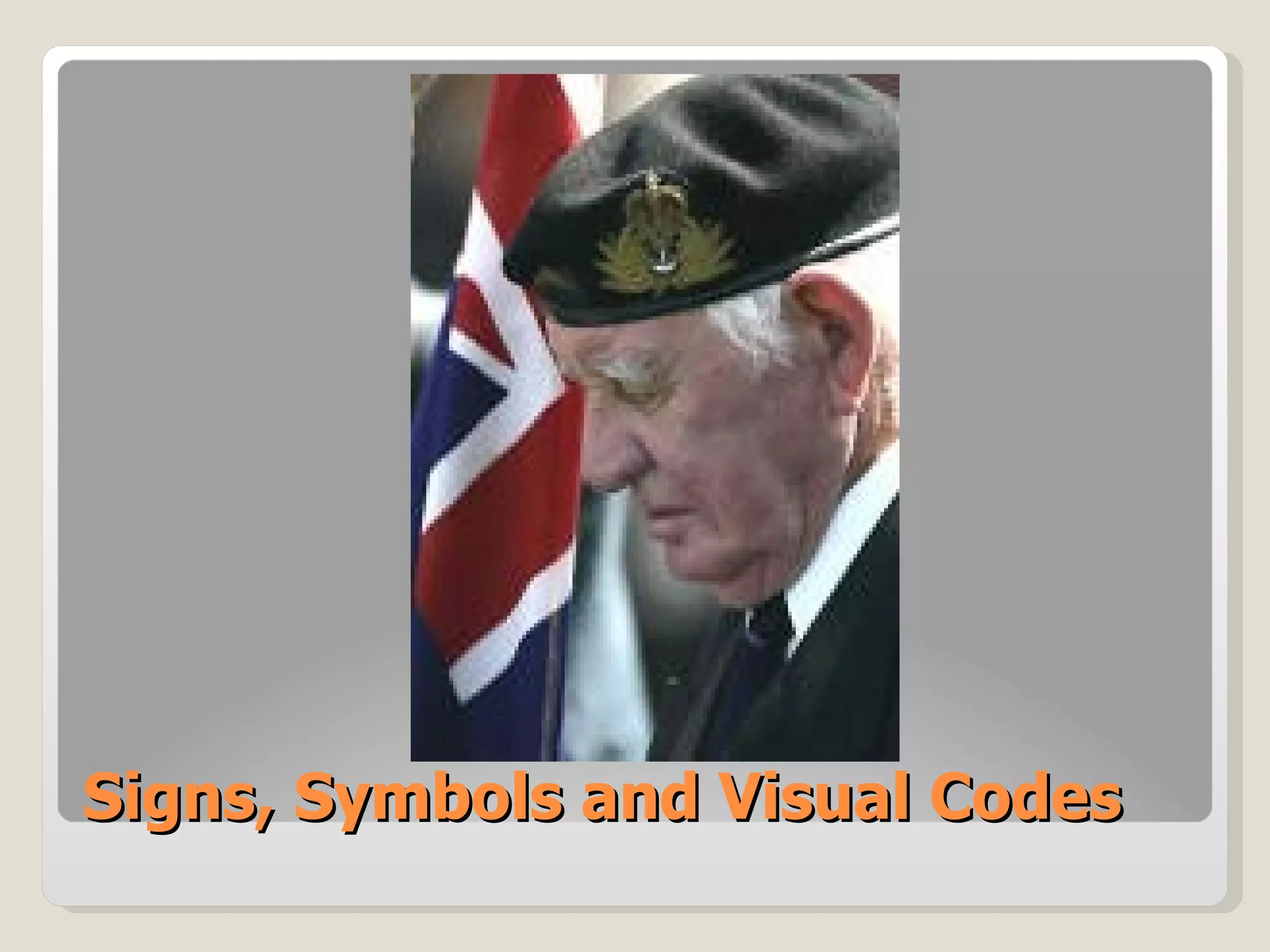
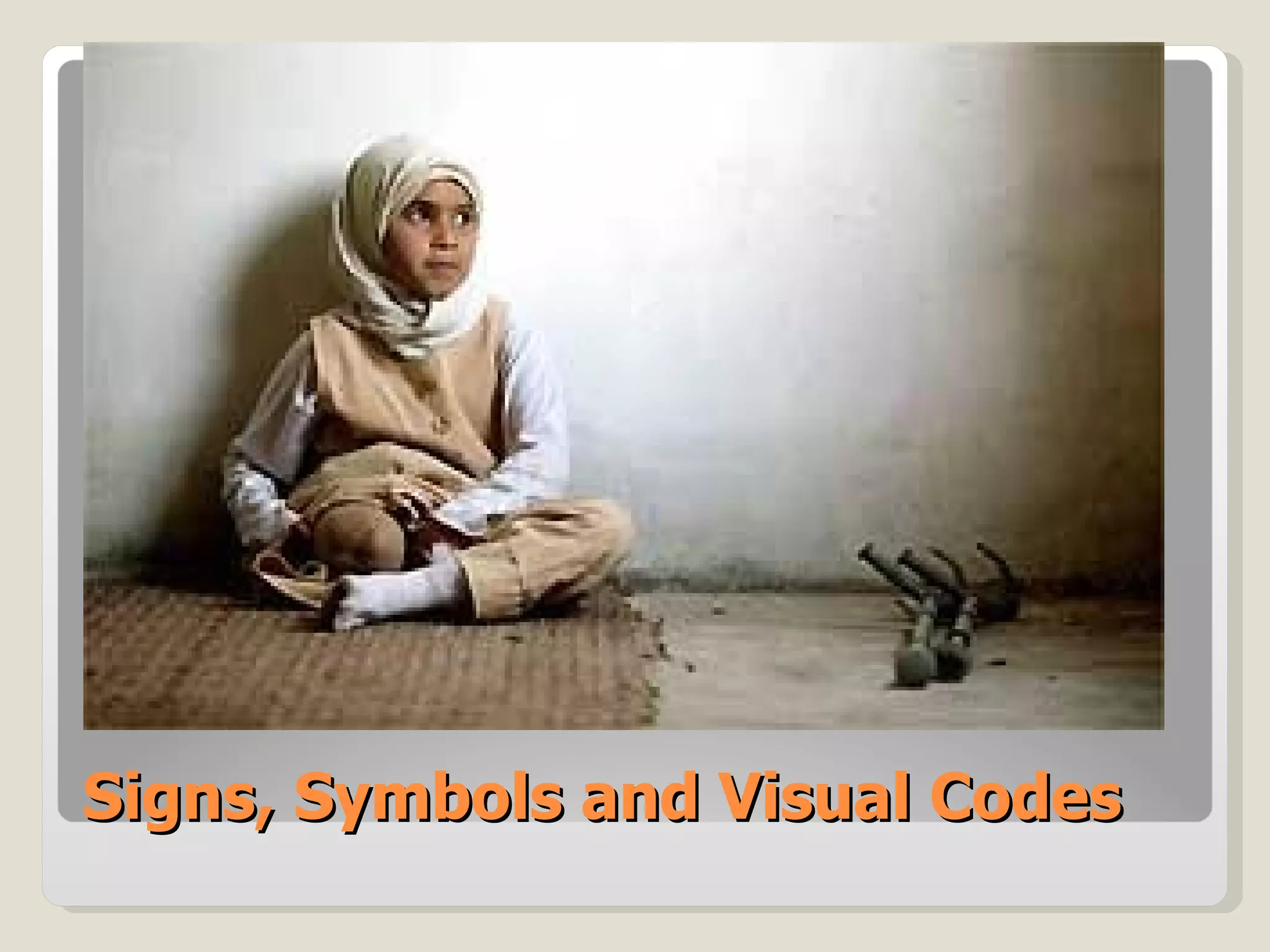
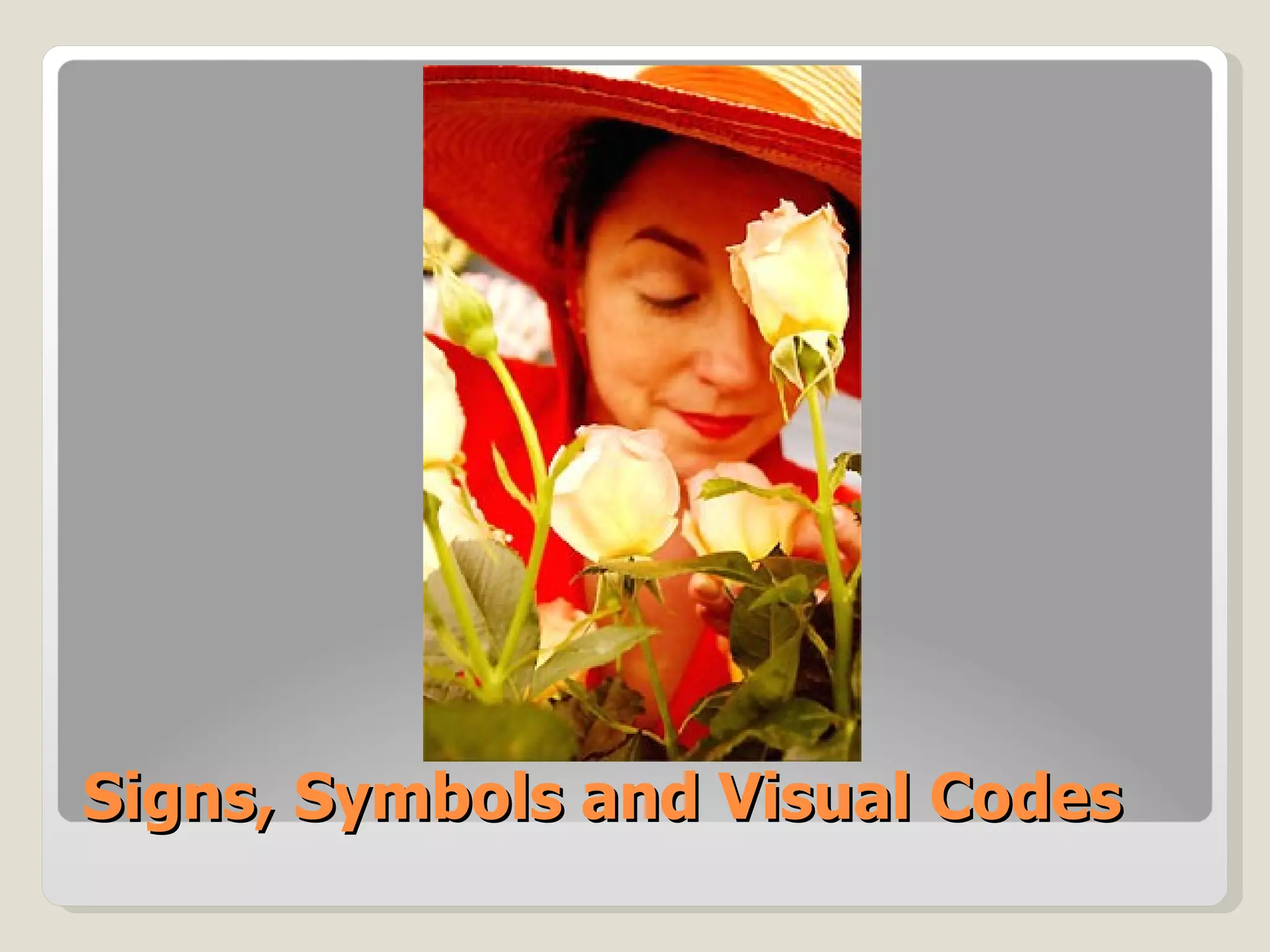
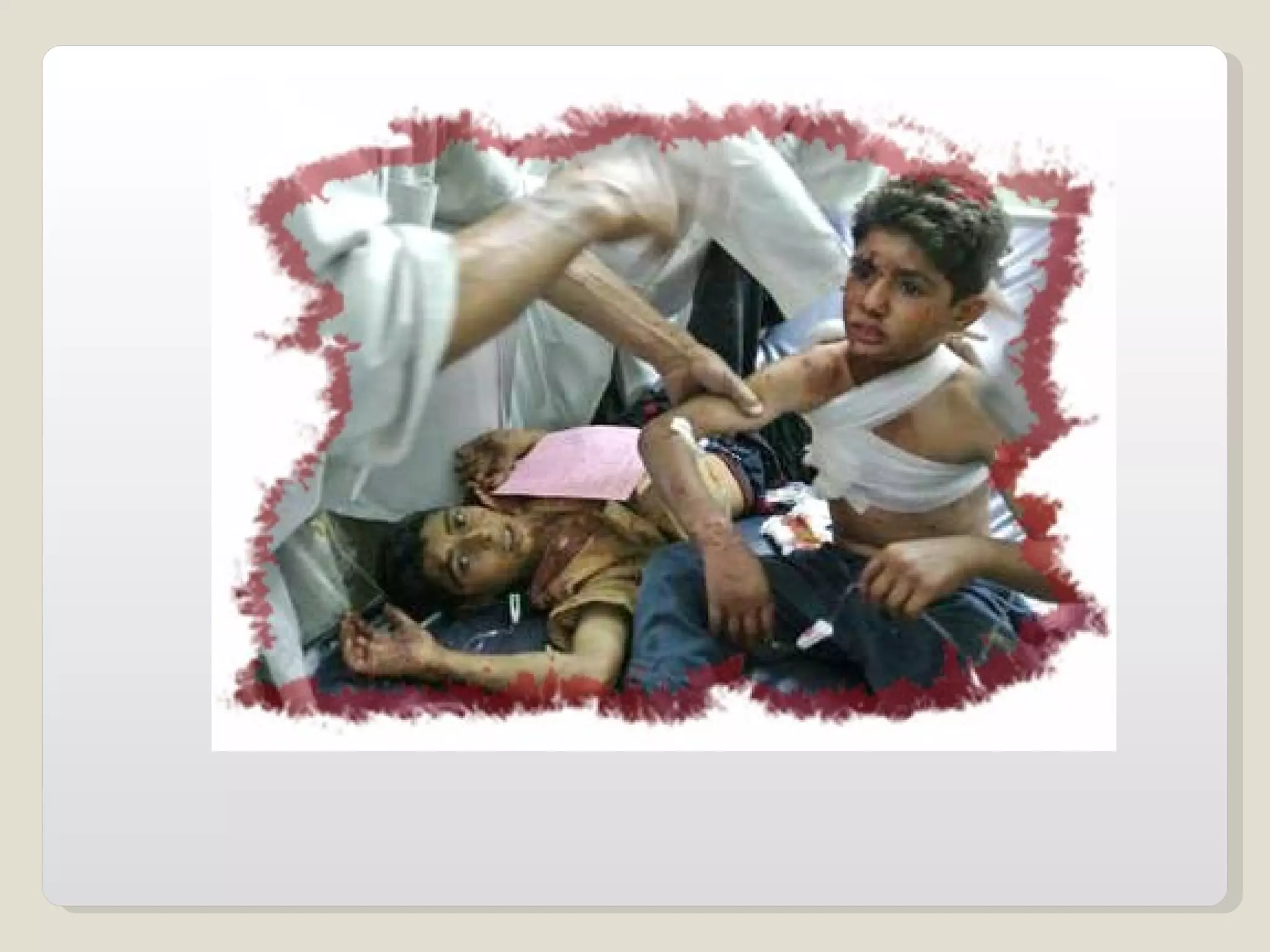
Signs, Symbols and Visual Codes Now use your knowledge of signs and visual codes to analyse the following three pictures.  Try to use the vocabulary you have learnt this lesson.
Signs, Symbols and Visual Codes
Signs, Symbols and Visual Codes Signs, symbols and visual codes help us make sense of a picture.


Signs, symbols and visual codes

  • 1.
    Reading Pictures Signs,Symbols and Visual Codes
  • 2.
    Signs, Symbols andVisual Codes From looking at optical illusions it is clear that we can read pictures in several ways. In order to get a similar reading, pictures often contain signs, symbols and visual codes to help us.
  • 3.
    Signs, Symbols andVisual Codes Signs can be divided into three types: Symbolic Iconic Indexical
  • 4.
    Signs, Symbols andVisual Codes Symbolic signs are the ones most difficult to get your head round! Symbolic signs have no obvious connection between between the sign and the object.
  • 5.
    Signs, Symbols andVisual Codes For example the word CAT has no obvious link with a small pet furry animal. It only works because we understand the rules that say the letters C-A-T, when put in a certain order mean that small furry animal. CAT =
  • 6.
    Signs, Symbols andVisual Codes Iconic signs are a lot easier to understand! Iconic signs have a visual likeness to the things they represent. Can you think of at least two iconic signs you see everyday?
  • 7.
    Signs, Symbols andVisual Codes Here are some you can see when you use a computer:
  • 8.
    Signs, Symbols andVisual Codes Look at the following signs and explain why they are iconic.
  • 9.
    Signs, Symbols andVisual Codes
  • 10.
    Signs, Symbols andVisual Codes
  • 11.
    Signs, Symbols andVisual Codes
  • 12.
    Signs, Symbols andVisual Codes The only alphabet in the world that contains iconic letters is the one used by Japanese and Chinese people. The letters are called kanji and there are over 2,000 of them compared to our 26! Each kanji looks like the word it represents.
  • 13.
    Signs, Symbols andVisual Codes Copy out each kanji. This one is naka, it means middle. You can see the line in the middle.
  • 14.
    Signs, Symbols andVisual Codes This one is gawa and means river.
  • 15.
    Signs, Symbols andVisual Codes This is yama and means mountain.
  • 16.
    Signs, Symbols andVisual Codes This is ta and means rice field.
  • 17.
    Signs, Symbols andVisual Codes You may have heard of the Japanese footballer Hidetoshi Nakata. He used to play for Arsenal and has played for several Italian teams. His surname means middle rice field.
  • 18.
    Signs, Symbols andVisual Codes If you want to find out what your name is in Japanese, go to this website: http://japanese.about.com/bltattoo.htm
  • 19.
    Signs, Symbols andVisual Codes The last kind of sign is indexical. Indexical signs have some kind of direct connection to what is being shown. Example: A tear running down someone’s cheek can be an indexical sign for sorrow.
  • 20.
    Signs, Symbols andVisual Codes This is an indexical sign. What do you think it is for?
  • 21.
    Signs, Symbols andVisual Codes It is an old sign for a school. It is supposed to represent the light of learning! Now we use an iconic sign to represent this.
  • 22.
    Signs, Symbols andVisual Codes What location does this bus offer an indexical reference to?
  • 23.
    Signs, Symbols andVisual Codes What location does this taxi offer an indexical reference to?
  • 24.
    Signs, Symbols andVisual Codes Another way of helping us to read pictures is the use of visual codes. There are three main visual codes: - Dress Codes - Colour Codes - Non Verbal Communication
  • 25.
    Signs, Symbols andVisual Codes Dress codes relate to what people wear in particular situations. If we see people in evening dress we usually make the association of glamour, wealth and sophistication.
  • 26.
    Signs, Symbols andVisual Codes Colour codes Black is the colour people wear after someone has died. White is the colour of innocence. Red can mean danger and stop.
  • 27.
    Signs, Symbols andVisual Codes Non verbal codes are to do with gestures, expressions and body language. Happy Sad Angry Worried
  • 28.
    Signs, Symbols andVisual Codes Now use your knowledge of signs and visual codes to analyse the following three pictures. Try to use the vocabulary you have learnt this lesson.
  • 29.
    Signs, Symbols andVisual Codes
  • 30.
    Signs, Symbols andVisual Codes
  • 31.
    Signs, Symbols andVisual Codes
  • 32.
    Signs, Symbols andVisual Codes
  • 33.
    Signs, Symbols andVisual Codes Signs, symbols and visual codes help us make sense of a picture.
  • 34.
  • 35.
  • 36.