1
DR. AAQIB ANWAAR BUTT COMMUNICATION THEORIES AND MODELS
Communication Theories and Models
SJMJ701A
Dr. Aaqib Anwaar Butt
Assistant Professor
School of Journalism and Mass Communication (SJMC)
K. R. Mangalam University Gurugram
2
DR. AAQIB ANWAAR BUTT COMMUNICATION THEORIES AND MODEL
Unit I - Sessions:
Session 01: Communication: Definition, Types, Stages
Session 02: Verbal Communication
Session 03: Non- verbal Communication
Session 04: Barriers to communication
Session 05: Linear Models of Communication
Session 06: Interactive Models of Communication
Session 07:Transactional Models of Communication
Session 08: Extension of Audio and Visual Communication
Session 09: Process of communication
Session 10: Feedback and change agents
Session 11: Dyadic Communication
Session 12: Organizational Communication
3
Session Over View- Key Learnings from the session
 In the previous session we discussed about the different Linear Forms of
Models.
 In this session we will be discussing about the Interactive Models of
Communication
 We will discuss about the applicability of Interactive models of
Communication.
 We will also elaborate on the different aspects of these models and its
implications on the contemporary communication process.
 The session will also introduce you with the conceptual understanding of
communication Models and their significance in designing and
implementing communication strategies necessary for the functioning of
Communication process.
4
DR. AAQIB ANWAAR BUTT COMMUNICATION THEORIES AND MODEL
Sessions 06
Interactive Models of Communication
5
DeFleur Model of Communication
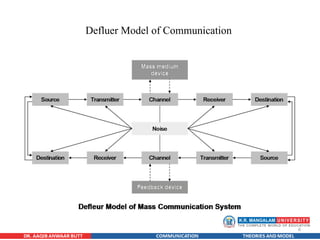
 The theory De fleur model of communication is expanded version
of Shannon and weaver model of communication
 It is also based on the “Westley & Maclean Model of communication” that
describes the circular process of communication with feedback from the
receiver.
 Shannon and Weaver model is a one way communication and they explain
the role of noise in the communication process.
 Westley & Maclean model is a two way communication and for first time
they introduced the important component called “Linear Feedback” in the
communication model.
 De fleur combine these two models and creates new one called “De Fleur
Model of Communication”.
6
Defluer Model of Communication
7
Contributions of Model
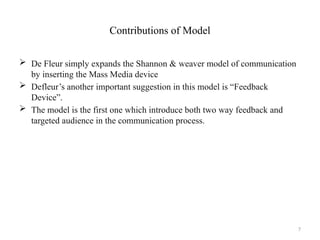
 De Fleur simply expands the Shannon & weaver model of communication
by inserting the Mass Media device
 Defleur’s another important suggestion in this model is “Feedback
Device”.
 The model is the first one which introduce both two way feedback and
targeted audience in the communication process.
8
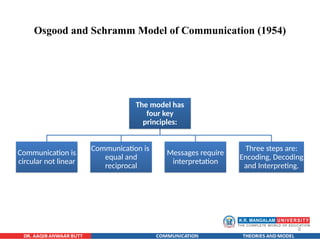
Osgood and Schramm Model of Communication (1954)
The model has
four key
principles:
Communication is
circular not linear
Communication is
equal and
reciprocal
Messages require
interpretation
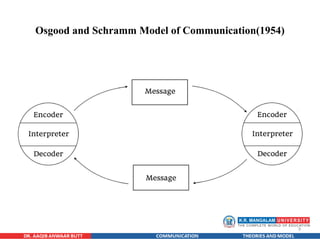
Three steps are:
Encoding, Decoding
and Interpreting.
9
Osgood and Schramm Model of Communication(1954)
10
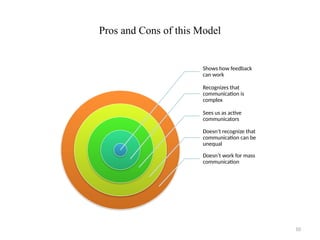
Pros and Cons of this Model
Shows how feedback
can work
Recognizes that
communication is
complex
Sees us as active
communicators
Doesn’t recognize that
communication can be
unequal
Doesn’t work for mass
communication
11
New Combs Model( 1953)
• The model introduced the role of communication in a social relationship.
• Studies the maintenance of social equilibrium within a society.
12
Shannon and Weaver Model 1948
 The original model that Shannon and Weaver proposed did not have feedback.
 Norbert Wiener created the feedback step to address criticism of the model that
it was linear.
 Elements of Shannon and Weaver Model:-
 Sender
 Encoder
 Channel
 Decoder
 Receiver
 Shannon and Weaver were the first to introduce the role of noise in the
communication process.
 The noise appears in the form of mishearing a conversation, misspelling an
email or static on a radio broadcast.
13
Sender or Source
 Sender- Source who creates and sends the message.
 Factors that affect the source are:-
 Communication skills:- reading, listening, speaking etc.
 Attitude:- One’s attitude in relationship to the audience, receiver and subject
changes the meaning and consequence of the message.
 Knowledge:- Familiarity with the subject of the message makes
communication more effective.
 Social systems:- Values, beliefs, religion and rules influence the way in which
the sender communicates the message, alongside location and circumstances.
 Culture:- Cultural differences may result in the message being interpreted
differently.
14
Message
The message is the package of information or meaning that is sent from sender to
receiver.
The message can be sent in various forms, such as audio, speech, text, video or
other media.
The message is influenced by:
 Content:- The content of the message from beginning to end.
 Elements:- Elements are (non)verbal aspects, such as gestures and signs, that
may influence the message.
 Treatment:- Treatment refers to the way in which the message is sent, the
message’s packaging.
 Structure:- the structure of the message refers to the way in which it is
structured.
 Code:- The code of the message is the form in which the message is sent. This
may include text, language, video, gestures, music, etc.
15
Channel
The channel is the medium used to send the message and involve
vision, sound, smell, taste or touch. Humans have the following senses:
 Hearing
 Seeing
 Touching
 Smelling
 Tasting
 Mass communication always involves technical tools, such as
phones, the Internet and television. In these cases, the transmitted
information is assimilated via vision and sound.
16
Receiver
 The receiver is the person who receives and subsequently decodes the
coded message.
 In order to make communication as effective and smooth as possible,
Berlo’s SMCR Model of Communication assumes the receiver’s thinking
pattern must be in accordance with that of the sender.
 The same factors therefore influence this component in Berlo’s SMCR
Model of Communication.
 After all, the receiver decodes the message him/herself and gives it their
own meaning.
17
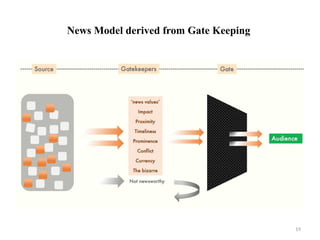
Gate Keeping Model of Communication
 Shoemaker, Vos and Reese (2009) refer to gatekeeping as “the process of
selecting, writing, editing, positioning, scheduling, repeating, and
otherwise massaging information to become news”
 Developed by Kurt lewin during second world war.
18
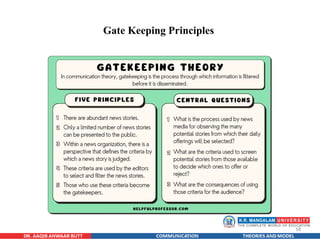
Gate Keeping Principles
19
News Model derived from Gate Keeping
20
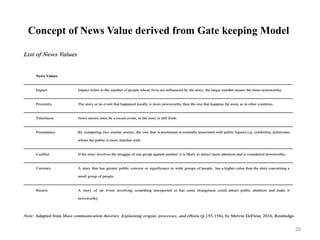
Concept of News Value derived from Gate keeping Model
21
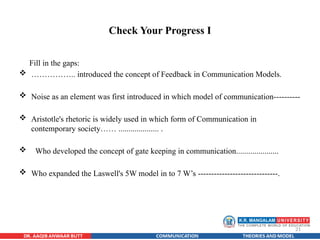
Check Your Progress I
Fill in the gaps:
 …………….. introduced the concept of Feedback in Communication Models.
 Noise as an element was first introduced in which model of communication----------
 Aristotle's rhetoric is widely used in which form of Communication in
contemporary society…… .................... .
 Who developed the concept of gate keeping in communication.....................
 Who expanded the Laswell's 5W model in to 7 W’s ------------------------------.
22
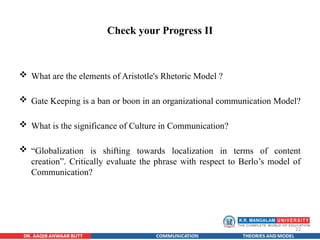
Check your Progress II
 What are the elements of Aristotle's Rhetoric Model ?
 Gate Keeping is a ban or boon in an organizational communication Model?
 What is the significance of Culture in Communication?
 “Globalization is shifting towards localization in terms of content
creation”. Critically evaluate the phrase with respect to Berlo’s model of
Communication?
23
References
• Baran, S. J., & Davis, D. K. (2016). Mass communication theory.
• DeFleur, M., & DeFleur, M. H. (2016). The Two-Step Flow of
Communication Theory. In Mass Communication Theories (pp. 194-204).
Routledge.
• Fiske, J. (2010). Introduction to communication studies. Routledge.
• Mattelart, A. (1996). The invention of communication. U of Minnesota
Press.
• McQuail, D, & Windahl, S. (2015). Communication models for the study of
mass communications. Routledge.
• McQuail, D. (1987). Mass communication theory: An introduction. Sage
Publications, Inc.
• Narula, U. (2006). Communication models. Atlantic Publishers & Dist.
Aaqib_Communicationtheories_session6_Interactive models.pptx

  • 1.
    1 DR. AAQIB ANWAARBUTT COMMUNICATION THEORIES AND MODELS Communication Theories and Models SJMJ701A Dr. Aaqib Anwaar Butt Assistant Professor School of Journalism and Mass Communication (SJMC) K. R. Mangalam University Gurugram
  • 2.
    2 DR. AAQIB ANWAARBUTT COMMUNICATION THEORIES AND MODEL Unit I - Sessions: Session 01: Communication: Definition, Types, Stages Session 02: Verbal Communication Session 03: Non- verbal Communication Session 04: Barriers to communication Session 05: Linear Models of Communication Session 06: Interactive Models of Communication Session 07:Transactional Models of Communication Session 08: Extension of Audio and Visual Communication Session 09: Process of communication Session 10: Feedback and change agents Session 11: Dyadic Communication Session 12: Organizational Communication
  • 3.
    3 Session Over View-Key Learnings from the session  In the previous session we discussed about the different Linear Forms of Models.  In this session we will be discussing about the Interactive Models of Communication  We will discuss about the applicability of Interactive models of Communication.  We will also elaborate on the different aspects of these models and its implications on the contemporary communication process.  The session will also introduce you with the conceptual understanding of communication Models and their significance in designing and implementing communication strategies necessary for the functioning of Communication process.
  • 4.
    4 DR. AAQIB ANWAARBUTT COMMUNICATION THEORIES AND MODEL Sessions 06 Interactive Models of Communication
  • 5.
    5 DeFleur Model ofCommunication  The theory De fleur model of communication is expanded version of Shannon and weaver model of communication  It is also based on the “Westley & Maclean Model of communication” that describes the circular process of communication with feedback from the receiver.  Shannon and Weaver model is a one way communication and they explain the role of noise in the communication process.  Westley & Maclean model is a two way communication and for first time they introduced the important component called “Linear Feedback” in the communication model.  De fleur combine these two models and creates new one called “De Fleur Model of Communication”.
  • 6.
    6 Defluer Model ofCommunication
  • 7.
    7 Contributions of Model De Fleur simply expands the Shannon & weaver model of communication by inserting the Mass Media device  Defleur’s another important suggestion in this model is “Feedback Device”.  The model is the first one which introduce both two way feedback and targeted audience in the communication process.
  • 8.
    8 Osgood and SchrammModel of Communication (1954) The model has four key principles: Communication is circular not linear Communication is equal and reciprocal Messages require interpretation Three steps are: Encoding, Decoding and Interpreting.
  • 9.
    9 Osgood and SchrammModel of Communication(1954)
  • 10.
    10 Pros and Consof this Model Shows how feedback can work Recognizes that communication is complex Sees us as active communicators Doesn’t recognize that communication can be unequal Doesn’t work for mass communication
  • 11.
    11 New Combs Model(1953) • The model introduced the role of communication in a social relationship. • Studies the maintenance of social equilibrium within a society.
  • 12.
    12 Shannon and WeaverModel 1948  The original model that Shannon and Weaver proposed did not have feedback.  Norbert Wiener created the feedback step to address criticism of the model that it was linear.  Elements of Shannon and Weaver Model:-  Sender  Encoder  Channel  Decoder  Receiver  Shannon and Weaver were the first to introduce the role of noise in the communication process.  The noise appears in the form of mishearing a conversation, misspelling an email or static on a radio broadcast.
  • 13.
    13 Sender or Source Sender- Source who creates and sends the message.  Factors that affect the source are:-  Communication skills:- reading, listening, speaking etc.  Attitude:- One’s attitude in relationship to the audience, receiver and subject changes the meaning and consequence of the message.  Knowledge:- Familiarity with the subject of the message makes communication more effective.  Social systems:- Values, beliefs, religion and rules influence the way in which the sender communicates the message, alongside location and circumstances.  Culture:- Cultural differences may result in the message being interpreted differently.
  • 14.
    14 Message The message isthe package of information or meaning that is sent from sender to receiver. The message can be sent in various forms, such as audio, speech, text, video or other media. The message is influenced by:  Content:- The content of the message from beginning to end.  Elements:- Elements are (non)verbal aspects, such as gestures and signs, that may influence the message.  Treatment:- Treatment refers to the way in which the message is sent, the message’s packaging.  Structure:- the structure of the message refers to the way in which it is structured.  Code:- The code of the message is the form in which the message is sent. This may include text, language, video, gestures, music, etc.
  • 15.
    15 Channel The channel isthe medium used to send the message and involve vision, sound, smell, taste or touch. Humans have the following senses:  Hearing  Seeing  Touching  Smelling  Tasting  Mass communication always involves technical tools, such as phones, the Internet and television. In these cases, the transmitted information is assimilated via vision and sound.
  • 16.
    16 Receiver  The receiveris the person who receives and subsequently decodes the coded message.  In order to make communication as effective and smooth as possible, Berlo’s SMCR Model of Communication assumes the receiver’s thinking pattern must be in accordance with that of the sender.  The same factors therefore influence this component in Berlo’s SMCR Model of Communication.  After all, the receiver decodes the message him/herself and gives it their own meaning.
  • 17.
    17 Gate Keeping Modelof Communication  Shoemaker, Vos and Reese (2009) refer to gatekeeping as “the process of selecting, writing, editing, positioning, scheduling, repeating, and otherwise massaging information to become news”  Developed by Kurt lewin during second world war.
  • 18.
  • 19.
    19 News Model derivedfrom Gate Keeping
  • 20.
    20 Concept of NewsValue derived from Gate keeping Model
  • 21.
    21 Check Your ProgressI Fill in the gaps:  …………….. introduced the concept of Feedback in Communication Models.  Noise as an element was first introduced in which model of communication----------  Aristotle's rhetoric is widely used in which form of Communication in contemporary society…… .................... .  Who developed the concept of gate keeping in communication.....................  Who expanded the Laswell's 5W model in to 7 W’s ------------------------------.
  • 22.
    22 Check your ProgressII  What are the elements of Aristotle's Rhetoric Model ?  Gate Keeping is a ban or boon in an organizational communication Model?  What is the significance of Culture in Communication?  “Globalization is shifting towards localization in terms of content creation”. Critically evaluate the phrase with respect to Berlo’s model of Communication?
  • 23.
    23 References • Baran, S.J., & Davis, D. K. (2016). Mass communication theory. • DeFleur, M., & DeFleur, M. H. (2016). The Two-Step Flow of Communication Theory. In Mass Communication Theories (pp. 194-204). Routledge. • Fiske, J. (2010). Introduction to communication studies. Routledge. • Mattelart, A. (1996). The invention of communication. U of Minnesota Press. • McQuail, D, & Windahl, S. (2015). Communication models for the study of mass communications. Routledge. • McQuail, D. (1987). Mass communication theory: An introduction. Sage Publications, Inc. • Narula, U. (2006). Communication models. Atlantic Publishers & Dist.