What is sociolinguistics Wednesday, 22 sept 2010
Sociolinguistics is the study of the effect of any and all aspects of society, including cultural norms, expectations, and the way language is used. It studies how lects differ between groups separated by certain social variables, e.g., ethnicity, religion, status, gender, level of education, age, etc,. And how creation and adherence to these rules is used to categorize individuals in social class or socio-economic classes.
Sociolinguists also study the grammar, phonetics, vocabulary, and other aspects of this sociolect much as dialectologists would study the same for a regional dialect. Sociolinguistics is the effect of the society on the language, while the latter’s focus is on the language’s effect on the society
Develop in 19 th  century First appeared 1960s Pioneered William Labov in USA   Basil Bernstein in UK William Labov : a founder of sociolinguistics. Noted for introducing the quantitative study of language variation and change, making the sociology of language into a scientific discipline.
Sociolinguistics variables Be high in frequency Have a certain immunity from conscious suppression, Be an integral part of larger structures, and Be easily quantified on a linier scale
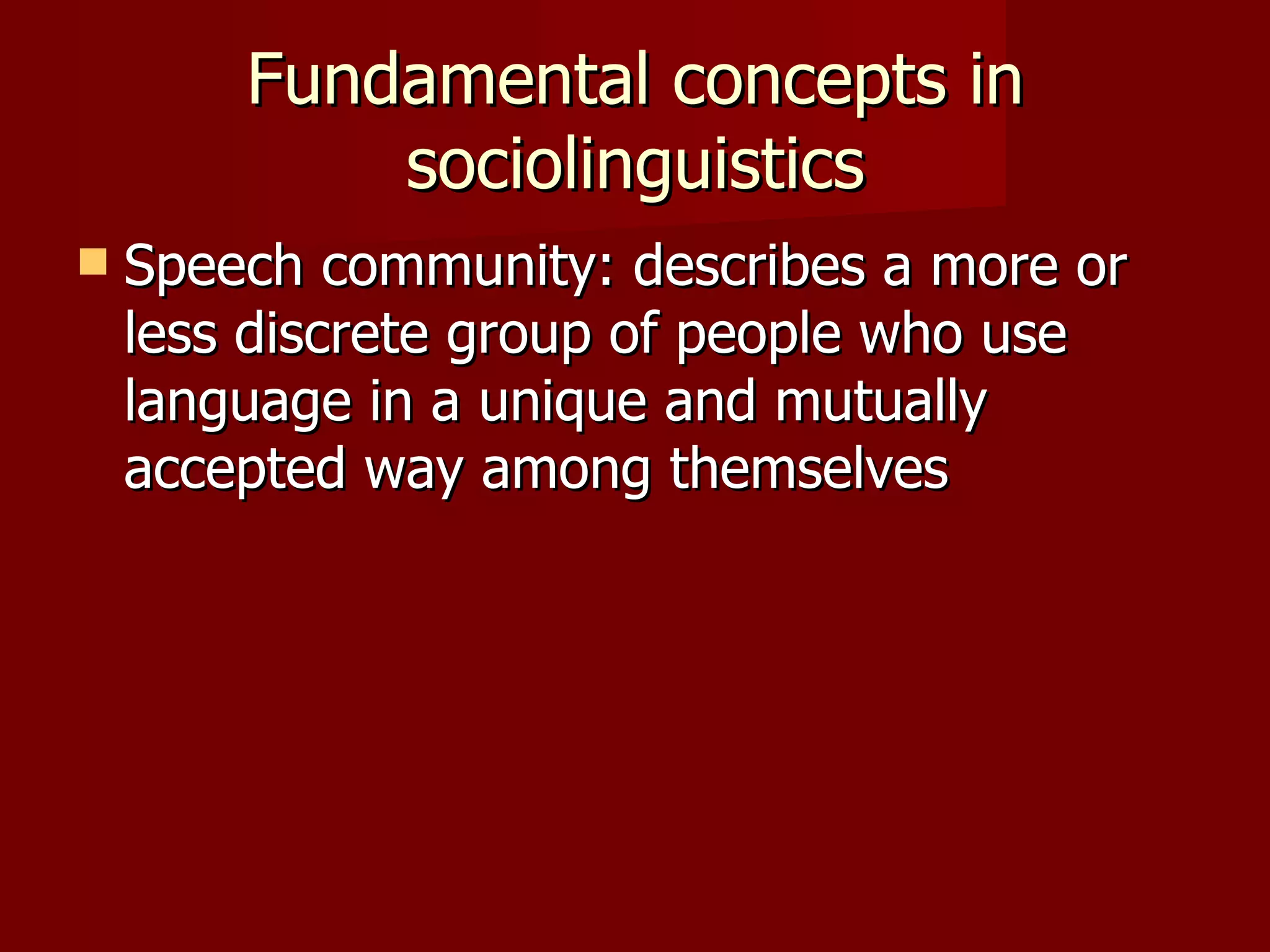
Fundamental concepts in sociolinguistics Speech community: describes a more or less discrete group of people who use language in a unique and mutually accepted way among themselves
High prestige and low prestige varieties; certain speech habits are assigned a positive or a negative value which is then applied to the speaker
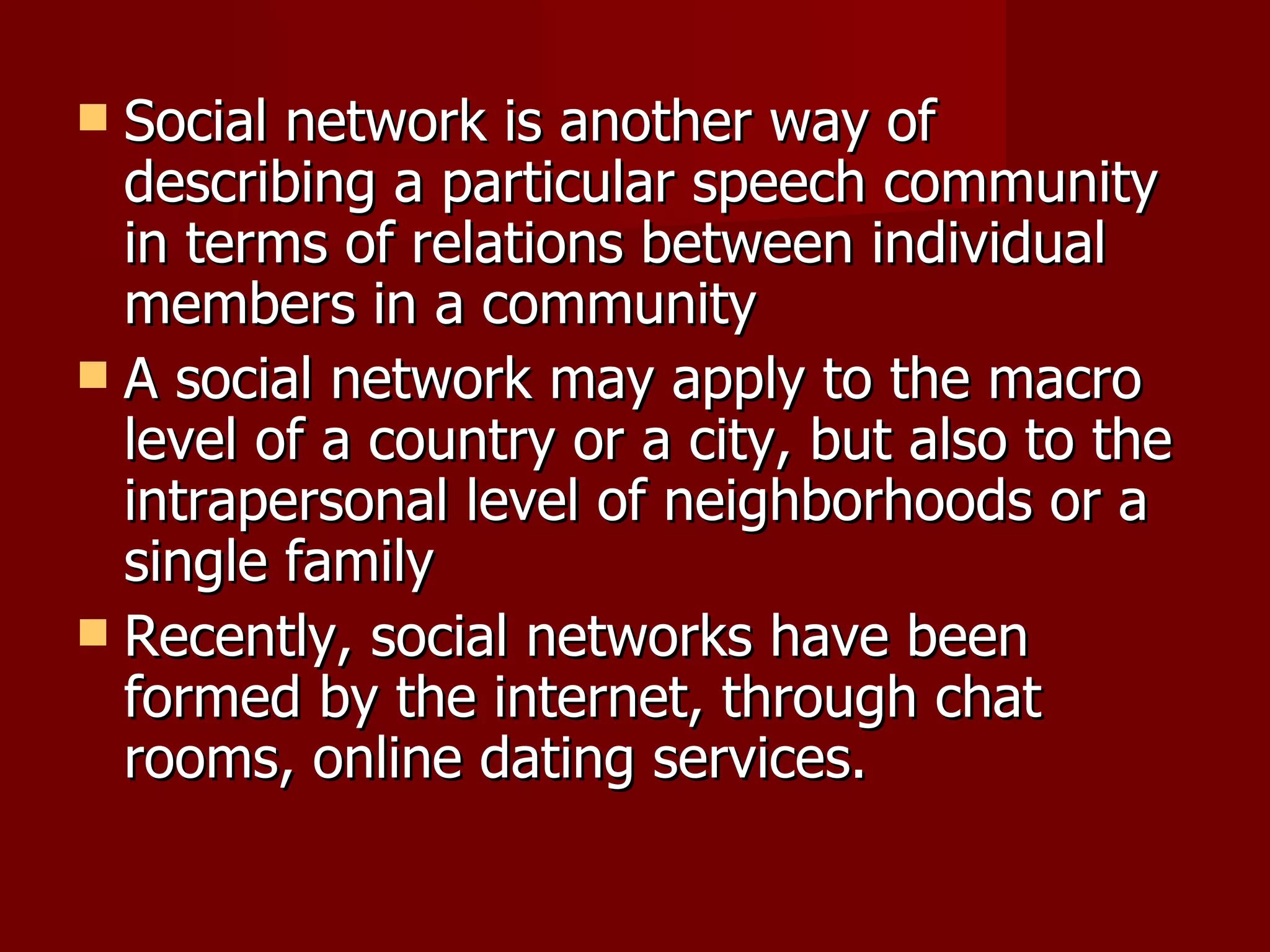
Social network is another way of describing a particular speech community in terms of relations between individual members in a community A social network may apply to the macro level of a country or a city, but also to the intrapersonal level of neighborhoods or a single family Recently, social networks have been formed by the internet, through chat rooms, online dating services.
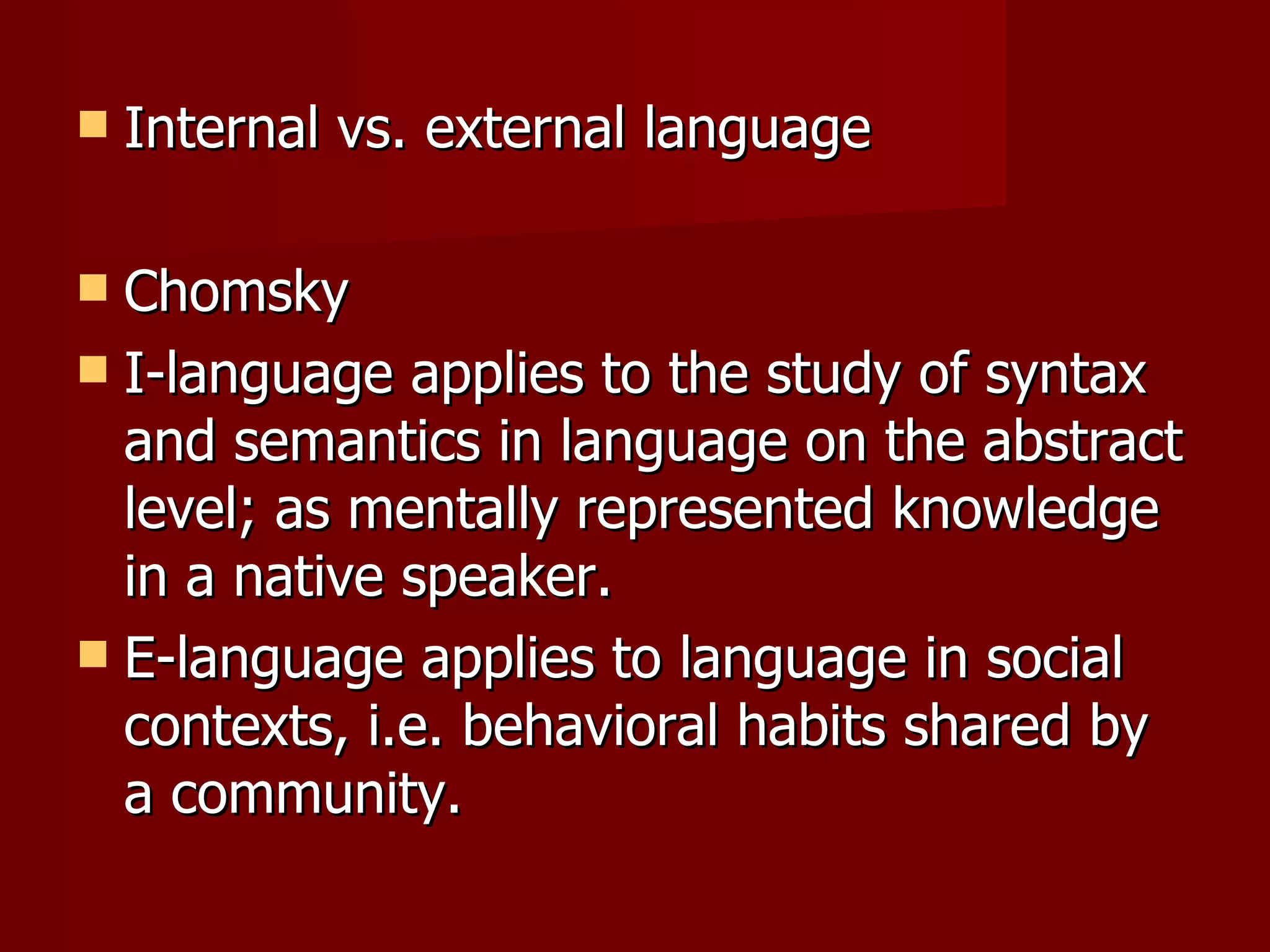
Internal vs. external language Chomsky I-language applies to the study of syntax and semantics in language on the abstract level; as mentally represented knowledge in a native speaker. E-language applies to language in social contexts, i.e. behavioral habits shared by a community.
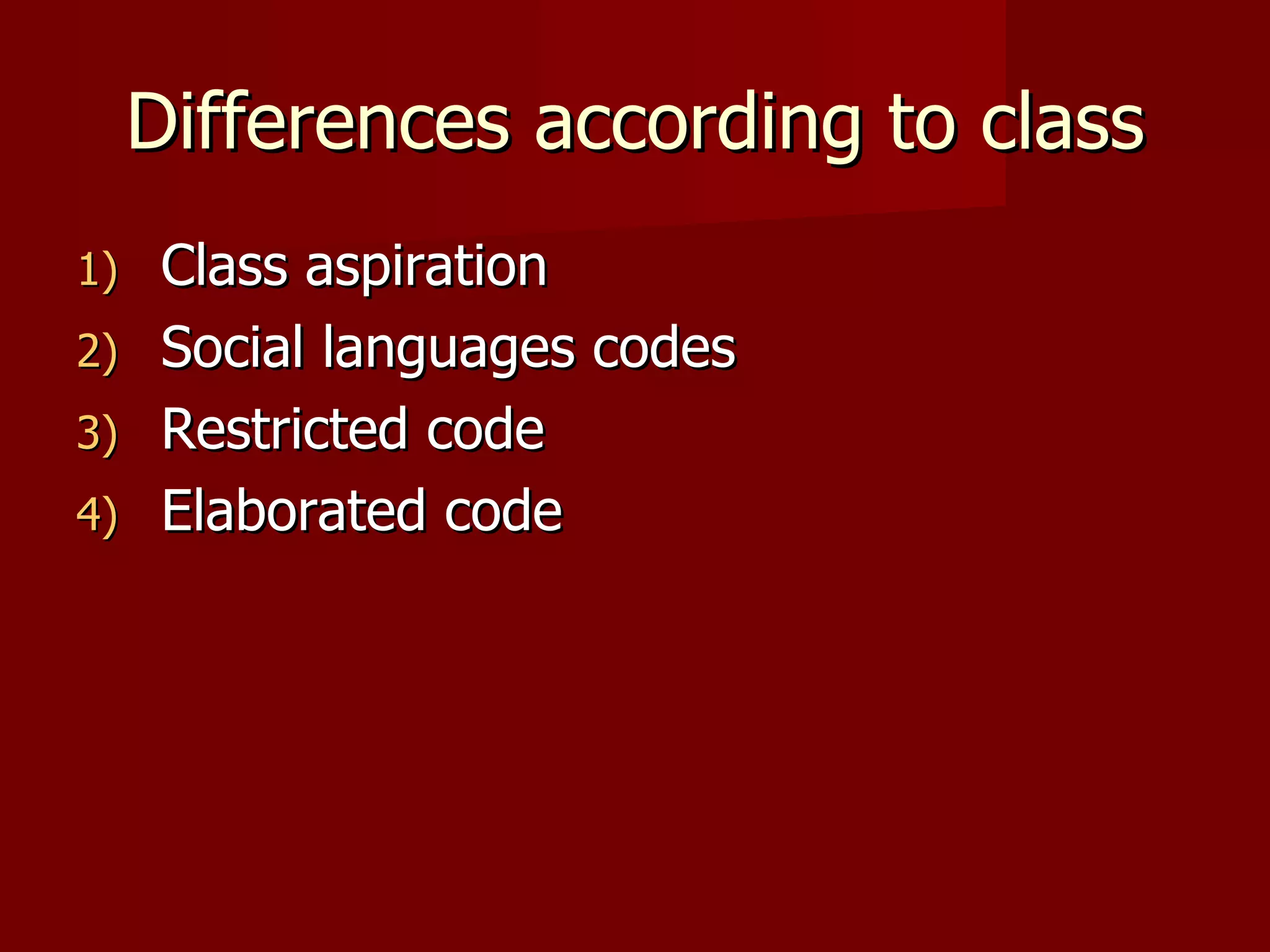
Differences according to class Class aspiration Social languages codes Restricted code Elaborated code
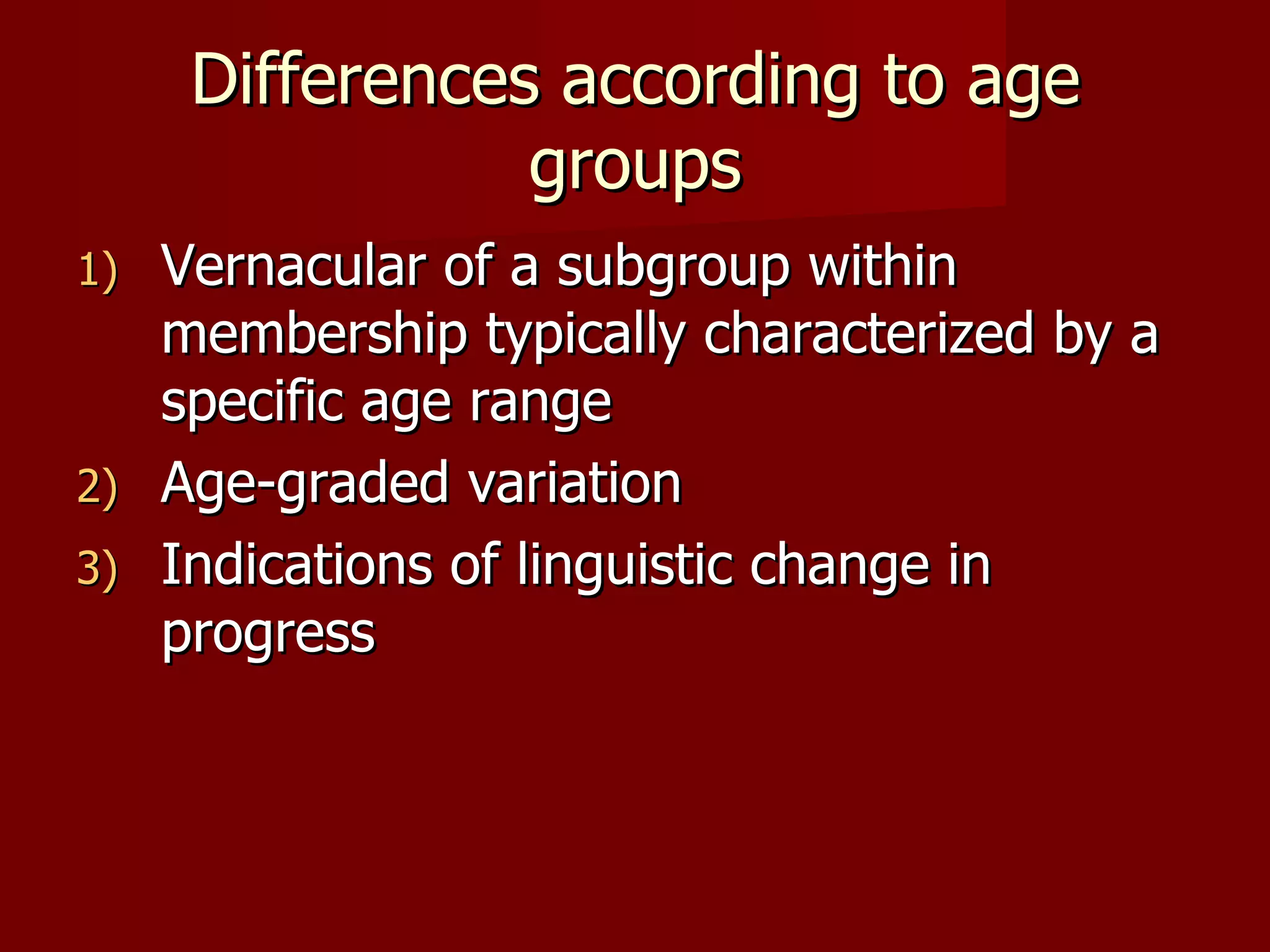
Differences according to age groups Vernacular of a subgroup within membership typically characterized by a specific age range Age-graded variation Indications of linguistic change in progress
Differences according to geography Dialectology
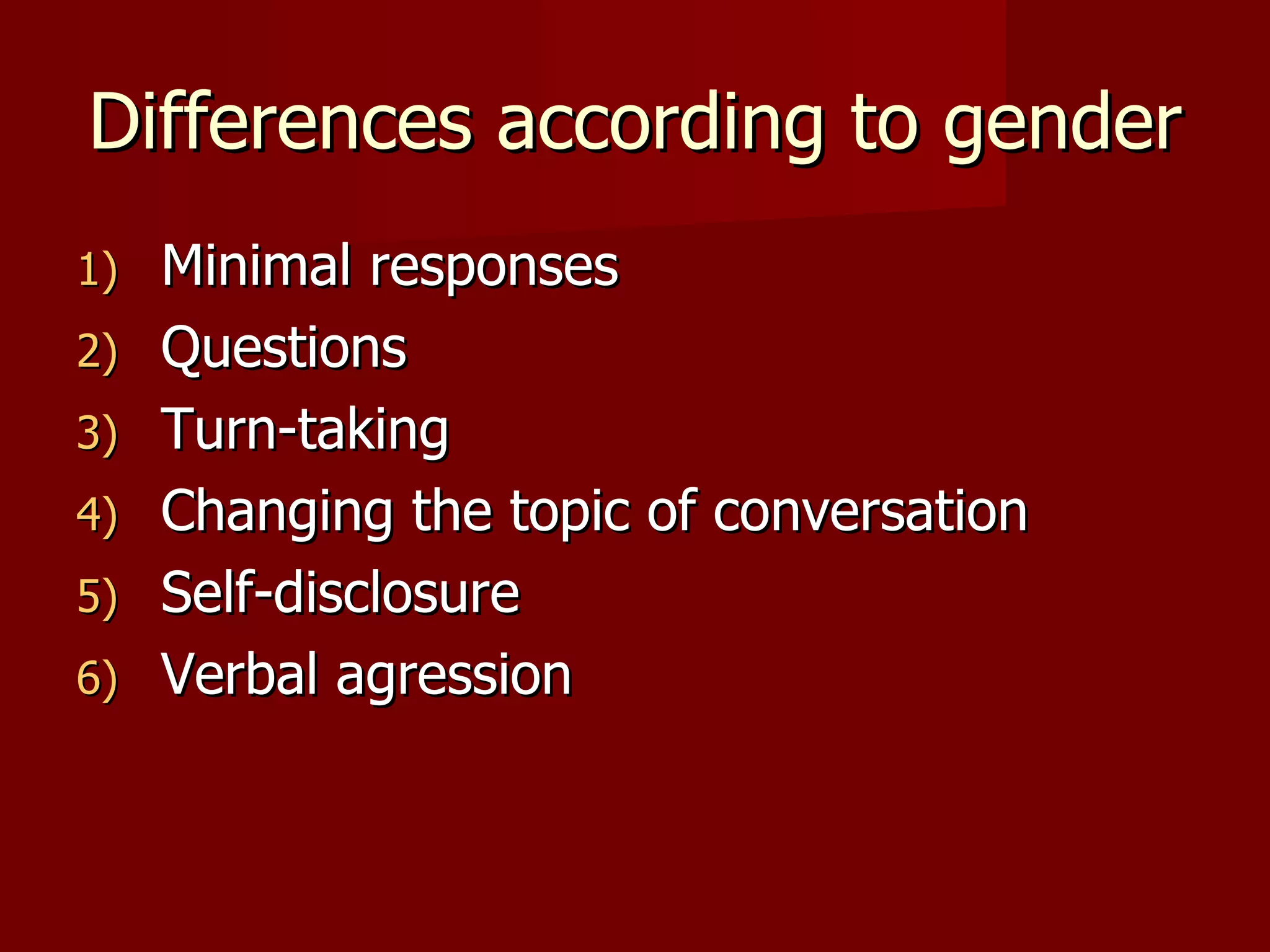
Differences according to gender Minimal responses Questions Turn-taking Changing the topic of conversation Self-disclosure Verbal agression
politeness

What is sociolinguistics,

  • 1.
    What is sociolinguisticsWednesday, 22 sept 2010
  • 2.
    Sociolinguistics is thestudy of the effect of any and all aspects of society, including cultural norms, expectations, and the way language is used. It studies how lects differ between groups separated by certain social variables, e.g., ethnicity, religion, status, gender, level of education, age, etc,. And how creation and adherence to these rules is used to categorize individuals in social class or socio-economic classes.
  • 3.
    Sociolinguists also studythe grammar, phonetics, vocabulary, and other aspects of this sociolect much as dialectologists would study the same for a regional dialect. Sociolinguistics is the effect of the society on the language, while the latter’s focus is on the language’s effect on the society
  • 4.
    Develop in 19th century First appeared 1960s Pioneered William Labov in USA Basil Bernstein in UK William Labov : a founder of sociolinguistics. Noted for introducing the quantitative study of language variation and change, making the sociology of language into a scientific discipline.
  • 5.
    Sociolinguistics variables Behigh in frequency Have a certain immunity from conscious suppression, Be an integral part of larger structures, and Be easily quantified on a linier scale
  • 6.
    Fundamental concepts insociolinguistics Speech community: describes a more or less discrete group of people who use language in a unique and mutually accepted way among themselves
  • 7.
    High prestige andlow prestige varieties; certain speech habits are assigned a positive or a negative value which is then applied to the speaker
  • 8.
    Social network isanother way of describing a particular speech community in terms of relations between individual members in a community A social network may apply to the macro level of a country or a city, but also to the intrapersonal level of neighborhoods or a single family Recently, social networks have been formed by the internet, through chat rooms, online dating services.
  • 9.
    Internal vs. externallanguage Chomsky I-language applies to the study of syntax and semantics in language on the abstract level; as mentally represented knowledge in a native speaker. E-language applies to language in social contexts, i.e. behavioral habits shared by a community.
  • 10.
    Differences according toclass Class aspiration Social languages codes Restricted code Elaborated code
  • 11.
    Differences according toage groups Vernacular of a subgroup within membership typically characterized by a specific age range Age-graded variation Indications of linguistic change in progress
  • 12.
    Differences according togeography Dialectology
  • 13.
    Differences according togender Minimal responses Questions Turn-taking Changing the topic of conversation Self-disclosure Verbal agression
  • 14.