Language Attitudes 
{ 
Group 3 
Erni 
Fitri Puji W. 
Popy Tria M. 
Rania Nur Cahya P.
 Language Attitude 
Semantic Shift 
Semantic Derogation 
 Social Identity Theory 
The CAT
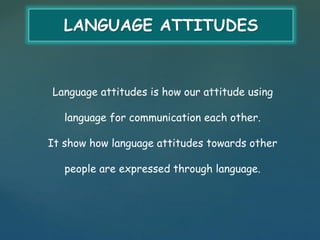
LANGUAGE ATTITUDES 
Language attitudes is how our attitude using 
language for communication each other. 
It show how language attitudes towards other 
people are expressed through language.
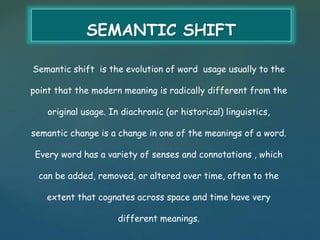
SEMANTIC SHIFT 
Semantic shift is the evolution of word usage usually to the 
point that the modern meaning is radically different from the 
original usage. In diachronic (or historical) linguistics, 
semantic change is a change in one of the meanings of a word. 
Every word has a variety of senses and connotations , which 
can be added, removed, or altered over time, often to the 
extent that cognates across space and time have very 
different meanings.
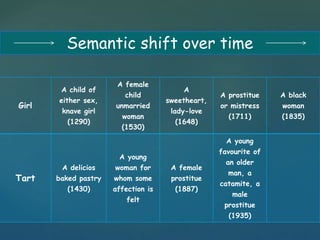
Girl 
Semantic shift over time 
A child of 
either sex, 
knave girl 
(1290) 
A female 
child 
unmarried 
woman 
(1530) 
A 
sweetheart, 
lady-love 
(1648) 
A prostitue 
or mistress 
(1711) 
A black 
woman 
(1835) 
Tart 
A delicios 
baked pastry 
(1430) 
A young 
woman for 
whom some 
affection is 
felt 
A female 
prostitue 
(1887) 
A young 
favourite of 
an older 
man, a 
catamite, a 
male 
prostitue 
(1935)
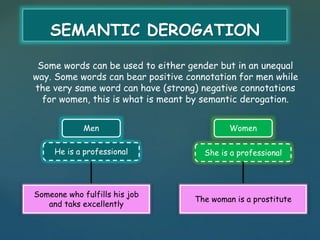
SEMANTIC DEROGATION 
Some words can be used to either gender but in an unequal 
way. Some words can bear positive connotation for men while 
the very same word can have (strong) negative connotations 
for women, this is what is meant by semantic derogation. 
Men 
Women 
He is a professional She is a professional 
Someone who fulfills his job 
and taks excellently 
The woman is a prostitute
Social Identity Theory (SIT) 
According to James (2002) : 
Social identity is self personality in social interaction, where 
someone can judges ourselves, not only physically but also familiy, 
environment, clan, economy, education, etc.
The CAT 
(Communication Accomodation Theory) 
According to Giles (1973) there are two important sociolingustics 
concepts in the theory, namely: 
 CONVERGENCE 
 DIVERGENCE
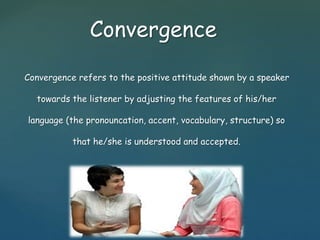
Convergence 
Convergence refers to the positive attitude shown by a speaker 
towards the listener by adjusting the features of his/her 
language (the pronouncation, accent, vocabulary, structure) so 
that he/she is understood and accepted.
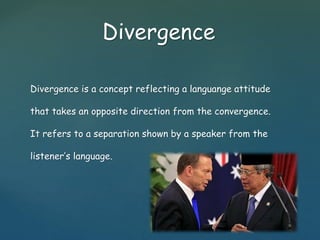
Divergence 
Divergence is a concept reflecting a languange attitude 
that takes an opposite direction from the convergence. 
It refers to a separation shown by a speaker from the 
listener’s language.
conclusion 
This topic has reviewed several rather different approaches 
to the study of language attitudes. It has tried to make the 
case for including attitudes about language and about 
different users of language as an important part of 
sociolingistics, including te study of variation which generally 
relies almost exclusively on data from production and avoid 
issue related to preception.
Thanks for 
your attention

Language attitude

  • 1.
    Language Attitudes { Group 3 Erni Fitri Puji W. Popy Tria M. Rania Nur Cahya P.
  • 2.
     Language Attitude Semantic Shift Semantic Derogation  Social Identity Theory The CAT
  • 3.
    LANGUAGE ATTITUDES Languageattitudes is how our attitude using language for communication each other. It show how language attitudes towards other people are expressed through language.
  • 4.
    SEMANTIC SHIFT Semanticshift is the evolution of word usage usually to the point that the modern meaning is radically different from the original usage. In diachronic (or historical) linguistics, semantic change is a change in one of the meanings of a word. Every word has a variety of senses and connotations , which can be added, removed, or altered over time, often to the extent that cognates across space and time have very different meanings.
  • 5.
    Girl Semantic shiftover time A child of either sex, knave girl (1290) A female child unmarried woman (1530) A sweetheart, lady-love (1648) A prostitue or mistress (1711) A black woman (1835) Tart A delicios baked pastry (1430) A young woman for whom some affection is felt A female prostitue (1887) A young favourite of an older man, a catamite, a male prostitue (1935)
  • 6.
    SEMANTIC DEROGATION Somewords can be used to either gender but in an unequal way. Some words can bear positive connotation for men while the very same word can have (strong) negative connotations for women, this is what is meant by semantic derogation. Men Women He is a professional She is a professional Someone who fulfills his job and taks excellently The woman is a prostitute
  • 7.
    Social Identity Theory(SIT) According to James (2002) : Social identity is self personality in social interaction, where someone can judges ourselves, not only physically but also familiy, environment, clan, economy, education, etc.
  • 8.
    The CAT (CommunicationAccomodation Theory) According to Giles (1973) there are two important sociolingustics concepts in the theory, namely:  CONVERGENCE  DIVERGENCE
  • 9.
    Convergence Convergence refersto the positive attitude shown by a speaker towards the listener by adjusting the features of his/her language (the pronouncation, accent, vocabulary, structure) so that he/she is understood and accepted.
  • 10.
    Divergence Divergence isa concept reflecting a languange attitude that takes an opposite direction from the convergence. It refers to a separation shown by a speaker from the listener’s language.
  • 11.
    conclusion This topichas reviewed several rather different approaches to the study of language attitudes. It has tried to make the case for including attitudes about language and about different users of language as an important part of sociolingistics, including te study of variation which generally relies almost exclusively on data from production and avoid issue related to preception.
  • 12.
    Thanks for yourattention