COMMUNICATION
• Is the process of sharing information, ideas, and feelings
between people or groups.
• It can be verbal or non-verbal, and is a vital part of
human interaction.
Types of communication
• Verbal communication
• Sharing information through speech, such as in conversations,
speeches, or interviews
• Non-verbal communication
• Sharing information without using words, such as through body
language, gestures, facial expressions, or touch
CONT..
• Written communication
• Sharing information through written language, such as in letters,
emails, or creative writing
• Formal communication
• The official exchange of information, often through a prescribed
channel
• Informal communication
• Communication that takes place without following formal channels,
often referred to as the "grapevine"
Elements of communication
1.Sender
2.Encoding
3.Message
4.Enviroment
5.Receiver
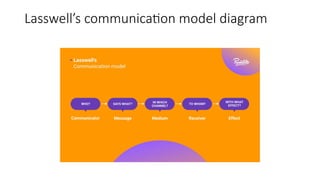
6.Decoding
7.Feedback
8.Noise
The stages of communication
• are idea formation, encoding, channel selection, decoding, and feedback.
1.Idea formation
• The sender comes up with an idea to communicate.
2.Encoding
• The sender translates their idea into a message that can be sent to the
receiver.
• The sender uses a medium, such as a phone call, email, or in-person meeting,
to send the message.
3.Channel selection
• The sender chooses a medium to send the message.
CONT..
4.Decoding
• The receiver interprets the message to understand its meaning.
5.Feedback
• The receiver responds to the message in some way, such as a spoken
comment, a smile, or a written message.
6.Noise
• Anything that interferes with the communication process is called
noise. Noise can occur at any stage of the communication process.
The process of communication involves the
following steps:
1. Sender
• The person who conveys his thoughts, message or ideas to the receiver
is known as the sender. He is at the starting point of the communication
system and represents the source of communication. E.g., In a
classroom, a teacher is a sender.
2. Message
• The subject matter of communication is termed as messages. It includes
ideas, feelings, suggestions, order, etc., which a sender wants to convey
to the receiver.
3. Encoding
• The process of converting messages into communication symbols,
which may be understood by the receiver. It includes words, pictures,
gestures, symbols, etc. Encoding translates the internal thought of the
sender into a language which can be understandable
4. Media
• The path, channel or medium through which encoded message is
transmitted to the receiver is known as media. It is the carrier of the
message. It can be in written form, face to face, through telephone,
letter, internet, etc.
5. Decoding
• The process of translating the encoded message into an effective
language, which can be understood by the receiver is known as
decoding. In this, the encoded symbols of the sender are converted.
6.Receiver.
• The person who receives the message of the sender is known as the
receiver. E.g., Students are receivers in the classroom.
7. Feedback
• In order to complete the process of communication, feedback is
essential. The process of reversal of communication in which the
receiver expresses his reaction to the sender of the message is known
as feedback. Feedback ensures that the receiver has received and
understood the message
8. Noise
• Any construction or hindrance which hampers the communication
process is known as noise. The hindrance may be caused to the
sender, message or receiver. It acts as a
barrier to effective communication and because of this message is
interpreted differently by the receiver. Disturbance in the telephone
line, inattentive receiver, faulty decoding, poor internet connection,
improper gestures and postures, etc., are some examples of noise.
Importance of Communication Process
• It is essential for coordination for people to understand the thoughts, and
ideas of one another
• It is essential in decision-making.
• It helps in increasing managerial efficiency in organizations
• It promotes and increases the overall organizational peace and cooperation
among all employees holding different places in the hierarchy
• It helps in boosting the morale of all employees and promotes and healthy
working environment in the organization
COMMUNICATION MODELS
• There are 8 major models of communication, which can be divided
into 3 categories:
1.Linear models of communication
They only look at one-way communication.
The most prominent linear models of communication are:
1.Aristotle’s communication model,
2.Lasswell’s communication model,
3.The Shannon-Weaver communication model, and
4.Berlo’s S-M-C-R communication model.
2.Interactive models of communication
They analyze two-way communication. These are the following:
1.The Osgood-Schramm communication model, and
2.The Westley and Maclean communication model.
3.Transactional models of communication
They illustrate two-way communication where the message gets more
complex as the communication event progresses. These include:
1.Barnlund’s transactional communication model, and
2.Dance’s Helical communication model.
1.Linear models of communication
The linear communication model is straightforward and used mainly in
marketing, sales, and PR, in communication with customers.
• What is a linear model of communication?
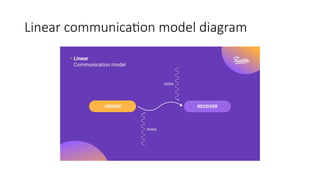
• Linear communication models suggest that communication takes
place only in one direction.
The main elements in these models are:
• The channel,
• The sender, and
• The receiver.
Linear communication model diagram
1.Aristotle’s model
• primarily focuses on the sender (public speaker, professor,
etc.) who passes on their message to the receiver (the
audience).
• The sender is also the only active member in this model, whereas the
audience is passive. This makes Aristotle’s communication model a
foolproof way to excel in public speaking, seminars, and lectures.
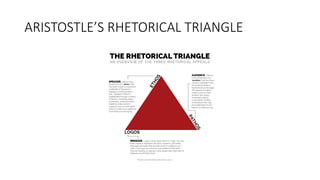
ARISTOSTLE’S RHETORICAL TRIANGLE
What are the main elements of Aristotle’s
communication model?
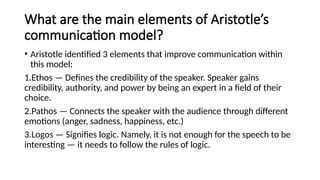
• Aristotle identified 3 elements that improve communication within
this model:
1.Ethos — Defines the credibility of the speaker. Speaker gains
credibility, authority, and power by being an expert in a field of their
choice.
2.Pathos — Connects the speaker with the audience through different
emotions (anger, sadness, happiness, etc.)
3.Logos — Signifies logic. Namely, it is not enough for the speech to be
interesting — it needs to follow the rules of logic.
Aristotle’s communication model diagram
CONT..
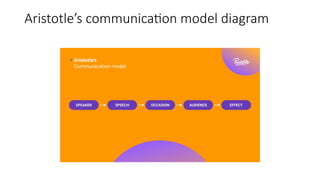
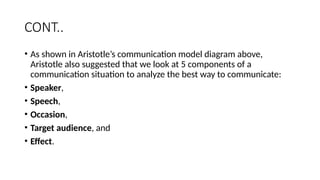
• As shown in Aristotle’s communication model diagram above,
Aristotle also suggested that we look at 5 components of a
communication situation to analyze the best way to communicate:
• Speaker,
• Speech,
• Occasion,
• Target audience, and
• Effect.
Criticisms of Aristotle’s Model of Communication
• Does not include any noise failures that can affect speech.
• it is considered a communication process one-way where the model is
mainly focussed from speaker to receiver. It starts from the speaker
gives a speech and ends at the receiver or the audience.
• there is no way for the listeners to send feedback.
• Exploring human nature is not a criterion of this communication
concept as the Aristotle model is mainly focused on the speaker
• The model is used in public speaking and this limits its usefulness
Conclusion
• It is clear now that the Aristotle model is mainly focused on the
speaker’s ability to organize and prepare his/her speech beforehand
as per the target audience and occasion to create a specific kind of
effect.
2.Lasswell’s model of communication
• views communication as the transmission of a message with the
effect as the result.
• The effect in this case is the measurable and obvious change in the
receiver of the message that is caused by the elements of
communication.
• If any of the elements change, the effect also changes.
What are the main elements of Lasswell’s
communication model?
• Aims to answer the following 5 questions regarding its elements:
a.Who created the message?
b.What did they say?
c.What channel did they use (TV, radio, blog)?
d.To whom did they say it?
e.What effect did it have on the receiver?
The answers to these questions offer us the main components of this
model:
• Communicator,
• Message,
• Medium,
• Audience/Receiver, and
• Effect.
Lasswell’s communication model diagram
3.The Shannon-Weaver model of
communication
• Strangely enough, Shannon and Weaver were mathematicians, who
developed their work during the Second World War in the Bell
Telephone Laboratories. They aimed to discover which channels are
most effective for communicating
What is the Shannon-Weaver model of communication?
• is a mathematical communication concept that proposes that
communication is a linear, one-way process that can be broken down
into 5 key concepts.
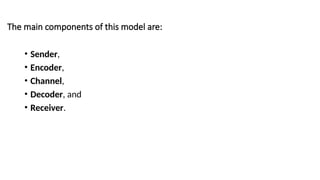
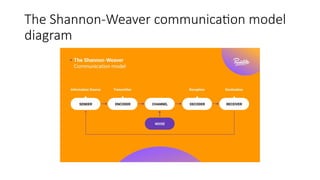
The main components of this model are:
• Sender,
• Encoder,
• Channel,
• Decoder, and
• Receiver.
The Shannon-Weaver communication model
diagram
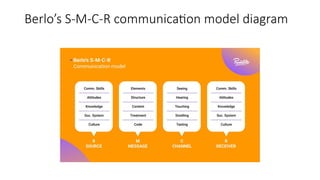
4. Berlo’s S-M-C-R model of communication
Berlo’s model of communication was first defined by David Berlo in his
1960 book The Process of Communication.
• This communication model is unique in the sense that it gives a
detailed account of the key elements in each step.
What is Berlo’s S-M-C-R model of communication?
• is a linear model of communication that suggests communication is
the transfer of information between 4 basic steps or key elements.
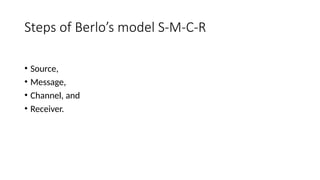
Steps of Berlo’s model S-M-C-R
• Source,
• Message,
• Channel, and
• Receiver.
The source
• The source or the sender carefully puts their thoughts into words and
transfers the message to the receiver.
• So, how does the sender transfer the information to the receiver
according to Berlo’s S-M-C-R communication model?
With the help of:
• Communication skills — First and foremost, the source needs
good communication skills to ensure the
communication will be effective. The speaker should know when to
pause, what to repeat, how to pronounce a word, etc.
Cont..
• Attitude — Secondly, the source needs the right attitude. Without it,
not even a great speaker would ever emerge as a winner. The source
needs to make a lasting impression on the receiver(s).
• Knowledge — Here, knowledge does not refer to educational
qualifications but to the clarity of the information that the source
wants to transfer to the receiver.
Cont,
• Social system — The source should be familiar with the social system
in which the communication process takes place. That would help the
source not to offend anyone.
• Culture — Last but not least, to achieve effective communication, the
source needs to be acquainted with the culture in which the
communication encounter is taking place. This is especially important
for cross-cultural communication
2.The message
• The speaker creates the message when they transform their thoughts
into words.
The key factors of the message:
• Content — Simply put, this is the script of the conversation.
• Elements — Speech alone is not enough for the message to be fully
understood. That is why other elements have to be taken into account:
gestures, body language, facial expressions, etc.
• Treatment — The way the source treats the message. They have to be
aware of the importance of the message so that they can convey it
appropriately.
Cont..
• Structure — The source has to properly structure the message to
ensure the receiver will understand it correctly.
• Code — All the elements, verbal and nonverbal, need to be accurate if
you do not want your message to get distorted and misinterpreted.
3: The channel
• To get from the source to the receiver, the message goes through the
channel.
• Berlo’s S-M-C-R communication model identifies all our senses are the
channels that help us communicate with one another.
• Our sense of hearing lets us know that someone is speaking to us.
• Through our sense of taste, we gather information about the
spiciness of a sauce we are eating.
Cont,,
• Our sense of sight allows us to decipher traffic signs while driving.
• We decide whether we like a certain perfume or not by smelling it.
• By touching the water we feel whether it is too cold for a swim.
4: The receiver
• A receiver is a person the source is speaking to — the destination of
the conveyed message.
• To understand the message, the receiver should involve the same
elements as the source. They should have similar communication
skills, attitudes, and knowledge, and be acquainted with the social
system and culture in which they communicate
Berlo’s S-M-C-R communication model diagram
Berol's S-M-C-R communication model example
• Watching the news on television is the perfect example of Berlo’s S-
M-C-R Model of communication.
• In this case, the news presenter is the source of the news and they
convey the message to the audience.
• The news is the message, the television is the channel, and the
audience are the receivers of the message.
2.Interactive models of communication
• Are used in internet-based and mediated communication such as
telephone conversations, letters, etc.
• interactive communication models refer to two-way communication
with feedback.
• However, feedback within interactive communication models is not
simultaneous, but rather slow and indirect.
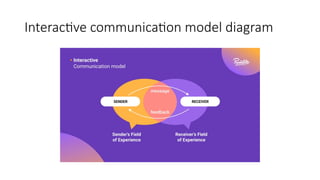
main elements of interactive communication
models
• Sender,
• Message,
• Receiver,
• Feedback, and
• Field of experience.
The field of experience represents a person’s culture, past
experiences, and personal history.
Interactive communication model diagram
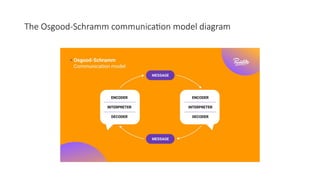
5. The Osgood-Schramm model of communication
• is a circular model of communication, in which messages go in two
directions between encoding and decoding.
• Interestingly, in the Osgood-Schramm communication model, there
is no difference between a sender and a receiver.
• Both parties are equally encoding and decoding the messages.
• The interpreter is the person trying to understand the message at that
moment.
• This model shows that information is of no use until it is put into
words and conveyed to other people.
4 main principles of communication in
Osgood-Schramm
• Communication is circular. — Individuals involved in the
communication process are changing their roles as encoders and
decoders.
• Communication is equal and reciprocal. — Both parties are equally
engaged as encoders and decoders.
• The message requires interpretation. — The information needs to be
properly interpreted to be understood.
3 steps in the process of communication in
Osgood-Schramm
• Encoding,
• Decoding, and
• Interpreting.
The Osgood-Schramm communication model diagram
The Osgood-Schramm communication model example
• Imagine you have not heard from your college friend for 15 years.
Suddenly, they call you, and you start updating each other about what
happened during the time you have not seen each other.
• In this example, you and your friend are equally encoding and
decoding messages, and your communication is synchronous.
• You are both interpreting each other’s messages
6. The Westley and Maclean model of
communication
• suggests that the communication process does not start with the
source/sender, but rather with environmental factors.
• This model also takes into account the object of the
orientation (background, culture, and beliefs) of the sender and the
receiver of messages.
• The very process of communication, according to this communication
model, starts with environmental factors that influence the speaker —
the culture or society the speaker lives in, whether the speaker is in a
public or private space, etc.
main elements of the Westley and Maclean communication model?
This model consists of 9 crucial components:
• Environment (X),
• Sensory experience (X¹),
• Source/Sender (A),
• The object of the orientation of the source (X²),
• Receiver (B),
• The object of the orientation of the receiver (X³),
• Feedback (F),
• Gatekeepers (C), and
• Opinion leaders.
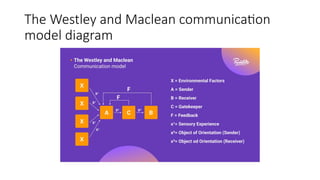
The Westley and Maclean communication
model diagram
The Westley and Maclean communication model example
• Imagine that on your way to the class, you witness a road accident.
• This is the type of stimulus that would nudge you to call your friends
and tell them about what you had seen, or call your boss to say you
are going to be a bit late.
• So, the communication process in this example does not start with
you, but with the road accident you have witnessed.
9 Key elements of communication in the Westley and Maclean communication model
1: Environment (X)
• According to the Westley and Maclean Model, the communication
process starts when a stimulus from the environment motivates a
person to create and send a message.
2. Sensory experience (X¹)
• When the sender of the message experiences something in their
environment that nudges them to send the message, then that
sensory experience becomes an element of communication.
Cont..
• In the example above, the sensory experience would be witnessing a
road accident.
3: Source/Sender (A)
• In the above-mentioned example, you are the sender, as well as a
participant in the interpersonal communication situation.
• However, a sender can also be a newscaster sending a message to
millions of viewers. In that case, we are talking about mass
communication.
4: The object of the orientation of the source (X²)
• Namely, the object of the orientation of the source is the sender’s
beliefs or experiences.
• For example, your friend (B) watching the news is worried about your
safety (X³) after receiving the message.
7: Feedback (F)
• Feedback is crucial for this model because it makes this model
circular, rather than linear.
• As a matter of fact, feedback influences how messages are sent.
• That means that a receiver and a gatekeeper are sending messages
back to the sender.
• After they have received the feedback, the sender modifies the
message and sends it back.
8: Gatekeepers (C)
• This element usually occurs in mass communication, rather than in
interpersonal communication.
• Gatekeepers are editors of the messages senders are trying to
communicate to receivers.
• For example, these are newspaper editors who edit the message
before it reaches the readers.
9: Opinion leaders
• Again, this element of communication refers to mass communication
situations.
• Namely, opinion leaders have an immense influence as
an environmental factor (X) on the sender of the message (A).
• These are political leaders, celebrities, or social media influencers
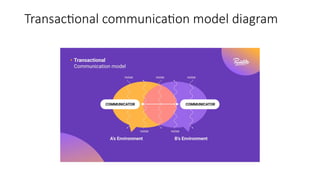
3.Transactional communication models
• view communication as a transaction, meaning that it is a cooperative
process in which communicators co-create the process of
communication, thereby influencing its outcome and effectiveness.
• show that we do not just exchange information during our
interactions, but create relationships, form cross-cultural bonds, and
shape our opinions.
• In other words, communication helps us establish our realities.
Cont,
• These models also introduced the roles of:
• Social,
• Relational, and
• Cultural contexts.
main elements of transactional communication models
• Encoding,
• Decoding,
• Communicators,
• The message,
• The channel, and
• Noise.
Transactional communication model diagram
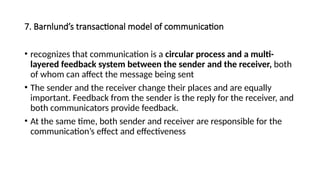
7. Barnlund’s transactional model of communication
• recognizes that communication is a circular process and a multi-
layered feedback system between the sender and the receiver, both
of whom can affect the message being sent
• The sender and the receiver change their places and are equally
important. Feedback from the sender is the reply for the receiver, and
both communicators provide feedback.
• At the same time, both sender and receiver are responsible for the
communication’s effect and effectiveness
main components of this communication model:
• Encoding,
• Decoding,
• Communicators,
• The message (including the cues, environment, and noise), and
• The channel.
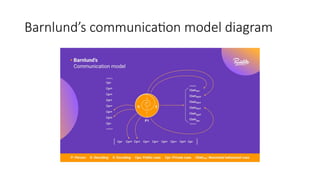
Barnlund’s communication model diagram
So, Barnlund differentiates between
• Public cues (environmental cues),
• Private cues (person’s personal thoughts and background), and
• Behavioral cues (person’s behavior, that can be verbal and nonverbal).
• Examples of Barnlund’s Model of communication include:
• Face-to-face interactions,
• Chat sessions,
• Telephone conversations,
• Meetings, etc.
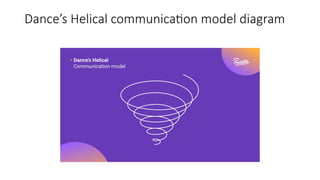
8. Dance’s Helical model of communication
• views communication as a circular process that gets more and more
complex as communication progresses.
• That is why it is represented by a helical spiral in the Dance’s Helical
communication model diagram below.
Dance’s Helical communication model diagram
Cont..
• According to this communication model, in the communication
process, the feedback we get from the other party involved influences
our next statement and we become more knowledgeable with every
new cycle.
Dance’s Helical communication model
example
• For instance, as babies, we cry to get our mothers’ attention. Later on,
we learn to speak in words, and then in full sentences.
• During the whole process, we build on what we know to improve our
communication.
• Every communication act is, therefore, a chance for us to learn how to
communicate more effectively in the future, and feedback helps us
achieve more effective communication.
summary
The 8 elements of the communication process. These are
• source
• Message,
• Channel,
• Receiver,
• Feedback,
• Environment,
• Context, and
• Interference.
Advantages of Effective communication
1.Better relationships
Effective communication builds trust and can help people form stronger
relationships
2.Improved productivity
When people understand what's expected of them, they're more likely to
be productive and perform well.
3.Increased engagement
People feel more confident and engaged when they understand what they
need to do.
Cont.
4.Conflict resolution
• Effective communication helps people voice their concerns and
viewpoints without making the situation worse.
5.Increased innovation
• When people can communicate effectively, they can share ideas and
collaborate more efficiently.
Cont,,
6.Increased employee retention
• When people feel understood and valued, they're more likely to stay
with the company.
7.Problem-solving
• Effective communication can help people work together to solve
problems.
8.Team building
• Effective communication can help people work together more
efficiently and effectively.
9.Professional growth
• Effective communication can help people grow professionally.
10.Self-confidence
• Effective communication can help people feel more confident in their
work.
Barriers to effective communication
can be physical, psychological, emotional, cultural, or linguistic.
1.Physical barriers
• Distance: When people are physically separated, communication can
be difficult.
• Noise: Background noise can make it difficult to hear what someone
is saying.
• Physical objects: Closed doors, high walls, and blocked-off areas can
make it hard to communicate.
2.Psychological barriers
• Mental health: Conditions like depression, phobias, and speech disorders can
make it difficult to communicate.
• Social anxiety: Stage fright, social anxiety, and self-esteem issues can make it
difficult to communicate.
• Biases and judgments: Unchecked assumptions and biases can make it difficult
to communicate.
• Emotional barriers
• Fear, anger, and anxiety: These emotions can make it difficult to communicate
clearly.
• Mental blocks: Emotional barriers can prevent you from communicating your
feelings clearly.
3.Emotional barriers
• Fear, anger, and anxiety: These emotions can make it difficult to
communicate clearly.
• Mental blocks: Emotional barriers can prevent you from
communicating your feelings clearly.
4.Cultural barriers
• Differences in culture
People from different cultures may have difficulty communicating
with each other.
• Stereotyping
Stereotyping can make it difficult to communicate with people from
different cultures.
5.Language barriers
• Different languages: When people speak different languages, they
may not be able to understand each other.
• Technical jargon: Using technical terms or jargon can make it difficult
for people to understand.
• Regional differences: Regional slang or colloquialisms can make it
difficult to communicate.
MODES OF COMMUNICATION/ Types of
communication
1.intra-personal
2.Interpersonal
3.Group
4.mass communication.
Intra-personal communication
• This refers to a process when one communicates with
one's own self.
• Such communication is within the self and to the self,
e.g., thinking, working out a problem, writing diaries
Inter-personal communication
• This is the communication that takes place when at least two people
interact, whether face-to-face, e.g., an interview, talking to friends in a
cafe, or otherwise, as with a telephone conversation etc.
• In this case, emphasis is laid on speech as well as on non-verbal forms
of communication.
Group communication
• By group communication we mean communication within and between
groups of people.
• The groups may be small, such as a family, or large, as in the case of a
committee meeting
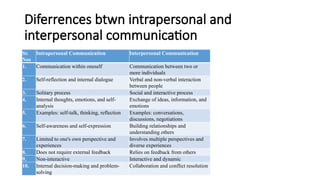
Diferrences btwn intrapersonal and
interpersonal communication
Sr.
Nos
Intrapersonal Communication Interpersonal Communication
1. Communication within oneself Communication between two or
more individuals
2. Self-reflection and internal dialogue Verbal and non-verbal interaction
between people
3. Solitary process Social and interactive process
4. Internal thoughts, emotions, and self-
analysis
Exchange of ideas, information, and
emotions
5. Examples: self-talk, thinking, reflection Examples: conversations,
discussions, negotiations
6. Self-awareness and self-expression Building relationships and
understanding others
7. Limited to one's own perspective and
experiences
Involves multiple perspectives and
diverse experiences
8. Does not require external feedback Relies on feedback from others
9. Non-interactive Interactive and dynamic
10. Internal decision-making and problem-
solving
Collaboration and conflict resolution
Mass communication
Is the process of sharing a message with a large audience through a
medium. It can be used to educate, entertain, or influence people.
How it works
• A sender encodes a message
• The message is transmitted through a medium, such as television,
radio, or social media
• The receiver decodes the message
• The receiver may provide feedback
Examples of mass communication
• Advertising
A visual or audio message that promotes a product, service, brand, or
company
• Public relations
A strategic process that manages how information about a company or
individual is shared with the public
• News
A form of mass communication that provides information about current
events
Functions of mass communication
• Surveillance: Mass communication can provide information about the world
• Entertainment: Mass communication can be used to entertain people
• Influence: Mass communication can be used to persuade people to buy
products or behave in a certain way
Mass media vs mass communication
• Mass media is the means of communication, such as television, radio, or social
media
• Mass communication is the message that is transmitted through mass media
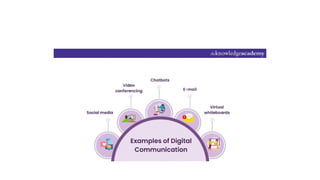
Digital communication
• is the use of electronic tools to send and receive messages. It can
include sending emails, using social media, or reading a webpage.
• Examples of digital communication
• Email, Social media, Texting, Websites, Blogs, Live chat, Video chat,
and Web calling.
Benefits of digital communication
• Speed and efficiency: Digital communication allows for quick
transmission and reception of information.
• Cost-effectiveness: Digital communication can be more cost-effective
than traditional methods like phone calls or mail.
• Improved collaboration: Digital communication can help people
collaborate more effectively.
• Increased productivity: Digital communication tools can help people
be more productive.
Impact of digital communication
• Digital communication can impact personal relationships, business
operations, education, and governance.
CONT..
a) Instant messaging: Platforms like WhatsApp, Facebook Messenger, and Slack enable
us to exchange messages in real time, facilitating quick and efficient communication.
b) Video conferencing: Tools like Google Meet, Zoom, and Microsoft Teams have
transformed remote communication by allowing face-to-face interactions and virtual
meetings.
c) Social media platforms: Facebook, Twitter, Instagram, and LinkedIn connect people
globally, enabling them to share updates, engage in discussions, and build networks.
d) Email: It remains a widely used example of Digital Communication method,
providing a formal and reliable means of exchanging messages and files.
e) Collaborative tools and cloud storage: Platforms such as Google Drive and Dropbox
allow users to collaborate on documents in real-time, enhancing teamwork and
productivity.
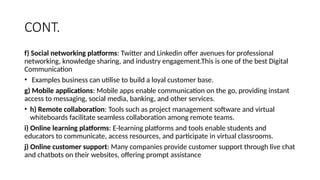
CONT.
f) Social networking platforms: Twitter and Linkedin offer avenues for professional
networking, knowledge sharing, and industry engagement.This is one of the best Digital
Communication
• Examples business can utilise to build a loyal customer base.
g) Mobile applications: Mobile apps enable communication on the go, providing instant
access to messaging, social media, banking, and other services.
• h) Remote collaboration: Tools such as project management software and virtual
whiteboards facilitate seamless collaboration among remote teams.
i) Online learning platforms: E-learning platforms and tools enable students and
educators to communicate, access resources, and participate in virtual classrooms.
j) Online customer support: Many companies provide customer support through live chat
and chatbots on their websites, offering prompt assistance
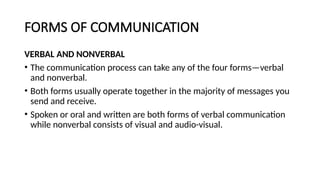
FORMS OF COMMUNICATION
VERBAL AND NONVERBAL
• The communication process can take any of the four forms—verbal
and nonverbal.
• Both forms usually operate together in the majority of messages you
send and receive.
• Spoken or oral and written are both forms of verbal communication
while nonverbal consists of visual and audio-visual.
VERBAL COMMUNICATION
1. Oral
2. Written
3. Visual
4. Audio visual
Types of verbal communication
1. Face to face communication
• involves the speaker and the listener interacting face to face such as in dyadic, small
group or public speaking.
2. Telephone conversation:
involve two people interacting by use of telephone though it is possible for a small
group by means of teleconferencing.
3. The radio
makes it possible to speak to a large number of people at the same time.
4. Written communication:
involves use of written forms of communication such as letters, memos, reports,
circulars, etc.
Importance of verbal communication
(i) Speed: Oral communication is fast with immediate feedback.
(ii) Record:
• Written communication serves as a record and can be used for future reference.
• It is a documentary proof, and can be used as legal evidence.
• Written records and documents are more reliable and acceptable.
(iii)Precision and accuracy:
• Written communication is precise and accurate. Choice of precise words is possible in
written communication because the writer has the time to look for suitable words
and phrases, and to revise the draft, if necessary.
(iv)Length: A written message is usually shorter than an oral communication. There are
standard formats for opening and closing which can keep the message short
• (v) Body Language: Oral communication is supported by the speaker's
body language and paralanguage which enrich meaning. (vi)Feedback:
Oral communication allows immediate feedback; the listener's face
gives some feedback and the speaker can modify the message on the
spot. Clarifications can be sought and given at once. A conversation
can be brought to a satisfactory conclusion by continuous exchange of
ideas and views. (vii) Formality: verbal communication allow for
choice between being formal or informal. Spoken language tends to
be less formal than written language. The vocabulary used in written
English is also more formal than in spoken English.
NONVERBAL COMMUNICATION
• is all communication that is not spoken or written.
Types of nonverbal communication
1. Body Movement (body language)
• The study of body movement is known as kinesics and it deals with all
the ways people use their bodies to communicate or enhance their
verbal communication.
• Body movement includes posture, gestures, facial expressions, and
eye contact
Importance of nonverbal communication
(a) Non-verbal methods have almost instant effect because of quicker grasp by
the receiver.
(b) Visual non-verbal methods aid verbal communication; maps, charts and
graphs are necessary for conveying information or plans related to geography,
It makes information available conveniently, at a glance for comparisons.
(c) Response to visuals and plain sounds is more powerful than to language. A
cry of agony arouses stronger response than a sad story; a film is more
effective than a written story. TV news is more interesting than on radio.
(d) It is the best method to convey information to illiterate people.
(e) Sign language helps the hearing impaired to communicate, learn and be able
to work like any other physically normal persons.
Functions of non-verbal communication
a) Message reinforcement or complementation of verbal messages,
for example, a warm welcome and a firm handshake.
b) Negation of the verbal message.
c) Message substitution, i.e. using nonverbal without verbal
communication such as pointing.
d) Message accentuation/intensification i.e. smiling as you say, “It is
nice to meet you.”
e) Message regulation, i.e. lowering the voice to mark the end of a
turn or eye contact to nominate the next speaker
VISUAL, AND AUDIO COMMUNICATION
Visual communication aids It includes pictures, posters, graphs,
diagrams, charts and billboards etc. Organization make extensive use of
pictures such a blue prints progress charts, maps, visual aids in training
programmes, scale models of products and similar devices. The use of
such means of communication is increasing in training and education as
well as in organisational communication. Pictures can provide powerful
visual images as suggested by the proverb "A picture is worth a
thousand words". In fact, many companies have designed their
advertisement copies in which only pictures are used; however pictures
should be combined with well-chosen words and action to tell the
complete message

COMMUNICATION POWERPOINT NOTES FOR KMTC STUDENTS

  • 1.
    COMMUNICATION • Is theprocess of sharing information, ideas, and feelings between people or groups. • It can be verbal or non-verbal, and is a vital part of human interaction.
  • 2.
    Types of communication •Verbal communication • Sharing information through speech, such as in conversations, speeches, or interviews • Non-verbal communication • Sharing information without using words, such as through body language, gestures, facial expressions, or touch
  • 3.
    CONT.. • Written communication •Sharing information through written language, such as in letters, emails, or creative writing • Formal communication • The official exchange of information, often through a prescribed channel • Informal communication • Communication that takes place without following formal channels, often referred to as the "grapevine"
  • 4.
  • 5.
    The stages ofcommunication • are idea formation, encoding, channel selection, decoding, and feedback. 1.Idea formation • The sender comes up with an idea to communicate. 2.Encoding • The sender translates their idea into a message that can be sent to the receiver. • The sender uses a medium, such as a phone call, email, or in-person meeting, to send the message. 3.Channel selection • The sender chooses a medium to send the message.
  • 6.
    CONT.. 4.Decoding • The receiverinterprets the message to understand its meaning. 5.Feedback • The receiver responds to the message in some way, such as a spoken comment, a smile, or a written message. 6.Noise • Anything that interferes with the communication process is called noise. Noise can occur at any stage of the communication process.
  • 7.
    The process ofcommunication involves the following steps: 1. Sender • The person who conveys his thoughts, message or ideas to the receiver is known as the sender. He is at the starting point of the communication system and represents the source of communication. E.g., In a classroom, a teacher is a sender. 2. Message • The subject matter of communication is termed as messages. It includes ideas, feelings, suggestions, order, etc., which a sender wants to convey to the receiver.
  • 8.
    3. Encoding • Theprocess of converting messages into communication symbols, which may be understood by the receiver. It includes words, pictures, gestures, symbols, etc. Encoding translates the internal thought of the sender into a language which can be understandable
  • 9.
    4. Media • Thepath, channel or medium through which encoded message is transmitted to the receiver is known as media. It is the carrier of the message. It can be in written form, face to face, through telephone, letter, internet, etc.
  • 10.
    5. Decoding • Theprocess of translating the encoded message into an effective language, which can be understood by the receiver is known as decoding. In this, the encoded symbols of the sender are converted.
  • 11.
    6.Receiver. • The personwho receives the message of the sender is known as the receiver. E.g., Students are receivers in the classroom.
  • 12.
    7. Feedback • Inorder to complete the process of communication, feedback is essential. The process of reversal of communication in which the receiver expresses his reaction to the sender of the message is known as feedback. Feedback ensures that the receiver has received and understood the message
  • 13.
    8. Noise • Anyconstruction or hindrance which hampers the communication process is known as noise. The hindrance may be caused to the sender, message or receiver. It acts as a barrier to effective communication and because of this message is interpreted differently by the receiver. Disturbance in the telephone line, inattentive receiver, faulty decoding, poor internet connection, improper gestures and postures, etc., are some examples of noise.
  • 14.
    Importance of CommunicationProcess • It is essential for coordination for people to understand the thoughts, and ideas of one another • It is essential in decision-making. • It helps in increasing managerial efficiency in organizations • It promotes and increases the overall organizational peace and cooperation among all employees holding different places in the hierarchy • It helps in boosting the morale of all employees and promotes and healthy working environment in the organization
  • 15.
    COMMUNICATION MODELS • Thereare 8 major models of communication, which can be divided into 3 categories: 1.Linear models of communication They only look at one-way communication. The most prominent linear models of communication are: 1.Aristotle’s communication model, 2.Lasswell’s communication model, 3.The Shannon-Weaver communication model, and 4.Berlo’s S-M-C-R communication model.
  • 16.
    2.Interactive models ofcommunication They analyze two-way communication. These are the following: 1.The Osgood-Schramm communication model, and 2.The Westley and Maclean communication model.
  • 17.
    3.Transactional models ofcommunication They illustrate two-way communication where the message gets more complex as the communication event progresses. These include: 1.Barnlund’s transactional communication model, and 2.Dance’s Helical communication model.
  • 18.
    1.Linear models ofcommunication The linear communication model is straightforward and used mainly in marketing, sales, and PR, in communication with customers. • What is a linear model of communication? • Linear communication models suggest that communication takes place only in one direction. The main elements in these models are: • The channel, • The sender, and • The receiver.
  • 19.
  • 20.
    1.Aristotle’s model • primarilyfocuses on the sender (public speaker, professor, etc.) who passes on their message to the receiver (the audience). • The sender is also the only active member in this model, whereas the audience is passive. This makes Aristotle’s communication model a foolproof way to excel in public speaking, seminars, and lectures.
  • 21.
  • 22.
    What are themain elements of Aristotle’s communication model? • Aristotle identified 3 elements that improve communication within this model: 1.Ethos — Defines the credibility of the speaker. Speaker gains credibility, authority, and power by being an expert in a field of their choice. 2.Pathos — Connects the speaker with the audience through different emotions (anger, sadness, happiness, etc.) 3.Logos — Signifies logic. Namely, it is not enough for the speech to be interesting — it needs to follow the rules of logic.
  • 23.
  • 24.
    CONT.. • As shownin Aristotle’s communication model diagram above, Aristotle also suggested that we look at 5 components of a communication situation to analyze the best way to communicate: • Speaker, • Speech, • Occasion, • Target audience, and • Effect.
  • 25.
    Criticisms of Aristotle’sModel of Communication • Does not include any noise failures that can affect speech. • it is considered a communication process one-way where the model is mainly focussed from speaker to receiver. It starts from the speaker gives a speech and ends at the receiver or the audience. • there is no way for the listeners to send feedback. • Exploring human nature is not a criterion of this communication concept as the Aristotle model is mainly focused on the speaker • The model is used in public speaking and this limits its usefulness
  • 26.
    Conclusion • It isclear now that the Aristotle model is mainly focused on the speaker’s ability to organize and prepare his/her speech beforehand as per the target audience and occasion to create a specific kind of effect.
  • 27.
    2.Lasswell’s model ofcommunication • views communication as the transmission of a message with the effect as the result. • The effect in this case is the measurable and obvious change in the receiver of the message that is caused by the elements of communication. • If any of the elements change, the effect also changes.
  • 28.
    What are themain elements of Lasswell’s communication model? • Aims to answer the following 5 questions regarding its elements: a.Who created the message? b.What did they say? c.What channel did they use (TV, radio, blog)? d.To whom did they say it? e.What effect did it have on the receiver?
  • 29.
    The answers tothese questions offer us the main components of this model: • Communicator, • Message, • Medium, • Audience/Receiver, and • Effect.
  • 30.
  • 31.
    3.The Shannon-Weaver modelof communication • Strangely enough, Shannon and Weaver were mathematicians, who developed their work during the Second World War in the Bell Telephone Laboratories. They aimed to discover which channels are most effective for communicating What is the Shannon-Weaver model of communication? • is a mathematical communication concept that proposes that communication is a linear, one-way process that can be broken down into 5 key concepts.
  • 32.
    The main componentsof this model are: • Sender, • Encoder, • Channel, • Decoder, and • Receiver.
  • 33.
  • 34.
    4. Berlo’s S-M-C-Rmodel of communication Berlo’s model of communication was first defined by David Berlo in his 1960 book The Process of Communication. • This communication model is unique in the sense that it gives a detailed account of the key elements in each step. What is Berlo’s S-M-C-R model of communication? • is a linear model of communication that suggests communication is the transfer of information between 4 basic steps or key elements.
  • 35.
    Steps of Berlo’smodel S-M-C-R • Source, • Message, • Channel, and • Receiver.
  • 36.
    The source • Thesource or the sender carefully puts their thoughts into words and transfers the message to the receiver. • So, how does the sender transfer the information to the receiver according to Berlo’s S-M-C-R communication model? With the help of: • Communication skills — First and foremost, the source needs good communication skills to ensure the communication will be effective. The speaker should know when to pause, what to repeat, how to pronounce a word, etc.
  • 37.
    Cont.. • Attitude —Secondly, the source needs the right attitude. Without it, not even a great speaker would ever emerge as a winner. The source needs to make a lasting impression on the receiver(s). • Knowledge — Here, knowledge does not refer to educational qualifications but to the clarity of the information that the source wants to transfer to the receiver.
  • 38.
    Cont, • Social system— The source should be familiar with the social system in which the communication process takes place. That would help the source not to offend anyone. • Culture — Last but not least, to achieve effective communication, the source needs to be acquainted with the culture in which the communication encounter is taking place. This is especially important for cross-cultural communication
  • 39.
    2.The message • Thespeaker creates the message when they transform their thoughts into words. The key factors of the message: • Content — Simply put, this is the script of the conversation. • Elements — Speech alone is not enough for the message to be fully understood. That is why other elements have to be taken into account: gestures, body language, facial expressions, etc. • Treatment — The way the source treats the message. They have to be aware of the importance of the message so that they can convey it appropriately.
  • 40.
    Cont.. • Structure —The source has to properly structure the message to ensure the receiver will understand it correctly. • Code — All the elements, verbal and nonverbal, need to be accurate if you do not want your message to get distorted and misinterpreted.
  • 41.
    3: The channel •To get from the source to the receiver, the message goes through the channel. • Berlo’s S-M-C-R communication model identifies all our senses are the channels that help us communicate with one another. • Our sense of hearing lets us know that someone is speaking to us. • Through our sense of taste, we gather information about the spiciness of a sauce we are eating.
  • 42.
    Cont,, • Our senseof sight allows us to decipher traffic signs while driving. • We decide whether we like a certain perfume or not by smelling it. • By touching the water we feel whether it is too cold for a swim.
  • 43.
    4: The receiver •A receiver is a person the source is speaking to — the destination of the conveyed message. • To understand the message, the receiver should involve the same elements as the source. They should have similar communication skills, attitudes, and knowledge, and be acquainted with the social system and culture in which they communicate
  • 44.
  • 45.
    Berol's S-M-C-R communicationmodel example • Watching the news on television is the perfect example of Berlo’s S- M-C-R Model of communication. • In this case, the news presenter is the source of the news and they convey the message to the audience. • The news is the message, the television is the channel, and the audience are the receivers of the message.
  • 46.
    2.Interactive models ofcommunication • Are used in internet-based and mediated communication such as telephone conversations, letters, etc. • interactive communication models refer to two-way communication with feedback. • However, feedback within interactive communication models is not simultaneous, but rather slow and indirect.
  • 47.
    main elements ofinteractive communication models • Sender, • Message, • Receiver, • Feedback, and • Field of experience. The field of experience represents a person’s culture, past experiences, and personal history.
  • 48.
  • 49.
    5. The Osgood-Schrammmodel of communication • is a circular model of communication, in which messages go in two directions between encoding and decoding. • Interestingly, in the Osgood-Schramm communication model, there is no difference between a sender and a receiver. • Both parties are equally encoding and decoding the messages. • The interpreter is the person trying to understand the message at that moment. • This model shows that information is of no use until it is put into words and conveyed to other people.
  • 50.
    4 main principlesof communication in Osgood-Schramm • Communication is circular. — Individuals involved in the communication process are changing their roles as encoders and decoders. • Communication is equal and reciprocal. — Both parties are equally engaged as encoders and decoders. • The message requires interpretation. — The information needs to be properly interpreted to be understood.
  • 51.
    3 steps inthe process of communication in Osgood-Schramm • Encoding, • Decoding, and • Interpreting.
  • 52.
  • 53.
    The Osgood-Schramm communicationmodel example • Imagine you have not heard from your college friend for 15 years. Suddenly, they call you, and you start updating each other about what happened during the time you have not seen each other. • In this example, you and your friend are equally encoding and decoding messages, and your communication is synchronous. • You are both interpreting each other’s messages
  • 54.
    6. The Westleyand Maclean model of communication • suggests that the communication process does not start with the source/sender, but rather with environmental factors. • This model also takes into account the object of the orientation (background, culture, and beliefs) of the sender and the receiver of messages. • The very process of communication, according to this communication model, starts with environmental factors that influence the speaker — the culture or society the speaker lives in, whether the speaker is in a public or private space, etc.
  • 55.
    main elements ofthe Westley and Maclean communication model? This model consists of 9 crucial components: • Environment (X), • Sensory experience (X¹), • Source/Sender (A), • The object of the orientation of the source (X²), • Receiver (B), • The object of the orientation of the receiver (X³), • Feedback (F), • Gatekeepers (C), and • Opinion leaders.
  • 56.
    The Westley andMaclean communication model diagram
  • 57.
    The Westley andMaclean communication model example • Imagine that on your way to the class, you witness a road accident. • This is the type of stimulus that would nudge you to call your friends and tell them about what you had seen, or call your boss to say you are going to be a bit late. • So, the communication process in this example does not start with you, but with the road accident you have witnessed.
  • 58.
    9 Key elementsof communication in the Westley and Maclean communication model 1: Environment (X) • According to the Westley and Maclean Model, the communication process starts when a stimulus from the environment motivates a person to create and send a message. 2. Sensory experience (X¹) • When the sender of the message experiences something in their environment that nudges them to send the message, then that sensory experience becomes an element of communication.
  • 59.
    Cont.. • In theexample above, the sensory experience would be witnessing a road accident. 3: Source/Sender (A) • In the above-mentioned example, you are the sender, as well as a participant in the interpersonal communication situation. • However, a sender can also be a newscaster sending a message to millions of viewers. In that case, we are talking about mass communication.
  • 60.
    4: The objectof the orientation of the source (X²) • Namely, the object of the orientation of the source is the sender’s beliefs or experiences. • For example, your friend (B) watching the news is worried about your safety (X³) after receiving the message.
  • 61.
    7: Feedback (F) •Feedback is crucial for this model because it makes this model circular, rather than linear. • As a matter of fact, feedback influences how messages are sent. • That means that a receiver and a gatekeeper are sending messages back to the sender. • After they have received the feedback, the sender modifies the message and sends it back.
  • 62.
    8: Gatekeepers (C) •This element usually occurs in mass communication, rather than in interpersonal communication. • Gatekeepers are editors of the messages senders are trying to communicate to receivers. • For example, these are newspaper editors who edit the message before it reaches the readers.
  • 63.
    9: Opinion leaders •Again, this element of communication refers to mass communication situations. • Namely, opinion leaders have an immense influence as an environmental factor (X) on the sender of the message (A). • These are political leaders, celebrities, or social media influencers
  • 64.
    3.Transactional communication models •view communication as a transaction, meaning that it is a cooperative process in which communicators co-create the process of communication, thereby influencing its outcome and effectiveness. • show that we do not just exchange information during our interactions, but create relationships, form cross-cultural bonds, and shape our opinions. • In other words, communication helps us establish our realities.
  • 65.
    Cont, • These modelsalso introduced the roles of: • Social, • Relational, and • Cultural contexts.
  • 66.
    main elements oftransactional communication models • Encoding, • Decoding, • Communicators, • The message, • The channel, and • Noise.
  • 67.
  • 68.
    7. Barnlund’s transactionalmodel of communication • recognizes that communication is a circular process and a multi- layered feedback system between the sender and the receiver, both of whom can affect the message being sent • The sender and the receiver change their places and are equally important. Feedback from the sender is the reply for the receiver, and both communicators provide feedback. • At the same time, both sender and receiver are responsible for the communication’s effect and effectiveness
  • 69.
    main components ofthis communication model: • Encoding, • Decoding, • Communicators, • The message (including the cues, environment, and noise), and • The channel.
  • 70.
  • 71.
    So, Barnlund differentiatesbetween • Public cues (environmental cues), • Private cues (person’s personal thoughts and background), and • Behavioral cues (person’s behavior, that can be verbal and nonverbal). • Examples of Barnlund’s Model of communication include: • Face-to-face interactions, • Chat sessions, • Telephone conversations, • Meetings, etc.
  • 72.
    8. Dance’s Helicalmodel of communication • views communication as a circular process that gets more and more complex as communication progresses. • That is why it is represented by a helical spiral in the Dance’s Helical communication model diagram below.
  • 73.
  • 74.
    Cont.. • According tothis communication model, in the communication process, the feedback we get from the other party involved influences our next statement and we become more knowledgeable with every new cycle.
  • 75.
    Dance’s Helical communicationmodel example • For instance, as babies, we cry to get our mothers’ attention. Later on, we learn to speak in words, and then in full sentences. • During the whole process, we build on what we know to improve our communication. • Every communication act is, therefore, a chance for us to learn how to communicate more effectively in the future, and feedback helps us achieve more effective communication.
  • 76.
    summary The 8 elementsof the communication process. These are • source • Message, • Channel, • Receiver, • Feedback, • Environment, • Context, and • Interference.
  • 77.
    Advantages of Effectivecommunication 1.Better relationships Effective communication builds trust and can help people form stronger relationships 2.Improved productivity When people understand what's expected of them, they're more likely to be productive and perform well. 3.Increased engagement People feel more confident and engaged when they understand what they need to do.
  • 78.
    Cont. 4.Conflict resolution • Effectivecommunication helps people voice their concerns and viewpoints without making the situation worse. 5.Increased innovation • When people can communicate effectively, they can share ideas and collaborate more efficiently.
  • 79.
    Cont,, 6.Increased employee retention •When people feel understood and valued, they're more likely to stay with the company. 7.Problem-solving • Effective communication can help people work together to solve problems. 8.Team building • Effective communication can help people work together more efficiently and effectively.
  • 80.
    9.Professional growth • Effectivecommunication can help people grow professionally. 10.Self-confidence • Effective communication can help people feel more confident in their work.
  • 81.
    Barriers to effectivecommunication can be physical, psychological, emotional, cultural, or linguistic. 1.Physical barriers • Distance: When people are physically separated, communication can be difficult. • Noise: Background noise can make it difficult to hear what someone is saying. • Physical objects: Closed doors, high walls, and blocked-off areas can make it hard to communicate.
  • 82.
    2.Psychological barriers • Mentalhealth: Conditions like depression, phobias, and speech disorders can make it difficult to communicate. • Social anxiety: Stage fright, social anxiety, and self-esteem issues can make it difficult to communicate. • Biases and judgments: Unchecked assumptions and biases can make it difficult to communicate. • Emotional barriers • Fear, anger, and anxiety: These emotions can make it difficult to communicate clearly. • Mental blocks: Emotional barriers can prevent you from communicating your feelings clearly.
  • 83.
    3.Emotional barriers • Fear,anger, and anxiety: These emotions can make it difficult to communicate clearly. • Mental blocks: Emotional barriers can prevent you from communicating your feelings clearly.
  • 84.
    4.Cultural barriers • Differencesin culture People from different cultures may have difficulty communicating with each other. • Stereotyping Stereotyping can make it difficult to communicate with people from different cultures.
  • 85.
    5.Language barriers • Differentlanguages: When people speak different languages, they may not be able to understand each other. • Technical jargon: Using technical terms or jargon can make it difficult for people to understand. • Regional differences: Regional slang or colloquialisms can make it difficult to communicate.
  • 86.
    MODES OF COMMUNICATION/Types of communication 1.intra-personal 2.Interpersonal 3.Group 4.mass communication. Intra-personal communication • This refers to a process when one communicates with one's own self. • Such communication is within the self and to the self, e.g., thinking, working out a problem, writing diaries
  • 87.
    Inter-personal communication • Thisis the communication that takes place when at least two people interact, whether face-to-face, e.g., an interview, talking to friends in a cafe, or otherwise, as with a telephone conversation etc. • In this case, emphasis is laid on speech as well as on non-verbal forms of communication. Group communication • By group communication we mean communication within and between groups of people. • The groups may be small, such as a family, or large, as in the case of a committee meeting
  • 88.
    Diferrences btwn intrapersonaland interpersonal communication Sr. Nos Intrapersonal Communication Interpersonal Communication 1. Communication within oneself Communication between two or more individuals 2. Self-reflection and internal dialogue Verbal and non-verbal interaction between people 3. Solitary process Social and interactive process 4. Internal thoughts, emotions, and self- analysis Exchange of ideas, information, and emotions 5. Examples: self-talk, thinking, reflection Examples: conversations, discussions, negotiations 6. Self-awareness and self-expression Building relationships and understanding others 7. Limited to one's own perspective and experiences Involves multiple perspectives and diverse experiences 8. Does not require external feedback Relies on feedback from others 9. Non-interactive Interactive and dynamic 10. Internal decision-making and problem- solving Collaboration and conflict resolution
  • 89.
    Mass communication Is theprocess of sharing a message with a large audience through a medium. It can be used to educate, entertain, or influence people. How it works • A sender encodes a message • The message is transmitted through a medium, such as television, radio, or social media • The receiver decodes the message • The receiver may provide feedback
  • 90.
    Examples of masscommunication • Advertising A visual or audio message that promotes a product, service, brand, or company • Public relations A strategic process that manages how information about a company or individual is shared with the public • News A form of mass communication that provides information about current events
  • 91.
    Functions of masscommunication • Surveillance: Mass communication can provide information about the world • Entertainment: Mass communication can be used to entertain people • Influence: Mass communication can be used to persuade people to buy products or behave in a certain way Mass media vs mass communication • Mass media is the means of communication, such as television, radio, or social media • Mass communication is the message that is transmitted through mass media
  • 92.
    Digital communication • isthe use of electronic tools to send and receive messages. It can include sending emails, using social media, or reading a webpage. • Examples of digital communication • Email, Social media, Texting, Websites, Blogs, Live chat, Video chat, and Web calling.
  • 93.
    Benefits of digitalcommunication • Speed and efficiency: Digital communication allows for quick transmission and reception of information. • Cost-effectiveness: Digital communication can be more cost-effective than traditional methods like phone calls or mail. • Improved collaboration: Digital communication can help people collaborate more effectively. • Increased productivity: Digital communication tools can help people be more productive.
  • 94.
    Impact of digitalcommunication • Digital communication can impact personal relationships, business operations, education, and governance.
  • 96.
    CONT.. a) Instant messaging:Platforms like WhatsApp, Facebook Messenger, and Slack enable us to exchange messages in real time, facilitating quick and efficient communication. b) Video conferencing: Tools like Google Meet, Zoom, and Microsoft Teams have transformed remote communication by allowing face-to-face interactions and virtual meetings. c) Social media platforms: Facebook, Twitter, Instagram, and LinkedIn connect people globally, enabling them to share updates, engage in discussions, and build networks. d) Email: It remains a widely used example of Digital Communication method, providing a formal and reliable means of exchanging messages and files. e) Collaborative tools and cloud storage: Platforms such as Google Drive and Dropbox allow users to collaborate on documents in real-time, enhancing teamwork and productivity.
  • 97.
    CONT. f) Social networkingplatforms: Twitter and Linkedin offer avenues for professional networking, knowledge sharing, and industry engagement.This is one of the best Digital Communication • Examples business can utilise to build a loyal customer base. g) Mobile applications: Mobile apps enable communication on the go, providing instant access to messaging, social media, banking, and other services. • h) Remote collaboration: Tools such as project management software and virtual whiteboards facilitate seamless collaboration among remote teams. i) Online learning platforms: E-learning platforms and tools enable students and educators to communicate, access resources, and participate in virtual classrooms. j) Online customer support: Many companies provide customer support through live chat and chatbots on their websites, offering prompt assistance
  • 98.
    FORMS OF COMMUNICATION VERBALAND NONVERBAL • The communication process can take any of the four forms—verbal and nonverbal. • Both forms usually operate together in the majority of messages you send and receive. • Spoken or oral and written are both forms of verbal communication while nonverbal consists of visual and audio-visual.
  • 99.
    VERBAL COMMUNICATION 1. Oral 2.Written 3. Visual 4. Audio visual
  • 100.
    Types of verbalcommunication 1. Face to face communication • involves the speaker and the listener interacting face to face such as in dyadic, small group or public speaking. 2. Telephone conversation: involve two people interacting by use of telephone though it is possible for a small group by means of teleconferencing. 3. The radio makes it possible to speak to a large number of people at the same time. 4. Written communication: involves use of written forms of communication such as letters, memos, reports, circulars, etc.
  • 101.
    Importance of verbalcommunication (i) Speed: Oral communication is fast with immediate feedback. (ii) Record: • Written communication serves as a record and can be used for future reference. • It is a documentary proof, and can be used as legal evidence. • Written records and documents are more reliable and acceptable. (iii)Precision and accuracy: • Written communication is precise and accurate. Choice of precise words is possible in written communication because the writer has the time to look for suitable words and phrases, and to revise the draft, if necessary. (iv)Length: A written message is usually shorter than an oral communication. There are standard formats for opening and closing which can keep the message short
  • 102.
    • (v) BodyLanguage: Oral communication is supported by the speaker's body language and paralanguage which enrich meaning. (vi)Feedback: Oral communication allows immediate feedback; the listener's face gives some feedback and the speaker can modify the message on the spot. Clarifications can be sought and given at once. A conversation can be brought to a satisfactory conclusion by continuous exchange of ideas and views. (vii) Formality: verbal communication allow for choice between being formal or informal. Spoken language tends to be less formal than written language. The vocabulary used in written English is also more formal than in spoken English.
  • 103.
    NONVERBAL COMMUNICATION • isall communication that is not spoken or written. Types of nonverbal communication 1. Body Movement (body language) • The study of body movement is known as kinesics and it deals with all the ways people use their bodies to communicate or enhance their verbal communication. • Body movement includes posture, gestures, facial expressions, and eye contact
  • 104.
    Importance of nonverbalcommunication (a) Non-verbal methods have almost instant effect because of quicker grasp by the receiver. (b) Visual non-verbal methods aid verbal communication; maps, charts and graphs are necessary for conveying information or plans related to geography, It makes information available conveniently, at a glance for comparisons. (c) Response to visuals and plain sounds is more powerful than to language. A cry of agony arouses stronger response than a sad story; a film is more effective than a written story. TV news is more interesting than on radio. (d) It is the best method to convey information to illiterate people. (e) Sign language helps the hearing impaired to communicate, learn and be able to work like any other physically normal persons.
  • 105.
    Functions of non-verbalcommunication a) Message reinforcement or complementation of verbal messages, for example, a warm welcome and a firm handshake. b) Negation of the verbal message. c) Message substitution, i.e. using nonverbal without verbal communication such as pointing. d) Message accentuation/intensification i.e. smiling as you say, “It is nice to meet you.” e) Message regulation, i.e. lowering the voice to mark the end of a turn or eye contact to nominate the next speaker
  • 106.
    VISUAL, AND AUDIOCOMMUNICATION Visual communication aids It includes pictures, posters, graphs, diagrams, charts and billboards etc. Organization make extensive use of pictures such a blue prints progress charts, maps, visual aids in training programmes, scale models of products and similar devices. The use of such means of communication is increasing in training and education as well as in organisational communication. Pictures can provide powerful visual images as suggested by the proverb "A picture is worth a thousand words". In fact, many companies have designed their advertisement copies in which only pictures are used; however pictures should be combined with well-chosen words and action to tell the complete message