The Periodic Table & Periodic
Law
Objective:
 ▫ Trace the development of the periodic table
 ▫ Identify key features of the periodic table
• Sheldon & The Element Song
Development of the periodic table
• - John Newlands

• - Meyer and Meedeleev
John Newlands
• 1864 English chemist

• -Proposed a scheme for the elements

• -He noticed that when elements where arranged
  based on atomic mass their properties repeated
  every 8th element.
John Newlands
• -Newlands named the periodic relationship Law
  of octaves. (after a musical, a name which was
  frowned upon because it was unscientific)

• -Although not accepted Newland’s correct in the
  aspect that elements do repeat each other.
Meyer & Mendeleev
• Meyer-Russian chemist-1869
• Dmitri Mendeleev- 1869

 ▫ Demonstrated a connection between atomic mass
   and elemental properties.
Meyer
 ▫ Demonstrated a connection between atomic mass
   and elemental properties
 ▫ Arranged the elements in order of increasing
   atomic mass
Mendeleev
 ▫ Demonstrated a connection between atomic mass
   and elemental properties
 ▫ Arranged the elements in order of increasing
   atomic mass
 ▫ Predicted the existence of properties of
   undiscovered elements.
Mendeleev
 ▫ Mendeleev is given more credit.


 ▫ History of the Periodic Table
Periodic Table Activity
 ▫ Recognizing patterns
What did Mendeleev miss?
 ▫ New elements were discovered, it became evident
   that the periodic table was not in the correct
   order.
 ▫ Henry Moseley (1887-1915), arrange elements by
   atomic number.
Moseley
 ▫ Discovered that atoms contain a unique number of
   protons called the atomic number
 ▫ Arranged element in order of increasing atomic
   number, which resulted in a periodic pattern of
   properties.
The Periodic Law
• Atoms with similar properties appear in groups
  or families (vertical columns) on the periodic
  table.
• They are similar because they all have the same
  number of valence (outer shell) electrons, which
  governs their chemical behavior.
The Periodic Table & Periodic
Law
Elements & Modern periodic table
• Element Song
Modern Periodic Table
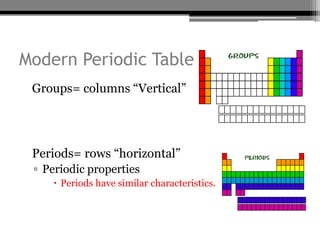
• Groups= columns “Vertical”


• Periods= rows “horizontal”
 ▫ Periodic properties
      Periods have similar characteristics.
Metals, Nonmetals, Metalloids
•   How can you identify a metal?
•   What are its properties?
•   What about the less common nonmetals?
•   What are their properties?
•   And what the heck is a metalloid?
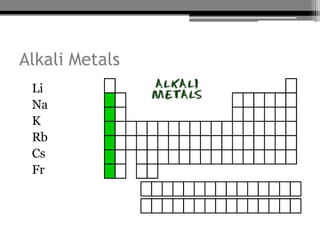
Alkali Metals
•   Li
•   Na
•   K
•   Rb
•   Cs
•   Fr
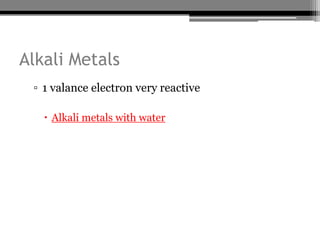
Alkali Metals
 ▫ 1 valance electron very reactive

    Alkali metals with water
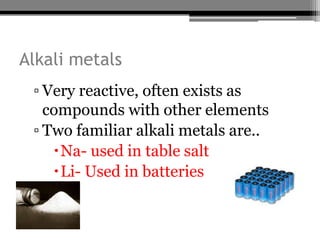
Alkali metals
 ▫ Very reactive, often exists as
   compounds with other elements
 ▫ Two familiar alkali metals are..
    Na- used in table salt
    Li- Used in batteries
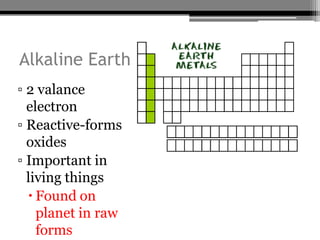
Alkaline Earth
▫ 2 valance
  electron
▫ Reactive-forms
  oxides
▫ Important in
  living things
   Found on
    planet in raw
    forms
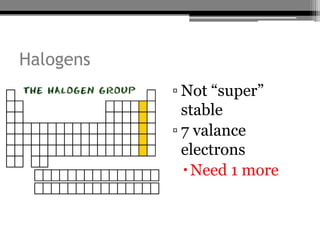
Halogens
           ▫ Not “super”
             stable
           ▫ 7 valance
             electrons
              Need 1 more
Halogens

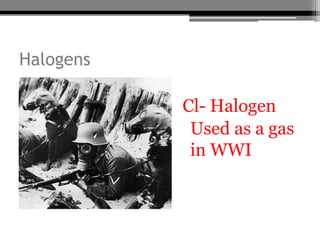
           Cl- Halogen
            Used as a gas
            in WWI
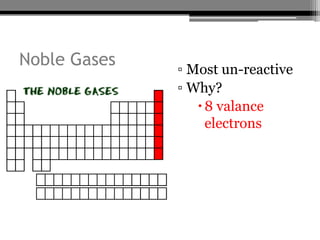
Noble Gases   ▫ Most un-reactive
              ▫ Why?
                  8 valance
                   electrons
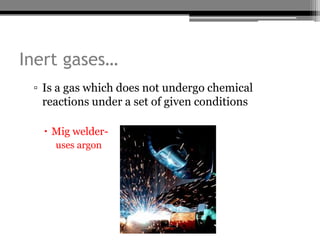
Inert gases…
 ▫ Is a gas which does not undergo chemical
   reactions under a set of given conditions

    Mig welder-
     uses argon
CHNOPSS-nonmetals “important to life”
  ▫ Carbon- that's what we are “made of”
  ▫ Hydrogen-your body is mostly H2O
  ▫ Nitrogen – amino acids
  ▫ Oxygen-energy out of food
  ▫ Phosphorous-DNA
  ▫ Sulfur-Protein
  ▫ Selenium –micro amounts/ a deficiency
    is thought to cause cancer
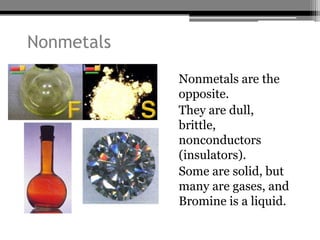
Nonmetals
            • Nonmetals are the
              opposite.
            • They are dull,
              brittle,
              nonconductors
              (insulators).
            • Some are solid, but
              many are gases, and
              Bromine is a liquid.
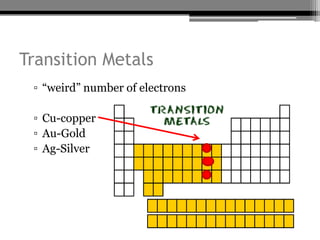
Transition Metals
 ▫ “weird” number of electrons

 ▫ Cu-copper
 ▫ Au-Gold
 ▫ Ag-Silver
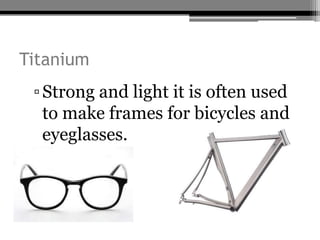
Titanium
 ▫ Strong and light it is often used
   to make frames for bicycles and
   eyeglasses.
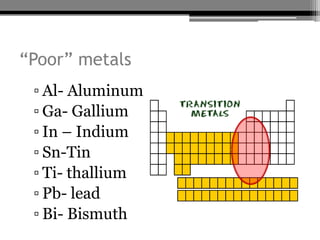
“Poor” metals
 ▫ Al- Aluminum
 ▫ Ga- Gallium
 ▫ In – Indium
 ▫ Sn-Tin
 ▫ Ti- thallium
 ▫ Pb- lead
 ▫ Bi- Bismuth
“inner” transition metals
 ▫ Actinide series

 ▫ Lanthanide series
    used extensively as phosphors, substances that emit
     light when struck by electrons
Metals
 ▫ Malleable & ductile, meaning they can be
   pounded into thin sheets & drawn into wire

   Metals met the nonmetals, forming a stair step on
    the right hand side of the periodic table.
Metals
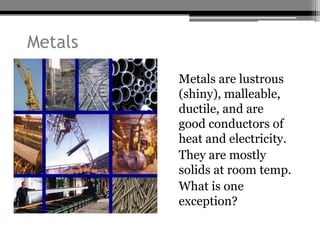
         • Metals are lustrous
           (shiny), malleable,
           ductile, and are
           good conductors of
           heat and electricity.
         • They are mostly
           solids at room temp.
         • What is one
           exception?
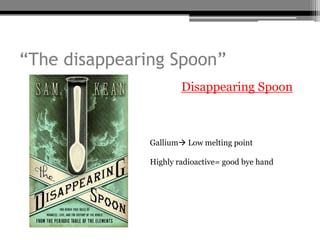
“The disappearing Spoon”
                     • Disappearing Spoon


               Gallium Low melting point

               Highly radioactive= good bye hand
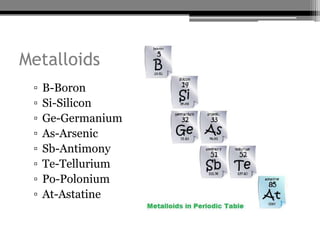
Metalloids
 ▫   B-Boron
 ▫   Si-Silicon
 ▫   Ge-Germanium
 ▫   As-Arsenic
 ▫   Sb-Antimony
 ▫   Te-Tellurium
 ▫   Po-Polonium
 ▫   At-Astatine
Metalloids
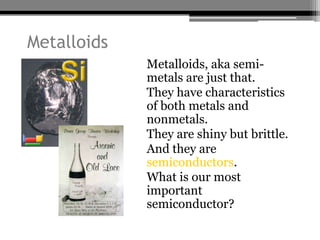
             • Metalloids, aka semi-
               metals are just that.
             • They have characteristics
               of both metals and
               nonmetals.
             • They are shiny but brittle.
             • And they are
               semiconductors.
             • What is our most
               important
               semiconductor?
Metalloids
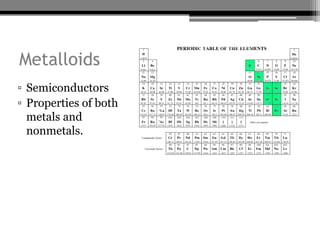
▫ Semiconductors
▫ Properties of both
  metals and
  nonmetals.
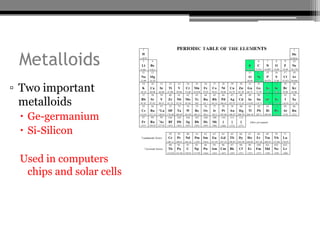
Metalloids
▫ Two important
  metalloids
  Ge-germanium
  Si-Silicon

 Used in computers
  chips and solar cells
Metals, Nonmetals, Metalloids
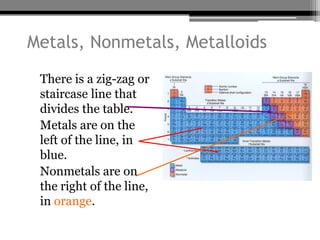
• There is a zig-zag or
  staircase line that
  divides the table.
• Metals are on the
  left of the line, in
  blue.
• Nonmetals are on
  the right of the line,
  in orange.
Metals, Nonmetals, Metalloids
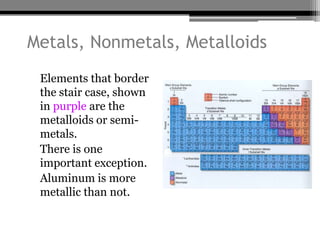
• Elements that border
  the stair case, shown
  in purple are the
  metalloids or semi-
  metals.
• There is one
  important exception.
• Aluminum is more
  metallic than not.
The Periodic Table & Periodic
Law
Classification of Elements
Objective:
 ▫ Explain why elements in the same group have
   similar properties
 ▫ Identify the four block of the periodic table based
   in their electron configuration
Valence Electrons
• Do you remember how to tell the number of
  valence electrons for elements in the s- and p-
  blocks?
• How many valence electrons will the atoms in
  the d-block (transition metals) and the f-block
  (inner transition metals) have?
• Most have 2 valence e-, some only have 1.
Valance electrons
Electron configuration
s, p, d, and f blocks
The Periodic Table & Periodic
Law
Periodic Trends
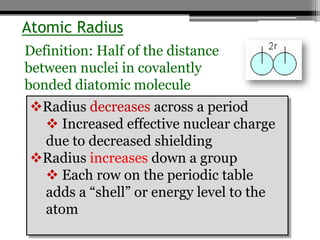
Atomic Radius
Definition: Half of the distance
between nuclei in covalently
bonded diatomic molecule
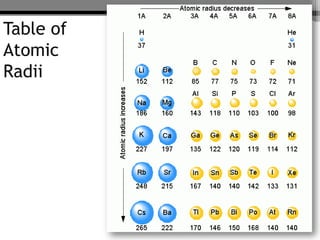
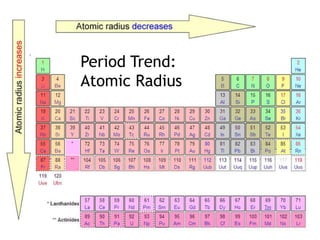
 Radius decreases across a period
   Increased effective nuclear charge
  due to decreased shielding
 Radius increases down a group
   Each row on the periodic table
  adds a “shell” or energy level to the
  atom
Table of
Atomic
Radii
Explanation Video-Atomic Radii
Period Trend:
Atomic Radius
Ionization Energy
Definition: the energy required to remove
an electron from an atom
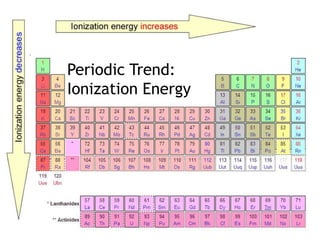
   Tends to increase across a period
      As radius decreases across a
     period, the electron you are removing
     is closer to the nucleus and harder to
     remove
   Tends to decrease down a group
      Outer electrons are farther from
     the nucleus and easier to remove
Periodic Trend:
Ionization Energy
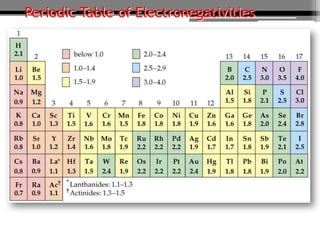
Electronegativity
 Definition: A measure of the ability of an
 atom in a chemical compound to attract
 electrons
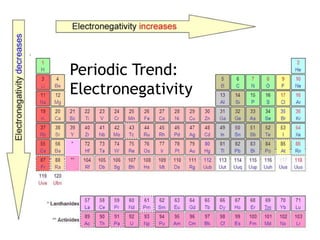
o Electronegativity tends to increase
across a period
   o As radius decreases, electrons get
   closer to the bonding atom’s nucleus
o Electronegativity tends to decrease down
a group or remain the same
   o As radius increases, electrons are
   farther from the bonding atom’s nucleus
Periodic Table of Electronegativities
Periodic Trend:
Electronegativity
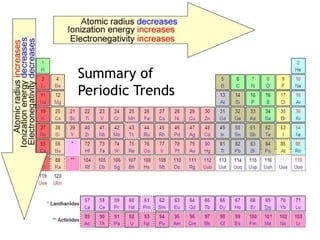
Summary of
Periodic Trends
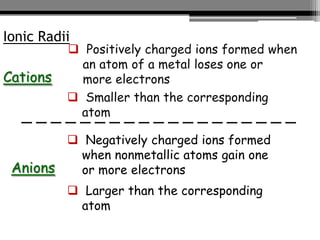
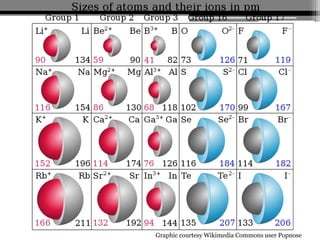
Ionic Radii
           Positively charged ions formed when
            an atom of a metal loses one or
Cations     more electrons
           Smaller than the corresponding
            atom

         Negatively charged ions formed
          when nonmetallic atoms gain one
 Anions   or more electrons
           Larger than the corresponding
            atom
The Octet Rule
  • The “goal” of most atoms (except H, Li and
    Be) is to have an octet or group of 8 electrons
    in their valence energy level.
  • They may accomplish this by either giving
    electrons away or taking them.
  • Metals generally give electrons, nonmetals
    take them from other atoms.
  • Atoms that have gained or lost electrons are
    called ions.
Ions
• When an atom gains an electron, it becomes
  negatively charged (more electrons than protons
  ) and is called an anion.
• In the same way that nonmetal atoms can gain
  electrons, metal atoms can lose electrons.
• They become positively charged cations.
Ions
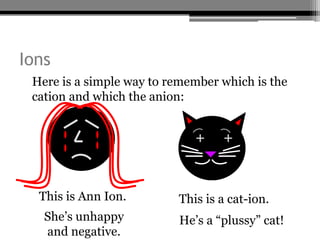
• Here is a simple way to remember which is the
  cation and which the anion:


                              +    +


  This is Ann Ion.         This is a cat-ion.
   She’s unhappy           He’s a “plussy” cat!
   and negative.
Ionic Radius
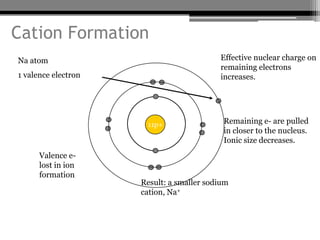
• Cations are always smaller than the original
  atom.
• The entire outer PEL is removed during
  ionization.
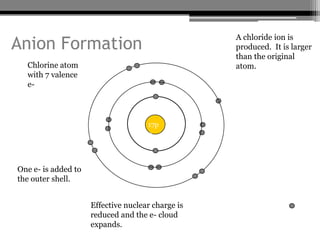
• Conversely, anions are always larger than the
  original atom.
• Electrons are added to the outer PEL.
Cation Formation
Na atom                                   Effective nuclear charge on
                                          remaining electrons
1 valence electron                        increases.


                      11p+                 Remaining e- are pulled
                                           in closer to the nucleus.
                                           Ionic size decreases.
      Valence e-
      lost in ion
      formation
                     Result: a smaller sodium
                     cation, Na+
A chloride ion is
Anion Formation                                    produced. It is larger
                                                   than the original
  Chlorine atom                                    atom.
  with 7 valence
  e-


                                     17p
                                     +


One e- is added to
the outer shell.


                     Effective nuclear charge is
                     reduced and the e- cloud
                     expands.
Graphic courtesy Wikimedia Commons user Popnose

The periodic table & periodic law

  • 1.
    The Periodic Table& Periodic Law
  • 2.
    Objective: ▫ Tracethe development of the periodic table ▫ Identify key features of the periodic table
  • 3.
    • Sheldon &The Element Song
  • 4.
    Development of theperiodic table • - John Newlands • - Meyer and Meedeleev
  • 5.
    John Newlands • 1864English chemist • -Proposed a scheme for the elements • -He noticed that when elements where arranged based on atomic mass their properties repeated every 8th element.
  • 6.
    John Newlands • -Newlandsnamed the periodic relationship Law of octaves. (after a musical, a name which was frowned upon because it was unscientific) • -Although not accepted Newland’s correct in the aspect that elements do repeat each other.
  • 7.
    Meyer & Mendeleev •Meyer-Russian chemist-1869 • Dmitri Mendeleev- 1869 ▫ Demonstrated a connection between atomic mass and elemental properties.
  • 8.
    Meyer ▫ Demonstrateda connection between atomic mass and elemental properties ▫ Arranged the elements in order of increasing atomic mass
  • 9.
    Mendeleev ▫ Demonstrateda connection between atomic mass and elemental properties ▫ Arranged the elements in order of increasing atomic mass ▫ Predicted the existence of properties of undiscovered elements.
  • 10.
    Mendeleev ▫ Mendeleevis given more credit. ▫ History of the Periodic Table
  • 11.
    Periodic Table Activity ▫ Recognizing patterns
  • 12.
    What did Mendeleevmiss? ▫ New elements were discovered, it became evident that the periodic table was not in the correct order. ▫ Henry Moseley (1887-1915), arrange elements by atomic number.
  • 13.
    Moseley ▫ Discoveredthat atoms contain a unique number of protons called the atomic number ▫ Arranged element in order of increasing atomic number, which resulted in a periodic pattern of properties.
  • 14.
    The Periodic Law •Atoms with similar properties appear in groups or families (vertical columns) on the periodic table. • They are similar because they all have the same number of valence (outer shell) electrons, which governs their chemical behavior.
  • 15.
    The Periodic Table& Periodic Law Elements & Modern periodic table
  • 16.
  • 17.
    Modern Periodic Table •Groups= columns “Vertical” • Periods= rows “horizontal” ▫ Periodic properties  Periods have similar characteristics.
  • 18.
    Metals, Nonmetals, Metalloids • How can you identify a metal? • What are its properties? • What about the less common nonmetals? • What are their properties? • And what the heck is a metalloid?
  • 19.
    Alkali Metals • Li • Na • K • Rb • Cs • Fr
  • 20.
    Alkali Metals ▫1 valance electron very reactive  Alkali metals with water
  • 21.
    Alkali metals ▫Very reactive, often exists as compounds with other elements ▫ Two familiar alkali metals are.. Na- used in table salt Li- Used in batteries
  • 22.
    Alkaline Earth ▫ 2valance electron ▫ Reactive-forms oxides ▫ Important in living things  Found on planet in raw forms
  • 23.
    Halogens ▫ Not “super” stable ▫ 7 valance electrons  Need 1 more
  • 24.
    Halogens Cl- Halogen Used as a gas in WWI
  • 25.
    Noble Gases ▫ Most un-reactive ▫ Why?  8 valance electrons
  • 26.
    Inert gases… ▫Is a gas which does not undergo chemical reactions under a set of given conditions  Mig welder- uses argon
  • 27.
    CHNOPSS-nonmetals “important tolife” ▫ Carbon- that's what we are “made of” ▫ Hydrogen-your body is mostly H2O ▫ Nitrogen – amino acids ▫ Oxygen-energy out of food ▫ Phosphorous-DNA ▫ Sulfur-Protein ▫ Selenium –micro amounts/ a deficiency is thought to cause cancer
  • 28.
    Nonmetals • Nonmetals are the opposite. • They are dull, brittle, nonconductors (insulators). • Some are solid, but many are gases, and Bromine is a liquid.
  • 29.
    Transition Metals ▫“weird” number of electrons ▫ Cu-copper ▫ Au-Gold ▫ Ag-Silver
  • 30.
    Titanium ▫ Strongand light it is often used to make frames for bicycles and eyeglasses.
  • 31.
    “Poor” metals ▫Al- Aluminum ▫ Ga- Gallium ▫ In – Indium ▫ Sn-Tin ▫ Ti- thallium ▫ Pb- lead ▫ Bi- Bismuth
  • 32.
    “inner” transition metals ▫ Actinide series ▫ Lanthanide series  used extensively as phosphors, substances that emit light when struck by electrons
  • 33.
    Metals ▫ Malleable& ductile, meaning they can be pounded into thin sheets & drawn into wire  Metals met the nonmetals, forming a stair step on the right hand side of the periodic table.
  • 34.
    Metals • Metals are lustrous (shiny), malleable, ductile, and are good conductors of heat and electricity. • They are mostly solids at room temp. • What is one exception?
  • 35.
    “The disappearing Spoon” • Disappearing Spoon Gallium Low melting point Highly radioactive= good bye hand
  • 36.
    Metalloids ▫ B-Boron ▫ Si-Silicon ▫ Ge-Germanium ▫ As-Arsenic ▫ Sb-Antimony ▫ Te-Tellurium ▫ Po-Polonium ▫ At-Astatine
  • 37.
    Metalloids • Metalloids, aka semi- metals are just that. • They have characteristics of both metals and nonmetals. • They are shiny but brittle. • And they are semiconductors. • What is our most important semiconductor?
  • 38.
    Metalloids ▫ Semiconductors ▫ Propertiesof both metals and nonmetals.
  • 39.
    Metalloids ▫ Two important metalloids  Ge-germanium  Si-Silicon Used in computers chips and solar cells
  • 40.
    Metals, Nonmetals, Metalloids •There is a zig-zag or staircase line that divides the table. • Metals are on the left of the line, in blue. • Nonmetals are on the right of the line, in orange.
  • 41.
    Metals, Nonmetals, Metalloids •Elements that border the stair case, shown in purple are the metalloids or semi- metals. • There is one important exception. • Aluminum is more metallic than not.
  • 42.
    The Periodic Table& Periodic Law Classification of Elements
  • 43.
    Objective: ▫ Explainwhy elements in the same group have similar properties ▫ Identify the four block of the periodic table based in their electron configuration
  • 44.
    Valence Electrons • Doyou remember how to tell the number of valence electrons for elements in the s- and p- blocks? • How many valence electrons will the atoms in the d-block (transition metals) and the f-block (inner transition metals) have? • Most have 2 valence e-, some only have 1.
  • 45.
  • 46.
  • 47.
    s, p, d,and f blocks
  • 48.
    The Periodic Table& Periodic Law Periodic Trends
  • 49.
    Atomic Radius Definition: Halfof the distance between nuclei in covalently bonded diatomic molecule Radius decreases across a period  Increased effective nuclear charge due to decreased shielding Radius increases down a group  Each row on the periodic table adds a “shell” or energy level to the atom
  • 50.
  • 51.
  • 52.
  • 53.
    Ionization Energy Definition: theenergy required to remove an electron from an atom  Tends to increase across a period  As radius decreases across a period, the electron you are removing is closer to the nucleus and harder to remove  Tends to decrease down a group  Outer electrons are farther from the nucleus and easier to remove
  • 54.
  • 55.
    Electronegativity Definition: Ameasure of the ability of an atom in a chemical compound to attract electrons o Electronegativity tends to increase across a period o As radius decreases, electrons get closer to the bonding atom’s nucleus o Electronegativity tends to decrease down a group or remain the same o As radius increases, electrons are farther from the bonding atom’s nucleus
  • 56.
    Periodic Table ofElectronegativities
  • 57.
  • 58.
  • 59.
    Ionic Radii  Positively charged ions formed when an atom of a metal loses one or Cations more electrons  Smaller than the corresponding atom  Negatively charged ions formed when nonmetallic atoms gain one Anions or more electrons  Larger than the corresponding atom
  • 60.
    The Octet Rule • The “goal” of most atoms (except H, Li and Be) is to have an octet or group of 8 electrons in their valence energy level. • They may accomplish this by either giving electrons away or taking them. • Metals generally give electrons, nonmetals take them from other atoms. • Atoms that have gained or lost electrons are called ions.
  • 61.
    Ions • When anatom gains an electron, it becomes negatively charged (more electrons than protons ) and is called an anion. • In the same way that nonmetal atoms can gain electrons, metal atoms can lose electrons. • They become positively charged cations.
  • 62.
    Ions • Here isa simple way to remember which is the cation and which the anion: + + This is Ann Ion. This is a cat-ion. She’s unhappy He’s a “plussy” cat! and negative.
  • 63.
    Ionic Radius • Cationsare always smaller than the original atom. • The entire outer PEL is removed during ionization. • Conversely, anions are always larger than the original atom. • Electrons are added to the outer PEL.
  • 64.
    Cation Formation Na atom Effective nuclear charge on remaining electrons 1 valence electron increases. 11p+ Remaining e- are pulled in closer to the nucleus. Ionic size decreases. Valence e- lost in ion formation Result: a smaller sodium cation, Na+
  • 65.
    A chloride ionis Anion Formation produced. It is larger than the original Chlorine atom atom. with 7 valence e- 17p + One e- is added to the outer shell. Effective nuclear charge is reduced and the e- cloud expands.
  • 66.
    Graphic courtesy WikimediaCommons user Popnose