The Periodic Table Unit 3 Chapter 4 pp 114-131
Ok, so now what? Recall: Element cannot be broken down any further. In the late 1800’s, we had “discovered” about 60 elements. We had no idea of the structure of atoms. Many scientists attempted to put order to the rapidly expanding list of elements.
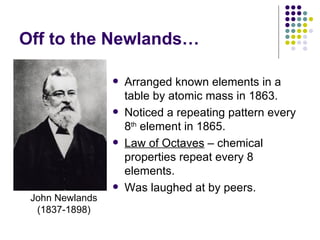
Off to the Newlands… Arranged known elements in a table by atomic mass in 1863. Noticed a repeating pattern every 8 th  element in 1865. Law of Octaves  – chemical properties repeat every 8 elements. Was laughed at by peers. John Newlands (1837-1898)
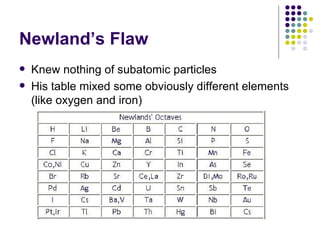
Newland’s Flaw Knew nothing of subatomic particles His table mixed some obviously different elements (like oxygen and iron)
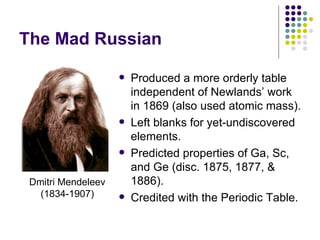
The Mad Russian Produced a more orderly table independent of Newlands’ work in 1869 (also used atomic mass). Left blanks for yet-undiscovered elements. Predicted properties of Ga, Sc, and Ge (disc. 1875, 1877, & 1886). Credited with the Periodic Table. Dmitri Mendeleev (1834-1907)
Russian Roulette Mendeleev’s table had a few problems. Based on atomic mass, had to switch a few elements (e.g. Tellurium and Iodine) to keep reactivities in order. Many believed he predicted too many elements (we had 63 already!!!). Still, this is what we used for half a century.
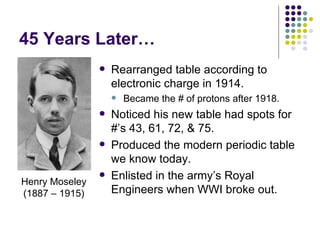
45 Years Later… Rearranged table according to electronic charge in 1914. Became the # of protons after 1918. Noticed his new table had spots for #’s 43, 61, 72, & 75. Produced the modern periodic table we know today. Enlisted in the army’s Royal Engineers when WWI broke out. Henry Moseley (1887 – 1915)
Moseley’s New Order Gave experimental meaning to atomic number. Gave reason for Tellurium and Iodine being switched.  Moseley’s technique easily separated rare earth metals. Plagued chemists for years and years. Predicted how many elements remained between others. (e.g. 13 elements between La and Lu)
Moseley’s Lost Nobel Many thought he should have won Nobel Prize. It’s only given to the living…he was shot in the head by a sniper in Gallipoli. Bohr (1962):  "You see actually the Rutherford work [the nuclear atom] was not taken seriously. We cannot understand today, but it was not taken seriously at all. There was no mention of it any place. The great change came from Moseley."   British barred scientists from enlisting for combat.
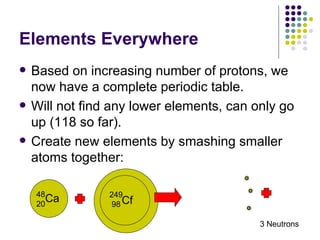
Elements Everywhere Based on increasing number of protons, we now have a complete periodic table. Will not find any lower elements, can only go up (118 so far). Create new elements by smashing smaller atoms together: 3 Neutrons 294 118 Uuo 48 20 Ca 249 98 Cf
Periodicity In order by atomic number (# of Protons) H has 1 p + , U has 92 Arranged in Rows and Columns Rows = Periods Pd 3 = Na, Mg, Al, Si, P, S, Cl, Ar Columns = Groups or Families Group 1 = H, Li, Na, K, Rb, Cs, Fr Have similar properties (e.g. Form hydroxides: LiOH, NaOH, KOH, etc)
Division of Labor Different types of elements are found on different parts of the table: Metals to the left (majority of the elements). Nonmetals to the right (18 elements). Metalloids found on a “staircase” dividing metals and nonmetals (7 elements). Lanthanoids & Actinoids (metals) added to bottom to make table manageable.
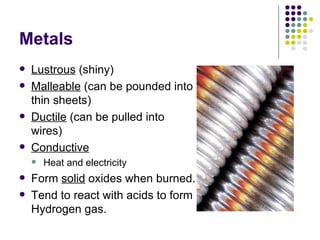
Metals Lustrous  (shiny) Malleable  (can be pounded into thin sheets) Ductile  (can be pulled into wires) Conductive Heat and electricity Form  solid  oxides when burned. Tend to react with acids to form Hydrogen gas.
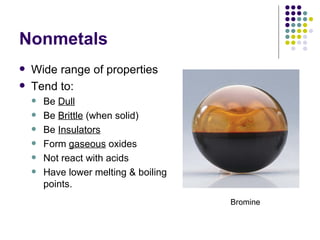
Nonmetals Wide range of properties Tend to: Be  Dull Be  Brittle  (when solid) Be  Insulators Form  gaseous  oxides Not react with acids Have lower melting & boiling points. Bromine
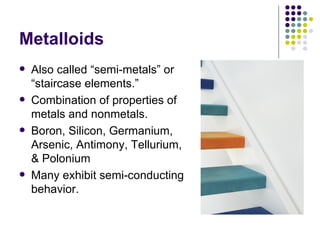
Metalloids Also called “semi-metals” or “staircase elements.” Combination of properties of metals and nonmetals. Boron, Silicon, Germanium, Arsenic, Antimony, Tellurium, & Polonium Many exhibit semi-conducting behavior.
Groups/Families Alkali Metals Alkali Earth Metals Halogens Noble Gases Transition Metals Inner Transition Metals Lanthanoids (Rare Earths) Actinoids
s-Block Elements At least 1 e -  in s orbital (ns x ) Groups 1 & 2 Alkali Metals Alkaline Earth Metals Reactivity increases as you go down All are metals, except H & He Helium is technically an s-block, but placed with Noble Gases b/c of reactivity
p-Block Elements At least 1 e -  in p orbital (np x ) Groups 13-18 Nonmetals at top, gradually transitioning into metals All nonmetals and metalloids are p-block elements (excl H & He) Some metals (Al, Ga, In, Sn, Tl, Pb, Bi)
d-Block Elements At least 1 e -  in d orbital (nd x ) Groups 3-12 Transition Metals Very little similarities w/in group All are metals Most form multiple ions (charged atoms)
f-Block Elements At least 1 e -  in f orbital (nf x ) Oddballs Lanthanoids start with #57, La Actinoids start with #89, Ac The groups are NOT similar up & down All are metals Lanthanoids (4f) are natural, most Actinoids (5f) are man-made
Representative Elements Exhibit nearly perfect periodicity. All members of these groups behave as expected. Groups on the outside of the table: Alkali Metals (Group 1) Alkaline Earth Metals (Group 2) Halogens (Group 17) Noble Gases (Group 18)
Alkali Metals Group 1 (excluding hydrogen) [ns 1 ] Soft, lustrous, oxidize when exposed to air. Difficult to isolate – never found in nature. React (violently) with water to form a base. React with chlorine to form a salt with a 1-to-1 ratio: LiCl  NaCl  KCl RbCl  CsCl (also FrCl)
Alkaline Earth Metals Group 2 [ns 2 ] Harder & Denser than Alkali Metals. Lustrous, oxidize slowly when exposed to air. React with water or steam to form a base. React with chlorine to form a salt with a 1-to-2 ratio: BeCl 2 MgCl 2 CaCl 2 SrCl 2 BaCl 2 RaCl 2
Halogens Group 17 [np 5 ] Nonmetals Gases (F, Cl), liquid (Br), and solids (I, At) Name means “salt former.” React with sodium to form a salt with a 1-to-1 ratio: NaF NaCl NaBr NaI NaAt
Noble Gases Group 18 [np 6 ] Unreactive Gases – colorless, odorless. Some of the last natural elements to be discovered. Once called “Inert Gases.” Monatomic in Nature
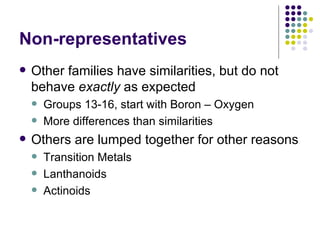
Non-representatives Other families have similarities, but do not behave  exactly  as expected Groups 13-16, start with Boron – Oxygen More differences than similarities Others are lumped together for other reasons Transition Metals Lanthanoids Actinoids
Transition Metals Groups 3 to 12 [nd x ] Central portion of the PT. Behavior and appearance vary. Variable oxidation state (charge). Different oxidation states can produce different colors. Often used to make pigments. Co +2   Cr +6 Cr +6 Ni +2   Cu +2  Mn +7
Lanthanoids 1 st  Row on Bottom of table [4f x ] AKA Lanthanides & Rare Earths Not so rare (Ce 25 th  most abundant) So similar, very difficult to separate – remember Moseley? Most deflect UV – used in sunglasses Shiny, silvery white, soft, react violently with most nonmetals, tarnish in air
Actinoids 2 nd  Row on Bottom of table [5f x ] AKA Actinides All are radioactive Not as similar as the Lanthanoids Only Th and U are common in nature Most are man-made Nuclear fallout Particle colliders
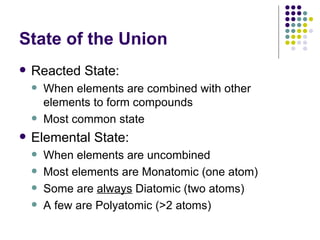
State of the Union Reacted State:  When elements are combined with other elements to form compounds Most common state Elemental State:  When elements are uncombined Most elements are Monatomic (one atom) Some are  always  Diatomic (two atoms)  A few are Polyatomic (>2 atoms)
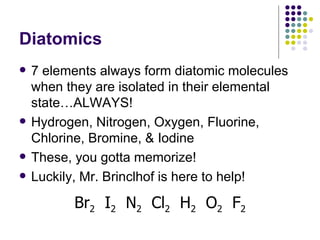
Diatomics 7 elements always form diatomic molecules when they are isolated in their elemental state…ALWAYS! Hydrogen, Nitrogen, Oxygen, Fluorine, Chlorine, Bromine, & Iodine These, you gotta memorize! Luckily, Mr. Brinclhof is here to help! Br 2   I 2   N 2   Cl 2   H 2   O 2   F 2
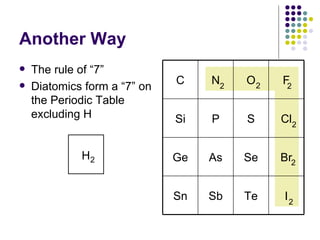
Another Way The rule of “7” Diatomics form a “7” on the Periodic Table  excluding H 2 2 2 2 2 2 2 I Te Sb Sn Br Se As Ge Cl S P Si F O N C H
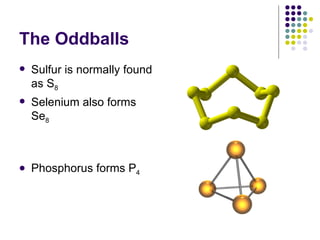
The Oddballs Sulfur is normally found as S 8 Selenium also forms Se 8 Phosphorus forms P 4
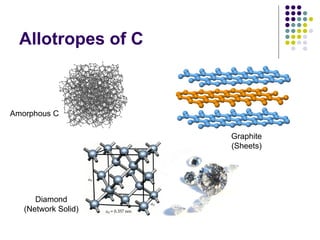
Allotrope When an element can be found in more than one form Several elements have different allotropes, but most often cited is Carbon Carbon has 3 common allotropes Amorphous – Random arrangement of C atoms Graphite – Hexagonal arrangement in sheets Conducts electricity! Diamond – 3-D network solid
Allotropes of C Amorphous C Diamond (Network Solid) Graphite (Sheets)
Trends in the Periodic Table Several trends appear once we have the elements in order Atomic Radius Ionization Energy Electronegativity Reactivity
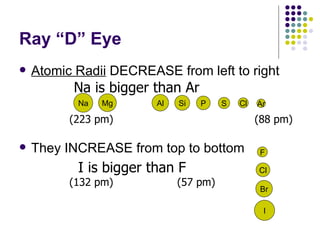
Ray “D” Eye Atomic Radii  DECREASE from left to right They INCREASE from top to bottom Na is bigger than Ar (223 pm)  (88 pm) I is bigger than F (132 pm)  (57 pm) Na Mg Al Si P S Cl Ar I Br Cl F
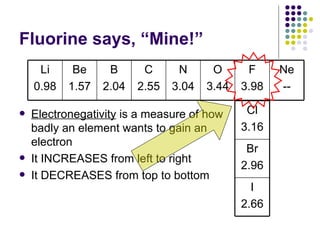
Fluorine says, “Mine!” Electronegativity  is a measure of how badly an element wants to gain an electron It INCREASES from left to right It DECREASES from top to bottom Ne -- F 3.98 O 3.44 N 3.04 C 2.55 B 2.04 Be 1.57 Li 0.98 I 2.66 Br 2.96 Cl 3.16
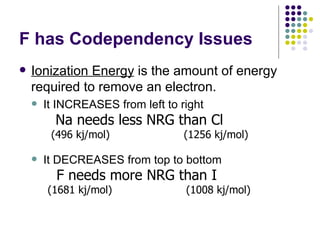
F has Codependency Issues Ionization Energy  is the amount of energy required to remove an electron. It INCREASES from left to right It DECREASES from top to bottom Na needs less NRG than Cl (496 kj/mol)  (1256 kj/mol) F needs more NRG than I (1681 kj/mol)  (1008 kj/mol)
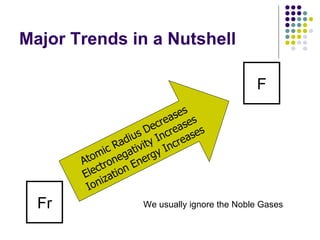
Major Trends in a Nutshell Atomic Radius Decreases Electronegativity Increases Ionization Energy Increases Fr F We usually ignore the Noble Gases
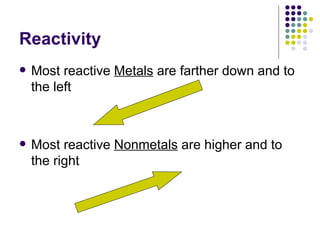
Reactivity Most reactive  Metals  are farther down and to the left Most reactive  Nonmetals  are higher and to the right
Tidbits Hydrogen by far most abundant (4 out of every 5 atoms in universe) Atoms in the Elemental state tend to be more dangerous/poisonous than those in the Reacted state – Exceptions: Cu & Pb Oddo-Harkins Rule: even #’d elements more common than odd ones (protons apparently like to be paired up).

Notes 11 14 08 To 11 21 08

  • 1.
    The Periodic TableUnit 3 Chapter 4 pp 114-131
  • 2.
    Ok, so nowwhat? Recall: Element cannot be broken down any further. In the late 1800’s, we had “discovered” about 60 elements. We had no idea of the structure of atoms. Many scientists attempted to put order to the rapidly expanding list of elements.
  • 3.
    Off to theNewlands… Arranged known elements in a table by atomic mass in 1863. Noticed a repeating pattern every 8 th element in 1865. Law of Octaves – chemical properties repeat every 8 elements. Was laughed at by peers. John Newlands (1837-1898)
  • 4.
    Newland’s Flaw Knewnothing of subatomic particles His table mixed some obviously different elements (like oxygen and iron)
  • 5.
    The Mad RussianProduced a more orderly table independent of Newlands’ work in 1869 (also used atomic mass). Left blanks for yet-undiscovered elements. Predicted properties of Ga, Sc, and Ge (disc. 1875, 1877, & 1886). Credited with the Periodic Table. Dmitri Mendeleev (1834-1907)
  • 6.
    Russian Roulette Mendeleev’stable had a few problems. Based on atomic mass, had to switch a few elements (e.g. Tellurium and Iodine) to keep reactivities in order. Many believed he predicted too many elements (we had 63 already!!!). Still, this is what we used for half a century.
  • 7.
    45 Years Later…Rearranged table according to electronic charge in 1914. Became the # of protons after 1918. Noticed his new table had spots for #’s 43, 61, 72, & 75. Produced the modern periodic table we know today. Enlisted in the army’s Royal Engineers when WWI broke out. Henry Moseley (1887 – 1915)
  • 8.
    Moseley’s New OrderGave experimental meaning to atomic number. Gave reason for Tellurium and Iodine being switched. Moseley’s technique easily separated rare earth metals. Plagued chemists for years and years. Predicted how many elements remained between others. (e.g. 13 elements between La and Lu)
  • 9.
    Moseley’s Lost NobelMany thought he should have won Nobel Prize. It’s only given to the living…he was shot in the head by a sniper in Gallipoli. Bohr (1962): "You see actually the Rutherford work [the nuclear atom] was not taken seriously. We cannot understand today, but it was not taken seriously at all. There was no mention of it any place. The great change came from Moseley." British barred scientists from enlisting for combat.
  • 10.
    Elements Everywhere Basedon increasing number of protons, we now have a complete periodic table. Will not find any lower elements, can only go up (118 so far). Create new elements by smashing smaller atoms together: 3 Neutrons 294 118 Uuo 48 20 Ca 249 98 Cf
  • 11.
    Periodicity In orderby atomic number (# of Protons) H has 1 p + , U has 92 Arranged in Rows and Columns Rows = Periods Pd 3 = Na, Mg, Al, Si, P, S, Cl, Ar Columns = Groups or Families Group 1 = H, Li, Na, K, Rb, Cs, Fr Have similar properties (e.g. Form hydroxides: LiOH, NaOH, KOH, etc)
  • 12.
    Division of LaborDifferent types of elements are found on different parts of the table: Metals to the left (majority of the elements). Nonmetals to the right (18 elements). Metalloids found on a “staircase” dividing metals and nonmetals (7 elements). Lanthanoids & Actinoids (metals) added to bottom to make table manageable.
  • 13.
    Metals Lustrous (shiny) Malleable (can be pounded into thin sheets) Ductile (can be pulled into wires) Conductive Heat and electricity Form solid oxides when burned. Tend to react with acids to form Hydrogen gas.
  • 14.
    Nonmetals Wide rangeof properties Tend to: Be Dull Be Brittle (when solid) Be Insulators Form gaseous oxides Not react with acids Have lower melting & boiling points. Bromine
  • 15.
    Metalloids Also called“semi-metals” or “staircase elements.” Combination of properties of metals and nonmetals. Boron, Silicon, Germanium, Arsenic, Antimony, Tellurium, & Polonium Many exhibit semi-conducting behavior.
  • 16.
    Groups/Families Alkali MetalsAlkali Earth Metals Halogens Noble Gases Transition Metals Inner Transition Metals Lanthanoids (Rare Earths) Actinoids
  • 17.
    s-Block Elements Atleast 1 e - in s orbital (ns x ) Groups 1 & 2 Alkali Metals Alkaline Earth Metals Reactivity increases as you go down All are metals, except H & He Helium is technically an s-block, but placed with Noble Gases b/c of reactivity
  • 18.
    p-Block Elements Atleast 1 e - in p orbital (np x ) Groups 13-18 Nonmetals at top, gradually transitioning into metals All nonmetals and metalloids are p-block elements (excl H & He) Some metals (Al, Ga, In, Sn, Tl, Pb, Bi)
  • 19.
    d-Block Elements Atleast 1 e - in d orbital (nd x ) Groups 3-12 Transition Metals Very little similarities w/in group All are metals Most form multiple ions (charged atoms)
  • 20.
    f-Block Elements Atleast 1 e - in f orbital (nf x ) Oddballs Lanthanoids start with #57, La Actinoids start with #89, Ac The groups are NOT similar up & down All are metals Lanthanoids (4f) are natural, most Actinoids (5f) are man-made
  • 21.
    Representative Elements Exhibitnearly perfect periodicity. All members of these groups behave as expected. Groups on the outside of the table: Alkali Metals (Group 1) Alkaline Earth Metals (Group 2) Halogens (Group 17) Noble Gases (Group 18)
  • 22.
    Alkali Metals Group1 (excluding hydrogen) [ns 1 ] Soft, lustrous, oxidize when exposed to air. Difficult to isolate – never found in nature. React (violently) with water to form a base. React with chlorine to form a salt with a 1-to-1 ratio: LiCl NaCl KCl RbCl CsCl (also FrCl)
  • 23.
    Alkaline Earth MetalsGroup 2 [ns 2 ] Harder & Denser than Alkali Metals. Lustrous, oxidize slowly when exposed to air. React with water or steam to form a base. React with chlorine to form a salt with a 1-to-2 ratio: BeCl 2 MgCl 2 CaCl 2 SrCl 2 BaCl 2 RaCl 2
  • 24.
    Halogens Group 17[np 5 ] Nonmetals Gases (F, Cl), liquid (Br), and solids (I, At) Name means “salt former.” React with sodium to form a salt with a 1-to-1 ratio: NaF NaCl NaBr NaI NaAt
  • 25.
    Noble Gases Group18 [np 6 ] Unreactive Gases – colorless, odorless. Some of the last natural elements to be discovered. Once called “Inert Gases.” Monatomic in Nature
  • 26.
    Non-representatives Other familieshave similarities, but do not behave exactly as expected Groups 13-16, start with Boron – Oxygen More differences than similarities Others are lumped together for other reasons Transition Metals Lanthanoids Actinoids
  • 27.
    Transition Metals Groups3 to 12 [nd x ] Central portion of the PT. Behavior and appearance vary. Variable oxidation state (charge). Different oxidation states can produce different colors. Often used to make pigments. Co +2 Cr +6 Cr +6 Ni +2 Cu +2 Mn +7
  • 28.
    Lanthanoids 1 st Row on Bottom of table [4f x ] AKA Lanthanides & Rare Earths Not so rare (Ce 25 th most abundant) So similar, very difficult to separate – remember Moseley? Most deflect UV – used in sunglasses Shiny, silvery white, soft, react violently with most nonmetals, tarnish in air
  • 29.
    Actinoids 2 nd Row on Bottom of table [5f x ] AKA Actinides All are radioactive Not as similar as the Lanthanoids Only Th and U are common in nature Most are man-made Nuclear fallout Particle colliders
  • 30.
    State of theUnion Reacted State: When elements are combined with other elements to form compounds Most common state Elemental State: When elements are uncombined Most elements are Monatomic (one atom) Some are always Diatomic (two atoms) A few are Polyatomic (>2 atoms)
  • 31.
    Diatomics 7 elementsalways form diatomic molecules when they are isolated in their elemental state…ALWAYS! Hydrogen, Nitrogen, Oxygen, Fluorine, Chlorine, Bromine, & Iodine These, you gotta memorize! Luckily, Mr. Brinclhof is here to help! Br 2 I 2 N 2 Cl 2 H 2 O 2 F 2
  • 32.
    Another Way Therule of “7” Diatomics form a “7” on the Periodic Table excluding H 2 2 2 2 2 2 2 I Te Sb Sn Br Se As Ge Cl S P Si F O N C H
  • 33.
    The Oddballs Sulfuris normally found as S 8 Selenium also forms Se 8 Phosphorus forms P 4
  • 34.
    Allotrope When anelement can be found in more than one form Several elements have different allotropes, but most often cited is Carbon Carbon has 3 common allotropes Amorphous – Random arrangement of C atoms Graphite – Hexagonal arrangement in sheets Conducts electricity! Diamond – 3-D network solid
  • 35.
    Allotropes of CAmorphous C Diamond (Network Solid) Graphite (Sheets)
  • 36.
    Trends in thePeriodic Table Several trends appear once we have the elements in order Atomic Radius Ionization Energy Electronegativity Reactivity
  • 37.
    Ray “D” EyeAtomic Radii DECREASE from left to right They INCREASE from top to bottom Na is bigger than Ar (223 pm) (88 pm) I is bigger than F (132 pm) (57 pm) Na Mg Al Si P S Cl Ar I Br Cl F
  • 38.
    Fluorine says, “Mine!”Electronegativity is a measure of how badly an element wants to gain an electron It INCREASES from left to right It DECREASES from top to bottom Ne -- F 3.98 O 3.44 N 3.04 C 2.55 B 2.04 Be 1.57 Li 0.98 I 2.66 Br 2.96 Cl 3.16
  • 39.
    F has CodependencyIssues Ionization Energy is the amount of energy required to remove an electron. It INCREASES from left to right It DECREASES from top to bottom Na needs less NRG than Cl (496 kj/mol) (1256 kj/mol) F needs more NRG than I (1681 kj/mol) (1008 kj/mol)
  • 40.
    Major Trends ina Nutshell Atomic Radius Decreases Electronegativity Increases Ionization Energy Increases Fr F We usually ignore the Noble Gases
  • 41.
    Reactivity Most reactive Metals are farther down and to the left Most reactive Nonmetals are higher and to the right
  • 42.
    Tidbits Hydrogen byfar most abundant (4 out of every 5 atoms in universe) Atoms in the Elemental state tend to be more dangerous/poisonous than those in the Reacted state – Exceptions: Cu & Pb Oddo-Harkins Rule: even #’d elements more common than odd ones (protons apparently like to be paired up).