Properties of the
periodic table
Presented to you from :-
Ibrahem Salama Saber
Mostafa Mohammed Kotb
Youssef Mohammed Ezzat
Mostafa Gamal
Ahmed Sayed
Ahmed Mohammed Alsayed
Ahmed Khaled
Development of the periodic table
 The question of whether there is an organizing principle
behind matter in our world is an age old one. Greek
philosophers, convinced that only logic and deduction
could provide an insight into the harmony of the universe,
attempted to analyze such things using reason alone.
Meanwhile, a cadre of metallurgists, smiths, miners and
alchemists learned about the behaviour of matter and,
honing chemical techniques, began to build a list of ‘pure’,
simple substances.
 The success of classification systems in the 18th century,
such as Linnaean taxonomy of the natural world,
highlighted the need for a ‘natural system of elements’.
But the project to organize the chemical elements by type
was frustrated by inaccuracies in measurement of atomic
weights, and confusion between elements and
compounds. Dmitri Mendeleev’s 1869 periodic table
swept away these inconsistencies, revealing hidden
patterns (and some missing elements), and even
prefiguring 20th-century discoveries of atomic structure.
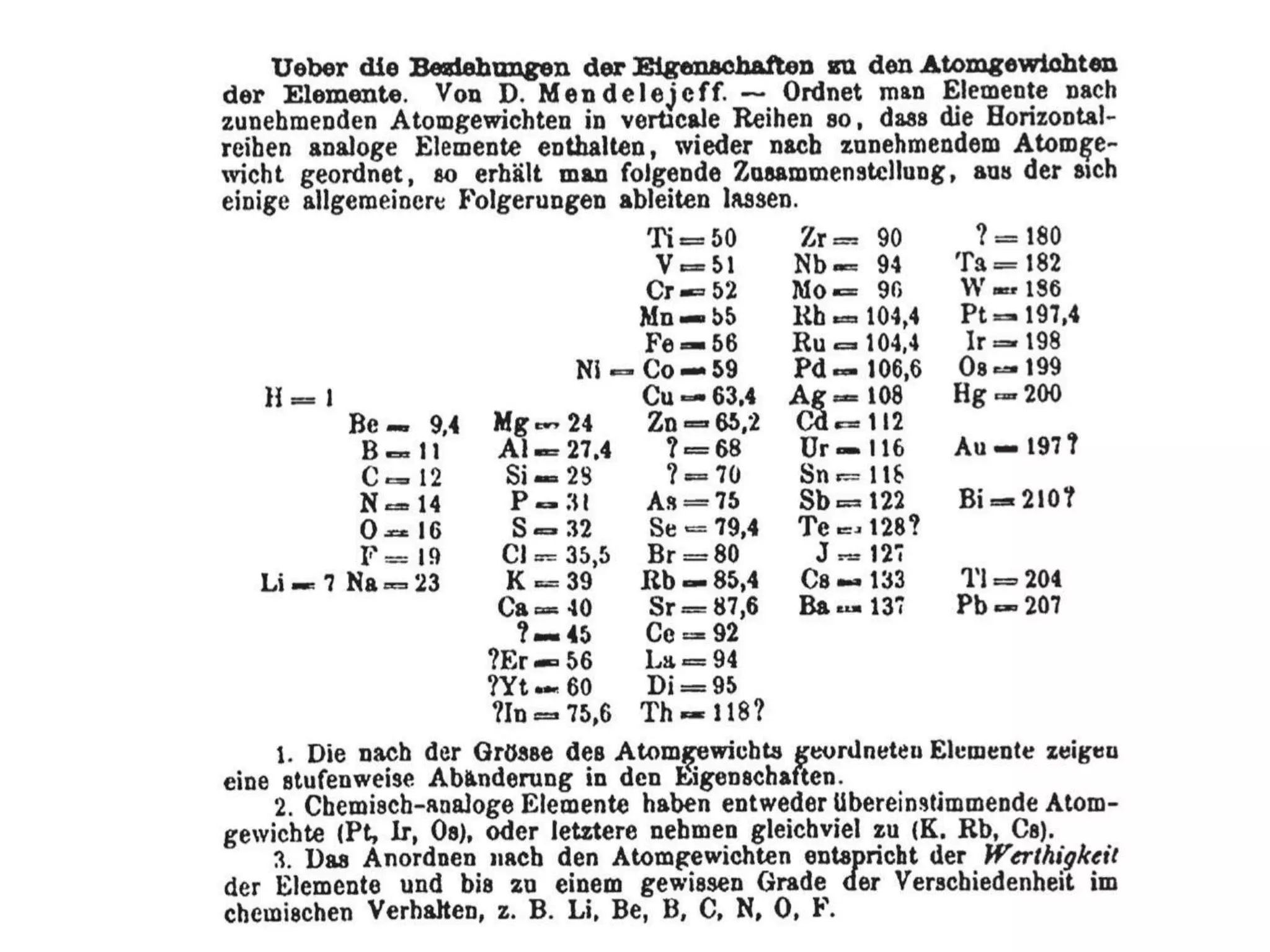
Mendeleev’s table
 Mendeleev’s periodic table at last brought order to the
growing list of chemical elements. By organizing them
into groups with shared chemical properties, he arrived at
its unconventional pattern of short rows at the top and
longer rows lower down. This matched exactly with the
periodic trends (repeating patterns in physical properties)
plotted by German chemist Lothar Meyer (1830–95), who
independently developed a periodic law of chemical
elements but published a year later. Where Newlands
shoehorned elements into place to fit his scheme),
Mendeleev had the courage to leave blank spaces for as-
yet-undiscovered elements. He even ventured to claim
that certain accepted atomic weights were incorrect. The
predictions of new elements with their weights, and their
subsequent discoveries – eka-aluminium (gallium) in
1875; eka-boron (scandium) in 1879; and eka-silicon
(germanium) in 1886 – caused a sensation. The periodic
law was a genuine new discovery about the nature of
matter, not the mere invention of a new way to organize
elements.
 The world got its first sight of the
periodic table in 1869, in the German
periodical Zeitschrift für Chemie. One
of Mendeleev’s most important
insights was that atomic weight
determines the character of a
chemical element.
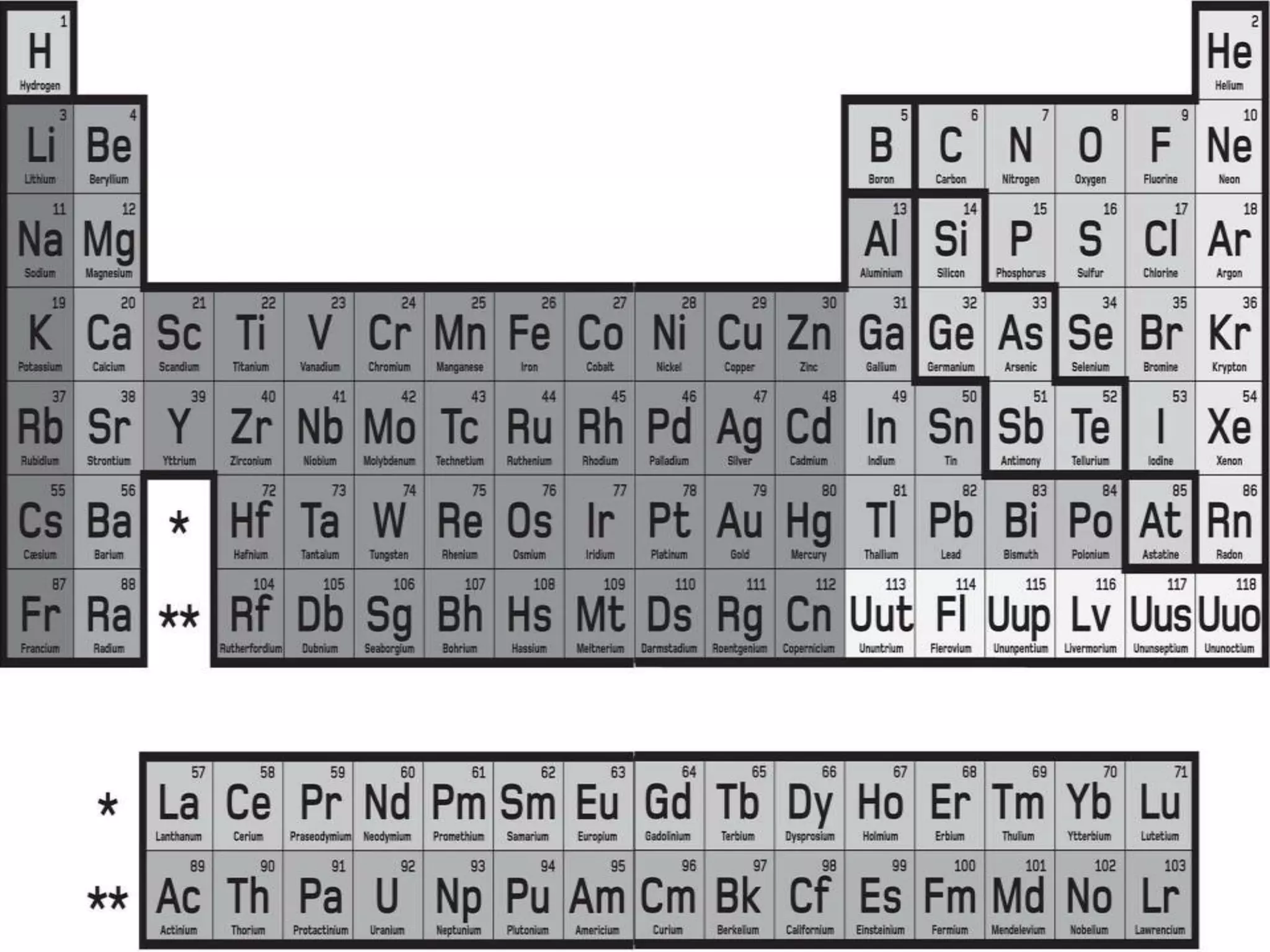
Patterns in the periodic table
 Originally laid out using shared chemical behaviour as an
organizing principle, the periodic table gives rise to
‘chemical families’ of related elements. Metals account for
over 75 per cent of elements, falling into alkali, alkaline
earth, transition, lanthanoid, actinoid and – with less
strongly metallic characteristics – post-transition metals .
A thin strip of metalloids separate the metals from the
non-metals, while the noble gases run down the extreme
right-hand side of the table.
 More than a simple spreadsheet for the elements, the
periodic table is a philosophical construct, which has
been robust enough to incorporate later discoveries of
atomic number, electron configuration and isotopes .Each
entry represents a set of isotopes, a kind of ‘median’ that
Dmitri Mendeleev called the ‘real element’. The table is a
map to the building blocks of matter, revealing at a glance
an element’s make-up, behaviour and the direction in
which properties change.
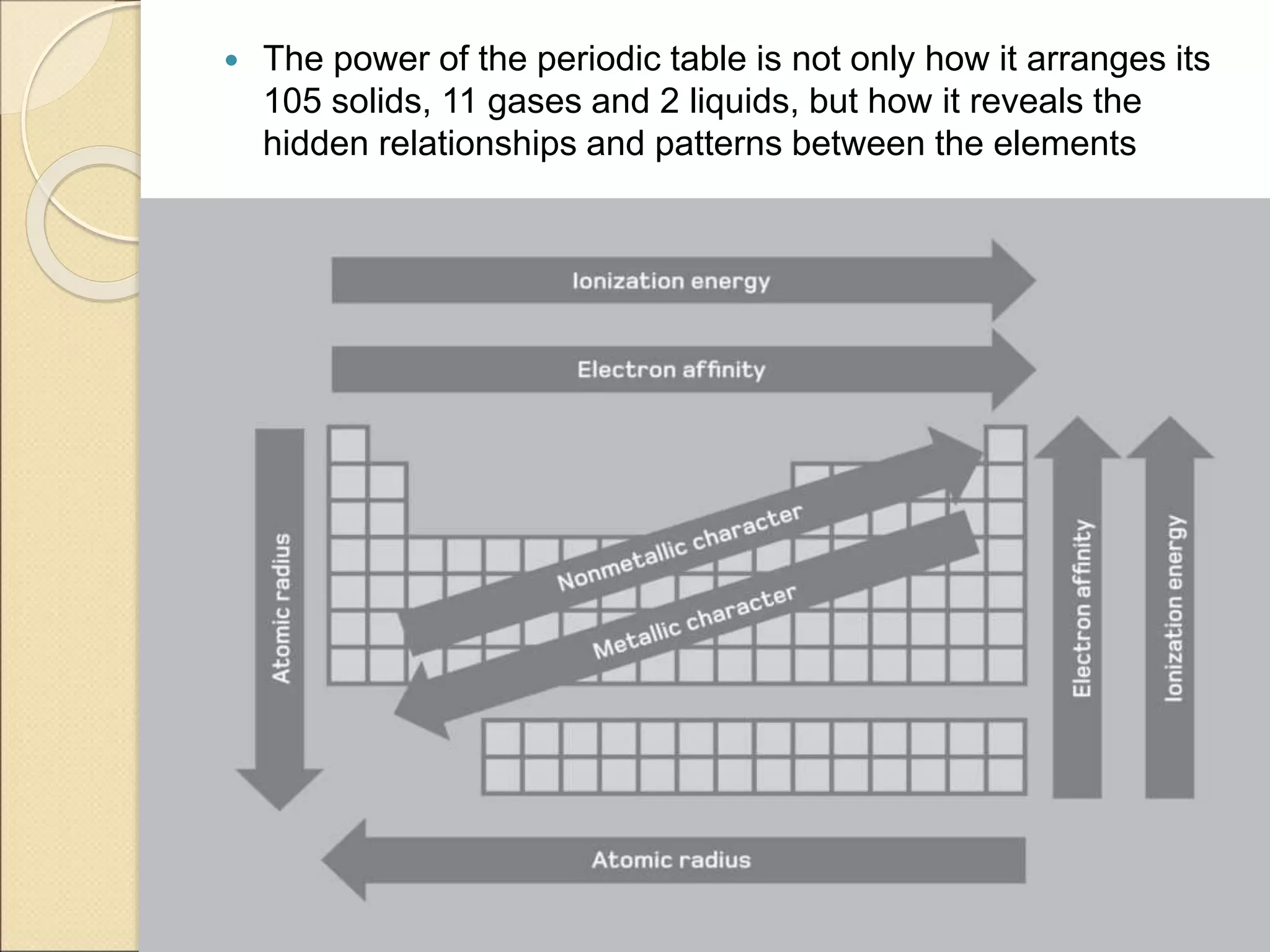
 The power of the periodic table is not only how it arranges its
105 solids, 11 gases and 2 liquids, but how it reveals the
hidden relationships and patterns between the elements
Groups and periods
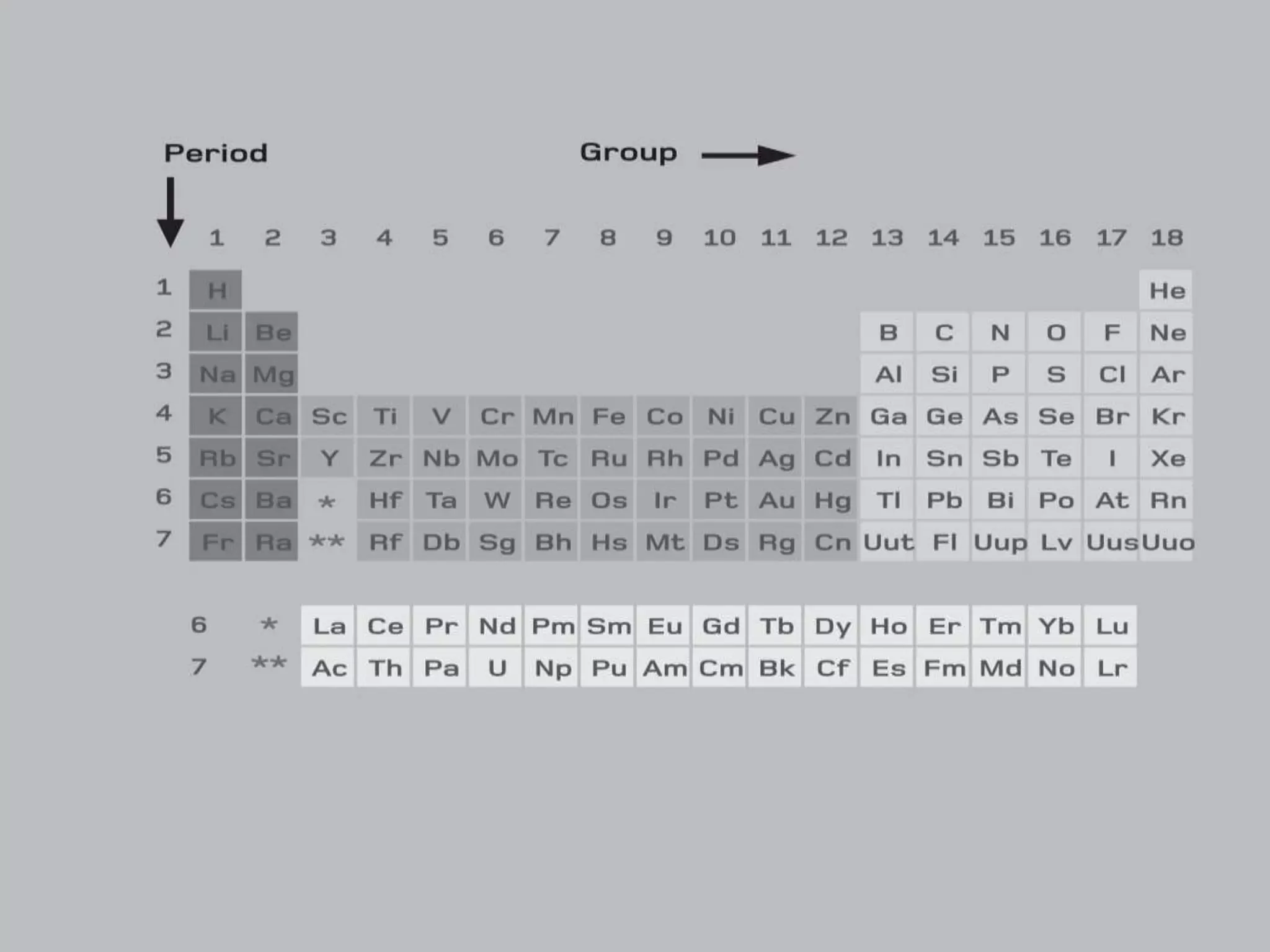
 The periodic table is laid out with groups forming vertical
columns, and periods in horizontal rows. Schoolchildren are
commonly taught that the main body elements – those in
groups headed by lithium, beryllium, boron, carbon,
nitrogen, oxygen, fluorine and helium – are numbered
groups 1–8. However, this system gets messy when it’s
necessary to talk about the 10 columns of transition
elements lying between groups 2 and 3. IUPAC – the
International Union of Pure and Applied Chemistry –
endorses a 1–18 nomenclature to avoid complication. The
lanthanoid and actinoid series fall between groups 2 and 3.
Periodic table rows run from period 1, with only 2 elements,
through to period 7, with 32 elements. Atomic number
increases along a period, in increments of one – equivalent
to adding a proton to the atomic nucleus each time. The
different number of elements in each period corresponds to
the maximum number of electrons held by each successive
energy level. Elements in a group have identical valence
shell electron configurations.
Blocks
 As well as its groups and periods, the periodic table has a
‘hidden feature’, with elements falling into zones called
blocks. Corresponding to the broad groupings of ‘types’ –
alkali and alkaline earth metals, transition metals and non-
metals – these regions have a deeper underlying
significance, based on the electron configuration of the
elements they contain.
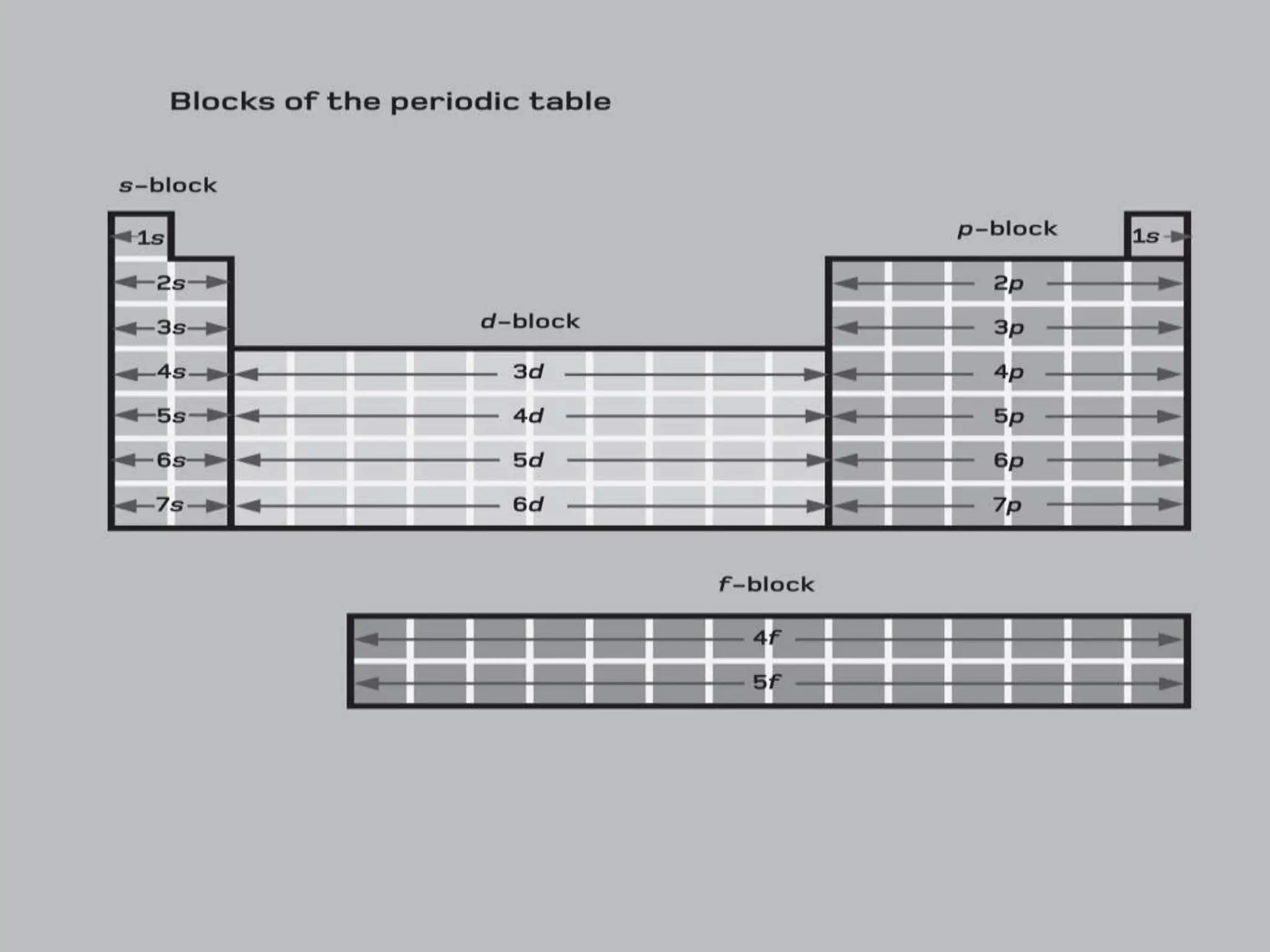
 The blocks are named after the orbital in which the
highest-energy electron resides. There are four in all: the
s-block (groups 1 and 2) have their outermost electrons in
s-orbitals; the p-block (groups 13–18) have their valence
electrons in the p-orbitals; d-orbital electrons define the d-
block (groups 3–12); and the f-block elements are the
lanthanoid and actinoid series with electrons occupying f-
orbitals. Helium is an anomaly: it has both its valence
electrons in the s-orbital (a full first shell), but sits with the
p-block elements of group 18. The position of the blocks
reflects the order in which electron orbitals fill up .
Properties of the periodic
table
Atomic size
 Finding the size of an atom is not as simple as putting it
under a powerful microscope and measuring it. For a
start, atoms exist in compounds. They shrink or swell
depending on how they interact with other atoms –
whether they are covalently bonded, exist as an ion or
form part of a metallic lattice.
 Generally, half the bond length is used as a measure of
atomic radius, but since covalently bonded atoms
overlap their electron clouds, ‘covalent radius’ comes up
smaller than ‘metallic radius’, and there is no way of
directly comparing the relative sizes of non-metal and
metal elements.
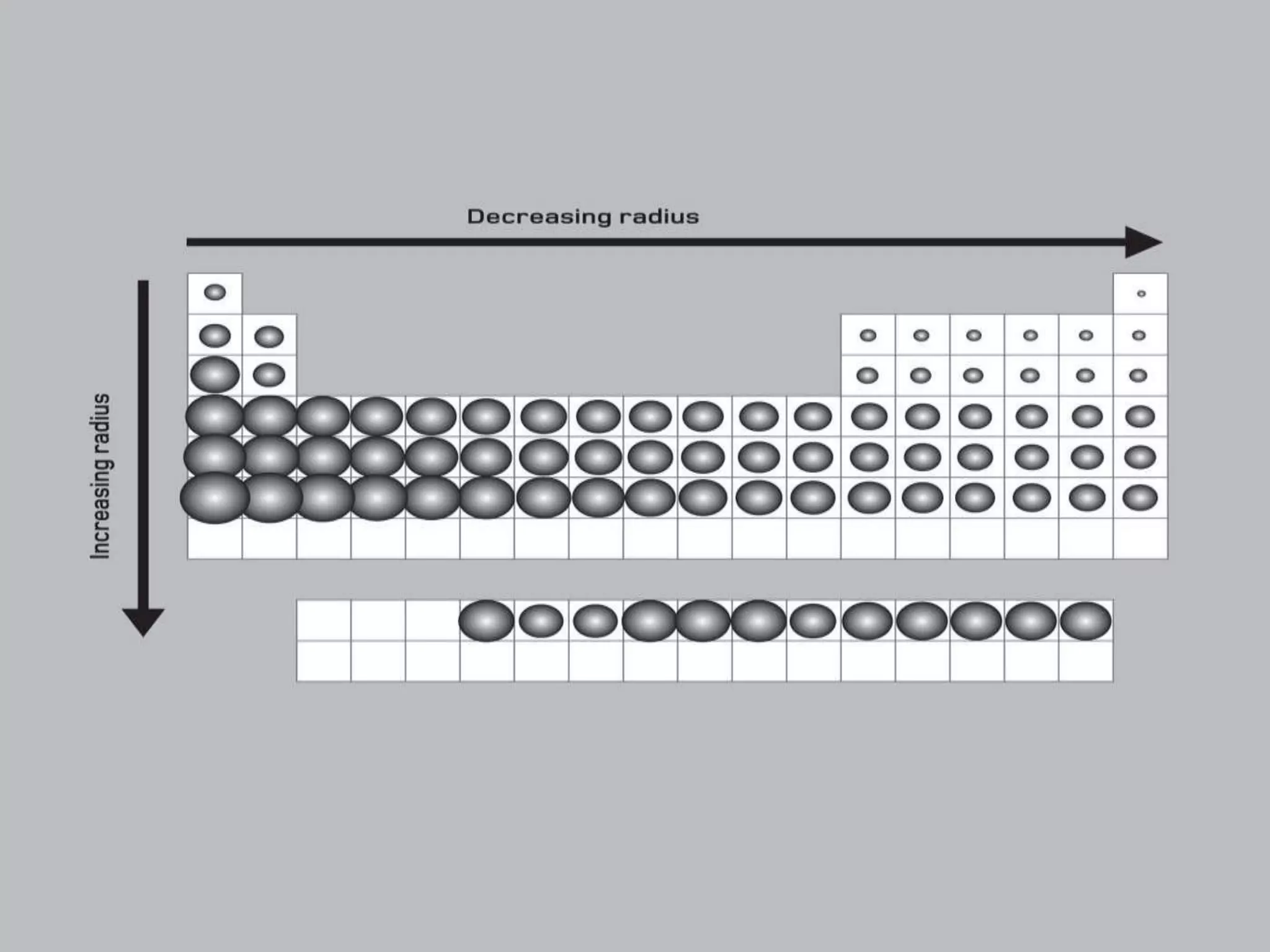
 Despite these technical difficulties, two things are clear:
the size of atoms increases down a group and decreases
along a period. The first trend is caused by the additional
electron shells of heavier elements, but electron
shielding, in which electrons in inner shells ‘block’ the
electrostatic attraction outer electrons feel toward the
nucleus, also plays a part. Along periods, electrons are
added to the same valence shell. The shielding effect is
negligible, so the extra proton in the nucleus draws the
Melting and boiling points
 Melting points and boiling points are the temperatures at
which substances change state – from solid to liquid, and
liquid to gas respectively (see here). They can both be
regarded as a measure of the energy of bonds holding a
substance together, which must be overcome in order for a
phase change to take place. For elements whose atoms
form ionic and metallic bonds, melting and boiling points are
high: their solids have strong electrostatic forces acting in all
directions, and the attractive forces between individual
atoms in liquids also tend to be strong.
 Covalently bonded substances with weak intermolecular
forces, by contrast, need little encouragement to turn into
liquids. Helium, a diatomic gas with negligible attraction
between molecules, has the lowest melting point of all the
elements, close to absolute zero. But beware of applying
this rule universally – the element with the highest melting
point of all, carbon in its diamond form, is also covalently
bonded. Breaking diamond’s strongly bonded crystal lattice
requires a temperature of 3,642°C (6,588°F), at which point
it sublimates, turning directly from solid to gas.
Electronegativity
 Electronegativity describes an element’s affinity for
electrons – its ‘graspiness’, or how easily it acquires
electrons and binds with them. This is often described in
terms of an ‘ability’ or ‘willingness’: although of course
atoms have no agency, they are routinely thought to
‘want’ to achieve a full electron shell. In reality, of course,
this is no more than energetics driving events: if a
particular electron configuration is more stable, then a
system will naturally ‘settle’ into it.
 Because the metal elements on the left side of the
periodic table have valence shells that are less than half
full, it takes more energy for them to gain a full shell than
it does to lose electrons and achieve stability that way.
Therefore, these elements tend to lose electrons while
those on the right side gain electrons. From left to right
across periods, electronegativity increases, while it
decreases down groups. The most electronegative
element, therefore, is fluorine near the top-right corner.
With full valence shells, the noble gases have no
electronegativity values.
Ionization energy
 Ionization energy is the energy required to remove a
single electron from an isolated atom in its gaseous state
– the energy needed to created a cation with a positive
charge of +1. Unlike electronegativity, which cannot be
directly measured, the energy of first ionization is
relatively simple to determine by experiment. The two
concepts are different, but linked: the lower the ionization
energy, the more easily an atom will form a cation; the
higher the electronegativity, the more easily it will form an
anion.
 On the periodic table, ionization energy increases with
atomic number along a period, as a result of the
increasing valence shell stability. Down each group it
decreases, largely because electrons in inner shells
‘shield’ valence electrons, reducing their attraction to the
protons in the nucleus. These trends mirror
electronegativity, but while noble metals have no value for
electron affinity, they have very large ionization energies.
This spike is due to the stability of a full valence shell.
Metallic character
 Metals are elements whose atoms form metallic bonds,
giving the bulk material the expected attributes of a
metal, such as flexibility, workability and good conduction
of heat and electricity. Despite the impression given by
the periodic table, the line between metal and non-metal
is not that clear; although the elements appear to be
neatly sorted with metals facing non-metals like armies
ranged against each other, the reality is more a grading
of metal into non-metal.
 From left to right along any period, metallic character
tails off, but there is no sharp divide. The metals to the
right of the d-block – sometimes called ‘poor metals’ –
have only weak metallic character, while metalloids
indulge in a variety of chemical bonding. Down a group,
metallic nature increases, a pattern predicted by trends
in ionization energy and electronegativity. As ionization
energy decreases, so the tendency to form a positively
charged cation increases: this explains the change from
non-metal to metal in groups 13–15.
The End

Properties of the periodic table 2003.ppt

  • 1.
  • 2.
    Presented to youfrom :- Ibrahem Salama Saber Mostafa Mohammed Kotb Youssef Mohammed Ezzat Mostafa Gamal Ahmed Sayed Ahmed Mohammed Alsayed Ahmed Khaled
  • 4.
    Development of theperiodic table  The question of whether there is an organizing principle behind matter in our world is an age old one. Greek philosophers, convinced that only logic and deduction could provide an insight into the harmony of the universe, attempted to analyze such things using reason alone. Meanwhile, a cadre of metallurgists, smiths, miners and alchemists learned about the behaviour of matter and, honing chemical techniques, began to build a list of ‘pure’, simple substances.  The success of classification systems in the 18th century, such as Linnaean taxonomy of the natural world, highlighted the need for a ‘natural system of elements’. But the project to organize the chemical elements by type was frustrated by inaccuracies in measurement of atomic weights, and confusion between elements and compounds. Dmitri Mendeleev’s 1869 periodic table swept away these inconsistencies, revealing hidden patterns (and some missing elements), and even prefiguring 20th-century discoveries of atomic structure.
  • 5.
    Mendeleev’s table  Mendeleev’speriodic table at last brought order to the growing list of chemical elements. By organizing them into groups with shared chemical properties, he arrived at its unconventional pattern of short rows at the top and longer rows lower down. This matched exactly with the periodic trends (repeating patterns in physical properties) plotted by German chemist Lothar Meyer (1830–95), who independently developed a periodic law of chemical elements but published a year later. Where Newlands shoehorned elements into place to fit his scheme), Mendeleev had the courage to leave blank spaces for as- yet-undiscovered elements. He even ventured to claim that certain accepted atomic weights were incorrect. The predictions of new elements with their weights, and their subsequent discoveries – eka-aluminium (gallium) in 1875; eka-boron (scandium) in 1879; and eka-silicon (germanium) in 1886 – caused a sensation. The periodic law was a genuine new discovery about the nature of matter, not the mere invention of a new way to organize elements.
  • 7.
     The worldgot its first sight of the periodic table in 1869, in the German periodical Zeitschrift für Chemie. One of Mendeleev’s most important insights was that atomic weight determines the character of a chemical element.
  • 8.
    Patterns in theperiodic table  Originally laid out using shared chemical behaviour as an organizing principle, the periodic table gives rise to ‘chemical families’ of related elements. Metals account for over 75 per cent of elements, falling into alkali, alkaline earth, transition, lanthanoid, actinoid and – with less strongly metallic characteristics – post-transition metals . A thin strip of metalloids separate the metals from the non-metals, while the noble gases run down the extreme right-hand side of the table.  More than a simple spreadsheet for the elements, the periodic table is a philosophical construct, which has been robust enough to incorporate later discoveries of atomic number, electron configuration and isotopes .Each entry represents a set of isotopes, a kind of ‘median’ that Dmitri Mendeleev called the ‘real element’. The table is a map to the building blocks of matter, revealing at a glance an element’s make-up, behaviour and the direction in which properties change.
  • 9.
     The powerof the periodic table is not only how it arranges its 105 solids, 11 gases and 2 liquids, but how it reveals the hidden relationships and patterns between the elements
  • 10.
    Groups and periods The periodic table is laid out with groups forming vertical columns, and periods in horizontal rows. Schoolchildren are commonly taught that the main body elements – those in groups headed by lithium, beryllium, boron, carbon, nitrogen, oxygen, fluorine and helium – are numbered groups 1–8. However, this system gets messy when it’s necessary to talk about the 10 columns of transition elements lying between groups 2 and 3. IUPAC – the International Union of Pure and Applied Chemistry – endorses a 1–18 nomenclature to avoid complication. The lanthanoid and actinoid series fall between groups 2 and 3. Periodic table rows run from period 1, with only 2 elements, through to period 7, with 32 elements. Atomic number increases along a period, in increments of one – equivalent to adding a proton to the atomic nucleus each time. The different number of elements in each period corresponds to the maximum number of electrons held by each successive energy level. Elements in a group have identical valence shell electron configurations.
  • 12.
    Blocks  As wellas its groups and periods, the periodic table has a ‘hidden feature’, with elements falling into zones called blocks. Corresponding to the broad groupings of ‘types’ – alkali and alkaline earth metals, transition metals and non- metals – these regions have a deeper underlying significance, based on the electron configuration of the elements they contain.  The blocks are named after the orbital in which the highest-energy electron resides. There are four in all: the s-block (groups 1 and 2) have their outermost electrons in s-orbitals; the p-block (groups 13–18) have their valence electrons in the p-orbitals; d-orbital electrons define the d- block (groups 3–12); and the f-block elements are the lanthanoid and actinoid series with electrons occupying f- orbitals. Helium is an anomaly: it has both its valence electrons in the s-orbital (a full first shell), but sits with the p-block elements of group 18. The position of the blocks reflects the order in which electron orbitals fill up .
  • 14.
    Properties of theperiodic table
  • 15.
    Atomic size  Findingthe size of an atom is not as simple as putting it under a powerful microscope and measuring it. For a start, atoms exist in compounds. They shrink or swell depending on how they interact with other atoms – whether they are covalently bonded, exist as an ion or form part of a metallic lattice.  Generally, half the bond length is used as a measure of atomic radius, but since covalently bonded atoms overlap their electron clouds, ‘covalent radius’ comes up smaller than ‘metallic radius’, and there is no way of directly comparing the relative sizes of non-metal and metal elements.  Despite these technical difficulties, two things are clear: the size of atoms increases down a group and decreases along a period. The first trend is caused by the additional electron shells of heavier elements, but electron shielding, in which electrons in inner shells ‘block’ the electrostatic attraction outer electrons feel toward the nucleus, also plays a part. Along periods, electrons are added to the same valence shell. The shielding effect is negligible, so the extra proton in the nucleus draws the
  • 17.
    Melting and boilingpoints  Melting points and boiling points are the temperatures at which substances change state – from solid to liquid, and liquid to gas respectively (see here). They can both be regarded as a measure of the energy of bonds holding a substance together, which must be overcome in order for a phase change to take place. For elements whose atoms form ionic and metallic bonds, melting and boiling points are high: their solids have strong electrostatic forces acting in all directions, and the attractive forces between individual atoms in liquids also tend to be strong.  Covalently bonded substances with weak intermolecular forces, by contrast, need little encouragement to turn into liquids. Helium, a diatomic gas with negligible attraction between molecules, has the lowest melting point of all the elements, close to absolute zero. But beware of applying this rule universally – the element with the highest melting point of all, carbon in its diamond form, is also covalently bonded. Breaking diamond’s strongly bonded crystal lattice requires a temperature of 3,642°C (6,588°F), at which point it sublimates, turning directly from solid to gas.
  • 18.
    Electronegativity  Electronegativity describesan element’s affinity for electrons – its ‘graspiness’, or how easily it acquires electrons and binds with them. This is often described in terms of an ‘ability’ or ‘willingness’: although of course atoms have no agency, they are routinely thought to ‘want’ to achieve a full electron shell. In reality, of course, this is no more than energetics driving events: if a particular electron configuration is more stable, then a system will naturally ‘settle’ into it.  Because the metal elements on the left side of the periodic table have valence shells that are less than half full, it takes more energy for them to gain a full shell than it does to lose electrons and achieve stability that way. Therefore, these elements tend to lose electrons while those on the right side gain electrons. From left to right across periods, electronegativity increases, while it decreases down groups. The most electronegative element, therefore, is fluorine near the top-right corner. With full valence shells, the noble gases have no electronegativity values.
  • 20.
    Ionization energy  Ionizationenergy is the energy required to remove a single electron from an isolated atom in its gaseous state – the energy needed to created a cation with a positive charge of +1. Unlike electronegativity, which cannot be directly measured, the energy of first ionization is relatively simple to determine by experiment. The two concepts are different, but linked: the lower the ionization energy, the more easily an atom will form a cation; the higher the electronegativity, the more easily it will form an anion.  On the periodic table, ionization energy increases with atomic number along a period, as a result of the increasing valence shell stability. Down each group it decreases, largely because electrons in inner shells ‘shield’ valence electrons, reducing their attraction to the protons in the nucleus. These trends mirror electronegativity, but while noble metals have no value for electron affinity, they have very large ionization energies. This spike is due to the stability of a full valence shell.
  • 22.
    Metallic character  Metalsare elements whose atoms form metallic bonds, giving the bulk material the expected attributes of a metal, such as flexibility, workability and good conduction of heat and electricity. Despite the impression given by the periodic table, the line between metal and non-metal is not that clear; although the elements appear to be neatly sorted with metals facing non-metals like armies ranged against each other, the reality is more a grading of metal into non-metal.  From left to right along any period, metallic character tails off, but there is no sharp divide. The metals to the right of the d-block – sometimes called ‘poor metals’ – have only weak metallic character, while metalloids indulge in a variety of chemical bonding. Down a group, metallic nature increases, a pattern predicted by trends in ionization energy and electronegativity. As ionization energy decreases, so the tendency to form a positively charged cation increases: this explains the change from non-metal to metal in groups 13–15.
  • 23.