NEO-CLASSICAL
Architecture
NEOCLASSICAL ARCHITECTURE
 Architectural Style produced by the neoclassical
movement
 Lasted 1850-1900.
 Reaction against the Rococo style of naturalistic
ornament
 In its purest form it is a style principally derived
from the architecture of Classical
Greece and Rome and the
 Architecture of the Italian architect Andrea
Palladio.
 International movement-Neoclassical ideas in
architecture spread quickly throughout Europe.
 Emphasize its planar qualities, rather than
sculptural volumes.
 Projections and recessions and their effects
of light and shade are more flat; sculptural bas-
reliefs are flatter and tend to be enframed in
friezes, tablets or panels.
 In form, Neoclassical architecture emphasizes the
wall rather than chiaroscuro and maintains
separate identities to each of its parts.
 Clearly articulated individual features – isolated.
CHARACTERISTICS
 Neoclassicism in architecture is evocative
and picturesque, a recreation of a distant,
lost world framed within the Romantic
sensibility.
 Neoclassicism was symptomatic of a desire
to return to the perceived "purity" of the
arts of Rome
 Palladian style-influenced architecture is
classified as Neoclassical.
The Style..
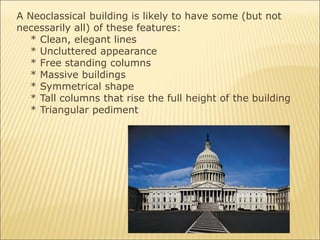
A Neoclassical building is likely to have some (but not
necessarily all) of these features:
* Clean, elegant lines
* Uncluttered appearance
* Free standing columns
* Massive buildings
* Symmetrical shape
* Tall columns that rise the full height of the building
* Triangular pediment
 The ideal form that Neoclassical architecture looks at was the
temple.Which was represented classical architecture in its purest
form.
 Columns were used to carry the weight of the building's
structure. But later they became used as a graphical element.
 Roof is usually flat and horizontal and often is visible from the
ground.
 Neoclassical architecture style had no domes or towers.
 Building's facade is flat and long. Often having a screen of free-
standing columns.
 Exterior was built in such ways as to represent classical perfection.
Doors and windows were built to represent that perfection.
Decorations were reduced to a minimum on outside.
 There were often gardens around buildings completed in
geometric patterns.
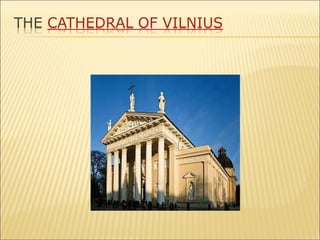
THE CATHEDRAL OF VILNIUS
GEORGIAN STYLE
 In Europe, the first phase of Neoclassicism was
influenced by the books of the Italian Renaissance
architect Andrea Palladio (1508-80).
 In the second half of the 18th century Robert
Adam (1760-1792) first popularized a simpler, purer
Neoclassical style based on excavations in Herculaneum
and Pompeii.
 Both Palladian and Adam variations of Neoclassicism are
also referred to in terms of the reigning monarch (1760-
1820) as George III, or simply Georgian.
NEOCLASSICISM IN THE US
 In the U.S., Neoclassicism (both earlier Palladian and
later Adamesque) is referred to as "Colonial" (until the
Revolutionary War), and then "Federal" (after the
Revolutionary War).
 The first example of Georgian style in America was
the Wren Building (begun in 1695) at the College of
William and Mary, and soon after that the Governor's
Palace and the Capitol in Williamsburg, Virginia.
 Another excellent example of the style near Charleston,
S. C., is Drayton Hall (1738-42).
 "Federal" style is Adamesque.
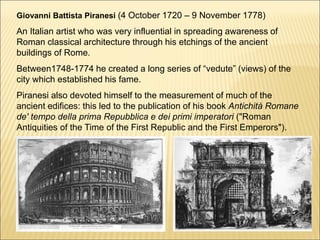
Giovanni Battista Piranesi (4 October 1720 – 9 November 1778)
An Italian artist who was very influential in spreading awareness of
Roman classical architecture through his etchings of the ancient
buildings of Rome.
Between1748-1774 he created a long series of “vedute” (views) of the
city which established his fame.
Piranesi also devoted himself to the measurement of much of the
ancient edifices: this led to the publication of his book Antichità Romane
de' tempo della prima Repubblica e dei primi imperatori ("Roman
Antiquities of the Time of the First Republic and the First Emperors").
 Italian Renaissance architect.
 Palladio's work is indebted the Roman
architect Vitruvius (The Ten Books on
Architecture) and Leon Battista
Alberti ( De Re Aedificatoria).
 He published the first scholarly guide
book to classical Rome in 1554. He built
churches, town and country houses,
public buildings and bridges in Venice
and on the Venetian mainland.
Andrea Palladio, 1508-1580
•Often described as the most influential and
most copied architect in the Western world.
•Inspiration from classical architecture-
proportioned, pedimented buildings that
became models for stately homes and
government buildings in Europe and America.
•Palladio's Four Books of Architecture was
widely translated, and spread across Europe
and the New World.
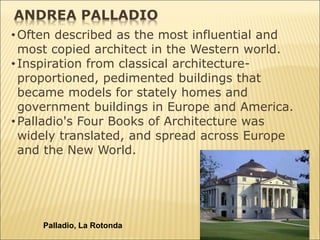
Palladio, La Rotonda
ANDREA PALLADIO
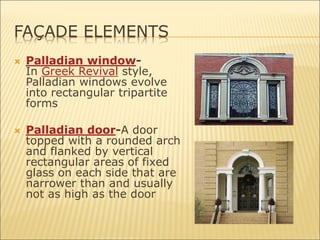
FAÇADE ELEMENTS
 Palladian window-
In Greek Revival style,
Palladian windows evolve
into rectangular tripartite
forms
 Palladian door-A door
topped with a rounded arch
and flanked by vertical
rectangular areas of fixed
glass on each side that are
narrower than and usually
not as high as the door
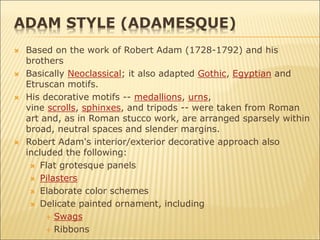
ADAM STYLE (ADAMESQUE)
 Based on the work of Robert Adam (1728-1792) and his
brothers
 Basically Neoclassical; it also adapted Gothic, Egyptian and
Etruscan motifs.
 His decorative motifs -- medallions, urns,
vine scrolls, sphinxes, and tripods -- were taken from Roman
art and, as in Roman stucco work, are arranged sparsely within
broad, neutral spaces and slender margins.
 Robert Adam's interior/exterior decorative approach also
included the following:
 Flat grotesque panels
 Pilasters
 Elaborate color schemes
 Delicate painted ornament, including
 Swags
 Ribbons
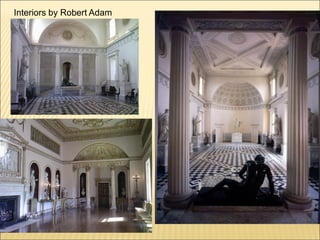
Interiors by Robert Adam
ADAMESQUE
 The style was predominant in England in the late
18th C. and strongly influential in the U.S.A., Russia.
and elsewhere.
 Palladio studied Roman ruins; In the 18th century,
Robert Adam would study excavations at Pompeii
and Herculaneum and be more influential than
Palladio in the development of
English Neoclassicism and American Federal style.
 It was enthusiastically embraced by Americans, who
then adapted it to suit their own tastes and
circumstances
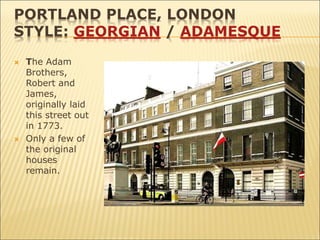
PORTLAND PLACE, LONDON
STYLE: GEORGIAN / ADAMESQUE
 The Adam
Brothers,
Robert and
James,
originally laid
this street out
in 1773.
 Only a few of
the original
houses
remain.
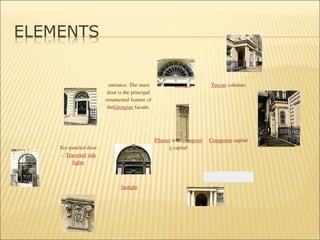
ELEMENTS
entrance. The main
door is the principal
ornamental feature of
theGeorgian facade.
#43 fanlight Tuscan columns
Six-paneled door
... Traceried side
lights
Pilaster withComposit
e capital
Composite capital
fanlight
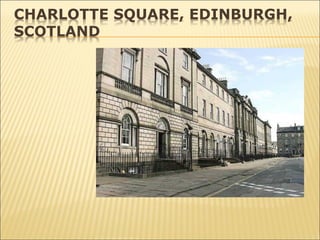
CHARLOTTE SQUARE, EDINBURGH,
SCOTLAND
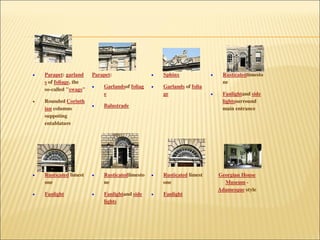
 Parapet: garland
s of foliage, the
so-called "swags"
 Rounded Corinth
ian columns
suppoting
entablature
Parapet:
 Garlandsof foliag
e
 Balustrade
 Sphinx
 Garlands of folia
ge
 Rusticatedlimesto
ne
 Fanlightand side
lightssurround
main entrance
 Rusticated limest
one
 Fanlight
 Rusticatedlimesto
ne
 Fanlightand side
lights
 Rusticated limest
one
 Fanlight
Georgian House
Museum -
Adamesque style
NEOCLASSICAL- AMERICA-FEDERAL
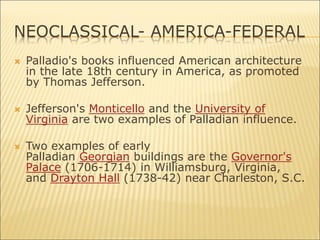
 Palladio's books influenced American architecture
in the late 18th century in America, as promoted
by Thomas Jefferson.
 Jefferson's Monticello and the University of
Virginia are two examples of Palladian influence.
 Two examples of early
Palladian Georgian buildings are the Governor's
Palace (1706-1714) in Williamsburg, Virginia,
and Drayton Hall (1738-42) near Charleston, S.C.
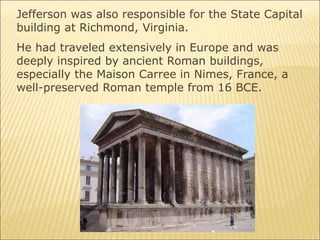
Jefferson was also responsible for the State Capital
building at Richmond, Virginia.
He had traveled extensively in Europe and was
deeply inspired by ancient Roman buildings,
especially the Maison Carree in Nimes, France, a
well-preserved Roman temple from 16 BCE.
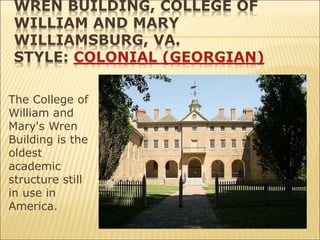
WREN BUILDING, COLLEGE OF
WILLIAM AND MARY
WILLIAMSBURG, VA.
STYLE: COLONIAL (GEORGIAN)
The College of
William and
Mary's Wren
Building is the
oldest
academic
structure still
in use in
America.
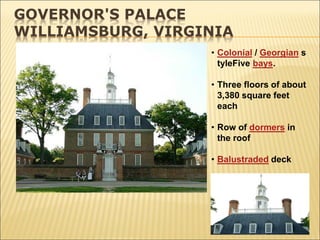
GOVERNOR'S PALACE
WILLIAMSBURG, VIRGINIA
• Colonial / Georgian s
tyleFive bays.
• Three floors of about
3,380 square feet
each
• Row of dormers in
the roof
• Balustraded deck
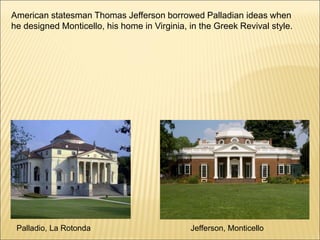
American statesman Thomas Jefferson borrowed Palladian ideas when
he designed Monticello, his home in Virginia, in the Greek Revival style.
Palladio, La Rotonda Jefferson, Monticello
END

Neo classical architecture

  • 1.
  • 2.
    NEOCLASSICAL ARCHITECTURE  ArchitecturalStyle produced by the neoclassical movement  Lasted 1850-1900.  Reaction against the Rococo style of naturalistic ornament  In its purest form it is a style principally derived from the architecture of Classical Greece and Rome and the  Architecture of the Italian architect Andrea Palladio.
  • 3.
     International movement-Neoclassicalideas in architecture spread quickly throughout Europe.  Emphasize its planar qualities, rather than sculptural volumes.  Projections and recessions and their effects of light and shade are more flat; sculptural bas- reliefs are flatter and tend to be enframed in friezes, tablets or panels.  In form, Neoclassical architecture emphasizes the wall rather than chiaroscuro and maintains separate identities to each of its parts.  Clearly articulated individual features – isolated. CHARACTERISTICS
  • 4.
     Neoclassicism inarchitecture is evocative and picturesque, a recreation of a distant, lost world framed within the Romantic sensibility.  Neoclassicism was symptomatic of a desire to return to the perceived "purity" of the arts of Rome  Palladian style-influenced architecture is classified as Neoclassical. The Style..
  • 5.
    A Neoclassical buildingis likely to have some (but not necessarily all) of these features: * Clean, elegant lines * Uncluttered appearance * Free standing columns * Massive buildings * Symmetrical shape * Tall columns that rise the full height of the building * Triangular pediment
  • 6.
     The idealform that Neoclassical architecture looks at was the temple.Which was represented classical architecture in its purest form.  Columns were used to carry the weight of the building's structure. But later they became used as a graphical element.  Roof is usually flat and horizontal and often is visible from the ground.  Neoclassical architecture style had no domes or towers.  Building's facade is flat and long. Often having a screen of free- standing columns.  Exterior was built in such ways as to represent classical perfection. Doors and windows were built to represent that perfection. Decorations were reduced to a minimum on outside.  There were often gardens around buildings completed in geometric patterns.
  • 7.
  • 8.
    GEORGIAN STYLE  InEurope, the first phase of Neoclassicism was influenced by the books of the Italian Renaissance architect Andrea Palladio (1508-80).  In the second half of the 18th century Robert Adam (1760-1792) first popularized a simpler, purer Neoclassical style based on excavations in Herculaneum and Pompeii.  Both Palladian and Adam variations of Neoclassicism are also referred to in terms of the reigning monarch (1760- 1820) as George III, or simply Georgian.
  • 9.
    NEOCLASSICISM IN THEUS  In the U.S., Neoclassicism (both earlier Palladian and later Adamesque) is referred to as "Colonial" (until the Revolutionary War), and then "Federal" (after the Revolutionary War).  The first example of Georgian style in America was the Wren Building (begun in 1695) at the College of William and Mary, and soon after that the Governor's Palace and the Capitol in Williamsburg, Virginia.  Another excellent example of the style near Charleston, S. C., is Drayton Hall (1738-42).  "Federal" style is Adamesque.
  • 10.
    Giovanni Battista Piranesi(4 October 1720 – 9 November 1778) An Italian artist who was very influential in spreading awareness of Roman classical architecture through his etchings of the ancient buildings of Rome. Between1748-1774 he created a long series of “vedute” (views) of the city which established his fame. Piranesi also devoted himself to the measurement of much of the ancient edifices: this led to the publication of his book Antichità Romane de' tempo della prima Repubblica e dei primi imperatori ("Roman Antiquities of the Time of the First Republic and the First Emperors").
  • 11.
     Italian Renaissancearchitect.  Palladio's work is indebted the Roman architect Vitruvius (The Ten Books on Architecture) and Leon Battista Alberti ( De Re Aedificatoria).  He published the first scholarly guide book to classical Rome in 1554. He built churches, town and country houses, public buildings and bridges in Venice and on the Venetian mainland. Andrea Palladio, 1508-1580
  • 12.
    •Often described asthe most influential and most copied architect in the Western world. •Inspiration from classical architecture- proportioned, pedimented buildings that became models for stately homes and government buildings in Europe and America. •Palladio's Four Books of Architecture was widely translated, and spread across Europe and the New World. Palladio, La Rotonda ANDREA PALLADIO
  • 13.
    FAÇADE ELEMENTS  Palladianwindow- In Greek Revival style, Palladian windows evolve into rectangular tripartite forms  Palladian door-A door topped with a rounded arch and flanked by vertical rectangular areas of fixed glass on each side that are narrower than and usually not as high as the door
  • 14.
    ADAM STYLE (ADAMESQUE) Based on the work of Robert Adam (1728-1792) and his brothers  Basically Neoclassical; it also adapted Gothic, Egyptian and Etruscan motifs.  His decorative motifs -- medallions, urns, vine scrolls, sphinxes, and tripods -- were taken from Roman art and, as in Roman stucco work, are arranged sparsely within broad, neutral spaces and slender margins.  Robert Adam's interior/exterior decorative approach also included the following:  Flat grotesque panels  Pilasters  Elaborate color schemes  Delicate painted ornament, including  Swags  Ribbons
  • 15.
  • 16.
    ADAMESQUE  The stylewas predominant in England in the late 18th C. and strongly influential in the U.S.A., Russia. and elsewhere.  Palladio studied Roman ruins; In the 18th century, Robert Adam would study excavations at Pompeii and Herculaneum and be more influential than Palladio in the development of English Neoclassicism and American Federal style.  It was enthusiastically embraced by Americans, who then adapted it to suit their own tastes and circumstances
  • 17.
    PORTLAND PLACE, LONDON STYLE:GEORGIAN / ADAMESQUE  The Adam Brothers, Robert and James, originally laid this street out in 1773.  Only a few of the original houses remain.
  • 18.
    ELEMENTS entrance. The main dooris the principal ornamental feature of theGeorgian facade. #43 fanlight Tuscan columns Six-paneled door ... Traceried side lights Pilaster withComposit e capital Composite capital fanlight
  • 19.
  • 20.
     Parapet: garland sof foliage, the so-called "swags"  Rounded Corinth ian columns suppoting entablature Parapet:  Garlandsof foliag e  Balustrade  Sphinx  Garlands of folia ge  Rusticatedlimesto ne  Fanlightand side lightssurround main entrance  Rusticated limest one  Fanlight  Rusticatedlimesto ne  Fanlightand side lights  Rusticated limest one  Fanlight Georgian House Museum - Adamesque style
  • 21.
    NEOCLASSICAL- AMERICA-FEDERAL  Palladio'sbooks influenced American architecture in the late 18th century in America, as promoted by Thomas Jefferson.  Jefferson's Monticello and the University of Virginia are two examples of Palladian influence.  Two examples of early Palladian Georgian buildings are the Governor's Palace (1706-1714) in Williamsburg, Virginia, and Drayton Hall (1738-42) near Charleston, S.C.
  • 22.
    Jefferson was alsoresponsible for the State Capital building at Richmond, Virginia. He had traveled extensively in Europe and was deeply inspired by ancient Roman buildings, especially the Maison Carree in Nimes, France, a well-preserved Roman temple from 16 BCE.
  • 23.
    WREN BUILDING, COLLEGEOF WILLIAM AND MARY WILLIAMSBURG, VA. STYLE: COLONIAL (GEORGIAN) The College of William and Mary's Wren Building is the oldest academic structure still in use in America.
  • 24.
    GOVERNOR'S PALACE WILLIAMSBURG, VIRGINIA •Colonial / Georgian s tyleFive bays. • Three floors of about 3,380 square feet each • Row of dormers in the roof • Balustraded deck
  • 25.
    American statesman ThomasJefferson borrowed Palladian ideas when he designed Monticello, his home in Virginia, in the Greek Revival style. Palladio, La Rotonda Jefferson, Monticello
  • 26.