THE MATHEMATICS OF
RSA ENCRYPTION
Casco Bay .NET User Group
Nov. 2016
Goals
 Make encryption less mysterious
Outline
 What is RSA Encryption?
 Math Refresher
 How does it work?
 Math Deep Dive
 Where do keys come from?
 Why does it work?
 Why is it secure?
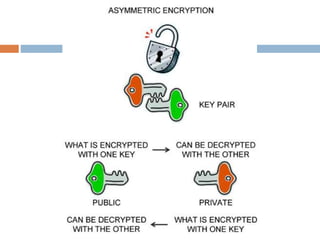
What is RSA Encryption?
 Public Key Cryptography Scheme
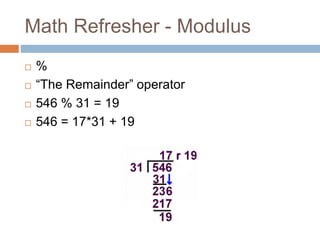
Math Refresher - Modulus
 %
 “The Remainder” operator
 546 % 31 = 19
 546 = 17*31 + 19
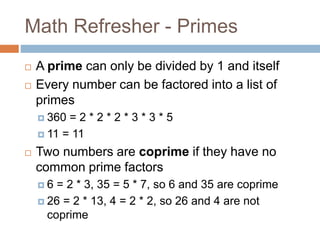
Math Refresher - Primes
 A prime can only be divided by 1 and itself
 Every number can be factored into a list of
primes
 360 = 2 * 2 * 2 * 3 * 3 * 5
 11 = 11
 Two numbers are coprime if they have no
common prime factors
 6 = 2 * 3, 35 = 5 * 7, so 6 and 35 are coprime
 26 = 2 * 13, 4 = 2 * 2, so 26 and 4 are not
coprime
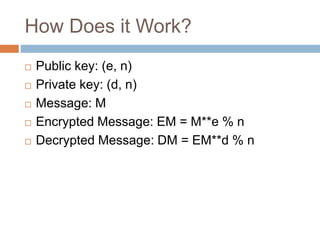
How Does it Work?
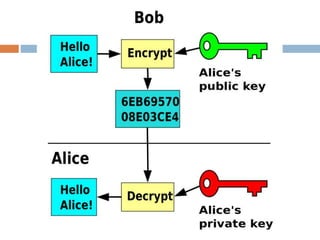
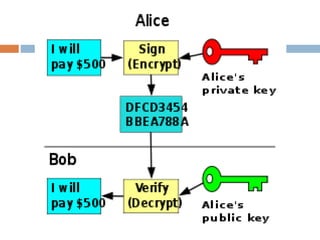
 Public key: (e, n)
 Private key: (d, n)
 Message: M
 Encrypted Message: EM = M**e % n
 Decrypted Message: DM = EM**d % n
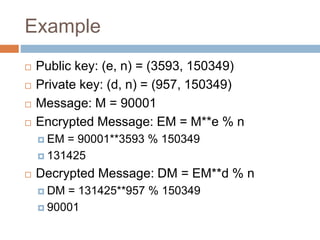
Example
 Public key: (e, n) = (3593, 150349)
 Private key: (d, n) = (957, 150349)
 Message: M = 90001
 Encrypted Message: EM = M**e % n
 EM = 90001**3593 % 150349
 131425
 Decrypted Message: DM = EM**d % n
 DM = 131425**957 % 150349
 90001
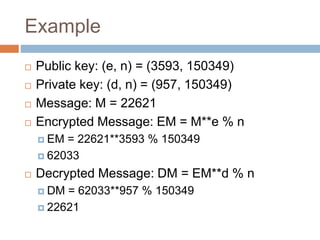
Example
 Public key: (e, n) = (3593, 150349)
 Private key: (d, n) = (957, 150349)
 Message: M = 22621
 Encrypted Message: EM = M**e % n
 EM = 22621**3593 % 150349
 62033
 Decrypted Message: DM = EM**d % n
 DM = 62033**957 % 150349
 22621
Why did that work?
Why did that work?
 Math
Why did that work?
 Math
 Cleverly chosen keys
Why did that work?
 Math
 Cleverly chosen keys
 Euler’s Theorem
φ, the totient function
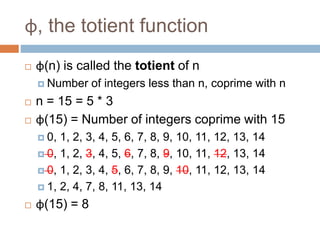
 φ(n) is called the totient of n
 Number of integers less than n, coprime with n
 n = 15 = 5 * 3
 φ(15) = Number of integers coprime with 15
 0, 1, 2, 3, 4, 5, 6, 7, 8, 9, 10, 11, 12, 13, 14
 0, 1, 2, 3, 4, 5, 6, 7, 8, 9, 10, 11, 12, 13, 14
 0, 1, 2, 3, 4, 5, 6, 7, 8, 9, 10, 11, 12, 13, 14
 1, 2, 4, 7, 8, 11, 13, 14
 φ(15) = 8
Calculating φ(n)
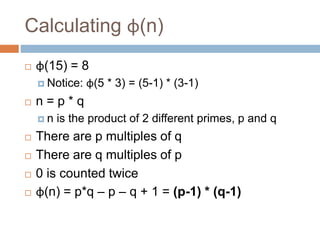
 φ(15) = 8
 Notice: φ(5 * 3) = (5-1) * (3-1)
 n = p * q
 n is the product of 2 different primes, p and q
 There are p multiples of q
 There are q multiples of p
 0 is counted twice
 φ(n) = p*q – p – q + 1 = (p-1) * (q-1)
Euler’s Theorem
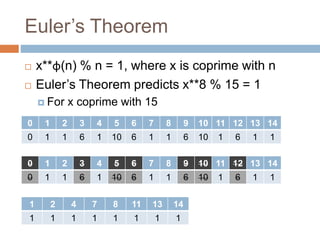
 x**φ(n) % n = 1, where x is coprime with n
 Euler’s Theorem predicts x**8 % 15 = 1
 For x coprime with 15
0 1 2 3 4 5 6 7 8 9 10 11 12 13 14
0 1 1 6 1 10 6 1 1 6 10 1 6 1 1
0 1 2 3 4 5 6 7 8 9 10 11 12 13 14
0 1 1 6 1 10 6 1 1 6 10 1 6 1 1
1 2 4 7 8 11 13 14
1 1 1 1 1 1 1 1
Proof of Euler’s Theorem
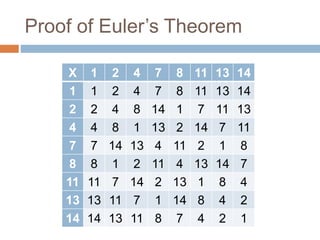
X 1 2 4 7 8 11 13 14
1 1 2 4 7 8 11 13 14
2 2 4 8 14 1 7 11 13
4 4 8 1 13 2 14 7 11
7 7 14 13 4 11 2 1 8
8 8 1 2 11 4 13 14 7
11 11 7 14 2 13 1 8 4
13 13 11 7 1 14 8 4 2
14 14 13 11 8 7 4 2 1
Proof of Euler’s Theorem
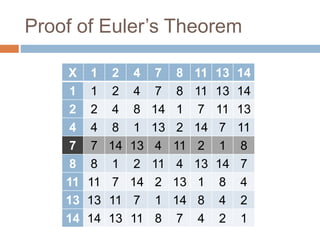
X 1 2 4 7 8 11 13 14
1 1 2 4 7 8 11 13 14
2 2 4 8 14 1 7 11 13
4 4 8 1 13 2 14 7 11
7 7 14 13 4 11 2 1 8
8 8 1 2 11 4 13 14 7
11 11 7 14 2 13 1 8 4
13 13 11 7 1 14 8 4 2
14 14 13 11 8 7 4 2 1
Proof of Euler’s Theorem
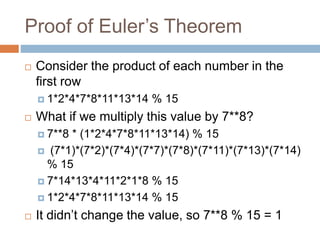
 Consider the product of each number in the
first row
 1*2*4*7*8*11*13*14 % 15
 What if we multiply this value by 7**8?
 7**8 * (1*2*4*7*8*11*13*14) % 15
 (7*1)*(7*2)*(7*4)*(7*7)*(7*8)*(7*11)*(7*13)*(7*14)
% 15
 7*14*13*4*11*2*1*8 % 15
 1*2*4*7*8*11*13*14 % 15
 It didn’t change the value, so 7**8 % 15 = 1
Key Generation
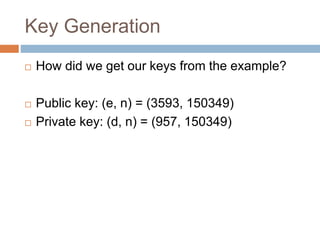
 How did we get our keys from the example?
 Public key: (e, n) = (3593, 150349)
 Private key: (d, n) = (957, 150349)
Key Generation
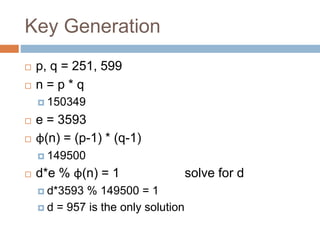
 p, q = 251, 599
 n = p * q
 150349
 e = 3593
 φ(n) = (p-1) * (q-1)
 149500
 d*e % φ(n) = 1 solve for d
 d*3593 % 149500 = 1
 d = 957 is the only solution
What makes those keys work?
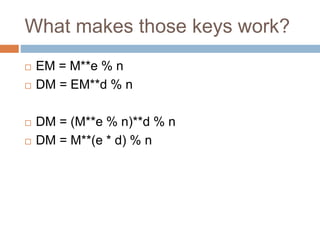
 EM = M**e % n
 DM = EM**d % n
 DM = (M**e % n)**d % n
 DM = M**(e * d) % n
Why does it work?
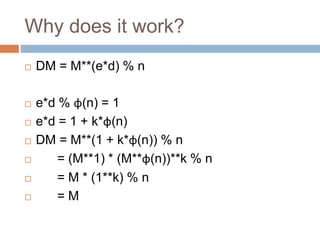
 DM = M**(e*d) % n
 e*d % φ(n) = 1
 e*d = 1 + k*φ(n)
 DM = M**(1 + k*φ(n)) % n
 = (M**1) * (M**φ(n))**k % n
 = M * (1**k) % n
 = M
Why is it secure?
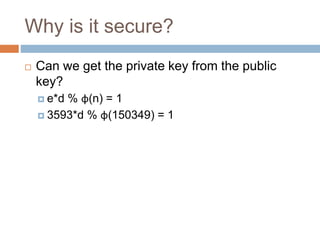
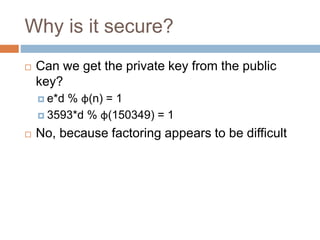
 Can we get the private key from the public
key?
 e*d % φ(n) = 1
 3593*d % φ(150349) = 1
Why is it secure?
 Can we get the private key from the public
key?
 e*d % φ(n) = 1
 3593*d % φ(150349) = 1
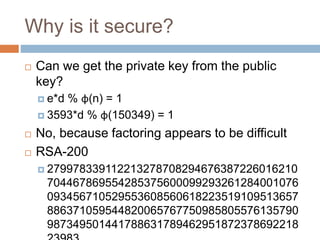
 No, because factoring appears to be difficult
Why is it secure?
 Can we get the private key from the public
key?
 e*d % φ(n) = 1
 3593*d % φ(150349) = 1
 No, because factoring appears to be difficult
 RSA-200
 279978339112213278708294676387226016210
704467869554285375600099293261284001076
093456710529553608560618223519109513657
886371059544820065767750985805576135790
987349501441788631789462951872378692218
Why is it secure?
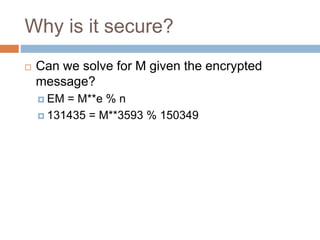
 Can we solve for M given the encrypted
message?
 EM = M**e % n
 131435 = M**3593 % 150349
Why is it secure?
 Can we solve for M given the encrypted
message?
 EM = M**e % n
 131435 = M**3593 % 150349
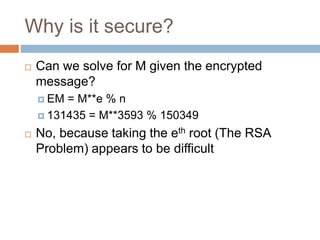
 No, because taking the eth root (The RSA
Problem) appears to be difficult
Why is it secure?
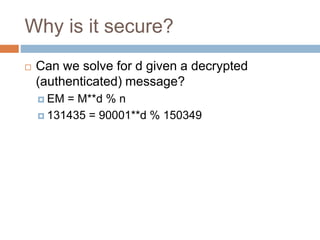
 Can we solve for d given a decrypted
(authenticated) message?
 EM = M**d % n
 131435 = 90001**d % 150349
Why is it secure?
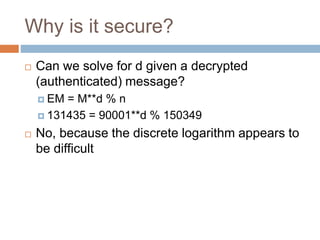
 Can we solve for d given a decrypted
(authenticated) message?
 EM = M**d % n
 131435 = 90001**d % 150349
 No, because the discrete logarithm appears to
be difficult
Why is it secure?
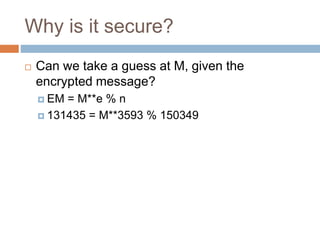
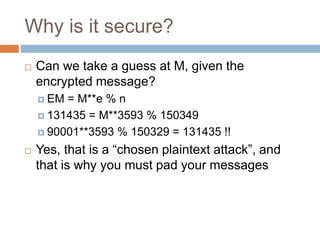
 Can we take a guess at M, given the
encrypted message?
 EM = M**e % n
 131435 = M**3593 % 150349
Why is it secure?
 Can we take a guess at M, given the
encrypted message?
 EM = M**e % n
 131435 = M**3593 % 150349
 90001**3593 % 150329 = 131435 !!
Why is it secure?
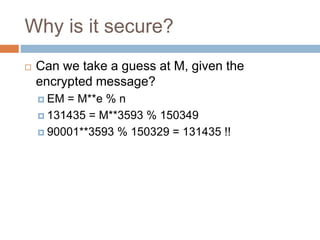
 Can we take a guess at M, given the
encrypted message?
 EM = M**e % n
 131435 = M**3593 % 150349
 90001**3593 % 150329 = 131435 !!
 Yes, that is a “chosen plaintext attack”, and
that is why you must pad your messages
More References
 Video demonstrating Public Key Cryptography
 https://www.youtube.com/watch?v=GSIDS_lvRv4
 Wikipedia Page
 https://en.wikipedia.org/wiki/RSA_(cryptosystem)
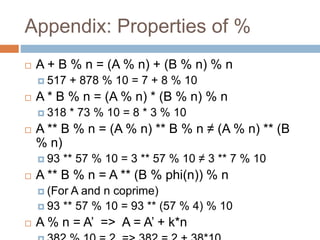
Appendix: Properties of %
 A + B % n = (A % n) + (B % n) % n
 517 + 878 % 10 = 7 + 8 % 10
 A * B % n = (A % n) * (B % n) % n
 318 * 73 % 10 = 8 * 3 % 10
 A ** B % n = (A % n) ** B % n ≠ (A % n) ** (B
% n)
 93 ** 57 % 10 = 3 ** 57 % 10 ≠ 3 ** 7 % 10
 A ** B % n = A ** (B % phi(n)) % n
 (For A and n coprime)
 93 ** 57 % 10 = 93 ** (57 % 4) % 10
 A % n = A’ => A = A’ + k*n

The Mathematics of RSA Encryption

  • 1.
    THE MATHEMATICS OF RSAENCRYPTION Casco Bay .NET User Group Nov. 2016
  • 2.
  • 3.
    Outline  What isRSA Encryption?  Math Refresher  How does it work?  Math Deep Dive  Where do keys come from?  Why does it work?  Why is it secure?
  • 4.
    What is RSAEncryption?  Public Key Cryptography Scheme
  • 8.
    Math Refresher -Modulus  %  “The Remainder” operator  546 % 31 = 19  546 = 17*31 + 19
  • 9.
    Math Refresher -Primes  A prime can only be divided by 1 and itself  Every number can be factored into a list of primes  360 = 2 * 2 * 2 * 3 * 3 * 5  11 = 11  Two numbers are coprime if they have no common prime factors  6 = 2 * 3, 35 = 5 * 7, so 6 and 35 are coprime  26 = 2 * 13, 4 = 2 * 2, so 26 and 4 are not coprime
  • 10.
    How Does itWork?  Public key: (e, n)  Private key: (d, n)  Message: M  Encrypted Message: EM = M**e % n  Decrypted Message: DM = EM**d % n
  • 11.
    Example  Public key:(e, n) = (3593, 150349)  Private key: (d, n) = (957, 150349)  Message: M = 90001  Encrypted Message: EM = M**e % n  EM = 90001**3593 % 150349  131425  Decrypted Message: DM = EM**d % n  DM = 131425**957 % 150349  90001
  • 12.
    Example  Public key:(e, n) = (3593, 150349)  Private key: (d, n) = (957, 150349)  Message: M = 22621  Encrypted Message: EM = M**e % n  EM = 22621**3593 % 150349  62033  Decrypted Message: DM = EM**d % n  DM = 62033**957 % 150349  22621
  • 13.
  • 14.
    Why did thatwork?  Math
  • 15.
    Why did thatwork?  Math  Cleverly chosen keys
  • 16.
    Why did thatwork?  Math  Cleverly chosen keys  Euler’s Theorem
  • 17.
    φ, the totientfunction  φ(n) is called the totient of n  Number of integers less than n, coprime with n  n = 15 = 5 * 3  φ(15) = Number of integers coprime with 15  0, 1, 2, 3, 4, 5, 6, 7, 8, 9, 10, 11, 12, 13, 14  0, 1, 2, 3, 4, 5, 6, 7, 8, 9, 10, 11, 12, 13, 14  0, 1, 2, 3, 4, 5, 6, 7, 8, 9, 10, 11, 12, 13, 14  1, 2, 4, 7, 8, 11, 13, 14  φ(15) = 8
  • 18.
    Calculating φ(n)  φ(15)= 8  Notice: φ(5 * 3) = (5-1) * (3-1)  n = p * q  n is the product of 2 different primes, p and q  There are p multiples of q  There are q multiples of p  0 is counted twice  φ(n) = p*q – p – q + 1 = (p-1) * (q-1)
  • 19.
    Euler’s Theorem  x**φ(n)% n = 1, where x is coprime with n  Euler’s Theorem predicts x**8 % 15 = 1  For x coprime with 15 0 1 2 3 4 5 6 7 8 9 10 11 12 13 14 0 1 1 6 1 10 6 1 1 6 10 1 6 1 1 0 1 2 3 4 5 6 7 8 9 10 11 12 13 14 0 1 1 6 1 10 6 1 1 6 10 1 6 1 1 1 2 4 7 8 11 13 14 1 1 1 1 1 1 1 1
  • 20.
    Proof of Euler’sTheorem X 1 2 4 7 8 11 13 14 1 1 2 4 7 8 11 13 14 2 2 4 8 14 1 7 11 13 4 4 8 1 13 2 14 7 11 7 7 14 13 4 11 2 1 8 8 8 1 2 11 4 13 14 7 11 11 7 14 2 13 1 8 4 13 13 11 7 1 14 8 4 2 14 14 13 11 8 7 4 2 1
  • 21.
    Proof of Euler’sTheorem X 1 2 4 7 8 11 13 14 1 1 2 4 7 8 11 13 14 2 2 4 8 14 1 7 11 13 4 4 8 1 13 2 14 7 11 7 7 14 13 4 11 2 1 8 8 8 1 2 11 4 13 14 7 11 11 7 14 2 13 1 8 4 13 13 11 7 1 14 8 4 2 14 14 13 11 8 7 4 2 1
  • 22.
    Proof of Euler’sTheorem  Consider the product of each number in the first row  1*2*4*7*8*11*13*14 % 15  What if we multiply this value by 7**8?  7**8 * (1*2*4*7*8*11*13*14) % 15  (7*1)*(7*2)*(7*4)*(7*7)*(7*8)*(7*11)*(7*13)*(7*14) % 15  7*14*13*4*11*2*1*8 % 15  1*2*4*7*8*11*13*14 % 15  It didn’t change the value, so 7**8 % 15 = 1
  • 23.
    Key Generation  Howdid we get our keys from the example?  Public key: (e, n) = (3593, 150349)  Private key: (d, n) = (957, 150349)
  • 24.
    Key Generation  p,q = 251, 599  n = p * q  150349  e = 3593  φ(n) = (p-1) * (q-1)  149500  d*e % φ(n) = 1 solve for d  d*3593 % 149500 = 1  d = 957 is the only solution
  • 25.
    What makes thosekeys work?  EM = M**e % n  DM = EM**d % n  DM = (M**e % n)**d % n  DM = M**(e * d) % n
  • 26.
    Why does itwork?  DM = M**(e*d) % n  e*d % φ(n) = 1  e*d = 1 + k*φ(n)  DM = M**(1 + k*φ(n)) % n  = (M**1) * (M**φ(n))**k % n  = M * (1**k) % n  = M
  • 27.
    Why is itsecure?  Can we get the private key from the public key?  e*d % φ(n) = 1  3593*d % φ(150349) = 1
  • 28.
    Why is itsecure?  Can we get the private key from the public key?  e*d % φ(n) = 1  3593*d % φ(150349) = 1  No, because factoring appears to be difficult
  • 29.
    Why is itsecure?  Can we get the private key from the public key?  e*d % φ(n) = 1  3593*d % φ(150349) = 1  No, because factoring appears to be difficult  RSA-200  279978339112213278708294676387226016210 704467869554285375600099293261284001076 093456710529553608560618223519109513657 886371059544820065767750985805576135790 987349501441788631789462951872378692218
  • 30.
    Why is itsecure?  Can we solve for M given the encrypted message?  EM = M**e % n  131435 = M**3593 % 150349
  • 31.
    Why is itsecure?  Can we solve for M given the encrypted message?  EM = M**e % n  131435 = M**3593 % 150349  No, because taking the eth root (The RSA Problem) appears to be difficult
  • 32.
    Why is itsecure?  Can we solve for d given a decrypted (authenticated) message?  EM = M**d % n  131435 = 90001**d % 150349
  • 33.
    Why is itsecure?  Can we solve for d given a decrypted (authenticated) message?  EM = M**d % n  131435 = 90001**d % 150349  No, because the discrete logarithm appears to be difficult
  • 34.
    Why is itsecure?  Can we take a guess at M, given the encrypted message?  EM = M**e % n  131435 = M**3593 % 150349
  • 35.
    Why is itsecure?  Can we take a guess at M, given the encrypted message?  EM = M**e % n  131435 = M**3593 % 150349  90001**3593 % 150329 = 131435 !!
  • 36.
    Why is itsecure?  Can we take a guess at M, given the encrypted message?  EM = M**e % n  131435 = M**3593 % 150349  90001**3593 % 150329 = 131435 !!  Yes, that is a “chosen plaintext attack”, and that is why you must pad your messages
  • 37.
    More References  Videodemonstrating Public Key Cryptography  https://www.youtube.com/watch?v=GSIDS_lvRv4  Wikipedia Page  https://en.wikipedia.org/wiki/RSA_(cryptosystem)
  • 38.
    Appendix: Properties of%  A + B % n = (A % n) + (B % n) % n  517 + 878 % 10 = 7 + 8 % 10  A * B % n = (A % n) * (B % n) % n  318 * 73 % 10 = 8 * 3 % 10  A ** B % n = (A % n) ** B % n ≠ (A % n) ** (B % n)  93 ** 57 % 10 = 3 ** 57 % 10 ≠ 3 ** 7 % 10  A ** B % n = A ** (B % phi(n)) % n  (For A and n coprime)  93 ** 57 % 10 = 93 ** (57 % 4) % 10  A % n = A’ => A = A’ + k*n

Editor's Notes

  • #3 Factoring What does encryption actually do?
  • #6 http://www.technicaljones.com/AsymmetricEncryption_March%202010.gif
  • #7 https://upload.wikimedia.org/wikipedia/commons/thumb/f/f9/Public_key_encryption.svg/2000px-Public_key_encryption.svg.png
  • #8 https://upload.wikimedia.org/wikipedia/commons/thumb/1/1e/Public_key_signing.svg/250px-Public_key_signing.svg.png
  • #9 http://www.ducksters.com/kidsmath/division_long8.gif
  • #12 Numbers are artificially small M is a prime number No way to get M back using just e and n If you change d, this will fail
  • #18 Bear with me, but consider 15
  • #23 TODO need the simplification justification
  • #25 Choose two really huge primes. These are not huge
  • #28 https://en.wikipedia.org/wiki/Integer_factorization https://en.wikipedia.org/wiki/RSA_numbers#RSA-200
  • #29 https://en.wikipedia.org/wiki/Integer_factorization https://en.wikipedia.org/wiki/RSA_numbers#RSA-200
  • #30 https://en.wikipedia.org/wiki/Integer_factorization https://en.wikipedia.org/wiki/RSA_numbers#RSA-200
  • #31 Someone snoops the message, know who it is intended for, so they know what public key was used https://en.wikipedia.org/wiki/RSA_problem
  • #32 https://en.wikipedia.org/wiki/RSA_problem
  • #33 https://en.wikipedia.org/wiki/Discrete_logarithm
  • #34 https://en.wikipedia.org/wiki/Discrete_logarithm
  • #35 https://en.wikipedia.org/wiki/RSA_problem
  • #36 https://en.wikipedia.org/wiki/RSA_problem
  • #37 https://en.wikipedia.org/wiki/RSA_problem