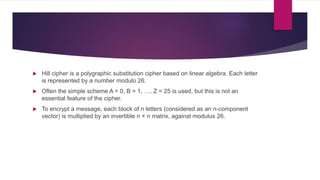
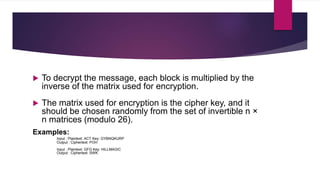
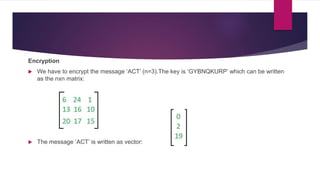
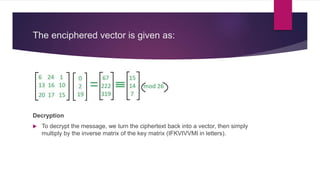
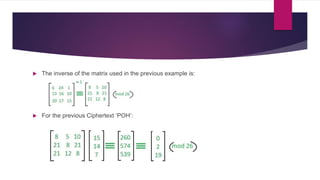
The Hill cipher is a polygraphic substitution cipher that uses linear algebra. It operates on blocks of letters that are treated as vectors, and encrypts each block by multiplying it by a random invertible matrix based on the cipher key. To decrypt, the ciphertext vectors are multiplied by the inverse of the encryption matrix. The key is an n×n matrix of numbers representing the letters, and encryption/decryption involve matrix multiplication modulo 26.


![Code :
// Java code to implement Hill Cipher
class GFG
{
// Following function generates the
// key matrix for the key string
static void getKeyMatrix(String key, int keyMatrix[][])
{ int k = 0;
for (int i = 0; i < 3; i++)
{ for (int j = 0; j < 3; j++){
keyMatrix[i][j] = (key.charAt(k)) % 65;
k++;
}}}](https://image.slidesharecdn.com/activityhillcipher-220921072112-c2e6aff9/85/Activity-Hill-Cipher-pptx-8-320.jpg)
![// Following function encrypts the message
static void encrypt(int cipherMatrix[][],
int keyMatrix[][],int messageVector[][])
{int x, i, j;
for (i = 0; i < 3; i++)
{for (j = 0; j < 1; j++)
{ cipherMatrix[i][j] = 0;
for (x = 0; x < 3; x++) {
cipherMatrix[i][j] +=
keyMatrix[i][x] * messageVector[x][j];
}](https://image.slidesharecdn.com/activityhillcipher-220921072112-c2e6aff9/85/Activity-Hill-Cipher-pptx-9-320.jpg)
![cipherMatrix[i][j] = cipherMatrix[i][j] % 26;
}}}
// Function to implement Hill Cipher
static void HillCipher(String message, String key)
{
// Get key matrix from the key string
int [][]keyMatrix = new int[3][3];
getKeyMatrix(key, keyMatrix);
int [][]messageVector = new int[3][1]; // Generate vector for the message
for (int i = 0; i < 3; i++)
messageVector[i][0] = (message.charAt(i)) % 65;
int [][]cipherMatrix = new int[3][1];](https://image.slidesharecdn.com/activityhillcipher-220921072112-c2e6aff9/85/Activity-Hill-Cipher-pptx-10-320.jpg)
![// Following function generates
// the encrypted vector
encrypt(cipherMatrix, keyMatrix, messageVector);
String CipherText="";
// Generate the encrypted text from
// the encrypted vector
for (int i = 0; i < 3; i++)
CipherText += (char)(cipherMatrix[i][0] + 65);
// Finally print the ciphertext
System.out.print(" Ciphertext:" + CipherText);
}](https://image.slidesharecdn.com/activityhillcipher-220921072112-c2e6aff9/85/Activity-Hill-Cipher-pptx-11-320.jpg)
![public static void main(String[] args)
{
// Get the message to be encrypted
String message = "ACT";
// Get the key
String key = "GYBNQKURP";
HillCipher(message, key);
}}
Output :
Ciphertext: POH](https://image.slidesharecdn.com/activityhillcipher-220921072112-c2e6aff9/85/Activity-Hill-Cipher-pptx-12-320.jpg)


