Experiments on RSA
without integrity checks
Demo of Reversing the Plaintexts from the Ciphertexts
Dr. Dharma Ganesan, Ph.D.,
Disclaimer
● The opinions expressed here are my own
○ But not the views of my employer
● The source code fragments and exploits shown here can be reused
○ But without any warranty nor accept any responsibility for failures
● Do not apply the exploit discussed here on other systems
○ Without obtaining authorization from owners
2
Goal of this presentation (details later)
● Explain how to break unauthenticated RSA
○ That is, RSA without digital signature/integrity checks
● Present exploit: Man-in-the-middle edit public exponents
○ Uses Bézout’s theorem to recover the plaintexts from ciphertexts
○ Extended Euclidean Algorithm is the core
● This challenge was given to me by a friend who works for
a social media giant
3
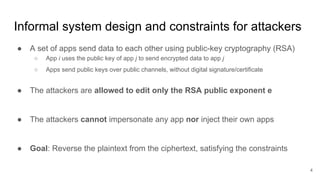
Informal system design and constraints for attackers
● A set of apps send data to each other using public-key cryptography (RSA)
○ App i uses the public key of app j to send encrypted data to app j
○ Apps send public keys over public channels, without digital signature/certificate
● The attackers are allowed to edit only the RSA public exponent e
● The attackers cannot impersonate any app nor inject their own apps
● Goal: Reverse the plaintext from the ciphertext, satisfying the constraints
4
Prerequisite (to follow the remaining slides)
Some familiarity with the following topics will help to follow the rest of the slides
● Group Theory (Abstract Algebra/Discrete Math)
● Modular Arithmetic (Number Theory)
● Algorithms and Complexity Theory
● If not, it should still be possible to obtain a high-level overview
5
How can Bob send a message to Alice securely?
6
Public Key PuA
● Alice and Bob never met each other
● Bob will encrypt using Alice’s public key
○ Assume that public keys are known to the world
● Alice will decrypt using her private key
○ Private keys are secrets (never sent out)
● Bob can sign messages using his private key
○ Alice verifies message integrity using Bob’s public key
○ Not important for this presentation/attack
● Note: Alice and Bob need other evidence (e.g., passwords,
certificates) to prove their identity to each other
Private Key PrA
Public Key PuB
Private Key PrB
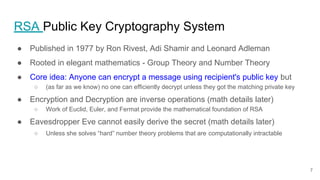
RSA Public Key Cryptography System
● Published in 1977 by Ron Rivest, Adi Shamir and Leonard Adleman
● Rooted in elegant mathematics - Group Theory and Number Theory
● Core idea: Anyone can encrypt a message using recipient's public key but
○ (as far as we know) no one can efficiently decrypt unless they got the matching private key
● Encryption and Decryption are inverse operations (math details later)
○ Work of Euclid, Euler, and Fermat provide the mathematical foundation of RSA
● Eavesdropper Eve cannot easily derive the secret (math details later)
○ Unless she solves “hard” number theory problems that are computationally intractable
7
8
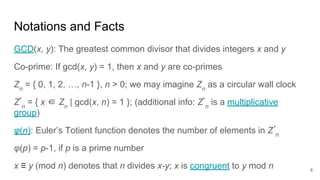
Notations and Facts
GCD(x, y): The greatest common divisor that divides integers x and y
Co-prime: If gcd(x, y) = 1, then x and y are co-primes
Zn
= { 0, 1, 2, …, n-1 }, n > 0; we may imagine Zn
as a circular wall clock
Z*
n
= { x ∈ Zn
| gcd(x, n) = 1 }; (additional info: Z*
n
is a multiplicative
group)
φ(n): Euler’s Totient function denotes the number of elements in Z*
n
φ(p) = p-1, if p is a prime number
x ≡ y (mod n) denotes that n divides x-y; x is congruent to y mod n
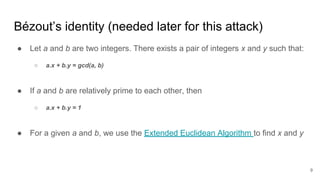
Bézout’s identity (needed later for this attack)
● Let a and b are two integers. There exists a pair of integers x and y such that:
○ a.x + b.y = gcd(a, b)
● If a and b are relatively prime to each other, then
○ a.x + b.y = 1
● For a given a and b, we use the Extended Euclidean Algorithm to find x and y
9
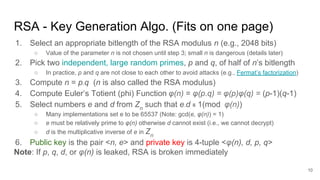
RSA - Key Generation Algo. (Fits on one page)
1. Select an appropriate bitlength of the RSA modulus n (e.g., 2048 bits)
○ Value of the parameter n is not chosen until step 3; small n is dangerous (details later)
2. Pick two independent, large random primes, p and q, of half of n’s bitlength
○ In practice, p and q are not close to each other to avoid attacks (e.g., Fermat’s factorization)
3. Compute n = p.q (n is also called the RSA modulus)
4. Compute Euler’s Totient (phi) Function φ(n) = φ(p.q) = φ(p)φ(q) = (p-1)(q-1)
5. Select numbers e and d from Zn
such that e.d ≡ 1(mod φ(n))
○ Many implementations set e to be 65537 (Note: gcd(e, φ(n)) = 1)
○ e must be relatively prime to φ(n) otherwise d cannot exist (i.e., we cannot decrypt)
○ d is the multiplicative inverse of e in Zn
6. Public key is the pair <n, e> and private key is 4-tuple <φ(n), d, p, q>
Note: If p, q, d, or φ(n) is leaked, RSA is broken immediately
10
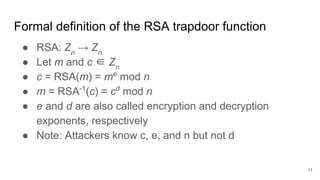
Formal definition of the RSA trapdoor function
● RSA: Zn
→ Zn
● Let m and c ∈ Zn
● c = RSA(m) = me
mod n
● m = RSA-1
(c) = cd
mod n
● e and d are also called encryption and decryption
exponents, respectively
● Note: Attackers know c, e, and n but not d
11
12
13
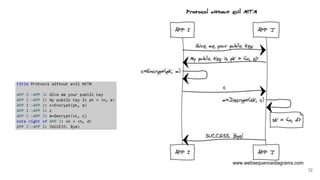
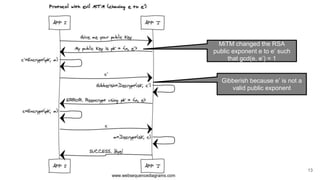
MiTM changed the RSA
public exponent e to e’ such
that gcd(e, e’) = 1
Gibberish because e’ is not a
valid public exponent
Core idea of the attack
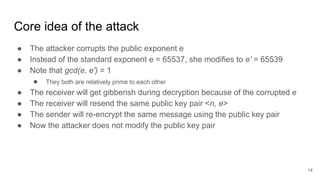
● The attacker corrupts the public exponent e
● Instead of the standard exponent e = 65537, she modifies to e' = 65539
● Note that gcd(e, e') = 1
● They both are relatively prime to each other
● The receiver will get gibberish during decryption because of the corrupted e
● The receiver will resend the same public key pair <n, e>
● The sender will re-encrypt the same message using the public key pair
● Now the attacker does not modify the public key pair
14
Core idea of the attack …
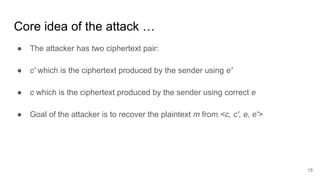
● The attacker has two ciphertext pair:
● c' which is the ciphertext produced by the sender using e'
● c which is the ciphertext produced by the sender using correct e
● Goal of the attacker is to recover the plaintext m from <c, c', e, e'>
15
Algorithm: Recover the plaintext m from <c, c', e, e'>
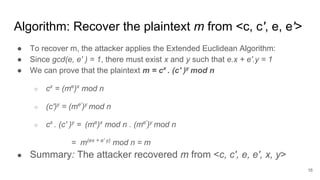
● To recover m, the attacker applies the Extended Euclidean Algorithm:
● Since gcd(e, e' ) = 1, there must exist x and y such that e.x + e'.y = 1
● We can prove that the plaintext m = cx
. (c' )y
mod n
○ cx
= (me
)x
mod n
○ (c')y
= (me'
)y
mod n
○ cx
. (c' )y
= (me
)x
mod n . (me'
)y
mod n
= m(ex + e' y)
mod n = m
● Summary: The attacker recovered m from <c, c', e, e', x, y>
16
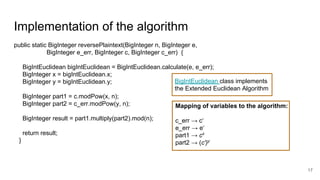
Implementation of the algorithm
17
public static BigInteger reversePlaintext(BigInteger n, BigInteger e,
BigInteger e_err, BigInteger c, BigInteger c_err) {
BigIntEuclidean bigIntEuclidean = BigIntEuclidean.calculate(e, e_err);
BigInteger x = bigIntEuclidean.x;
BigInteger y = bigIntEuclidean.y;
BigInteger part1 = c.modPow(x, n);
BigInteger part2 = c_err.modPow(y, n);
BigInteger result = part1.multiply(part2).mod(n);
return result;
}
Mapping of variables to the algorithm:
c_err → c‘
e_err → e‘
part1 → cx
part2 → (c')y
BigIntEuclidean class implements
the Extended Euclidean Algorithm
Slide demo
18
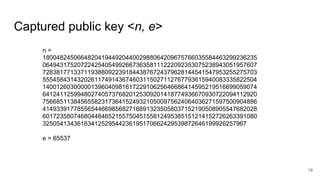
Captured public key <n, e>
19
n =
18004824506648204194492044002988064209675766035584463299236235
06494317520722425405499266736358111222092353075238943051957607
72838177133711938809223918443876724379628144541547953255275703
55545843143202611749143674603115027112767793615940083335822504
14001260300000139604098161722910625646686414595219516699059074
64124112599480274057376820125309201418774936670930722094112920
75668511384565582317364152493210500975624064036271597500904886
41493391778556544669856827168913235058037152190508905547682028
60172358074680448465215575045155812495385151214152726263391080
32505413436163412529544236195170662429539872646199926257967
e = 65537
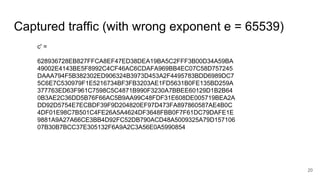
Captured traffic (with wrong exponent e = 65539)
20
c' =
628936728EB827FFCA8EF47ED38DEA19BA5C2FFF3B00D34A59BA
49002E4143BE5F8992C4CF46AC6CDAFA969BB4EC07C58D757245
DAAA794F5B382302ED906324B3973D453A2F4495783BDD6989DC7
5C6E7C530979F1E5216734BF3FB3203AE1FD5631B0FE135BD259A
377763ED63F961C7598C5C4871B990F3230A7BBEE60129D1B2B64
0B3AE2C36DD5B76F66AC5B9AA99C48FDF31E608DE005719BEA2A
DD92D5754E7ECBDF39F9D204820EF97D473FA897860587AE4B0C
4DF01E98C7B501C4FE26A5A4624DF3648FBB0F7F61DC79DAFE1E
9881A9A27A66CE3BB4D92FC52DB790ACD48A5009325A79D157106
07B30B7BCC37E305132F6A9A2C3A56E0A5990854
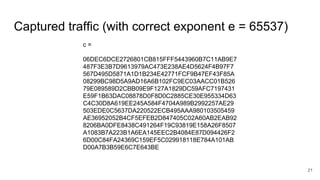
Captured traffic (with correct exponent e = 65537)
21
c =
06DEC6DCE2726801CB815FFF5443960B7C11AB9E7
487F3E3B7D9613979AC473E238AE4D5624F4B97F7
567D495D5871A1D1B234E42771FCF9B47EF43F85A
08299BC98D5A9AD16A6B102FC9EC03AACC01B526
79E089589D2CBB09E9F127A1829DC59AFC7197431
E59F1B63DAC08878D0F8D0C2885CE30E955334D63
C4C30D8A619EE245A584F4704A989B2992257AE29
503EDE0C5637DA220522ECB495AAA980103505459
AE36952052B4CF5EFEB2D847405C02A60AB2EAB92
8206BA0DFE8438C491264F19C93819E158A26F8507
A1083B7A223B1A6EA145EEC2B4084E87D094426F2
6D00C84FA24369C159EF5C029918118E784A101AB
D00A7B3B59E6C7E643BE
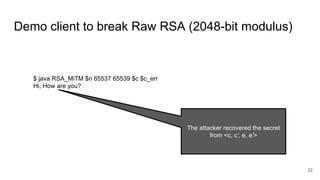
Demo client to break Raw RSA (2048-bit modulus)
22
$ java RSA_MiTM $n 65537 65539 $c $c_err
Hi, How are you?
The attacker recovered the secret
from <c, c', e, e'>
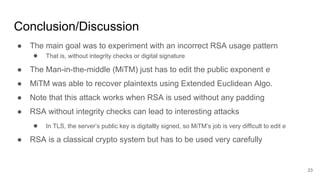
Conclusion/Discussion
23
● The main goal was to experiment with an incorrect RSA usage pattern
● That is, without integrity checks or digital signature
● The Man-in-the-middle (MiTM) just has to edit the public exponent e
● MiTM was able to recover plaintexts using Extended Euclidean Algo.
● Note that this attack works when RSA is used without any padding
● RSA without integrity checks can lead to interesting attacks
● In TLS, the server’s public key is digitallly signed, so MiTM’s job is very difficult to edit e
● RSA is a classical crypto system but has to be used very carefully
References
● W. Diffie and M. E. Hellman, “New Directions in Cryptography,” IEEE
Transactions on Information Theory, vol. IT-22, no. 6, November, 1976.
● R. L. Rivest, A. Shamir, and L. Adleman, “A method for obtaining digital
signatures and public-key cryptosystems,” CACM 21, 2, February, 1978.
● A. Menezes, P. van Oorschot, and S. Vanstone, “Handbook of Applied
Cryptography,” CRC Press, 1996.
● C. Paar and J. Pelzl, “Understanding Cryptography: A Textbook for Students
and Practitioners,” Springer, 2011.
24

RSA without Integrity Checks

  • 1.
    Experiments on RSA withoutintegrity checks Demo of Reversing the Plaintexts from the Ciphertexts Dr. Dharma Ganesan, Ph.D.,
  • 2.
    Disclaimer ● The opinionsexpressed here are my own ○ But not the views of my employer ● The source code fragments and exploits shown here can be reused ○ But without any warranty nor accept any responsibility for failures ● Do not apply the exploit discussed here on other systems ○ Without obtaining authorization from owners 2
  • 3.
    Goal of thispresentation (details later) ● Explain how to break unauthenticated RSA ○ That is, RSA without digital signature/integrity checks ● Present exploit: Man-in-the-middle edit public exponents ○ Uses Bézout’s theorem to recover the plaintexts from ciphertexts ○ Extended Euclidean Algorithm is the core ● This challenge was given to me by a friend who works for a social media giant 3
  • 4.
    Informal system designand constraints for attackers ● A set of apps send data to each other using public-key cryptography (RSA) ○ App i uses the public key of app j to send encrypted data to app j ○ Apps send public keys over public channels, without digital signature/certificate ● The attackers are allowed to edit only the RSA public exponent e ● The attackers cannot impersonate any app nor inject their own apps ● Goal: Reverse the plaintext from the ciphertext, satisfying the constraints 4
  • 5.
    Prerequisite (to followthe remaining slides) Some familiarity with the following topics will help to follow the rest of the slides ● Group Theory (Abstract Algebra/Discrete Math) ● Modular Arithmetic (Number Theory) ● Algorithms and Complexity Theory ● If not, it should still be possible to obtain a high-level overview 5
  • 6.
    How can Bobsend a message to Alice securely? 6 Public Key PuA ● Alice and Bob never met each other ● Bob will encrypt using Alice’s public key ○ Assume that public keys are known to the world ● Alice will decrypt using her private key ○ Private keys are secrets (never sent out) ● Bob can sign messages using his private key ○ Alice verifies message integrity using Bob’s public key ○ Not important for this presentation/attack ● Note: Alice and Bob need other evidence (e.g., passwords, certificates) to prove their identity to each other Private Key PrA Public Key PuB Private Key PrB
  • 7.
    RSA Public KeyCryptography System ● Published in 1977 by Ron Rivest, Adi Shamir and Leonard Adleman ● Rooted in elegant mathematics - Group Theory and Number Theory ● Core idea: Anyone can encrypt a message using recipient's public key but ○ (as far as we know) no one can efficiently decrypt unless they got the matching private key ● Encryption and Decryption are inverse operations (math details later) ○ Work of Euclid, Euler, and Fermat provide the mathematical foundation of RSA ● Eavesdropper Eve cannot easily derive the secret (math details later) ○ Unless she solves “hard” number theory problems that are computationally intractable 7
  • 8.
    8 Notations and Facts GCD(x,y): The greatest common divisor that divides integers x and y Co-prime: If gcd(x, y) = 1, then x and y are co-primes Zn = { 0, 1, 2, …, n-1 }, n > 0; we may imagine Zn as a circular wall clock Z* n = { x ∈ Zn | gcd(x, n) = 1 }; (additional info: Z* n is a multiplicative group) φ(n): Euler’s Totient function denotes the number of elements in Z* n φ(p) = p-1, if p is a prime number x ≡ y (mod n) denotes that n divides x-y; x is congruent to y mod n
  • 9.
    Bézout’s identity (neededlater for this attack) ● Let a and b are two integers. There exists a pair of integers x and y such that: ○ a.x + b.y = gcd(a, b) ● If a and b are relatively prime to each other, then ○ a.x + b.y = 1 ● For a given a and b, we use the Extended Euclidean Algorithm to find x and y 9
  • 10.
    RSA - KeyGeneration Algo. (Fits on one page) 1. Select an appropriate bitlength of the RSA modulus n (e.g., 2048 bits) ○ Value of the parameter n is not chosen until step 3; small n is dangerous (details later) 2. Pick two independent, large random primes, p and q, of half of n’s bitlength ○ In practice, p and q are not close to each other to avoid attacks (e.g., Fermat’s factorization) 3. Compute n = p.q (n is also called the RSA modulus) 4. Compute Euler’s Totient (phi) Function φ(n) = φ(p.q) = φ(p)φ(q) = (p-1)(q-1) 5. Select numbers e and d from Zn such that e.d ≡ 1(mod φ(n)) ○ Many implementations set e to be 65537 (Note: gcd(e, φ(n)) = 1) ○ e must be relatively prime to φ(n) otherwise d cannot exist (i.e., we cannot decrypt) ○ d is the multiplicative inverse of e in Zn 6. Public key is the pair <n, e> and private key is 4-tuple <φ(n), d, p, q> Note: If p, q, d, or φ(n) is leaked, RSA is broken immediately 10
  • 11.
    Formal definition ofthe RSA trapdoor function ● RSA: Zn → Zn ● Let m and c ∈ Zn ● c = RSA(m) = me mod n ● m = RSA-1 (c) = cd mod n ● e and d are also called encryption and decryption exponents, respectively ● Note: Attackers know c, e, and n but not d 11
  • 12.
  • 13.
    13 MiTM changed theRSA public exponent e to e’ such that gcd(e, e’) = 1 Gibberish because e’ is not a valid public exponent
  • 14.
    Core idea ofthe attack ● The attacker corrupts the public exponent e ● Instead of the standard exponent e = 65537, she modifies to e' = 65539 ● Note that gcd(e, e') = 1 ● They both are relatively prime to each other ● The receiver will get gibberish during decryption because of the corrupted e ● The receiver will resend the same public key pair <n, e> ● The sender will re-encrypt the same message using the public key pair ● Now the attacker does not modify the public key pair 14
  • 15.
    Core idea ofthe attack … ● The attacker has two ciphertext pair: ● c' which is the ciphertext produced by the sender using e' ● c which is the ciphertext produced by the sender using correct e ● Goal of the attacker is to recover the plaintext m from <c, c', e, e'> 15
  • 16.
    Algorithm: Recover theplaintext m from <c, c', e, e'> ● To recover m, the attacker applies the Extended Euclidean Algorithm: ● Since gcd(e, e' ) = 1, there must exist x and y such that e.x + e'.y = 1 ● We can prove that the plaintext m = cx . (c' )y mod n ○ cx = (me )x mod n ○ (c')y = (me' )y mod n ○ cx . (c' )y = (me )x mod n . (me' )y mod n = m(ex + e' y) mod n = m ● Summary: The attacker recovered m from <c, c', e, e', x, y> 16
  • 17.
    Implementation of thealgorithm 17 public static BigInteger reversePlaintext(BigInteger n, BigInteger e, BigInteger e_err, BigInteger c, BigInteger c_err) { BigIntEuclidean bigIntEuclidean = BigIntEuclidean.calculate(e, e_err); BigInteger x = bigIntEuclidean.x; BigInteger y = bigIntEuclidean.y; BigInteger part1 = c.modPow(x, n); BigInteger part2 = c_err.modPow(y, n); BigInteger result = part1.multiply(part2).mod(n); return result; } Mapping of variables to the algorithm: c_err → c‘ e_err → e‘ part1 → cx part2 → (c')y BigIntEuclidean class implements the Extended Euclidean Algorithm
  • 18.
  • 19.
    Captured public key<n, e> 19 n = 18004824506648204194492044002988064209675766035584463299236235 06494317520722425405499266736358111222092353075238943051957607 72838177133711938809223918443876724379628144541547953255275703 55545843143202611749143674603115027112767793615940083335822504 14001260300000139604098161722910625646686414595219516699059074 64124112599480274057376820125309201418774936670930722094112920 75668511384565582317364152493210500975624064036271597500904886 41493391778556544669856827168913235058037152190508905547682028 60172358074680448465215575045155812495385151214152726263391080 32505413436163412529544236195170662429539872646199926257967 e = 65537
  • 20.
    Captured traffic (withwrong exponent e = 65539) 20 c' = 628936728EB827FFCA8EF47ED38DEA19BA5C2FFF3B00D34A59BA 49002E4143BE5F8992C4CF46AC6CDAFA969BB4EC07C58D757245 DAAA794F5B382302ED906324B3973D453A2F4495783BDD6989DC7 5C6E7C530979F1E5216734BF3FB3203AE1FD5631B0FE135BD259A 377763ED63F961C7598C5C4871B990F3230A7BBEE60129D1B2B64 0B3AE2C36DD5B76F66AC5B9AA99C48FDF31E608DE005719BEA2A DD92D5754E7ECBDF39F9D204820EF97D473FA897860587AE4B0C 4DF01E98C7B501C4FE26A5A4624DF3648FBB0F7F61DC79DAFE1E 9881A9A27A66CE3BB4D92FC52DB790ACD48A5009325A79D157106 07B30B7BCC37E305132F6A9A2C3A56E0A5990854
  • 21.
    Captured traffic (withcorrect exponent e = 65537) 21 c = 06DEC6DCE2726801CB815FFF5443960B7C11AB9E7 487F3E3B7D9613979AC473E238AE4D5624F4B97F7 567D495D5871A1D1B234E42771FCF9B47EF43F85A 08299BC98D5A9AD16A6B102FC9EC03AACC01B526 79E089589D2CBB09E9F127A1829DC59AFC7197431 E59F1B63DAC08878D0F8D0C2885CE30E955334D63 C4C30D8A619EE245A584F4704A989B2992257AE29 503EDE0C5637DA220522ECB495AAA980103505459 AE36952052B4CF5EFEB2D847405C02A60AB2EAB92 8206BA0DFE8438C491264F19C93819E158A26F8507 A1083B7A223B1A6EA145EEC2B4084E87D094426F2 6D00C84FA24369C159EF5C029918118E784A101AB D00A7B3B59E6C7E643BE
  • 22.
    Demo client tobreak Raw RSA (2048-bit modulus) 22 $ java RSA_MiTM $n 65537 65539 $c $c_err Hi, How are you? The attacker recovered the secret from <c, c', e, e'>
  • 23.
    Conclusion/Discussion 23 ● The maingoal was to experiment with an incorrect RSA usage pattern ● That is, without integrity checks or digital signature ● The Man-in-the-middle (MiTM) just has to edit the public exponent e ● MiTM was able to recover plaintexts using Extended Euclidean Algo. ● Note that this attack works when RSA is used without any padding ● RSA without integrity checks can lead to interesting attacks ● In TLS, the server’s public key is digitallly signed, so MiTM’s job is very difficult to edit e ● RSA is a classical crypto system but has to be used very carefully
  • 24.
    References ● W. Diffieand M. E. Hellman, “New Directions in Cryptography,” IEEE Transactions on Information Theory, vol. IT-22, no. 6, November, 1976. ● R. L. Rivest, A. Shamir, and L. Adleman, “A method for obtaining digital signatures and public-key cryptosystems,” CACM 21, 2, February, 1978. ● A. Menezes, P. van Oorschot, and S. Vanstone, “Handbook of Applied Cryptography,” CRC Press, 1996. ● C. Paar and J. Pelzl, “Understanding Cryptography: A Textbook for Students and Practitioners,” Springer, 2011. 24