Cognitive Approach
Main Ideas


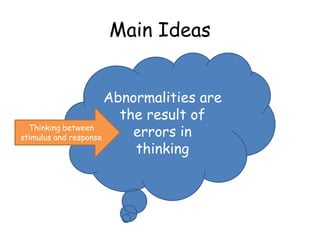
                      Abnormalities are
                        the result of
  Thinking between
stimulus and response     errors in
                          thinking
Cognitive Approach contd...
• Errors in thinking

• Heavily influenced by the behavioural
  approach

• Thinking between the stimulus and the
  response

• Mental disorders are linked directly to
  distortions in the thinking process
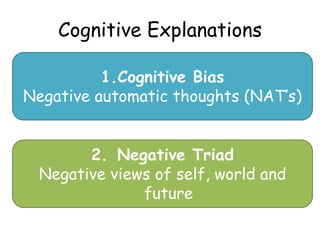
Cognitive Explanations

          1.Cognitive Bias
Negative automatic thoughts (NAT’s)


       2. Negative Triad
 Negative views of self, world and
              future
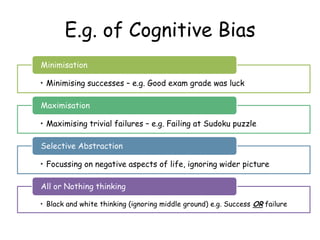
E.g. of Cognitive Bias
Minimisation

• Minimising successes – e.g. Good exam grade was luck

Maximisation

• Maximising trivial failures – e.g. Failing at Sudoku puzzle

Selective Abstraction

• Focussing on negative aspects of life, ignoring wider picture

All or Nothing thinking

• Black and white thinking (ignoring middle ground) e.g. Success OR failure
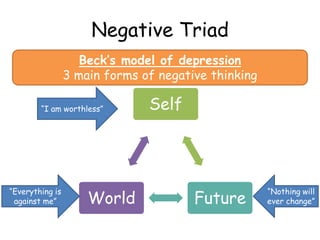
Negative Triad
                    Beck’s model of depression
                 3 main forms of negative thinking

        “I am worthless”       Self


                     World             Future
“Everything is                                       “Nothing will
 against me”                                         ever change”
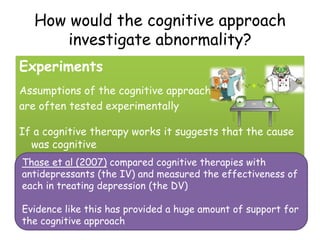
How would the cognitive approach
       investigate abnormality?
Experiments
Assumptions of the cognitive approach
are often tested experimentally

If a cognitive therapy works it suggests that the cause
  was cognitive
Thase et al (2007) compared cognitive therapies with
antidepressants (the IV) and measured the effectiveness of
each in treating depression (the DV)

Evidence like this has provided a huge amount of support for
the cognitive approach
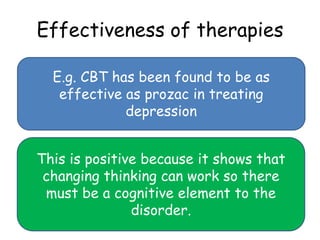
Effectiveness of therapies

  E.g. CBT has been found to be as
   effective as prozac in treating
             depression


This is positive because it shows that
 changing thinking can work so there
 must be a cognitive element to the
               disorder.
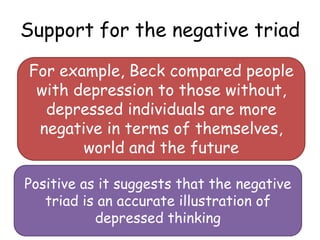
Support for the negative triad

For example, Beck compared people
 with depression to those without,
  depressed individuals are more
 negative in terms of themselves,
       world and the future

Positive as it suggests that the negative
   triad is an accurate illustration of
           depressed thinking
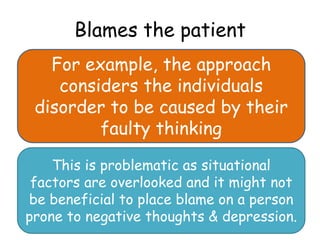
Blames the patient
   For example, the approach
    considers the individuals
 disorder to be caused by their
         faulty thinking

    This is problematic as situational
 factors are overlooked and it might not
be beneficial to place blame on a person
prone to negative thoughts & depression.
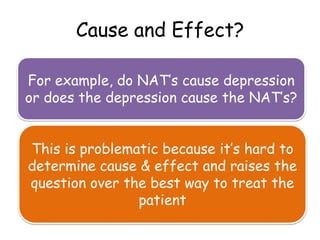
Cause and Effect?

For example, do NAT’s cause depression
or does the depression cause the NAT’s?


This is problematic because it’s hard to
determine cause & effect and raises the
question over the best way to treat the
                patient
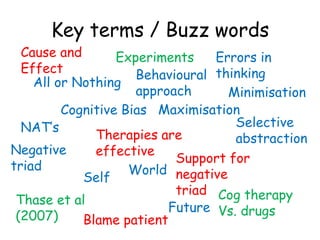
Key terms / Buzz words
  Cause and       Experiments    Errors in
  Effect             Behavioural thinking
    All or Nothing
                     approach      Minimisation
         Cognitive Bias Maximisation
  NAT’s                             Selective
              Therapies are         abstraction
Negative      effective
                           Support for
triad               World negative
            Self
                           triad Cog therapy
 Thase et al
                          Future Vs. drugs
 (2007)     Blame patient
Cognitive
   Therapies/Treatments

• Rational-Emotive Behavioural Therapy
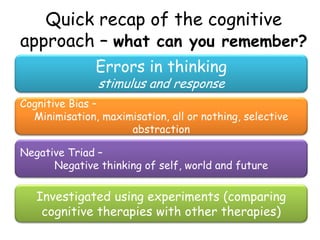
Quick recap of the cognitive
approach – what can you remember?
               Errors in thinking
               stimulus and response
Cognitive Bias –
  Minimisation, maximisation, all or nothing, selective
                     abstraction

Negative Triad –
      Negative thinking of self, world and future

   Investigated using experiments (comparing
    cognitive therapies with other therapies)
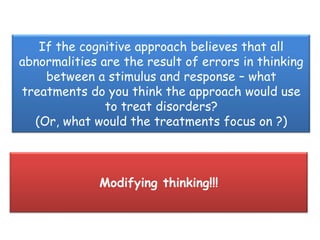
If the cognitive approach believes that all
abnormalities are the result of errors in thinking
    between a stimulus and response – what
treatments do you think the approach would use
               to treat disorders?
  (Or, what would the treatments focus on ?)


              Modifying thinking!!!
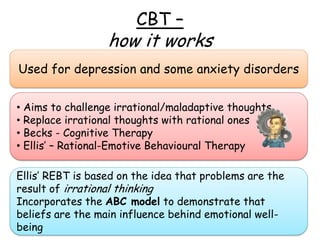
CBT –
                  how it works
Used for depression and some anxiety disorders


• Aims to challenge irrational/maladaptive thoughts
• Replace irrational thoughts with rational ones
• Becks - Cognitive Therapy
• Ellis’ – Rational-Emotive Behavioural Therapy

Ellis’ REBT is based on the idea that problems are the
result of irrational thinking
Incorporates the ABC model to demonstrate that
beliefs are the main influence behind emotional well-
being
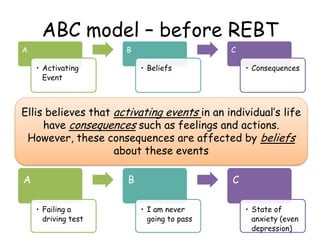
ABC model – before REBT
A                     B                      C

    • Activating           • Beliefs              • Consequences
      Event


Ellis believes that activating events in an individual’s life
     have consequences such as feelings and actions.
 However, these consequences are affected by beliefs
                    about these events

A                      B                      C

    • Failing a            • I am never           • State of
      driving test           going to pass          anxiety (even
                                                    depression)
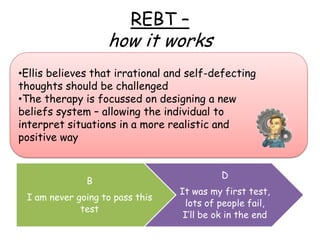
REBT –
                   how it works
•Ellis believes that irrational and self-defecting
thoughts should be challenged
•The therapy is focussed on designing a new
beliefs system – allowing the individual to
interpret situations in a more realistic and
positive way


                                           D
              B
                                 It was my first test,
 I am never going to pass this
                                  lots of people fail,
             test
                                  I’ll be ok in the end
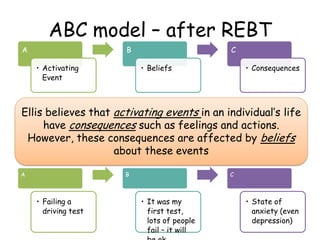
ABC model – after REBT
A                     B                      C

    • Activating          • Beliefs              • Consequences
      Event


Ellis believes that activating events in an individual’s life
     have consequences such as feelings and actions.
 However, these consequences are affected by beliefs
                    about these events

A                     B                      C


    • Failing a           • It was my            • State of
      driving test          first test,            anxiety (even
                            lots of people         depression)
                            fail – it will
REBT – how it works
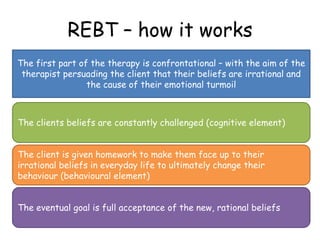
The first part of the therapy is confrontational – with the aim of the
 therapist persuading the client that their beliefs are irrational and
                 the cause of their emotional turmoil


The clients beliefs are constantly challenged (cognitive element)


The client is given homework to make them face up to their
irrational beliefs in everyday life to ultimately change their
behaviour (behavioural element)


The eventual goal is full acceptance of the new, rational beliefs
REBT – how it works

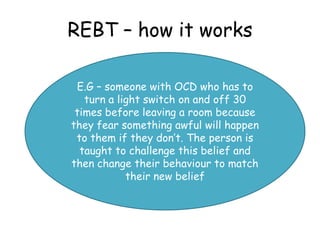
 E.G – someone with OCD who has to
   turn a light switch on and off 30
 times before leaving a room because
they fear something awful will happen
 to them if they don’t. The person is
  taught to challenge this belief and
then change their behaviour to match
            their new belief
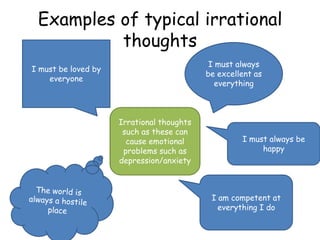
Examples of typical irrational
          thoughts
                                            I must always
I must be loved by
                                           be excellent as
    everyone
                                              everything


                     Irrational thoughts
                      such as these can
                       cause emotional              I must always be
                      problems such as                   happy
                     depression/anxiety


                                            I am competent at
                                              everything I do
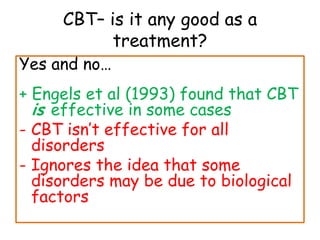
CBT– is it any good as a
           treatment?
Yes and no…
+ Engels et al (1993) found that CBT
  is effective in some cases
- CBT isn’t effective for all
  disorders
- Ignores the idea that some
  disorders may be due to biological
  factors
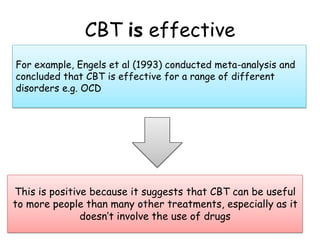
CBT is effective
For example, Engels et al (1993) conducted meta-analysis and
concluded that CBT is effective for a range of different
disorders e.g. OCD


This is positive because it suggests that CBT can be useful
to more people than many other treatments, especially as it
               doesn’t involve the use of drugs
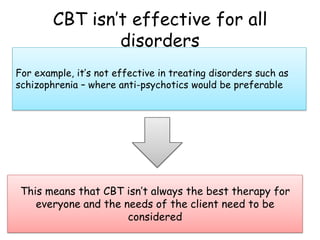
CBT isn’t effective for all
                disorders
For example, it’s not effective in treating disorders such as
schizophrenia – where anti-psychotics would be preferable


 This means that CBT isn’t always the best therapy for
    everyone and the needs of the client need to be
                      considered
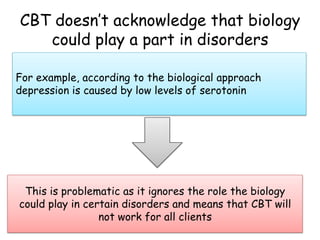
CBT doesn’t acknowledge that biology
   could play a part in disorders

For example, according to the biological approach
depression is caused by low levels of serotonin


 This is problematic as it ignores the role the biology
could play in certain disorders and means that CBT will
                 not work for all clients

Cognitive approach & therapies

  • 1.
  • 2.
    Main Ideas Abnormalities are the result of Thinking between stimulus and response errors in thinking
  • 3.
    Cognitive Approach contd... •Errors in thinking • Heavily influenced by the behavioural approach • Thinking between the stimulus and the response • Mental disorders are linked directly to distortions in the thinking process
  • 4.
    Cognitive Explanations 1.Cognitive Bias Negative automatic thoughts (NAT’s) 2. Negative Triad Negative views of self, world and future
  • 5.
    E.g. of CognitiveBias Minimisation • Minimising successes – e.g. Good exam grade was luck Maximisation • Maximising trivial failures – e.g. Failing at Sudoku puzzle Selective Abstraction • Focussing on negative aspects of life, ignoring wider picture All or Nothing thinking • Black and white thinking (ignoring middle ground) e.g. Success OR failure
  • 6.
    Negative Triad Beck’s model of depression 3 main forms of negative thinking “I am worthless” Self World Future “Everything is “Nothing will against me” ever change”
  • 7.
    How would thecognitive approach investigate abnormality? Experiments Assumptions of the cognitive approach are often tested experimentally If a cognitive therapy works it suggests that the cause was cognitive Thase et al (2007) compared cognitive therapies with antidepressants (the IV) and measured the effectiveness of each in treating depression (the DV) Evidence like this has provided a huge amount of support for the cognitive approach
  • 8.
    Effectiveness of therapies E.g. CBT has been found to be as effective as prozac in treating depression This is positive because it shows that changing thinking can work so there must be a cognitive element to the disorder.
  • 9.
    Support for thenegative triad For example, Beck compared people with depression to those without, depressed individuals are more negative in terms of themselves, world and the future Positive as it suggests that the negative triad is an accurate illustration of depressed thinking
  • 10.
    Blames the patient For example, the approach considers the individuals disorder to be caused by their faulty thinking This is problematic as situational factors are overlooked and it might not be beneficial to place blame on a person prone to negative thoughts & depression.
  • 11.
    Cause and Effect? Forexample, do NAT’s cause depression or does the depression cause the NAT’s? This is problematic because it’s hard to determine cause & effect and raises the question over the best way to treat the patient
  • 12.
    Key terms /Buzz words Cause and Experiments Errors in Effect Behavioural thinking All or Nothing approach Minimisation Cognitive Bias Maximisation NAT’s Selective Therapies are abstraction Negative effective Support for triad World negative Self triad Cog therapy Thase et al Future Vs. drugs (2007) Blame patient
  • 13.
    Cognitive Therapies/Treatments • Rational-Emotive Behavioural Therapy
  • 14.
    Quick recap ofthe cognitive approach – what can you remember? Errors in thinking stimulus and response Cognitive Bias – Minimisation, maximisation, all or nothing, selective abstraction Negative Triad – Negative thinking of self, world and future Investigated using experiments (comparing cognitive therapies with other therapies)
  • 15.
    If the cognitiveapproach believes that all abnormalities are the result of errors in thinking between a stimulus and response – what treatments do you think the approach would use to treat disorders? (Or, what would the treatments focus on ?) Modifying thinking!!!
  • 16.
    CBT – how it works Used for depression and some anxiety disorders • Aims to challenge irrational/maladaptive thoughts • Replace irrational thoughts with rational ones • Becks - Cognitive Therapy • Ellis’ – Rational-Emotive Behavioural Therapy Ellis’ REBT is based on the idea that problems are the result of irrational thinking Incorporates the ABC model to demonstrate that beliefs are the main influence behind emotional well- being
  • 17.
    ABC model –before REBT A B C • Activating • Beliefs • Consequences Event Ellis believes that activating events in an individual’s life have consequences such as feelings and actions. However, these consequences are affected by beliefs about these events A B C • Failing a • I am never • State of driving test going to pass anxiety (even depression)
  • 18.
    REBT – how it works •Ellis believes that irrational and self-defecting thoughts should be challenged •The therapy is focussed on designing a new beliefs system – allowing the individual to interpret situations in a more realistic and positive way D B It was my first test, I am never going to pass this lots of people fail, test I’ll be ok in the end
  • 19.
    ABC model –after REBT A B C • Activating • Beliefs • Consequences Event Ellis believes that activating events in an individual’s life have consequences such as feelings and actions. However, these consequences are affected by beliefs about these events A B C • Failing a • It was my • State of driving test first test, anxiety (even lots of people depression) fail – it will
  • 20.
    REBT – howit works The first part of the therapy is confrontational – with the aim of the therapist persuading the client that their beliefs are irrational and the cause of their emotional turmoil The clients beliefs are constantly challenged (cognitive element) The client is given homework to make them face up to their irrational beliefs in everyday life to ultimately change their behaviour (behavioural element) The eventual goal is full acceptance of the new, rational beliefs
  • 21.
    REBT – howit works E.G – someone with OCD who has to turn a light switch on and off 30 times before leaving a room because they fear something awful will happen to them if they don’t. The person is taught to challenge this belief and then change their behaviour to match their new belief
  • 22.
    Examples of typicalirrational thoughts I must always I must be loved by be excellent as everyone everything Irrational thoughts such as these can cause emotional I must always be problems such as happy depression/anxiety I am competent at everything I do
  • 23.
    CBT– is itany good as a treatment? Yes and no… + Engels et al (1993) found that CBT is effective in some cases - CBT isn’t effective for all disorders - Ignores the idea that some disorders may be due to biological factors
  • 24.
    CBT is effective Forexample, Engels et al (1993) conducted meta-analysis and concluded that CBT is effective for a range of different disorders e.g. OCD This is positive because it suggests that CBT can be useful to more people than many other treatments, especially as it doesn’t involve the use of drugs
  • 25.
    CBT isn’t effectivefor all disorders For example, it’s not effective in treating disorders such as schizophrenia – where anti-psychotics would be preferable This means that CBT isn’t always the best therapy for everyone and the needs of the client need to be considered
  • 26.
    CBT doesn’t acknowledgethat biology could play a part in disorders For example, according to the biological approach depression is caused by low levels of serotonin This is problematic as it ignores the role the biology could play in certain disorders and means that CBT will not work for all clients