COGNITIVE BEHAVIOR 
THERAPY
Rational Emotive Therapy (REBT) 
- proposed by Albert Ellis (1913-2007), an American 
Psychologist who was known to be an abrasive, 
humorous and flamboyant speaker 
- Ellis has rightly been referred to as the grandfather of 
cognitive behaviour therapy
Tenets/Key Points 
- psychological problems are often due to people’s rigid and extreme 
beliefs they hold about events and situations 
- emotions stems mainly from our beliefs which influence the evaluations 
and interpretations people make of the reactions we have to life 
situations 
- human beings are born with both potential for both rational and 
irrational thinking 
- people learn irrational beliefs from significant others during childhood 
and then re-create these irrational beliefs throughout lifetime and then 
behave in ways that are consistent with this beliefs
- blame is at the core of most emotional disturbances. To 
be psychologically healthy, people need to stop blaming 
themselves and others and learn to fully and 
unconditionally accept themselves despite its 
imperfections 
- “people are disturbed not by events, but by the views 
which they take of them”
- people have strong tendencies to transform desires and 
preferences into dogmatic “shoulds”, “musts”, “oughts”, 
demands and commands. When people are disturbed, it is good 
to look to their hidden dogmas. Such demands underpin 
disruptive feelings and dysfunctional behaviors.
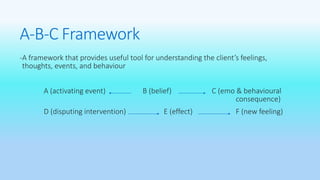
A-B-C Framework 
-A framework that provides useful tool for understanding the client’s feelings, 
thoughts, events, and behaviour 
A (activating event) B (belief) C (emo & behavioural 
consequence) 
D (disputing intervention) E (effect) F (new feeling)
Therapeutic Goals 
- learn skills that give them tools to identify and dispute 
irrational beliefs 
- replace ineffective ways of thinking with effective and rational 
cognitions, and as a result they change their emotional 
reactions to situations 
- focus is on working with thinking and acting rather than 
primarily with expressing feelings. Therapy is seen as an 
educational process
- acquiring a more realistic and workable philosophy of life 
- to assist clients in the process of achieving unconditional self-acceptance 
(USA) and unconditional other acceptance (UOA), 
and see how these are interrelated. As clients become more 
able to accept themselves, they are more likely to 
unconditionally accept others
Therapist’s Function and Role 
-Therapist teaches clients how to feel sad, but not depressed 
- encourage clients to be less emotionally reactive, for example, but feeling sadness 
and disappointment about life’s adversities rather than by feeling anxiety, depression 
and shame 
- therapist disputes clients’ irrational beliefs and to replace their rigid “musts” with 
preferences 
- demonstrate how clients are keeping their emotional disturbances active by 
continuing to think illogically and unrealistically 
- helping clients modify their thinking and minimize their irrational ideas by 
encouraging clients to identify the irrational beliefs they originally unquestioningly 
accepted and demonstrates how they are continuing themselves with these beliefs
- challenge clients to develop a rational philosophy of life so 
that in the future they can avoid becoming a victim of other 
irrational beliefs 
- teach the clients about the cognitive hypothesis of disturbance 
and showing how rigid and extreme irrational beliefs lead to 
disturbed negative consequences
APPLICATION 
-Cognitive Methods 
- disputing irrational beliefs 
- doing cognitive homework 
- bibliotherapy 
- changing one’s language 
- psychoeducational methods 
- cognitive restructuring
- Emotive Techniques 
- rational emotive imaginary 
- using humor 
- role playing 
- shame-attacking exercises 
- Behavioral Techniques
COGNITIVE THERAPY
Cognitive Therapy 
- proposed by Aaron T. Beck as a result of his research of 
depression 
- cognitive distortions are contributed by the negative bias in 
the interpretation of certain life events 
- perceives psychological problems as stemming from faulty 
thinking, making incorrect inferences on the basis of inadequate 
or incorrect information, and failing to distinguish between 
fantasy and reality 
- the way people feel and behave is influenced by how they 
perceive and structure their experience
** Systematic errors or logical errors in reasoning that 
lead to faulty assumptions and misconceptions 
1. arbitrary inferences – refer to making conclusions 
without supporting and relevant evidence. This includes 
catastrophizing or thinking of the absolute worst scenario 
or situation 
2. selective abstraction – forming conclusions based on 
an isolated detail of an event. In this process other 
information is ignored, and the significance of the total 
context is missed
3. Overgeneralization – process of holding extreme beliefs on a 
basis of a single incident and applying them inappropriately to 
disseminate events or settings 
4. Magnification and minimization – perceiving case or situation 
in a greater or lesser light that it deserves 
5. Personalization – tendency for individuals to relate external 
events to themselves, even when there is no basis for making 
this connection
6. Labelling and mislabelling – portraying one’s identity on the 
basis of imperfections and mistakes made in the past and 
allowing them to define one’s true identity 
7. Dichotomous thinking – categorizing experiences in either-or 
extremes. Events are labelled in black and white terms
- cognitive techniques focus on identifying and examining 
client’s beliefs, exploring the origins of these beliefs, and 
modifying them if the client cannot support these beliefs.
Therapeutic Goals 
- emphasize recognizing and changing unrealistic 
negative thoughts and maladaptive beliefs 
- To assist clients in examining and restructuring their 
core beliefs
- an important way to produce lasting change in 
dysfunctional emotions and behaviours is to modify 
inaccurate and dysfunctional thinking 
- clients learn to employ specific problem-solving and 
coping skills
- clients are expected to identify the distortions in their 
thinking, summarize important points in the session, and 
collaboratively devise homework assignments that they 
agree to carry out 
- the aim is to identify specific, measurable goals and to 
move directly into the areas that are causing the most 
difficulty for clients
Therapist’s Function and Role 
- encourage clients to gather and weigh the evidence in 
support of their beliefs, therapists help clients bring about 
enduring changes in their mood and their behaviour 
- teaches clients how to identify these distorted and 
dysfunctional cognitions through a process of evaluation 
- clients learn to engage in more realistic thinking, especially 
if they consistently notice times when they tend to get 
caught up in catastrophic thinking
- clients are taught to test these automatic thoughts 
against reality by examining and weighing the evidence 
for and against them 
- therapist considers it essential to understand how and 
when certain core dysfunctional beliefs originated and 
how these ideas have a current impact on the client’s 
specific schema
- therapists must also have a cognitive conceptualization of 
cases, be creative and active, be able to engage clients through 
a Socratic questioning and be knowledgeable and skilled in the 
use of cognitive and behavioural strategies aimed at guiding 
clients in self-discoveries that will lead to change 
- help clients frame their conclusions in the form of testable 
hypotheses 
- therapists aim to teach clients how to be their own therapist. 
Typically they will educate clients about the nature and course 
of their problem, about the process of cognitive therapy and 
how thoughts influence their emotions and behaviours
Applications of Cognitive Therapy 
- behavioural techniques typically used by cognitive therapists include activity 
scheduling, behavioural experiments, skills training, role playing, behavioural 
rehearsal, and exposure therapy 
- therapist would ask you to look at your inferences which may be faulty, and may 
investigate whether these inferences can be traced back to earlier experiences in your 
life 
- learn about the process of magnification and minimization of thinking. The therapist 
would assist the client how he/she disregard important aspect of the situation , 
engage in overly simplified and rigid thinking, and generalize from a single incident of 
future
Cognitive behavior therapy

Cognitive behavior therapy

  • 1.
  • 2.
    Rational Emotive Therapy(REBT) - proposed by Albert Ellis (1913-2007), an American Psychologist who was known to be an abrasive, humorous and flamboyant speaker - Ellis has rightly been referred to as the grandfather of cognitive behaviour therapy
  • 3.
    Tenets/Key Points -psychological problems are often due to people’s rigid and extreme beliefs they hold about events and situations - emotions stems mainly from our beliefs which influence the evaluations and interpretations people make of the reactions we have to life situations - human beings are born with both potential for both rational and irrational thinking - people learn irrational beliefs from significant others during childhood and then re-create these irrational beliefs throughout lifetime and then behave in ways that are consistent with this beliefs
  • 4.
    - blame isat the core of most emotional disturbances. To be psychologically healthy, people need to stop blaming themselves and others and learn to fully and unconditionally accept themselves despite its imperfections - “people are disturbed not by events, but by the views which they take of them”
  • 5.
    - people havestrong tendencies to transform desires and preferences into dogmatic “shoulds”, “musts”, “oughts”, demands and commands. When people are disturbed, it is good to look to their hidden dogmas. Such demands underpin disruptive feelings and dysfunctional behaviors.
  • 6.
    A-B-C Framework -Aframework that provides useful tool for understanding the client’s feelings, thoughts, events, and behaviour A (activating event) B (belief) C (emo & behavioural consequence) D (disputing intervention) E (effect) F (new feeling)
  • 7.
    Therapeutic Goals -learn skills that give them tools to identify and dispute irrational beliefs - replace ineffective ways of thinking with effective and rational cognitions, and as a result they change their emotional reactions to situations - focus is on working with thinking and acting rather than primarily with expressing feelings. Therapy is seen as an educational process
  • 8.
    - acquiring amore realistic and workable philosophy of life - to assist clients in the process of achieving unconditional self-acceptance (USA) and unconditional other acceptance (UOA), and see how these are interrelated. As clients become more able to accept themselves, they are more likely to unconditionally accept others
  • 9.
    Therapist’s Function andRole -Therapist teaches clients how to feel sad, but not depressed - encourage clients to be less emotionally reactive, for example, but feeling sadness and disappointment about life’s adversities rather than by feeling anxiety, depression and shame - therapist disputes clients’ irrational beliefs and to replace their rigid “musts” with preferences - demonstrate how clients are keeping their emotional disturbances active by continuing to think illogically and unrealistically - helping clients modify their thinking and minimize their irrational ideas by encouraging clients to identify the irrational beliefs they originally unquestioningly accepted and demonstrates how they are continuing themselves with these beliefs
  • 10.
    - challenge clientsto develop a rational philosophy of life so that in the future they can avoid becoming a victim of other irrational beliefs - teach the clients about the cognitive hypothesis of disturbance and showing how rigid and extreme irrational beliefs lead to disturbed negative consequences
  • 11.
    APPLICATION -Cognitive Methods - disputing irrational beliefs - doing cognitive homework - bibliotherapy - changing one’s language - psychoeducational methods - cognitive restructuring
  • 12.
    - Emotive Techniques - rational emotive imaginary - using humor - role playing - shame-attacking exercises - Behavioral Techniques
  • 13.
  • 14.
    Cognitive Therapy -proposed by Aaron T. Beck as a result of his research of depression - cognitive distortions are contributed by the negative bias in the interpretation of certain life events - perceives psychological problems as stemming from faulty thinking, making incorrect inferences on the basis of inadequate or incorrect information, and failing to distinguish between fantasy and reality - the way people feel and behave is influenced by how they perceive and structure their experience
  • 15.
    ** Systematic errorsor logical errors in reasoning that lead to faulty assumptions and misconceptions 1. arbitrary inferences – refer to making conclusions without supporting and relevant evidence. This includes catastrophizing or thinking of the absolute worst scenario or situation 2. selective abstraction – forming conclusions based on an isolated detail of an event. In this process other information is ignored, and the significance of the total context is missed
  • 16.
    3. Overgeneralization –process of holding extreme beliefs on a basis of a single incident and applying them inappropriately to disseminate events or settings 4. Magnification and minimization – perceiving case or situation in a greater or lesser light that it deserves 5. Personalization – tendency for individuals to relate external events to themselves, even when there is no basis for making this connection
  • 17.
    6. Labelling andmislabelling – portraying one’s identity on the basis of imperfections and mistakes made in the past and allowing them to define one’s true identity 7. Dichotomous thinking – categorizing experiences in either-or extremes. Events are labelled in black and white terms
  • 18.
    - cognitive techniquesfocus on identifying and examining client’s beliefs, exploring the origins of these beliefs, and modifying them if the client cannot support these beliefs.
  • 19.
    Therapeutic Goals -emphasize recognizing and changing unrealistic negative thoughts and maladaptive beliefs - To assist clients in examining and restructuring their core beliefs
  • 20.
    - an importantway to produce lasting change in dysfunctional emotions and behaviours is to modify inaccurate and dysfunctional thinking - clients learn to employ specific problem-solving and coping skills
  • 21.
    - clients areexpected to identify the distortions in their thinking, summarize important points in the session, and collaboratively devise homework assignments that they agree to carry out - the aim is to identify specific, measurable goals and to move directly into the areas that are causing the most difficulty for clients
  • 22.
    Therapist’s Function andRole - encourage clients to gather and weigh the evidence in support of their beliefs, therapists help clients bring about enduring changes in their mood and their behaviour - teaches clients how to identify these distorted and dysfunctional cognitions through a process of evaluation - clients learn to engage in more realistic thinking, especially if they consistently notice times when they tend to get caught up in catastrophic thinking
  • 23.
    - clients aretaught to test these automatic thoughts against reality by examining and weighing the evidence for and against them - therapist considers it essential to understand how and when certain core dysfunctional beliefs originated and how these ideas have a current impact on the client’s specific schema
  • 24.
    - therapists mustalso have a cognitive conceptualization of cases, be creative and active, be able to engage clients through a Socratic questioning and be knowledgeable and skilled in the use of cognitive and behavioural strategies aimed at guiding clients in self-discoveries that will lead to change - help clients frame their conclusions in the form of testable hypotheses - therapists aim to teach clients how to be their own therapist. Typically they will educate clients about the nature and course of their problem, about the process of cognitive therapy and how thoughts influence their emotions and behaviours
  • 25.
    Applications of CognitiveTherapy - behavioural techniques typically used by cognitive therapists include activity scheduling, behavioural experiments, skills training, role playing, behavioural rehearsal, and exposure therapy - therapist would ask you to look at your inferences which may be faulty, and may investigate whether these inferences can be traced back to earlier experiences in your life - learn about the process of magnification and minimization of thinking. The therapist would assist the client how he/she disregard important aspect of the situation , engage in overly simplified and rigid thinking, and generalize from a single incident of future