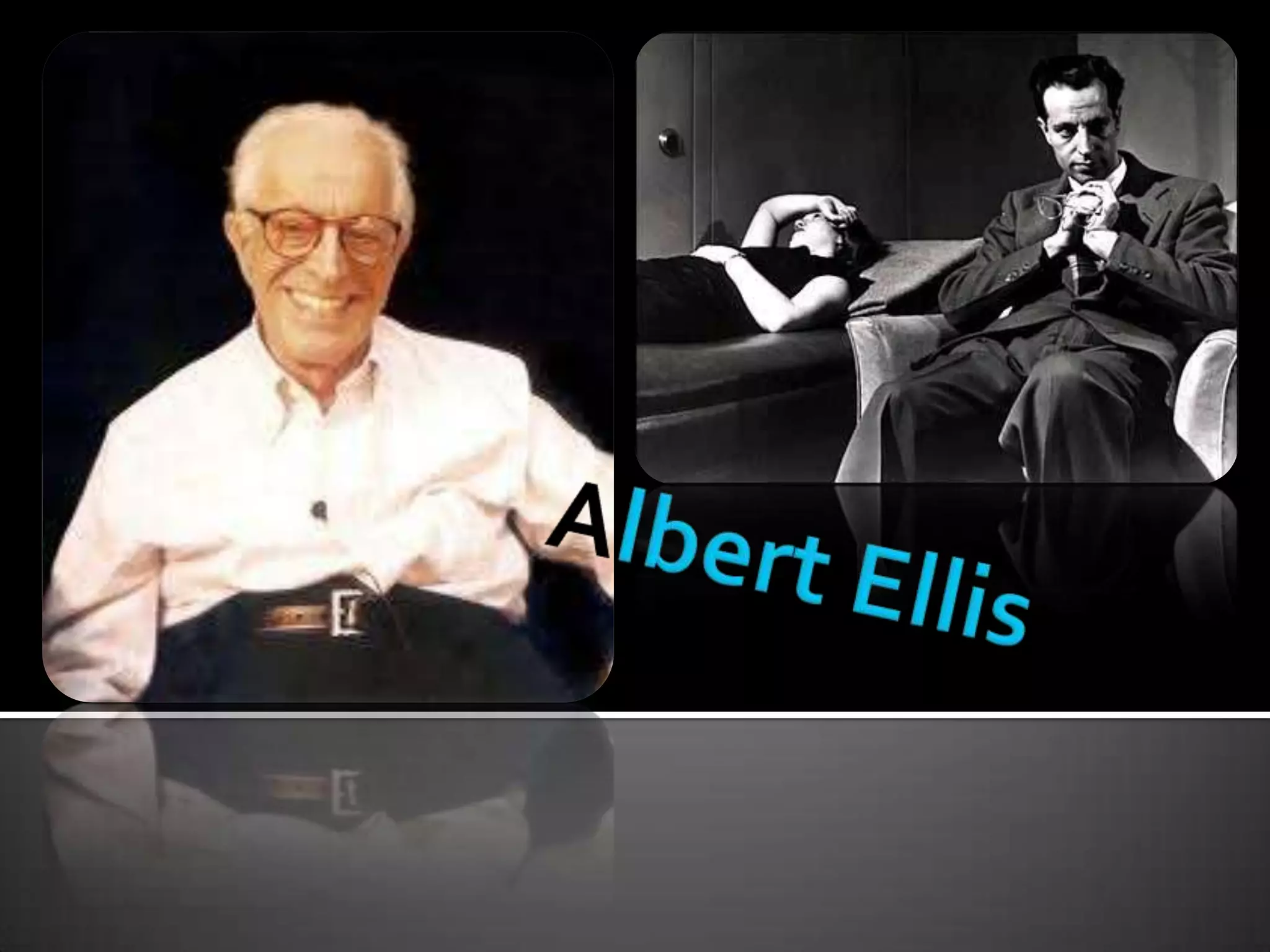
Albert Ellis
Albert EllisEllis was born in Pittsburgh in 1913 and raised in New York City. He made the best of a difficult childhood by using his head and becoming, in his words, "a stubborn and pronounced problem-solver." A serious kidney disorder turned his attention from sports to books, and the strife in his family (his parents were divorced when he was 12) led him to work at understanding others.
Albert EllisIn junior high school Ellis set his sights on becoming the Great American Novelist. He planned to study accounting in high school and college, make enough money to retire at 30, and write without the pressure of financial need. The Great Depression put an end to his vision, but he made it through college in 1934 with a degree in business administration from the City University of New York.
Albert EllisEllis devoted most of his spare time to writing short stories, plays, novels, comic poetry, essays and nonfiction books. By the time he was 28, he had finished almost two dozen full-length manuscripts, but had not been able to get them published. He realized his future did not lie in writing fiction, and turned exclusively to nonfiction, to promoting what he called the "sex-family revolution."
Albert EllisAt the time Columbia awarded him a doctorate in 1947 Ellis had come to believe that psychoanalysis was the deepest and most effective form of therapy. He decided to undertake a training analysis, and "become an outstanding psychoanalyst the next few years." The psychoanalytic institutes refused to take trainees without M.D.s, but he found an analyst with the Karen Horney group who agreed to work with him. Ellis completed a full analysis and began to practice classical psychoanalysis under his teacher's direction.
Albert EllisBy 1955 Ellis had given up psychoanalysis entirely, and instead was concentrating on changing people's behavior by confronting them with their irrational beliefs and persuading them to adopt rational ones. This role was more to Ellis' taste, for he could be more honestly himself. "When I became rational-emotive," he said, "my own personality processes really began to vibrate.“
Albert EllisHe published his first book on REBT, How to Live with a Neurotic, in 1957. Two years later he organized the Institute for Rational Living, where he held workshops to teach his principles to other therapists. The Art and Science of Love, his first really successful book, appeared in 1960, and he has now published 54 books and over 600 articles on REBT, sex and marriage.Albert Ellis died of heart and kidney failure July 24, 2007
Rational Emotive Behavior TherapyREBTREBT—interrelation of thought, feeling, and behaviorHuman thinking and emotion are not two different processes—our thinking, emoting, and acting all interact togetherREBT is based on the concept that emotions and behaviors result from cognitive processes
Rational Emotive Behavior TherapyREBT is a philosophically-based, humanistic approach that emphasizes individuals’ capacity for creating their own self-enhancing and self-defeating emotions. Ellis borrowed from philosophy. Epictetus, the Stoic philosopher said, “People are not influenced by things but their view of things.”REBT holds that an individual’s belief system affects whether s/he  attains maximum pleasure and self-actualization. Happiness is the goal of all human beings.REBT is a theory of how people (who want happiness) can inadvertently create personality and emotional disturbance.
Rational Emotive Behavior TherapyREBT seeks to help people understand that it is not past or present events that “cause” emotional disturbancesIt is the individual’s belief system about the event, self, others and the world that cause such disturbances—what Ellis called irrational beliefs
Rational Emotive Behavior TherapyUnhealthy functioning occurs when a person places unrealistic and absolutist demands on self and others—musturbatory thinking (e.g., “I must be able to always get what I want”; “I must be able to do everything perfectly”)These demands often lead to feelings of unhealthy anger, rage, guilt, depression, anxiety or shame
Rational Emotive Behavior TherapyIrrational Beliefs are beliefs that are unrealistic, illogical, absolutistThey arise from taking a sensible preference or desire and raising it to a grandiose, absolutist must or demandIt is a person’s irrational beliefs that lead to great anxiety, depression, shame, anger, guilt, not the event which he/she is experiencing
Rational Emotive Behavior TherapyPeople continuously reindoctrinate themselves with these irrational beliefs, upsetting themselves, making themselves feel miserableBecause it is easy for people to make themselves miserable and hold on to self-defeating thoughts, feelings and behaviors, one can overcome such disturbances by vigorously disputing them
Definition of Rational ThinkingEmpirically consistent with realityLogicalGoal-facilitatingNon-absolutist (flexible)Preferential (expresses a desire not a demand)
Definition of Irrational ThinkingCan’t be empirically validated and/or is inconsistent w/ confirmable realityIllogicalBlocks goalsDogmatic instead of flexibleDemand rather than preference	(Ellis calls this musturbation)
Irrational Beliefs1. The idea that it is a dire necessity for adults to be loved by significant others for almost everything they do -- instead of their concentrating on their own self-respect, on winning approval for practical purposes, and on loving rather than on being loved.It is irrational because . . .It is more rational to . . .
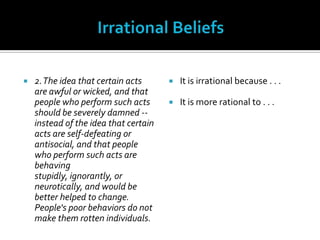
Irrational Beliefs2. The idea that certain acts are awful or wicked, and that people who perform such acts should be severely damned -- instead of the idea that certain acts are self-defeating or antisocial, and that people who perform such acts are behaving stupidly, ignorantly, or neurotically, and would be better helped to change. People's poor behaviors do not make them rotten individuals.It is irrational because . . .It is more rational to . . .
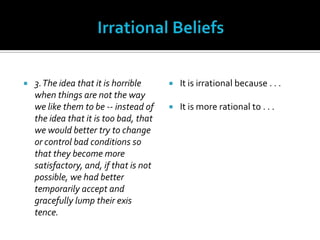
Irrational Beliefs3. The idea that it is horrible when things are not the way we like them to be -- instead of the idea that it is too bad, that we would better try to change or control bad conditions so that they become more satisfactory, and, if that is not possible, we had better temporarily accept and gracefully lump their existence.It is irrational because . . .It is more rational to . . .
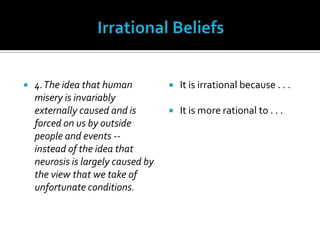
Irrational Beliefs4. The idea that human misery is invariably externally caused and is forced on us by outside people and events -- instead of the idea that neurosis is largely caused by the view that we take of unfortunate conditions.It is irrational because . . .It is more rational to . . .
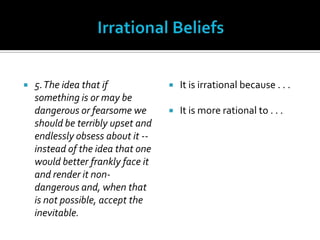
Irrational Beliefs5. The idea that if something is or may be dangerous or fearsome we should be terribly upset and endlessly obsess about it -- instead of the idea that one would better frankly face it and render it non-dangerous and, when that is not possible, accept the inevitable.It is irrational because . . .It is more rational to . . .
Irrational Beliefs6. The idea that it is easier to avoid than to face life difficulties and self-responsibilities -- instead of the idea that the so-called easy way is usually much harder in the long run.It is irrational because . . .It is more rational to . . .
Irrational Beliefs7. The idea that we absolutely need something other or stronger or greater than ourself on which to rely -- instead of the idea that it is better to take the risks of thinking and acting less dependently.It is irrational because . . .It is more rational to . . .
Irrational Beliefs8. The idea that we should be thoroughly competent, intelligent, and achieving in all possible respects -- instead of the idea that we would better do rather than always need to do well and accept ourself as a quite imperfect creature, who has general human limitations and specific fallibilities.It is irrational because . . .It is more rational to . . .
Irrational Beliefs9. The idea that because something once strongly affected our life, it should indefinitely affect it -- instead of the idea that we can learn from our past experiences but not be overly-attached to or prejudiced by them..It is irrational because . . .It is more rational to . . .
Irrational Beliefs10. The idea that we must have certain and perfect control over things -- instead of the idea that the world is full of probability and chance and that we can still enjoy life despite thisIt is irrational because . . .It is more rational to . . .
Irrational Beliefs11. The idea that human happiness can be achieved by inertia and inaction -- instead of the idea that we tend to  be happiest when we are vitally absorbed in creative pursuits, or when we are devoting ourselves to people or projects outside ourselves.It is irrational because . . .It is more rational to . . .
Irrational Beliefs12. The idea that we have virtually no control over our emotions and that we cannot help feeling disturbed about things -- instead of the idea that we have real control over our destructive emotions if we choose to work at changing the musturbatory hypotheses which we often employ to create them.It is irrational because . . .It is more rational to . . .
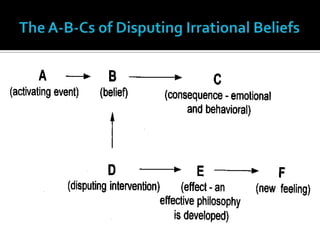
ABC ModelABC ModelA =	activating event (actual event, thought or image)B =	belief(s) about the eventC =	emotional and/or behavioral consequenceABC Model is used to help people understand the B-C connection and suggests that people are influenced by what they tell themselves. An ABC form is typically used. People initially only see the A-C connection (John made me angry… I am depressed because I didn’t get my raise)
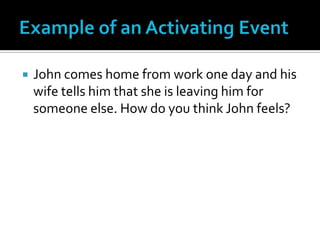
Example of an Activating EventJohn comes home from work one day and his wife tells him that she is leaving him for someone else. How do you think John feels?
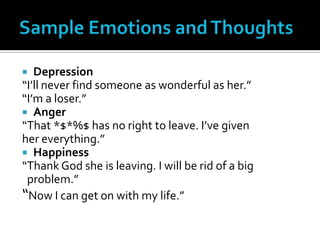
Sample Emotions and Thoughts Depression“I’ll never find someone as wonderful as her.”“I’m a loser.”Anger“That *$*%$ has no right to leave. I’ve given her everything.”Happiness“Thank God she is leaving. I will be rid of a big  problem.”“Now I can get on with my life.”
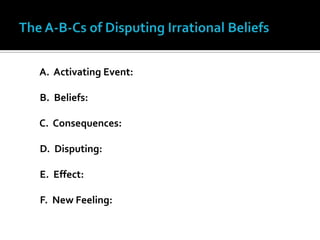
The A-B-Cs of Disputing Irrational Beliefs        A.  Activating Event:        B.  Beliefs:        C.  Consequences:        D.  Disputing:        E.  Effect:	   F.  New Feeling:
The A-B-Cs of Disputing Irrational Beliefs
THE ENDPrepared by: JC de Egurrolajeelchristine@i.ph

Albert Ellis

  • 1.
  • 2.
    Albert EllisEllis wasborn in Pittsburgh in 1913 and raised in New York City. He made the best of a difficult childhood by using his head and becoming, in his words, "a stubborn and pronounced problem-solver." A serious kidney disorder turned his attention from sports to books, and the strife in his family (his parents were divorced when he was 12) led him to work at understanding others.
  • 3.
    Albert EllisIn juniorhigh school Ellis set his sights on becoming the Great American Novelist. He planned to study accounting in high school and college, make enough money to retire at 30, and write without the pressure of financial need. The Great Depression put an end to his vision, but he made it through college in 1934 with a degree in business administration from the City University of New York.
  • 4.
    Albert EllisEllis devotedmost of his spare time to writing short stories, plays, novels, comic poetry, essays and nonfiction books. By the time he was 28, he had finished almost two dozen full-length manuscripts, but had not been able to get them published. He realized his future did not lie in writing fiction, and turned exclusively to nonfiction, to promoting what he called the "sex-family revolution."
  • 5.
    Albert EllisAt thetime Columbia awarded him a doctorate in 1947 Ellis had come to believe that psychoanalysis was the deepest and most effective form of therapy. He decided to undertake a training analysis, and "become an outstanding psychoanalyst the next few years." The psychoanalytic institutes refused to take trainees without M.D.s, but he found an analyst with the Karen Horney group who agreed to work with him. Ellis completed a full analysis and began to practice classical psychoanalysis under his teacher's direction.
  • 6.
    Albert EllisBy 1955Ellis had given up psychoanalysis entirely, and instead was concentrating on changing people's behavior by confronting them with their irrational beliefs and persuading them to adopt rational ones. This role was more to Ellis' taste, for he could be more honestly himself. "When I became rational-emotive," he said, "my own personality processes really began to vibrate.“
  • 7.
    Albert EllisHe publishedhis first book on REBT, How to Live with a Neurotic, in 1957. Two years later he organized the Institute for Rational Living, where he held workshops to teach his principles to other therapists. The Art and Science of Love, his first really successful book, appeared in 1960, and he has now published 54 books and over 600 articles on REBT, sex and marriage.Albert Ellis died of heart and kidney failure July 24, 2007
  • 8.
    Rational Emotive BehaviorTherapyREBTREBT—interrelation of thought, feeling, and behaviorHuman thinking and emotion are not two different processes—our thinking, emoting, and acting all interact togetherREBT is based on the concept that emotions and behaviors result from cognitive processes
  • 9.
    Rational Emotive BehaviorTherapyREBT is a philosophically-based, humanistic approach that emphasizes individuals’ capacity for creating their own self-enhancing and self-defeating emotions. Ellis borrowed from philosophy. Epictetus, the Stoic philosopher said, “People are not influenced by things but their view of things.”REBT holds that an individual’s belief system affects whether s/he attains maximum pleasure and self-actualization. Happiness is the goal of all human beings.REBT is a theory of how people (who want happiness) can inadvertently create personality and emotional disturbance.
  • 10.
    Rational Emotive BehaviorTherapyREBT seeks to help people understand that it is not past or present events that “cause” emotional disturbancesIt is the individual’s belief system about the event, self, others and the world that cause such disturbances—what Ellis called irrational beliefs
  • 11.
    Rational Emotive BehaviorTherapyUnhealthy functioning occurs when a person places unrealistic and absolutist demands on self and others—musturbatory thinking (e.g., “I must be able to always get what I want”; “I must be able to do everything perfectly”)These demands often lead to feelings of unhealthy anger, rage, guilt, depression, anxiety or shame
  • 12.
    Rational Emotive BehaviorTherapyIrrational Beliefs are beliefs that are unrealistic, illogical, absolutistThey arise from taking a sensible preference or desire and raising it to a grandiose, absolutist must or demandIt is a person’s irrational beliefs that lead to great anxiety, depression, shame, anger, guilt, not the event which he/she is experiencing
  • 13.
    Rational Emotive BehaviorTherapyPeople continuously reindoctrinate themselves with these irrational beliefs, upsetting themselves, making themselves feel miserableBecause it is easy for people to make themselves miserable and hold on to self-defeating thoughts, feelings and behaviors, one can overcome such disturbances by vigorously disputing them
  • 14.
    Definition of RationalThinkingEmpirically consistent with realityLogicalGoal-facilitatingNon-absolutist (flexible)Preferential (expresses a desire not a demand)
  • 15.
    Definition of IrrationalThinkingCan’t be empirically validated and/or is inconsistent w/ confirmable realityIllogicalBlocks goalsDogmatic instead of flexibleDemand rather than preference (Ellis calls this musturbation)
  • 16.
    Irrational Beliefs1. Theidea that it is a dire necessity for adults to be loved by significant others for almost everything they do -- instead of their concentrating on their own self-respect, on winning approval for practical purposes, and on loving rather than on being loved.It is irrational because . . .It is more rational to . . .
  • 17.
    Irrational Beliefs2. Theidea that certain acts are awful or wicked, and that people who perform such acts should be severely damned -- instead of the idea that certain acts are self-defeating or antisocial, and that people who perform such acts are behaving stupidly, ignorantly, or neurotically, and would be better helped to change. People's poor behaviors do not make them rotten individuals.It is irrational because . . .It is more rational to . . .
  • 18.
    Irrational Beliefs3. Theidea that it is horrible when things are not the way we like them to be -- instead of the idea that it is too bad, that we would better try to change or control bad conditions so that they become more satisfactory, and, if that is not possible, we had better temporarily accept and gracefully lump their existence.It is irrational because . . .It is more rational to . . .
  • 19.
    Irrational Beliefs4. Theidea that human misery is invariably externally caused and is forced on us by outside people and events -- instead of the idea that neurosis is largely caused by the view that we take of unfortunate conditions.It is irrational because . . .It is more rational to . . .
  • 20.
    Irrational Beliefs5. Theidea that if something is or may be dangerous or fearsome we should be terribly upset and endlessly obsess about it -- instead of the idea that one would better frankly face it and render it non-dangerous and, when that is not possible, accept the inevitable.It is irrational because . . .It is more rational to . . .
  • 21.
    Irrational Beliefs6. Theidea that it is easier to avoid than to face life difficulties and self-responsibilities -- instead of the idea that the so-called easy way is usually much harder in the long run.It is irrational because . . .It is more rational to . . .
  • 22.
    Irrational Beliefs7. Theidea that we absolutely need something other or stronger or greater than ourself on which to rely -- instead of the idea that it is better to take the risks of thinking and acting less dependently.It is irrational because . . .It is more rational to . . .
  • 23.
    Irrational Beliefs8. Theidea that we should be thoroughly competent, intelligent, and achieving in all possible respects -- instead of the idea that we would better do rather than always need to do well and accept ourself as a quite imperfect creature, who has general human limitations and specific fallibilities.It is irrational because . . .It is more rational to . . .
  • 24.
    Irrational Beliefs9. Theidea that because something once strongly affected our life, it should indefinitely affect it -- instead of the idea that we can learn from our past experiences but not be overly-attached to or prejudiced by them..It is irrational because . . .It is more rational to . . .
  • 25.
    Irrational Beliefs10. Theidea that we must have certain and perfect control over things -- instead of the idea that the world is full of probability and chance and that we can still enjoy life despite thisIt is irrational because . . .It is more rational to . . .
  • 26.
    Irrational Beliefs11. Theidea that human happiness can be achieved by inertia and inaction -- instead of the idea that we tend to  be happiest when we are vitally absorbed in creative pursuits, or when we are devoting ourselves to people or projects outside ourselves.It is irrational because . . .It is more rational to . . .
  • 27.
    Irrational Beliefs12. Theidea that we have virtually no control over our emotions and that we cannot help feeling disturbed about things -- instead of the idea that we have real control over our destructive emotions if we choose to work at changing the musturbatory hypotheses which we often employ to create them.It is irrational because . . .It is more rational to . . .
  • 28.
    ABC ModelABC ModelA= activating event (actual event, thought or image)B = belief(s) about the eventC = emotional and/or behavioral consequenceABC Model is used to help people understand the B-C connection and suggests that people are influenced by what they tell themselves. An ABC form is typically used. People initially only see the A-C connection (John made me angry… I am depressed because I didn’t get my raise)
  • 29.
    Example of anActivating EventJohn comes home from work one day and his wife tells him that she is leaving him for someone else. How do you think John feels?
  • 30.
    Sample Emotions andThoughts Depression“I’ll never find someone as wonderful as her.”“I’m a loser.”Anger“That *$*%$ has no right to leave. I’ve given her everything.”Happiness“Thank God she is leaving. I will be rid of a big problem.”“Now I can get on with my life.”
  • 31.
    The A-B-Cs ofDisputing Irrational Beliefs A. Activating Event: B. Beliefs: C. Consequences: D. Disputing: E. Effect: F. New Feeling:
  • 32.
    The A-B-Cs ofDisputing Irrational Beliefs
  • 33.
    THE ENDPrepared by:JC de Egurrolajeelchristine@i.ph