COGNITIVE
BEHAVIOURAL
THERAPY
CASE PRESENTATION
Vandhna Sharma
July 2015
CASE OUTLINE
 Client: A.M.
 15 years old.
 Background:
- Diagnosed with Asperger’s syndrome.
- Referred to CBT for anxiety.
 Impact: - “Fail to prepare, prepare to fail”
- Reliant on parents
- No friends
- Anger and aggression
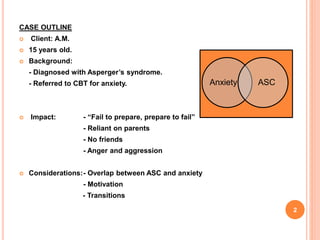
 Considerations:- Overlap between ASC and anxiety
- Motivation
- Transitions
Anxiety ASC
2
CBT EVIDENCE BASE
 CBT is a psychotherapeutic intervention that addresses unhelpful
thoughts and behaviours, by understanding the physical and emotional
impact on the individual (Wills, 2008).
 The client becomes their own therapist.
 More evidence for CBT than any other psychosocial intervention.
 Multiple randomised control trials and meta-analyses: anxiety disorders,
depression, eating disorders and substance misuse.
 The evidence base for CBT with young people is growing.
 NICE guidelines for social anxiety.
Ref: Wills, 2008; Kuyken et al., 2011; Padesky, 1993; NICE, 2012; Wilson and
Branch, 2006; Department of Health (DH), 2001; National Institute for Health
and Clinical Excellence (NICE), 2013; Ahrens-Eipper 2005; Muris et.al, 2008.
3
THEORETICAL MODELS UTILISED
 Goal setting
 Psycho-education work around anxiety
 Personalised case formulation tool – core belief
 Self-focused attention fuelling his worries.
 Experiences
- Being different to others
- Being bullied
- Lifelong struggle to adapt to social norms. “Why cant
people just say what they mean?”
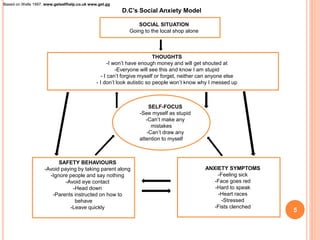
 Applied the Clark & Wells Social Phobia protocol
Ref: Greenberger and Padesky, 1995; Bieling and Kuyken, 2003; Williams
and Garland, 2002; Clark and Wells, 1995; Clark 2002. 4
People
think I am
stupid
SOCIAL SITUATION
Going to the local shop alone
SELF-FOCUS
-See myself as stupid
-Can’t make any
mistakes
-Can’t draw any
attention to myself
SAFETY BEHAVIOURS
-Avoid paying by taking parent along
-Ignore people and say nothing
-Avoid eye contact
-Head down
-Parents instructed on how to
behave
-Leave quickly
ANXIETY SYMPTOMS
-Feeling sick
-Face goes red
-Hard to speak
-Heart races
-Stressed
-Fists clenched
THOUGHTS
-I won’t have enough money and will get shouted at
-Everyone will see this and know I am stupid
- I can’t forgive myself or forget, neither can anyone else
- I don’t look autistic so people won’t know why I messed up
Based on Wells 1997, www.getselfhelp.co.uk www.get.gg
D.C’s Social Anxiety Model
5
WORK UNDERTAKEN
 Thoughts/images related to his fears.
 Alternate views/theories.
 Practiced social situations in sessions.
 Highlighted strengths.
 Tracked Progress – GOALS, SRS & CORS.
 Behavioural experiments.
1/ Weekly trip to the local shop alone.
2/ Created a survey.
3/ Shifted his focus of attention.
Ref: Bennet-Levy et. al, 2004
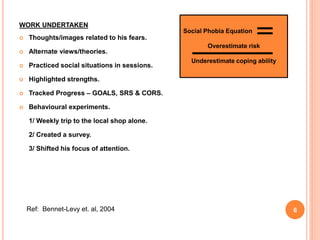
Social Phobia Equation
Overestimate risk
Underestimate coping ability
6
OUTCOME
 No aggression past 6 months
 Better communication between family
 Calmer
 Goes to shops alone
 Played pool after college - unplanned
 Attended CAMHS Service User Forums; one on his own
7
REFLECTIONS
 Stedmon and Dallos, 2009: Reflection is about refining therapeutic
practice by exploring results, feedback and skills
 Paused CBT to do psychoeducation work on ASC: NAS website and
videos
 Adjustment at a slower pace.
 More able to generate and consider alternate beliefs after doing BE.
What would I do differently:
- ASC psychoeducation work first.
- Focused more on the behavioural aspect of CBT, which in itself leads
to change in cognitions.
Refs: Bennet-Levy, 2006
8
 ANY QUESTIONS?
9
REFERENCES
 Ahrens-Eipper, S. (2005).Applying the Clark-Wells model of social phobia to children: the case of a “dictation
phobia.” Behavioural and Cognitive Psychotherapy: 34, pp. 1-4.
 Bennett-Levy, J. (2006) Therapist skills: a cognitive model of their acquisition and refinement. Behavioural and
Cognitive Psychotherapy, 34, pp. 57–78.
 Bennet-Levy, J., Butler, G., Fennell, M.M Hackman, A., Mueller, M. And Westbrook, D. (2004) Oxford guide to
behavioural experiments in cognitive therapy: cognitive behaviour therapy: science and practice. Oxford: Oxford
University Press.
 Bieling, P.J. and Kuyken, W. (2003) Is cognitive case formulation science or science fiction? Clinical Psychology:
Science and Practice, 10(1), pp. 52-69.
 Clark, D.M. & Wells, A. (1995). A cognitive model of social phobia. In R.Heimburg, M. Liebowitz, D.A. Hope, &
F.R. Schneier (Eds) Social phobia: diagnosis, assessment and treatment, (pp.69-93). New York: Guilford Press.
 Greenberger, D. and Padesky, C.A. (1995) Mind over mood: a cognitive therapy treatment manual for clients.
New York: Guilford Press.
 Department of Health (2001) Treatment choice in psychological therapies and counselling. London: Department of
Health.
 Kuyken, W., Padesky, C.A. and Dudley, R. (2011) Collaborative case conceptualisation: working effectively with
clients in cognitive-behavioural therapy. New York: Guilford Press.
 Muris, P., Mayer, B., Adel, M., Roos, T., Wamelen, J. (2008). Predictors of Change Following Cognitive-Behavioral
Treatment of Children with Anxiety Problems: A Preliminary Investigation on Negative Automatic Thoughts and
Anxiety Control. Child Psychiatry and Human Development DOI: 10.1007/s10578-008-0116-7
 National Institute of Health and Clinical Excellence (2012) Depression and anxiety – computerised cognitive
behavioural therapy (CCBT): NICE guideline (TA97). London: National Institute for Health and Clinical Excellence
 National Institute of Health and Clinical Excellence (2013) Social anxiety disorder: recognition, assessment and
treatment. NICE Guideline (CG159) London: National Institute for Health and Clinical Excellence
 Padesky, C.A. (1993) Socratic questioning: changing minds or guided discovery? A keynote address delivered at
the European Congress of Behavioural and Cognitive Therapies, September 24th, London.
 Stedmon, J. and Dallos, R. (2009) Reflective practice in psychotherapy and counselling. New York: Open
University Press.
 Wells, A. (1997). Cognitive Therapy of Anxiety Disorders: a practice manual and conceptual guide. Chichester:
Wiley
 Williams, C. and Garland, A. (2002) A cognitive-behavioural therapy assessment model for use in everyday
practice. Advances in Psychiatric Treatment, 8, pp.172-179.
 Wills, F. (2008) Skills in cognitive behaviour counselling and psychotherapy. London: SAGE Publications
 Wilson, R. and Branch, R. (2006) Cognitive behavioural therapy for dummies. Chichester: John Wiley & Sons, Ltd
10

ASC CBT Case Presentation

  • 1.
  • 2.
    CASE OUTLINE  Client:A.M.  15 years old.  Background: - Diagnosed with Asperger’s syndrome. - Referred to CBT for anxiety.  Impact: - “Fail to prepare, prepare to fail” - Reliant on parents - No friends - Anger and aggression  Considerations:- Overlap between ASC and anxiety - Motivation - Transitions Anxiety ASC 2
  • 3.
    CBT EVIDENCE BASE CBT is a psychotherapeutic intervention that addresses unhelpful thoughts and behaviours, by understanding the physical and emotional impact on the individual (Wills, 2008).  The client becomes their own therapist.  More evidence for CBT than any other psychosocial intervention.  Multiple randomised control trials and meta-analyses: anxiety disorders, depression, eating disorders and substance misuse.  The evidence base for CBT with young people is growing.  NICE guidelines for social anxiety. Ref: Wills, 2008; Kuyken et al., 2011; Padesky, 1993; NICE, 2012; Wilson and Branch, 2006; Department of Health (DH), 2001; National Institute for Health and Clinical Excellence (NICE), 2013; Ahrens-Eipper 2005; Muris et.al, 2008. 3
  • 4.
    THEORETICAL MODELS UTILISED Goal setting  Psycho-education work around anxiety  Personalised case formulation tool – core belief  Self-focused attention fuelling his worries.  Experiences - Being different to others - Being bullied - Lifelong struggle to adapt to social norms. “Why cant people just say what they mean?”  Applied the Clark & Wells Social Phobia protocol Ref: Greenberger and Padesky, 1995; Bieling and Kuyken, 2003; Williams and Garland, 2002; Clark and Wells, 1995; Clark 2002. 4 People think I am stupid
  • 5.
    SOCIAL SITUATION Going tothe local shop alone SELF-FOCUS -See myself as stupid -Can’t make any mistakes -Can’t draw any attention to myself SAFETY BEHAVIOURS -Avoid paying by taking parent along -Ignore people and say nothing -Avoid eye contact -Head down -Parents instructed on how to behave -Leave quickly ANXIETY SYMPTOMS -Feeling sick -Face goes red -Hard to speak -Heart races -Stressed -Fists clenched THOUGHTS -I won’t have enough money and will get shouted at -Everyone will see this and know I am stupid - I can’t forgive myself or forget, neither can anyone else - I don’t look autistic so people won’t know why I messed up Based on Wells 1997, www.getselfhelp.co.uk www.get.gg D.C’s Social Anxiety Model 5
  • 6.
    WORK UNDERTAKEN  Thoughts/imagesrelated to his fears.  Alternate views/theories.  Practiced social situations in sessions.  Highlighted strengths.  Tracked Progress – GOALS, SRS & CORS.  Behavioural experiments. 1/ Weekly trip to the local shop alone. 2/ Created a survey. 3/ Shifted his focus of attention. Ref: Bennet-Levy et. al, 2004 Social Phobia Equation Overestimate risk Underestimate coping ability 6
  • 7.
    OUTCOME  No aggressionpast 6 months  Better communication between family  Calmer  Goes to shops alone  Played pool after college - unplanned  Attended CAMHS Service User Forums; one on his own 7
  • 8.
    REFLECTIONS  Stedmon andDallos, 2009: Reflection is about refining therapeutic practice by exploring results, feedback and skills  Paused CBT to do psychoeducation work on ASC: NAS website and videos  Adjustment at a slower pace.  More able to generate and consider alternate beliefs after doing BE. What would I do differently: - ASC psychoeducation work first. - Focused more on the behavioural aspect of CBT, which in itself leads to change in cognitions. Refs: Bennet-Levy, 2006 8
  • 9.
  • 10.
    REFERENCES  Ahrens-Eipper, S.(2005).Applying the Clark-Wells model of social phobia to children: the case of a “dictation phobia.” Behavioural and Cognitive Psychotherapy: 34, pp. 1-4.  Bennett-Levy, J. (2006) Therapist skills: a cognitive model of their acquisition and refinement. Behavioural and Cognitive Psychotherapy, 34, pp. 57–78.  Bennet-Levy, J., Butler, G., Fennell, M.M Hackman, A., Mueller, M. And Westbrook, D. (2004) Oxford guide to behavioural experiments in cognitive therapy: cognitive behaviour therapy: science and practice. Oxford: Oxford University Press.  Bieling, P.J. and Kuyken, W. (2003) Is cognitive case formulation science or science fiction? Clinical Psychology: Science and Practice, 10(1), pp. 52-69.  Clark, D.M. & Wells, A. (1995). A cognitive model of social phobia. In R.Heimburg, M. Liebowitz, D.A. Hope, & F.R. Schneier (Eds) Social phobia: diagnosis, assessment and treatment, (pp.69-93). New York: Guilford Press.  Greenberger, D. and Padesky, C.A. (1995) Mind over mood: a cognitive therapy treatment manual for clients. New York: Guilford Press.  Department of Health (2001) Treatment choice in psychological therapies and counselling. London: Department of Health.  Kuyken, W., Padesky, C.A. and Dudley, R. (2011) Collaborative case conceptualisation: working effectively with clients in cognitive-behavioural therapy. New York: Guilford Press.  Muris, P., Mayer, B., Adel, M., Roos, T., Wamelen, J. (2008). Predictors of Change Following Cognitive-Behavioral Treatment of Children with Anxiety Problems: A Preliminary Investigation on Negative Automatic Thoughts and Anxiety Control. Child Psychiatry and Human Development DOI: 10.1007/s10578-008-0116-7  National Institute of Health and Clinical Excellence (2012) Depression and anxiety – computerised cognitive behavioural therapy (CCBT): NICE guideline (TA97). London: National Institute for Health and Clinical Excellence  National Institute of Health and Clinical Excellence (2013) Social anxiety disorder: recognition, assessment and treatment. NICE Guideline (CG159) London: National Institute for Health and Clinical Excellence  Padesky, C.A. (1993) Socratic questioning: changing minds or guided discovery? A keynote address delivered at the European Congress of Behavioural and Cognitive Therapies, September 24th, London.  Stedmon, J. and Dallos, R. (2009) Reflective practice in psychotherapy and counselling. New York: Open University Press.  Wells, A. (1997). Cognitive Therapy of Anxiety Disorders: a practice manual and conceptual guide. Chichester: Wiley  Williams, C. and Garland, A. (2002) A cognitive-behavioural therapy assessment model for use in everyday practice. Advances in Psychiatric Treatment, 8, pp.172-179.  Wills, F. (2008) Skills in cognitive behaviour counselling and psychotherapy. London: SAGE Publications  Wilson, R. and Branch, R. (2006) Cognitive behavioural therapy for dummies. Chichester: John Wiley & Sons, Ltd 10