BLOCK DIAGRAM OF
                     INTEL 8085


                                 GURSHARAN SINGH TATLA
                                   professorgstatla@gmail.com


    Gursharan Singh Tatla
1                                                www.eazynotes.com
    professorgstatla@gmail.com
Introduction to 8085
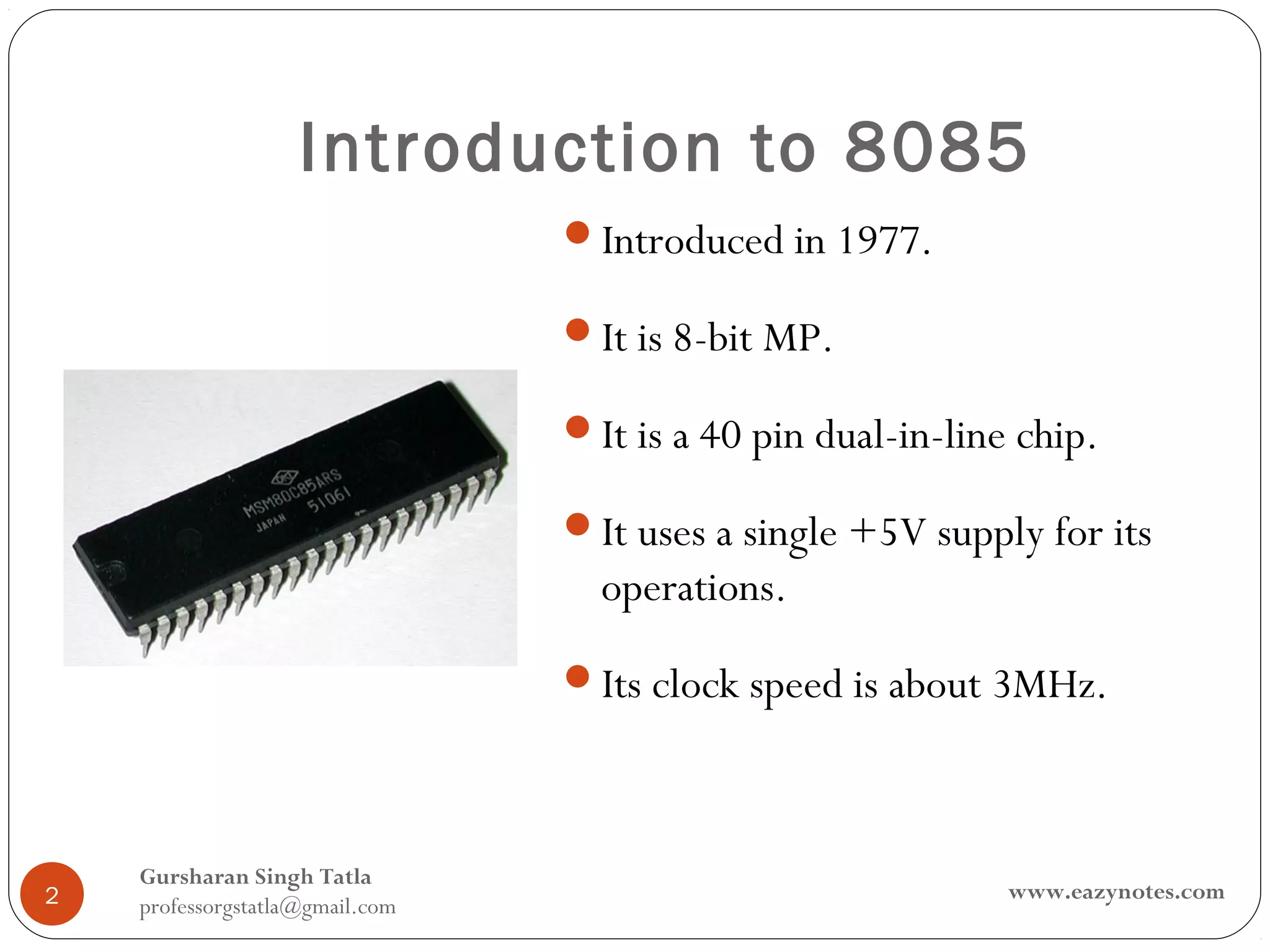
                                 Introduced in 1977.

                                 It is 8-bit MP.

                                 It is a 40 pin dual-in-line chip.

                                 It uses a single +5V supply for its
                                   operations.
                                 Its clock speed is about 3MHz.


    Gursharan Singh Tatla
2                                                            www.eazynotes.com
    professorgstatla@gmail.com
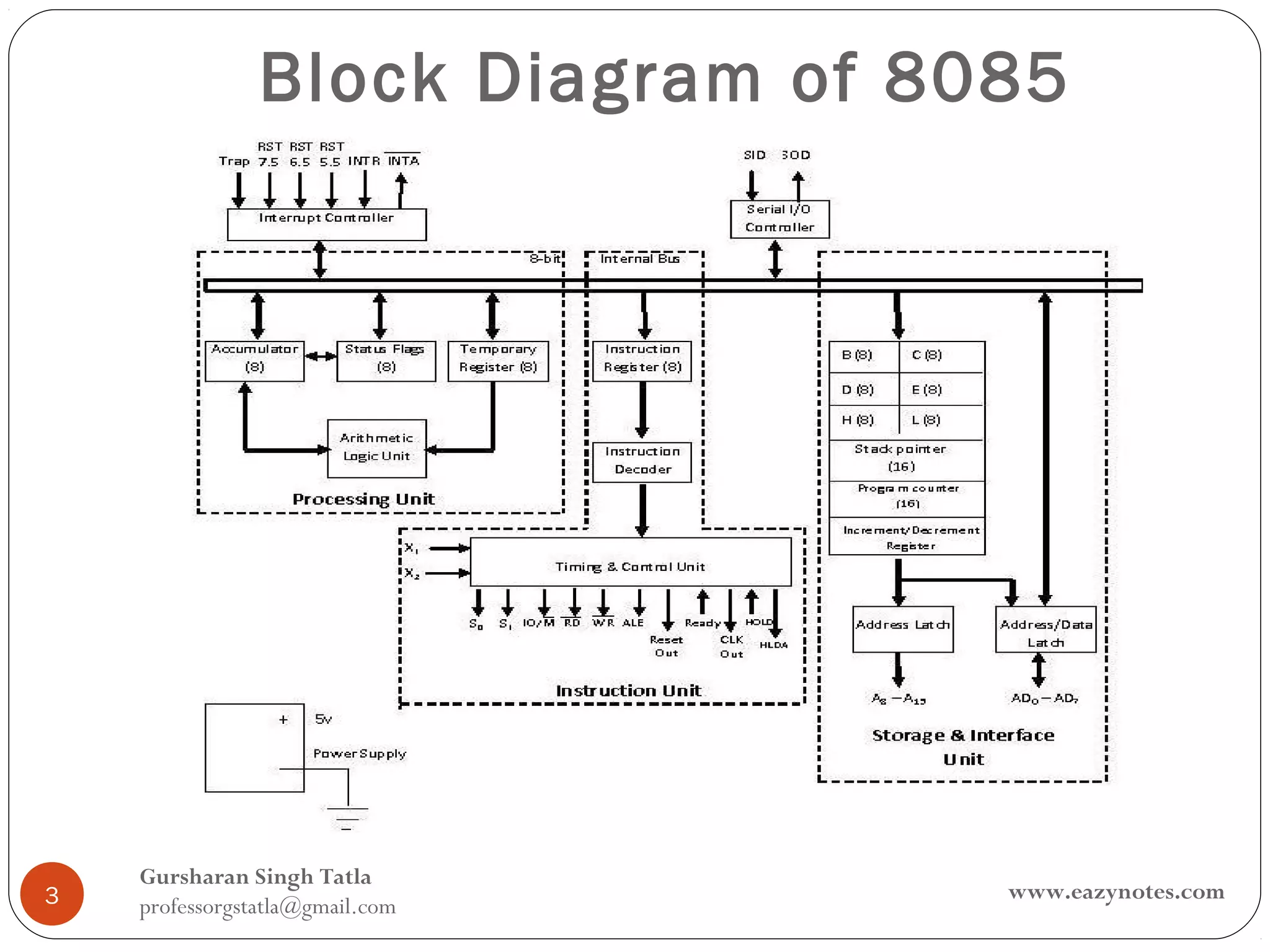
Block Diagram of 8085


    Gursharan Singh Tatla
3                                  www.eazynotes.com
    professorgstatla@gmail.com
Three Units of 8085

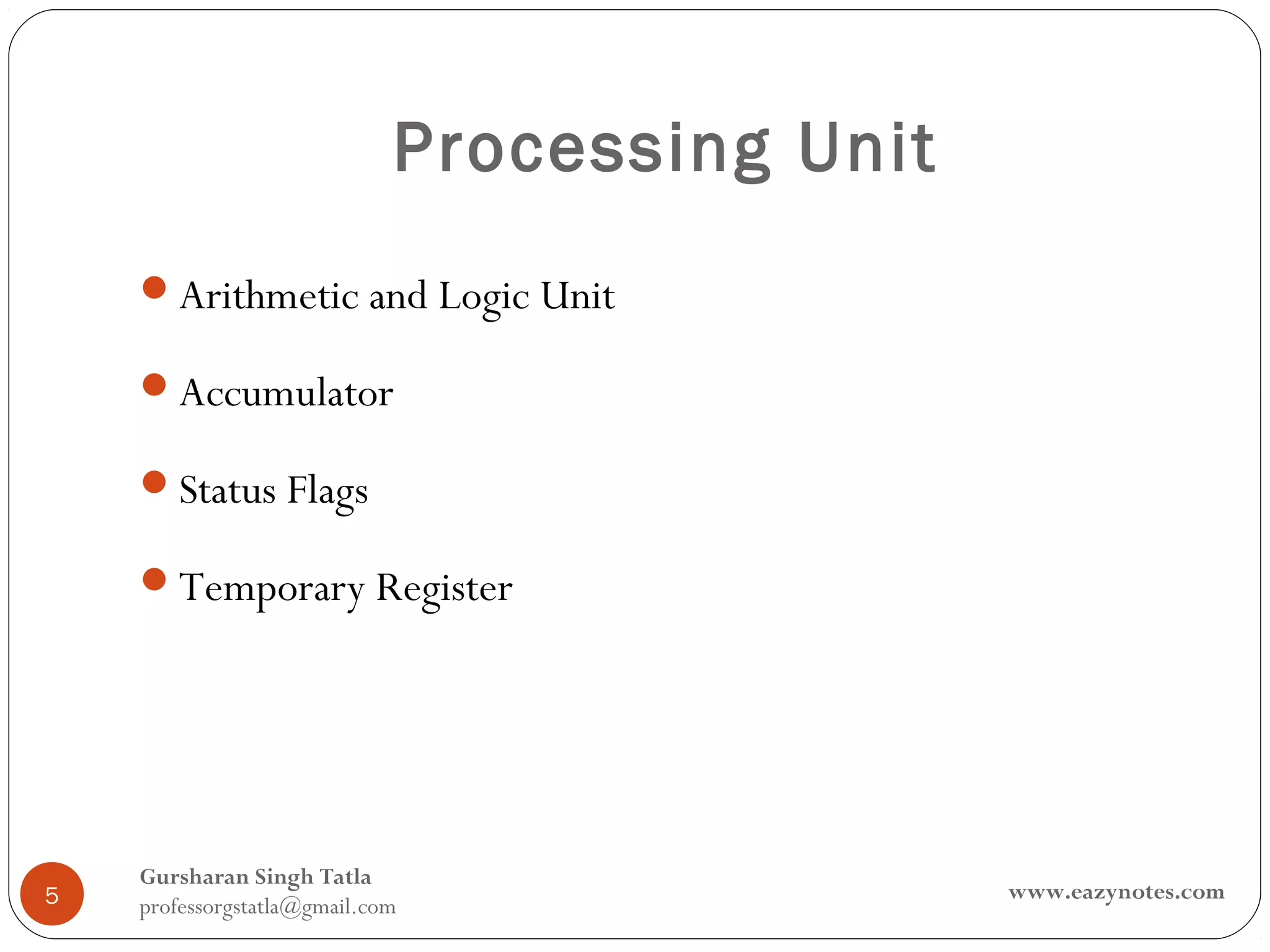
    Processing Unit


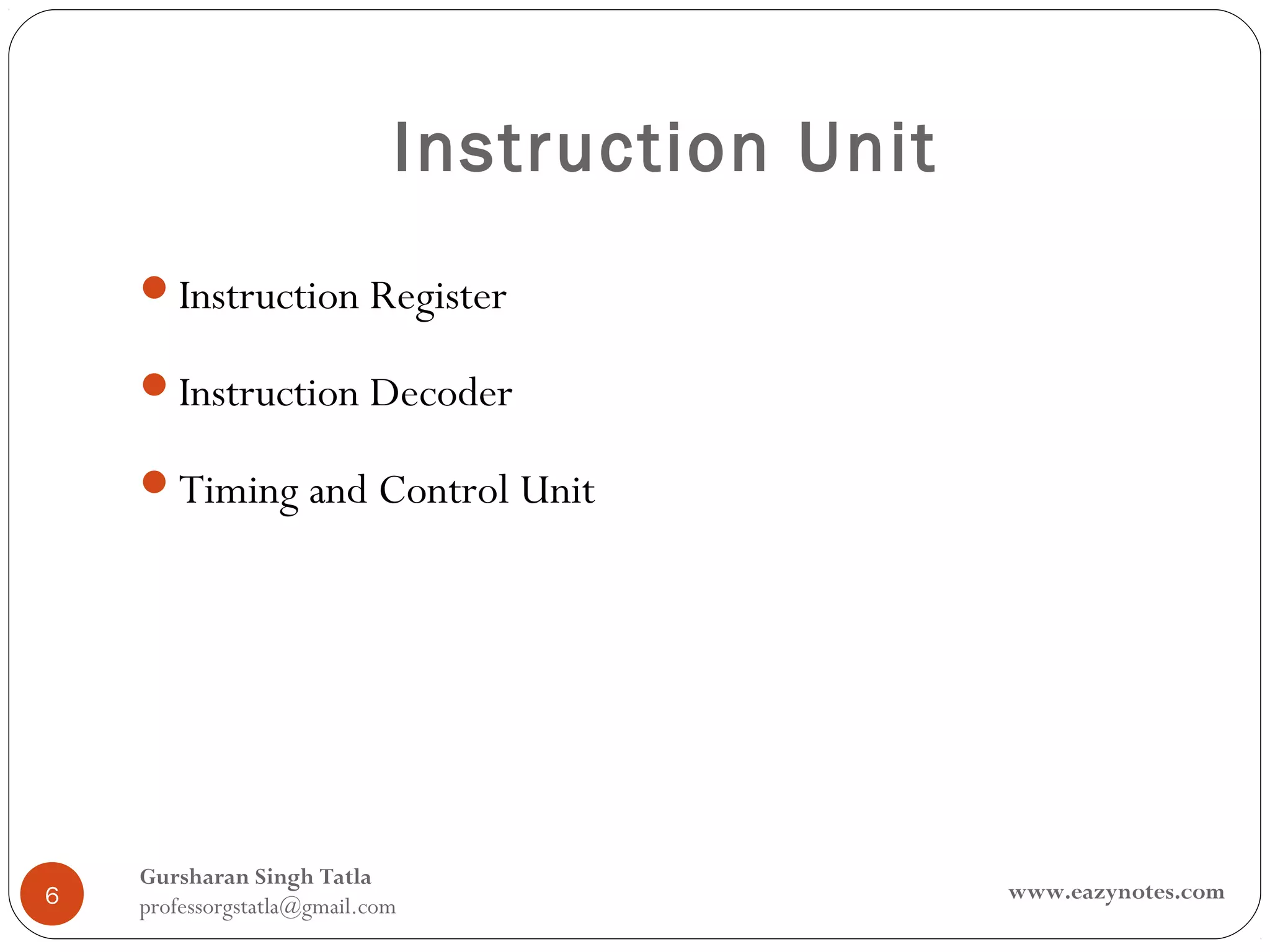
    Instruction Unit


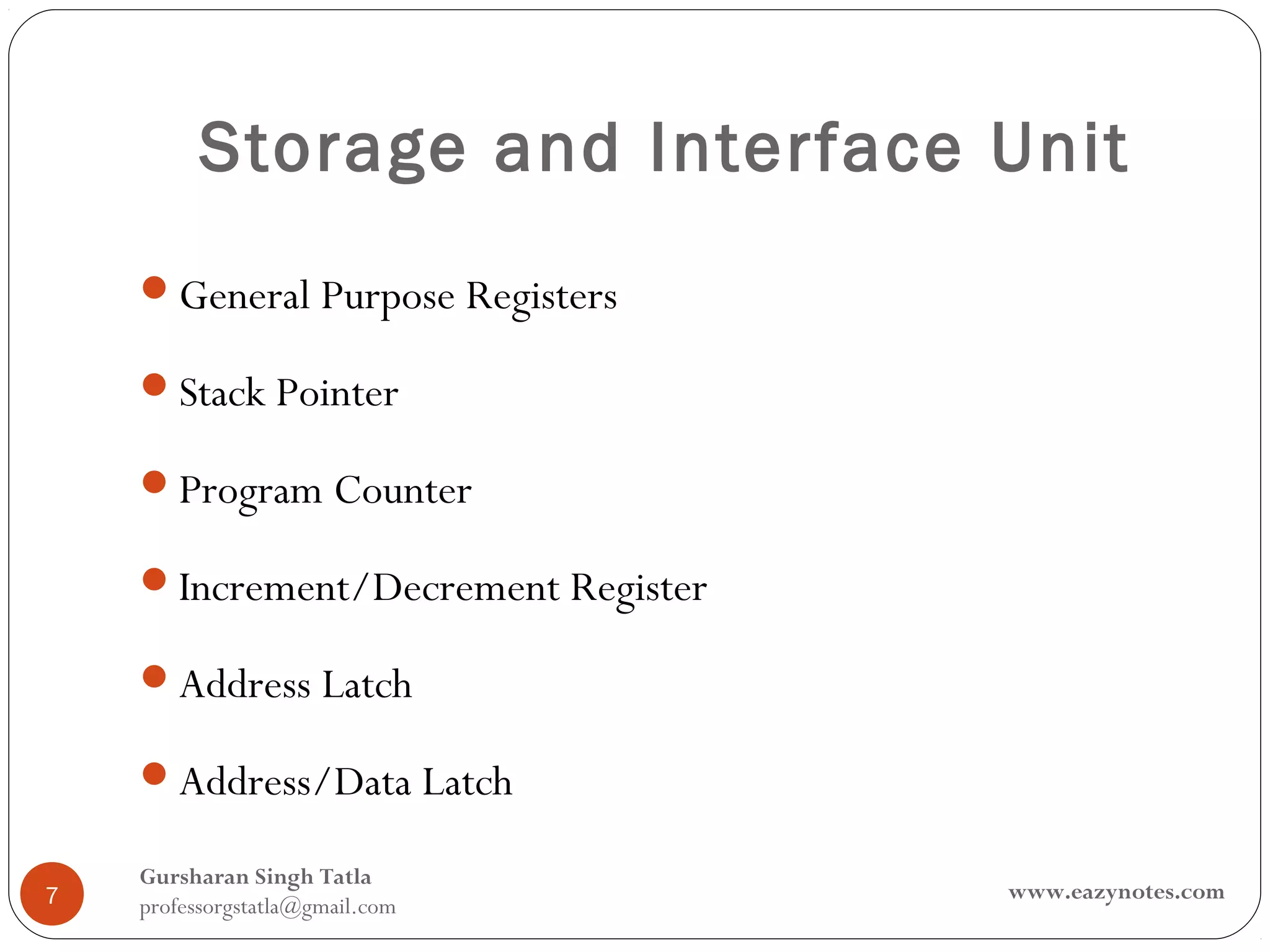
    Storage and Interface Unit


    Gursharan Singh Tatla
4                                      www.eazynotes.com
    professorgstatla@gmail.com
Processing Unit
    Arithmetic and Logic Unit

    Accumulator

    Status Flags

    Temporary Register


    Gursharan Singh Tatla
5                                              www.eazynotes.com
    professorgstatla@gmail.com
Instruction Unit
    Instruction Register

    Instruction Decoder

    Timing and Control Unit


    Gursharan Singh Tatla
6                                               www.eazynotes.com
    professorgstatla@gmail.com
Storage and Interface Unit
    General Purpose Registers

    Stack Pointer

    Program Counter

    Increment/Decrement Register

    Address Latch

    Address/Data Latch

    Gursharan Singh Tatla
7                                   www.eazynotes.com
    professorgstatla@gmail.com
Three Other Units
    Interrupt Controller

    Serial I/O Controller

    Power Supply


    Gursharan Singh Tatla
8                                            www.eazynotes.com
    professorgstatla@gmail.com
Accumulator
     It the main register of microprocessor.

     It is also called register ‘A’.

     It is an 8-bit register.

     It is used in the arithmetic and logic operations.

     It always contains one of the operands on which arithmetic/logic
       has to be performed.
     After the arithmetic/logic operation, the contents of accumulator
       are replaced by the result.

    Gursharan Singh Tatla
9                                                          www.eazynotes.com
    professorgstatla@gmail.com
Arithmetic & Logic Unit (ALU)
     It performs various arithmetic and logic operations.

     The data is available in accumulator and temporary/general
        purpose registers.
     Arithmetic Operations:

         Addition, Subtraction, Increment, Decrement etc.

     Logic Operations:

         AND, OR, X-OR, Complement etc.


     Gursharan Singh Tatla
10                                                           www.eazynotes.com
     professorgstatla@gmail.com
Temporary Register
     It is an 8-bit register.

     It is used to store temporary 8-bit operand from general
        purpose register.
     It is also used to store intermediate results.


     Gursharan Singh Tatla
11                                                      www.eazynotes.com
     professorgstatla@gmail.com
Status Flags
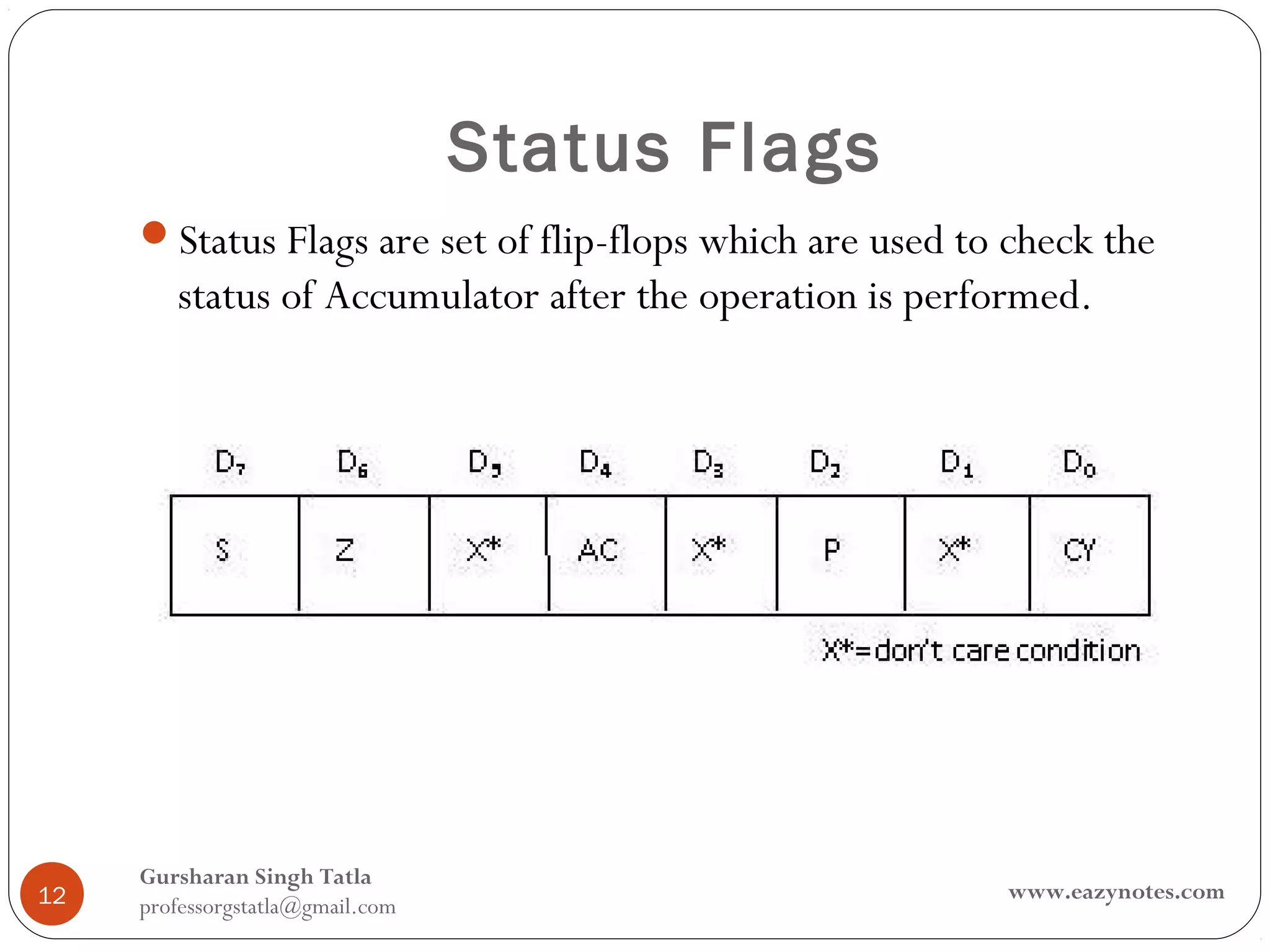
     Status Flags are set of flip-flops which are used to check the
        status of Accumulator after the operation is performed.


     Gursharan Singh Tatla
12                                                        www.eazynotes.com
     professorgstatla@gmail.com
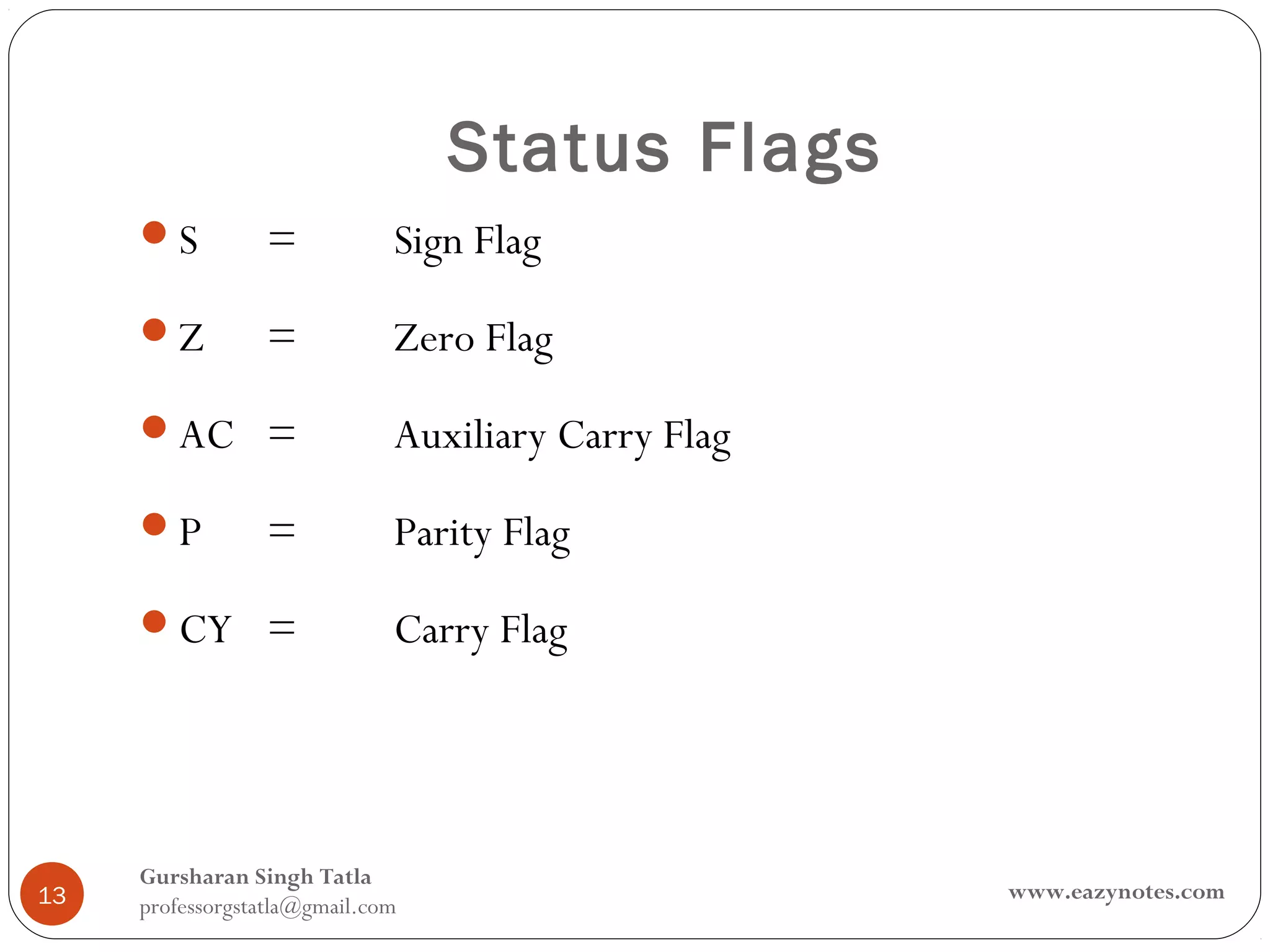
Status Flags
     S          =            Sign Flag
     Z          =            Zero Flag
     AC =                    Auxiliary Carry Flag
     P          =            Parity Flag
     CY =                    Carry Flag


     Gursharan Singh Tatla
13                                                   www.eazynotes.com
     professorgstatla@gmail.com
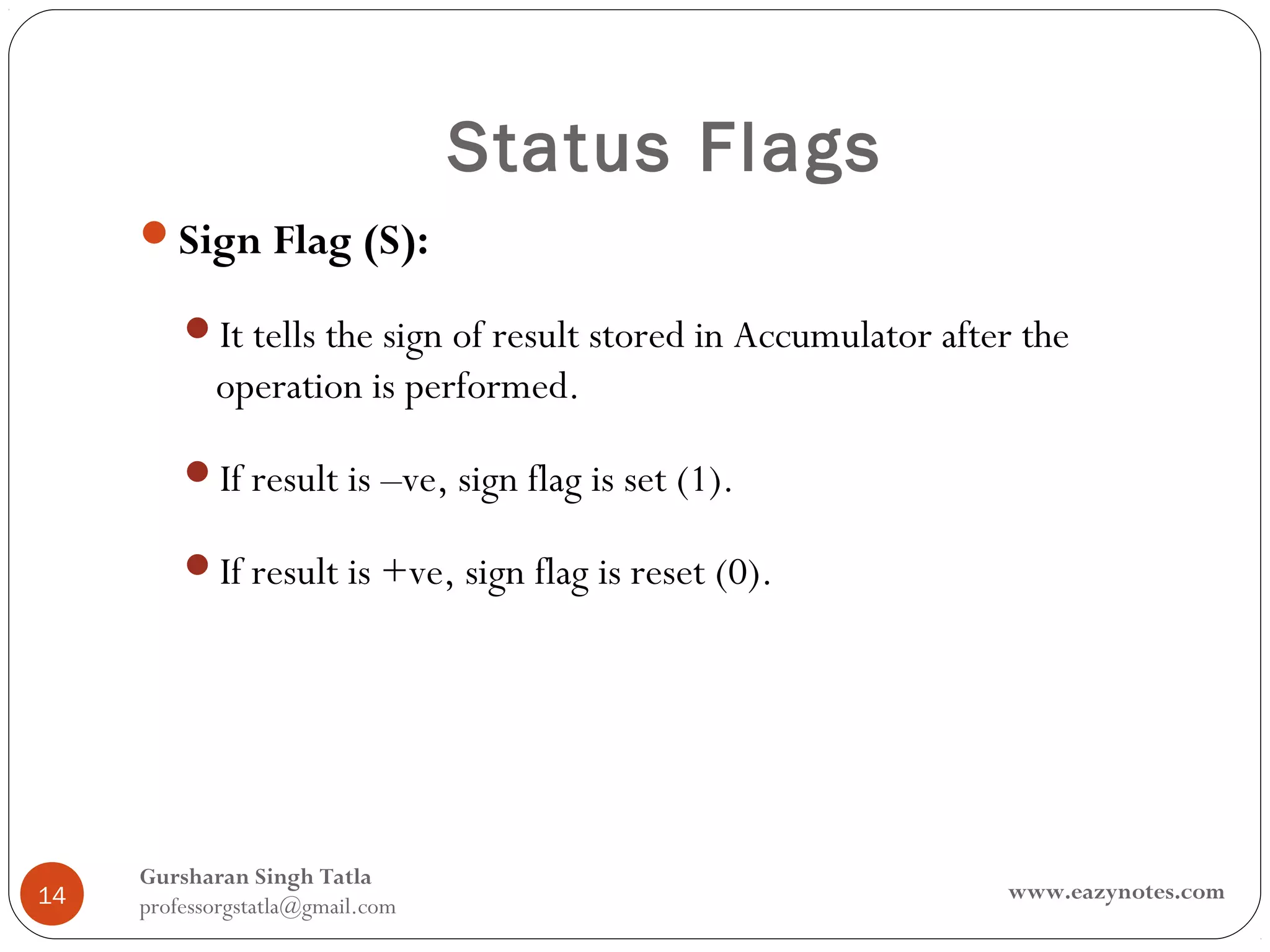
Status Flags
     Sign Flag (S):

         It tells the sign of result stored in Accumulator after the
            operation is performed.

         If result is –ve, sign flag is set (1).

         If result is +ve, sign flag is reset (0).


     Gursharan Singh Tatla
14                                                              www.eazynotes.com
     professorgstatla@gmail.com
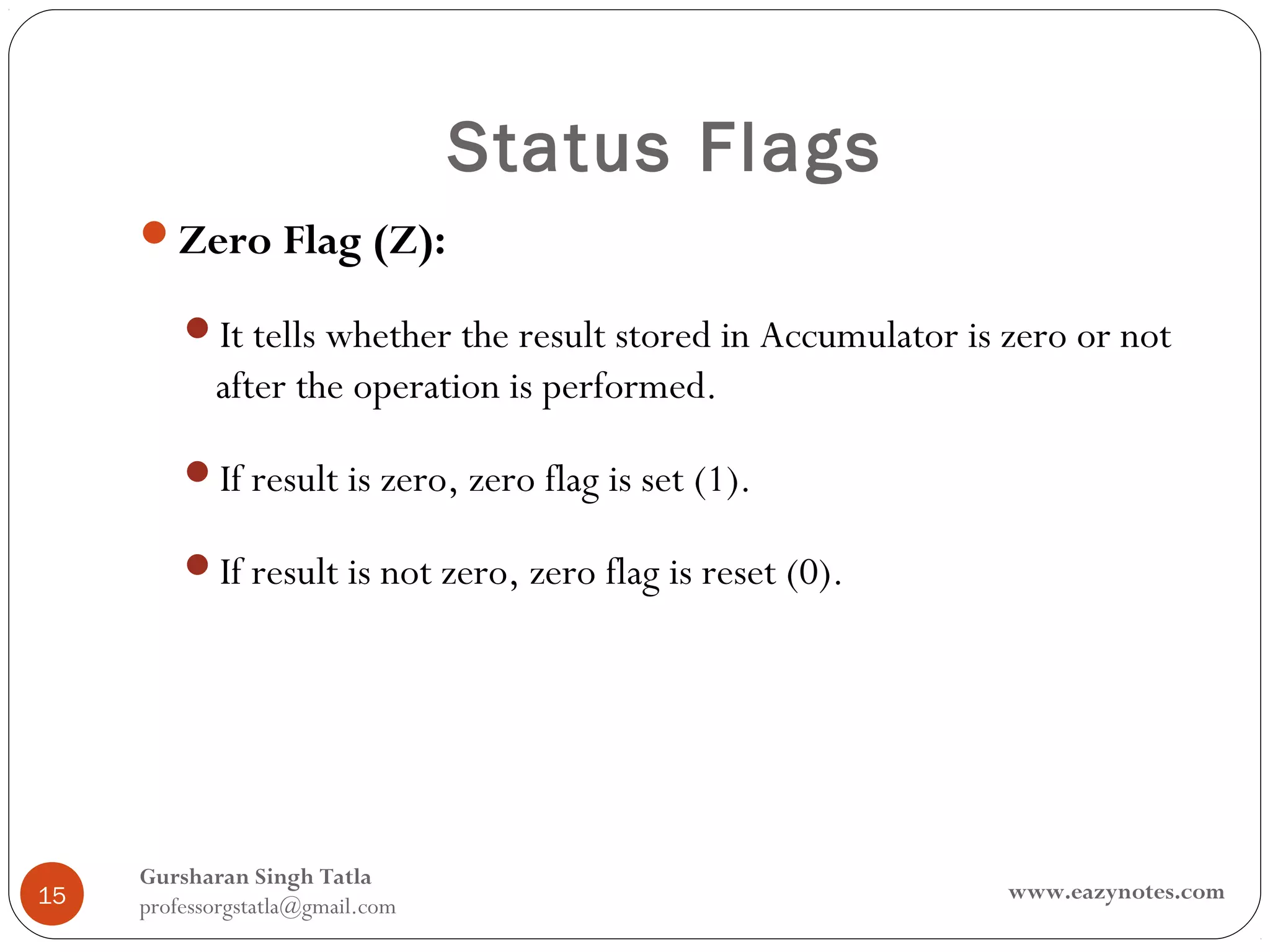
Status Flags
     Zero Flag (Z):

         It tells whether the result stored in Accumulator is zero or not
            after the operation is performed.

         If result is zero, zero flag is set (1).

         If result is not zero, zero flag is reset (0).


     Gursharan Singh Tatla
15                                                             www.eazynotes.com
     professorgstatla@gmail.com
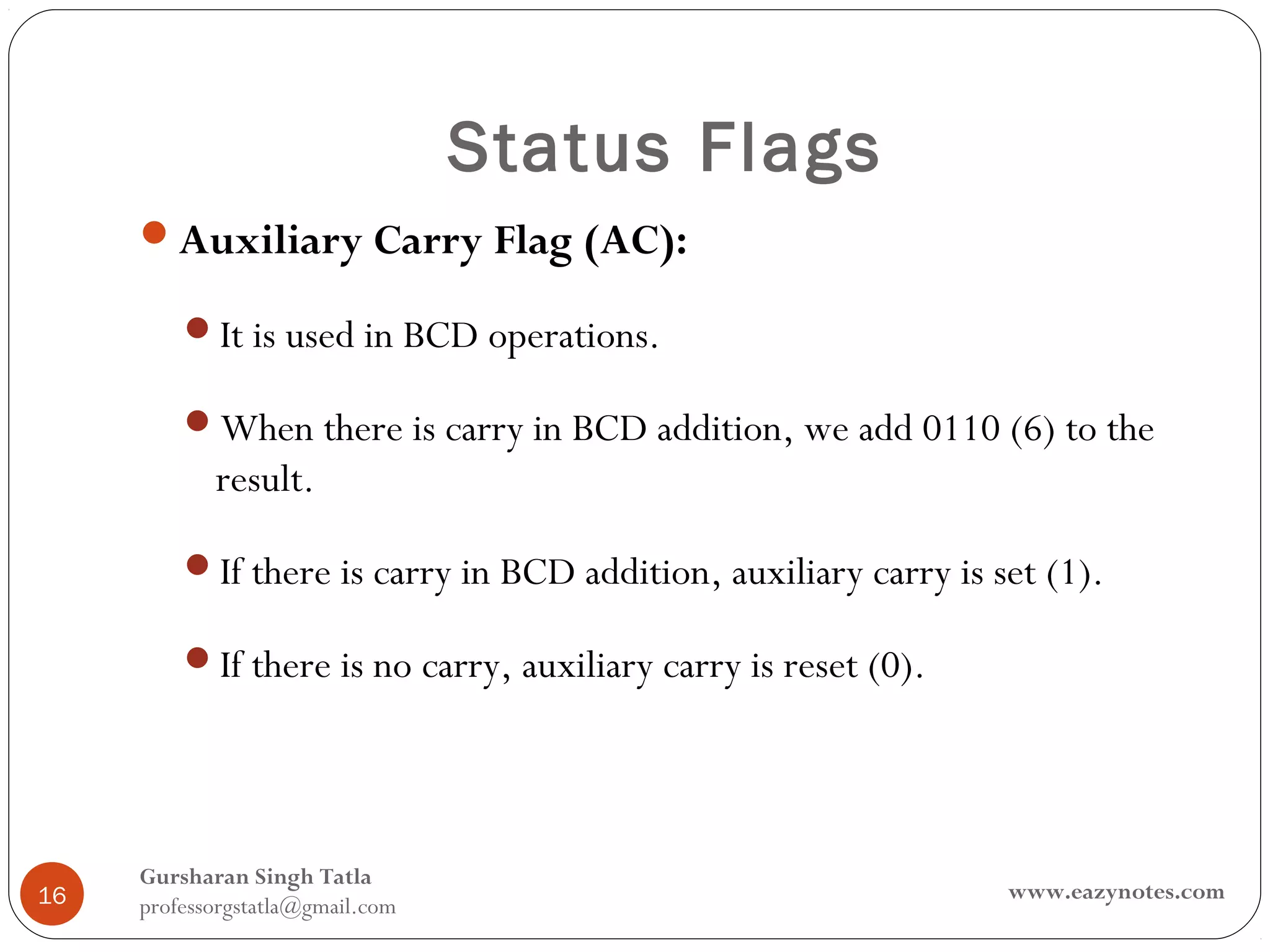
Status Flags
     Auxiliary Carry Flag (AC):

         It is used in BCD operations.

         When there is carry in BCD addition, we add 0110 (6) to the
            result.

         If there is carry in BCD addition, auxiliary carry is set (1).

         If there is no carry, auxiliary carry is reset (0).


     Gursharan Singh Tatla
16                                                               www.eazynotes.com
     professorgstatla@gmail.com
Status Flags
     Parity Flag (P):

         It tells the parity of data stored in Accumulator.

         If parity is even, parity flag is set (1).

         If parity is odd, parity flag is reset (0).


     Gursharan Singh Tatla
17                                                             www.eazynotes.com
     professorgstatla@gmail.com
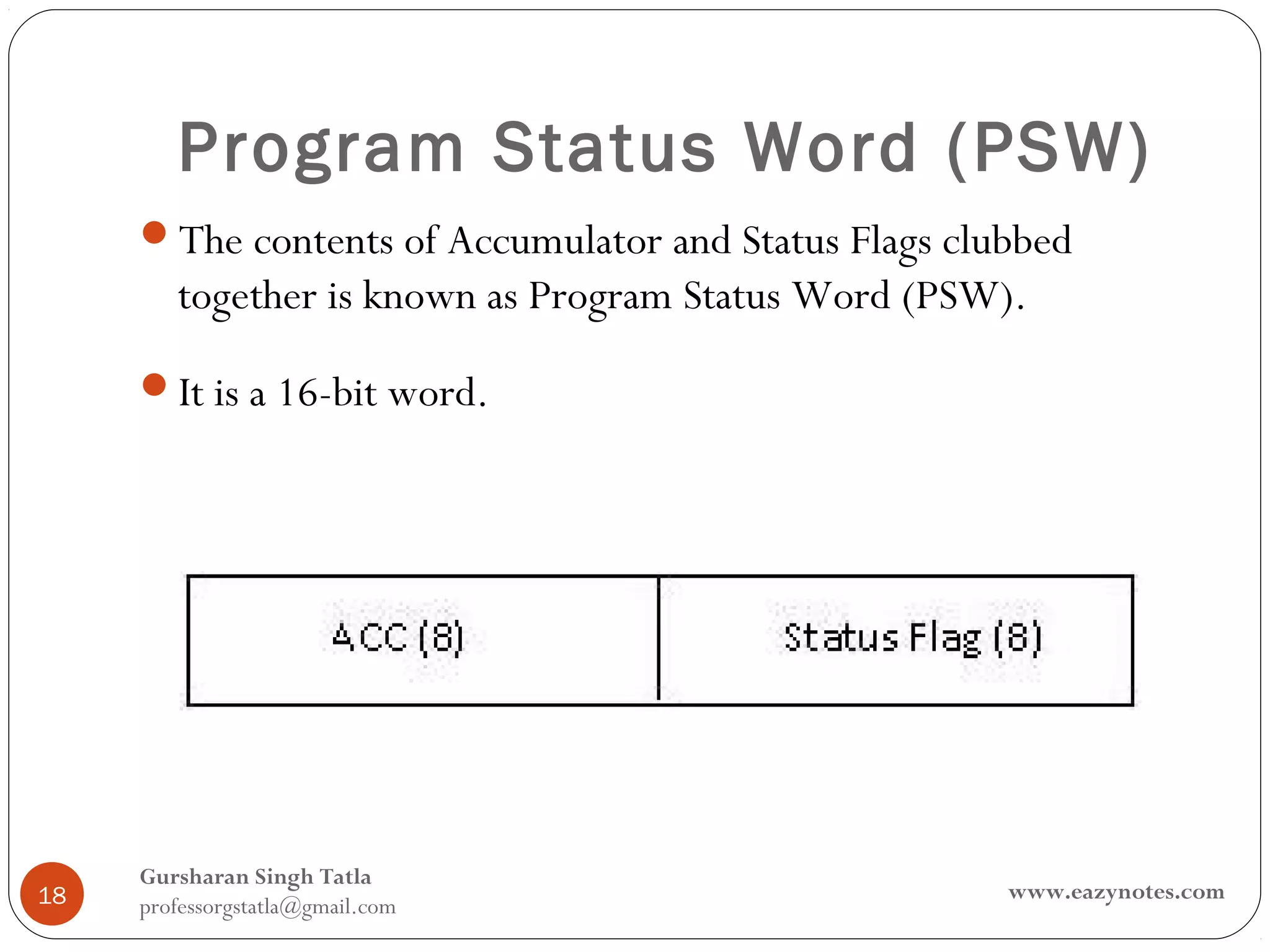
Program Status Word (PSW)
     The contents of Accumulator and Status Flags clubbed
        together is known as Program Status Word (PSW).
     It is a 16-bit word.


     Gursharan Singh Tatla
18                                                    www.eazynotes.com
     professorgstatla@gmail.com
Instruction Register
     It is used to hold the current instruction which the
        microprocessor is about to execute.
     It is an 8-bit register.


     Gursharan Singh Tatla
19                                                       www.eazynotes.com
     professorgstatla@gmail.com
Instruction Decoder
     It interprets the instruction stored in instruction register.

     It generates various machine cycles depending upon the
        instruction.
     The machine cycles are then given to the Timing and Control
        Unit.


     Gursharan Singh Tatla
20                                                         www.eazynotes.com
     professorgstatla@gmail.com
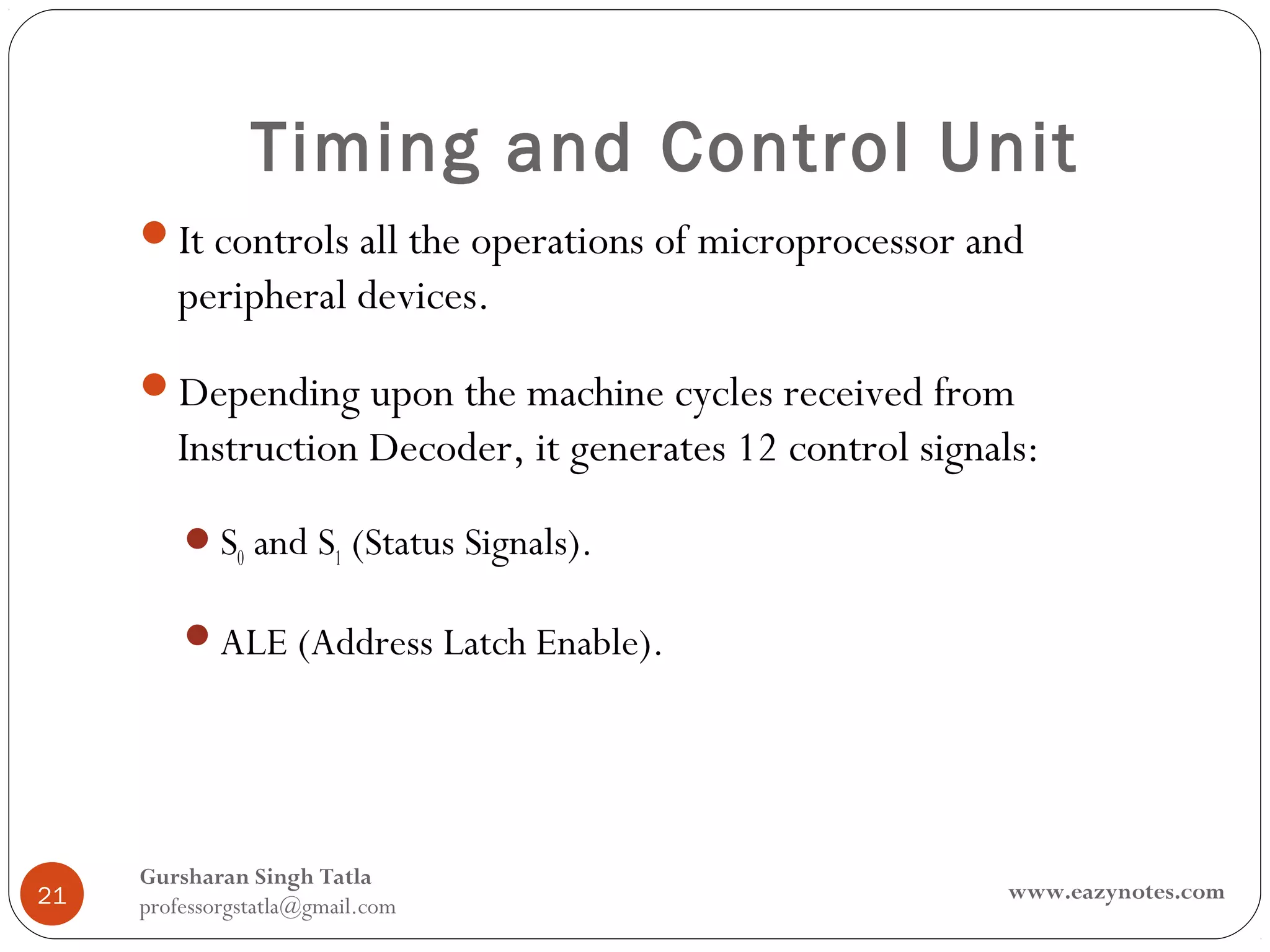
Timing and Control Unit
     It controls all the operations of microprocessor and
        peripheral devices.
     Depending upon the machine cycles received from
        Instruction Decoder, it generates 12 control signals:
         S0 and S1 (Status Signals).

         ALE (Address Latch Enable).


     Gursharan Singh Tatla
21                                                         www.eazynotes.com
     professorgstatla@gmail.com
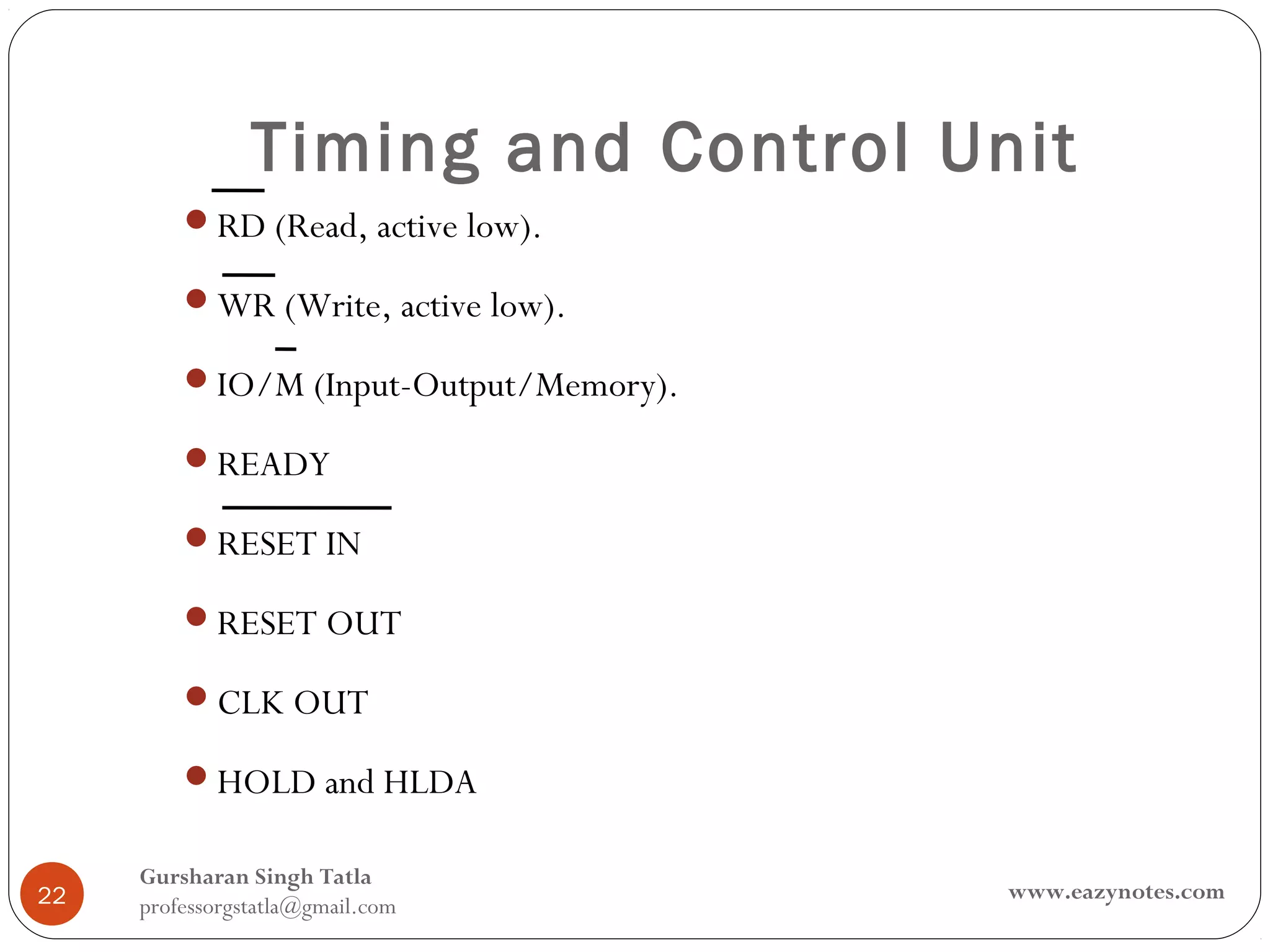
Timing and Control Unit
         RD (Read, active low).

         WR (Write, active low).

         IO/M (Input-Output/Memory).

         READY

         RESET IN

         RESET OUT

         CLK OUT

         HOLD and HLDA

     Gursharan Singh Tatla
22                                      www.eazynotes.com
     professorgstatla@gmail.com
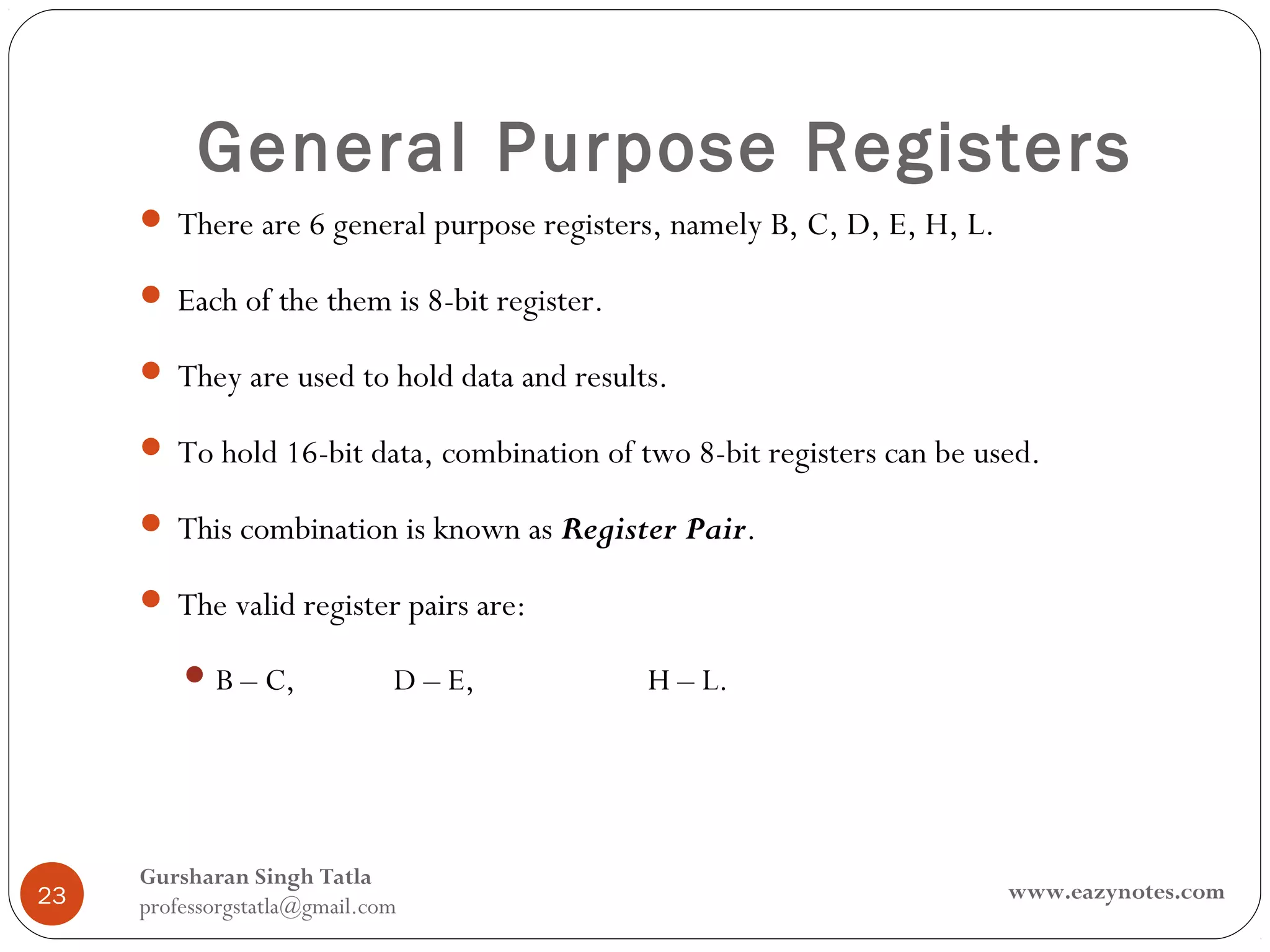
General Purpose Registers
      There are 6 general purpose registers, namely B, C, D, E, H, L.

      Each of the them is 8-bit register.

      They are used to hold data and results.

      To hold 16-bit data, combination of two 8-bit registers can be used.

      This combination is known as Register Pair.

      The valid register pairs are:

          B – C,             D – E,         H – L.


     Gursharan Singh Tatla
23                                                                       www.eazynotes.com
     professorgstatla@gmail.com
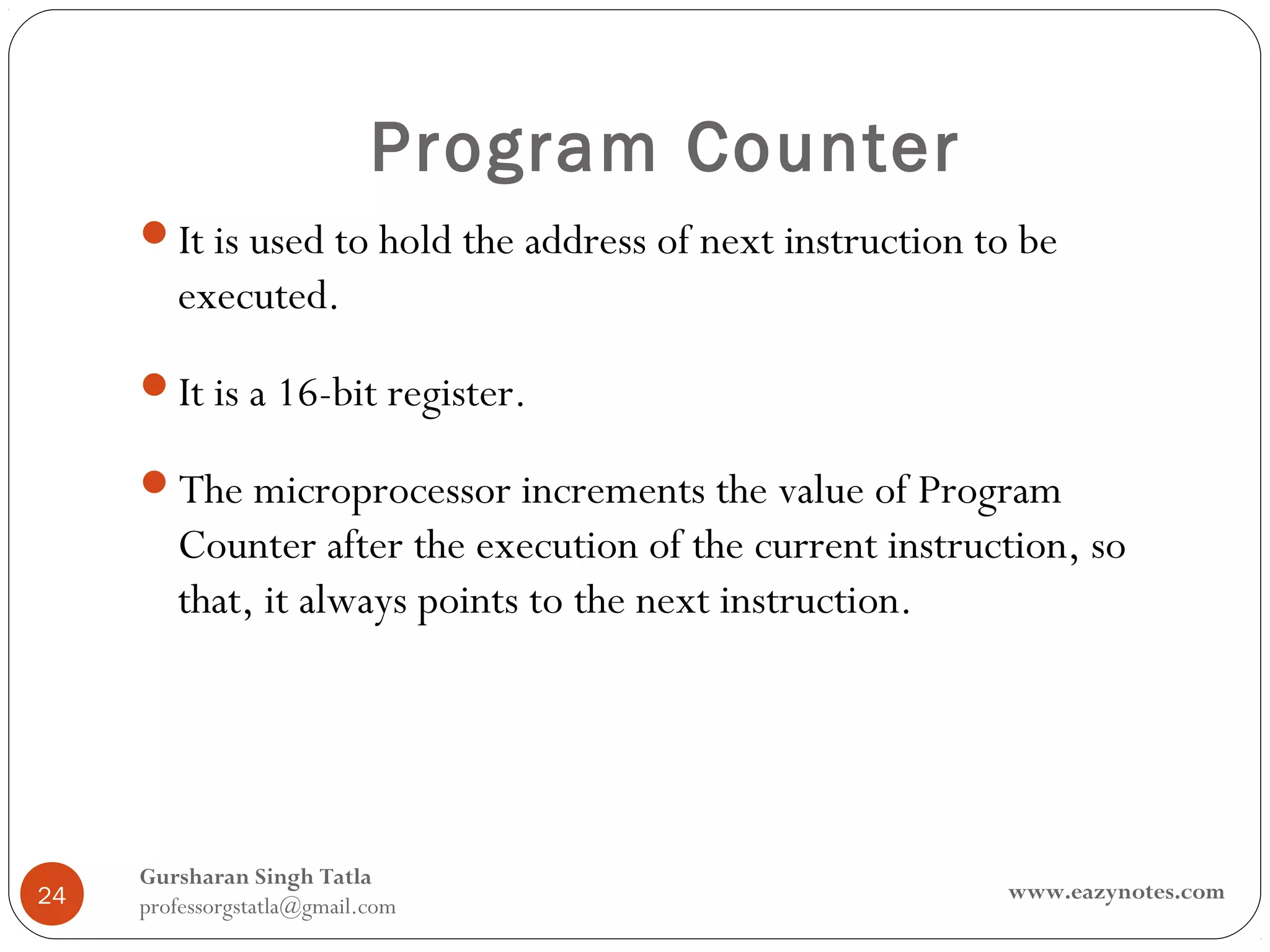
Program Counter
     It is used to hold the address of next instruction to be
        executed.
     It is a 16-bit register.

     The microprocessor increments the value of Program
        Counter after the execution of the current instruction, so
        that, it always points to the next instruction.


     Gursharan Singh Tatla
24                                                        www.eazynotes.com
     professorgstatla@gmail.com
Stack Pointer
     It holds the address of top most item in the stack.

     It is also 16-bit register.

     Any portion of memory can be used as stack.


     Gursharan Singh Tatla
25                                                          www.eazynotes.com
     professorgstatla@gmail.com
Increment/Decrement
                         Register
     This register is used to increment or decrement the value of
        Stack Pointer.
     During PUSH operation, the value of Stack Pointer is
        incremented.
     During POP operation, the value of Stack Pointer is
        decremented.


     Gursharan Singh Tatla
26                                                      www.eazynotes.com
     professorgstatla@gmail.com
Address Latch
     It is group of 8 buffers.

     The upper-byte of 16-bit address is stored in this latch.

     And then it is made available to the peripheral devices.


     Gursharan Singh Tatla
27                                                        www.eazynotes.com
     professorgstatla@gmail.com
Address/Data Latch
      The lower-byte of address and 8-bit of data are multiplexed.

      It holds either lower-byte of address or 8-bits of data.

      This is decided by ALE (Address Latch Enable) signal.

      If ALE = 1 then

         Address/Data Latch contains lower-byte of address.

      If ALE = 0 then

         It contains 8-bit data.


     Gursharan Singh Tatla
28                                                                www.eazynotes.com
     professorgstatla@gmail.com
Serial I/O Controller
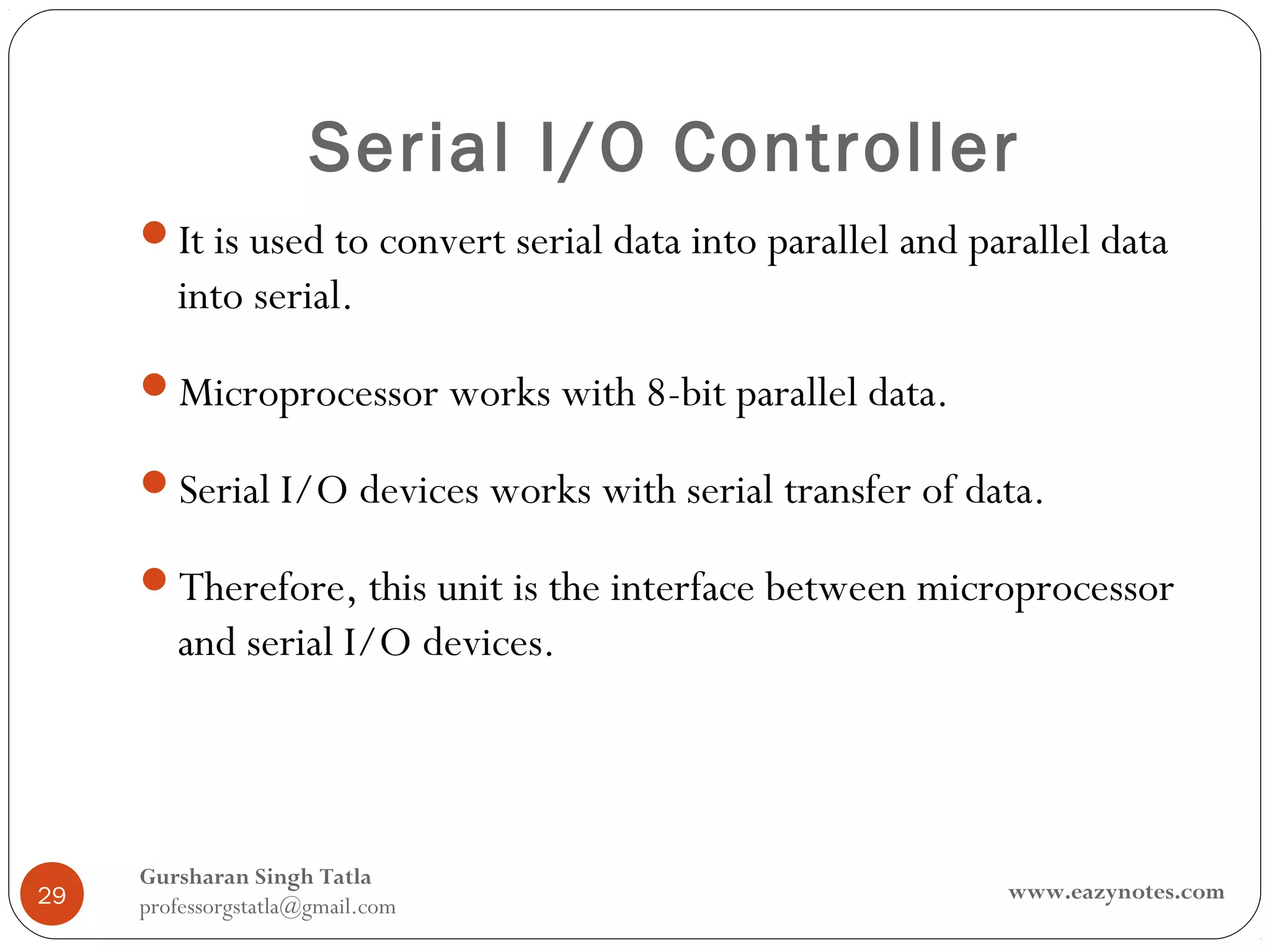
     It is used to convert serial data into parallel and parallel data
        into serial.
     Microprocessor works with 8-bit parallel data.

     Serial I/O devices works with serial transfer of data.

     Therefore, this unit is the interface between microprocessor
        and serial I/O devices.


     Gursharan Singh Tatla
29                                                          www.eazynotes.com
     professorgstatla@gmail.com
Interrupt Controller
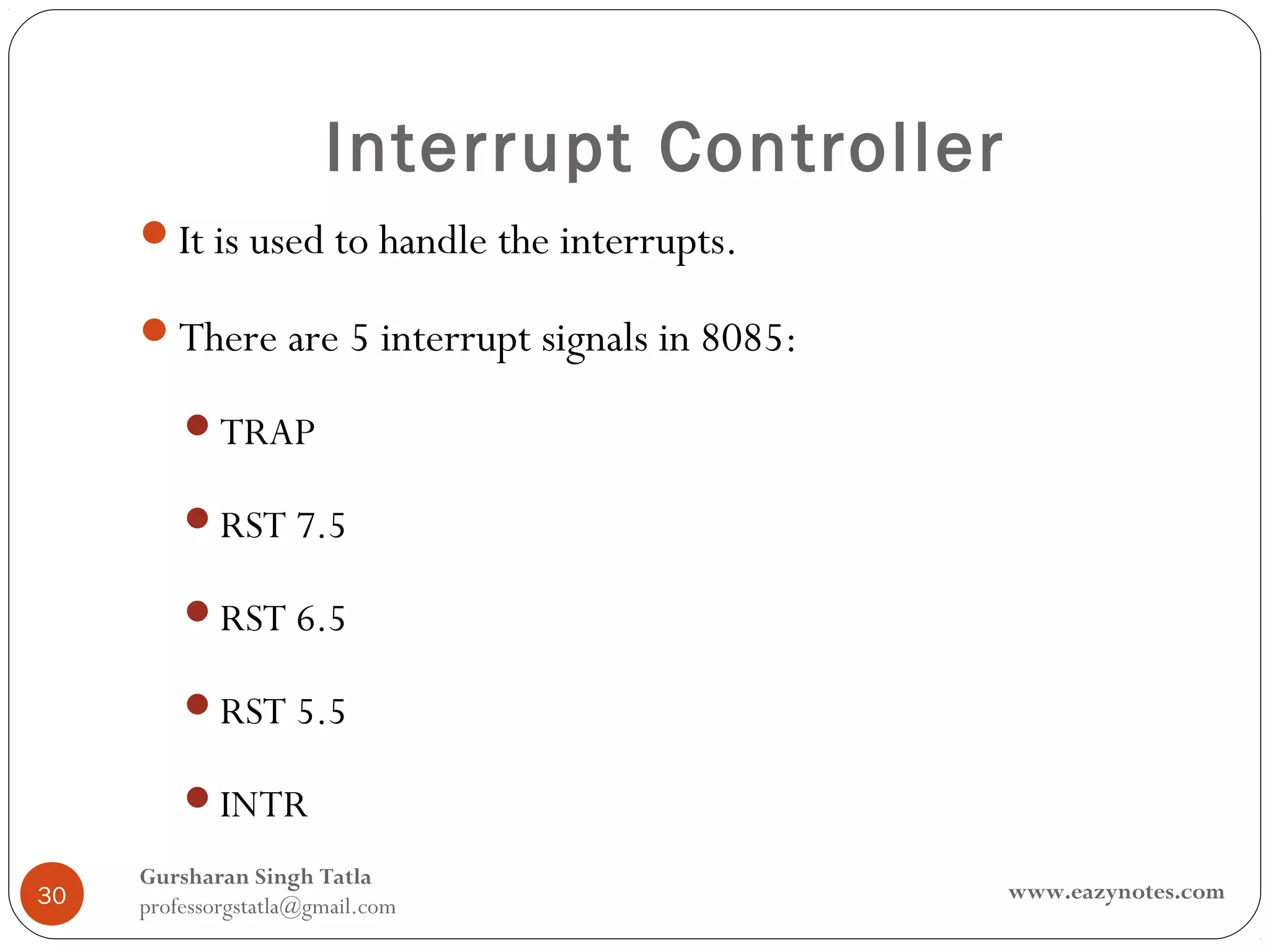
     It is used to handle the interrupts.

     There are 5 interrupt signals in 8085:

         TRAP

         RST 7.5

         RST 6.5

         RST 5.5

         INTR

     Gursharan Singh Tatla
30                                             www.eazynotes.com
     professorgstatla@gmail.com
Interrupt Controller
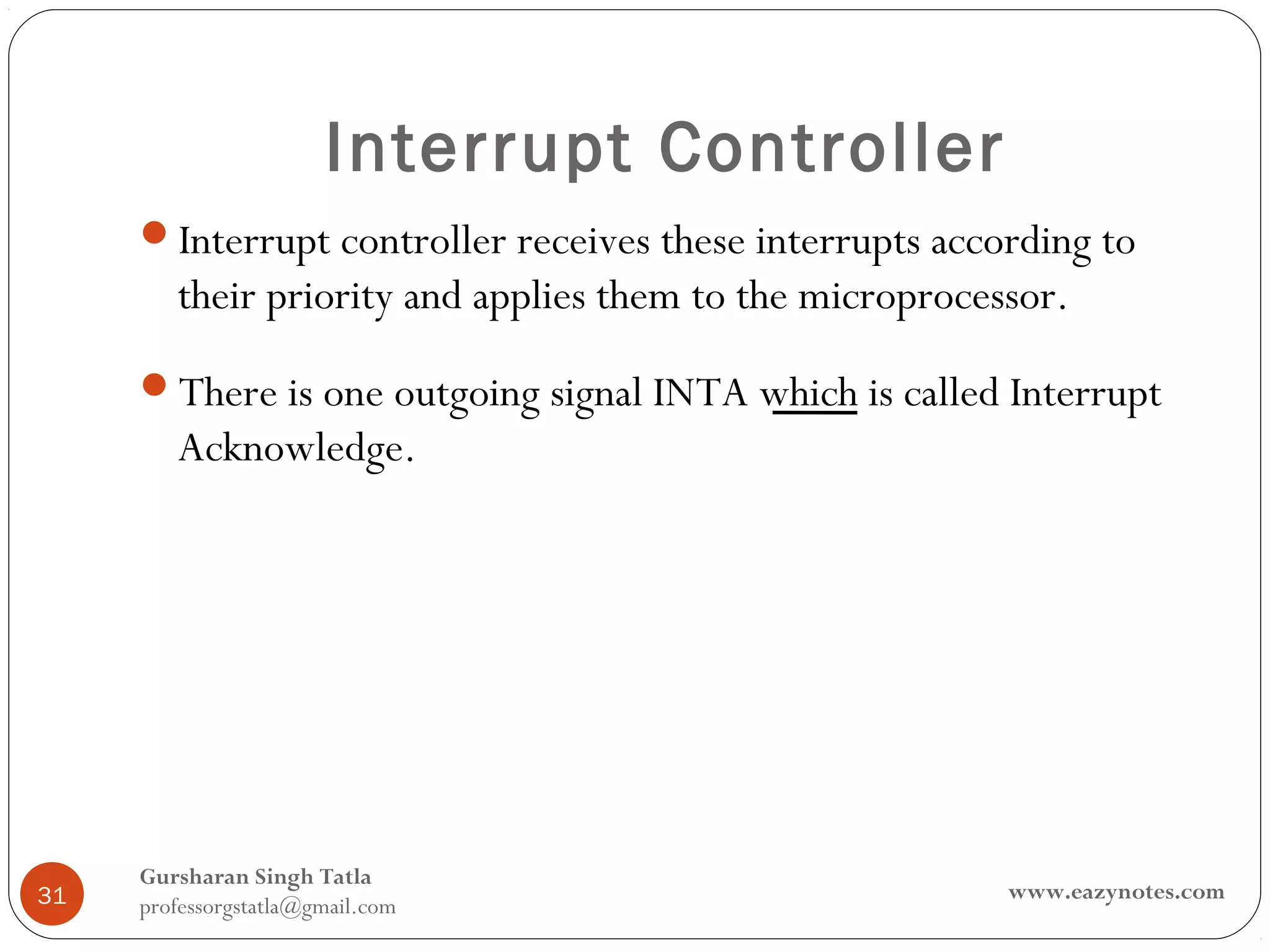
     Interrupt controller receives these interrupts according to
        their priority and applies them to the microprocessor.
     There is one outgoing signal INTA which is called Interrupt
        Acknowledge.


     Gursharan Singh Tatla
31                                                        www.eazynotes.com
     professorgstatla@gmail.com
Power Supply
     This unit provides +5V power supply to the microprocessor.

     The microprocessor needs +5V power supply for its
        operation.


     Gursharan Singh Tatla
32                                                   www.eazynotes.com
     professorgstatla@gmail.com

Block diagram-of-8085

  • 1.
    BLOCK DIAGRAM OF INTEL 8085 GURSHARAN SINGH TATLA professorgstatla@gmail.com Gursharan Singh Tatla 1 www.eazynotes.com professorgstatla@gmail.com
  • 2.
    Introduction to 8085 Introduced in 1977. It is 8-bit MP. It is a 40 pin dual-in-line chip. It uses a single +5V supply for its operations. Its clock speed is about 3MHz. Gursharan Singh Tatla 2 www.eazynotes.com professorgstatla@gmail.com
  • 3.
    Block Diagram of8085 Gursharan Singh Tatla 3 www.eazynotes.com professorgstatla@gmail.com
  • 4.
    Three Units of8085 Processing Unit Instruction Unit Storage and Interface Unit Gursharan Singh Tatla 4 www.eazynotes.com professorgstatla@gmail.com
  • 5.
    Processing Unit Arithmetic and Logic Unit Accumulator Status Flags Temporary Register Gursharan Singh Tatla 5 www.eazynotes.com professorgstatla@gmail.com
  • 6.
    Instruction Unit Instruction Register Instruction Decoder Timing and Control Unit Gursharan Singh Tatla 6 www.eazynotes.com professorgstatla@gmail.com
  • 7.
    Storage and InterfaceUnit General Purpose Registers Stack Pointer Program Counter Increment/Decrement Register Address Latch Address/Data Latch Gursharan Singh Tatla 7 www.eazynotes.com professorgstatla@gmail.com
  • 8.
    Three Other Units Interrupt Controller Serial I/O Controller Power Supply Gursharan Singh Tatla 8 www.eazynotes.com professorgstatla@gmail.com
  • 9.
    Accumulator  It the main register of microprocessor.  It is also called register ‘A’.  It is an 8-bit register.  It is used in the arithmetic and logic operations.  It always contains one of the operands on which arithmetic/logic has to be performed.  After the arithmetic/logic operation, the contents of accumulator are replaced by the result. Gursharan Singh Tatla 9 www.eazynotes.com professorgstatla@gmail.com
  • 10.
    Arithmetic & LogicUnit (ALU) It performs various arithmetic and logic operations. The data is available in accumulator and temporary/general purpose registers. Arithmetic Operations: Addition, Subtraction, Increment, Decrement etc. Logic Operations: AND, OR, X-OR, Complement etc. Gursharan Singh Tatla 10 www.eazynotes.com professorgstatla@gmail.com
  • 11.
    Temporary Register It is an 8-bit register. It is used to store temporary 8-bit operand from general purpose register. It is also used to store intermediate results. Gursharan Singh Tatla 11 www.eazynotes.com professorgstatla@gmail.com
  • 12.
    Status Flags Status Flags are set of flip-flops which are used to check the status of Accumulator after the operation is performed. Gursharan Singh Tatla 12 www.eazynotes.com professorgstatla@gmail.com
  • 13.
    Status Flags S = Sign Flag Z = Zero Flag AC = Auxiliary Carry Flag P = Parity Flag CY = Carry Flag Gursharan Singh Tatla 13 www.eazynotes.com professorgstatla@gmail.com
  • 14.
    Status Flags Sign Flag (S): It tells the sign of result stored in Accumulator after the operation is performed. If result is –ve, sign flag is set (1). If result is +ve, sign flag is reset (0). Gursharan Singh Tatla 14 www.eazynotes.com professorgstatla@gmail.com
  • 15.
    Status Flags Zero Flag (Z): It tells whether the result stored in Accumulator is zero or not after the operation is performed. If result is zero, zero flag is set (1). If result is not zero, zero flag is reset (0). Gursharan Singh Tatla 15 www.eazynotes.com professorgstatla@gmail.com
  • 16.
    Status Flags Auxiliary Carry Flag (AC): It is used in BCD operations. When there is carry in BCD addition, we add 0110 (6) to the result. If there is carry in BCD addition, auxiliary carry is set (1). If there is no carry, auxiliary carry is reset (0). Gursharan Singh Tatla 16 www.eazynotes.com professorgstatla@gmail.com
  • 17.
    Status Flags Parity Flag (P): It tells the parity of data stored in Accumulator. If parity is even, parity flag is set (1). If parity is odd, parity flag is reset (0). Gursharan Singh Tatla 17 www.eazynotes.com professorgstatla@gmail.com
  • 18.
    Program Status Word(PSW) The contents of Accumulator and Status Flags clubbed together is known as Program Status Word (PSW). It is a 16-bit word. Gursharan Singh Tatla 18 www.eazynotes.com professorgstatla@gmail.com
  • 19.
    Instruction Register It is used to hold the current instruction which the microprocessor is about to execute. It is an 8-bit register. Gursharan Singh Tatla 19 www.eazynotes.com professorgstatla@gmail.com
  • 20.
    Instruction Decoder It interprets the instruction stored in instruction register. It generates various machine cycles depending upon the instruction. The machine cycles are then given to the Timing and Control Unit. Gursharan Singh Tatla 20 www.eazynotes.com professorgstatla@gmail.com
  • 21.
    Timing and ControlUnit It controls all the operations of microprocessor and peripheral devices. Depending upon the machine cycles received from Instruction Decoder, it generates 12 control signals: S0 and S1 (Status Signals). ALE (Address Latch Enable). Gursharan Singh Tatla 21 www.eazynotes.com professorgstatla@gmail.com
  • 22.
    Timing and ControlUnit RD (Read, active low). WR (Write, active low). IO/M (Input-Output/Memory). READY RESET IN RESET OUT CLK OUT HOLD and HLDA Gursharan Singh Tatla 22 www.eazynotes.com professorgstatla@gmail.com
  • 23.
    General Purpose Registers  There are 6 general purpose registers, namely B, C, D, E, H, L.  Each of the them is 8-bit register.  They are used to hold data and results.  To hold 16-bit data, combination of two 8-bit registers can be used.  This combination is known as Register Pair.  The valid register pairs are:  B – C, D – E, H – L. Gursharan Singh Tatla 23 www.eazynotes.com professorgstatla@gmail.com
  • 24.
    Program Counter It is used to hold the address of next instruction to be executed. It is a 16-bit register. The microprocessor increments the value of Program Counter after the execution of the current instruction, so that, it always points to the next instruction. Gursharan Singh Tatla 24 www.eazynotes.com professorgstatla@gmail.com
  • 25.
    Stack Pointer It holds the address of top most item in the stack. It is also 16-bit register. Any portion of memory can be used as stack. Gursharan Singh Tatla 25 www.eazynotes.com professorgstatla@gmail.com
  • 26.
    Increment/Decrement Register This register is used to increment or decrement the value of Stack Pointer. During PUSH operation, the value of Stack Pointer is incremented. During POP operation, the value of Stack Pointer is decremented. Gursharan Singh Tatla 26 www.eazynotes.com professorgstatla@gmail.com
  • 27.
    Address Latch It is group of 8 buffers. The upper-byte of 16-bit address is stored in this latch. And then it is made available to the peripheral devices. Gursharan Singh Tatla 27 www.eazynotes.com professorgstatla@gmail.com
  • 28.
    Address/Data Latch  The lower-byte of address and 8-bit of data are multiplexed.  It holds either lower-byte of address or 8-bits of data.  This is decided by ALE (Address Latch Enable) signal.  If ALE = 1 then Address/Data Latch contains lower-byte of address.  If ALE = 0 then It contains 8-bit data. Gursharan Singh Tatla 28 www.eazynotes.com professorgstatla@gmail.com
  • 29.
    Serial I/O Controller It is used to convert serial data into parallel and parallel data into serial. Microprocessor works with 8-bit parallel data. Serial I/O devices works with serial transfer of data. Therefore, this unit is the interface between microprocessor and serial I/O devices. Gursharan Singh Tatla 29 www.eazynotes.com professorgstatla@gmail.com
  • 30.
    Interrupt Controller It is used to handle the interrupts. There are 5 interrupt signals in 8085: TRAP RST 7.5 RST 6.5 RST 5.5 INTR Gursharan Singh Tatla 30 www.eazynotes.com professorgstatla@gmail.com
  • 31.
    Interrupt Controller Interrupt controller receives these interrupts according to their priority and applies them to the microprocessor. There is one outgoing signal INTA which is called Interrupt Acknowledge. Gursharan Singh Tatla 31 www.eazynotes.com professorgstatla@gmail.com
  • 32.
    Power Supply This unit provides +5V power supply to the microprocessor. The microprocessor needs +5V power supply for its operation. Gursharan Singh Tatla 32 www.eazynotes.com professorgstatla@gmail.com