Register Transfer Language,Bus and Memory Transfer
This document discusses register transfer language (RTL) which provides a concise way to describe operations between registers in a computer using symbolic notation. It defines common registers like the memory address register (MAR) and program counter (PC). Information can be transferred between registers using arrows. Basic symbols are used to denote registers and parts of registers. Transfers can happen over a shared bus connecting all registers. Memory is represented as a device that is accessed using a memory address register to specify the location. RTL provides an organized way to describe the internal operations of a computer concisely and precisely.
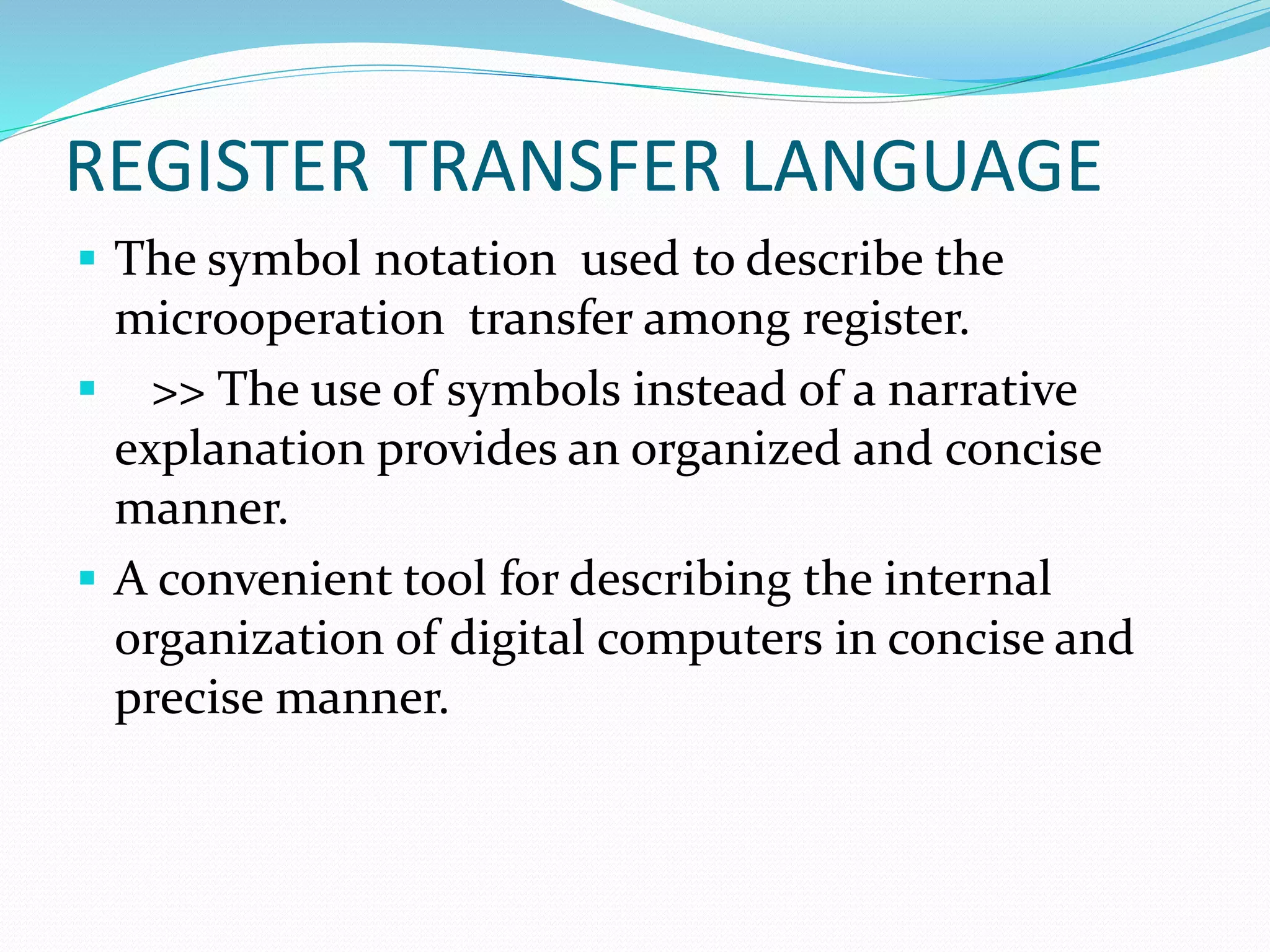
The symbolnotation used to describe the
microoperation transfer among register.
>> The use of symbols instead of a narrative
explanation provides an organized and concise
manner.
A convenient tool for describing the internal
organization of digital computers in concise and
precise manner.
REGISTER TRANSFER LANGUAGE
3.
REGISTER TRANSFER
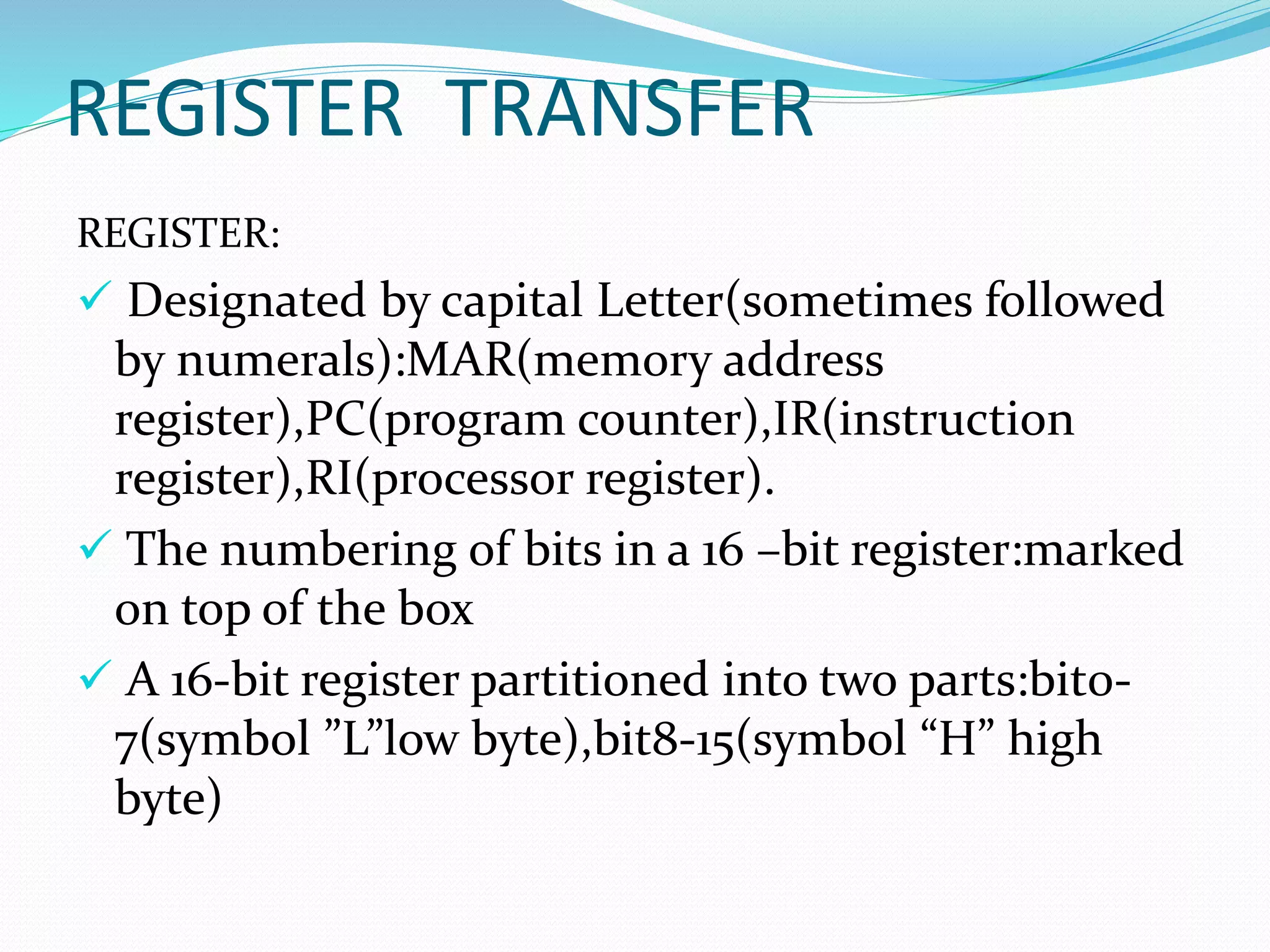
REGISTER:
Designatedby capital Letter(sometimes followed
by numerals):MAR(memory address
register),PC(program counter),IR(instruction
register),RI(processor register).
The numbering of bits in a 16 –bit register:marked
on top of the box
A 16-bit register partitioned into two parts:bit0-
7(symbol ”L”low byte),bit8-15(symbol “H” high
byte)
4.
REGISTER TRANSFER
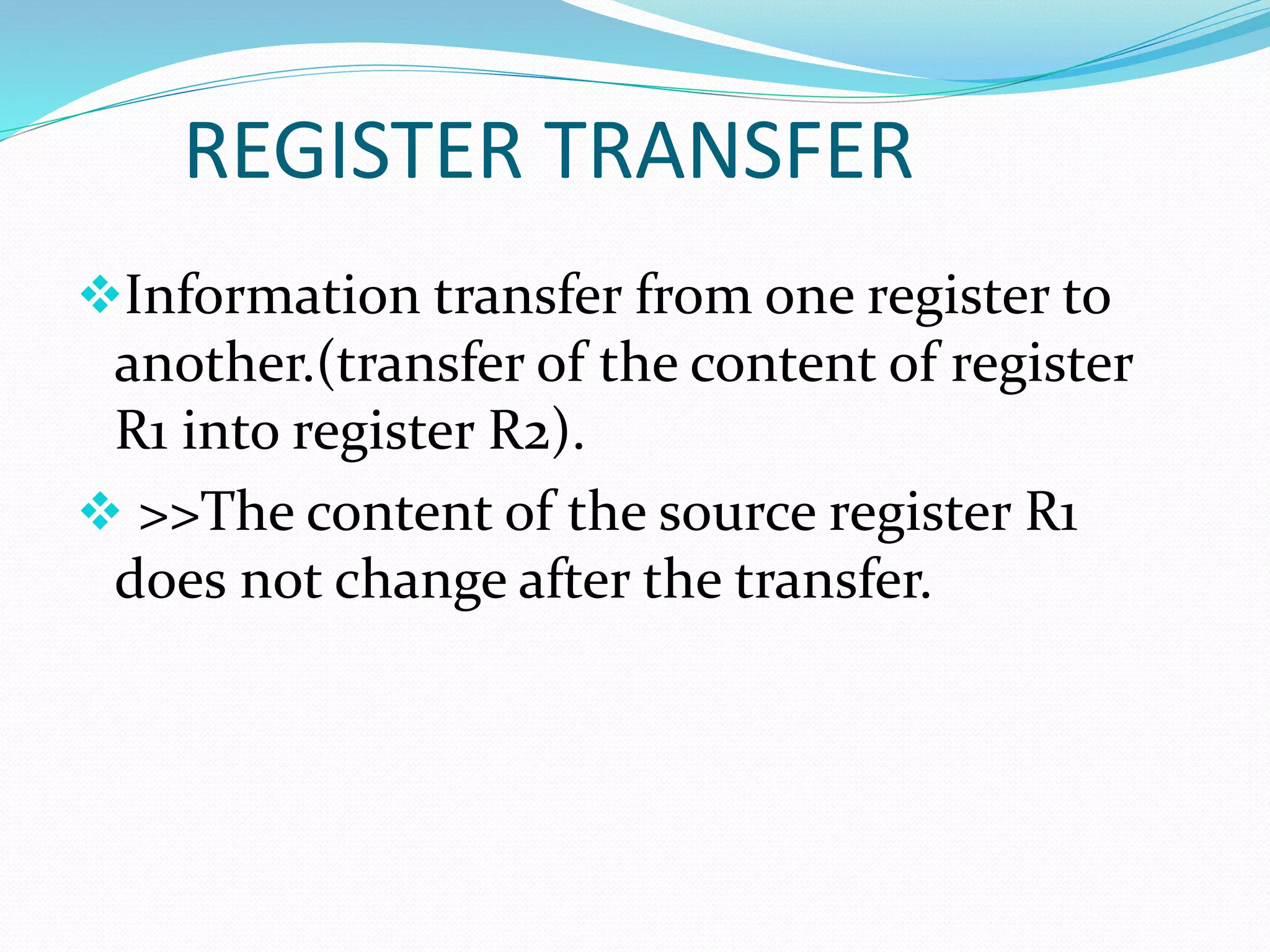
Information transferfrom one register to
another.(transfer of the content of register
R1 into register R2).
>>The content of the source register R1
does not change after the transfer.
5.
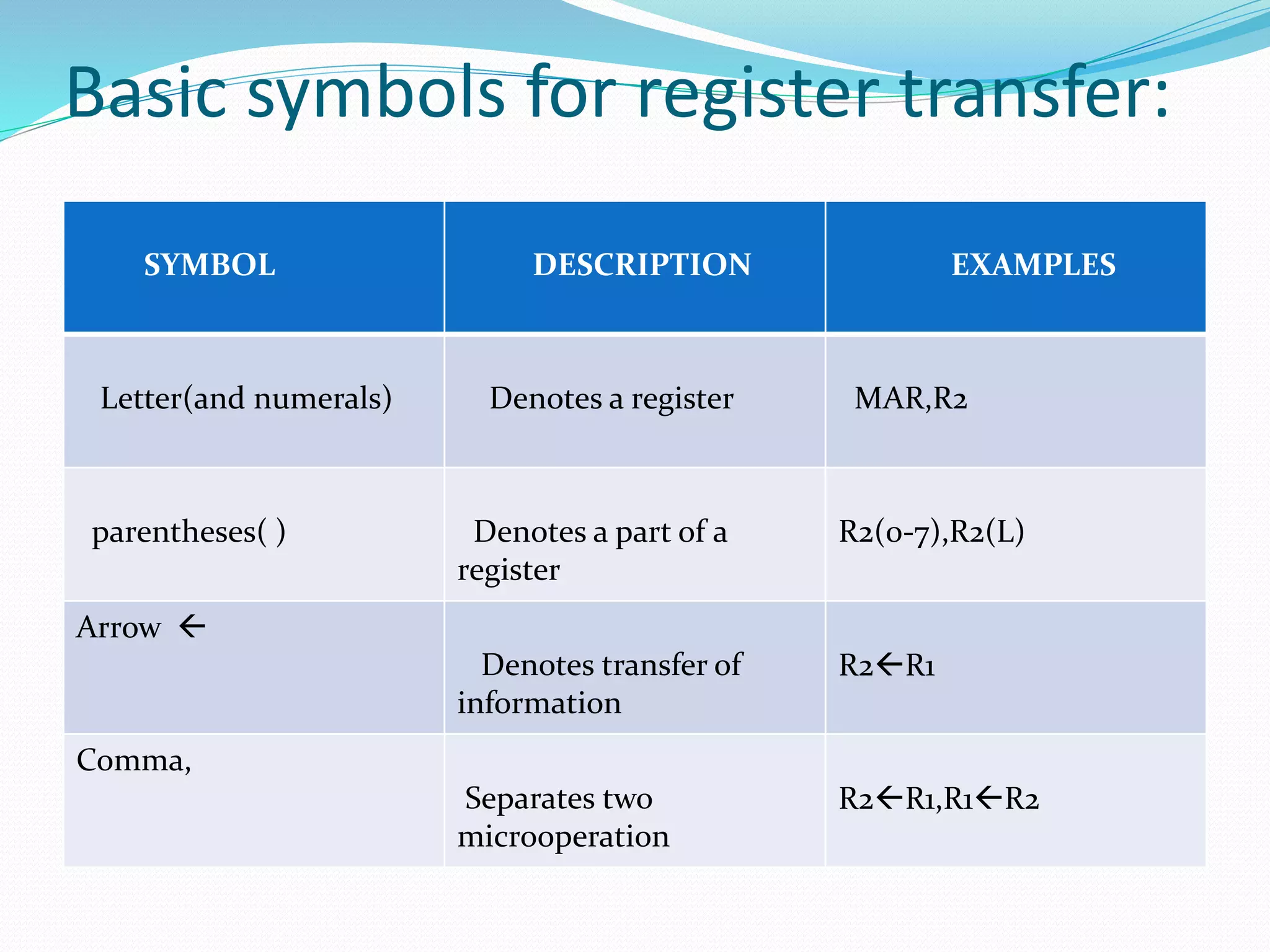
Basic symbols forregister transfer:
SYMBOL DESCRIPTION EXAMPLES
Letter(and numerals) Denotes a register MAR,R2
parentheses( ) Denotes a part of a
register
R2(0-7),R2(L)
Arrow
Denotes transfer of
information
R2R1
Comma,
Separates two
microoperation
R2R1,R1R2
6.
BUS AND MEMORYTRANSFER
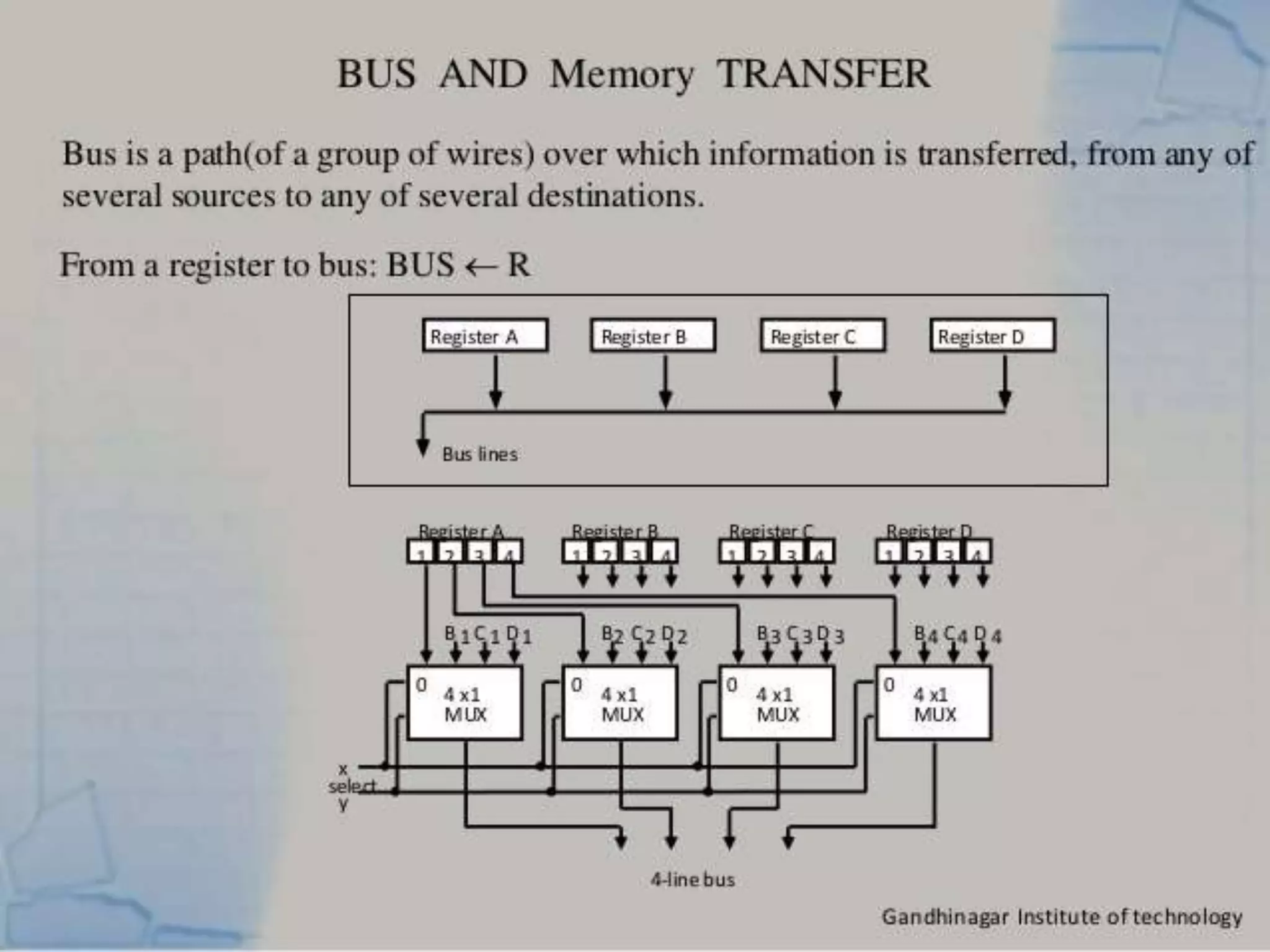
BUS:
If a computer has 16 register, each holding 32 bits.
A bus is a single shared set of wires connecting all
registers.
8.
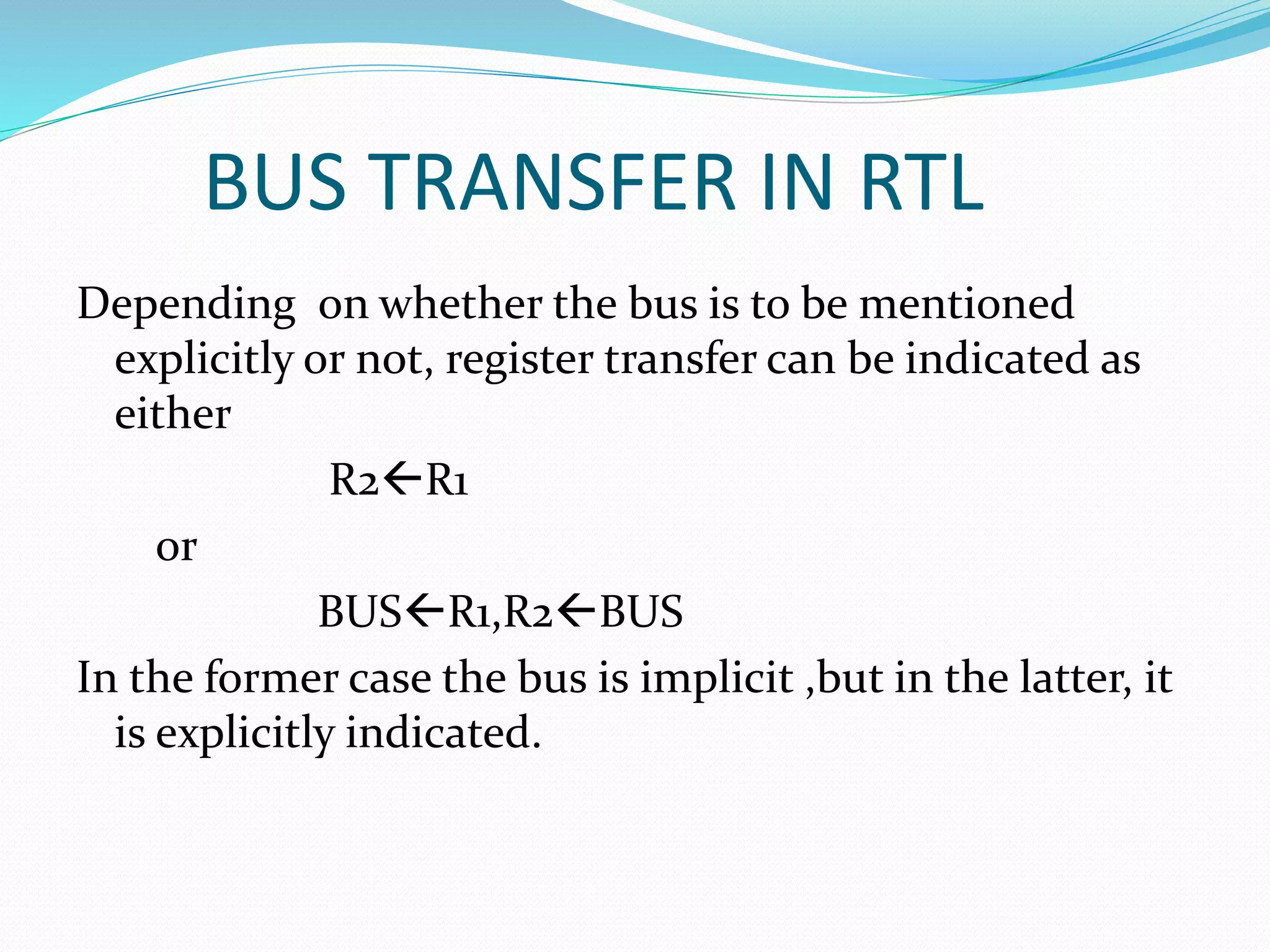
BUS TRANSFER INRTL
Depending on whether the bus is to be mentioned
explicitly or not, register transfer can be indicated as
either
R2R1
or
BUSR1,R2BUS
In the former case the bus is implicit ,but in the latter, it
is explicitly indicated.
9.
MEMORY TRANSFER
Collectively,the memoryis viewed at the
register level as a device,M.
Since it contains multiple locations,we must
specify which address in memory we will be
using.
This is done by indexing memory reference.
The memory address register(MAR or AR).
10.
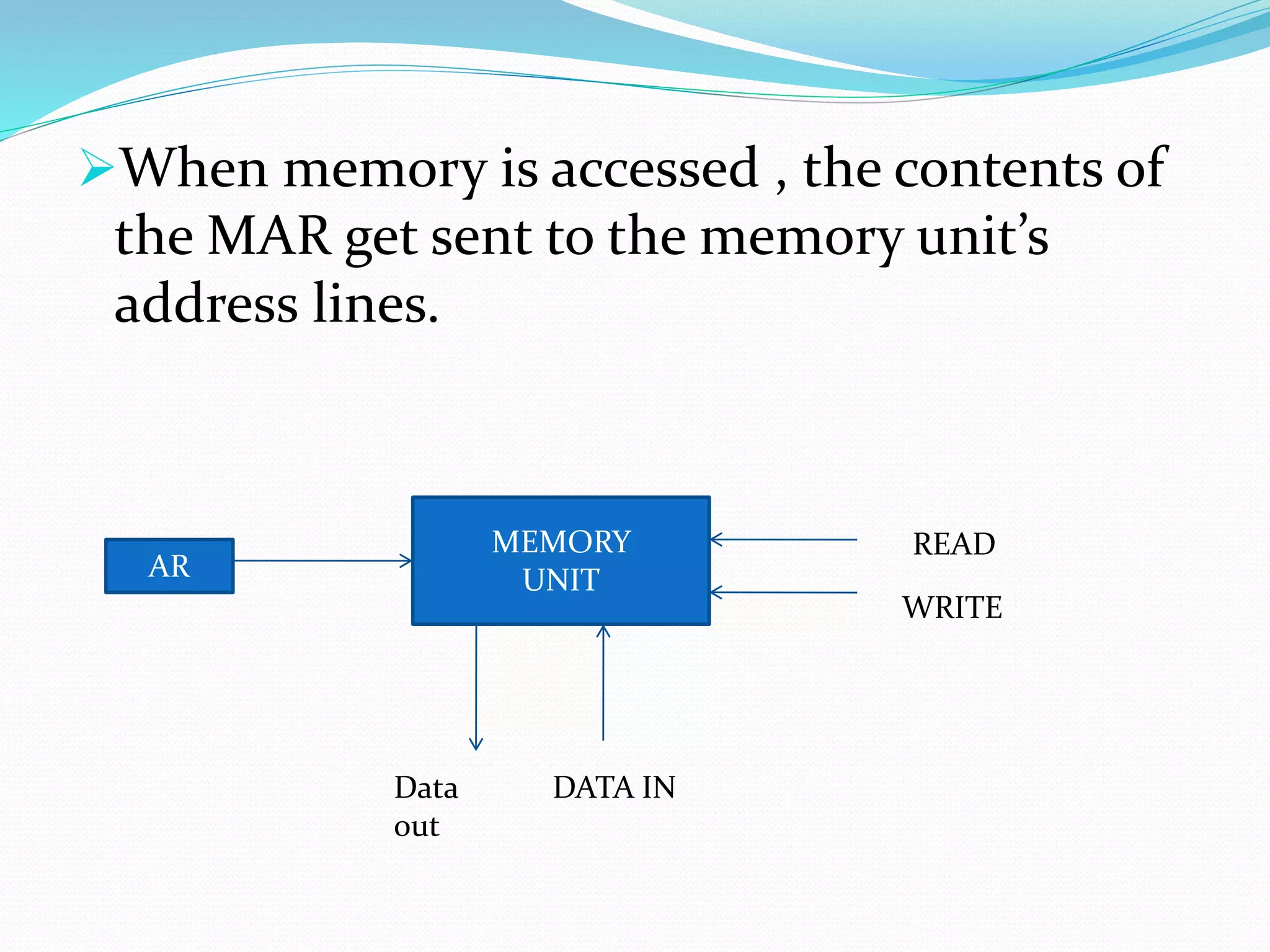
When memory isaccessed , the contents of
the MAR get sent to the memory unit’s
address lines.
MEMORY
UNIT
READ
WRITE
AR
Data
out
DATA IN