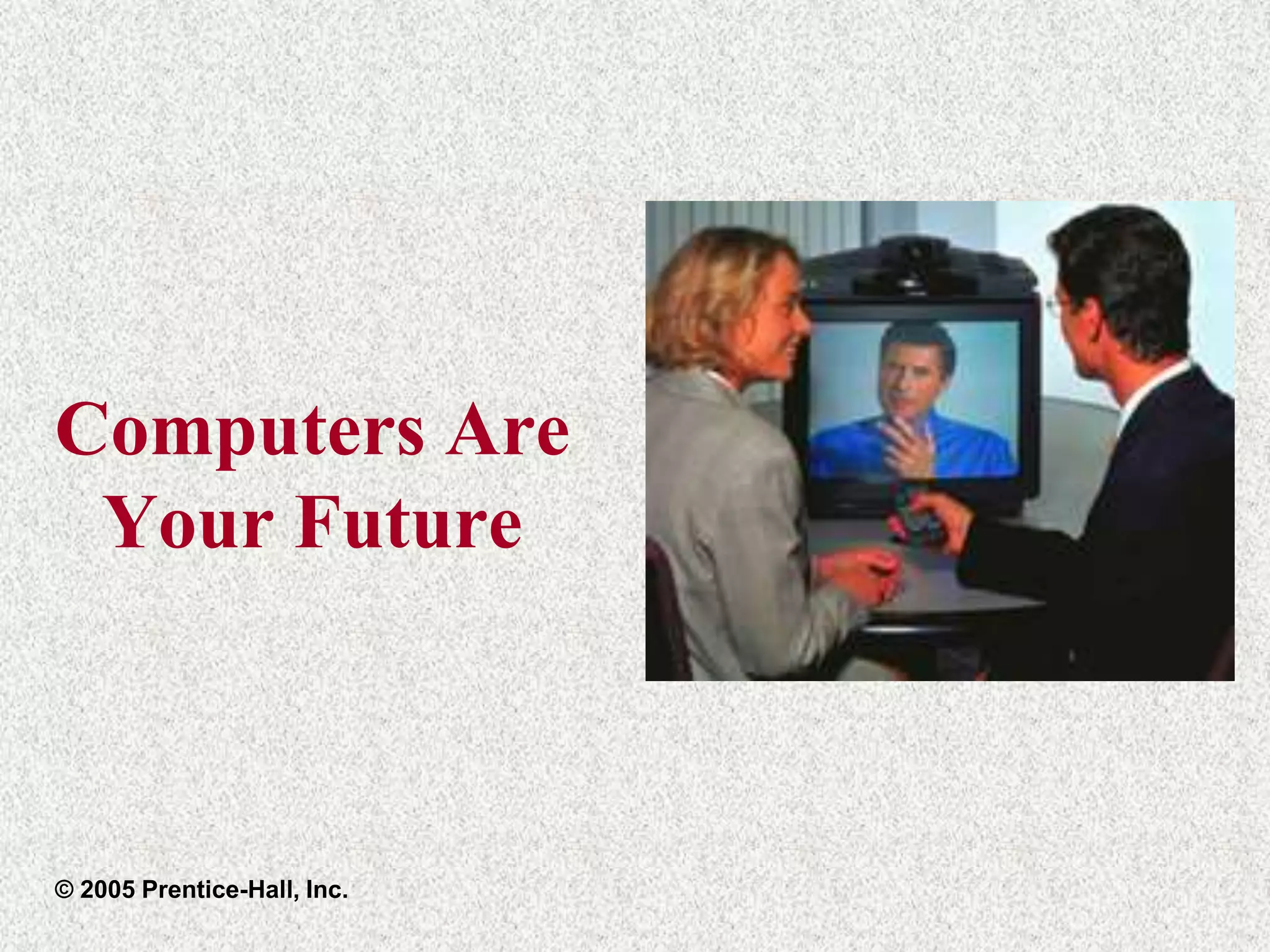
Computers Are
Your Future
© 2005 Prentice-Hall, Inc.
Computers Are Your Future Chapter 7
© 2005 Prentice-Hall, Inc Slide 2
Computers Are Your Future
Chapter 7
The Internet and World Wide Web
Computers Are Your Future Chapter 7
© 2005 Prentice-Hall, Inc Slide 3
What You Will Learn About
 The Internet and its history
 The differences between the Internet and the Web
 The concept of hypertext
 Web browsers and Web servers
 The parts of a URL
Computers Are Your Future Chapter 7
© 2005 Prentice-Hall, Inc Slide 4
What You Will Learn About
 The elements of Internet addresses
 The most popular Internet services
 Web subject guides and search engines
 Search operators
 The reliability of information on a Web page
Computers Are Your Future Chapter 7
© 2005 Prentice-Hall, Inc Slide 5
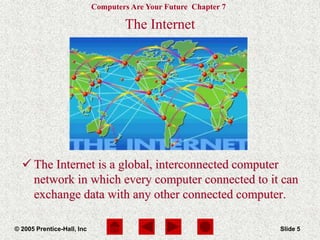
The Internet
 The Internet is a global, interconnected computer
network in which every computer connected to it can
exchange data with any other connected computer.
Computers Are Your Future Chapter 7
© 2005 Prentice-Hall, Inc Slide 6
The Significance of the Internet
 It’s the first mass medium that involves computers
and uses digitized data.
 It provides the potential for media convergence, the
unification of all media.
 It’s transforming how we communicate, obtain
information, learn, seek jobs, and maintain
professional growth.
 Businesses find it an indispensable tool for their
needs.
Computers Are Your Future Chapter 7
© 2005 Prentice-Hall, Inc Slide 7
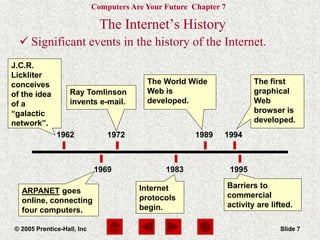
The Internet’s History
 Significant events in the history of the Internet.
1962
1969
1972
1983
1989 1994
1995
J.C.R.
Lickliter
conceives
of the idea
of a
“galactic
network”.
Ray Tomlinson
invents e-mail.
The World Wide
Web is
developed.
The first
graphical
Web
browser is
developed.
ARPANET goes
online, connecting
four computers.
Internet
protocols
begin.
Barriers to
commercial
activity are lifted.
Computers Are Your Future Chapter 7
© 2005 Prentice-Hall, Inc Slide 8
The Future of the Internet
 Key changes in the Internet need to take place to
handle the growing number of users and the speed of
the connections.
 Future changes include:
More bandwidth
 Internet 2 (I2) is being developed and tested to establish
gigabits per second Points of Presence (gigaPOP).
Computers Are Your Future Chapter 7
© 2005 Prentice-Hall, Inc Slide 9
The Internet and Web: What’s the Difference?
 The Internet is the physical connection of millions of
networks.
 The Web uses the Internet for its existence.
 The Web consists of hypertext embedded on Web
pages that are hosted on Web sites.
Computers Are Your Future Chapter 7
© 2005 Prentice-Hall, Inc Slide 10
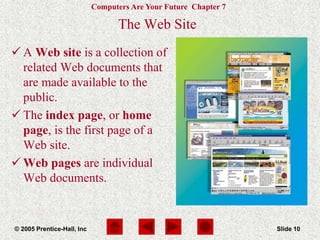
The Web Site
 A Web site is a collection of
related Web documents that
are made available to the
public.
 The index page, or home
page, is the first page of a
Web site.
 Web pages are individual
Web documents.
Computers Are Your Future Chapter 7
© 2005 Prentice-Hall, Inc Slide 11
The Hypertext Concept
 Hypertext is a way of presenting information so that
the order in which it’s read is left up to the reader.
 Hyperlinks are underlined or highlighted words that
can be used to view another document or Web page.
 Hypermedia refers to a link to multimedia, such as
music and movies.
 The Web is a distributed hypermedia system or a
system where the responsibility for creating content
is distributed among many people.
Computers Are Your Future Chapter 7
© 2005 Prentice-Hall, Inc Slide 12
Web Browsers and Servers
 Web browsers display a Web document and enable
users to link to other Web pages.
The first browsers were text-only.
Mosaic was the first graphical browser.
 Web servers respond to the requests of browsers.
They find and send requested resources back to the
browser.
Computers Are Your Future Chapter 7
© 2005 Prentice-Hall, Inc Slide 13
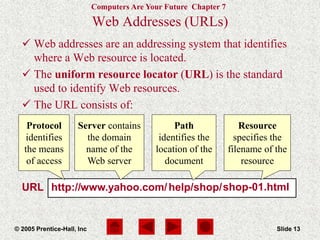
 Web addresses are an addressing system that identifies
where a Web resource is located.
 The uniform resource locator (URL) is the standard
used to identify Web resources.
 The URL consists of:
URL
Web Addresses (URLs)
http://
Protocol
identifies
the means
of access
www.yahoo.com/
Server contains
the domain
name of the
Web server
help/shop/
Path
identifies the
location of the
document
shop-01.html
Resource
specifies the
filename of the
resource
Computers Are Your Future Chapter 7
© 2005 Prentice-Hall, Inc Slide 14
Browsing the Web
 To access a Web page, you can do any of the
following:
Click a hyperlink.
Type a URL in the Address box.
Click a button on the Links toolbar.
Use the Back and Forward buttons.
Use a Web site’s navigation aids.
Use the History list.
Use the Favorites or Bookmarks list.
Computers Are Your Future Chapter 7
© 2005 Prentice-Hall, Inc Slide 15
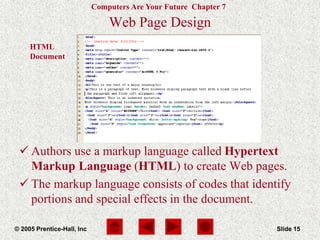
HTML
Document
Web Page Design
 Authors use a markup language called Hypertext
Markup Language (HTML) to create Web pages.
 The markup language consists of codes that identify
portions and special effects in the document.
Computers Are Your Future Chapter 7
© 2005 Prentice-Hall, Inc Slide 16
How the Internet Works
 The Internet provides immediate and direct contact
with all computers on the network.
All Internet computers have an Internet address (IP
address).
Internet service providers (ISPs) sell subscriptions to the
public.
Its interoperability feature enables access for all types of
computers.
 Large organizations maintain the Internet.
Many private and public networks are linked together to
provide a worldwide networking system.
 Packet switching technology is used to transmit data.
Computers Are Your Future Chapter 7
© 2005 Prentice-Hall, Inc Slide 17
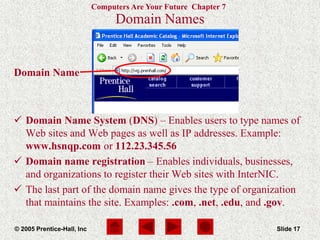
Domain Name
Domain Names
 Domain Name System (DNS) – Enables users to type names of
Web sites and Web pages as well as IP addresses. Example:
www.hsnqp.com or 112.23.345.56
 Domain name registration – Enables individuals, businesses,
and organizations to register their Web sites with InterNIC.
 The last part of the domain name gives the type of organization
that maintains the site. Examples: .com, .net, .edu, and .gov.
Computers Are Your Future Chapter 7
© 2005 Prentice-Hall, Inc Slide 18
Accessing the Internet
 The Internet can be accessed in the following ways:
Dial-up access with Point-to-Point Protocol (PPP)
Digital Subscriber Line (DSL)
Cable and satellite access
LAN access
Computers Are Your Future Chapter 7
© 2005 Prentice-Hall, Inc Slide 19
R
E
G
I
O
N
A
L
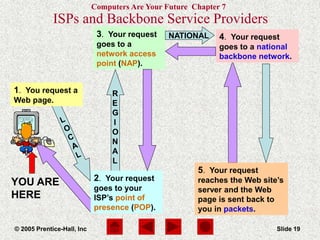
1. You request a
Web page.
2. Your request
goes to your
ISP’s point of
presence (POP).
3. Your request
goes to a
network access
point (NAP).
4. Your request
goes to a national
backbone network.
5. Your request
reaches the Web site’s
server and the Web
page is sent back to
you in packets.
YOU ARE
HERE
NATIONAL
ISPs and Backbone Service Providers
Computers Are Your Future Chapter 7
© 2005 Prentice-Hall, Inc Slide 20
E-Mail: Staying in Touch
 E-mail is short for electronic mail.
 It’s the most popular of the Internet services.
 Messages are sent and received in a few seconds.
 Attachments such as photos, music files, and any
document may be sent with the message.
Computers Are Your Future Chapter 7
© 2005 Prentice-Hall, Inc Slide 21
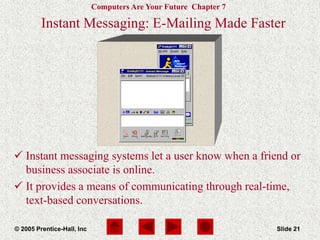
Instant Messaging: E-Mailing Made Faster
 Instant messaging systems let a user know when a friend or
business associate is online.
 It provides a means of communicating through real-time,
text-based conversations.
Computers Are Your Future Chapter 7
© 2005 Prentice-Hall, Inc Slide 22
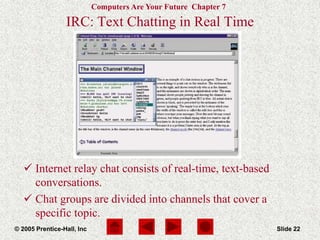
IRC: Text Chatting in Real Time
 Internet relay chat consists of real-time, text-based
conversations.
 Chat groups are divided into channels that cover a
specific topic.
Computers Are Your Future Chapter 7
© 2005 Prentice-Hall, Inc Slide 23
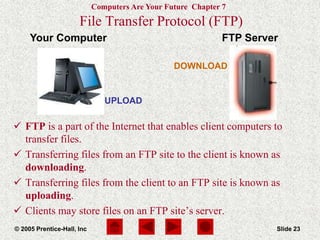
Your Computer FTP Server
DOWNLOAD
UPLOAD
File Transfer Protocol (FTP)
 FTP is a part of the Internet that enables client computers to
transfer files.
 Transferring files from an FTP site to the client is known as
downloading.
 Transferring files from the client to an FTP site is known as
uploading.
 Clients may store files on an FTP site’s server.
Computers Are Your Future Chapter 7
© 2005 Prentice-Hall, Inc Slide 24
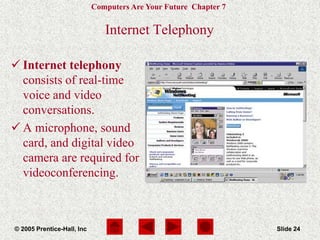
Internet Telephony
 Internet telephony
consists of real-time
voice and video
conversations.
 A microphone, sound
card, and digital video
camera are required for
videoconferencing.
Computers Are Your Future Chapter 7
© 2005 Prentice-Hall, Inc Slide 25
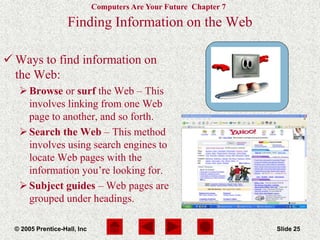
Finding Information on the Web
 Ways to find information on
the Web:
Browse or surf the Web – This
involves linking from one Web
page to another, and so forth.
Search the Web – This method
involves using search engines to
locate Web pages with the
information you’re looking for.
Subject guides – Web pages are
grouped under headings.
Computers Are Your Future Chapter 7
© 2005 Prentice-Hall, Inc Slide 26
Using Search Engines
 To use a search engine, you:
 Choose a search engine (Google, Bing, MSN, Lycos, Alta-
Vista, Yahoo, etc).
 Type in one or more words describing your topic.
 The search engine checks its database of Web pages
that contain the words typed.
 The results are sent to your computer.
 Clicking on the link takes you to that page.
Computers Are Your Future Chapter 7
© 2005 Prentice-Hall, Inc Slide 27
Using Search Techniques
 Learning a few search techniques can increase the
accuracy of Web searches.
 Searches using search operators will improve search
performance.
 Most search engines use the following search
operators:
Inclusion/exclusion operators
Wild cards
Phrases
Boolean operators
Computers Are Your Future Chapter 7
© 2005 Prentice-Hall, Inc Slide 28
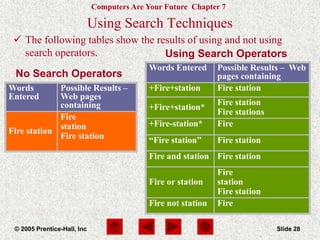
 The following tables show the results of using and not using
search operators.
Words
Entered
Possible Results –
Web pages
containing
Fire station
Fire
station
Fire station
Words Entered Possible Results – Web
pages containing
+Fire+station Fire station
+Fire+station*
Fire station
Fire stations
+Fire-station* Fire
“Fire station” Fire station
Fire and station Fire station
Fire or station
Fire
station
Fire station
Fire not station Fire
No Search Operators
Using Search Operators
Using Search Techniques
Computers Are Your Future Chapter 7
© 2005 Prentice-Hall, Inc Slide 29
Rules for Evaluating Web Pages
1. Author – Who is the author?
2. Sources – Where does the information come from?
3. Server – Who provides the server for the page?
4. Objectivity – Is the information objective or one-
sided?
5. Style – Is the language objective or argumentative?
6. Purpose – What is the purpose of the page?
7. Accuracy – Is the information accurate?
8. Currency – Is the page up-to-date?
Computers Are Your Future Chapter 7
© 2005 Prentice-Hall, Inc Slide 30
Chapter 7 Summary
• The Internet is a global network providing direct access to
computers worldwide.
• Because of its cross-platform feature, computers of all types can
use the Internet.
• Related information, in hypertext documents, is referenced by
linking to other documents.
• The user’s Web browser is known as the client, and the Web
server retrieves documents requested by the client.
• A URL consists of the:
Protocol
Server
Path
Resource name
• Web pages are created using Hypertext Markup Language
(HTML).
Computers Are Your Future Chapter 7
© 2005 Prentice-Hall, Inc Slide 31
Chapter 7 Summary (continued)
• Online services are proprietary.
• Client software enables information to be accessed, and server
software delivers the information.
• An Internet address uniquely identifies each computer
connected to the Internet.
• Intranets enable companies to set up internal communications.
• Popular Internet services include:
E-mail
World Wide Web
FTP
Usenet
Listservs
Instant messaging
Internet Relay Chat
Internet telephony
Computers Are Your Future Chapter 7
© 2005 Prentice-Hall, Inc Slide 32
Chapter 7 Summary (continued)
• You can improve search results by using inclusion operators,
phrases, and Boolean operators.
• Critically evaluate the author’s credentials and purposes for
publishing when reading Web pages.

Internet and computer are your future

  • 1.
    Computers Are Your Future ©2005 Prentice-Hall, Inc.
  • 2.
    Computers Are YourFuture Chapter 7 © 2005 Prentice-Hall, Inc Slide 2 Computers Are Your Future Chapter 7 The Internet and World Wide Web
  • 3.
    Computers Are YourFuture Chapter 7 © 2005 Prentice-Hall, Inc Slide 3 What You Will Learn About  The Internet and its history  The differences between the Internet and the Web  The concept of hypertext  Web browsers and Web servers  The parts of a URL
  • 4.
    Computers Are YourFuture Chapter 7 © 2005 Prentice-Hall, Inc Slide 4 What You Will Learn About  The elements of Internet addresses  The most popular Internet services  Web subject guides and search engines  Search operators  The reliability of information on a Web page
  • 5.
    Computers Are YourFuture Chapter 7 © 2005 Prentice-Hall, Inc Slide 5 The Internet  The Internet is a global, interconnected computer network in which every computer connected to it can exchange data with any other connected computer.
  • 6.
    Computers Are YourFuture Chapter 7 © 2005 Prentice-Hall, Inc Slide 6 The Significance of the Internet  It’s the first mass medium that involves computers and uses digitized data.  It provides the potential for media convergence, the unification of all media.  It’s transforming how we communicate, obtain information, learn, seek jobs, and maintain professional growth.  Businesses find it an indispensable tool for their needs.
  • 7.
    Computers Are YourFuture Chapter 7 © 2005 Prentice-Hall, Inc Slide 7 The Internet’s History  Significant events in the history of the Internet. 1962 1969 1972 1983 1989 1994 1995 J.C.R. Lickliter conceives of the idea of a “galactic network”. Ray Tomlinson invents e-mail. The World Wide Web is developed. The first graphical Web browser is developed. ARPANET goes online, connecting four computers. Internet protocols begin. Barriers to commercial activity are lifted.
  • 8.
    Computers Are YourFuture Chapter 7 © 2005 Prentice-Hall, Inc Slide 8 The Future of the Internet  Key changes in the Internet need to take place to handle the growing number of users and the speed of the connections.  Future changes include: More bandwidth  Internet 2 (I2) is being developed and tested to establish gigabits per second Points of Presence (gigaPOP).
  • 9.
    Computers Are YourFuture Chapter 7 © 2005 Prentice-Hall, Inc Slide 9 The Internet and Web: What’s the Difference?  The Internet is the physical connection of millions of networks.  The Web uses the Internet for its existence.  The Web consists of hypertext embedded on Web pages that are hosted on Web sites.
  • 10.
    Computers Are YourFuture Chapter 7 © 2005 Prentice-Hall, Inc Slide 10 The Web Site  A Web site is a collection of related Web documents that are made available to the public.  The index page, or home page, is the first page of a Web site.  Web pages are individual Web documents.
  • 11.
    Computers Are YourFuture Chapter 7 © 2005 Prentice-Hall, Inc Slide 11 The Hypertext Concept  Hypertext is a way of presenting information so that the order in which it’s read is left up to the reader.  Hyperlinks are underlined or highlighted words that can be used to view another document or Web page.  Hypermedia refers to a link to multimedia, such as music and movies.  The Web is a distributed hypermedia system or a system where the responsibility for creating content is distributed among many people.
  • 12.
    Computers Are YourFuture Chapter 7 © 2005 Prentice-Hall, Inc Slide 12 Web Browsers and Servers  Web browsers display a Web document and enable users to link to other Web pages. The first browsers were text-only. Mosaic was the first graphical browser.  Web servers respond to the requests of browsers. They find and send requested resources back to the browser.
  • 13.
    Computers Are YourFuture Chapter 7 © 2005 Prentice-Hall, Inc Slide 13  Web addresses are an addressing system that identifies where a Web resource is located.  The uniform resource locator (URL) is the standard used to identify Web resources.  The URL consists of: URL Web Addresses (URLs) http:// Protocol identifies the means of access www.yahoo.com/ Server contains the domain name of the Web server help/shop/ Path identifies the location of the document shop-01.html Resource specifies the filename of the resource
  • 14.
    Computers Are YourFuture Chapter 7 © 2005 Prentice-Hall, Inc Slide 14 Browsing the Web  To access a Web page, you can do any of the following: Click a hyperlink. Type a URL in the Address box. Click a button on the Links toolbar. Use the Back and Forward buttons. Use a Web site’s navigation aids. Use the History list. Use the Favorites or Bookmarks list.
  • 15.
    Computers Are YourFuture Chapter 7 © 2005 Prentice-Hall, Inc Slide 15 HTML Document Web Page Design  Authors use a markup language called Hypertext Markup Language (HTML) to create Web pages.  The markup language consists of codes that identify portions and special effects in the document.
  • 16.
    Computers Are YourFuture Chapter 7 © 2005 Prentice-Hall, Inc Slide 16 How the Internet Works  The Internet provides immediate and direct contact with all computers on the network. All Internet computers have an Internet address (IP address). Internet service providers (ISPs) sell subscriptions to the public. Its interoperability feature enables access for all types of computers.  Large organizations maintain the Internet. Many private and public networks are linked together to provide a worldwide networking system.  Packet switching technology is used to transmit data.
  • 17.
    Computers Are YourFuture Chapter 7 © 2005 Prentice-Hall, Inc Slide 17 Domain Name Domain Names  Domain Name System (DNS) – Enables users to type names of Web sites and Web pages as well as IP addresses. Example: www.hsnqp.com or 112.23.345.56  Domain name registration – Enables individuals, businesses, and organizations to register their Web sites with InterNIC.  The last part of the domain name gives the type of organization that maintains the site. Examples: .com, .net, .edu, and .gov.
  • 18.
    Computers Are YourFuture Chapter 7 © 2005 Prentice-Hall, Inc Slide 18 Accessing the Internet  The Internet can be accessed in the following ways: Dial-up access with Point-to-Point Protocol (PPP) Digital Subscriber Line (DSL) Cable and satellite access LAN access
  • 19.
    Computers Are YourFuture Chapter 7 © 2005 Prentice-Hall, Inc Slide 19 R E G I O N A L 1. You request a Web page. 2. Your request goes to your ISP’s point of presence (POP). 3. Your request goes to a network access point (NAP). 4. Your request goes to a national backbone network. 5. Your request reaches the Web site’s server and the Web page is sent back to you in packets. YOU ARE HERE NATIONAL ISPs and Backbone Service Providers
  • 20.
    Computers Are YourFuture Chapter 7 © 2005 Prentice-Hall, Inc Slide 20 E-Mail: Staying in Touch  E-mail is short for electronic mail.  It’s the most popular of the Internet services.  Messages are sent and received in a few seconds.  Attachments such as photos, music files, and any document may be sent with the message.
  • 21.
    Computers Are YourFuture Chapter 7 © 2005 Prentice-Hall, Inc Slide 21 Instant Messaging: E-Mailing Made Faster  Instant messaging systems let a user know when a friend or business associate is online.  It provides a means of communicating through real-time, text-based conversations.
  • 22.
    Computers Are YourFuture Chapter 7 © 2005 Prentice-Hall, Inc Slide 22 IRC: Text Chatting in Real Time  Internet relay chat consists of real-time, text-based conversations.  Chat groups are divided into channels that cover a specific topic.
  • 23.
    Computers Are YourFuture Chapter 7 © 2005 Prentice-Hall, Inc Slide 23 Your Computer FTP Server DOWNLOAD UPLOAD File Transfer Protocol (FTP)  FTP is a part of the Internet that enables client computers to transfer files.  Transferring files from an FTP site to the client is known as downloading.  Transferring files from the client to an FTP site is known as uploading.  Clients may store files on an FTP site’s server.
  • 24.
    Computers Are YourFuture Chapter 7 © 2005 Prentice-Hall, Inc Slide 24 Internet Telephony  Internet telephony consists of real-time voice and video conversations.  A microphone, sound card, and digital video camera are required for videoconferencing.
  • 25.
    Computers Are YourFuture Chapter 7 © 2005 Prentice-Hall, Inc Slide 25 Finding Information on the Web  Ways to find information on the Web: Browse or surf the Web – This involves linking from one Web page to another, and so forth. Search the Web – This method involves using search engines to locate Web pages with the information you’re looking for. Subject guides – Web pages are grouped under headings.
  • 26.
    Computers Are YourFuture Chapter 7 © 2005 Prentice-Hall, Inc Slide 26 Using Search Engines  To use a search engine, you:  Choose a search engine (Google, Bing, MSN, Lycos, Alta- Vista, Yahoo, etc).  Type in one or more words describing your topic.  The search engine checks its database of Web pages that contain the words typed.  The results are sent to your computer.  Clicking on the link takes you to that page.
  • 27.
    Computers Are YourFuture Chapter 7 © 2005 Prentice-Hall, Inc Slide 27 Using Search Techniques  Learning a few search techniques can increase the accuracy of Web searches.  Searches using search operators will improve search performance.  Most search engines use the following search operators: Inclusion/exclusion operators Wild cards Phrases Boolean operators
  • 28.
    Computers Are YourFuture Chapter 7 © 2005 Prentice-Hall, Inc Slide 28  The following tables show the results of using and not using search operators. Words Entered Possible Results – Web pages containing Fire station Fire station Fire station Words Entered Possible Results – Web pages containing +Fire+station Fire station +Fire+station* Fire station Fire stations +Fire-station* Fire “Fire station” Fire station Fire and station Fire station Fire or station Fire station Fire station Fire not station Fire No Search Operators Using Search Operators Using Search Techniques
  • 29.
    Computers Are YourFuture Chapter 7 © 2005 Prentice-Hall, Inc Slide 29 Rules for Evaluating Web Pages 1. Author – Who is the author? 2. Sources – Where does the information come from? 3. Server – Who provides the server for the page? 4. Objectivity – Is the information objective or one- sided? 5. Style – Is the language objective or argumentative? 6. Purpose – What is the purpose of the page? 7. Accuracy – Is the information accurate? 8. Currency – Is the page up-to-date?
  • 30.
    Computers Are YourFuture Chapter 7 © 2005 Prentice-Hall, Inc Slide 30 Chapter 7 Summary • The Internet is a global network providing direct access to computers worldwide. • Because of its cross-platform feature, computers of all types can use the Internet. • Related information, in hypertext documents, is referenced by linking to other documents. • The user’s Web browser is known as the client, and the Web server retrieves documents requested by the client. • A URL consists of the: Protocol Server Path Resource name • Web pages are created using Hypertext Markup Language (HTML).
  • 31.
    Computers Are YourFuture Chapter 7 © 2005 Prentice-Hall, Inc Slide 31 Chapter 7 Summary (continued) • Online services are proprietary. • Client software enables information to be accessed, and server software delivers the information. • An Internet address uniquely identifies each computer connected to the Internet. • Intranets enable companies to set up internal communications. • Popular Internet services include: E-mail World Wide Web FTP Usenet Listservs Instant messaging Internet Relay Chat Internet telephony
  • 32.
    Computers Are YourFuture Chapter 7 © 2005 Prentice-Hall, Inc Slide 32 Chapter 7 Summary (continued) • You can improve search results by using inclusion operators, phrases, and Boolean operators. • Critically evaluate the author’s credentials and purposes for publishing when reading Web pages.