THALASSEMIA
PRESENTEDBY :
JAGDISH SAMBAD
M.SC.NURSING
INTRODUCTION :
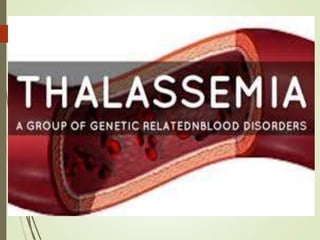
 Thalassemia is an inherited blood related disorder due to
absent or reduced production of hemoglobin, a protein
present in red blood cells responsible for carrying oxygen
through the body.
 Each red blood cell may contain between 240 and 300
million molecules of hemoglobin.
Cont..
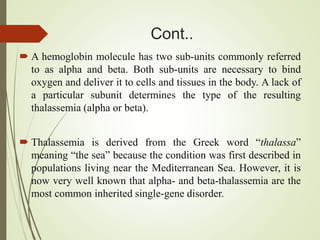
 A hemoglobin molecule has two sub-units commonly referred
to as alpha and beta. Both sub-units are necessary to bind
oxygen and deliver it to cells and tissues in the body. A lack of
a particular subunit determines the type of the resulting
thalassemia (alpha or beta).
 Thalassemia is derived from the Greek word “thalassa”
meaning “the sea” because the condition was first described in
populations living near the Mediterranean Sea. However, it is
now very well known that alpha- and beta-thalassemia are the
most common inherited single-gene disorder.
DEFINITION :
Thalassemia is an autosomal-recessive genetic
disorder that results in inadequate normal
Hemoglobin production.
Thalassemia is a hetergeonous group of inherited
chronic disorder, characterized by absence or
decreased by synthesis of one or more globin
chains of hemoglobin.
RISK FACTORS :
 Family history : Thalassemias are inherited— that is,
they're passed from parents to children through the
genes. If person’s parents have missing or altered
hemoglobin-making genes, person may have
thalassemia.
 Ancestry : Alpha thalassemias most often affect people
of Southeast Asian, Indian, Chinese, or Filipino origin
or ancestry.Beta thalassemias most often affect people of
Mediterranean (Greek, Italian , & Middle Eastern),
Asian, or African origin or ancestry
TYPES OF THALASSEMIA :
1) Alpha Thalassemia :
 Alpha thalassemia is the result of changes in the genes
for the alpha globin component in hemoglobin.
 Alpha globin genes on chromosome 16.
 There is need for four genes (two from each parent) to
make enough alpha globin protein chains. If one or more
of the genes is missing, people have alpha thalassemia
trait or disease. This means that body doesn't make
enough alpha globin protein.
Cont..
 If person only missing one gene, that person is a Silent Carrier.
This means you won't have any signs of illness.
 If person missing two genes, person have Alpha Thalassemia
Minor. Person may have mild anemia.
 If person missing three genes, person likely will have
Hemoglobin H disease (which a Blood test can detect). This form
of Thalassemia causes moderate to severe anemia.
 Very rarely, a baby will be missing all four genes. This condition
is called Alpha Thalassemia Major or Hydrops fetalis. Babies
who have hydrops fetalis usually die before or shortly after birth.
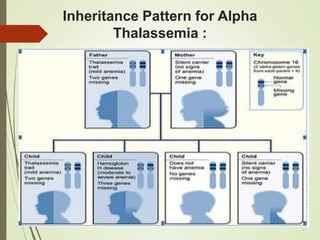
Inheritance Pattern for Alpha
Thalassemia :
Cont..
 The picture shows one example of how alpha
thalassemia is inherited. The alpha globin genes are
located on chromosome 16. A child inherits four alpha
globin genes—two from each parent. In this example,
the father is missing two alpha globin genes and the
mother is missing one alpha globin gene.
 Each child has a 25 percent chance of inheriting two
missing genes and two normal genes (thalassemia trait),
three missing genes and one normal gene (hemoglobin
H disease), four normal genes (no anemia), or one
missing gene and three normal genes (silent carrier).
2) Beta Thalassemia :
 Person need two genes (one from each parent) to make enough
beta globin protein chains. If one or both of these genes are
altered , person will have beta thalassemia. This means that
person body doesn’t make enough beta protein.
 If person have one altered gene , he/she is a carrier. This
condition is called beta thalassemia trait or beta thalassemia
minor. It causes mild anemia.
 If both genes are altered , person will have beta thalassemia
intermedia or beta thalassemia major (also called Cooley’s
anemia). The intermedia form of the disorder causes moderate
anemia. The major form causes severe anemia.
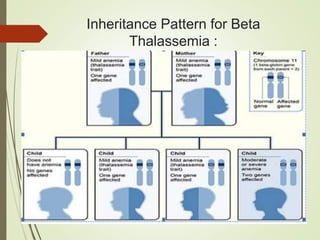
Inheritance Pattern for Beta
Thalassemia :
Cont..
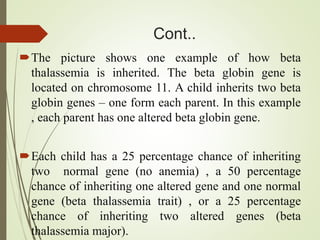
The picture shows one example of how beta
thalassemia is inherited. The beta globin gene is
located on chromosome 11. A child inherits two beta
globin genes – one form each parent. In this example
, each parent has one altered beta globin gene.
Each child has a 25 percentage chance of inheriting
two normal gene (no anemia) , a 50 percentage
chance of inheriting one altered gene and one normal
gene (beta thalassemia trait) , or a 25 percentage
chance of inheriting two altered genes (beta
thalassemia major).
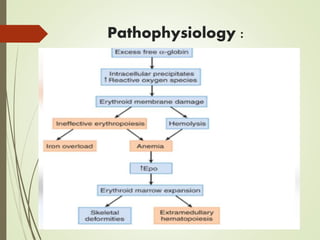
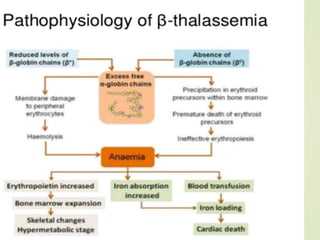
Pathophysiology :
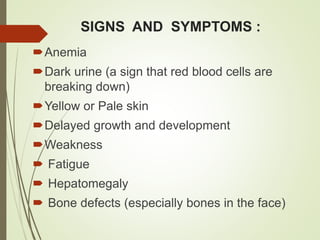
SIGNS AND SYMPTOMS :
Anemia
Dark urine (a sign that red blood cells are
breaking down)
Yellow or Pale skin
Delayed growth and development
Weakness
 Fatigue
 Hepatomegaly
 Bone defects (especially bones in the face)
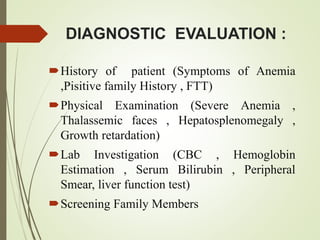
DIAGNOSTIC EVALUATION :
History of patient (Symptoms of Anemia
,Pisitive family History , FTT)
Physical Examination (Severe Anemia ,
Thalassemic faces , Hepatosplenomegaly ,
Growth retardation)
Lab Investigation (CBC , Hemoglobin
Estimation , Serum Bilirubin , Peripheral
Smear, liver function test)
Screening Family Members
MEDICAL MANAGEMENT :
 Blood Transfusion
 Iron Chelation Therapy
 Folic acid Supplementation
 Bone Marrow Transplantation
 Gene Therapy
 Diet Supplements
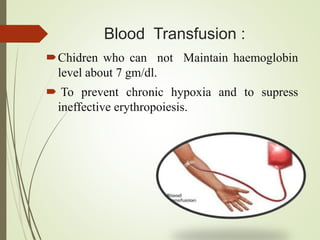
Blood Transfusion :
Chidren who can not Maintain haemoglobin
level about 7 gm/dl.
 To prevent chronic hypoxia and to supress
ineffective erythropoiesis.
Cont..
 Transfusions of red blood cells are the main treatment for
people who have moderate or severe thalassemias. This
treatment gives person healthy red blood cells with normal
hemoglobin.
 The procedure usually takes 1 to 4 hours.
 Red blood cells live only for about 120 days. So, may need
repeated transfusions to maintain a supply of healthy red blood
cells.
 If person have hemoglobin H disease or beta thalassemia
intermedia, person may need blood transfusions on occasion.
For example, personmay need this treatment when person have
an infection or other illness, or when anemia is severe enough
to cause tiredness.
Cont..
 If person have beta thalassemia major, or Cooley's
anemia, person need regular blood transfusions (often
every 2 to 4 weeks). These transfusions will help
maintain normal hemoglobin and red blood cell levels.
 Blood transfusions allow person to feel better, enjoy
normal activities, and live into adulthood. This treatment
is lifesaving, but it's expensive and carries a risk of
transmitting infections and viruses (for example,
hepatitis). However, the risk is very low in the United
States because of careful blood screening.
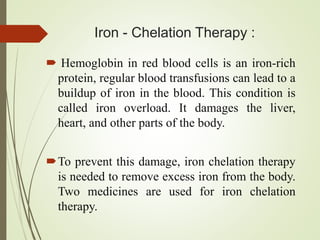
Iron - Chelation Therapy :
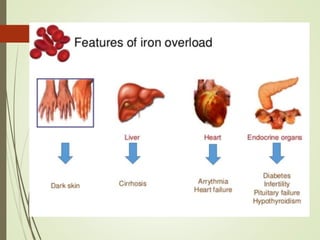
 Hemoglobin in red blood cells is an iron-rich
protein, regular blood transfusions can lead to a
buildup of iron in the blood. This condition is
called iron overload. It damages the liver,
heart, and other parts of the body.
To prevent this damage, iron chelation therapy
is needed to remove excess iron from the body.
Two medicines are used for iron chelation
therapy.
Cont..
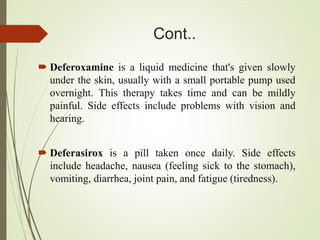
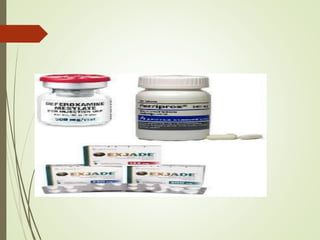
 Deferoxamine is a liquid medicine that's given slowly
under the skin, usually with a small portable pump used
overnight. This therapy takes time and can be mildly
painful. Side effects include problems with vision and
hearing.
 Deferasirox is a pill taken once daily. Side effects
include headache, nausea (feeling sick to the stomach),
vomiting, diarrhea, joint pain, and fatigue (tiredness).
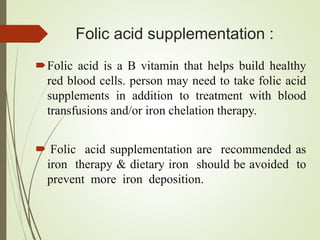
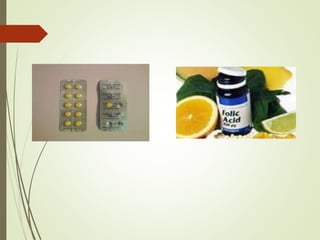
Folic acid supplementation :
Folic acid is a B vitamin that helps build healthy
red blood cells. person may need to take folic acid
supplements in addition to treatment with blood
transfusions and/or iron chelation therapy.
 Folic acid supplementation are recommended as
iron therapy & dietary iron should be avoided to
prevent more iron deposition.
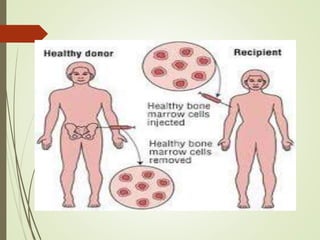
Bone Marrow Transplantation:
 A blood and marrow stem cell transplant replaces faulty
stem cells with healthy ones from another person (a
donor). Stem cells are the cells inside bone marrow that
make red blood cells and other types of blood cells.
 A stem cell transplant is the only treatment that can cure
thalassemia. But only a small number of people who
have severe thalassemias are able to find a good donor
match and have the risky procedure.
 Defective stem cells are replaced by normal stem
cells.
 It is Extremely Expensive and possible in only very
selected cases.
Cont ..
This is the curative therapy available today.
Sources of stem cells are Bone marrow ,
Peripheral Blood , Cord Blood .
Though expensive , it is cost effective as
compared to yearly cost of regular blood
transfusion and chelation therapy.
Cost is 8 to 10 lakhs.
Umbilical cord stem cells have good results.
Gene therapy :
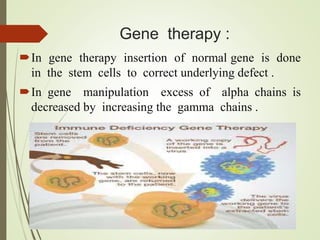
In gene therapy insertion of normal gene is done
in the stem cells to correct underlying defect .
In gene manipulation excess of alpha chains is
decreased by increasing the gamma chains .
Diet and Supplements :
Oral folate at minimum 1 mg daily.
Avoid iron rich food such as red meat and
iron fortified cereals or milk.
Tea may help decrease intestinal iron
absorption.
Dairy products are recommended as they
are rich in calcium.
Get Ongoing Medical Care
 Keep your scheduled medical appointments and get any tests
that your doctor recommends.
These tests may include:
 Monthly complete blood counts and tests for blood iron levels
every 3 months
 Yearly tests for heart function, liver function, and viral infection
(for example, hepatitis B and C and HIV)
 Yearly tests to check for iron buildup in your liver
 Yearly vision and hearing tests
 Regular checkups to make sure blood transfusions are working.
Cont..
Other tests as needed (such as lung function tests,
genetic tests, and tests to match your tissues
against a possible donor if a blood and marrow
stem cell transplant is being considered)
Children who have thalassemias should receive
yearly checkups to monitor their growth and
development. The checkups include a physical
exam, including a height and weight check, and
any necessary tests.
SURGICAL MANAGEMENT :
 Splenectomy :
It leading to excessive destruction of erythrocytes and
increasing need for frequent blood transfusion which
result in further iron accumulation.
 Cholecystectomy :
patients with thalassemia minor may have bilirubin stones
in their gallbladder and , if symptomatic , may require
treatment. Perform a cholecystectomy using a laproscopic
or carry out the procedure at the same time as the
splenectomy.
NURSING MANAGEMENT :
NURSING ASSESSMENT :
History includes Symptoms of Anemia , Family
history , etc.
Pain Assessment and Blood Studies..
Antenatal and Prenatal Counselling.
Prevention
To avoid this burden thalassemia
occurring/screening should be done to find out
the carrier status of individual who are planning
to get married & have children.
Birth of thalassemia major children can be
prevented by marital counseling, pre-natal
diagnosis & abortion of affected fetus among
thalassemic parents.
Complication :
 Hepatic Failure
 Congestive Cardiac Failure
 Gall stone
 Hemochromatosis
 Transfusion related Infection
 Hypothyrodism
 Hypogonadism
 Skeletal complication and Multi-Organ Dysfunction .
Thalassemia
Thalassemia

Thalassemia

  • 1.
  • 3.
    INTRODUCTION :  Thalassemiais an inherited blood related disorder due to absent or reduced production of hemoglobin, a protein present in red blood cells responsible for carrying oxygen through the body.  Each red blood cell may contain between 240 and 300 million molecules of hemoglobin.
  • 4.
    Cont..  A hemoglobinmolecule has two sub-units commonly referred to as alpha and beta. Both sub-units are necessary to bind oxygen and deliver it to cells and tissues in the body. A lack of a particular subunit determines the type of the resulting thalassemia (alpha or beta).  Thalassemia is derived from the Greek word “thalassa” meaning “the sea” because the condition was first described in populations living near the Mediterranean Sea. However, it is now very well known that alpha- and beta-thalassemia are the most common inherited single-gene disorder.
  • 6.
    DEFINITION : Thalassemia isan autosomal-recessive genetic disorder that results in inadequate normal Hemoglobin production. Thalassemia is a hetergeonous group of inherited chronic disorder, characterized by absence or decreased by synthesis of one or more globin chains of hemoglobin.
  • 7.
    RISK FACTORS : Family history : Thalassemias are inherited— that is, they're passed from parents to children through the genes. If person’s parents have missing or altered hemoglobin-making genes, person may have thalassemia.  Ancestry : Alpha thalassemias most often affect people of Southeast Asian, Indian, Chinese, or Filipino origin or ancestry.Beta thalassemias most often affect people of Mediterranean (Greek, Italian , & Middle Eastern), Asian, or African origin or ancestry
  • 8.
  • 9.
    1) Alpha Thalassemia:  Alpha thalassemia is the result of changes in the genes for the alpha globin component in hemoglobin.  Alpha globin genes on chromosome 16.  There is need for four genes (two from each parent) to make enough alpha globin protein chains. If one or more of the genes is missing, people have alpha thalassemia trait or disease. This means that body doesn't make enough alpha globin protein.
  • 10.
    Cont..  If persononly missing one gene, that person is a Silent Carrier. This means you won't have any signs of illness.  If person missing two genes, person have Alpha Thalassemia Minor. Person may have mild anemia.  If person missing three genes, person likely will have Hemoglobin H disease (which a Blood test can detect). This form of Thalassemia causes moderate to severe anemia.  Very rarely, a baby will be missing all four genes. This condition is called Alpha Thalassemia Major or Hydrops fetalis. Babies who have hydrops fetalis usually die before or shortly after birth.
  • 11.
    Inheritance Pattern forAlpha Thalassemia :
  • 12.
    Cont..  The pictureshows one example of how alpha thalassemia is inherited. The alpha globin genes are located on chromosome 16. A child inherits four alpha globin genes—two from each parent. In this example, the father is missing two alpha globin genes and the mother is missing one alpha globin gene.  Each child has a 25 percent chance of inheriting two missing genes and two normal genes (thalassemia trait), three missing genes and one normal gene (hemoglobin H disease), four normal genes (no anemia), or one missing gene and three normal genes (silent carrier).
  • 13.
    2) Beta Thalassemia:  Person need two genes (one from each parent) to make enough beta globin protein chains. If one or both of these genes are altered , person will have beta thalassemia. This means that person body doesn’t make enough beta protein.  If person have one altered gene , he/she is a carrier. This condition is called beta thalassemia trait or beta thalassemia minor. It causes mild anemia.  If both genes are altered , person will have beta thalassemia intermedia or beta thalassemia major (also called Cooley’s anemia). The intermedia form of the disorder causes moderate anemia. The major form causes severe anemia.
  • 14.
    Inheritance Pattern forBeta Thalassemia :
  • 15.
    Cont.. The picture showsone example of how beta thalassemia is inherited. The beta globin gene is located on chromosome 11. A child inherits two beta globin genes – one form each parent. In this example , each parent has one altered beta globin gene. Each child has a 25 percentage chance of inheriting two normal gene (no anemia) , a 50 percentage chance of inheriting one altered gene and one normal gene (beta thalassemia trait) , or a 25 percentage chance of inheriting two altered genes (beta thalassemia major).
  • 16.
  • 18.
    SIGNS AND SYMPTOMS: Anemia Dark urine (a sign that red blood cells are breaking down) Yellow or Pale skin Delayed growth and development Weakness  Fatigue  Hepatomegaly  Bone defects (especially bones in the face)
  • 20.
    DIAGNOSTIC EVALUATION : Historyof patient (Symptoms of Anemia ,Pisitive family History , FTT) Physical Examination (Severe Anemia , Thalassemic faces , Hepatosplenomegaly , Growth retardation) Lab Investigation (CBC , Hemoglobin Estimation , Serum Bilirubin , Peripheral Smear, liver function test) Screening Family Members
  • 21.
    MEDICAL MANAGEMENT : Blood Transfusion  Iron Chelation Therapy  Folic acid Supplementation  Bone Marrow Transplantation  Gene Therapy  Diet Supplements
  • 22.
    Blood Transfusion : Chidrenwho can not Maintain haemoglobin level about 7 gm/dl.  To prevent chronic hypoxia and to supress ineffective erythropoiesis.
  • 23.
    Cont..  Transfusions ofred blood cells are the main treatment for people who have moderate or severe thalassemias. This treatment gives person healthy red blood cells with normal hemoglobin.  The procedure usually takes 1 to 4 hours.  Red blood cells live only for about 120 days. So, may need repeated transfusions to maintain a supply of healthy red blood cells.  If person have hemoglobin H disease or beta thalassemia intermedia, person may need blood transfusions on occasion. For example, personmay need this treatment when person have an infection or other illness, or when anemia is severe enough to cause tiredness.
  • 24.
    Cont..  If personhave beta thalassemia major, or Cooley's anemia, person need regular blood transfusions (often every 2 to 4 weeks). These transfusions will help maintain normal hemoglobin and red blood cell levels.  Blood transfusions allow person to feel better, enjoy normal activities, and live into adulthood. This treatment is lifesaving, but it's expensive and carries a risk of transmitting infections and viruses (for example, hepatitis). However, the risk is very low in the United States because of careful blood screening.
  • 25.
    Iron - ChelationTherapy :  Hemoglobin in red blood cells is an iron-rich protein, regular blood transfusions can lead to a buildup of iron in the blood. This condition is called iron overload. It damages the liver, heart, and other parts of the body. To prevent this damage, iron chelation therapy is needed to remove excess iron from the body. Two medicines are used for iron chelation therapy.
  • 26.
    Cont..  Deferoxamine isa liquid medicine that's given slowly under the skin, usually with a small portable pump used overnight. This therapy takes time and can be mildly painful. Side effects include problems with vision and hearing.  Deferasirox is a pill taken once daily. Side effects include headache, nausea (feeling sick to the stomach), vomiting, diarrhea, joint pain, and fatigue (tiredness).
  • 28.
    Folic acid supplementation: Folic acid is a B vitamin that helps build healthy red blood cells. person may need to take folic acid supplements in addition to treatment with blood transfusions and/or iron chelation therapy.  Folic acid supplementation are recommended as iron therapy & dietary iron should be avoided to prevent more iron deposition.
  • 30.
    Bone Marrow Transplantation: A blood and marrow stem cell transplant replaces faulty stem cells with healthy ones from another person (a donor). Stem cells are the cells inside bone marrow that make red blood cells and other types of blood cells.  A stem cell transplant is the only treatment that can cure thalassemia. But only a small number of people who have severe thalassemias are able to find a good donor match and have the risky procedure.  Defective stem cells are replaced by normal stem cells.  It is Extremely Expensive and possible in only very selected cases.
  • 32.
    Cont .. This isthe curative therapy available today. Sources of stem cells are Bone marrow , Peripheral Blood , Cord Blood . Though expensive , it is cost effective as compared to yearly cost of regular blood transfusion and chelation therapy. Cost is 8 to 10 lakhs. Umbilical cord stem cells have good results.
  • 33.
    Gene therapy : Ingene therapy insertion of normal gene is done in the stem cells to correct underlying defect . In gene manipulation excess of alpha chains is decreased by increasing the gamma chains .
  • 34.
    Diet and Supplements: Oral folate at minimum 1 mg daily. Avoid iron rich food such as red meat and iron fortified cereals or milk. Tea may help decrease intestinal iron absorption. Dairy products are recommended as they are rich in calcium.
  • 35.
    Get Ongoing MedicalCare  Keep your scheduled medical appointments and get any tests that your doctor recommends. These tests may include:  Monthly complete blood counts and tests for blood iron levels every 3 months  Yearly tests for heart function, liver function, and viral infection (for example, hepatitis B and C and HIV)  Yearly tests to check for iron buildup in your liver  Yearly vision and hearing tests  Regular checkups to make sure blood transfusions are working.
  • 36.
    Cont.. Other tests asneeded (such as lung function tests, genetic tests, and tests to match your tissues against a possible donor if a blood and marrow stem cell transplant is being considered) Children who have thalassemias should receive yearly checkups to monitor their growth and development. The checkups include a physical exam, including a height and weight check, and any necessary tests.
  • 37.
    SURGICAL MANAGEMENT : Splenectomy : It leading to excessive destruction of erythrocytes and increasing need for frequent blood transfusion which result in further iron accumulation.  Cholecystectomy : patients with thalassemia minor may have bilirubin stones in their gallbladder and , if symptomatic , may require treatment. Perform a cholecystectomy using a laproscopic or carry out the procedure at the same time as the splenectomy.
  • 38.
    NURSING MANAGEMENT : NURSINGASSESSMENT : History includes Symptoms of Anemia , Family history , etc. Pain Assessment and Blood Studies.. Antenatal and Prenatal Counselling.
  • 39.
    Prevention To avoid thisburden thalassemia occurring/screening should be done to find out the carrier status of individual who are planning to get married & have children. Birth of thalassemia major children can be prevented by marital counseling, pre-natal diagnosis & abortion of affected fetus among thalassemic parents.
  • 40.
    Complication :  HepaticFailure  Congestive Cardiac Failure  Gall stone  Hemochromatosis  Transfusion related Infection  Hypothyrodism  Hypogonadism  Skeletal complication and Multi-Organ Dysfunction .