11/24/2020 Melvin Jacob 1
POLYCYTHEMIA
Mr. Melvin Jacob
MSc Nursing
It is an abnormally increased concentration of
haemoglobin in the blood, either through
reduction of plasma volume or increase in red
cell numbers.
DEFINITION
211/24/2020 Melvin Jacob
NORMAL RANGE
Haemoglobin:- 14 to 17 gm/dL (M)
12 to 15 gm/dL. (F)
Hematocrit:- 41.5% to 50.4% (M)
36.9% to 44.6% (F)
Red blood cell:-
4.5 million to 5.9 million cells/mcL (M)
4.1 million to 5.1 million cells/mcL. (F)
311/24/2020 Melvin Jacob
Haemoglobin:- >15 g/dL (F)
>17 g/dL (M)
Hematocrit:- >48% (F)
>52% (M)
411/24/2020 Melvin Jacob
RISK FACTORS
• Chronic hypoxia
 long-term cigarette smoking
 familial and genetic predisposition
 living in high altitudes
 long-term exposure to carbon monoxide (tunnel
workers, car garage attendants, residents of
highly polluted cities)
511/24/2020 Melvin Jacob
TYPES
• PRIMARYPOLYCYTHEMIA
• SECONDARY POLYCYTHEMIA
• RELATIVEPOLYCYTHEMIA
• STRESS POLYCYTHEMIA
611/24/2020 Melvin Jacob
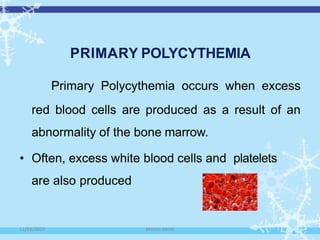
PRIMARY POLYCYTHEMIA
Primary Polycythemia occurs when excess
red blood cells are produced as a result of an
abnormality of the bone marrow.
• Often, excess white blood cells and platelets
are also produced
711/24/2020 Melvin Jacob
SECONDARY POLYCYTHEMIA
Secondary polycythemia is usually due to
increased erythropoietin (EPO) production either
in response to chronic hypoxia (low blood
oxygen level) or from an erythropoietin secreting
tumor.
811/24/2020 Melvin Jacob
911/24/2020 Melvin Jacob
RELATIVE POLYCYTHEMIA
• It is an increase in RBC numbers without an
increase in total RBC mass.
• Usually, this is caused by loss of plasma v o l u me
with resultant hemo-concentration, as seen in
severe dehydration related to vomiting and
diarrhoea.
1011/24/2020 Melvin Jacob
STRESS POLYCYTHEMIA
Stress Polycythemia is a term applied to a
chronic (long standing) state of low plasma
volume which is seen commonly in active, hard
working, anxious, middle-aged men. In these
people, the red blood cell volume is normal, but
the plasma volume is low.
1111/24/2020 Melvin Jacob
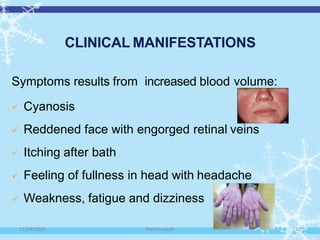
CLINICAL MANIFESTATIONS
Symptoms results from increased blood volume:
 Cyanosis
 Reddened face with engorged retinal veins
 Itching after bath
 Feeling of fullness in head with headache
 Weakness, fatigue and dizziness
1211/24/2020 Melvin Jacob
 Tinnitus (ringing or buzzing in the ears.)
 Parasthesia, numbness, burning or weakness in
hands and legs.
 Visual disturbances
 Nose bleeding
 Abdominal bloating
1311/24/2020 Melvin Jacob
Symptoms from increased viscosity:
 Angina
 Dyspnea
 Hypoxia
 Bone and joint pain
 Thrombophlebitis
1411/24/2020 Melvin Jacob
Other symptoms are
 Weight loss
 Breathing difficulty when lying down
 Chronic cough
 Night sweats and sleep disturbances
 Burning sensation over fingers or toes
 Splenomegaly and hepatomegaly
 Formation of blood clots in the blood vessels
1511/24/2020 Melvin Jacob
DIAGNOSIS
• History collection and physical examination:
 Smoking
 Living at high altitudes
 Breathing difficulty
 Sleep disturbances and chronic cough.
1611/24/2020 Melvin Jacob
Blood tests
The blood studies will show
 An increase in the number of red blood cells
 Elevated hematocrit measurement
 Elevated levels of hemoglobin
 Very low levels of erythropoietin
1711/24/2020 Melvin Jacob
Bone marrow aspiration orbiopsy
If an examination of the bone marrow
shows that it's producing higher than normal
numbers of blood cells, it may be a sign of
polycythemia.
1811/24/2020 Melvin Jacob
Other diagnosting meassures are,
 Chest X-Ray
 Electrocardiogram
 Echocardiogram
 SpO2 measurement
1911/24/2020 Melvin Jacob
MANAGEMENT
20
PHLEBOTOMY:
Drawing a certain amount of blood out of
the veins in a procedure called phlebotomy is usually
the first treatment option for people with
polycythemia.
• Reduces the number of blood cells
• Decreases blood volume
• Blood to function properly.
11/24/2020 Melvin Jacob
Low-dose aspirin
•low dose of aspirin to reduce risk of blood
clots.
•May also help reduce burning pain in feet or
hands.
2111/24/2020 Melvin Jacob
Medication to decrease blood cells
•Hydroxyurea (Droxia, Hydrea) :- to suppress the
bone marrow's ability to produce blood cells
•Interferon alpha:- stimulate the immune system to
fight the overproduction of red blood cells.
2211/24/2020 Melvin Jacob
Therapy to reduceitching
Itching - antihistamines, or ultraviolet light
treatment to relieve discomfort.
2311/24/2020 Melvin Jacob
Lifestyle and homeremedies
24
Exercise.
•Moderate exercise can improve the blood flow,
which decreases risk of blood clots.
•Leg and ankle stretches and exercises also can
improve the blood circulation.
11/24/2020 Melvin Jacob
Avoidtobacco.
Blood vessels to narrow, increasing the risk of
heart attack or stroke due to blood clots.
Watch for sores.
Poor circulation can make it difficult for sores to
heal, particularly on the hands and feet. Inspect the
feet regularly and tell the doctor about any sores.
2511/24/2020 Melvin Jacob
Avoid extreme temperatures
•Poor blood flow increases the risk of injury from
hot and cold temperatures.
•Always wear warm clothing (hands and feet). In
hot weather -drink plenty of liquids.
2611/24/2020 Melvin Jacob
NURSING MANAGEMENT
27
Monitor for peripheral and cerebral thrombosis.
Assist the patient for ambulation
Perform phlebotomy as per doctors order
Administer iv fluids and encourage to take oral fluids
Administer pain management measures
Advice to do regular exercise
11/24/2020 Melvin Jacob
Instruct to avoidtobacco
Advise to maintain skinhygiene
Avoid extremetemperatures
Provide psychological support to the patient.
2811/24/2020 Melvin Jacob
NURSING DIAGNOSIS
• Impaired tissue perfusion related to phlebotomy as
evidenced by cyanosis.
• Acute pain related to surgical intervention as
evidenced by verbalization
• Impaired breath pattern related to decreased level of
RBC in blood as evidenced by dyspnea.
• Imbalanced nutrition less than body requirement
related to less oral intake of food as evidenced by
weight loss. 2911/24/2020 Melvin Jacob
CONCLUSION
Polycythemia is an increase in the number of
red blood cells in the body. Doctors may
discover it as part of a routine blood check, or
they might diagnose it once the person starts
experiencing symptoms.
11/24/2020 30Melvin Jacob
REFERENCE
• Smeltzer – Brunner & Suddharth Textbook of
Medical Surgical Nursing, Wolters kluwer
publishers, 12th edition 2009.
• Black – Medical Surgical Nursing, Elsevier
publishers, 8th edition 2009.
• Nettina – Lippincott manual of Nursing Practice,
Wolters kluwer publishers, 7th edition 2014.
11/24/2020 Melvin Jacob 31
11/24/2020 Melvin Jacob 32
Thank you

Polycythemia

  • 1.
    11/24/2020 Melvin Jacob1 POLYCYTHEMIA Mr. Melvin Jacob MSc Nursing
  • 2.
    It is anabnormally increased concentration of haemoglobin in the blood, either through reduction of plasma volume or increase in red cell numbers. DEFINITION 211/24/2020 Melvin Jacob
  • 3.
    NORMAL RANGE Haemoglobin:- 14to 17 gm/dL (M) 12 to 15 gm/dL. (F) Hematocrit:- 41.5% to 50.4% (M) 36.9% to 44.6% (F) Red blood cell:- 4.5 million to 5.9 million cells/mcL (M) 4.1 million to 5.1 million cells/mcL. (F) 311/24/2020 Melvin Jacob
  • 4.
    Haemoglobin:- >15 g/dL(F) >17 g/dL (M) Hematocrit:- >48% (F) >52% (M) 411/24/2020 Melvin Jacob
  • 5.
    RISK FACTORS • Chronichypoxia  long-term cigarette smoking  familial and genetic predisposition  living in high altitudes  long-term exposure to carbon monoxide (tunnel workers, car garage attendants, residents of highly polluted cities) 511/24/2020 Melvin Jacob
  • 6.
    TYPES • PRIMARYPOLYCYTHEMIA • SECONDARYPOLYCYTHEMIA • RELATIVEPOLYCYTHEMIA • STRESS POLYCYTHEMIA 611/24/2020 Melvin Jacob
  • 7.
    PRIMARY POLYCYTHEMIA Primary Polycythemiaoccurs when excess red blood cells are produced as a result of an abnormality of the bone marrow. • Often, excess white blood cells and platelets are also produced 711/24/2020 Melvin Jacob
  • 8.
    SECONDARY POLYCYTHEMIA Secondary polycythemiais usually due to increased erythropoietin (EPO) production either in response to chronic hypoxia (low blood oxygen level) or from an erythropoietin secreting tumor. 811/24/2020 Melvin Jacob
  • 9.
  • 10.
    RELATIVE POLYCYTHEMIA • Itis an increase in RBC numbers without an increase in total RBC mass. • Usually, this is caused by loss of plasma v o l u me with resultant hemo-concentration, as seen in severe dehydration related to vomiting and diarrhoea. 1011/24/2020 Melvin Jacob
  • 11.
    STRESS POLYCYTHEMIA Stress Polycythemiais a term applied to a chronic (long standing) state of low plasma volume which is seen commonly in active, hard working, anxious, middle-aged men. In these people, the red blood cell volume is normal, but the plasma volume is low. 1111/24/2020 Melvin Jacob
  • 12.
    CLINICAL MANIFESTATIONS Symptoms resultsfrom increased blood volume:  Cyanosis  Reddened face with engorged retinal veins  Itching after bath  Feeling of fullness in head with headache  Weakness, fatigue and dizziness 1211/24/2020 Melvin Jacob
  • 13.
     Tinnitus (ringingor buzzing in the ears.)  Parasthesia, numbness, burning or weakness in hands and legs.  Visual disturbances  Nose bleeding  Abdominal bloating 1311/24/2020 Melvin Jacob
  • 14.
    Symptoms from increasedviscosity:  Angina  Dyspnea  Hypoxia  Bone and joint pain  Thrombophlebitis 1411/24/2020 Melvin Jacob
  • 15.
    Other symptoms are Weight loss  Breathing difficulty when lying down  Chronic cough  Night sweats and sleep disturbances  Burning sensation over fingers or toes  Splenomegaly and hepatomegaly  Formation of blood clots in the blood vessels 1511/24/2020 Melvin Jacob
  • 16.
    DIAGNOSIS • History collectionand physical examination:  Smoking  Living at high altitudes  Breathing difficulty  Sleep disturbances and chronic cough. 1611/24/2020 Melvin Jacob
  • 17.
    Blood tests The bloodstudies will show  An increase in the number of red blood cells  Elevated hematocrit measurement  Elevated levels of hemoglobin  Very low levels of erythropoietin 1711/24/2020 Melvin Jacob
  • 18.
    Bone marrow aspirationorbiopsy If an examination of the bone marrow shows that it's producing higher than normal numbers of blood cells, it may be a sign of polycythemia. 1811/24/2020 Melvin Jacob
  • 19.
    Other diagnosting meassuresare,  Chest X-Ray  Electrocardiogram  Echocardiogram  SpO2 measurement 1911/24/2020 Melvin Jacob
  • 20.
    MANAGEMENT 20 PHLEBOTOMY: Drawing a certainamount of blood out of the veins in a procedure called phlebotomy is usually the first treatment option for people with polycythemia. • Reduces the number of blood cells • Decreases blood volume • Blood to function properly. 11/24/2020 Melvin Jacob
  • 21.
    Low-dose aspirin •low doseof aspirin to reduce risk of blood clots. •May also help reduce burning pain in feet or hands. 2111/24/2020 Melvin Jacob
  • 22.
    Medication to decreaseblood cells •Hydroxyurea (Droxia, Hydrea) :- to suppress the bone marrow's ability to produce blood cells •Interferon alpha:- stimulate the immune system to fight the overproduction of red blood cells. 2211/24/2020 Melvin Jacob
  • 23.
    Therapy to reduceitching Itching- antihistamines, or ultraviolet light treatment to relieve discomfort. 2311/24/2020 Melvin Jacob
  • 24.
    Lifestyle and homeremedies 24 Exercise. •Moderateexercise can improve the blood flow, which decreases risk of blood clots. •Leg and ankle stretches and exercises also can improve the blood circulation. 11/24/2020 Melvin Jacob
  • 25.
    Avoidtobacco. Blood vessels tonarrow, increasing the risk of heart attack or stroke due to blood clots. Watch for sores. Poor circulation can make it difficult for sores to heal, particularly on the hands and feet. Inspect the feet regularly and tell the doctor about any sores. 2511/24/2020 Melvin Jacob
  • 26.
    Avoid extreme temperatures •Poorblood flow increases the risk of injury from hot and cold temperatures. •Always wear warm clothing (hands and feet). In hot weather -drink plenty of liquids. 2611/24/2020 Melvin Jacob
  • 27.
    NURSING MANAGEMENT 27 Monitor forperipheral and cerebral thrombosis. Assist the patient for ambulation Perform phlebotomy as per doctors order Administer iv fluids and encourage to take oral fluids Administer pain management measures Advice to do regular exercise 11/24/2020 Melvin Jacob
  • 28.
    Instruct to avoidtobacco Adviseto maintain skinhygiene Avoid extremetemperatures Provide psychological support to the patient. 2811/24/2020 Melvin Jacob
  • 29.
    NURSING DIAGNOSIS • Impairedtissue perfusion related to phlebotomy as evidenced by cyanosis. • Acute pain related to surgical intervention as evidenced by verbalization • Impaired breath pattern related to decreased level of RBC in blood as evidenced by dyspnea. • Imbalanced nutrition less than body requirement related to less oral intake of food as evidenced by weight loss. 2911/24/2020 Melvin Jacob
  • 30.
    CONCLUSION Polycythemia is anincrease in the number of red blood cells in the body. Doctors may discover it as part of a routine blood check, or they might diagnose it once the person starts experiencing symptoms. 11/24/2020 30Melvin Jacob
  • 31.
    REFERENCE • Smeltzer –Brunner & Suddharth Textbook of Medical Surgical Nursing, Wolters kluwer publishers, 12th edition 2009. • Black – Medical Surgical Nursing, Elsevier publishers, 8th edition 2009. • Nettina – Lippincott manual of Nursing Practice, Wolters kluwer publishers, 7th edition 2014. 11/24/2020 Melvin Jacob 31
  • 32.