o Thalassemia is an inherited blood disorder that can
result an abnormal formation of hemoglobin .The
disorder results in excessive destruction of red blood
cells which leads to anemia .
o There are two main types of thalassemia disorders:
• α – alpha thalassemia
• β - beta thalassemia.
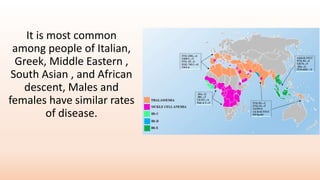
It is most common
among people of Italian,
Greek, Middle Eastern ,
South Asian , and African
descent, Males and
females have similar rates
of disease.
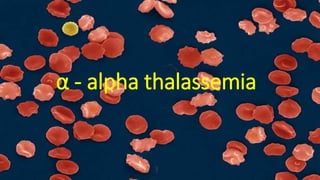
α - alpha thalassemia
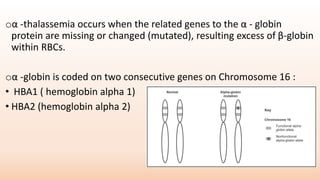
oα -thalassemia occurs when the related genes to the α - globin
protein are missing or changed (mutated), resulting excess of β-globin
within RBCs.
oα -globin is coded on two consecutive genes on Chromosome 16 :
• HBA1 ( hemoglobin alpha 1)
• HBA2 (hemoglobin alpha 2)
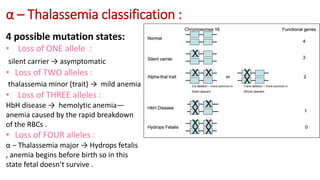
α – Thalassemia classification :
4 possible mutation states:
• Loss of ONE allele :
silent carrier → asymptomatic
• Loss of TWO alleles :
thalassemia minor (trait) → mild anemia
• Loss of THREE alleles :
HbH disease → hemolytic anemia—
anemia caused by the rapid breakdown
of the RBCs .
• Loss of FOUR alleles :
α – Thalassemia major → Hydrops fetalis
, anemia begins before birth so in this
state fetal doesn’t survive .
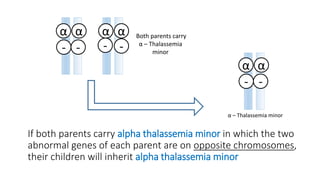
If both parents carry alpha thalassemia minor in which the two
abnormal genes of each parent are on opposite chromosomes,
their children will inherit alpha thalassemia minor
α ααα
- - --
αα
- -
Both parents carry
α – Thalassemia
minor
α – Thalassemia minor
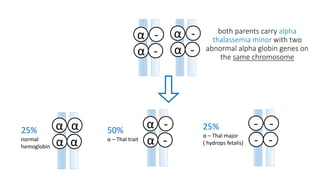
both parents carry alpha
thalassemia minor with two
abnormal alpha globin genes on
the same chromosome
-α
α -
-α
α -
αα
α α
-α
α -
--
- -
25%
normal
hemoglobin
50%
α – Thal trait
25%
α – Thal major
( hydrops fetalis)
one parent has alpha
thalassemia minor with
two abnormal alpha
globin genes on the same
chromosome
and the other parent has the silent
carrier state with a single abnormal
alpha globin gene on one
chromosome
-α
α -
αα
α -
-α
α -
αα
α -
αα
α α
α-
- -
25%
normal
hemoglobin
25%
α – Thal trait
25%
Silent Carrier
25%
HgH disease
β- beta thalassemia
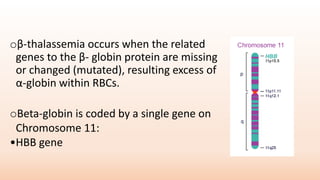
oβ-thalassemia occurs when the related
genes to the β- globin protein are missing
or changed (mutated), resulting excess of
α-globin within RBCs.
oBeta-globin is coded by a single gene on
Chromosome 11:
•HBB gene
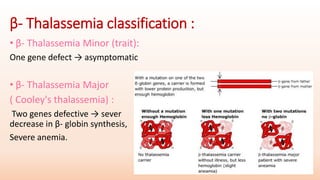
β- Thalassemia classification :
• β- Thalassemia Minor (trait):
One gene defect → asymptomatic
• β- Thalassemia Major
( Cooley's thalassemia) :
Two genes defective → sever
decrease in β- globin synthesis,
Severe anemia.
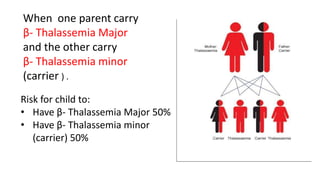
When one parent carry
β- Thalassemia Major
and the other carry
β- Thalassemia minor
(carrier ) .
Risk for child to:
• Have β- Thalassemia Major 50%
• Have β- Thalassemia minor
(carrier) 50%
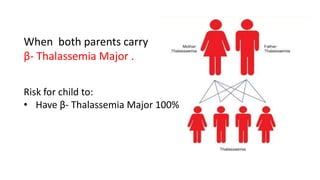
When both parents carry
β- Thalassemia Major .
Risk for child to:
• Have β- Thalassemia Major 100%
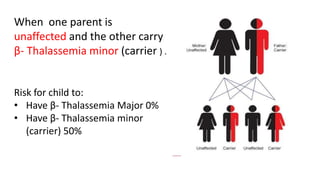
When one parent is
unaffected and the other carry
β- Thalassemia minor (carrier ) .
Risk for child to:
• Have β- Thalassemia Major 0%
• Have β- Thalassemia minor
(carrier) 50%
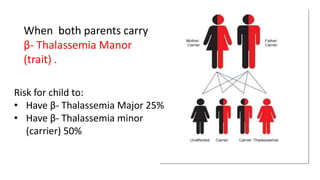
When both parents carry
β- Thalassemia Manor
(trait) .
Risk for child to:
• Have β- Thalassemia Major 25%
• Have β- Thalassemia minor
(carrier) 50%
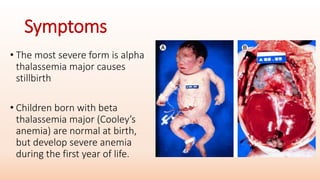
Symptoms
• The most severe form is alpha
thalassemia major causes
stillbirth
• Children born with beta
thalassemia major (Cooley’s
anemia) are normal at birth,
but develop severe anemia
during the first year of life.
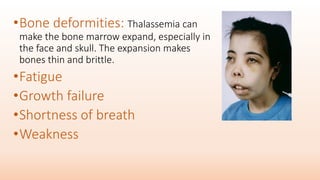
•Bone deformities: Thalassemia can
make the bone marrow expand, especially in
the face and skull. The expansion makes
bones thin and brittle.
•Fatigue
•Growth failure
•Shortness of breath
•Weakness
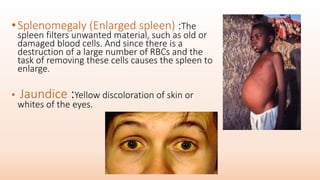
•Splenomegaly (Enlarged spleen) :The
spleen filters unwanted material, such as old or
damaged blood cells. And since there is a
destruction of a large number of RBCs and the
task of removing these cells causes the spleen to
enlarge.
• Jaundice :Yellow discoloration of skin or
whites of the eyes.
Treatment
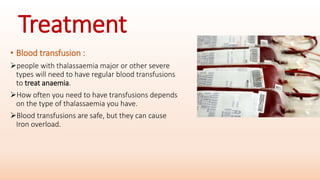
• Blood transfusion :
people with thalassaemia major or other severe
types will need to have regular blood transfusions
to treat anaemia.
How often you need to have transfusions depends
on the type of thalassaemia you have.
Blood transfusions are safe, but they can cause
Iron overload.
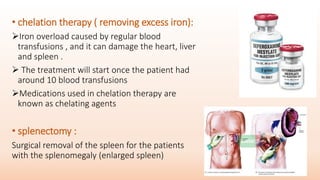
• chelation therapy ( removing excess iron):
Iron overload caused by regular blood
transfusions , and it can damage the heart, liver
and spleen .
 The treatment will start once the patient had
around 10 blood transfusions
Medications used in chelation therapy are
known as chelating agents
• splenectomy :
Surgical removal of the spleen for the patients
with the splenomegaly (enlarged spleen)
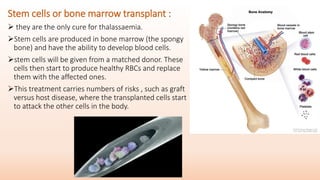
Stem cells or bone marrow transplant :
 they are the only cure for thalassaemia.
Stem cells are produced in bone marrow (the spongy
bone) and have the ability to develop blood cells.
stem cells will be given from a matched donor. These
cells then start to produce healthy RBCs and replace
them with the affected ones.
This treatment carries numbers of risks , such as graft
versus host disease, where the transplanted cells start
to attack the other cells in the body.
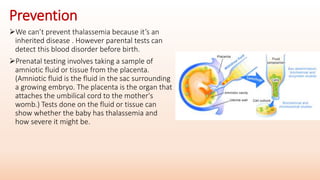
Prevention
We can’t prevent thalassemia because it’s an
inherited disease . However parental tests can
detect this blood disorder before birth.
Prenatal testing involves taking a sample of
amniotic fluid or tissue from the placenta.
(Amniotic fluid is the fluid in the sac surrounding
a growing embryo. The placenta is the organ that
attaches the umbilical cord to the mother's
womb.) Tests done on the fluid or tissue can
show whether the baby has thalassemia and
how severe it might be.
Time for Questions
Q1 : when α– Thalassemia and β – thalassemia
occur !?
α -thalassemia occurs when HBA1 and HBA2
genes on chromosome 16 are mutated.
β-thalassemia occurs when HBB gene on
chromosome 11 is mutated .
• Fatigue
• Growth failure
• Shortness of breath
• Weakness
• Bone deformities
• Splenomegaly (Enlarged spleen)
•Jaundice
Q2 : list 4 symptoms of thalassemia :
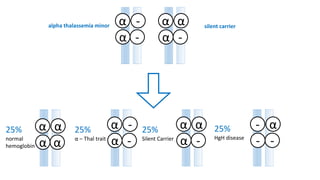
Q3 : If there’s one parent with alpha
thalassemia minor (mutated genes are on the
same chromosome) and the other one is a silent
carrier, what are the states there children may
get ?
alpha thalassemia minor silent carrier-α
α -
αα
α -
-α
α -
αα
α -
αα
α α
α-
- -
25%
normal
hemoglobin
25%
α – Thal trait
25%
Silent Carrier
25%
HgH disease
Q4 : Blood transfusions can cause Iron overload, explain
what Iron overload can cause, and what’s the treatment
for iron overload and when it can be used ?
it can damage the heart, liver and spleen, the
chelation therapy( removing excess iron)
will be the treatment , and it will start once
the patient had around 10 blood transfusions
Q5 : why does the spleen get enlarged with
Thalassemia ?!
Because there is a destruction of a large
number of RBCs and the task of removing
these cells causes the spleen to enlarge
References :
• Essential hematology A.V Hoffbrand , P.A.H Moss and J.E pettit Fifth edition
• National heart, lung and blood institution
https://www.nhlbi.nih.gov
• United kingdom thalassemia society
http://ukts.org
• Mayo clinic
http://www.mayoclinic.org
• UK National health service
http://www.nhs.uk
Thalassemia

Thalassemia

  • 2.
    o Thalassemia isan inherited blood disorder that can result an abnormal formation of hemoglobin .The disorder results in excessive destruction of red blood cells which leads to anemia . o There are two main types of thalassemia disorders: • α – alpha thalassemia • β - beta thalassemia.
  • 3.
    It is mostcommon among people of Italian, Greek, Middle Eastern , South Asian , and African descent, Males and females have similar rates of disease.
  • 4.
    α - alphathalassemia
  • 5.
    oα -thalassemia occurswhen the related genes to the α - globin protein are missing or changed (mutated), resulting excess of β-globin within RBCs. oα -globin is coded on two consecutive genes on Chromosome 16 : • HBA1 ( hemoglobin alpha 1) • HBA2 (hemoglobin alpha 2)
  • 6.
    α – Thalassemiaclassification : 4 possible mutation states: • Loss of ONE allele : silent carrier → asymptomatic • Loss of TWO alleles : thalassemia minor (trait) → mild anemia • Loss of THREE alleles : HbH disease → hemolytic anemia— anemia caused by the rapid breakdown of the RBCs . • Loss of FOUR alleles : α – Thalassemia major → Hydrops fetalis , anemia begins before birth so in this state fetal doesn’t survive .
  • 8.
    If both parentscarry alpha thalassemia minor in which the two abnormal genes of each parent are on opposite chromosomes, their children will inherit alpha thalassemia minor α ααα - - -- αα - - Both parents carry α – Thalassemia minor α – Thalassemia minor
  • 9.
    both parents carryalpha thalassemia minor with two abnormal alpha globin genes on the same chromosome -α α - -α α - αα α α -α α - -- - - 25% normal hemoglobin 50% α – Thal trait 25% α – Thal major ( hydrops fetalis)
  • 10.
    one parent hasalpha thalassemia minor with two abnormal alpha globin genes on the same chromosome and the other parent has the silent carrier state with a single abnormal alpha globin gene on one chromosome -α α - αα α - -α α - αα α - αα α α α- - - 25% normal hemoglobin 25% α – Thal trait 25% Silent Carrier 25% HgH disease
  • 11.
  • 12.
    oβ-thalassemia occurs whenthe related genes to the β- globin protein are missing or changed (mutated), resulting excess of α-globin within RBCs. oBeta-globin is coded by a single gene on Chromosome 11: •HBB gene
  • 13.
    β- Thalassemia classification: • β- Thalassemia Minor (trait): One gene defect → asymptomatic • β- Thalassemia Major ( Cooley's thalassemia) : Two genes defective → sever decrease in β- globin synthesis, Severe anemia.
  • 15.
    When one parentcarry β- Thalassemia Major and the other carry β- Thalassemia minor (carrier ) . Risk for child to: • Have β- Thalassemia Major 50% • Have β- Thalassemia minor (carrier) 50%
  • 16.
    When both parentscarry β- Thalassemia Major . Risk for child to: • Have β- Thalassemia Major 100%
  • 17.
    When one parentis unaffected and the other carry β- Thalassemia minor (carrier ) . Risk for child to: • Have β- Thalassemia Major 0% • Have β- Thalassemia minor (carrier) 50%
  • 18.
    When both parentscarry β- Thalassemia Manor (trait) . Risk for child to: • Have β- Thalassemia Major 25% • Have β- Thalassemia minor (carrier) 50%
  • 19.
    Symptoms • The mostsevere form is alpha thalassemia major causes stillbirth • Children born with beta thalassemia major (Cooley’s anemia) are normal at birth, but develop severe anemia during the first year of life.
  • 20.
    •Bone deformities: Thalassemiacan make the bone marrow expand, especially in the face and skull. The expansion makes bones thin and brittle. •Fatigue •Growth failure •Shortness of breath •Weakness
  • 21.
    •Splenomegaly (Enlarged spleen):The spleen filters unwanted material, such as old or damaged blood cells. And since there is a destruction of a large number of RBCs and the task of removing these cells causes the spleen to enlarge. • Jaundice :Yellow discoloration of skin or whites of the eyes.
  • 22.
    Treatment • Blood transfusion: people with thalassaemia major or other severe types will need to have regular blood transfusions to treat anaemia. How often you need to have transfusions depends on the type of thalassaemia you have. Blood transfusions are safe, but they can cause Iron overload.
  • 23.
    • chelation therapy( removing excess iron): Iron overload caused by regular blood transfusions , and it can damage the heart, liver and spleen .  The treatment will start once the patient had around 10 blood transfusions Medications used in chelation therapy are known as chelating agents • splenectomy : Surgical removal of the spleen for the patients with the splenomegaly (enlarged spleen)
  • 24.
    Stem cells orbone marrow transplant :  they are the only cure for thalassaemia. Stem cells are produced in bone marrow (the spongy bone) and have the ability to develop blood cells. stem cells will be given from a matched donor. These cells then start to produce healthy RBCs and replace them with the affected ones. This treatment carries numbers of risks , such as graft versus host disease, where the transplanted cells start to attack the other cells in the body.
  • 25.
    Prevention We can’t preventthalassemia because it’s an inherited disease . However parental tests can detect this blood disorder before birth. Prenatal testing involves taking a sample of amniotic fluid or tissue from the placenta. (Amniotic fluid is the fluid in the sac surrounding a growing embryo. The placenta is the organ that attaches the umbilical cord to the mother's womb.) Tests done on the fluid or tissue can show whether the baby has thalassemia and how severe it might be.
  • 26.
  • 27.
    Q1 : whenα– Thalassemia and β – thalassemia occur !? α -thalassemia occurs when HBA1 and HBA2 genes on chromosome 16 are mutated. β-thalassemia occurs when HBB gene on chromosome 11 is mutated .
  • 28.
    • Fatigue • Growthfailure • Shortness of breath • Weakness • Bone deformities • Splenomegaly (Enlarged spleen) •Jaundice Q2 : list 4 symptoms of thalassemia :
  • 29.
    Q3 : Ifthere’s one parent with alpha thalassemia minor (mutated genes are on the same chromosome) and the other one is a silent carrier, what are the states there children may get ?
  • 30.
    alpha thalassemia minorsilent carrier-α α - αα α - -α α - αα α - αα α α α- - - 25% normal hemoglobin 25% α – Thal trait 25% Silent Carrier 25% HgH disease
  • 31.
    Q4 : Bloodtransfusions can cause Iron overload, explain what Iron overload can cause, and what’s the treatment for iron overload and when it can be used ? it can damage the heart, liver and spleen, the chelation therapy( removing excess iron) will be the treatment , and it will start once the patient had around 10 blood transfusions
  • 32.
    Q5 : whydoes the spleen get enlarged with Thalassemia ?! Because there is a destruction of a large number of RBCs and the task of removing these cells causes the spleen to enlarge
  • 33.
    References : • Essentialhematology A.V Hoffbrand , P.A.H Moss and J.E pettit Fifth edition • National heart, lung and blood institution https://www.nhlbi.nih.gov • United kingdom thalassemia society http://ukts.org • Mayo clinic http://www.mayoclinic.org • UK National health service http://www.nhs.uk