Ratheesh.R
SLMGNC
Introduction
O Addison's disease (also known as primary adrenal
insufficiency or hypoadrenalism) is a rare disorder of
the adrenal glands. It affects the production of two
hormones - cortisol and aldosterone.
O Cortisol is released in stressful situations and helps to
maintain your energy levels, your blood sugar levels and
carbohydrate metabolism.
O Aldosterone maintains the balance of salt and water in
your body, which helps to control blood pressure.
Definition
O A disease characterized by progressive
anaemia, low blood pressure, great weakness,
and bronze discoloration of the skin. It is
caused by inadequate secretion of hormones
by the adrenal cortex.(Gluco-corticoids and
mineralocorticoids)
Etiology
O Auto immune response
O Inadequate secretion of the Adrenal
Hormone
O Infection of the Adrenal gland
O Atrophy of the adrenal cortex.
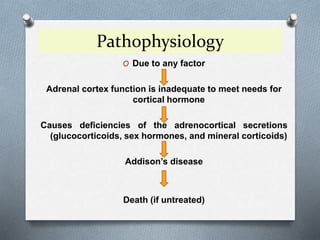
Pathophysiology
O Due to any factor
Adrenal cortex function is inadequate to meet needs for
cortical hormone
Causes deficiencies of the adrenocortical secretions
(glucocorticoids, sex hormones, and mineral corticoids)
Addison’s disease
Death (if untreated)
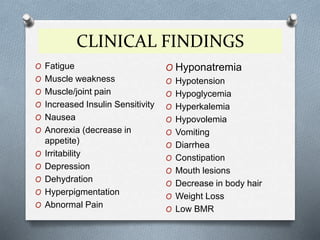
CLINICAL FINDINGS
O Fatigue
O Muscle weakness
O Muscle/joint pain
O Increased Insulin Sensitivity
O Nausea
O Anorexia (decrease in
appetite)
O Irritability
O Depression
O Dehydration
O Hyperpigmentation
O Abnormal Pain
O Hyponatremia
O Hypotension
O Hypoglycemia
O Hyperkalemia
O Hypovolemia
O Vomiting
O Diarrhea
O Constipation
O Mouth lesions
O Decrease in body hair
O Weight Loss
O Low BMR
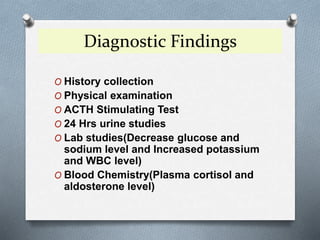
Diagnostic Findings
O History collection
O Physical examination
O ACTH Stimulating Test
O 24 Hrs urine studies
O Lab studies(Decrease glucose and
sodium level and Increased potassium
and WBC level)
O Blood Chemistry(Plasma cortisol and
aldosterone level)
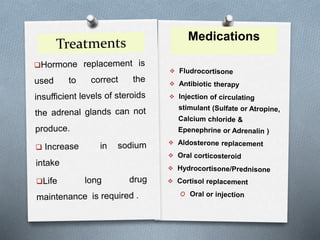
Medications
Patient Education
O Increase salt intake during hot weather and
heavy exercise
O Never skip a dose. This could lead to an
Addisonian crisis.
O Learn to recognize the symptoms of an
Addisonian crisis. (Ex: pain in lower back,
severe vomiting and diarrhea , extreme
weakness, fainting.-Contact physician
immediately.)
O Wear Med alert tag
O Frequently monitor weight
O Reframe from stressful activities
Nursing Consideration
O Monitor BP and weight
O 2hr postprandial glucose test.
O Chest x-ray if prolonged tx.
O Electrolytes (k+); I&O ratio (decreasing
output and increasing edema).
O Plasma cortisol levels (norm: 6-
23mcg/dL); signs of infection cardiac
symptoms (edema, HTN)
Cont….
O Monitor patient frequently for
dysrhythmias
O Administer NaCl IV to increase sodium
O Administer Insulin
O Administer an antiemetic as tolerated
by the patient
O Provide high calorie snacks and finger
foods
O Daily weight
O Nutritional supplements
Complication
O Hypotension
O Nausea and Vommiting
O Weakness
O Coma
O Psychological Stress
Nursing Diagnosis
O Electrolyte Imbalance r/t vomiting, diarrhea
hyperkalemia and hyponatremia
O Imbalanced nutrition: less than body
requirements r/t anorexia, decrease in weight
and inadequate food intake.
O Fluid volume deficit r/t renal loss of sodium
and water.
O Activity intolerance r/t decreased cortisol
production and fatigue.

Addisons disease

  • 1.
  • 2.
    Introduction O Addison's disease(also known as primary adrenal insufficiency or hypoadrenalism) is a rare disorder of the adrenal glands. It affects the production of two hormones - cortisol and aldosterone. O Cortisol is released in stressful situations and helps to maintain your energy levels, your blood sugar levels and carbohydrate metabolism. O Aldosterone maintains the balance of salt and water in your body, which helps to control blood pressure.
  • 3.
    Definition O A diseasecharacterized by progressive anaemia, low blood pressure, great weakness, and bronze discoloration of the skin. It is caused by inadequate secretion of hormones by the adrenal cortex.(Gluco-corticoids and mineralocorticoids)
  • 5.
    Etiology O Auto immuneresponse O Inadequate secretion of the Adrenal Hormone O Infection of the Adrenal gland O Atrophy of the adrenal cortex.
  • 6.
    Pathophysiology O Due toany factor Adrenal cortex function is inadequate to meet needs for cortical hormone Causes deficiencies of the adrenocortical secretions (glucocorticoids, sex hormones, and mineral corticoids) Addison’s disease Death (if untreated)
  • 7.
    CLINICAL FINDINGS O Fatigue OMuscle weakness O Muscle/joint pain O Increased Insulin Sensitivity O Nausea O Anorexia (decrease in appetite) O Irritability O Depression O Dehydration O Hyperpigmentation O Abnormal Pain O Hyponatremia O Hypotension O Hypoglycemia O Hyperkalemia O Hypovolemia O Vomiting O Diarrhea O Constipation O Mouth lesions O Decrease in body hair O Weight Loss O Low BMR
  • 8.
    Diagnostic Findings O Historycollection O Physical examination O ACTH Stimulating Test O 24 Hrs urine studies O Lab studies(Decrease glucose and sodium level and Increased potassium and WBC level) O Blood Chemistry(Plasma cortisol and aldosterone level)
  • 9.
  • 10.
    Patient Education O Increasesalt intake during hot weather and heavy exercise O Never skip a dose. This could lead to an Addisonian crisis. O Learn to recognize the symptoms of an Addisonian crisis. (Ex: pain in lower back, severe vomiting and diarrhea , extreme weakness, fainting.-Contact physician immediately.) O Wear Med alert tag O Frequently monitor weight O Reframe from stressful activities
  • 11.
    Nursing Consideration O MonitorBP and weight O 2hr postprandial glucose test. O Chest x-ray if prolonged tx. O Electrolytes (k+); I&O ratio (decreasing output and increasing edema). O Plasma cortisol levels (norm: 6- 23mcg/dL); signs of infection cardiac symptoms (edema, HTN)
  • 12.
    Cont…. O Monitor patientfrequently for dysrhythmias O Administer NaCl IV to increase sodium O Administer Insulin O Administer an antiemetic as tolerated by the patient O Provide high calorie snacks and finger foods O Daily weight O Nutritional supplements
  • 13.
    Complication O Hypotension O Nauseaand Vommiting O Weakness O Coma O Psychological Stress
  • 14.
    Nursing Diagnosis O ElectrolyteImbalance r/t vomiting, diarrhea hyperkalemia and hyponatremia O Imbalanced nutrition: less than body requirements r/t anorexia, decrease in weight and inadequate food intake. O Fluid volume deficit r/t renal loss of sodium and water. O Activity intolerance r/t decreased cortisol production and fatigue.