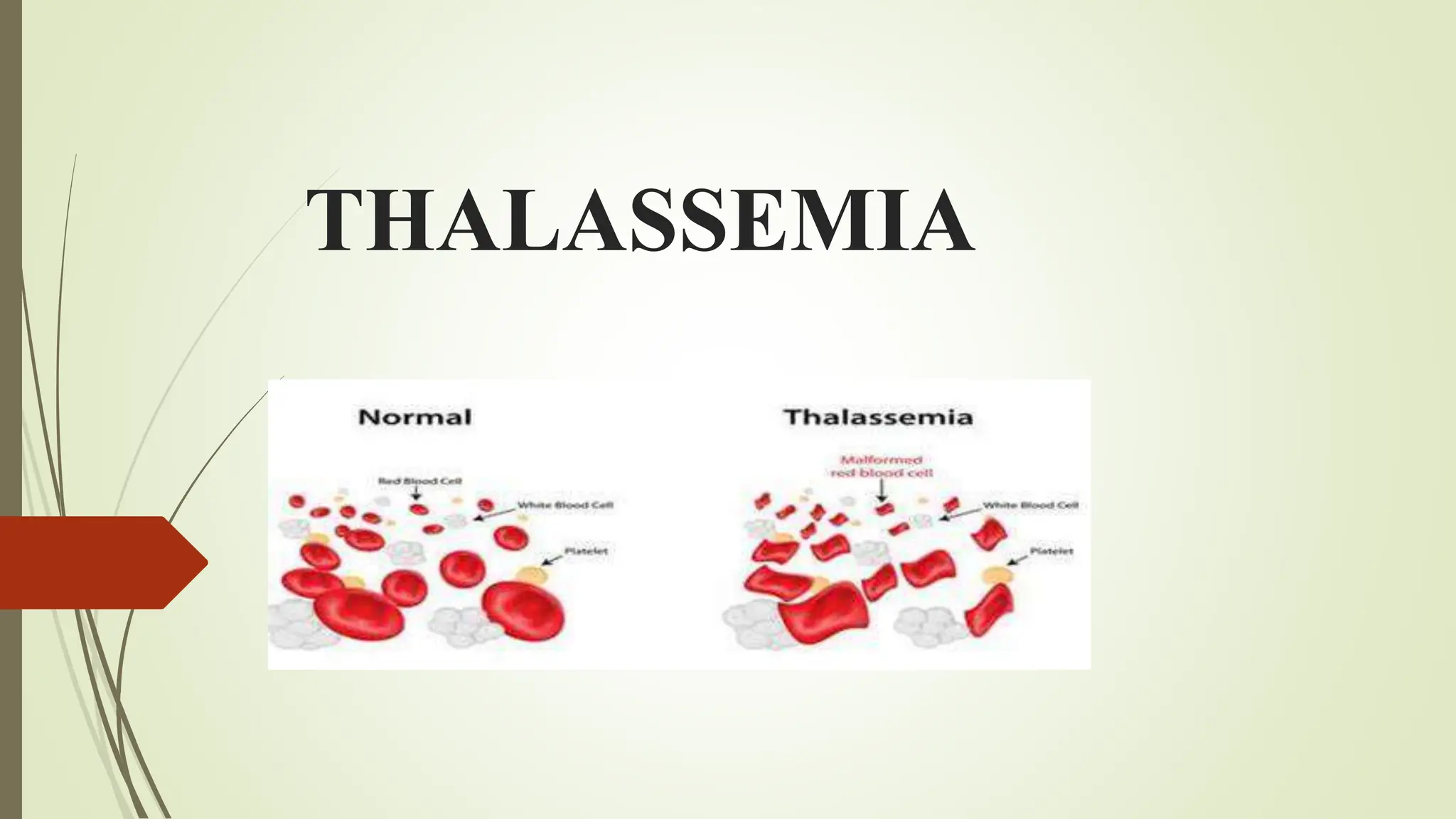
THALASSEMIA
WHAT IS THALASSEMIA?
 Thalassemia (thal-uh-SEE-me-uh) is an inherited blood disorder characterized by
less hemoglobin and fewer red blood cells in your body than normal. Hemoglobin
is the protein molecule in red blood cells that carries oxygen.
 The disorder results in excessive destruction of red blood cells, which leads to
anemia. Anemia is a condition in which your body doesn’t have enough normal,
healthy red blood cells.
 Thalassemia is inherited, meaning that at least one of your parents must be a
carrier of the Disorder. It’s caused by either a genetic mutation or a deletion of
certain key gene fragments.
TYPES OF THALASSEMIA
 Four alpha-globin and two beta-globin protein chains make up hemoglobin. The two main types of
thalassemia are alpha and beta.
 1. ALPHA THALASSEMIA:
 In alpha thalassemia, the hemoglobin does not produce enough alpha protein.
 To make alpha-globin protein chains we need four genes, two on each chromosome 16. We get two
from each parent. If one or more of these genes is missing, alpha thalassemia will result.
 The severity of thalassemia depends on how many genes are faulty, or mutated.
 One faulty gene(silent carriers): The patient has no symptoms. A healthy person
who has a child with symptoms of thalassemia is a carrier. This type is known as
alpha thalassemia minima.
 Two faulty genes(alpha thalassemia trait): The patient has mild anemia. It is known
as alpha thalassemia minor. There are two forms. When the two alpha globin
genes lost are on the same chromosome 16 is called cis, but when one alpha
globin gene is missing on each copy of chromosome 16 this is called trans.
 Three faulty genes(hemoglobin H disease): The patient has hemoglobin H disease, a type of
chronic anemia. In this case, there are an excessive amount of beta globin's. When these join
together, it is called Hemoglobin They will need regular blood transfusions throughout their life.
 Four faulty genes: Alpha thalassemia major is the most severe form of alpha thalassemia. It is
known to cause hydrops fetalis, a serious condition in which fluid accumulates in parts of the
fetus’ body. A fetus with four mutated genes cannot produce normal hemoglobin and is
unlikely to survive, even with blood transfusions.
Alpha thalassemia is common in southern China, Southeast Asia, India, the Middle East, and Africa.
 BETA THALASSEMIA:
 We need two globin genes to make beta-globin chains, one from each parent. If one or both
genes are faulty, beta thalassemia will occur.
 Severity depends on how many genes are mutated.
 One faulty gene: This is called beta thalassemia minor.
 Two faulty genes: There may be moderate or severe symptoms. This is known as thalassemia
major. It used to be called Cooley’s anemia in which the complete lack of beta protein in the
hemoglobin causes a life-threatening anemia that requires regular blood transfusions and
extensive ongoing medical care.
Beta thalassemia is more common among people of Mediterranean ancestry. Prevalence is higher
in North Africa, West Asia, and the Maldive Islands.
SYMPTOMS OF THALASSEMIA:
 The symptoms of thalassemia can vary. Some of the most common ones include:
 bone deformities, especially in the face
 dark urine
 delayed growth and development
 excessive tiredness and fatigue
 yellow or pale skin
 Not everyone has visible symptoms of thalassemia. Signs of the disorder also tend to show up later in
childhood or adolescence.
 The symptoms of thalassemia vary depending on the type of thalassemia.
 Symptoms will not show until the age of 6 months in most infants with beta thalassemia and some types of
alpha thalassemia. This is because neonates have a different type of hemoglobin, called fetal hemoglobin.
 After 6 months “normal” hemoglobin starts replacing the fetal type, and symptoms may begin to appear.
CAUSES OF THALASSEMIA
 Thalassemia occurs when there’s an abnormality or mutation in one of the genes
involved in hemoglobin production. You inherit this genetic abnormality from your
parents.
 If only one of your parents is a carrier for thalassemia, you may develop a form of
the disease known as thalassemia minor. If this occurs, you probably won’t have
symptoms, but you’ll be a carrier. Some people with thalassemia minor do develop
minor symptoms.
 If both of your parents are carriers of thalassemia, you have a greater chance of
inheriting a more serious form of the disease.
 Hemoglobin molecules are made of chains called alpha and beta chains that can be affected
by mutations. In thalassemia, the production of either the alpha or beta chains are reduced,
resulting in either alpha-thalassemia or beta-thalassemia.
 In alpha-thalassemia, the severity of thalassemia you have depends on the number of gene
mutations you inherit from your parents. The more mutated genes, the more severe your
thalassemia.
 In beta-thalassemia, the severity of thalassemia you have depends on how much one or
genes are affected.
DIAGNOSIS:
 Most children with moderate to severe thalassemia receive a diagnosis by the time
they are 2 years old.
 People with no symptoms may not realize that they are carriers until they have a
child with thalassemia.
 Blood tests can detect if a person is a carrier or if they have thalassemia.
 A complete blood count (CBC): This can check levels of hemoglobin and the level and size of
red blood cells.
 A reticulocyte count: This measures how fast red blood cells, or reticulocytes, are produced
and released by the bone marrow. Reticulocytes usually spend around 2 days in the
bloodstream before developing into mature red blood cells. Between 1 and 2 percent of a
healthy person’s red blood cells are reticulocytes.
 Iron: This will help the doctor determine the cause of anemia, whether thalassemia or iron
deficiency. In thalassemia, iron deficiency is not the cause.
 Genetic testing: DNA analysis will show whether a person has thalassemia or faulty genes.it is
used to make a diagnosis of alpha thalassemia.
 Hemoglobin electrophoresis: This test separates out the different molecules in the red blood
cells, allowing them to identify the abnormal type.it is used to diagnose beta thalassemia.
 Prenatal testing: This can show whether a fetus has thalassemia, and how severe it might be.
Chorionic villus sampling (CVS): a piece of placenta is removed for testing, usually around the
11th week of pregnancy.
Amniocentesis: a small sample of amniotic fluid is taken for testing, usually during the 16th week
of pregnancy. Amniotic fluid is the fluid that surrounds the fetus
TREATMENT OPTIONS FOR THALASSEMIA
 The treatment for thalassemia depends on the type and severity of disease involved. Your doctor will give you a
course of treatment that will work best for your particular case.
 Some of the treatments include:
 blood transfusions
 bone marrow transplant
 medications and supplements
 possible surgery to remove the spleen or gallbladder
 Your doctor may instruct you not to take vitamins or supplements containing iron. This is especially true if you need
blood transfusions because people who receive them accumulate extra iron that the body can’t easily get rid of. Iron
can build up in tissues, which can be potentially fatal.
 If you’re receiving a blood transfusion, you may also need chelation therapy. This generally involves receiving an
injection of a chemical that binds with iron and other heavy metals. This helps remove extra iron from your body.
 Blood transfusions: These can replenish hemoglobin and red blood cell levels. Patients with
thalassemia major will need between eight and twelve transfusions a year. Those with less
severe thalassemia will need up to eight transfusions each year, or more in times of stress,
illness, or infection.
 Iron chelation: This involves removing excess iron from the bloodstream. Sometimes blood
transfusions can cause iron overload. This can damage the heart and other organs. Patients
may be prescribed deferoxamine, a medication that is injected under the skin, or deferasirox,
taken by mouth.
 Patients who receive blood transfusions and chelation may also need folic acid supplements.
 Bone marrow, or stem cell, transplant: Bone marrow cells produce red and white
blood cells, hemoglobin, and platelets. A transplant from a compatible donor may
be an effective treatment, in severe cases.
 Surgery: This may be necessary to correct bone abnormalities.
 Gene therapy: Scientists are investigating genetic techniques to treat thalassemia.
Possibilities include inserting a normal beta-globin gene into the patient’s bone
marrow, or using drugs to reactivate the genes that produce fetal hemoglobin.
DIET FOR THALASSEMIA
 A low-fat, plant-based diet is the best choice for most people, including those with thalassemia.
However, you may need to limit iron-rich foods if you already have high iron levels in your blood.
Fish and meats are rich in iron, so you may need to limit these in your diet.
 You may also consider avoiding fortified cereals, breads, and juices. They contain high iron levels,
too.
 Thalassemia can cause folic acid (folate) deficiencies. Naturally found in foods such as dark leafy
greens and legumes, this B vitamin is essential for warding off the effects of high iron levels and
protecting red blood cells. If you’re not getting enough folic acid in your diet, your doctor may
recommend a 1 mg supplement taken daily.
 There’s no one diet that can cure thalassemia, but making sure you eat the right foods can help.
PROGNOSIS
 Since thalassemia is a genetic disorder, there’s no way to prevent it. However, there are ways you
can manage the disease to help prevent complications.
 In addition to ongoing medical care, the CDC recommends that all individuals with disorder protect
themselves from infections by keeping up with the following vaccines:
 haemophilus influenza type b
 hepatitis
 meningococcal
 pneumococcal
 In addition to a healthy diet, regular exercise can help manage your symptoms and lead to a more
positive prognosis. Moderate-intensity workouts are usually recommended, since heavy exercise
can make your symptoms worse.
RISK FACTORS:
 Factors that increase your risk of thalassemia include:
 Family history of thalassemia: Thalassemia is passed from parents to children
through mutated hemoglobin genes.
 Certain ancestry: Thalassemia occurs most often in African Americans and in
people of Mediterranean and Southeast Asian descent
COMPLICATIONS
 Possible complications of moderate to severe thalassemia include:
 Iron overload: People with thalassemia can get too much iron in their bodies, either
from the disease or from frequent blood transfusions. Too much iron can result in
damage to your heart, liver and endocrine system, which includes hormone-
producing glands that regulate processes throughout your body.
 Infection: People with thalassemia have an increased risk of infection. This is
especially true if you've had your spleen removed.
 In cases of severe thalassemia, the following complications can occur:
 Bone deformities: Thalassemia can make your bone marrow expand, which causes your bones to widen. This can
result in abnormal bone structure, especially in your face and skull. Bone marrow expansion also makes bones thin
and brittle, increasing the chance of broken bones.
 Enlarged spleen: The spleen helps your body fight infection and filter unwanted material, such as old or damaged
blood cells. Thalassemia is often accompanied by the destruction of a large number of red blood cells. This causes
your spleen to enlarge and work harder than normal.
 An enlarged spleen can make anemia worse, and it can reduce the life of transfused red blood cells. If your spleen
grows too big, your doctor might suggest surgery to remove it.
 Slowed growth rates: Anemia can both slow a child's growth and delay puberty.
 Heart problems: Congestive heart failure and abnormal heart rhythms can be associated with severe thalassemia.
PREVENTION
 In most cases, you can't prevent thalassemia. If you have thalassemia, or if you carry a
thalassemia gene, consider talking with a genetic counselor for guidance if you want to
have children.
 There is a form of assisted reproductive technology diagnosis, which screens an embryo in
its early stages for genetic mutations combined with in vitro fertilization. This might help
parents who have thalassemia or who are carriers of a defective hemoglobin gene have
healthy babies.
 The procedure involves retrieving mature eggs and fertilizing them with sperm in a dish in a
laboratory. The embryos are tested for the defective genes, and only those without genetic
defects are implanted into the uterus.
LIFE EXPECTANCY
 Thalassemia is a serious illness that can lead to life-threatening complications when left
untreated or undertreated. While it’s difficult to pinpoint an exact life expectancy, the general
rule is that the more severe the condition, the quicker thalassemia can become fatal.
 According to some estimates, people with beta thalassemia — the most severe form —
typically die by age 30. The shortened life span has to do with iron overload, which can
eventually affect your organs.
 Researchers are continuing to explore genetic testing as well as the possibility of gene therapy.
The earlier thalassemia is detected, the sooner you can receive treatment. In the future, gene
therapy could possibly reactivate hemoglobin and deactivate abnormal gene mutations in the
body.
IN PREGNANCY
 Thalassemia also brings up different concerns related to pregnancy. The disorder affects
reproductive organ development. Because of this, women with thalassemia may encounter
fertility difficulties.
 To ensure the health of both you and your baby, it’s important to plan ahead of time as
much as possible. If you want to have a baby, discuss this with your doctor to make sure that
you’re in the best health possible.
 Your iron levels will need to be carefully monitored. Preexisting issues with major organs are
also considered.
 Prenatal testing for thalassemia may be done at 11 and 16 weeks. This is done by taking
fluid samples from either the placenta or the fetus, respectively.
 Pregnancy carries the following risk factors in women with thalassemia:
 a higher risk for infections
 gestational diabetes
 heart problems
 hypothyroidism, or low thyroid
 increased number of blood transfusions
 low bone density
IN CHILDREN
 Children can start exhibiting symptoms of thalassemia during their first two years of life. Some of the most noticeable
signs include:
 fatigue
 jaundice
 pale skin
 poor appetite
 slow growth
 It’s important to diagnose thalassemia quickly in children. If any one parent are carriers, should have testing done early.
 When left untreated, this condition can lead to problems in the liver, heart, and spleen. Infections and heart failure are
the most common life-threatening complications of thalassemia in children.
 Like adults, children with severe thalassemia need frequent blood transfusions to get rid of excess iron in the body.
CONCLUSION
 Thalassemia (thal-uh-SEE-me-uh) is an inherited blood disorder characterized by
less hemoglobin .
 There are two types of thalassemia: alpha and beta thalassemia
 The symptoms of thalassemia include: bone deformities, dark urine, delayed
growth, excessive tiredness and fatigue ,yellow or pale skin.
 Diagnosis : CBC count, a reticulocyte count, genetic testing, hemoglobin
electrophoresis and prenatal testing.
 Treatment: blood transfusions, bone marrow transplant , medications and
supplements and possible surgery to remove the spleen
Thalassemia .pptx

Thalassemia .pptx

  • 1.
  • 2.
    WHAT IS THALASSEMIA? Thalassemia (thal-uh-SEE-me-uh) is an inherited blood disorder characterized by less hemoglobin and fewer red blood cells in your body than normal. Hemoglobin is the protein molecule in red blood cells that carries oxygen.  The disorder results in excessive destruction of red blood cells, which leads to anemia. Anemia is a condition in which your body doesn’t have enough normal, healthy red blood cells.  Thalassemia is inherited, meaning that at least one of your parents must be a carrier of the Disorder. It’s caused by either a genetic mutation or a deletion of certain key gene fragments.
  • 3.
    TYPES OF THALASSEMIA Four alpha-globin and two beta-globin protein chains make up hemoglobin. The two main types of thalassemia are alpha and beta.  1. ALPHA THALASSEMIA:  In alpha thalassemia, the hemoglobin does not produce enough alpha protein.  To make alpha-globin protein chains we need four genes, two on each chromosome 16. We get two from each parent. If one or more of these genes is missing, alpha thalassemia will result.  The severity of thalassemia depends on how many genes are faulty, or mutated.
  • 4.
     One faultygene(silent carriers): The patient has no symptoms. A healthy person who has a child with symptoms of thalassemia is a carrier. This type is known as alpha thalassemia minima.  Two faulty genes(alpha thalassemia trait): The patient has mild anemia. It is known as alpha thalassemia minor. There are two forms. When the two alpha globin genes lost are on the same chromosome 16 is called cis, but when one alpha globin gene is missing on each copy of chromosome 16 this is called trans.
  • 5.
     Three faultygenes(hemoglobin H disease): The patient has hemoglobin H disease, a type of chronic anemia. In this case, there are an excessive amount of beta globin's. When these join together, it is called Hemoglobin They will need regular blood transfusions throughout their life.  Four faulty genes: Alpha thalassemia major is the most severe form of alpha thalassemia. It is known to cause hydrops fetalis, a serious condition in which fluid accumulates in parts of the fetus’ body. A fetus with four mutated genes cannot produce normal hemoglobin and is unlikely to survive, even with blood transfusions. Alpha thalassemia is common in southern China, Southeast Asia, India, the Middle East, and Africa.
  • 6.
     BETA THALASSEMIA: We need two globin genes to make beta-globin chains, one from each parent. If one or both genes are faulty, beta thalassemia will occur.  Severity depends on how many genes are mutated.  One faulty gene: This is called beta thalassemia minor.  Two faulty genes: There may be moderate or severe symptoms. This is known as thalassemia major. It used to be called Cooley’s anemia in which the complete lack of beta protein in the hemoglobin causes a life-threatening anemia that requires regular blood transfusions and extensive ongoing medical care. Beta thalassemia is more common among people of Mediterranean ancestry. Prevalence is higher in North Africa, West Asia, and the Maldive Islands.
  • 7.
    SYMPTOMS OF THALASSEMIA: The symptoms of thalassemia can vary. Some of the most common ones include:  bone deformities, especially in the face  dark urine  delayed growth and development  excessive tiredness and fatigue  yellow or pale skin  Not everyone has visible symptoms of thalassemia. Signs of the disorder also tend to show up later in childhood or adolescence.  The symptoms of thalassemia vary depending on the type of thalassemia.  Symptoms will not show until the age of 6 months in most infants with beta thalassemia and some types of alpha thalassemia. This is because neonates have a different type of hemoglobin, called fetal hemoglobin.  After 6 months “normal” hemoglobin starts replacing the fetal type, and symptoms may begin to appear.
  • 8.
    CAUSES OF THALASSEMIA Thalassemia occurs when there’s an abnormality or mutation in one of the genes involved in hemoglobin production. You inherit this genetic abnormality from your parents.  If only one of your parents is a carrier for thalassemia, you may develop a form of the disease known as thalassemia minor. If this occurs, you probably won’t have symptoms, but you’ll be a carrier. Some people with thalassemia minor do develop minor symptoms.  If both of your parents are carriers of thalassemia, you have a greater chance of inheriting a more serious form of the disease.
  • 9.
     Hemoglobin moleculesare made of chains called alpha and beta chains that can be affected by mutations. In thalassemia, the production of either the alpha or beta chains are reduced, resulting in either alpha-thalassemia or beta-thalassemia.  In alpha-thalassemia, the severity of thalassemia you have depends on the number of gene mutations you inherit from your parents. The more mutated genes, the more severe your thalassemia.  In beta-thalassemia, the severity of thalassemia you have depends on how much one or genes are affected.
  • 10.
    DIAGNOSIS:  Most childrenwith moderate to severe thalassemia receive a diagnosis by the time they are 2 years old.  People with no symptoms may not realize that they are carriers until they have a child with thalassemia.  Blood tests can detect if a person is a carrier or if they have thalassemia.
  • 11.
     A completeblood count (CBC): This can check levels of hemoglobin and the level and size of red blood cells.  A reticulocyte count: This measures how fast red blood cells, or reticulocytes, are produced and released by the bone marrow. Reticulocytes usually spend around 2 days in the bloodstream before developing into mature red blood cells. Between 1 and 2 percent of a healthy person’s red blood cells are reticulocytes.  Iron: This will help the doctor determine the cause of anemia, whether thalassemia or iron deficiency. In thalassemia, iron deficiency is not the cause.  Genetic testing: DNA analysis will show whether a person has thalassemia or faulty genes.it is used to make a diagnosis of alpha thalassemia.
  • 12.
     Hemoglobin electrophoresis:This test separates out the different molecules in the red blood cells, allowing them to identify the abnormal type.it is used to diagnose beta thalassemia.  Prenatal testing: This can show whether a fetus has thalassemia, and how severe it might be. Chorionic villus sampling (CVS): a piece of placenta is removed for testing, usually around the 11th week of pregnancy. Amniocentesis: a small sample of amniotic fluid is taken for testing, usually during the 16th week of pregnancy. Amniotic fluid is the fluid that surrounds the fetus
  • 13.
    TREATMENT OPTIONS FORTHALASSEMIA  The treatment for thalassemia depends on the type and severity of disease involved. Your doctor will give you a course of treatment that will work best for your particular case.  Some of the treatments include:  blood transfusions  bone marrow transplant  medications and supplements  possible surgery to remove the spleen or gallbladder  Your doctor may instruct you not to take vitamins or supplements containing iron. This is especially true if you need blood transfusions because people who receive them accumulate extra iron that the body can’t easily get rid of. Iron can build up in tissues, which can be potentially fatal.  If you’re receiving a blood transfusion, you may also need chelation therapy. This generally involves receiving an injection of a chemical that binds with iron and other heavy metals. This helps remove extra iron from your body.
  • 14.
     Blood transfusions:These can replenish hemoglobin and red blood cell levels. Patients with thalassemia major will need between eight and twelve transfusions a year. Those with less severe thalassemia will need up to eight transfusions each year, or more in times of stress, illness, or infection.  Iron chelation: This involves removing excess iron from the bloodstream. Sometimes blood transfusions can cause iron overload. This can damage the heart and other organs. Patients may be prescribed deferoxamine, a medication that is injected under the skin, or deferasirox, taken by mouth.  Patients who receive blood transfusions and chelation may also need folic acid supplements.
  • 15.
     Bone marrow,or stem cell, transplant: Bone marrow cells produce red and white blood cells, hemoglobin, and platelets. A transplant from a compatible donor may be an effective treatment, in severe cases.  Surgery: This may be necessary to correct bone abnormalities.  Gene therapy: Scientists are investigating genetic techniques to treat thalassemia. Possibilities include inserting a normal beta-globin gene into the patient’s bone marrow, or using drugs to reactivate the genes that produce fetal hemoglobin.
  • 16.
    DIET FOR THALASSEMIA A low-fat, plant-based diet is the best choice for most people, including those with thalassemia. However, you may need to limit iron-rich foods if you already have high iron levels in your blood. Fish and meats are rich in iron, so you may need to limit these in your diet.  You may also consider avoiding fortified cereals, breads, and juices. They contain high iron levels, too.  Thalassemia can cause folic acid (folate) deficiencies. Naturally found in foods such as dark leafy greens and legumes, this B vitamin is essential for warding off the effects of high iron levels and protecting red blood cells. If you’re not getting enough folic acid in your diet, your doctor may recommend a 1 mg supplement taken daily.  There’s no one diet that can cure thalassemia, but making sure you eat the right foods can help.
  • 17.
    PROGNOSIS  Since thalassemiais a genetic disorder, there’s no way to prevent it. However, there are ways you can manage the disease to help prevent complications.  In addition to ongoing medical care, the CDC recommends that all individuals with disorder protect themselves from infections by keeping up with the following vaccines:  haemophilus influenza type b  hepatitis  meningococcal  pneumococcal  In addition to a healthy diet, regular exercise can help manage your symptoms and lead to a more positive prognosis. Moderate-intensity workouts are usually recommended, since heavy exercise can make your symptoms worse.
  • 18.
    RISK FACTORS:  Factorsthat increase your risk of thalassemia include:  Family history of thalassemia: Thalassemia is passed from parents to children through mutated hemoglobin genes.  Certain ancestry: Thalassemia occurs most often in African Americans and in people of Mediterranean and Southeast Asian descent
  • 19.
    COMPLICATIONS  Possible complicationsof moderate to severe thalassemia include:  Iron overload: People with thalassemia can get too much iron in their bodies, either from the disease or from frequent blood transfusions. Too much iron can result in damage to your heart, liver and endocrine system, which includes hormone- producing glands that regulate processes throughout your body.  Infection: People with thalassemia have an increased risk of infection. This is especially true if you've had your spleen removed.
  • 20.
     In casesof severe thalassemia, the following complications can occur:  Bone deformities: Thalassemia can make your bone marrow expand, which causes your bones to widen. This can result in abnormal bone structure, especially in your face and skull. Bone marrow expansion also makes bones thin and brittle, increasing the chance of broken bones.  Enlarged spleen: The spleen helps your body fight infection and filter unwanted material, such as old or damaged blood cells. Thalassemia is often accompanied by the destruction of a large number of red blood cells. This causes your spleen to enlarge and work harder than normal.  An enlarged spleen can make anemia worse, and it can reduce the life of transfused red blood cells. If your spleen grows too big, your doctor might suggest surgery to remove it.  Slowed growth rates: Anemia can both slow a child's growth and delay puberty.  Heart problems: Congestive heart failure and abnormal heart rhythms can be associated with severe thalassemia.
  • 21.
    PREVENTION  In mostcases, you can't prevent thalassemia. If you have thalassemia, or if you carry a thalassemia gene, consider talking with a genetic counselor for guidance if you want to have children.  There is a form of assisted reproductive technology diagnosis, which screens an embryo in its early stages for genetic mutations combined with in vitro fertilization. This might help parents who have thalassemia or who are carriers of a defective hemoglobin gene have healthy babies.  The procedure involves retrieving mature eggs and fertilizing them with sperm in a dish in a laboratory. The embryos are tested for the defective genes, and only those without genetic defects are implanted into the uterus.
  • 22.
    LIFE EXPECTANCY  Thalassemiais a serious illness that can lead to life-threatening complications when left untreated or undertreated. While it’s difficult to pinpoint an exact life expectancy, the general rule is that the more severe the condition, the quicker thalassemia can become fatal.  According to some estimates, people with beta thalassemia — the most severe form — typically die by age 30. The shortened life span has to do with iron overload, which can eventually affect your organs.  Researchers are continuing to explore genetic testing as well as the possibility of gene therapy. The earlier thalassemia is detected, the sooner you can receive treatment. In the future, gene therapy could possibly reactivate hemoglobin and deactivate abnormal gene mutations in the body.
  • 23.
    IN PREGNANCY  Thalassemiaalso brings up different concerns related to pregnancy. The disorder affects reproductive organ development. Because of this, women with thalassemia may encounter fertility difficulties.  To ensure the health of both you and your baby, it’s important to plan ahead of time as much as possible. If you want to have a baby, discuss this with your doctor to make sure that you’re in the best health possible.  Your iron levels will need to be carefully monitored. Preexisting issues with major organs are also considered.  Prenatal testing for thalassemia may be done at 11 and 16 weeks. This is done by taking fluid samples from either the placenta or the fetus, respectively.
  • 24.
     Pregnancy carriesthe following risk factors in women with thalassemia:  a higher risk for infections  gestational diabetes  heart problems  hypothyroidism, or low thyroid  increased number of blood transfusions  low bone density
  • 25.
    IN CHILDREN  Childrencan start exhibiting symptoms of thalassemia during their first two years of life. Some of the most noticeable signs include:  fatigue  jaundice  pale skin  poor appetite  slow growth  It’s important to diagnose thalassemia quickly in children. If any one parent are carriers, should have testing done early.  When left untreated, this condition can lead to problems in the liver, heart, and spleen. Infections and heart failure are the most common life-threatening complications of thalassemia in children.  Like adults, children with severe thalassemia need frequent blood transfusions to get rid of excess iron in the body.
  • 26.
    CONCLUSION  Thalassemia (thal-uh-SEE-me-uh)is an inherited blood disorder characterized by less hemoglobin .  There are two types of thalassemia: alpha and beta thalassemia  The symptoms of thalassemia include: bone deformities, dark urine, delayed growth, excessive tiredness and fatigue ,yellow or pale skin.  Diagnosis : CBC count, a reticulocyte count, genetic testing, hemoglobin electrophoresis and prenatal testing.  Treatment: blood transfusions, bone marrow transplant , medications and supplements and possible surgery to remove the spleen