THALASSEMIA
INTRODUCTION
Thalassemia is derived from the Greek word
thalassa ("sea") and -emia ("blood"), it is a
blood disorder and is caused by variant or
missing genes that affect how the body makes
hemoglobin
DEFINITION
Thalassemia are forms of inherited
autosomal recessive blood disorders and is
characterized by an absence or decrease
synthesis of one of the normal chains of
hemoglobin.
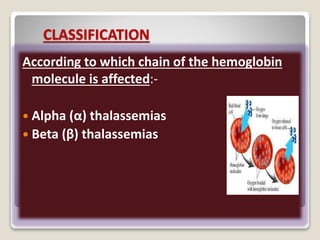
CLASSIFICATION
According to which chain of the hemoglobin
molecule is affected:-
 Alpha (α) thalassemias
 Beta (β) thalassemias
CAUSES
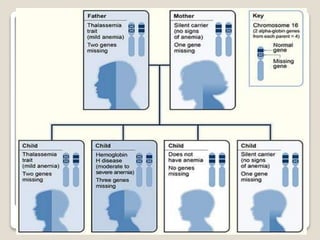
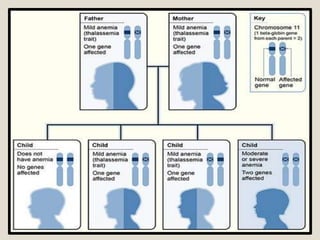
 Thalassemia is caused by an autosomal recessive
pattern of inheritance of genes.
 Alfa Thalassemia occur when a gene and genes
related to alpha globin protein are missing or
changed(mutated).
 Beta Thalassemia occur when similar gene defects
affect production of beta globulin protein.
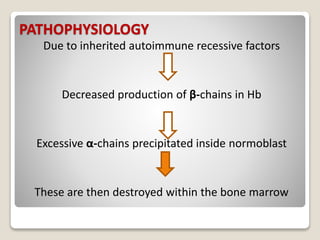
PATHOPHYSIOLOGY
Due to inherited autoimmune recessive factors
Decreased production of β-chains in Hb
Excessive α-chains precipitated inside normoblast
These are then destroyed within the bone marrow
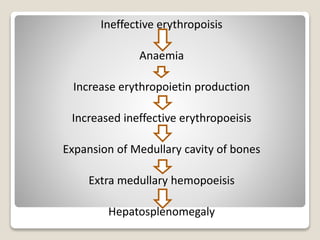
Ineffective erythropoisis
Anaemia
Increase erythropoietin production
Increased ineffective erythropoeisis
Expansion of Medullary cavity of bones
Extra medullary hemopoeisis
Hepatosplenomegaly
SIGN AND SYMPTOMS
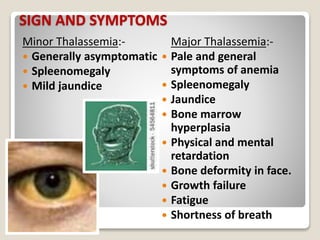
Minor Thalassemia:-
 Generally asymptomatic
 Spleenomegaly
 Mild jaundice
Major Thalassemia:-
 Pale and general
symptoms of anemia
 Spleenomegaly
 Jaundice
 Bone marrow
hyperplasia
 Physical and mental
retardation
 Bone deformity in face.
 Growth failure
 Fatigue
 Shortness of breath
DIAGNOSTIC EVALUATION
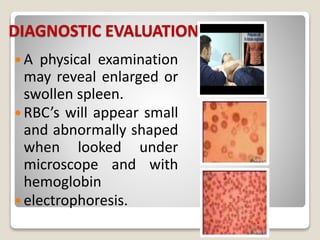
 A physical examination
may reveal enlarged or
swollen spleen.
 RBC’s will appear small
and abnormally shaped
when looked under
microscope and with
hemoglobin
 electrophoresis.
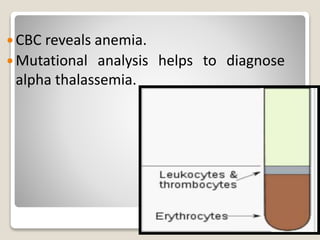
 CBC reveals anemia.
 Mutational analysis helps to diagnose
alpha thalassemia.
TREATMENT
MEDICAL CARE
Mild thalassemia : patients with thalassemia traits do
not require medical or follow-up care after the initial
diagnosis is made.
 They should use Iron therapy.
 Counseling is indicated in all persons with genetic
disorders.
Moderate to Severe thalassemia :
 medical treatment and a blood transfusion regimen
 stem cell and bone marrow transplantations are
necessary.
Medication
 Blood Transfusion:- Patient having Thalassemia Major
needs regular Blood Transfusion of RBC’s (often 2-4
weeks).
 Chelation Therapy:- Chelation or removal of excessive
iron deposits in the blood called Iron Overload. It
damages the heart, liver and other parts of body.
 Deferoxamine is the intravenously or subcutaneously
administered chelation agent.
 Deferasirox (Exjade) and Deferiprone are oral iron
chelation drugs.
 Folic Acid supplements
 It helps in building healthy RBC’s and proved more
beneficial if given with Vitamin B12 supplements.
 Certain food items like- spinach, whole grain, liver,
mushrooms, milk, eggs etc should be added to food.
 Other treatments:- Patient is likely to get other
infections like flu and pneumonia, so treatment
measures for these kinds of infections can be taken.
 Bone Marrow along with Stem Cell Transplantation.
 Bone Marrow Transplant (BMT) from compatible
donor
 Bone Marrow Transplant (BMT) from haploidentical
mother to child
 Hematopoietic stem cell transplantation
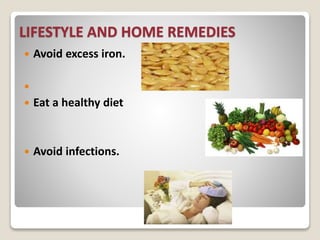
LIFESTYLE AND HOME REMEDIES
 Avoid excess iron.

 Eat a healthy diet
 Avoid infections.
COMPLICATIONS
 Iron overload
 Infection
 Bone deformities
 Enlarged spleen
 Slowed growth rates
 Heart problems
PREVENTIVE MEASURES
 CARRIER DETECTION
 A screening policy which includes pre-natal
screening and abortion
 Premarital screening
 Genetic counseling.
 IMMUNIZATION:- against influenza and flu shots.
NURSING MANAGEMENT
Nursing Assessment:-
 Obtain Family history of Thalassemia or
unexplained anemia or heart failure.
 Perform whole body examination to assess for
anaemia and systemic complications of
Thalassemia.
 Measure growth and development parameters in
children.
Ineffective tissue perfusion related to
abnormal Hb.
Goal:- Maximizing Tissue Perfusion.
 Administer blood transfusion as ordered.
 Monitor cardiovascular status for complications.
 Monitor vital signs.
 Monitor for any complications.
Acute bone pain related to disease condition.
 Monitor CBC as ordered and report Hb levels of less
than 10g/dl.
 Elevate lower extremities.
 Provide warm baths or soaks.
 Administer or teach proper administration of
NSAID’s.
Risk for infection related to nature to
disease and splenectomy.
 Explain the client that after splenectomy, there is an
increase in chance of acquiring infections.
 Give prophylaxis antibiotic before doing any invasive
procedures.
 Ensure that the client may have taken vaccination
against pneumococcal, hemophillus influenza,
meningococcal etc.
 Educate to take prompt treatment when any fever or
any signs of infection occurs
FAMILY EDUCATION AND HEALTH MAINTENANCE
 Discuss the genetic implications of thalessemia and
refer for genetic counseling.
 Provide detailed instruction about:
◦ Prevention and prompt treatment of infections.
◦ Medications
◦ Home chelation therapy.
◦ Dietary modification to limit iron intake.
◦ Activity restrictions,including avoidance of activities that
increase the risk of fractures.
◦ Signs of complications.
 Encourage parents of affected child to provide
information about the child’s condition to significant
adults who are involved with child and child care.
SUMMARIZATION
 Introduction
 Definition
 Classification
 Causes
 Pathophysiology
 Sign and symptoms
 Diagnostic tests
 Treatment
 Complication
 Prevention
 Family education and health maintenance.
BIBLIOGRAPHY
BOOK REFERENCES:-
 Black JM, Howks JH. Medical Surgical Nursing. South
Asia.ed.8th.Pp.822-34.
 Brunner, Sidharth.Textbook of Medical Surgical
Nursing. Lippincott William and
Wilkins.ed.10th.Pp.1676-81.
 Lippincott. Manual of Nursing Practice.Jaypee
Brothers Medical Publishers(p)Ltd.ed.8th.Pp.1107-8.
WEBSITE REFERENCES
◦ Weatherall David J, "Chapter 47. The Thalassemias: Disorders of Globin
Synthesis" (Chapter). Lichtman MA, Kipps TJ, Seligsohn U, Kaushansky K,
Prchal, JT: Williams Hematology, 8e:
http://www.accessmedicine.com/content.aspx?aID=6123722.
◦ Mayoclinic.http://www.mayoclinic.com/health/thalassemia/DS00905/DSECTI
ON=complications. Retrieved 20 September 2011.
◦ Modiano, G. et al. (1991). "Protection against malaria morbidity: Near-
fixation of the α-thalassemia gene in a Nepalese population". American
Journal of Human Genetics 48 (2): 390–397. PMC 1683029. PMID 1990845.
◦ Terrenato, L. et al. (1988). "Decreased Malaria Morbidity in the Tharu People
Compared to Sympatric Populations in Nepal". Annals of Tropical Medicine
and Parasitology 82 (1): 1–11. PMID 3041928.
◦ E. Goljan, Pathology, 2nd ed. Mosby Elsevier, Rapid Review Series.
◦ http://www.dmsc.moph.go.th/webrOOt/ri/Npublic/p04.htm
◦ Online 'Mendelian Inheritance in Man' (OMIM) 141800
◦ "Pediatric Thalassemia Treatment & Management". Medical Care. Open
Publishing. 30 April 2010. Retrieved 27 September 2011.
◦ Harrison's Principles of Internal Medicine 17th Edition. McGraw-Hill medical.
September 2008. pp. 776. ISBN 0-07-164114-9.
RESEARCH
 In Spain, a baby was selective for implantation in
order to be a cure for his brother's thalassemia. The
child was born from an embryo screened to be free
of the disease before implantation with In vitro
fertilization. The baby's supply of immunologically
compatible cord blood was saved for transplantation
to his brother. The transplantation was considered
successful.
 After a year a group of doctors and specialists in
Chennai and Coimbatore registered the successful
treatment of thalassemia in a child using a sibling's
umbilical cord blood.
THALASSEMIA PPT.pptx

THALASSEMIA PPT.pptx

  • 1.
  • 2.
    INTRODUCTION Thalassemia is derivedfrom the Greek word thalassa ("sea") and -emia ("blood"), it is a blood disorder and is caused by variant or missing genes that affect how the body makes hemoglobin
  • 3.
    DEFINITION Thalassemia are formsof inherited autosomal recessive blood disorders and is characterized by an absence or decrease synthesis of one of the normal chains of hemoglobin.
  • 4.
    CLASSIFICATION According to whichchain of the hemoglobin molecule is affected:-  Alpha (α) thalassemias  Beta (β) thalassemias
  • 7.
    CAUSES  Thalassemia iscaused by an autosomal recessive pattern of inheritance of genes.  Alfa Thalassemia occur when a gene and genes related to alpha globin protein are missing or changed(mutated).  Beta Thalassemia occur when similar gene defects affect production of beta globulin protein.
  • 8.
    PATHOPHYSIOLOGY Due to inheritedautoimmune recessive factors Decreased production of β-chains in Hb Excessive α-chains precipitated inside normoblast These are then destroyed within the bone marrow
  • 9.
    Ineffective erythropoisis Anaemia Increase erythropoietinproduction Increased ineffective erythropoeisis Expansion of Medullary cavity of bones Extra medullary hemopoeisis Hepatosplenomegaly
  • 10.
    SIGN AND SYMPTOMS MinorThalassemia:-  Generally asymptomatic  Spleenomegaly  Mild jaundice Major Thalassemia:-  Pale and general symptoms of anemia  Spleenomegaly  Jaundice  Bone marrow hyperplasia  Physical and mental retardation  Bone deformity in face.  Growth failure  Fatigue  Shortness of breath
  • 11.
    DIAGNOSTIC EVALUATION  Aphysical examination may reveal enlarged or swollen spleen.  RBC’s will appear small and abnormally shaped when looked under microscope and with hemoglobin  electrophoresis.
  • 12.
     CBC revealsanemia.  Mutational analysis helps to diagnose alpha thalassemia.
  • 13.
    TREATMENT MEDICAL CARE Mild thalassemia: patients with thalassemia traits do not require medical or follow-up care after the initial diagnosis is made.  They should use Iron therapy.  Counseling is indicated in all persons with genetic disorders. Moderate to Severe thalassemia :  medical treatment and a blood transfusion regimen  stem cell and bone marrow transplantations are necessary.
  • 14.
    Medication  Blood Transfusion:-Patient having Thalassemia Major needs regular Blood Transfusion of RBC’s (often 2-4 weeks).  Chelation Therapy:- Chelation or removal of excessive iron deposits in the blood called Iron Overload. It damages the heart, liver and other parts of body.  Deferoxamine is the intravenously or subcutaneously administered chelation agent.  Deferasirox (Exjade) and Deferiprone are oral iron chelation drugs.
  • 15.
     Folic Acidsupplements  It helps in building healthy RBC’s and proved more beneficial if given with Vitamin B12 supplements.  Certain food items like- spinach, whole grain, liver, mushrooms, milk, eggs etc should be added to food.  Other treatments:- Patient is likely to get other infections like flu and pneumonia, so treatment measures for these kinds of infections can be taken.
  • 16.
     Bone Marrowalong with Stem Cell Transplantation.  Bone Marrow Transplant (BMT) from compatible donor  Bone Marrow Transplant (BMT) from haploidentical mother to child  Hematopoietic stem cell transplantation
  • 17.
    LIFESTYLE AND HOMEREMEDIES  Avoid excess iron.   Eat a healthy diet  Avoid infections.
  • 18.
    COMPLICATIONS  Iron overload Infection  Bone deformities  Enlarged spleen  Slowed growth rates  Heart problems
  • 19.
    PREVENTIVE MEASURES  CARRIERDETECTION  A screening policy which includes pre-natal screening and abortion  Premarital screening  Genetic counseling.  IMMUNIZATION:- against influenza and flu shots.
  • 20.
    NURSING MANAGEMENT Nursing Assessment:- Obtain Family history of Thalassemia or unexplained anemia or heart failure.  Perform whole body examination to assess for anaemia and systemic complications of Thalassemia.  Measure growth and development parameters in children.
  • 21.
    Ineffective tissue perfusionrelated to abnormal Hb. Goal:- Maximizing Tissue Perfusion.  Administer blood transfusion as ordered.  Monitor cardiovascular status for complications.  Monitor vital signs.  Monitor for any complications.
  • 22.
    Acute bone painrelated to disease condition.  Monitor CBC as ordered and report Hb levels of less than 10g/dl.  Elevate lower extremities.  Provide warm baths or soaks.  Administer or teach proper administration of NSAID’s.
  • 23.
    Risk for infectionrelated to nature to disease and splenectomy.  Explain the client that after splenectomy, there is an increase in chance of acquiring infections.  Give prophylaxis antibiotic before doing any invasive procedures.  Ensure that the client may have taken vaccination against pneumococcal, hemophillus influenza, meningococcal etc.  Educate to take prompt treatment when any fever or any signs of infection occurs
  • 24.
    FAMILY EDUCATION ANDHEALTH MAINTENANCE  Discuss the genetic implications of thalessemia and refer for genetic counseling.  Provide detailed instruction about: ◦ Prevention and prompt treatment of infections. ◦ Medications ◦ Home chelation therapy. ◦ Dietary modification to limit iron intake. ◦ Activity restrictions,including avoidance of activities that increase the risk of fractures. ◦ Signs of complications.  Encourage parents of affected child to provide information about the child’s condition to significant adults who are involved with child and child care.
  • 25.
    SUMMARIZATION  Introduction  Definition Classification  Causes  Pathophysiology  Sign and symptoms  Diagnostic tests  Treatment  Complication  Prevention  Family education and health maintenance.
  • 26.
    BIBLIOGRAPHY BOOK REFERENCES:-  BlackJM, Howks JH. Medical Surgical Nursing. South Asia.ed.8th.Pp.822-34.  Brunner, Sidharth.Textbook of Medical Surgical Nursing. Lippincott William and Wilkins.ed.10th.Pp.1676-81.  Lippincott. Manual of Nursing Practice.Jaypee Brothers Medical Publishers(p)Ltd.ed.8th.Pp.1107-8.
  • 27.
    WEBSITE REFERENCES ◦ WeatherallDavid J, "Chapter 47. The Thalassemias: Disorders of Globin Synthesis" (Chapter). Lichtman MA, Kipps TJ, Seligsohn U, Kaushansky K, Prchal, JT: Williams Hematology, 8e: http://www.accessmedicine.com/content.aspx?aID=6123722. ◦ Mayoclinic.http://www.mayoclinic.com/health/thalassemia/DS00905/DSECTI ON=complications. Retrieved 20 September 2011. ◦ Modiano, G. et al. (1991). "Protection against malaria morbidity: Near- fixation of the α-thalassemia gene in a Nepalese population". American Journal of Human Genetics 48 (2): 390–397. PMC 1683029. PMID 1990845. ◦ Terrenato, L. et al. (1988). "Decreased Malaria Morbidity in the Tharu People Compared to Sympatric Populations in Nepal". Annals of Tropical Medicine and Parasitology 82 (1): 1–11. PMID 3041928. ◦ E. Goljan, Pathology, 2nd ed. Mosby Elsevier, Rapid Review Series. ◦ http://www.dmsc.moph.go.th/webrOOt/ri/Npublic/p04.htm ◦ Online 'Mendelian Inheritance in Man' (OMIM) 141800 ◦ "Pediatric Thalassemia Treatment & Management". Medical Care. Open Publishing. 30 April 2010. Retrieved 27 September 2011. ◦ Harrison's Principles of Internal Medicine 17th Edition. McGraw-Hill medical. September 2008. pp. 776. ISBN 0-07-164114-9.
  • 28.
    RESEARCH  In Spain,a baby was selective for implantation in order to be a cure for his brother's thalassemia. The child was born from an embryo screened to be free of the disease before implantation with In vitro fertilization. The baby's supply of immunologically compatible cord blood was saved for transplantation to his brother. The transplantation was considered successful.  After a year a group of doctors and specialists in Chennai and Coimbatore registered the successful treatment of thalassemia in a child using a sibling's umbilical cord blood.