HERNIA
By
Mr.Jagdish Sambad
M.Sc.Nursing-Medical Surgical Nursing
Definitions
• Hernia – protrusion of a structure from its normal
position to another through and opening that is
either congenital or acquired
• External hernia – protrudes to the outside
• Internal hernia – protrudes within the body
• Incisional hernia – protrudes through a pervious
incision
• Reducible hernia – protruding contents can be
pushed back in
• Irreducible (incarcerated) hernia – protruding
contents cannot be moved back into place
• Strangulated hernia – vascular compromise of
herniated contents
• Hernias by themselves usually are
harmless, but nearly all have a
potential risk of having their blood
supply cut off (becoming
strangulated).
• If the blood supply is cut off at the
hernia opening in the abdominal wall,
it becomes a medical and surgical
emergency.
What is hernia composed of ?
1. Sac: a folding of peritoneum consisting of
a mouth, neck, body and fundus.
2. Body: which varies in size and is not
necessarily occupied.
3. Coverings: derived from layers of the
abdominal wall.
4. Contents: which could be anything from
the omentum, intestines, ovary or urinary
bladder
Risk Factors
• Lack of developmental maturity of
anatomic structures
• Family History
• Undescended testis
• GU abnormalities
• Increased intra-abdominal pressure
– Peritoneal dialysis, ascitis, VP shunt, cystic
fibrosis, COPD, pregnancy
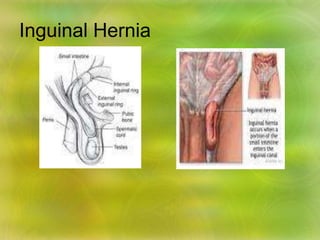
Inguinal Hernia
• Direct
– Protrudes through the floor of Hasselbach’s triangle
– Results from relaxation/weakening of the abdominal
musculature
– Increased frequency with age
– Rarely incarcerates
• Indirect
– Protrudes through the internal inguinal ring lateral to the
inferior epigastric vessels
– Congenital defect (incomplete closure of the processus
vaginalis)
– Most common hernia in males and females
– Most common in younger patients
– Bimodal distribution, in 1st year of life and over 40
– Frequently incarcerate, especially in infancy
Inguinal Hernia
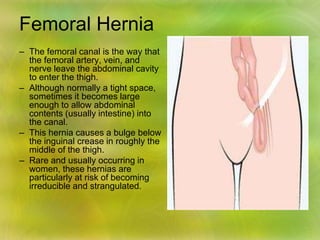
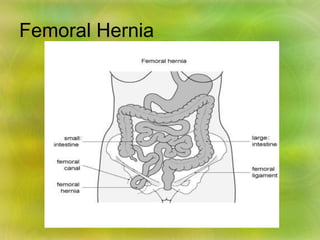
Femoral Hernia
– The femoral canal is the way that
the femoral artery, vein, and
nerve leave the abdominal cavity
to enter the thigh.
– Although normally a tight space,
sometimes it becomes large
enough to allow abdominal
contents (usually intestine) into
the canal.
– This hernia causes a bulge below
the inguinal crease in roughly the
middle of the thigh.
– Rare and usually occurring in
women, these hernias are
particularly at risk of becoming
irreducible and strangulated.
Femoral Hernia
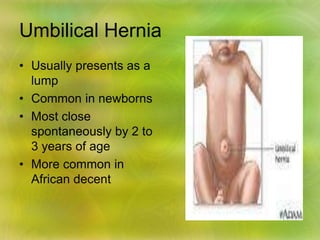
Umbilical Hernia
• Usually presents as a
lump
• Common in newborns
• Most close
spontaneously by 2 to
3 years of age
• More common in
African decent
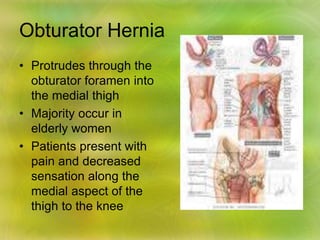
Obturator Hernia
• Protrudes through the
obturator foramen into
the medial thigh
• Majority occur in
elderly women
• Patients present with
pain and decreased
sensation along the
medial aspect of the
thigh to the knee
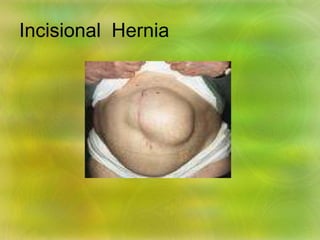
Incisional Hernia
Definition: An incisional hernia occurs when the area of weakness is
the result of an incompletely healed surgical wound. These can be
among the most frustrating and difficult hernias to treat. It can occur
at any incision, but tend to occur more commonly along a straight
line from the sternum breastbone straight down to the pubis, and are
more complex in these regions. Hernias in this area have a high rate
of recurrence.
Causes:
 Any reasons leading to an icrease in intraabdominal pressure
postoperatively such as: chronic cough, vomitting, infection,
malnutrition diabetes, steroid treatment or a tension closure
done during the previous operation.
Clinical Features:
 Swelling at the incisional site +/- pain.
Incisional Hernia
Misc. Hernias
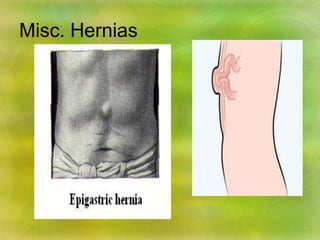
• Epigastric Hernia
– Herniation through the linea alba of the rectus sheath
• Spigelian Hernia
– Spigelian hernia (or lateral ventral hernia) is a
hernia through the spigelian fascia, which is the
aponeurotic layer between the rectus abdominis
muscle medially, and the semilunar line laterally.
These hernias almost always develop at or below the
linea arcuata, probably because of the lack of
posterior rectus sheath.
– Frequently interparietal, difficult to diagnose
Misc. Hernias
Causes of Hernia
• Any condition that increases the pressure of the
abdominal cavity may contribute to the formation
or worsening of a hernia.
– Obesity
– Heavy lifting
– Coughing
– Straining during a bowel movement or urination
– Chronic lung disease
– Fluid in the abdominal cavity
– Hereditary
Signs and Symptoms of Hernia
• The signs and symptoms of a hernia can
range from noticing a painless lump to the
painful, tender, swollen protrusion of tissue
that you are unable to push back into the
abdomen—possibly a strangulated hernia.
– Asymptomatic reducible hernia
• New lump n the groin or other abdominal wall area
• May ache but is not tender when touched.
• Sometimes pain precedes the discovery of the
lump.
Signs and Symptoms of Hernia
– Irreducible hernia
• Lump increases in size when standing or when
abdominal pressure is increased (such as
coughing)
• May be reduced (pushed back into the abdomen)
unless very large
• Usually painful enlargement of a previous hernia
that cannot be returned into the abdominal cavity
on its own or when you push it
• Some may be long term without pain Signs and
symptoms of bowel obstruction may occur, such as
nausea and vomiting
Signs and Symptoms of Hernia
– Strangulated hernia
• Can lead to strangulation
• Irreducible hernia where the entrapped intestine
has its blood supply cut off
• Pain always present followed quickly by
tenderness and sometimes symptoms of bowel
obstruction (nausea and vomiting)
• You may appear ill with or without fever
• Surgical emergency
• All strangulated hernias are irreducible (but all
irreducible hernias are not strangulated)
Diagnosis
Hernias must be examined with the patient
standing and in supine
Always examine both groins.
INSPECTION:
Visible swelling. (site, size and shape)
Visible cough impulse.
Easily reducible
Reappear on straining, standing or
coughing
Elucidate Fothergill and Carnet signs.
PALPATION:
Examine as a mass and then
Palpable cough impulse
Reduce
Occlusion test
Three Finger test ( Zimman’s test)
also asses the following:
Position
Temperature
Tenderness
Shape
Size
Tension
Composition
Expansile cough impulse
Reducible.
PERCUSSION AND
AUSCULTATION:
Bowel sound.
Diagnosis cont.
• Patients often present with pain
• Palpate and try to reduce, unless duration
of incarceration is unknown
• WBC may be elevated
• Vital signs may be unstable with
incarceration
• CT may be needed for spigelian or pelvic
hernias
Treatment
• Reduce hernia, unless not recent onset
– Place patient in trendelenburg position
– Give pain meds to relax patient
– Warm compress over area
– Gentle compression on hernia
• If no manual reduction, needs surgical fixation
• If strangulation is suspected, broad-spectrum
Abx and fluids
• Most asymptomatic hernias are fixed electively
Treatment cont.
Most abdominal hernias can be surgically repaired.
Uncomplicated hernias are principally repaired
by herniorrhaphy.
a Herniorrhaphy (Hernioplasty) is a surgical
procedure for correcting hernia, which can be
devided into four techniques:
Groups 1 and 2: open "tension" repair:
• in which the edges of the defect are sewn back
together without any reinforcement or
prosthesis. In the Bassini technique, the conjoint
tendon (formed by the distal ends of the
transversus abdominis muscle and the internal
oblique muscle) is approximated to the inguinal
canal and closed. [4]
• Although tension repairs are no longer the
standard of care due to the high rate of
recurrence of the hernia, long recovery period,
and post-operative pain, a few tension repairs
are still in use today.
Treatment cont.
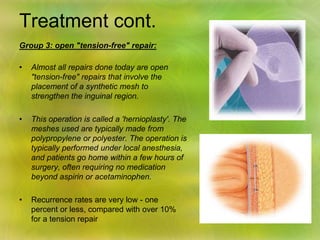
Group 3: open "tension-free" repair:
• Almost all repairs done today are open
"tension-free" repairs that involve the
placement of a synthetic mesh to
strengthen the inguinal region.
• This operation is called a 'hernioplasty'. The
meshes used are typically made from
polypropylene or polyester. The operation is
typically performed under local anesthesia,
and patients go home within a few hours of
surgery, often requiring no medication
beyond aspirin or acetaminophen.
• Recurrence rates are very low - one
percent or less, compared with over 10%
for a tension repair
Treatment cont.
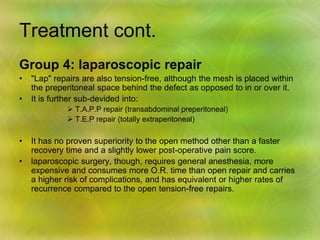
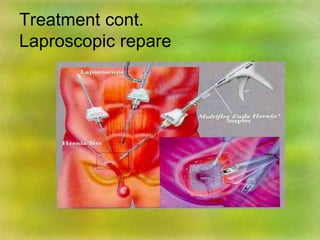
Group 4: laparoscopic repair
• "Lap" repairs are also tension-free, although the mesh is placed within
the preperitoneal space behind the defect as opposed to in or over it.
• It is further sub-devided into:
 T.A.P.P repair (transabdominal preperitoneal)
 T.E.P repair (totally extraperitoneal)
• It has no proven superiority to the open method other than a faster
recovery time and a slightly lower post-operative pain score.
• laparoscopic surgery, though, requires general anesthesia, more
expensive and consumes more O.R. time than open repair and carries
a higher risk of complications, and has equivalent or higher rates of
recurrence compared to the open tension-free repairs.
Treatment cont.
Laproscopic repare

Hernia

  • 1.
  • 2.
    Definitions • Hernia –protrusion of a structure from its normal position to another through and opening that is either congenital or acquired • External hernia – protrudes to the outside • Internal hernia – protrudes within the body • Incisional hernia – protrudes through a pervious incision • Reducible hernia – protruding contents can be pushed back in • Irreducible (incarcerated) hernia – protruding contents cannot be moved back into place • Strangulated hernia – vascular compromise of herniated contents
  • 3.
    • Hernias bythemselves usually are harmless, but nearly all have a potential risk of having their blood supply cut off (becoming strangulated). • If the blood supply is cut off at the hernia opening in the abdominal wall, it becomes a medical and surgical emergency.
  • 5.
    What is herniacomposed of ? 1. Sac: a folding of peritoneum consisting of a mouth, neck, body and fundus. 2. Body: which varies in size and is not necessarily occupied. 3. Coverings: derived from layers of the abdominal wall. 4. Contents: which could be anything from the omentum, intestines, ovary or urinary bladder
  • 6.
    Risk Factors • Lackof developmental maturity of anatomic structures • Family History • Undescended testis • GU abnormalities • Increased intra-abdominal pressure – Peritoneal dialysis, ascitis, VP shunt, cystic fibrosis, COPD, pregnancy
  • 7.
    Inguinal Hernia • Direct –Protrudes through the floor of Hasselbach’s triangle – Results from relaxation/weakening of the abdominal musculature – Increased frequency with age – Rarely incarcerates • Indirect – Protrudes through the internal inguinal ring lateral to the inferior epigastric vessels – Congenital defect (incomplete closure of the processus vaginalis) – Most common hernia in males and females – Most common in younger patients – Bimodal distribution, in 1st year of life and over 40 – Frequently incarcerate, especially in infancy
  • 8.
  • 9.
    Femoral Hernia – Thefemoral canal is the way that the femoral artery, vein, and nerve leave the abdominal cavity to enter the thigh. – Although normally a tight space, sometimes it becomes large enough to allow abdominal contents (usually intestine) into the canal. – This hernia causes a bulge below the inguinal crease in roughly the middle of the thigh. – Rare and usually occurring in women, these hernias are particularly at risk of becoming irreducible and strangulated.
  • 10.
  • 11.
    Umbilical Hernia • Usuallypresents as a lump • Common in newborns • Most close spontaneously by 2 to 3 years of age • More common in African decent
  • 12.
    Obturator Hernia • Protrudesthrough the obturator foramen into the medial thigh • Majority occur in elderly women • Patients present with pain and decreased sensation along the medial aspect of the thigh to the knee
  • 13.
    Incisional Hernia Definition: Anincisional hernia occurs when the area of weakness is the result of an incompletely healed surgical wound. These can be among the most frustrating and difficult hernias to treat. It can occur at any incision, but tend to occur more commonly along a straight line from the sternum breastbone straight down to the pubis, and are more complex in these regions. Hernias in this area have a high rate of recurrence. Causes:  Any reasons leading to an icrease in intraabdominal pressure postoperatively such as: chronic cough, vomitting, infection, malnutrition diabetes, steroid treatment or a tension closure done during the previous operation. Clinical Features:  Swelling at the incisional site +/- pain.
  • 14.
  • 15.
    Misc. Hernias • EpigastricHernia – Herniation through the linea alba of the rectus sheath • Spigelian Hernia – Spigelian hernia (or lateral ventral hernia) is a hernia through the spigelian fascia, which is the aponeurotic layer between the rectus abdominis muscle medially, and the semilunar line laterally. These hernias almost always develop at or below the linea arcuata, probably because of the lack of posterior rectus sheath. – Frequently interparietal, difficult to diagnose
  • 16.
  • 17.
    Causes of Hernia •Any condition that increases the pressure of the abdominal cavity may contribute to the formation or worsening of a hernia. – Obesity – Heavy lifting – Coughing – Straining during a bowel movement or urination – Chronic lung disease – Fluid in the abdominal cavity – Hereditary
  • 18.
    Signs and Symptomsof Hernia • The signs and symptoms of a hernia can range from noticing a painless lump to the painful, tender, swollen protrusion of tissue that you are unable to push back into the abdomen—possibly a strangulated hernia. – Asymptomatic reducible hernia • New lump n the groin or other abdominal wall area • May ache but is not tender when touched. • Sometimes pain precedes the discovery of the lump.
  • 19.
    Signs and Symptomsof Hernia – Irreducible hernia • Lump increases in size when standing or when abdominal pressure is increased (such as coughing) • May be reduced (pushed back into the abdomen) unless very large • Usually painful enlargement of a previous hernia that cannot be returned into the abdominal cavity on its own or when you push it • Some may be long term without pain Signs and symptoms of bowel obstruction may occur, such as nausea and vomiting
  • 20.
    Signs and Symptomsof Hernia – Strangulated hernia • Can lead to strangulation • Irreducible hernia where the entrapped intestine has its blood supply cut off • Pain always present followed quickly by tenderness and sometimes symptoms of bowel obstruction (nausea and vomiting) • You may appear ill with or without fever • Surgical emergency • All strangulated hernias are irreducible (but all irreducible hernias are not strangulated)
  • 21.
    Diagnosis Hernias must beexamined with the patient standing and in supine Always examine both groins. INSPECTION: Visible swelling. (site, size and shape) Visible cough impulse. Easily reducible Reappear on straining, standing or coughing Elucidate Fothergill and Carnet signs. PALPATION: Examine as a mass and then Palpable cough impulse Reduce Occlusion test Three Finger test ( Zimman’s test) also asses the following: Position Temperature Tenderness Shape Size Tension Composition Expansile cough impulse Reducible. PERCUSSION AND AUSCULTATION: Bowel sound.
  • 22.
    Diagnosis cont. • Patientsoften present with pain • Palpate and try to reduce, unless duration of incarceration is unknown • WBC may be elevated • Vital signs may be unstable with incarceration • CT may be needed for spigelian or pelvic hernias
  • 23.
    Treatment • Reduce hernia,unless not recent onset – Place patient in trendelenburg position – Give pain meds to relax patient – Warm compress over area – Gentle compression on hernia • If no manual reduction, needs surgical fixation • If strangulation is suspected, broad-spectrum Abx and fluids • Most asymptomatic hernias are fixed electively
  • 24.
    Treatment cont. Most abdominalhernias can be surgically repaired. Uncomplicated hernias are principally repaired by herniorrhaphy. a Herniorrhaphy (Hernioplasty) is a surgical procedure for correcting hernia, which can be devided into four techniques: Groups 1 and 2: open "tension" repair: • in which the edges of the defect are sewn back together without any reinforcement or prosthesis. In the Bassini technique, the conjoint tendon (formed by the distal ends of the transversus abdominis muscle and the internal oblique muscle) is approximated to the inguinal canal and closed. [4] • Although tension repairs are no longer the standard of care due to the high rate of recurrence of the hernia, long recovery period, and post-operative pain, a few tension repairs are still in use today.
  • 25.
    Treatment cont. Group 3:open "tension-free" repair: • Almost all repairs done today are open "tension-free" repairs that involve the placement of a synthetic mesh to strengthen the inguinal region. • This operation is called a 'hernioplasty'. The meshes used are typically made from polypropylene or polyester. The operation is typically performed under local anesthesia, and patients go home within a few hours of surgery, often requiring no medication beyond aspirin or acetaminophen. • Recurrence rates are very low - one percent or less, compared with over 10% for a tension repair
  • 26.
    Treatment cont. Group 4:laparoscopic repair • "Lap" repairs are also tension-free, although the mesh is placed within the preperitoneal space behind the defect as opposed to in or over it. • It is further sub-devided into:  T.A.P.P repair (transabdominal preperitoneal)  T.E.P repair (totally extraperitoneal) • It has no proven superiority to the open method other than a faster recovery time and a slightly lower post-operative pain score. • laparoscopic surgery, though, requires general anesthesia, more expensive and consumes more O.R. time than open repair and carries a higher risk of complications, and has equivalent or higher rates of recurrence compared to the open tension-free repairs.
  • 27.