BY: DR: NAJEEB MEMON Assist: Prof: Faculty of Community Medicine & Public Health Sciences Liaquat University of Medical & Health Sciences (LUMHS) Jamshoro Sind  Pakistan
RABIES Primarily a Zoonotic disease of warm blooded animal   such as :- Dogs,  wild cats,  Jackals,  wolves etc. It is caused by the Neurotropic RNA virus belongs to  Rhabdoviridae type I  ( LYSSAVIRUS type I ) is Bullet shaped virus
 
 
It is an acute Highly fatal viral dis: of CNS Transmitted to man by: Bites OR Licks of rabid animals
 
Agent Factors:   Agent    (LYSSAVIRUS type I)  Rhabdoviridae type I
Bullet shaped
History of Rabies Virus Man described the disease in  2300 B.C.   The origin “ rabhas”,  meaning  “to do violence”   comes from ancient Indian Sanskrit dating  3000 B.C.
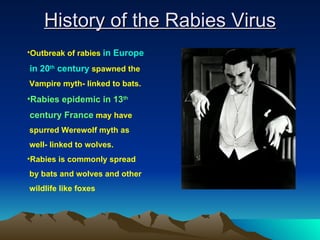
History of the Rabies Virus Outbreak of rabies  in Europe in 20 th  century  spawned the  Vampire myth- linked to bats. Rabies epidemic in 13 th century France  may have  spurred Werewolf myth as  well- linked to wolves.  Rabies is commonly spread by bats and wolves and other wildlife like foxes
History of the Rabies Virus Since Roman times, man established the link between the  infectivity of a rabid dogs saliva and the spread of the disease. Because there is  no cure  for rabies, those that had been bitten by a rabid dog would commonly  commit suicide   to avoid the painful death  that would inevitably follow.
History of the Rabies Virus Louis Pasteur  was the first person to diagnose that rabies targeted the CNS. Also determined that nervous tissue of an infected human or animal also contained the virus. In 1890 created the rabies vaccine  and saved 9 year old Joseph Meister after he had been bit by a rabid dog.
Epidemiology 87 countries contain Rabies, but more cases are reported in Asia. In Indo-Pakistan rabies is a major public health problem mainly due to presence of a large no: of stray dogs. More than 30,000 people died of Rabies every year in Asia.  Every year 10 million people require treatment and protection from Rabies which is great Financial loss.
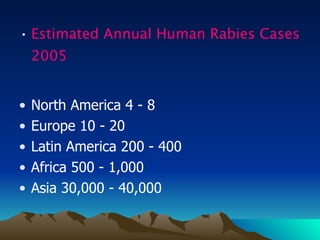
Estimated Annual Human Rabies Cases 2005 North America 4 - 8 Europe 10 - 20 Latin America 200 - 400 Africa 500 - 1,000 Asia 30,000 - 40,000
FREE RABIES ZONE:  Australia,  China,  Iceland,  Ireland, Japan,  New Zealand etc
Types of Rabies virus STREET VIRUS Definition : the virus recovered from naturally occurring cases of rabies is called “street virus” Sources : it is naturally occurring virus. It is found in saliva of infected animal. (continue) FIXED VIRUS Definition : the virus which has a short, fixed and reproducible incubation period is called “fixed virus S ources : it is prepared by repeated culture in brain of rabbit such that its I.P. is reduced & fixed
Features It produces Negri bodies Incubation period is long i.e. 20 to 60 days It is pathogenic for all mammals Cannot be used for preparation of vaccine Features It does not form Negri bodies Incubation period is constant between 4-6 days It can pathogenic for humans under certain conditions Is used for preparation of antirabies vaccine
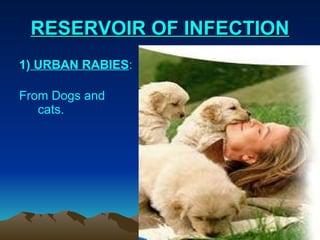
RESERVOIR OF INFECTION 1)  URBAN RABIES :  From Dogs and cats.
2)  WILD LIFE RABIES :  From jackals and foxes.
3)  BAT RABIES :  Vampire bats which live on the blood of animals and men. These are one of the main causes of the death of bovine, around 0.5 to 1 million per year.
Source of Infection Saliva of Rabid animal
Host Factors All warm blooded animals including man. Rabies in man is a dead-end infection.
Mode of Transmission ANIMAL BITES LICKS AEROSOL PERSON TO PERSON
INCUBATION PERIOD : normally it is 3 - 8 wks  may be short that is  4 days or may be prolonged for years.
PATHOGENESIS Replicate in muscle and C.T. --- attach to nerve ending --- CNS --- than centrifugally in peripheral nerve to many tissue including Skeletal muscle, heart, adrenal gland and skin --- salivary gland
CLINICAL PICTURE 1.  Prodromal symptoms Headache, malaise, sore throat, low fever, pain at the site of bite Excitation Symptoms sensory sys: involvement Aero phobia, excitation of N.S. Motor sys: inv:   increase reflexes, muscle spasm, Symp:inv:  dilatation of Pupils. increase perspiration, salivation, and Lacrimation,  Mental changes:  fear of death, anger, irritability and depression
Hydrophobia ( Fear of water) sight or sound of water may produce spasm of degulation the duration of illness is 2-3 days may be prolonged to 5-6 days Stage of paralysis & coma DEATH / Recovery
 
(summary )  Transmission of Rabies Cl:Picture  The rabies infection and the symptoms that accompany it is classified by five stages: 1. Incubation (1-3 months) 2. Prodromal, where first symptoms occur 3. Acute neurological phase 4. Coma 5. Death or recovery
DIAGNOSIS History Sign and symptom Examination Detection of Antigen by taking Skin Biopsy using Immunofluorescence  by virus isolation from Saliva & other secretions.
Control Measures Notification Isolation Disinfection Immunization
Prevention of human rabies post Exposure prophylaxis General consideration:-   Aim is to neutralize virus before entering CNS LOCAL WOUND TREATMENT   a, Cleansing of wound(soap & water) b, Chemical treatment:   Either Alcohol 400-700 ml /liter Tincture Iodine No more treatment with Ammonium    compound  No Carbolic acid and Nitric acid as it leave very bad scar
c, Suturing d,  Anti Rabies Serum e, Antibiotic and ATS f, Observe the animal for 10 days
3, Immunization 1,NERVOUS TISSUE VACCINE (NTV  2,  Human diploid cell vaccine (HDCV)
Vaccines for immunization Definition: it is  fluid or dried preparation  of Rabies “Fixed” virus grown in the Neural tissue of  Rabbits,  Sheep,  Goats,  Mice or Rats   OR  in embryonated duck eggs OR  in cell culture
2Tissue culture 2 nd  G (Non-human) Potent, low cost WHO recommendatio Now purified DEV developed Improvement over adult animal nervous tissue V Not available in India & Pakistan Suckling mouse brain V  Devoid of Neuroparalytic effect Used in Latin America  Improvement over adult animal nervous tissue V 1, (HDC)   safe, potent  Pre & post expos:Immunization Used in UK,USA in past Exposed subjects Uses Fewer Allergic risks Severe & fatal reactions Side effects Fewer doses of small volume Large nos: are required Doses More potent more safer Eliminate Neuroparalytic factors Low or variable potency From fixed virus grown in brain of sheep or other animals preparation Cell culture vaccine Duck embryo vaccine Nervous Tissue vaccine
Type of Vaccine NERVOUS TISSUE VACCINE (NTV) Derived from adult animal nervous   tissue  eg. Sheep Derived from suckling mouse brain Type: Killed viral vaccine Dose:  2.5 ml S/C (Ant. Abdominal wall) Schedule: 14 doses
Type of Vaccine (conti) Duck Embryo Vaccine (DEV) Type:  Killed viral vaccine Dose: 1 ml S/C ( Ant. Abdominal wall)  Schedule: 14 doses OD not available in Pakistan
Type of Vaccine (conti) CELL CULTURE VACCINES Human diploid cell vaccine (HDCV) Second generation tissue culture vaccine (non- Human) Type: Killed viral vaccine Dose: 1 ml IM  Schedule: on 0, 3, 7, 14, 28 day,    booster on day 90
PASSIVE IMMUNIZATION Horse Anti Rabies serum : 40 iu / kg at 0 day Human rabies immunoglobin  (HRIG): 20 iu / kg around the wound and rest in IM on 0 day Booster doses are essential whenever anti rabies serum is given with the vaccine
Classification Of Exposures Class I (slight Risk)   07 injection Licks on healthy unbroken skin. Scratches without oozing of blood. Class II (Moderate Risk) according to the Schedule plus one booster dose after 3 week Licks on fresh cuts. Scratches with oozing of blood. All bites except those on head, neck, face, palms and fingers. Minor wounds less than 5 in number. Class III (Severe Risk) according to the Schedule plus Two booster dose one after one week and another 2 week all bites or scratches with oozing of blood on neck, head, face, palms and fingers. Lacerated wounds on any part of the body. Multiple wounds 5 or more in number . Bites from wild animals.
IMMUNITY Duration of Immunity is upto 06 month  If again bite by rapid animal than dose according to blood titre if more than 0.5 i.u. / ml than only two dose 0, 3 day if less than 0.5 i.u. / ml than 0, 3, 7 day
General measures Regist:,licensing & taxation of dog. Muzzling of dogs Yearly mass vaccination of dog Destruction of stray dogs Facilities for diagnosis of rabies in dogs Destruction of wildlife where the animals are known to be the reservoir of infection . Publicity
Pre-Exposure Prophylaxis It is done in persons who have high risk of repeated exposures. Animal Handlers Wildlife officers Veterinarians Lab: staff working with rabies virus Protected by:-  Cell-culture vaccine 1ml I/M OR  0.1ml I/D ( 0,7& 28day) Post-exposure R/ of persons (who have been vaccinated previously) HDC vaccine (1ml I/M  0,3 & 7 day 0
Rabies in Dogs   Incubation period: 3-8 wks. Clinical features:   Rabies in dogs may manifest itself in two forms. Furious Rabies . This the typical mad-dog syndrome characterized by.  change in behavior . Tendency to run away from home , wander aimlessly and biting humans and animals. Change in voice  due to paralisis of laryngeal muscles. Excessive salivation & foaming  at the angle of the mouth. Paralysis of the whole body  leading to coma & death.
Dumb Rabies. The excitative or irritative stage is  lacking . The disease is predominantly  paralytic . Dog withdraws itself  from being seen or disturbed. It elapses into a  stage of sleepiness  and  dies  in about 3 days.
THANK YOU

Rabies ppt

  • 1.
  • 2.
    BY: DR: NAJEEBMEMON Assist: Prof: Faculty of Community Medicine & Public Health Sciences Liaquat University of Medical & Health Sciences (LUMHS) Jamshoro Sind Pakistan
  • 3.
    RABIES Primarily aZoonotic disease of warm blooded animal such as :- Dogs, wild cats, Jackals, wolves etc. It is caused by the Neurotropic RNA virus belongs to Rhabdoviridae type I ( LYSSAVIRUS type I ) is Bullet shaped virus
  • 4.
  • 5.
  • 6.
    It is anacute Highly fatal viral dis: of CNS Transmitted to man by: Bites OR Licks of rabid animals
  • 7.
  • 8.
    Agent Factors: Agent (LYSSAVIRUS type I) Rhabdoviridae type I
  • 9.
  • 10.
    History of RabiesVirus Man described the disease in 2300 B.C. The origin “ rabhas”, meaning “to do violence” comes from ancient Indian Sanskrit dating 3000 B.C.
  • 11.
    History of theRabies Virus Outbreak of rabies in Europe in 20 th century spawned the Vampire myth- linked to bats. Rabies epidemic in 13 th century France may have spurred Werewolf myth as well- linked to wolves. Rabies is commonly spread by bats and wolves and other wildlife like foxes
  • 12.
    History of theRabies Virus Since Roman times, man established the link between the infectivity of a rabid dogs saliva and the spread of the disease. Because there is no cure for rabies, those that had been bitten by a rabid dog would commonly commit suicide to avoid the painful death that would inevitably follow.
  • 13.
    History of theRabies Virus Louis Pasteur was the first person to diagnose that rabies targeted the CNS. Also determined that nervous tissue of an infected human or animal also contained the virus. In 1890 created the rabies vaccine and saved 9 year old Joseph Meister after he had been bit by a rabid dog.
  • 14.
    Epidemiology 87 countriescontain Rabies, but more cases are reported in Asia. In Indo-Pakistan rabies is a major public health problem mainly due to presence of a large no: of stray dogs. More than 30,000 people died of Rabies every year in Asia. Every year 10 million people require treatment and protection from Rabies which is great Financial loss.
  • 15.
    Estimated Annual HumanRabies Cases 2005 North America 4 - 8 Europe 10 - 20 Latin America 200 - 400 Africa 500 - 1,000 Asia 30,000 - 40,000
  • 16.
    FREE RABIES ZONE: Australia, China, Iceland, Ireland, Japan, New Zealand etc
  • 17.
    Types of Rabiesvirus STREET VIRUS Definition : the virus recovered from naturally occurring cases of rabies is called “street virus” Sources : it is naturally occurring virus. It is found in saliva of infected animal. (continue) FIXED VIRUS Definition : the virus which has a short, fixed and reproducible incubation period is called “fixed virus S ources : it is prepared by repeated culture in brain of rabbit such that its I.P. is reduced & fixed
  • 18.
    Features It producesNegri bodies Incubation period is long i.e. 20 to 60 days It is pathogenic for all mammals Cannot be used for preparation of vaccine Features It does not form Negri bodies Incubation period is constant between 4-6 days It can pathogenic for humans under certain conditions Is used for preparation of antirabies vaccine
  • 19.
    RESERVOIR OF INFECTION1) URBAN RABIES : From Dogs and cats.
  • 20.
    2) WILDLIFE RABIES : From jackals and foxes.
  • 21.
    3) BATRABIES : Vampire bats which live on the blood of animals and men. These are one of the main causes of the death of bovine, around 0.5 to 1 million per year.
  • 22.
    Source of InfectionSaliva of Rabid animal
  • 23.
    Host Factors Allwarm blooded animals including man. Rabies in man is a dead-end infection.
  • 24.
    Mode of TransmissionANIMAL BITES LICKS AEROSOL PERSON TO PERSON
  • 25.
    INCUBATION PERIOD :normally it is 3 - 8 wks may be short that is 4 days or may be prolonged for years.
  • 26.
    PATHOGENESIS Replicate inmuscle and C.T. --- attach to nerve ending --- CNS --- than centrifugally in peripheral nerve to many tissue including Skeletal muscle, heart, adrenal gland and skin --- salivary gland
  • 27.
    CLINICAL PICTURE 1. Prodromal symptoms Headache, malaise, sore throat, low fever, pain at the site of bite Excitation Symptoms sensory sys: involvement Aero phobia, excitation of N.S. Motor sys: inv: increase reflexes, muscle spasm, Symp:inv: dilatation of Pupils. increase perspiration, salivation, and Lacrimation, Mental changes: fear of death, anger, irritability and depression
  • 28.
    Hydrophobia ( Fearof water) sight or sound of water may produce spasm of degulation the duration of illness is 2-3 days may be prolonged to 5-6 days Stage of paralysis & coma DEATH / Recovery
  • 29.
  • 30.
    (summary ) Transmission of Rabies Cl:Picture The rabies infection and the symptoms that accompany it is classified by five stages: 1. Incubation (1-3 months) 2. Prodromal, where first symptoms occur 3. Acute neurological phase 4. Coma 5. Death or recovery
  • 31.
    DIAGNOSIS History Signand symptom Examination Detection of Antigen by taking Skin Biopsy using Immunofluorescence by virus isolation from Saliva & other secretions.
  • 32.
    Control Measures NotificationIsolation Disinfection Immunization
  • 33.
    Prevention of humanrabies post Exposure prophylaxis General consideration:- Aim is to neutralize virus before entering CNS LOCAL WOUND TREATMENT a, Cleansing of wound(soap & water) b, Chemical treatment: Either Alcohol 400-700 ml /liter Tincture Iodine No more treatment with Ammonium compound No Carbolic acid and Nitric acid as it leave very bad scar
  • 34.
    c, Suturing d, Anti Rabies Serum e, Antibiotic and ATS f, Observe the animal for 10 days
  • 35.
    3, Immunization 1,NERVOUSTISSUE VACCINE (NTV 2, Human diploid cell vaccine (HDCV)
  • 36.
    Vaccines for immunizationDefinition: it is fluid or dried preparation of Rabies “Fixed” virus grown in the Neural tissue of Rabbits, Sheep, Goats, Mice or Rats OR in embryonated duck eggs OR in cell culture
  • 37.
    2Tissue culture 2nd G (Non-human) Potent, low cost WHO recommendatio Now purified DEV developed Improvement over adult animal nervous tissue V Not available in India & Pakistan Suckling mouse brain V Devoid of Neuroparalytic effect Used in Latin America Improvement over adult animal nervous tissue V 1, (HDC) safe, potent Pre & post expos:Immunization Used in UK,USA in past Exposed subjects Uses Fewer Allergic risks Severe & fatal reactions Side effects Fewer doses of small volume Large nos: are required Doses More potent more safer Eliminate Neuroparalytic factors Low or variable potency From fixed virus grown in brain of sheep or other animals preparation Cell culture vaccine Duck embryo vaccine Nervous Tissue vaccine
  • 38.
    Type of VaccineNERVOUS TISSUE VACCINE (NTV) Derived from adult animal nervous tissue eg. Sheep Derived from suckling mouse brain Type: Killed viral vaccine Dose: 2.5 ml S/C (Ant. Abdominal wall) Schedule: 14 doses
  • 39.
    Type of Vaccine(conti) Duck Embryo Vaccine (DEV) Type: Killed viral vaccine Dose: 1 ml S/C ( Ant. Abdominal wall) Schedule: 14 doses OD not available in Pakistan
  • 40.
    Type of Vaccine(conti) CELL CULTURE VACCINES Human diploid cell vaccine (HDCV) Second generation tissue culture vaccine (non- Human) Type: Killed viral vaccine Dose: 1 ml IM Schedule: on 0, 3, 7, 14, 28 day, booster on day 90
  • 41.
    PASSIVE IMMUNIZATION HorseAnti Rabies serum : 40 iu / kg at 0 day Human rabies immunoglobin (HRIG): 20 iu / kg around the wound and rest in IM on 0 day Booster doses are essential whenever anti rabies serum is given with the vaccine
  • 42.
    Classification Of ExposuresClass I (slight Risk) 07 injection Licks on healthy unbroken skin. Scratches without oozing of blood. Class II (Moderate Risk) according to the Schedule plus one booster dose after 3 week Licks on fresh cuts. Scratches with oozing of blood. All bites except those on head, neck, face, palms and fingers. Minor wounds less than 5 in number. Class III (Severe Risk) according to the Schedule plus Two booster dose one after one week and another 2 week all bites or scratches with oozing of blood on neck, head, face, palms and fingers. Lacerated wounds on any part of the body. Multiple wounds 5 or more in number . Bites from wild animals.
  • 43.
    IMMUNITY Duration ofImmunity is upto 06 month If again bite by rapid animal than dose according to blood titre if more than 0.5 i.u. / ml than only two dose 0, 3 day if less than 0.5 i.u. / ml than 0, 3, 7 day
  • 44.
    General measures Regist:,licensing& taxation of dog. Muzzling of dogs Yearly mass vaccination of dog Destruction of stray dogs Facilities for diagnosis of rabies in dogs Destruction of wildlife where the animals are known to be the reservoir of infection . Publicity
  • 45.
    Pre-Exposure Prophylaxis Itis done in persons who have high risk of repeated exposures. Animal Handlers Wildlife officers Veterinarians Lab: staff working with rabies virus Protected by:- Cell-culture vaccine 1ml I/M OR 0.1ml I/D ( 0,7& 28day) Post-exposure R/ of persons (who have been vaccinated previously) HDC vaccine (1ml I/M 0,3 & 7 day 0
  • 46.
    Rabies in Dogs Incubation period: 3-8 wks. Clinical features: Rabies in dogs may manifest itself in two forms. Furious Rabies . This the typical mad-dog syndrome characterized by. change in behavior . Tendency to run away from home , wander aimlessly and biting humans and animals. Change in voice due to paralisis of laryngeal muscles. Excessive salivation & foaming at the angle of the mouth. Paralysis of the whole body leading to coma & death.
  • 47.
    Dumb Rabies. Theexcitative or irritative stage is lacking . The disease is predominantly paralytic . Dog withdraws itself from being seen or disturbed. It elapses into a stage of sleepiness and dies in about 3 days.
  • 48.