Meningitis
G e n e r a l
O v e r v i e w
Siddharth Bansal
MBBS
Gauhati Medical College
9/5/2013 1
Clinical description
 Meningitis is a disease caused by the inflammation of the
protective membranes covering the brain and spinal cord
known as the meninges.
 The inflammation is usually caused by an infection of the fluid
surrounding the brain and spinal cord.
 Meningitis can be life-threatening because of the
inflammation's proximity to the brain and spinal cord;
therefore the condition is classified as a medical emergency.
9/5/2013 2
Meninges
The meninges is the system of membranes which envelops the
central nervous system.
It has 3 layers:
1. Dura mater
2. Arachnoid mater
3. Pia mater
Subarachnoid space -
is the space which
exists between the
arachnoid and the pia
mater, which is filled
with cerebrospinal
fluid.
9/5/2013 3
Causes of Meningitis
- Bacterial
- Viral
- Fungal
- Ricketsial (Rocky mountain spotted fever)
- Parasitic/ protozoal
- Physical injury
- Cancer
- Certain drugs ( mainly, NSAID’S)
 Severity/treatment of illnesses differ
depending on the cause. Thus, it is
important to know the specific cause of
meningitis.
9/5/2013 4
Bacterial
- Haemophilus influenzae
- Listeria
- Meningococcus
- Mumps
- Pneumococcus
- Group A Streptococcus
- Group B Streptococcus
9/5/2013 5
 Premature babies and newborns (< 3 months): group B
streptococci, Listeria monocytogenes(serotype IVb).
 Older children: Neisseria meningitidis and Streptococcu
pneumoniae (serotypes 6, 9, 14, 18 and 23) and those
under five by Haemophilus influenzae type B
 Adults: N. meningitidis and S. pneumoniae (80% of all
cases) of bacterial meningitis, with increased risk of L.
monocytogenes (>50yrs)
Bacterial
9/5/2013 6
Haemophilus influenzae Meningitis
• Occurs mostly in children (6 months to 4 years).
• Gram-negative aerobic bacteria, normal throat microbiota
• Capsule antigen type b
• Prevented by Hib vaccine
Reduction in H.influenzae meningitis due to development of Hib vaccine
9/5/2013 7
Neisseria Meningitis,
(Meningococcal Meningitis)
• Gram-negative aerobic
cocci, capsule
• 10% of people are healthy
nasopharyngeal carriers
• Begins as throat infection, rash
• Serotype B is most common in
the United States
• Vaccination recommended for
college students.
9/5/2013 8
Streptococcus pneumoniae
Meningitis, Pneumococcal Meningitis
• Gram-positive diplococci
• 70% of people are healthy
nasopharyngeal carriers
• Most common in children (1
month to 4 years)
• Mortality: 30% in
children, 80% in elderly
• Prevented by vaccination
9/5/2013 9
Viral
- Enterovirus (coxsackie, echovirus)
- Arboviral (mosquito-borne diseases)
- Influenza
- Herpes simplex virus type2 ( especially in infants)
- Varicella zoster
- HIV
- Mumps
- measles
9/5/2013 10
Viral Meningitis
 Incubation period : 3 to 6 days.
 Duration of the illness : approx 7 to 10 days.
 Milder and occurs more often than bacterial
meningitis.
 Affects children and adults under age 30. Most
infections occur in children under age 5.
 Most viral meningitis is due to enteroviruses, that
also can cause intestinal illness.
 Diagnosed by laboratory tests of a patient’s spinal
fluid
9/5/2013 11
Fungal
Cryptococcus
Coccidiodes
Histoplasma
Mucormycosis
Aspergillus
Candida (yeasts)
Parasitic/protozoal
Angiostrongylus
Toxoplama
Hydatid
Amoeba
Plasmodium
Cysticercosis
9/5/2013 12
Symptoms can be the same for Viral and
Bacterial
9/5/2013 13
COMPLICATIONS
• Brain damage
• Buildup of fluid between the skull
and brain (subdural effusion)
• Hearing loss
• Hydrocephalus
• Seizures
9/5/2013 14
DIAGNOSIS
Tests that may be done include:
• For any patient who is suspected of having
meningitis, lumbar puncture ("spinal tap") is done
for CSF examination .
• Blood culture
• Chest x-ray
• CSF examination for cell count, glucose, and
protein
• CT scan of the head
• Gram stain, other special stains, and culture of CSF
9/5/2013 15
DIAGNOSIS (contd..)
• Specimen: CSF, blood, urine culture
• Blood tests and imaging
• Blood tests are performed for markers of inflammation (e.g. C-
reactive protein, complete blood count), as well as blood
cultures.
• Most important is CSF examination by LP. Blood tests are done
when it is C/I
• In severe forms of meningitis, monitoring of blood electrolytes
may be important; for example, hyponatremia is common in
bacterial meningitis.
9/5/2013 16
DIAGNOSIS (contd..)
Lumbar puncture
A lumbar puncture is done by positioning the patient, usually lying on
the side, applying local anesthetic, and inserting a needle into the dural
sac. CT or MRI scan is recommended prior to the lumbar puncture.
The CSF sample is examined for presence and types of white blood cells, red
blood cells, protein content and glucose level. Gram staining of the sample may
demonstrate bacteria in bacterial meningitis (60% cases).
C/I: Mass in the brain (tumor or abscess) or the intracranial pressure (ICP) is
elevated.
Gram stain of meningococci from a
culture showing Gram negative (pink)
bacteria, often in pairs
9/5/2013 17
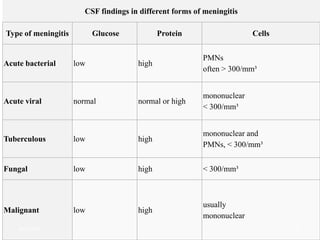
CSF findings in different forms of meningitis
Type of meningitis Glucose Protein Cells
Acute bacterial low high
PMNs
often > 300/mm³
Acute viral normal normal or high
mononuclear
< 300/mm³
Tuberculous low high
mononuclear and
PMNs, < 300/mm³
Fungal low high < 300/mm³
Malignant low high
usually
mononuclear
9/5/2013 18
• Latex agglutination - The clumping of cells such as
bacteria or RBCs in the presence of an antibody. The
antibody or other molecule binds multiple particles and
joins them, creating a large complex. Positive in meningitis
caused by Streptococcus pneumoniae, Neisseria
meningitidis, Haemophilus influenzae, Escherichia
coli and group B streptococci.
• Serotyping - Group of microorganisms classified together
based on their cell surface antigens
(virulence, lipopolysaccharides in Gram-negative
bacteria), presence of an exotoxin or other characteristics
which differentiate two members of the same species.
DIAGNOSIS (contd..)
9/5/2013 19
• Limulus amebocyte lysate (LAL): An aqueous
extract of blood cells (amoebocytes) from the
horseshoe crab, (Limulus polyphemus).
 LAL reacts with bacterial endotoxin or
lipopolysaccharide (LPS), which is a membrane
component of “Gram negative bacteria”.
• Polymerase chain reaction(PCR) is a technique
used to amplify small traces of bacterial DNA
DIAGNOSIS (contd..)
9/5/2013 20
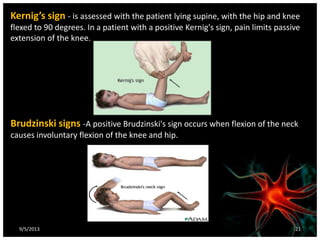
Kernig’s sign - is assessed with the patient lying supine, with the hip and knee
flexed to 90 degrees. In a patient with a positive Kernig's sign, pain limits passive
extension of the knee.
Brudzinski signs -A positive Brudzinski's sign occurs when flexion of the neck
causes involuntary flexion of the knee and hip.
9/5/2013 21
Skin findings: Nonspecific blanching, erythematous, maculopapular rash to a
petechial or purpuric rash.
**Approximately 6% of affected infants and children show signs
of disseminated intravascular coagulopathy and endotoxic shock.
These signs are indicative of a poor prognosis.
9/5/2013 22
Treatment
• Antibiotics for bacterial meningitis :Type vary depending on the
bacteria causing the infection.
• Antibiotics are not effective in viral meningitis.
• Other medications and intravenous fluids will be used to treat
symptoms such as brain swelling, shock, and seizures.
Prevention
• Haemophilus vaccine (HiB vaccine) in children.
• The pneumococcal conjugate vaccine is now a routine childhood
immunization and is very effective at preventing pneumococcal
meningitis.
• Household members and others in close contact with people who
have meningococcal meningitis should receive preventive antibiotics.
9/5/2013 23
9/5/2013 24

Meningitis

  • 1.
    Meningitis G e ne r a l O v e r v i e w Siddharth Bansal MBBS Gauhati Medical College 9/5/2013 1
  • 2.
    Clinical description  Meningitisis a disease caused by the inflammation of the protective membranes covering the brain and spinal cord known as the meninges.  The inflammation is usually caused by an infection of the fluid surrounding the brain and spinal cord.  Meningitis can be life-threatening because of the inflammation's proximity to the brain and spinal cord; therefore the condition is classified as a medical emergency. 9/5/2013 2
  • 3.
    Meninges The meninges isthe system of membranes which envelops the central nervous system. It has 3 layers: 1. Dura mater 2. Arachnoid mater 3. Pia mater Subarachnoid space - is the space which exists between the arachnoid and the pia mater, which is filled with cerebrospinal fluid. 9/5/2013 3
  • 4.
    Causes of Meningitis -Bacterial - Viral - Fungal - Ricketsial (Rocky mountain spotted fever) - Parasitic/ protozoal - Physical injury - Cancer - Certain drugs ( mainly, NSAID’S)  Severity/treatment of illnesses differ depending on the cause. Thus, it is important to know the specific cause of meningitis. 9/5/2013 4
  • 5.
    Bacterial - Haemophilus influenzae -Listeria - Meningococcus - Mumps - Pneumococcus - Group A Streptococcus - Group B Streptococcus 9/5/2013 5
  • 6.
     Premature babiesand newborns (< 3 months): group B streptococci, Listeria monocytogenes(serotype IVb).  Older children: Neisseria meningitidis and Streptococcu pneumoniae (serotypes 6, 9, 14, 18 and 23) and those under five by Haemophilus influenzae type B  Adults: N. meningitidis and S. pneumoniae (80% of all cases) of bacterial meningitis, with increased risk of L. monocytogenes (>50yrs) Bacterial 9/5/2013 6
  • 7.
    Haemophilus influenzae Meningitis •Occurs mostly in children (6 months to 4 years). • Gram-negative aerobic bacteria, normal throat microbiota • Capsule antigen type b • Prevented by Hib vaccine Reduction in H.influenzae meningitis due to development of Hib vaccine 9/5/2013 7
  • 8.
    Neisseria Meningitis, (Meningococcal Meningitis) •Gram-negative aerobic cocci, capsule • 10% of people are healthy nasopharyngeal carriers • Begins as throat infection, rash • Serotype B is most common in the United States • Vaccination recommended for college students. 9/5/2013 8
  • 9.
    Streptococcus pneumoniae Meningitis, PneumococcalMeningitis • Gram-positive diplococci • 70% of people are healthy nasopharyngeal carriers • Most common in children (1 month to 4 years) • Mortality: 30% in children, 80% in elderly • Prevented by vaccination 9/5/2013 9
  • 10.
    Viral - Enterovirus (coxsackie,echovirus) - Arboviral (mosquito-borne diseases) - Influenza - Herpes simplex virus type2 ( especially in infants) - Varicella zoster - HIV - Mumps - measles 9/5/2013 10
  • 11.
    Viral Meningitis  Incubationperiod : 3 to 6 days.  Duration of the illness : approx 7 to 10 days.  Milder and occurs more often than bacterial meningitis.  Affects children and adults under age 30. Most infections occur in children under age 5.  Most viral meningitis is due to enteroviruses, that also can cause intestinal illness.  Diagnosed by laboratory tests of a patient’s spinal fluid 9/5/2013 11
  • 12.
  • 13.
    Symptoms can bethe same for Viral and Bacterial 9/5/2013 13
  • 14.
    COMPLICATIONS • Brain damage •Buildup of fluid between the skull and brain (subdural effusion) • Hearing loss • Hydrocephalus • Seizures 9/5/2013 14
  • 15.
    DIAGNOSIS Tests that maybe done include: • For any patient who is suspected of having meningitis, lumbar puncture ("spinal tap") is done for CSF examination . • Blood culture • Chest x-ray • CSF examination for cell count, glucose, and protein • CT scan of the head • Gram stain, other special stains, and culture of CSF 9/5/2013 15
  • 16.
    DIAGNOSIS (contd..) • Specimen:CSF, blood, urine culture • Blood tests and imaging • Blood tests are performed for markers of inflammation (e.g. C- reactive protein, complete blood count), as well as blood cultures. • Most important is CSF examination by LP. Blood tests are done when it is C/I • In severe forms of meningitis, monitoring of blood electrolytes may be important; for example, hyponatremia is common in bacterial meningitis. 9/5/2013 16
  • 17.
    DIAGNOSIS (contd..) Lumbar puncture Alumbar puncture is done by positioning the patient, usually lying on the side, applying local anesthetic, and inserting a needle into the dural sac. CT or MRI scan is recommended prior to the lumbar puncture. The CSF sample is examined for presence and types of white blood cells, red blood cells, protein content and glucose level. Gram staining of the sample may demonstrate bacteria in bacterial meningitis (60% cases). C/I: Mass in the brain (tumor or abscess) or the intracranial pressure (ICP) is elevated. Gram stain of meningococci from a culture showing Gram negative (pink) bacteria, often in pairs 9/5/2013 17
  • 18.
    CSF findings indifferent forms of meningitis Type of meningitis Glucose Protein Cells Acute bacterial low high PMNs often > 300/mm³ Acute viral normal normal or high mononuclear < 300/mm³ Tuberculous low high mononuclear and PMNs, < 300/mm³ Fungal low high < 300/mm³ Malignant low high usually mononuclear 9/5/2013 18
  • 19.
    • Latex agglutination- The clumping of cells such as bacteria or RBCs in the presence of an antibody. The antibody or other molecule binds multiple particles and joins them, creating a large complex. Positive in meningitis caused by Streptococcus pneumoniae, Neisseria meningitidis, Haemophilus influenzae, Escherichia coli and group B streptococci. • Serotyping - Group of microorganisms classified together based on their cell surface antigens (virulence, lipopolysaccharides in Gram-negative bacteria), presence of an exotoxin or other characteristics which differentiate two members of the same species. DIAGNOSIS (contd..) 9/5/2013 19
  • 20.
    • Limulus amebocytelysate (LAL): An aqueous extract of blood cells (amoebocytes) from the horseshoe crab, (Limulus polyphemus).  LAL reacts with bacterial endotoxin or lipopolysaccharide (LPS), which is a membrane component of “Gram negative bacteria”. • Polymerase chain reaction(PCR) is a technique used to amplify small traces of bacterial DNA DIAGNOSIS (contd..) 9/5/2013 20
  • 21.
    Kernig’s sign -is assessed with the patient lying supine, with the hip and knee flexed to 90 degrees. In a patient with a positive Kernig's sign, pain limits passive extension of the knee. Brudzinski signs -A positive Brudzinski's sign occurs when flexion of the neck causes involuntary flexion of the knee and hip. 9/5/2013 21
  • 22.
    Skin findings: Nonspecificblanching, erythematous, maculopapular rash to a petechial or purpuric rash. **Approximately 6% of affected infants and children show signs of disseminated intravascular coagulopathy and endotoxic shock. These signs are indicative of a poor prognosis. 9/5/2013 22
  • 23.
    Treatment • Antibiotics forbacterial meningitis :Type vary depending on the bacteria causing the infection. • Antibiotics are not effective in viral meningitis. • Other medications and intravenous fluids will be used to treat symptoms such as brain swelling, shock, and seizures. Prevention • Haemophilus vaccine (HiB vaccine) in children. • The pneumococcal conjugate vaccine is now a routine childhood immunization and is very effective at preventing pneumococcal meningitis. • Household members and others in close contact with people who have meningococcal meningitis should receive preventive antibiotics. 9/5/2013 23
  • 24.