TETRACYCLINES
Dr. Johan Pandian
Assistant professor,
Department of Pharmacology,
MGMCRI
• Tetracyclines are
broad spectrum
bacteriostatic
antibiotics that inhibit
protein synthesis.
• They are active
against many gram-
positive and gram
negative bacteria
including anaerobes,
Rickettsiae,
Chlamydiae,
Mycoplasmas and L
forms.
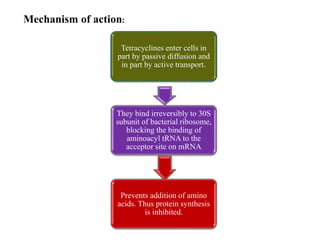
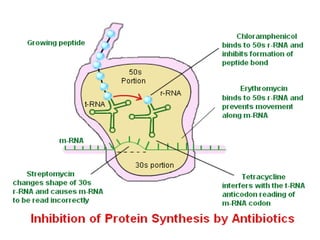
Mechanism of action:
Tetracyclines enter cells in
part by passive diffusion and
in part by active transport.
They bind irreversibly to 30S
subunit of bacterial ribosome,
blocking the binding of
aminoacyl tRNA to the
acceptor site on mRNA
Prevents addition of amino
acids. Thus protein synthesis
is inhibited.
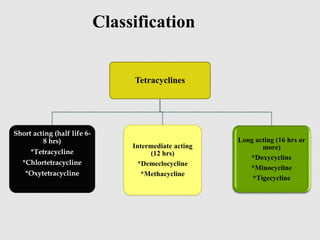
Tetracyclines
Short acting (half life 6-
8 hrs)
*Tetracycline
*Chlortetracycline
*Oxytetracycline
Intermediate acting
(12 hrs)
*Demeclocycline
*Methacycline
Long acting (16 hrs or
more)
*Doxycycline
*Minocycline
*Tigecycline
Classification
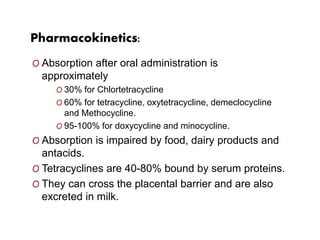
Pharmacokinetics:
O Absorption after oral administration is
approximately
O 30% for Chlortetracycline
O 60% for tetracycline, oxytetracycline, demeclocycline
and Methocycline.
O 95-100% for doxycycline and minocycline.
O Absorption is impaired by food, dairy products and
antacids.
O Tetracyclines are 40-80% bound by serum proteins.
O They can cross the placental barrier and are also
excreted in milk.
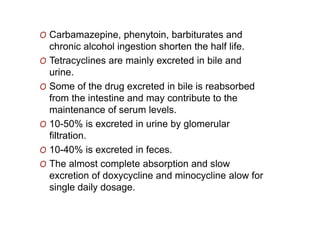
O Carbamazepine, phenytoin, barbiturates and
chronic alcohol ingestion shorten the half life.
O Tetracyclines are mainly excreted in bile and
urine.
O Some of the drug excreted in bile is reabsorbed
from the intestine and may contribute to the
maintenance of serum levels.
O 10-50% is excreted in urine by glomerular
filtration.
O 10-40% is excreted in feces.
O The almost complete absorption and slow
excretion of doxycycline and minocycline alow for
single daily dosage.
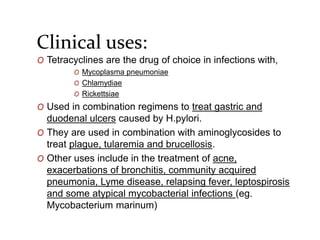
Clinical uses:
O Tetracyclines are the drug of choice in infections with,
O Mycoplasma pneumoniae
O Chlamydiae
O Rickettsiae
O Used in combination regimens to treat gastric and
duodenal ulcers caused by H.pylori.
O They are used in combination with aminoglycosides to
treat plague, tularemia and brucellosis.
O Other uses include in the treatment of acne,
exacerbations of bronchitis, community acquired
pneumonia, Lyme disease, relapsing fever, leptospirosis
and some atypical mycobacterial infections (eg.
Mycobacterium marinum)
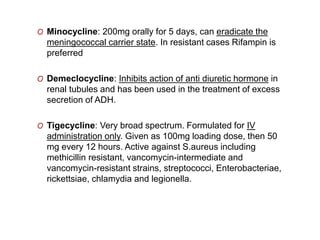
O Minocycline: 200mg orally for 5 days, can eradicate the
meningococcal carrier state. In resistant cases Rifampin is
preferred
O Demeclocycline: Inhibits action of anti diuretic hormone in
renal tubules and has been used in the treatment of excess
secretion of ADH.
O Tigecycline: Very broad spectrum. Formulated for IV
administration only. Given as 100mg loading dose, then 50
mg every 12 hours. Active against S.aureus including
methicillin resistant, vancomycin-intermediate and
vancomycin-resistant strains, streptococci, Enterobacteriae,
rickettsiae, chlamydia and legionella.
Adverse Reactions:
O Gastrointestinal effects: Nausea, vomiting, anorexia and
diarrhea. They modify normal flora, with suppression of
susceptible coliform organisms and overgrowth of
pseudomonas, proteus, staphylococci, clostridia and candida.
This can result in pruritis, vaginal or oral candidiasis,
enterocolitis and in certain cases shock and death.
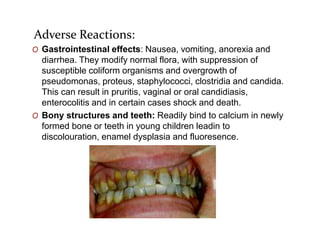
O Bony structures and teeth: Readily bind to calcium in newly
formed bone or teeth in young children leadin to
discolouration, enamel dysplasia and fluoresence.
O Liver toxicity: Hepatic necrosis has been reported with daily
doses of 4g or more intravenously.
O Kidney toxicity: Renal tubular acidosis and other injury
resulting in nitrogen retention.
O Local tissue toxicity: Intravenous injections can lead to
venous thrombosis. Intramuscular injections produces painful
local irritation.
O Photosensitization: Particularly in fair skinned persons.
O Vestibular reactions: Dizziness, nausea, vomiting.
THANK
YOU
CHLORAMPHENICOL
INTRODUCTION
Chloramphenicol was initially obtained from
streptomyces venezuelae.
It is a yellowish white crystalline
solid,aqueous solution is quite stable,stands
boiling,but needs protection from light.
It has a nitrobenzene substitution which is
probably responsible for the antibacterial
activity and its intensely bitter taste
Mechanism of action
• Chloramphenicol inhibits bacterial protien
synthesis by interferring with transfer of
elongating peptide chain
• It attaches to the 50s ribosome & hinder the
access of aminoacyl-tRNA to the acceptor site
for amino acid incorporation
• By acting as peptide analogue it prevents the
formation of peptide bonds
• At high doses it can inhibit mammalian
mitochondrial protein synthesis
Antimicrobial spectrum
• Chloramphenicol is highly active against
salmonella including s.typhi
• It is more active than tetracyclines against
gram –ve organisms-H.influenza, B.pertussis,
klebsiella, N.meningitidis and anaerobes
including Bact.fragilis
• It is less active against gram positive cocci-
spirochetes, enterobacteria and chlamydia.
Entamoeba and plasmodia are not inhibited.
• It is ineffective against mycobacteria,
pseudomonas, viruses and fungi.
PHARMACOKINETICS
• Chloramphenicol is rapidly and completely
absorbed after oral ingestion
• It is 50%-60% bound.
• Metabolized by glucoronide conjugation.
• It freely penetrates serous cavities and blood
brain barrier.
• It crosses placenta and is secreted in bile and
milk.
• Excreted through urine.
PREPARATION
• The commonest route of administration of
chloramphenicol is oral-as capsules:250-
500mg 6 hourly,children25-50mg/kg/day.
• It is available for application to ear/ eye, but
topical use at other sites is not recommended.
ADVERSE EFFECTS
• Bone marrow depression- anemia, leukemia,
thrombocytopenia.
• Idiosyncratic aplastic anemia.
• Hypersensitivity reactions
• Irritative effects
• Super infections
• Gray baby syndrome
INTERACTIONS
Chloramphenicol inhibits metabolism of
tolbutamide, chlorpropamide,warfarin,
cyclophosphamide and phenytoin
Toxicity can occur if dose adjustments are not
done.
Phenobarbitone,phenytoin,rifampin,enhance
chloramphenicol metabolism.
USES & INDICATIONS
• Never use chloramphenicol for minor infection
• Avoid repeated courses
• Daily dose not to exceed 2-3g;duration of therapy to
be <2weeks,total dose in a course <28g
• Regular blood counts may detect dose-related bone
marrow toxicity
• Combined formulation of chloramphenical with any
drug for internal use is banned in India
• Enteric fever
• Pyogenic meningitis
• Anaerobic infections (pelvic infections, brain abscess)
• Intraocular infections (endophthalmitis)
• Urinary tract infections
Tetracyclines   dr. johan pandian

Tetracyclines dr. johan pandian

  • 1.
    TETRACYCLINES Dr. Johan Pandian Assistantprofessor, Department of Pharmacology, MGMCRI
  • 2.
    • Tetracyclines are broadspectrum bacteriostatic antibiotics that inhibit protein synthesis. • They are active against many gram- positive and gram negative bacteria including anaerobes, Rickettsiae, Chlamydiae, Mycoplasmas and L forms.
  • 3.
    Mechanism of action: Tetracyclinesenter cells in part by passive diffusion and in part by active transport. They bind irreversibly to 30S subunit of bacterial ribosome, blocking the binding of aminoacyl tRNA to the acceptor site on mRNA Prevents addition of amino acids. Thus protein synthesis is inhibited.
  • 4.
    Tetracyclines Short acting (halflife 6- 8 hrs) *Tetracycline *Chlortetracycline *Oxytetracycline Intermediate acting (12 hrs) *Demeclocycline *Methacycline Long acting (16 hrs or more) *Doxycycline *Minocycline *Tigecycline Classification
  • 5.
    Pharmacokinetics: O Absorption afteroral administration is approximately O 30% for Chlortetracycline O 60% for tetracycline, oxytetracycline, demeclocycline and Methocycline. O 95-100% for doxycycline and minocycline. O Absorption is impaired by food, dairy products and antacids. O Tetracyclines are 40-80% bound by serum proteins. O They can cross the placental barrier and are also excreted in milk.
  • 6.
    O Carbamazepine, phenytoin,barbiturates and chronic alcohol ingestion shorten the half life. O Tetracyclines are mainly excreted in bile and urine. O Some of the drug excreted in bile is reabsorbed from the intestine and may contribute to the maintenance of serum levels. O 10-50% is excreted in urine by glomerular filtration. O 10-40% is excreted in feces. O The almost complete absorption and slow excretion of doxycycline and minocycline alow for single daily dosage.
  • 7.
    Clinical uses: O Tetracyclinesare the drug of choice in infections with, O Mycoplasma pneumoniae O Chlamydiae O Rickettsiae O Used in combination regimens to treat gastric and duodenal ulcers caused by H.pylori. O They are used in combination with aminoglycosides to treat plague, tularemia and brucellosis. O Other uses include in the treatment of acne, exacerbations of bronchitis, community acquired pneumonia, Lyme disease, relapsing fever, leptospirosis and some atypical mycobacterial infections (eg. Mycobacterium marinum)
  • 8.
    O Minocycline: 200mgorally for 5 days, can eradicate the meningococcal carrier state. In resistant cases Rifampin is preferred O Demeclocycline: Inhibits action of anti diuretic hormone in renal tubules and has been used in the treatment of excess secretion of ADH. O Tigecycline: Very broad spectrum. Formulated for IV administration only. Given as 100mg loading dose, then 50 mg every 12 hours. Active against S.aureus including methicillin resistant, vancomycin-intermediate and vancomycin-resistant strains, streptococci, Enterobacteriae, rickettsiae, chlamydia and legionella.
  • 9.
    Adverse Reactions: O Gastrointestinaleffects: Nausea, vomiting, anorexia and diarrhea. They modify normal flora, with suppression of susceptible coliform organisms and overgrowth of pseudomonas, proteus, staphylococci, clostridia and candida. This can result in pruritis, vaginal or oral candidiasis, enterocolitis and in certain cases shock and death. O Bony structures and teeth: Readily bind to calcium in newly formed bone or teeth in young children leadin to discolouration, enamel dysplasia and fluoresence.
  • 10.
    O Liver toxicity:Hepatic necrosis has been reported with daily doses of 4g or more intravenously. O Kidney toxicity: Renal tubular acidosis and other injury resulting in nitrogen retention. O Local tissue toxicity: Intravenous injections can lead to venous thrombosis. Intramuscular injections produces painful local irritation. O Photosensitization: Particularly in fair skinned persons. O Vestibular reactions: Dizziness, nausea, vomiting.
  • 11.
  • 12.
  • 13.
    INTRODUCTION Chloramphenicol was initiallyobtained from streptomyces venezuelae. It is a yellowish white crystalline solid,aqueous solution is quite stable,stands boiling,but needs protection from light. It has a nitrobenzene substitution which is probably responsible for the antibacterial activity and its intensely bitter taste
  • 14.
    Mechanism of action •Chloramphenicol inhibits bacterial protien synthesis by interferring with transfer of elongating peptide chain • It attaches to the 50s ribosome & hinder the access of aminoacyl-tRNA to the acceptor site for amino acid incorporation • By acting as peptide analogue it prevents the formation of peptide bonds • At high doses it can inhibit mammalian mitochondrial protein synthesis
  • 16.
    Antimicrobial spectrum • Chloramphenicolis highly active against salmonella including s.typhi • It is more active than tetracyclines against gram –ve organisms-H.influenza, B.pertussis, klebsiella, N.meningitidis and anaerobes including Bact.fragilis • It is less active against gram positive cocci- spirochetes, enterobacteria and chlamydia. Entamoeba and plasmodia are not inhibited. • It is ineffective against mycobacteria, pseudomonas, viruses and fungi.
  • 17.
    PHARMACOKINETICS • Chloramphenicol israpidly and completely absorbed after oral ingestion • It is 50%-60% bound. • Metabolized by glucoronide conjugation. • It freely penetrates serous cavities and blood brain barrier. • It crosses placenta and is secreted in bile and milk. • Excreted through urine.
  • 18.
    PREPARATION • The commonestroute of administration of chloramphenicol is oral-as capsules:250- 500mg 6 hourly,children25-50mg/kg/day. • It is available for application to ear/ eye, but topical use at other sites is not recommended.
  • 19.
    ADVERSE EFFECTS • Bonemarrow depression- anemia, leukemia, thrombocytopenia. • Idiosyncratic aplastic anemia. • Hypersensitivity reactions • Irritative effects • Super infections • Gray baby syndrome
  • 20.
    INTERACTIONS Chloramphenicol inhibits metabolismof tolbutamide, chlorpropamide,warfarin, cyclophosphamide and phenytoin Toxicity can occur if dose adjustments are not done. Phenobarbitone,phenytoin,rifampin,enhance chloramphenicol metabolism.
  • 21.
    USES & INDICATIONS •Never use chloramphenicol for minor infection • Avoid repeated courses • Daily dose not to exceed 2-3g;duration of therapy to be <2weeks,total dose in a course <28g • Regular blood counts may detect dose-related bone marrow toxicity • Combined formulation of chloramphenical with any drug for internal use is banned in India
  • 22.
    • Enteric fever •Pyogenic meningitis • Anaerobic infections (pelvic infections, brain abscess) • Intraocular infections (endophthalmitis) • Urinary tract infections