THEORIES OF
MINERALIZATION
PRESENTED TO:- DEPT. OF ORAL PATHOLOGY
& MICROBIOLOGY
PRESENTED BY:-ASHMITA SHRESTHA
BABIN KARMACHARYA
DATE:- FEBRUARY 28, 2018
Contents
• Mineralization
• Process of Mineralization
• Theories of Mineralization
• Inhibitors of Mineralization
• Enamel Mineralization
MINERALIZATION
Deposition of mineral salts in and around
the organic matrix to make it a calcified
structure.
Although , tissue fluid is supersaturated with Ca & P
ions, spontaneous precipitation of calcium phosphate
does not take place.
BECAUSE:-
 Inhibitory macromolecules-inhibit crystal formation.
 Unstable-initial cluster of ions needed to form a
lattice structure.
 Furthermore, the formation of clusters of ions
requires the expenditure of energy and an energy
barrier must be overcome for crystallization.
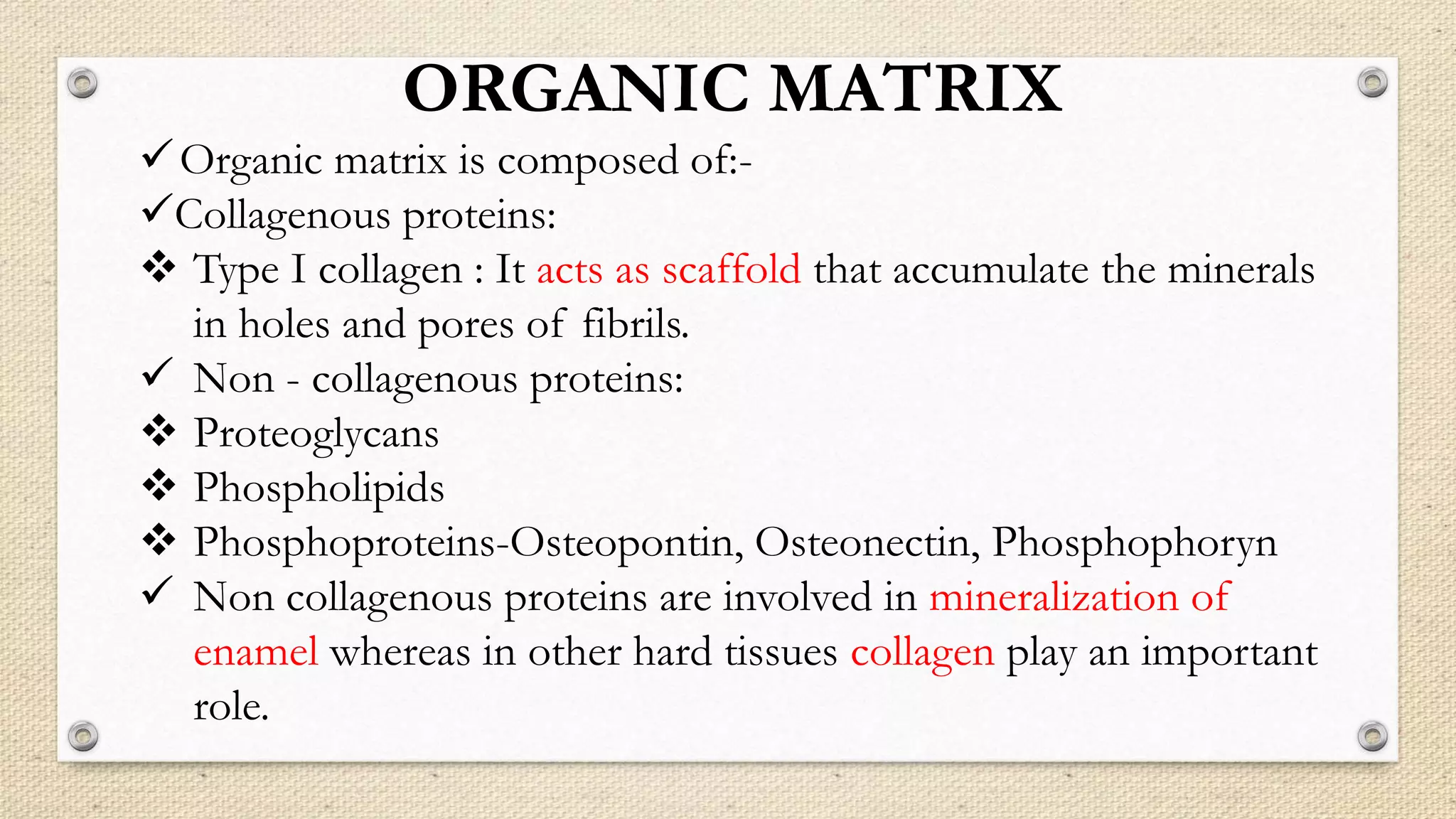
ORGANIC MATRIX
Organic matrix is composed of:-
Collagenous proteins:
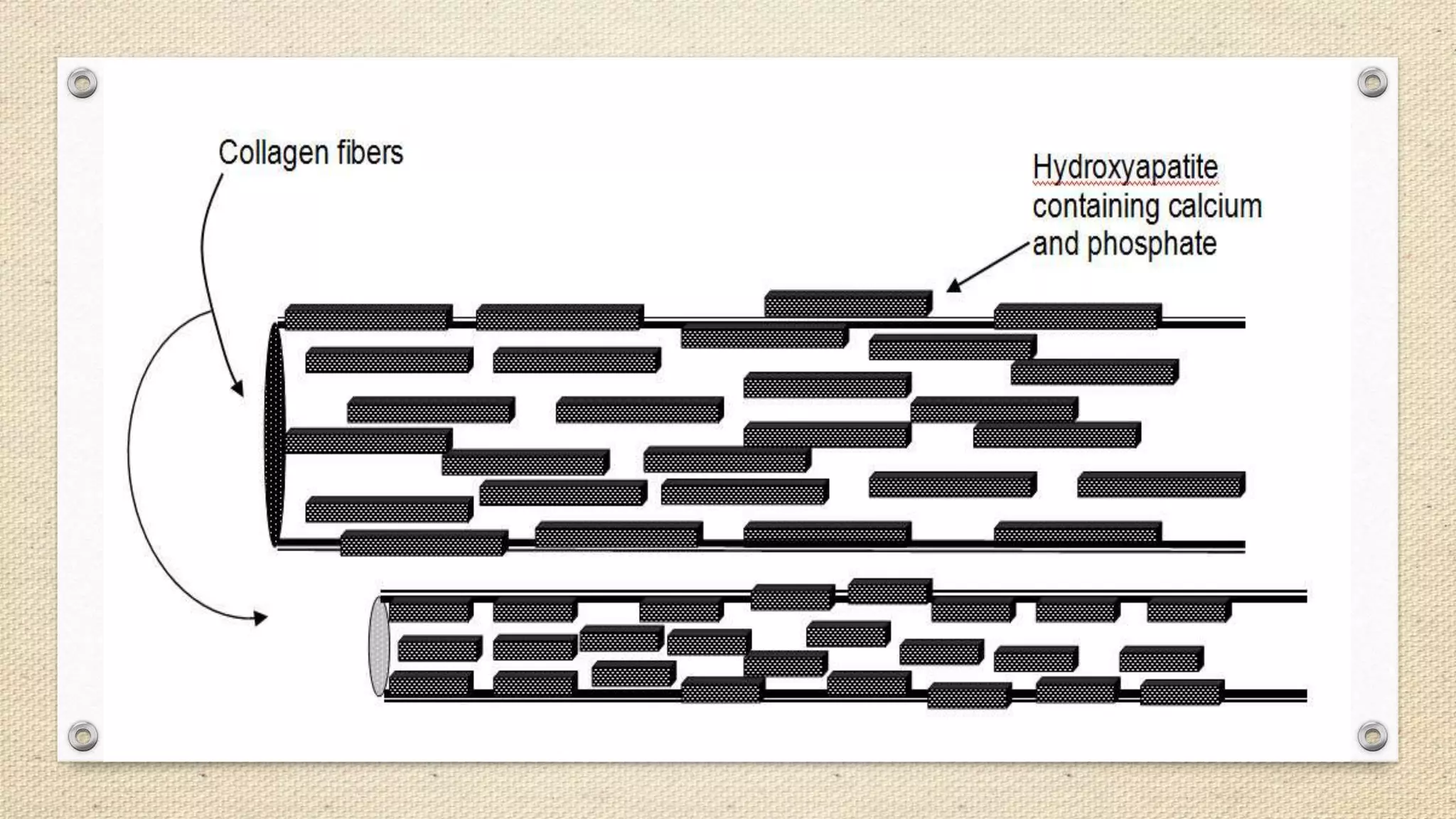
 Type I collagen : It acts as scaffold that accumulate the minerals
in holes and pores of fibrils.
 Non - collagenous proteins:
 Proteoglycans
 Phospholipids
 Phosphoproteins-Osteopontin, Osteonectin, Phosphophoryn
 Non collagenous proteins are involved in mineralization of
enamel whereas in other hard tissues collagen play an important
role.
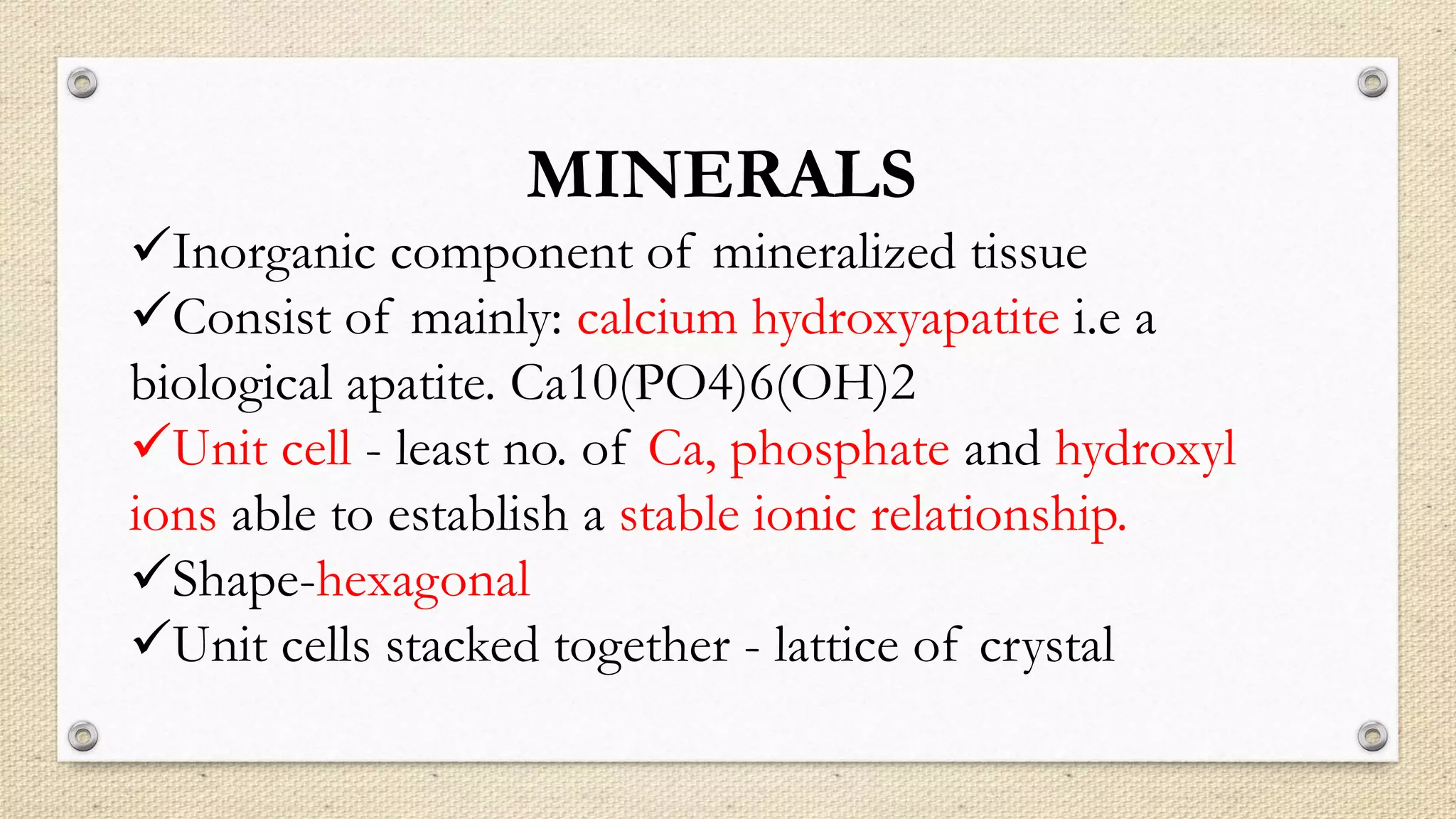
MINERALS
Inorganic component of mineralized tissue
Consist of mainly: calcium hydroxyapatite i.e a
biological apatite. Ca10(PO4)6(OH)2
Unit cell - least no. of Ca, phosphate and hydroxyl
ions able to establish a stable ionic relationship.
Shape-hexagonal
Unit cells stacked together - lattice of crystal
Process of Mineralization
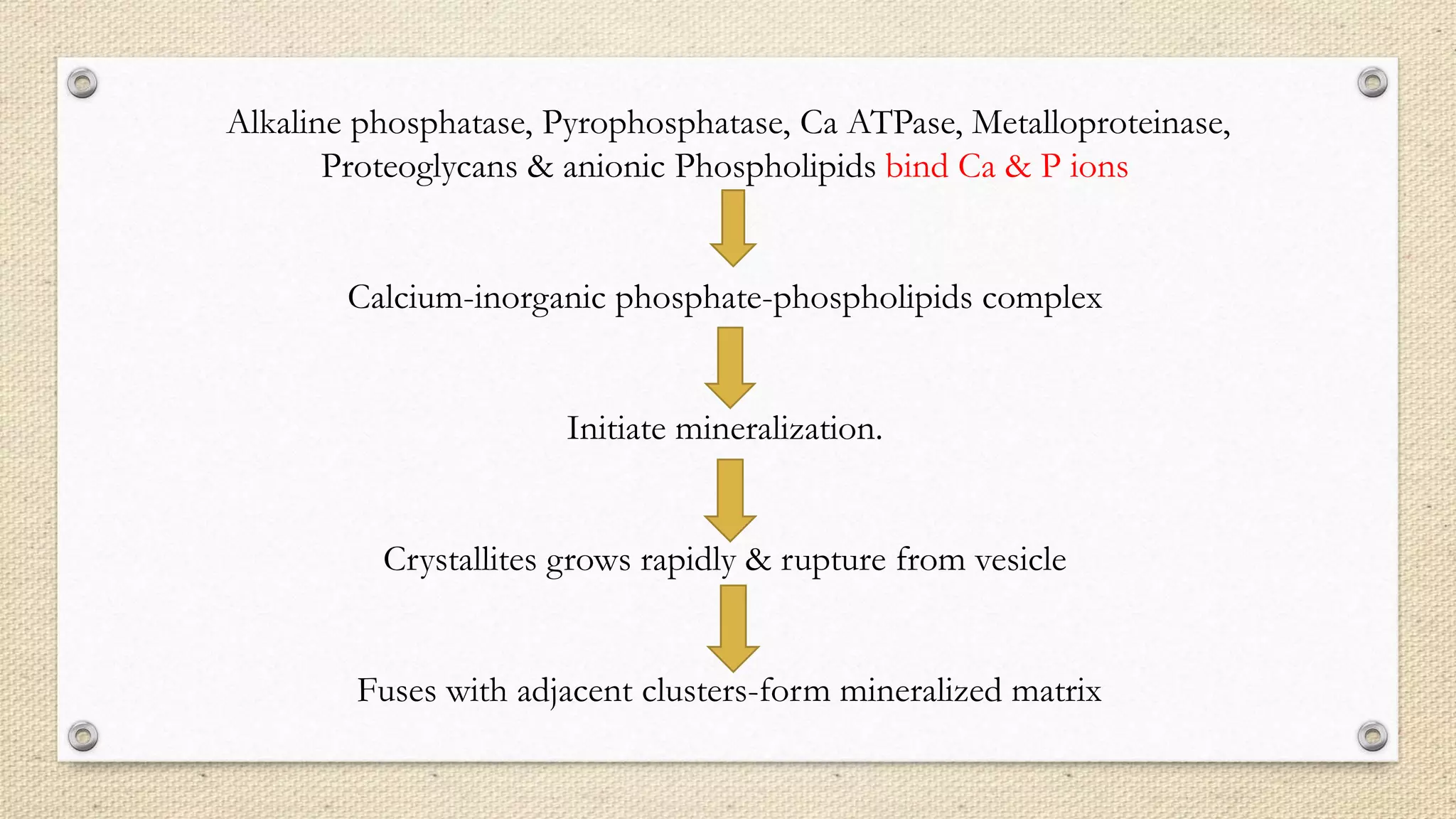
Alkaline phosphatase, Pyrophosphatase, Ca ATPase, Metalloproteinase,
Proteoglycans & anionic Phospholipids bind Ca & P ions
Calcium-inorganic phosphate-phospholipids complex
Initiate mineralization.
Crystallites grows rapidly & rupture from vesicle
Fuses with adjacent clusters-form mineralized matrix
Mechanism of mineralization
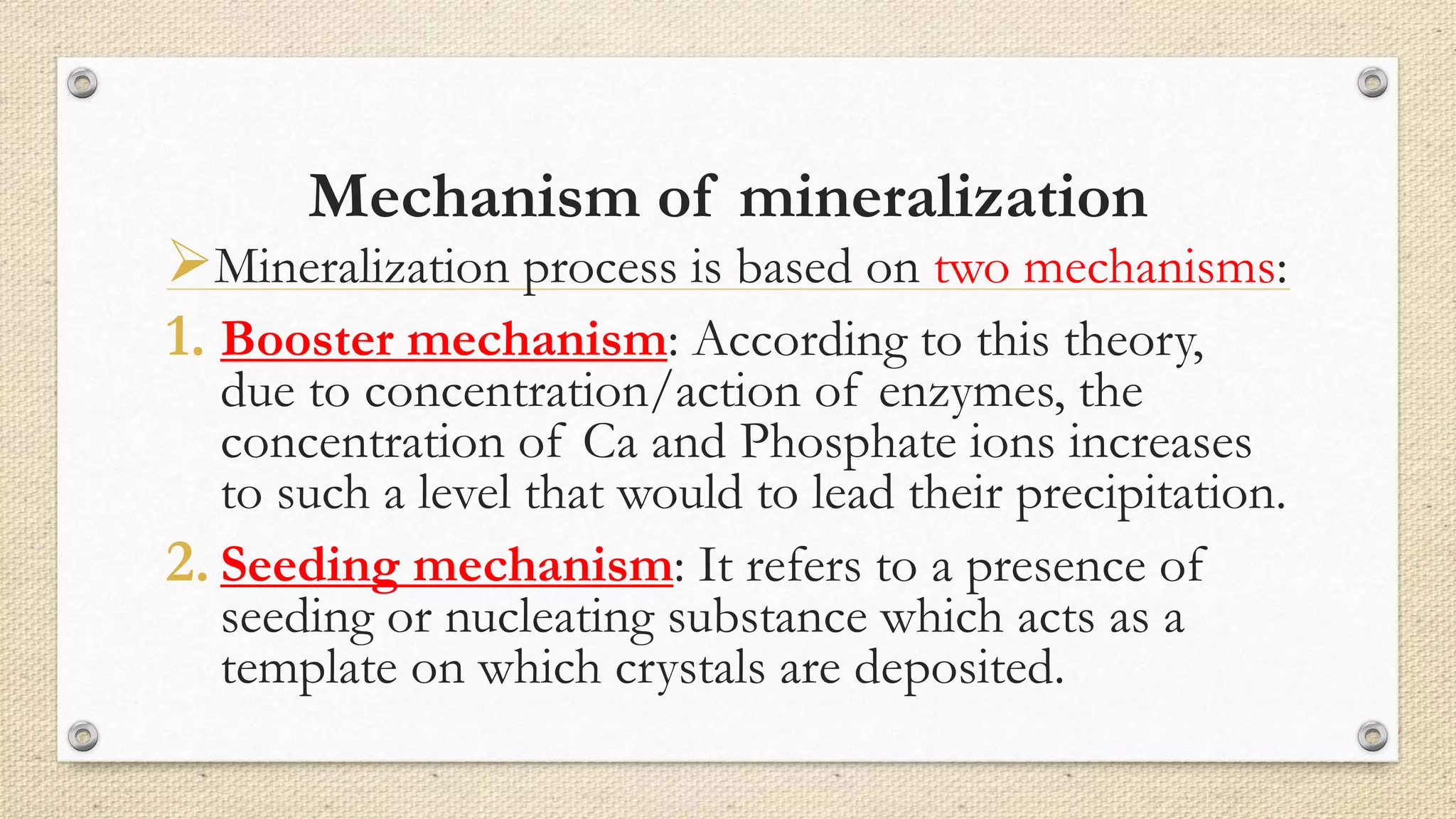
Mineralization process is based on two mechanisms:
1. Booster mechanism: According to this theory,
due to concentration/action of enzymes, the
concentration of Ca and Phosphate ions increases
to such a level that would to lead their precipitation.
2. Seeding mechanism: It refers to a presence of
seeding or nucleating substance which acts as a
template on which crystals are deposited.
THEORIES OF MINERALIZATION
1. Robinson’s phosphate(Alkaline Phosphatase) theory
2. Nucleation theory (Seeding theory)
3. Matrix vesicle theory
1. Robinson’s phosphate (Alkaline
Phosphatase) theory
Alkaline phosphatase is the enzyme which participates in the
process of calcification.
 It resides in matrix vesicle.
 This enzyme hydrolyses the organic phosphate containing
substrate and increases the local inorganic phosphate
concentration.
 This enzyme hydrolyses inhibitor of HA & provide Pi for the
formation of HA crystals.
Objections
1. Alkaline phosphatases seen in other tissues which
do not calcify.
2. Organic phosphate is not sufficient to produce
inorganic phosphate to initiate calcification
process.
2.Nucleation theory (Seeding theory)
Neumann and Neumann (1953)
According to this theory, a nucleus is formed
probably in relation to collagen, effective in
aggregating Ca and Phosphate ions. Then, HA
crystals grow spontaneously.
Nucleation sites and their nucleating agents:
1. Ground substance: Sulfated glycosaminoglycans,
Proteoglycans
2. Collagen: Collagen fibrils, Phosphoproteins including
Osteonectin
3. Mitochondria : the earliest storage sites of Ca and
Phosphate in the form of amorphous CaPo4. This stored
mineral is made available extracellularly which causes growth
of crystals forming extracellularly in association with matrix
vesicles.
HOMOGENOUS NUCLEATION:
Any local increase in concentration of inorganic ions
permits a sufficient no. of ionic clusters & crystallite to
form.
HETEROGENOUS NUCLEATION:
The presence of nucleating substance allows crystal
formation to occur, in absence of a locally increased
ionic concentration.
Objections
• Fails to explain mineralization in enamel and
cartilage.
• Fails to explain mineralization in soft tissues
though it contains collagens because collagens in
soft tissues are densely packed which impede
phosphate ion access to nucleation sites.
3. Matrix vesicle Theory
The mineralization requires the presence of extracellular matrix
vesicles.
 Matrix vesicle are small membrane bound structures, 25-250
nm in diameter, lying free in the matrix, where calcification
occurs.
The vesicles are rich in Phospholipids; esp. Phosphotidyl
serine, a lipid with high affinity for Ca ion.
The vesicles also contain Annexins, which forms Ca channel
thus incorporating the ion within the matrix vesicle.
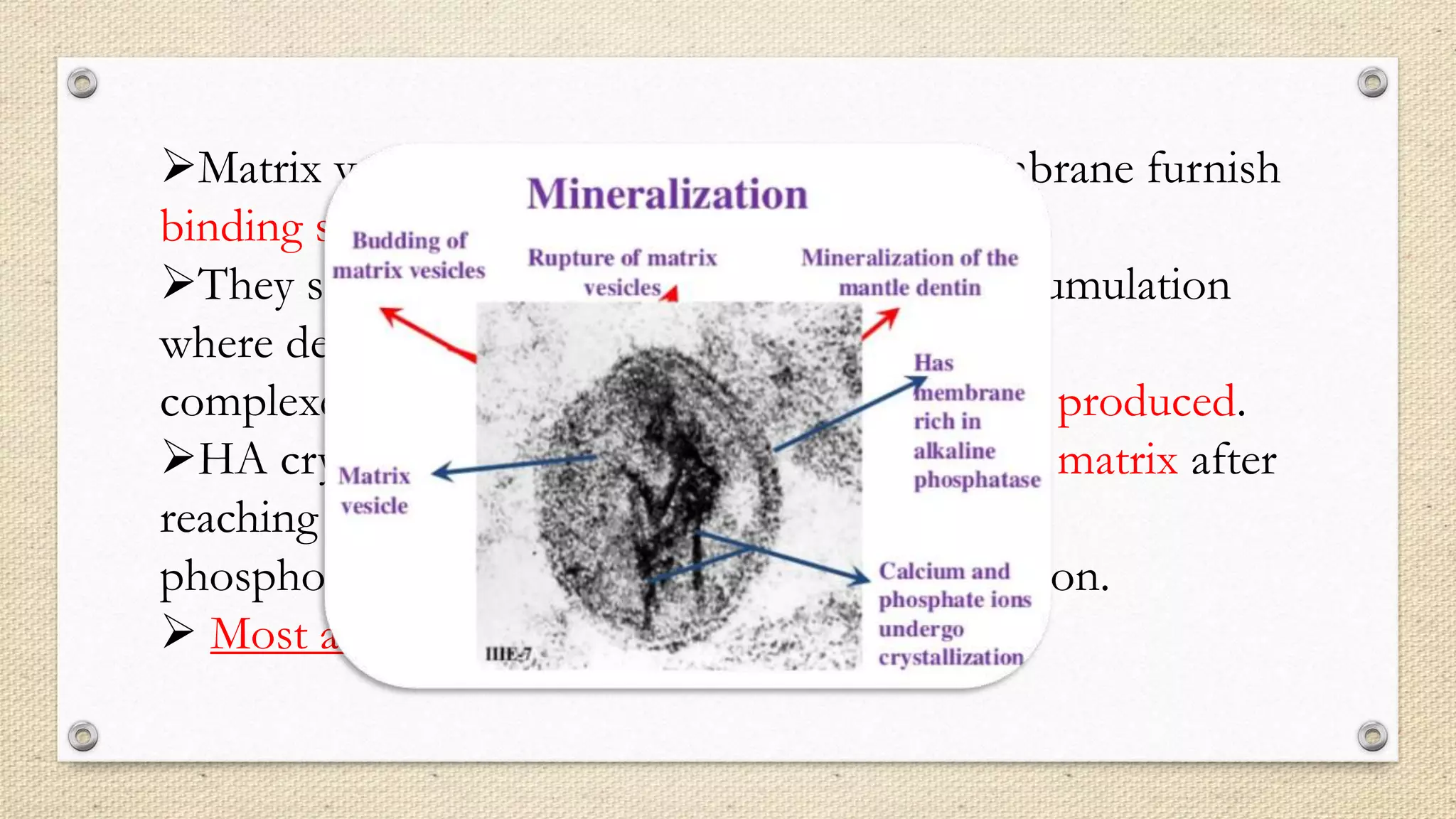
Matrix vesicle accumulate Ca and their membrane furnish
binding site for the nucleation of HA crystals.
They serve as site for Ca and inorganic P accumulation
where deposition of initial amorphous mineral
complexes(nucleation) occurs and where HA is produced.
HA crystals are released into the extracellular matrix after
reaching certain thickness which is triggered by
phospholipases, thus leading to tissue calcification.
 Most acceptable theory.
Inhibitors of calcification
• Pyrophosphate, Diphosphonates or Adenosine
triphosphate:- can delay or prevent the
transformation of amorphous calcium phosphate
to HA.
• Citrate, Magnesium and proteins like Albumin.
• Components of bone matrix- eg; Proteoglycans
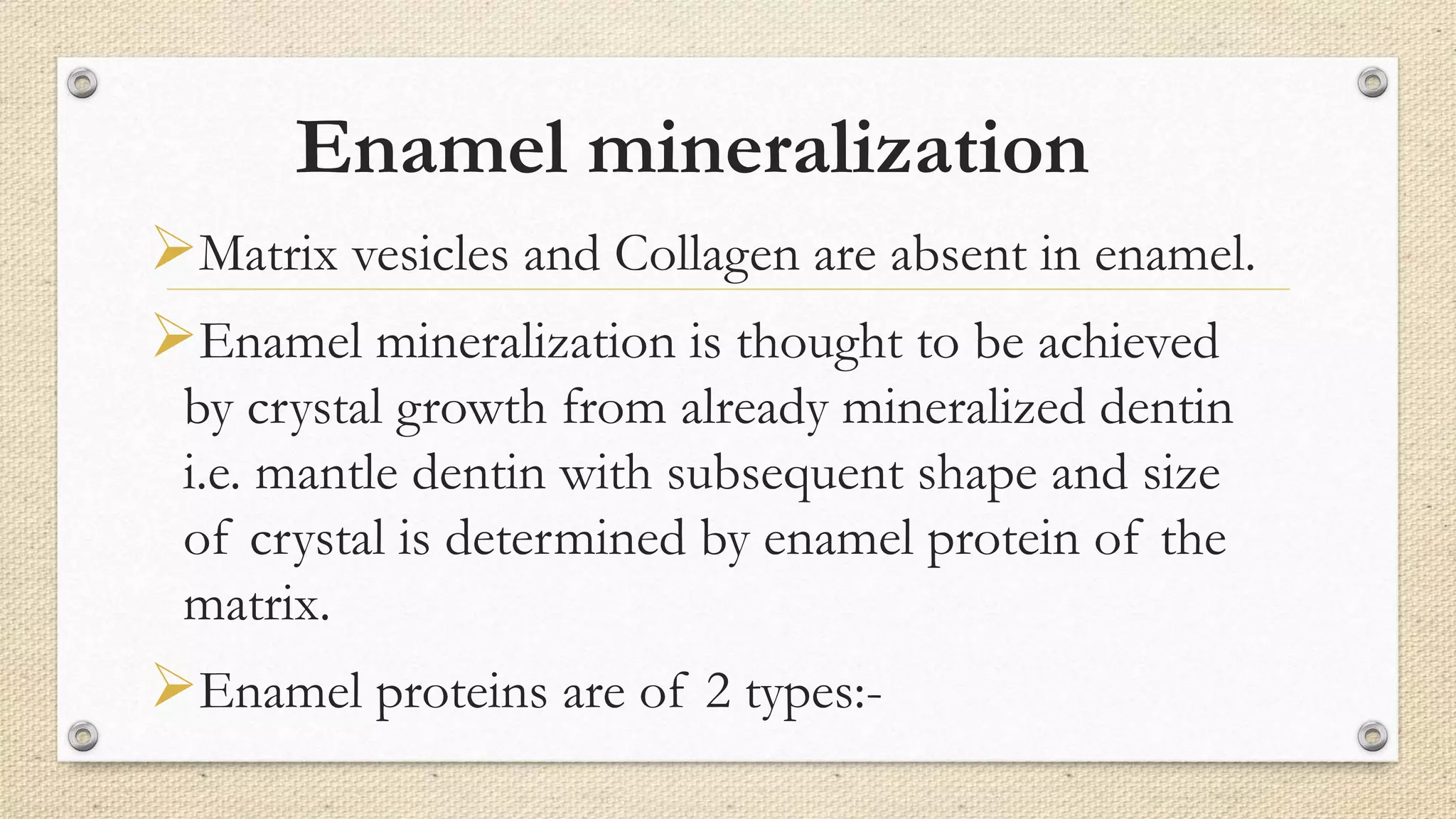
Enamel mineralization
Matrix vesicles and Collagen are absent in enamel.
Enamel mineralization is thought to be achieved
by crystal growth from already mineralized dentin
i.e. mantle dentin with subsequent shape and size
of crystal is determined by enamel protein of the
matrix.
Enamel proteins are of 2 types:-
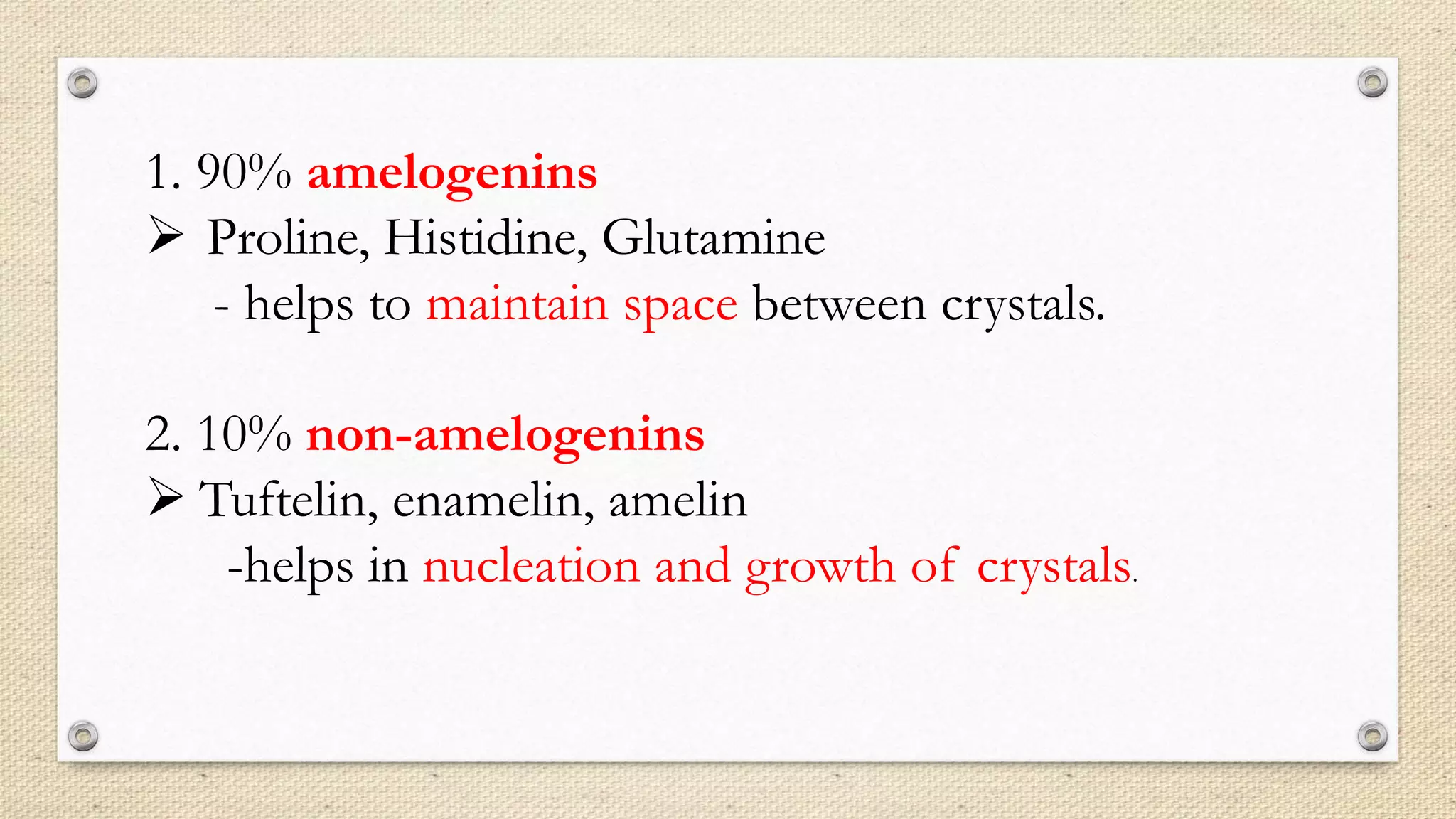
1. 90% amelogenins
 Proline, Histidine, Glutamine
- helps to maintain space between crystals.
2. 10% non-amelogenins
 Tuftelin, enamelin, amelin
-helps in nucleation and growth of crystals.
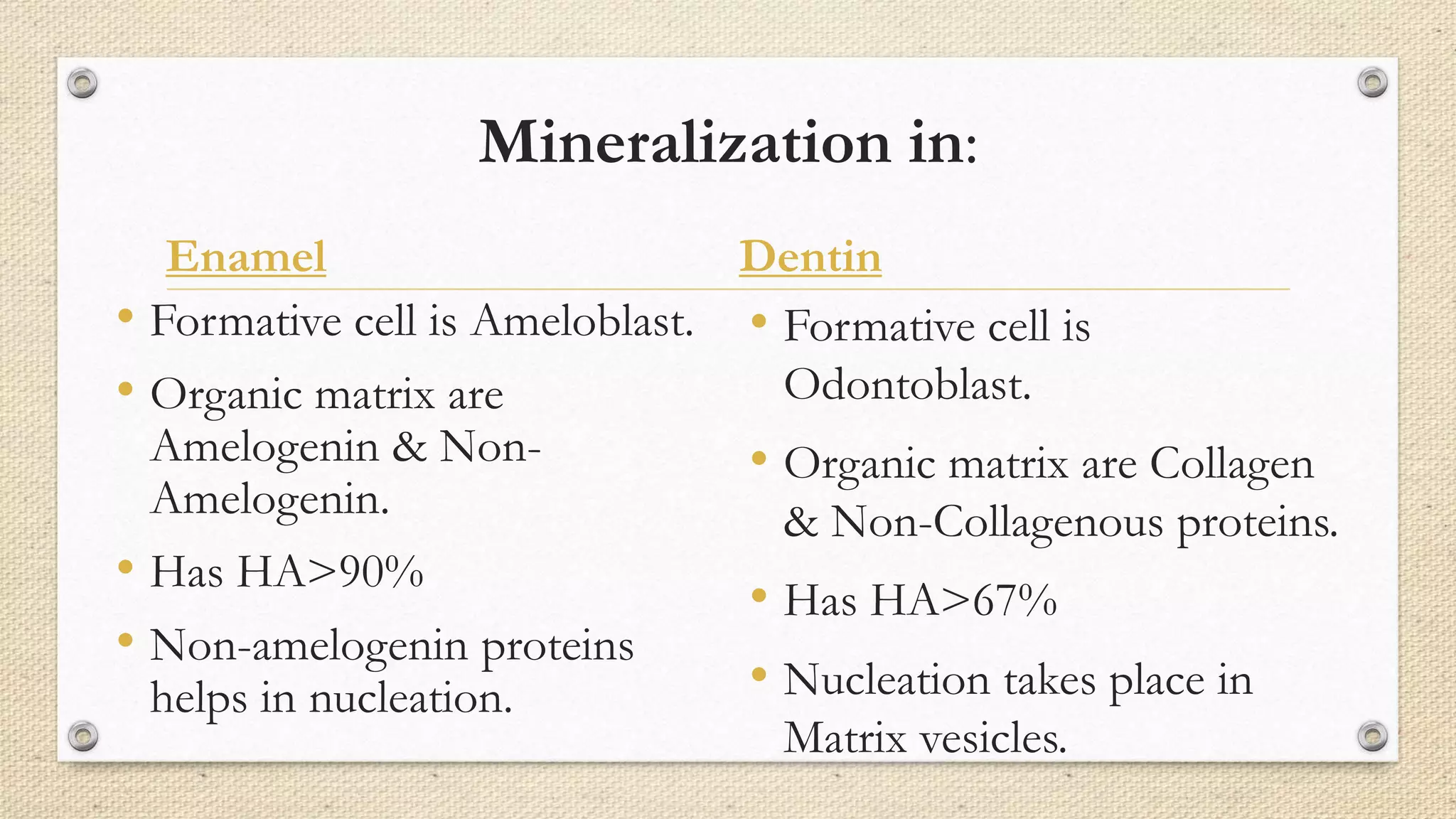
Mineralization in:
Enamel
• Formative cell is Ameloblast.
• Organic matrix are
Amelogenin & Non-
Amelogenin.
• Has HA>90%
• Non-amelogenin proteins
helps in nucleation.
Dentin
• Formative cell is
Odontoblast.
• Organic matrix are Collagen
& Non-Collagenous proteins.
• Has HA>67%
• Nucleation takes place in
Matrix vesicles.
References:-
Orban’s Oral Histology & Embryology 14th edition.
Tencate’s Oral Histology 5th edition.
Theories of mineralization

Theories of mineralization

  • 1.
    THEORIES OF MINERALIZATION PRESENTED TO:-DEPT. OF ORAL PATHOLOGY & MICROBIOLOGY PRESENTED BY:-ASHMITA SHRESTHA BABIN KARMACHARYA DATE:- FEBRUARY 28, 2018
  • 2.
    Contents • Mineralization • Processof Mineralization • Theories of Mineralization • Inhibitors of Mineralization • Enamel Mineralization
  • 3.
    MINERALIZATION Deposition of mineralsalts in and around the organic matrix to make it a calcified structure.
  • 4.
    Although , tissuefluid is supersaturated with Ca & P ions, spontaneous precipitation of calcium phosphate does not take place. BECAUSE:-  Inhibitory macromolecules-inhibit crystal formation.  Unstable-initial cluster of ions needed to form a lattice structure.  Furthermore, the formation of clusters of ions requires the expenditure of energy and an energy barrier must be overcome for crystallization.
  • 5.
    ORGANIC MATRIX Organic matrixis composed of:- Collagenous proteins:  Type I collagen : It acts as scaffold that accumulate the minerals in holes and pores of fibrils.  Non - collagenous proteins:  Proteoglycans  Phospholipids  Phosphoproteins-Osteopontin, Osteonectin, Phosphophoryn  Non collagenous proteins are involved in mineralization of enamel whereas in other hard tissues collagen play an important role.
  • 6.
    MINERALS Inorganic component ofmineralized tissue Consist of mainly: calcium hydroxyapatite i.e a biological apatite. Ca10(PO4)6(OH)2 Unit cell - least no. of Ca, phosphate and hydroxyl ions able to establish a stable ionic relationship. Shape-hexagonal Unit cells stacked together - lattice of crystal
  • 7.
  • 8.
    Alkaline phosphatase, Pyrophosphatase,Ca ATPase, Metalloproteinase, Proteoglycans & anionic Phospholipids bind Ca & P ions Calcium-inorganic phosphate-phospholipids complex Initiate mineralization. Crystallites grows rapidly & rupture from vesicle Fuses with adjacent clusters-form mineralized matrix
  • 10.
    Mechanism of mineralization Mineralizationprocess is based on two mechanisms: 1. Booster mechanism: According to this theory, due to concentration/action of enzymes, the concentration of Ca and Phosphate ions increases to such a level that would to lead their precipitation. 2. Seeding mechanism: It refers to a presence of seeding or nucleating substance which acts as a template on which crystals are deposited.
  • 11.
    THEORIES OF MINERALIZATION 1.Robinson’s phosphate(Alkaline Phosphatase) theory 2. Nucleation theory (Seeding theory) 3. Matrix vesicle theory
  • 12.
    1. Robinson’s phosphate(Alkaline Phosphatase) theory Alkaline phosphatase is the enzyme which participates in the process of calcification.  It resides in matrix vesicle.  This enzyme hydrolyses the organic phosphate containing substrate and increases the local inorganic phosphate concentration.  This enzyme hydrolyses inhibitor of HA & provide Pi for the formation of HA crystals.
  • 13.
    Objections 1. Alkaline phosphatasesseen in other tissues which do not calcify. 2. Organic phosphate is not sufficient to produce inorganic phosphate to initiate calcification process.
  • 14.
    2.Nucleation theory (Seedingtheory) Neumann and Neumann (1953) According to this theory, a nucleus is formed probably in relation to collagen, effective in aggregating Ca and Phosphate ions. Then, HA crystals grow spontaneously.
  • 15.
    Nucleation sites andtheir nucleating agents: 1. Ground substance: Sulfated glycosaminoglycans, Proteoglycans 2. Collagen: Collagen fibrils, Phosphoproteins including Osteonectin 3. Mitochondria : the earliest storage sites of Ca and Phosphate in the form of amorphous CaPo4. This stored mineral is made available extracellularly which causes growth of crystals forming extracellularly in association with matrix vesicles.
  • 16.
    HOMOGENOUS NUCLEATION: Any localincrease in concentration of inorganic ions permits a sufficient no. of ionic clusters & crystallite to form. HETEROGENOUS NUCLEATION: The presence of nucleating substance allows crystal formation to occur, in absence of a locally increased ionic concentration.
  • 17.
    Objections • Fails toexplain mineralization in enamel and cartilage. • Fails to explain mineralization in soft tissues though it contains collagens because collagens in soft tissues are densely packed which impede phosphate ion access to nucleation sites.
  • 18.
    3. Matrix vesicleTheory The mineralization requires the presence of extracellular matrix vesicles.  Matrix vesicle are small membrane bound structures, 25-250 nm in diameter, lying free in the matrix, where calcification occurs. The vesicles are rich in Phospholipids; esp. Phosphotidyl serine, a lipid with high affinity for Ca ion. The vesicles also contain Annexins, which forms Ca channel thus incorporating the ion within the matrix vesicle.
  • 19.
    Matrix vesicle accumulateCa and their membrane furnish binding site for the nucleation of HA crystals. They serve as site for Ca and inorganic P accumulation where deposition of initial amorphous mineral complexes(nucleation) occurs and where HA is produced. HA crystals are released into the extracellular matrix after reaching certain thickness which is triggered by phospholipases, thus leading to tissue calcification.  Most acceptable theory.
  • 20.
    Inhibitors of calcification •Pyrophosphate, Diphosphonates or Adenosine triphosphate:- can delay or prevent the transformation of amorphous calcium phosphate to HA. • Citrate, Magnesium and proteins like Albumin. • Components of bone matrix- eg; Proteoglycans
  • 21.
    Enamel mineralization Matrix vesiclesand Collagen are absent in enamel. Enamel mineralization is thought to be achieved by crystal growth from already mineralized dentin i.e. mantle dentin with subsequent shape and size of crystal is determined by enamel protein of the matrix. Enamel proteins are of 2 types:-
  • 22.
    1. 90% amelogenins Proline, Histidine, Glutamine - helps to maintain space between crystals. 2. 10% non-amelogenins  Tuftelin, enamelin, amelin -helps in nucleation and growth of crystals.
  • 23.
    Mineralization in: Enamel • Formativecell is Ameloblast. • Organic matrix are Amelogenin & Non- Amelogenin. • Has HA>90% • Non-amelogenin proteins helps in nucleation. Dentin • Formative cell is Odontoblast. • Organic matrix are Collagen & Non-Collagenous proteins. • Has HA>67% • Nucleation takes place in Matrix vesicles.
  • 24.
    References:- Orban’s Oral Histology& Embryology 14th edition. Tencate’s Oral Histology 5th edition.