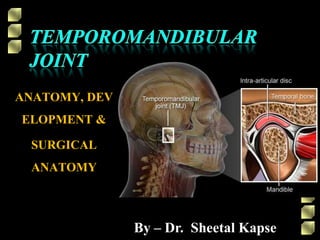
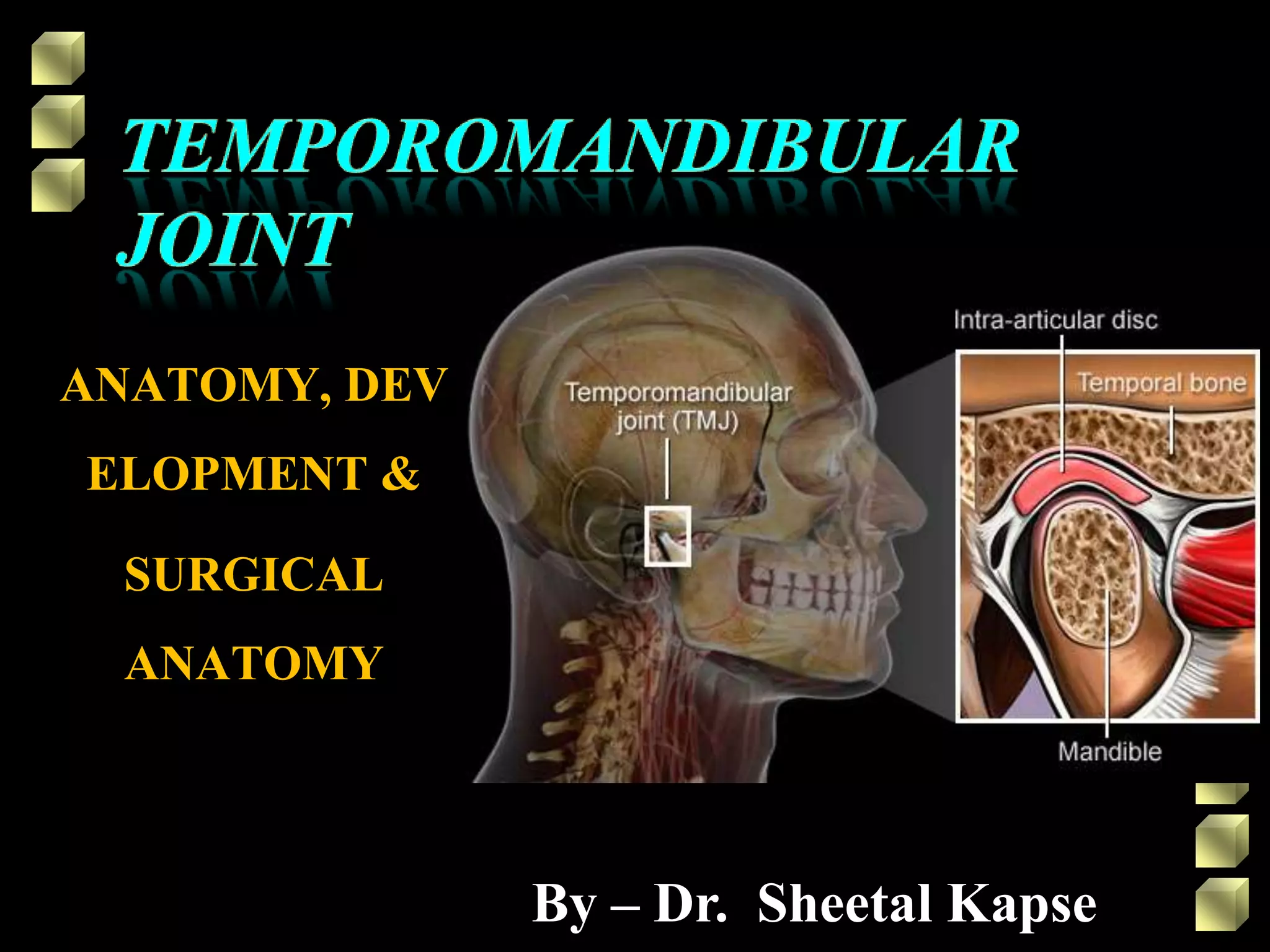
ANATOMY, DEV
ELOPMENT &
SURGICAL
ANATOMY
By – Dr. Sheetal Kapse
Contents
• INTRODUCTION
• PECULIARITY OF TMJ
• DEVELOPMENT
• COMPONENTS
• MOVEMENTS
• VASCULAR SUPPLY
• INNERVATIONS
• AGE CHANGES
• SURGICALY ANATOMY
• REFERENCES
Introduction
• The most important functions of the temporomandibular
joint (TMJ) are mastication and speech and are of great
interest to dentists, orthodontists, clinicians, and
radiologists.
• The TMJ is a ginglymoarthrodial joint, a term that is
derived from ginglymus, meaning a hinge joint, allowing
motion only backward and forward in one plane, and
arthrodia, meaning a joint of which permits a gliding
motion of the surfaces.
Dorland WA: Medical Dictionary. Philadelphia and London, Saunders
Co., 1957
• The right and left TMJ form a bicondylar
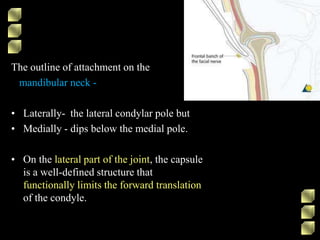
articulation and ellipsoid variety of the synovial
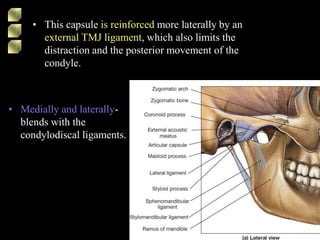
joints similar to knee articulation.
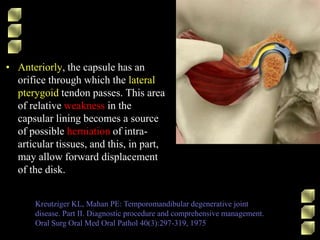
• The common features of the synovial joints
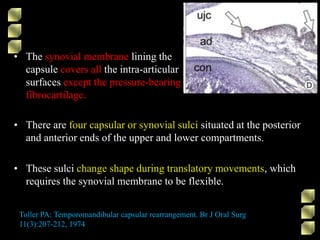
exhibited by this joint include a disk, bone, fibrous
capsule, fluid, synovial membrane, and ligaments.
However, the features that differentiate and make
this joint unique are its articular surface covered
by fibrocartilage instead of hyaline cartilage.
Williams PL: Gray’s anatomy, in Skeletal System (ed 38).
Churchill. Livingstone, London, 1999, pp 578-582
Peculiarity of TMJ
1. Bilateral diarthrosis – right & left function together
2. Articular surface covered by fibrocartilage
instead of hyaline cartilage
3. Only joint in human body to have a rigid endpoint
of closure that of the teeth making occlusal contact.
4. In contrast to other diarthrodial joints TMJ is last
joint to start develop, in about 7th week in
utero.
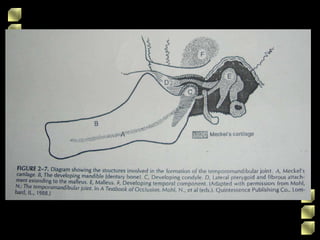
5. Develops from two distinct blastema.
Peculiarity of TMJ…….
Components
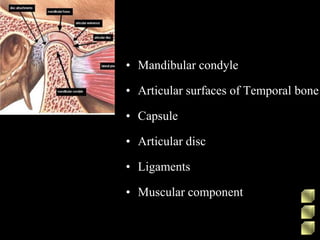
• Mandibular condyle
• Articular surfaces of Temporal bone
• Capsule
• Articular disc
• Ligaments
• Muscular component
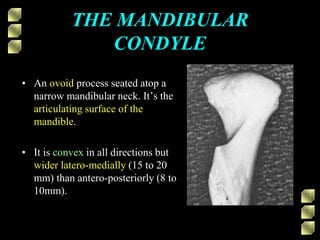
THE MANDIBULAR
CONDYLE
• An ovoid process seated atop a
narrow mandibular neck. It’s the
articulating surface of the
mandible.
• It is convex in all directions but
wider latero-medially (15 to 20
mm) than antero-posteriorly (8 to
10mm).
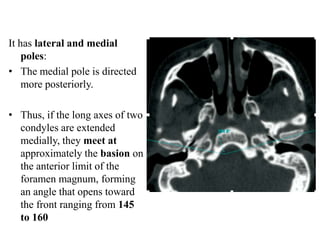
It has lateral and medial
poles:
• The medial pole is directed
more posteriorly.
• Thus, if the long axes of two
condyles are extended
medially, they meet at
approximately the basion on
the anterior limit of the
foramen magnum, forming
an angle that opens toward
the front ranging from 145
to 160
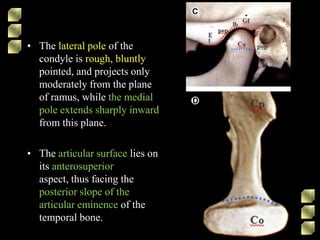
• The lateral pole of the
condyle is rough, bluntly
pointed, and projects only
moderately from the plane
of ramus, while the medial
pole extends sharply inward
from this plane.
• The articular surface lies on
its anterosuperior
aspect, thus facing the
posterior slope of the
articular eminence of the
temporal bone.
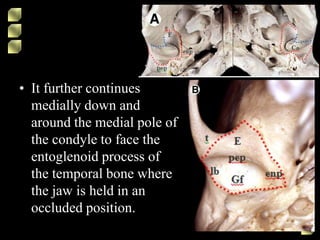
• It further continues
medially down and
around the medial pole of
the condyle to face the
entoglenoid process of
the temporal bone where
the jaw is held in an
occluded position.
Cranial Component
or
Articular surfaces of Temporal bone
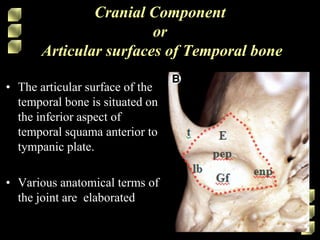
• The articular surface of the
temporal bone is situated on
the inferior aspect of
temporal squama anterior to
tympanic plate.
• Various anatomical terms of
the joint are elaborated
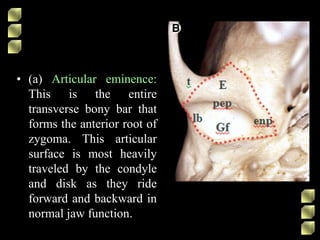
• (a) Articular eminence:
This is the entire
transverse bony bar that
forms the anterior root of
zygoma. This articular
surface is most heavily
traveled by the condyle
and disk as they ride
forward and backward in
normal jaw function.
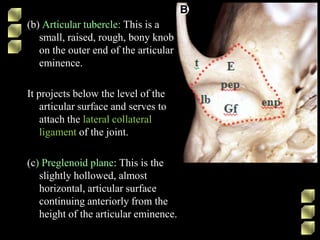
(b) Articular tubercle: This is a
small, raised, rough, bony knob
on the outer end of the articular
eminence.
It projects below the level of the
articular surface and serves to
attach the lateral collateral
ligament of the joint.
(c) Preglenoid plane: This is the
slightly hollowed, almost
horizontal, articular surface
continuing anteriorly from the
height of the articular eminence.
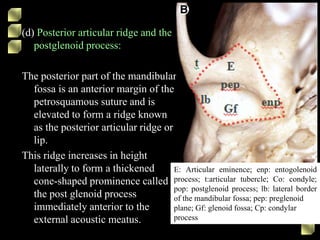
(d) Posterior articular ridge and the
postglenoid process:
The posterior part of the mandibular
fossa is an anterior margin of the
petrosquamous suture and is
elevated to form a ridge known
as the posterior articular ridge or
lip.
This ridge increases in height
laterally to form a thickened
cone-shaped prominence called
the post glenoid process
immediately anterior to the
external acoustic meatus.
E: Articular eminence; enp: entogolenoid
process; t:articular tubercle; Co: condyle;
pop: postglenoid process; lb: lateral border
of the mandibular fossa; pep: preglenoid
plane; Gf: glenoid fossa; Cp: condylar
process
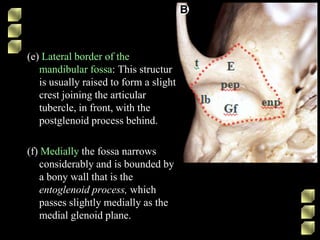
(e) Lateral border of the
mandibular fossa: This structur
is usually raised to form a slight
crest joining the articular
tubercle, in front, with the
postglenoid process behind.
(f) Medially the fossa narrows
considerably and is bounded by
a bony wall that is the
entoglenoid process, which
passes slightly medially as the
medial glenoid plane.
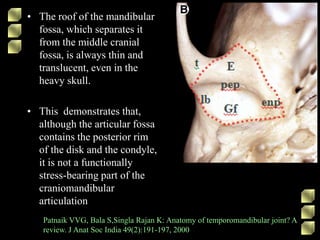
• The roof of the mandibular
fossa, which separates it
from the middle cranial
fossa, is always thin and
translucent, even in the
heavy skull.
• This demonstrates that,
although the articular fossa
contains the posterior rim
of the disk and the condyle,
it is not a functionally
stress-bearing part of the
craniomandibular
articulation
Patnaik VVG, Bala S,Singla Rajan K: Anatomy of temporomandibular joint? A
review. J Anat Soc India 49(2):191-197, 2000
Articular Disc
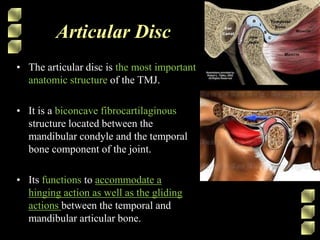
• The articular disc is the most important
anatomic structure of the TMJ.
• It is a biconcave fibrocartilaginous
structure located between the
mandibular condyle and the temporal
bone component of the joint.
• Its functions to accommodate a
hinging action as well as the gliding
actions between the temporal and
mandibular articular bone.
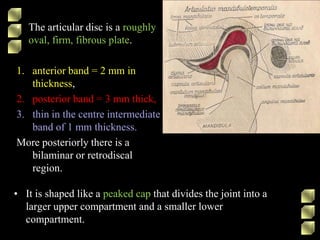
• The articular disc is a roughly
oval, firm, fibrous plate.
1. anterior band = 2 mm in
thickness,
2. posterior band = 3 mm thick,
3. thin in the centre intermediate
band of 1 mm thickness.
More posteriorly there is a
bilaminar or retrodiscal
region.
• It is shaped like a peaked cap that divides the joint into a
larger upper compartment and a smaller lower
compartment.
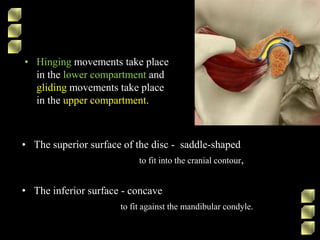
• Hinging movements take place
in the lower compartment and
gliding movements take place
in the upper compartment.
• The superior surface of the disc - saddle-shaped
to fit into the cranial contour,
• The inferior surface - concave
to fit against the mandibular condyle.
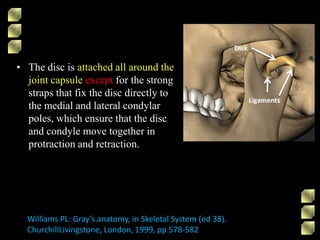
• The disc is attached all around the
joint capsule except for the strong
straps that fix the disc directly to
the medial and lateral condylar
poles, which ensure that the disc
and condyle move together in
protraction and retraction.
Williams PL: Gray’s anatomy, in Skeletal System (ed 38).
ChurchillLivingstone, London, 1999, pp 578-582
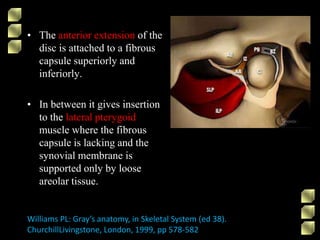
• The anterior extension of the
disc is attached to a fibrous
capsule superiorly and
inferiorly.
• In between it gives insertion
to the lateral pterygoid
muscle where the fibrous
capsule is lacking and the
synovial membrane is
supported only by loose
areolar tissue.
Williams PL: Gray’s anatomy, in Skeletal System (ed 38).
ChurchillLivingstone, London, 1999, pp 578-582
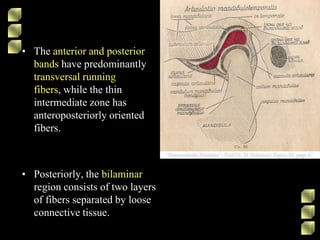
• The anterior and posterior
bands have predominantly
transversal running
fibers, while the thin
intermediate zone has
anteroposteriorly oriented
fibers.
• Posteriorly, the bilaminar
region consists of two layers
of fibers separated by loose
connective tissue.
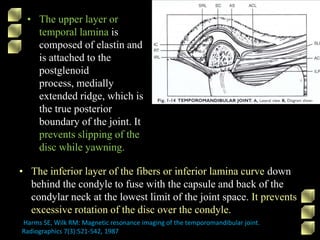
• The upper layer or
temporal lamina is
composed of elastin and
is attached to the
postglenoid
process, medially
extended ridge, which is
the true posterior
boundary of the joint. It
prevents slipping of the
disc while yawning.
Harms SE, Wilk RM: Magnetic resonance imaging of the temporomandibular joint.
Radiographics 7(3):521-542, 1987
• The inferior layer of the fibers or inferior lamina curve down
behind the condyle to fuse with the capsule and back of the
condylar neck at the lowest limit of the joint space. It prevents
excessive rotation of the disc over the condyle.
• In between the two layers, an
expansile, soft pad of blood
vessels and nerves are
sandwiched and wrapped in
elastic fibers that aid in
contracting vessels and
retracting disc in recoil of
closing movements.
Harms SE, Wilk RM: Magnetic resonance imaging of the temporomandibular joint.
Radiographics 7(3):521-542, 1987
• The volume of retrodiscal tissue must increase
instantaneously when the condyle translates
anteriorly.
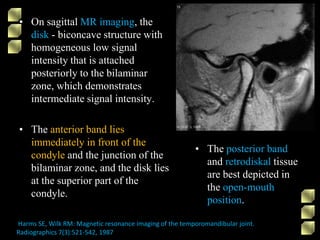
• On sagittal MR imaging, the
disk - biconcave structure with
homogeneous low signal
intensity that is attached
posteriorly to the bilaminar
zone, which demonstrates
intermediate signal intensity.
• The anterior band lies
immediately in front of the
condyle and the junction of the
bilaminar zone, and the disk lies
at the superior part of the
condyle.
Harms SE, Wilk RM: Magnetic resonance imaging of the temporomandibular joint.
Radiographics 7(3):521-542, 1987
• The posterior band
and retrodiskal tissue
are best depicted in
the open-mouth
position.
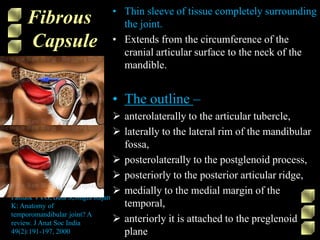
Fibrous
Capsule
• Thin sleeve of tissue completely surrounding
the joint.
• Extends from the circumference of the
cranial articular surface to the neck of the
mandible.
• The outline –
 anterolaterally to the articular tubercle,
 laterally to the lateral rim of the mandibular
fossa,
 posterolaterally to the postglenoid process,
 posteriorly to the posterior articular ridge,
 medially to the medial margin of the
temporal,
 anteriorly it is attached to the preglenoid
plane
Patnaik VVG, Bala S,Singla Rajan
K: Anatomy of
temporomandibular joint? A
review. J Anat Soc India
49(2):191-197, 2000
The outline of attachment on the
mandibular neck -
• Laterally- the lateral condylar pole but
• Medially - dips below the medial pole.
• On the lateral part of the joint, the capsule
is a well-defined structure that
functionally limits the forward translation
of the condyle.
• Medially and laterally-
blends with the
condylodiscal ligaments.
• This capsule is reinforced more laterally by an
external TMJ ligament, which also limits the
distraction and the posterior movement of the
condyle.
• Anteriorly, the capsule has an
orifice through which the lateral
pterygoid tendon passes. This area
of relative weakness in the
capsular lining becomes a source
of possible herniation of intra-
articular tissues, and this, in part,
may allow forward displacement
of the disk.
Kreutziger KL, Mahan PE: Temporomandibular degenerative joint
disease. Part II. Diagnostic procedure and comprehensive management.
Oral Surg Oral Med Oral Pathol 40(3):297-319, 1975
• The synovial membrane lining the
capsule covers all the intra-articular
surfaces except the pressure-bearing
fibrocartilage.
Toller PA: Temporomandibular capsular rearrangement. Br J Oral Surg
11(3):207-212, 1974
• There are four capsular or synovial sulci situated at the posterior
and anterior ends of the upper and lower compartments.
• These sulci change shape during translatory movements, which
requires the synovial membrane to be flexible.
Temporomandibular
Ligaments Complex
Collateral
Ligaments
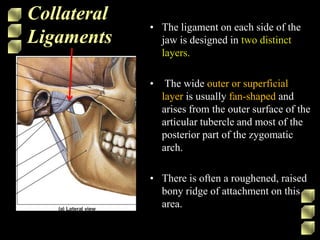
• The ligament on each side of the
jaw is designed in two distinct
layers.
• The wide outer or superficial
layer is usually fan-shaped and
arises from the outer surface of the
articular tubercle and most of the
posterior part of the zygomatic
arch.
• There is often a roughened, raised
bony ridge of attachment on this
area.
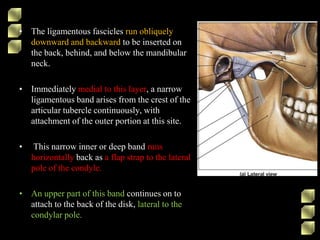
• The ligamentous fascicles run obliquely
downward and backward to be inserted on
the back, behind, and below the mandibular
neck.
• Immediately medial to this layer, a narrow
ligamentous band arises from the crest of the
articular tubercle continuously, with
attachment of the outer portion at this site.
• This narrow inner or deep band runs
horizontally back as a flap strap to the lateral
pole of the condyle.
• An upper part of this band continues on to
attach to the back of the disk, lateral to the
condylar pole.
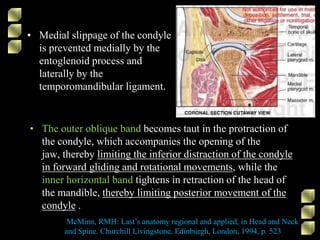
• Medial slippage of the condyle
is prevented medially by the
entoglenoid process and
laterally by the
temporomandibular ligament.
McMinn, RMH: Last’s anatomy regional and applied, in Head and Neck
and Spine. Churchill Livingstone, Edinburgh, London, 1994, p. 523
• The outer oblique band becomes taut in the protraction of
the condyle, which accompanies the opening of the
jaw, thereby limiting the inferior distraction of the condyle
in forward gliding and rotational movements, while the
inner horizontal band tightens in retraction of the head of
the mandible, thereby limiting posterior movement of the
condyle .
Sphenomandibular Ligament
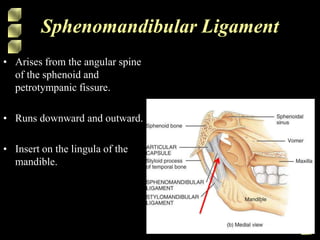
• Arises from the angular spine
of the sphenoid and
petrotympanic fissure.
• Runs downward and outward.
• Insert on the lingula of the
mandible.
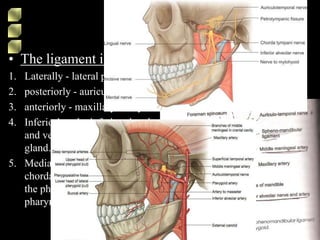
• The ligament is related –
1. Laterally - lateral pterygoidmuscle.
2. posteriorly - auriculotemporal nerve.
3. anteriorly - maxillary artery.
4. Inferiorly - the inferior alveolar nerve
and vessels a lobule of the parotid
gland.
5. Medially - medial pterygoid with the
chorda tympani nerve and the wall of
the pharynx with fat and the
pharyngeal veins intervening.
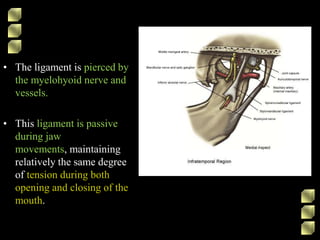
• The ligament is pierced by
the myelohyoid nerve and
vessels.
• This ligament is passive
during jaw
movements, maintaining
relatively the same degree
of tension during both
opening and closing of the
mouth.
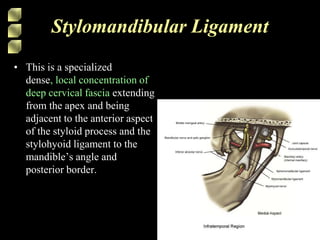
Stylomandibular Ligament
• This is a specialized
dense, local concentration of
deep cervical fascia extending
from the apex and being
adjacent to the anterior aspect
of the styloid process and the
stylohyoid ligament to the
mandible’s angle and
posterior border.
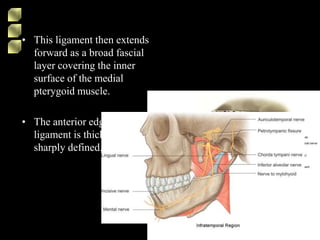
• This ligament then extends
forward as a broad fascial
layer covering the inner
surface of the medial
pterygoid muscle.
• The anterior edge of the
ligament is thickened and
sharply defined.
• It is lax when the jaws are closed and slackens
noticeably when the mouth is opened because the
angle of the mandible swings up and back while
the condyle slides downward and forward.
• This ligament becomes tense only in extreme
protrusive movements. Thus, it can be considered
only as an accessory ligament of uncertain
function.
Lubrication of the Joint
• The synovial fluid comes from two sources: first, from
plasma by dialysis, and second, by secretion from type A
and B synoviocytes with a volume of no more than 0.05
ml.
• However, contrast radiography studies have estimated that
the upper compartment could hold approximately 1.2 ml of
fluid without undue pressure being created, while the lower
has a capacity of approximately 0.5 ml.
Toller PA: Temporomandibular capsular rearrangement. Br J Oral Surg
11(3):207-212, 1974
Synovial fluid……
• It is clear, straw-colored viscous fluid.
• It diffuses out from the rich cappillary network of the
synovial membrane.
Contains:
• Hyaluronic acid which is highly viscous
• May also contain some free cells mostly macrophages.
Functions:
• Lubricant for articulating surfaces.
• Carry nutrients to the avascular tissue of the joint.
• Clear the tissue debris caused by normal wear and tear of
the articulating surfaces.
Muscular Component
• The masticatory muscles surrounding the joint are groups
of muscles that contract and relax in harmony so that the
jaws function properly.
• When the muscles are relaxed and flexible and are not
under stress, they work in harmony with the other parts of
the TMJ complex.
• The muscles of mastication produce all the movements of
the jaw.
• These muscles begin and are fixed on the cranium
extending between the cranium and the mandible on each
side of the head to insert on the mandible.
Teeth and Occlusion
• The way the teeth fit together may affect the TMJ
complex.
• A stable occlusion with good tooth contact and
interdigitation provides maximum support to the muscles
and joint, while poor occlusion (bite relationship) may
cause the muscles to malfunction and ultimately cause
damage to the joint itself.
• Instability of the occlusion can increase the pressure on the
joint, causing damage and degeneration.
VASCULARISATION
• Branches of External Carotid Artery
– Superficial temporal artery
– Deep auricular artery
– Anterior tympanic artery
– Ascending pharyngeal artery
– Maxillary artery
VASCULARISATION
• The Blood supply to TMJ is only Superficial,
i.e. there is no blood supply inside the capsule
• TMJ takes its nourishment from Synovial fluid
Innervations
Movements of synovial joint initiated & effected by muscle coordination.
Achieved in part through sensory innervation.
Hilton’s Law:
The principle that the nerve supplying a joint also supplies both the muscles
that move the joint and the skin covering the articular insertion of those
muscles.
Therefore:
Branches of the mandibular division of the fifth cranial nerve supply
the TMJ (auriculotemporal, deep temporal, and masseteric)
Innervations
4 Types of nerve endings:
1. Ruffini’s corpuscles (limited to capsule)
2. Pacini’s corpuscles (limited to capsule)
3. Golgi tendon organs (confined to ligament)
4. Free nerve endings (most abundant)
PROPIOCEPTION
• Ruffini Endings
 Position the mandible
• Pacinion Receptors
 Accelerate movement during Reflexes
• Golgi tendon Organs
 Protection of ligaments Around TMJ
• Free Nerve Endings
 Pain receptors
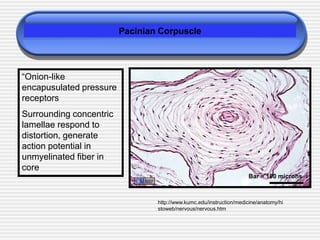
Pacinian Corpuscle
http://www.kumc.edu/instruction/medicine/anatomy/hi
stoweb/nervous/nervous.htm
“Onion-like
encapusulated pressure
receptors
Surrounding concentric
lamellae respond to
distortion, generate
action potential in
unmyelinated fiber in
core
Bar = 100 microns
Ruffini’s & Golgi Corpuscle
Function:
Ruffini’s = Posture (proprioception), dynamic and static balance
Golgi tendon organ = Static mechanoreception, protection (ligament)
Free nerve endings = Pain (nociception) protection (joint)
www.anatomyatlases.org/ MicroscopicAnatomy/Section06/Section06.shtml
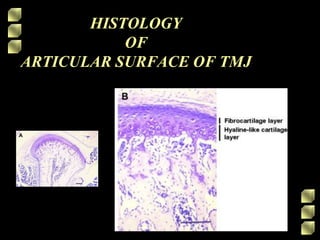
HISTOLOGY
OF
ARTICULAR SURFACE OF TMJ
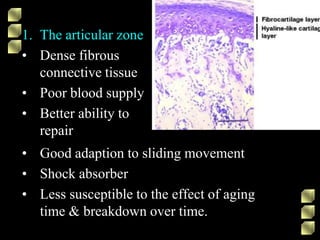
1. The articular zone
• Dense fibrous
connective tissue
• Poor blood supply
• Better ability to
repair
• Good adaption to sliding movement
• Shock absorber
• Less susceptible to the effect of aging
time & breakdown over time.
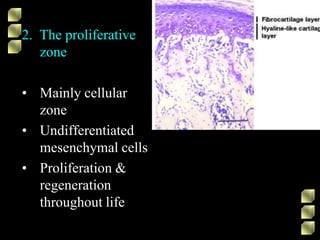
2. The proliferative
zone
• Mainly cellular
zone
• Undifferentiated
mesenchymal cells
• Proliferation &
regeneration
throughout life
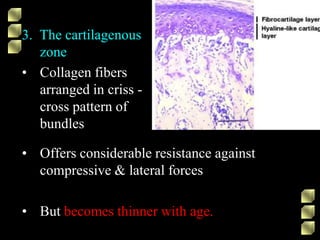
3. The cartilagenous
zone
• Collagen fibers
arranged in criss -
cross pattern of
bundles
• Offers considerable resistance against
compressive & lateral forces
• But becomes thinner with age.
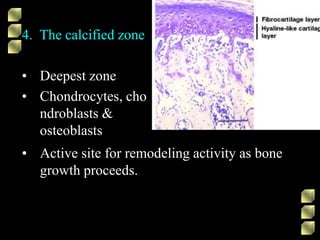
4. The calcified zone
• Deepest zone
• Chondrocytes, cho
ndroblasts &
osteoblasts
• Active site for remodeling activity as bone
growth proceeds.
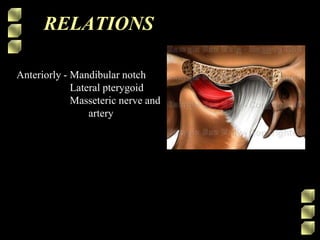
RELATIONS
Anteriorly - Mandibular notch
Lateral pterygoid
Masseteric nerve and
artery
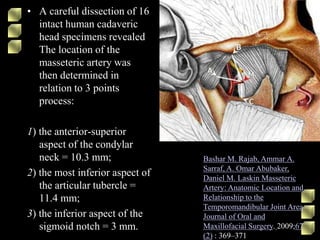
• A careful dissection of 16
intact human cadaveric
head specimens revealed
The location of the
masseteric artery was
then determined in
relation to 3 points
process:
1) the anterior-superior
aspect of the condylar
neck = 10.3 mm;
2) the most inferior aspect of
the articular tubercle =
11.4 mm;
3) the inferior aspect of the
sigmoid notch = 3 mm.
Bashar M. Rajab, Ammar A.
Sarraf, A. Omar Abubaker,
Daniel M. Laskin Masseteric
Artery: Anatomic Location and
Relationship to the
Temporomandibular Joint Area
Journal of Oral and
Maxillofacial Surgery. 2009;67
(2) : 369–371
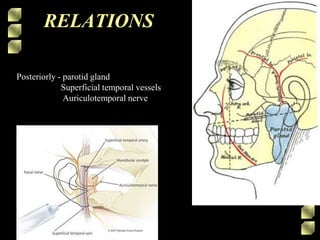
RELATIONS
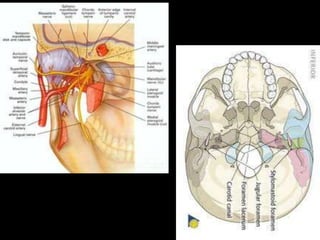
Posteriorly - parotid gland
Superficial temporal vessels
Auriculotemporal nerve
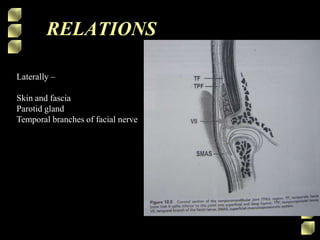
RELATIONS
Laterally –
Skin and fascia
Parotid gland
Temporal branches of facial nerve
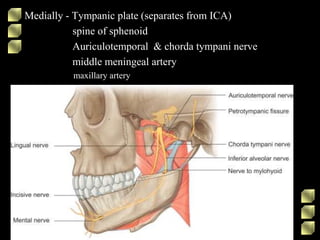
Medially - Tympanic plate (separates from ICA)
spine of sphenoid
Auriculotemporal & chorda tympani nerve
middle meningeal artery
maxillary artery
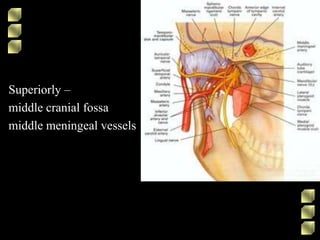
Superiorly –
middle cranial fossa
middle meningeal vessels
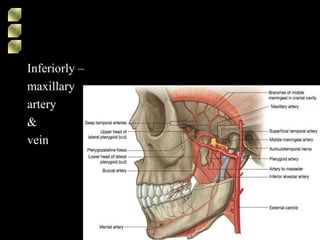
Inferiorly –
maxillary
artery
&
vein
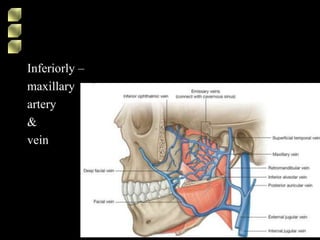
Inferiorly –
maxillary
artery
&
vein
Inferiorly –
maxillary
artery
&
vein
Movements
• Rotational / hinge movement in first 20-
25mm of mouth opening
• Translational movement after that when the
mouth is excessively opened.
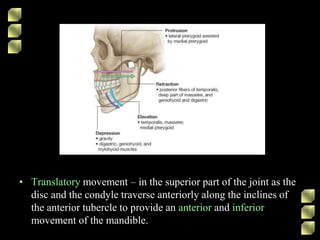
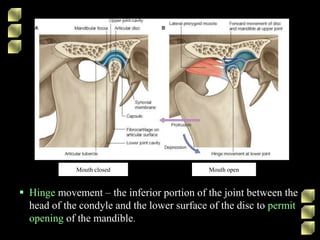
• Translatory movement – in the superior part of the joint as the
disc and the condyle traverse anteriorly along the inclines of
the anterior tubercle to provide an anterior and inferior
movement of the mandible.
Mouth closed Mouth open
 Hinge movement – the inferior portion of the joint between the
head of the condyle and the lower surface of the disc to permit
opening of the mandible.
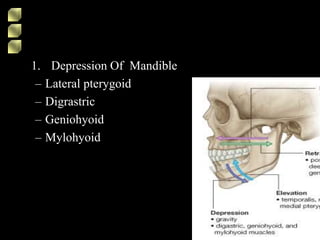
1. Depression Of Mandible
– Lateral pterygoid
– Digrastric
– Geniohyoid
– Mylohyoid
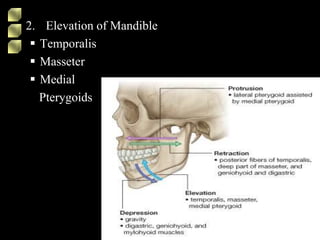
2. Elevation of Mandible
 Temporalis
 Masseter
 Medial
Pterygoids
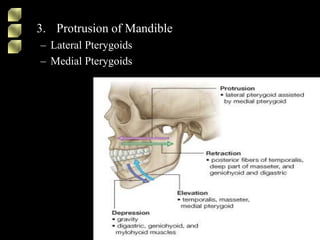
3. Protrusion of Mandible
– Lateral Pterygoids
– Medial Pterygoids
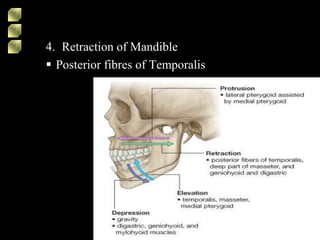
4. Retraction of Mandible
 Posterior fibres of Temporalis
Age changes of the TMJ:
• Condyle:
– Becomes more flattened
– Fibrous capsule becomes thicker.
– Osteoporosis of underlying bone.
– Thinning or absence of cartilaginous zone.
• Disk:
– Becomes thinner.
– Shows hyalinization and chondroid changes.
• Synovial fold:
– Become fibrotic with thick basement membrane.
• Blood vessels and nerves:
– Walls of blood vessels thickened.
– Nerves decrease in number
These age changes lead to:
 -Decrease in the synovial fluid formation
 -Impairment of motion due to decrease in the disc
and capsule extensibility
 -Decrease the resilience during mastication due to
chondroid changes into collagenous elements
 -Dysfunction in older people
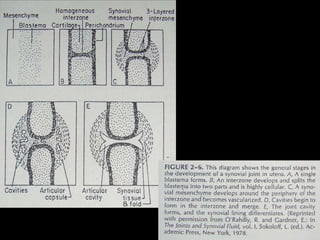
Development
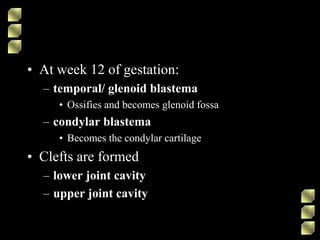
• At week 12 of gestation:
– temporal/ glenoid blastema
• Ossifies and becomes glenoid fossa
– condylar blastema
• Becomes the condylar cartilage
• Clefts are formed
– lower joint cavity
– upper joint cavity
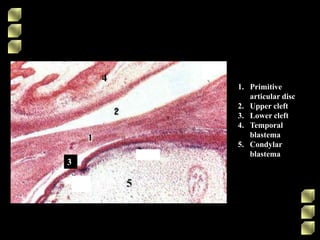
1. Primitive
articular disc
2. Upper cleft
3. Lower cleft
4. Temporal
blastema
5. Condylar
blastema
4
33
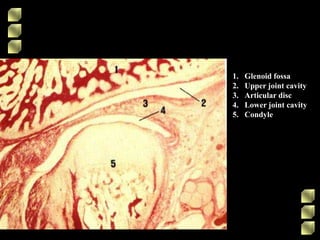
1. Glenoid fossa
2. Upper joint cavity
3. Articular disc
4. Lower joint cavity
5. Condyle
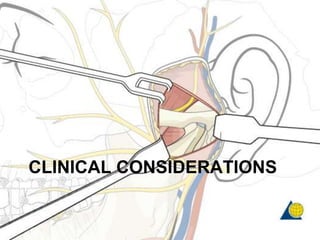
CLINICAL CONSIDERATIONS
SURGICAL
APPROACHES
TO
TMJ
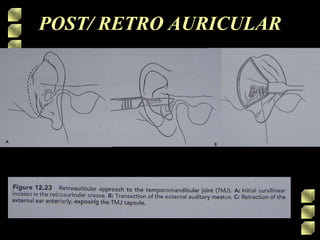
POST/ RETRO AURICULAR
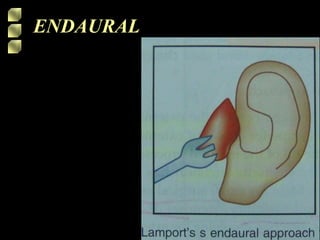
ENDAURAL
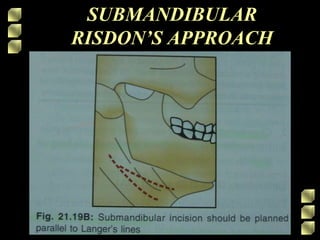
SUBMANDIBULAR
RISDON’S APPROACH
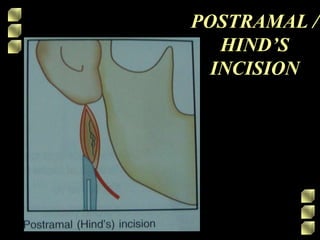
POSTRAMAL /
HIND’S
INCISION
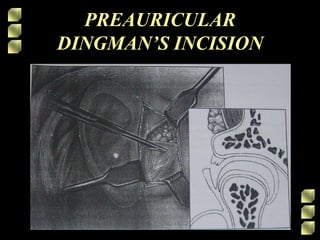
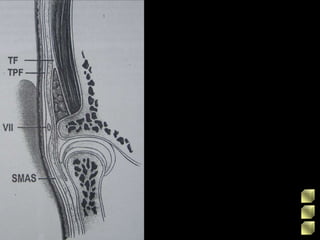
PREAURICULAR
DINGMAN’S INCISION
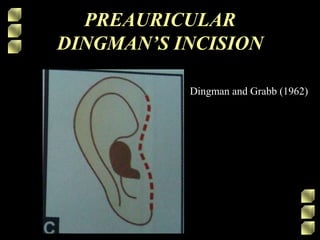
PREAURICULAR
DINGMAN’S INCISION
Dingman and Grabb (1962)
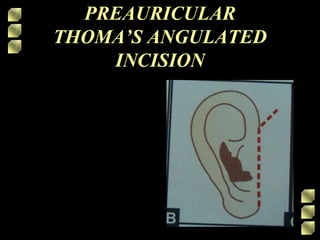
PREAURICULAR
THOMA’S ANGULATED
INCISION
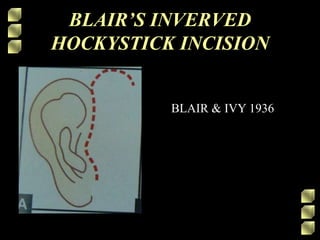
BLAIR’S INVERVED
HOCKYSTICK INCISION
BLAIR & IVY 1936
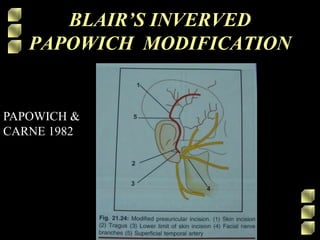
BLAIR’S INVERVED
PAPOWICH MODIFICATION
PAPOWICH &
CARNE 1982
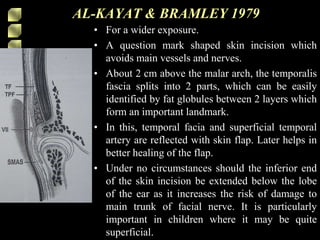
• For a wider exposure.
• A question mark shaped skin incision which
avoids main vessels and nerves.
• About 2 cm above the malar arch, the temporalis
fascia splits into 2 parts, which can be easily
identified by fat globules between 2 layers which
form an important landmark.
• In this, temporal facia and superficial temporal
artery are reflected with skin flap. Later helps in
better healing of the flap.
• Under no circumstances should the inferior end
of the skin incision be extended below the lobe
of the ear as it increases the risk of damage to
main trunk of facial nerve. It is particularly
important in children where it may be quite
superficial.
AL-KAYAT & BRAMLEY 1979
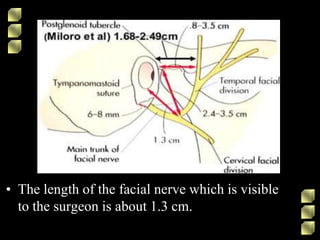
• The length of the facial nerve which is visible
to the surgeon is about 1.3 cm.
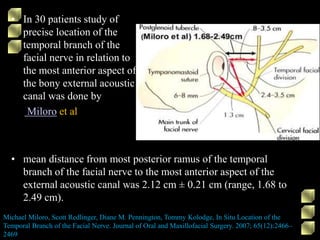
• In 30 patients study of
precise location of the
temporal branch of the
facial nerve in relation to
the most anterior aspect of
the bony external acoustic
canal was done by
Miloro et al
Michael Miloro, Scott Redlinger, Diane M. Pennington, Tommy Kolodge, In Situ Location of the
Temporal Branch of the Facial Nerve. Journal of Oral and Maxillofacial Surgery. 2007; 65(12):2466–
2469
• mean distance from most posterior ramus of the temporal
branch of the facial nerve to the most anterior aspect of the
external acoustic canal was 2.12 cm ± 0.21 cm (range, 1.68 to
2.49 cm).
• Intraoral approach: It was described by Sear
(1972) for removal of hyperplastic condyles. The
incision commences at the level of upper occlusal
plane and passes downwards and forwards
between the internal and external oblique ridges of
mandible and then forwards as necessary along
mandibular body. Upper end should not be
extended beyond the level of upper molar teeth,
otherwise buccal pad of fat is encountered and
prolapses in the wound decreasing the visibility
Arthroscopy
Arthroscopy of the TMJ was first introduced by
Ohnishi in 1975.
1. Superior posterolateral
2. Superior anterolateral
3. Inferior posterolateral
4. Inferior anterolateral
5. Endaural approach
Approaches for the arthroscopic
lysis and lavage of the TMJ
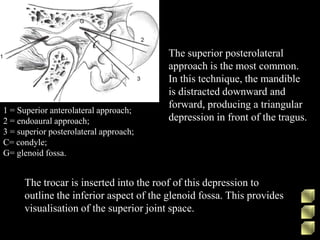
1 = Superior anterolateral approach;
2 = endoaural approach;
3 = superior posterolateral approach;
C= condyle;
G= glenoid fossa.
The superior posterolateral
approach is the most common.
In this technique, the mandible
is distracted downward and
forward, producing a triangular
depression in front of the tragus.
The trocar is inserted into the roof of this depression to
outline the inferior aspect of the glenoid fossa. This provides
visualisation of the superior joint space.
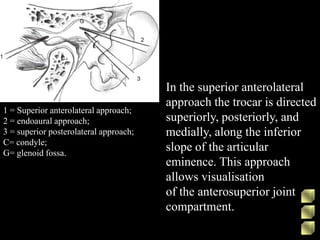
1 = Superior anterolateral approach;
2 = endoaural approach;
3 = superior posterolateral approach;
C= condyle;
G= glenoid fossa.
In the superior anterolateral
approach the trocar is directed
superiorly, posteriorly, and
medially, along the inferior
slope of the articular
eminence. This approach
allows visualisation
of the anterosuperior joint
compartment.
1 = Superior anterolateral approach;
2 = endoaural approach;
3 = superior posterolateral approach;
C= condyle;
G= glenoid fossa.
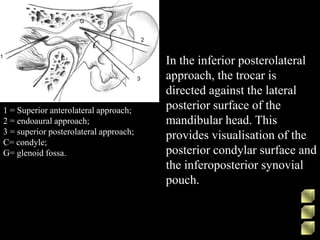
In the inferior posterolateral
approach, the trocar is
directed against the lateral
posterior surface of the
mandibular head. This
provides visualisation of the
posterior condylar surface and
the inferoposterior synovial
pouch.
1 = Superior anterolateral approach;
2 = endoaural approach;
3 = superior posterolateral approach;
C= condyle;
G= glenoid fossa.
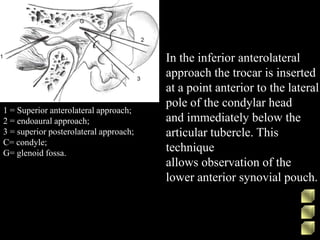
In the inferior anterolateral
approach the trocar is inserted
at a point anterior to the lateral
pole of the condylar head
and immediately below the
articular tubercle. This
technique
allows observation of the
lower anterior synovial pouch.
1 = Superior anterolateral approach;
2 = endoaural approach;
3 = superior posterolateral approach;
C= condyle;
G= glenoid fossa.
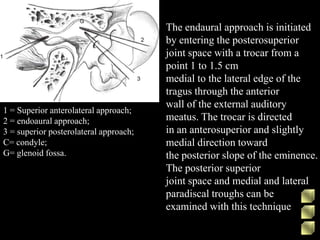
The endaural approach is initiated
by entering the posterosuperior
joint space with a trocar from a
point 1 to 1.5 cm
medial to the lateral edge of the
tragus through the anterior
wall of the external auditory
meatus. The trocar is directed
in an anterosuperior and slightly
medial direction toward
the posterior slope of the eminence.
The posterior superior
joint space and medial and lateral
paradiscal troughs can be
examined with this technique
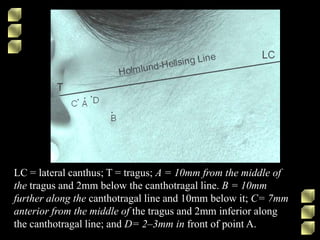
LC = lateral canthus; T = tragus; A = 10mm from the middle of
the tragus and 2mm below the canthotragal line. B = 10mm
further along the canthotragal line and 10mm below it; C= 7mm
anterior from the middle of the tragus and 2mm inferior along
the canthotragal line; and D= 2–3mm in front of point A.
Ankylosis & Kaban’s protocol
• The 7-step protocol consists of
1) Aggressive excision of the fibrous and/or bony ankylotic
mass,
2) Coronoidectomy on the affected side,
3) Coronoidectomy on the contralateral side, if steps 1 and 2
do not result in a maximal incisal opening greater than 35
mm or to the point of dislocation of the unaffected TMJ,
4) Lining of the TMJ with a temporalis myofascial flap or
the native disc, if it can be salvaged,
5) Reconstruction of the ramus condyle unit with either
distraction osteogenesis or costochondral graft
6) Rigid fixation,
7) Early mobilization of the jaw.
A Protocol for Management of Temporomandibular Joint
Ankylosis in Children. Leonard B. Kaban, Carl
Bouchard, Maria J. Troulis . Journal of Oral and Maxillofacial
Surgery 2009; 67(9):1966–1978
• If distraction osteogenesis is used to
reconstruct the ramus condyle
unit, mobilization begins the day of the
operation. In patients who undergo
costochondral graft
econstruction, mobilization begins after 10
days of maxillomandibular fixation. Finally
(step 7), all patients receive aggressive
physiotherapy
Dislocation
Conclusion
• The temporomandibular joint (TMJ), also known
as the mandibular joint, is an ellipsoid variety of
the right and left synovial joints forming a
bicondylar articulation.
• The common features of the synovial joints
exhibited by this joint include a fibrous capsule, a
disk, synovial membrane, fluid, and tough
adjacent ligaments.
• Not only is the mandible a single bone but the cranium is
also mechanically a single stable component; therefore, the
correct terminology for the joint is the craniomandibular
articulation.
• The term temporomandibular joint is misleading and seems
to only refer to one side when referring to joint function.
• Magnetic resonance imaging has been shown to accurately
delineate the structures of the TMJ and is the best
technique to correlate and compare the TMJ components
such as bone, disk, fluid, capsule, and ligaments with
autopsy specimens.
REFERENCES - TEXTBOOK
1. Sicher and Dubrul's Oral Anatomy by E. Lloyd Dubrul
2. The Tmj Book by Andrew S. Kaplan, Jr. Williams Gray
3. B.D. Chaurassia’s human anatomy 4th edition vol. 3 The
Head & Neck.
4. Williams PL: Gray’s anatomy, in Skeletal System (ed
38). Churchill Livingstone, London, 1999, pp 578-582
5. Fonseca volume 2 by Robert D. Marciani
6. Temporomandibular Disorder, A Problem Based
Approach by Dr Robin J. M. Gray & Dr M. Diad Al –
Ani
7. Surgical Approaches To Facial Skeleton By – Edward
Ellis III & Nmichael F. Zide
8. Surgery Of TMJ 2nd ed. by David A. Keith
REFERENCES - ARTICLES
1. Dorland WA: Medical Dictionary. Philadelphia and London, Saunders Co., 1957
2. Williams PL: Gray’s anatomy, in Skeletal System (ed 38). Churchill
Livingstone, London, 1999, pp 578-582
3. Yale SH: Radiographic evaluation of the temporomandibular joint. J Am Dent
Assoc 79(1):102-107, 1969
4. Patnaik VVG, Bala S,Singla Rajan K: Anatomy of temporomandibular joint? A
review. J Anat Soc India 49(2):191-197, 2000
5. Harms SE, Wilk RM: Magnetic resonance imaging of the temporomandibular
joint. Radiographics 7(3):521-542, 1987
6. Tallents RH, Katzberg RW, Murphy W, et al: Magnetic resonance imaging
findings in asymptomatic volunteers and symptomatic patients with
temporomandibular disorders. J Prosthet Dent 75(5):529-533, 1996
7. Helms CA, Kaplan P: Diagnostic imaging of the temporomandibular joint:
recommendations for use of the various techniques. AJR Am J Roentgenol
154(2):319-322, 1990
8. Helms CA, Kaban LB, McNeill C, et al: Temporomandibular joint: morphology
and signal intensity characteristics of the disk at MR imaging. Radiology
172(3):817-820, 1989
REFERENCES - ARTICLES
9. Kreutziger KL, Mahan PE: Temporomandibular degenerative joint disease. Part
II. Diagnostic procedure and comprehensive management. Oral Surg Oral Med
Oral Pathol 40(3):297-319, 1975
10. Toller PA: Temporomandibular capsular rearrangement. Br J Oral Surg
11(3):207-212, 1974
11. McMinn, RMH: Last’s anatomy regional and applied, in Head and Neck and
Spine. Churchill Livingstone, Edinburgh, London, 1994, p. 523
12. Roberts D, Schenck J, Joseph P, et al: Temporomandibular joint: magnetic
resonance imaging. Radiology 154(3):829-830, 1985
13. Harms SE, Wilk RM, Wolford LM, et al: The temporomandibular joint: magnetic
resonance imaging using surface coils. Radiology 157(1):133- 136, 1985
14. Edelstein WA, Bottomley PA, Hart HR, et al: Signal, noise, and contrast in
nuclear magnetic resonance (NMR) imaging. J Comput Assist Tomogr 7(3):391-
401, 1983
15. Westesson PL, Katzberg RW, Tallents RH, et al: Temporomandibular joint:
comparison of MR images with cryosectional anatomy. Radiology 164(1):59-
64, 1987
T H A N K
Y
O
U

Tmj.ppt

  • 1.
  • 2.
    Contents • INTRODUCTION • PECULIARITYOF TMJ • DEVELOPMENT • COMPONENTS • MOVEMENTS • VASCULAR SUPPLY • INNERVATIONS • AGE CHANGES • SURGICALY ANATOMY • REFERENCES
  • 3.
    Introduction • The mostimportant functions of the temporomandibular joint (TMJ) are mastication and speech and are of great interest to dentists, orthodontists, clinicians, and radiologists. • The TMJ is a ginglymoarthrodial joint, a term that is derived from ginglymus, meaning a hinge joint, allowing motion only backward and forward in one plane, and arthrodia, meaning a joint of which permits a gliding motion of the surfaces. Dorland WA: Medical Dictionary. Philadelphia and London, Saunders Co., 1957
  • 4.
    • The rightand left TMJ form a bicondylar articulation and ellipsoid variety of the synovial joints similar to knee articulation. • The common features of the synovial joints exhibited by this joint include a disk, bone, fibrous capsule, fluid, synovial membrane, and ligaments. However, the features that differentiate and make this joint unique are its articular surface covered by fibrocartilage instead of hyaline cartilage. Williams PL: Gray’s anatomy, in Skeletal System (ed 38). Churchill. Livingstone, London, 1999, pp 578-582
  • 5.
    Peculiarity of TMJ 1.Bilateral diarthrosis – right & left function together 2. Articular surface covered by fibrocartilage instead of hyaline cartilage 3. Only joint in human body to have a rigid endpoint of closure that of the teeth making occlusal contact.
  • 6.
    4. In contrastto other diarthrodial joints TMJ is last joint to start develop, in about 7th week in utero. 5. Develops from two distinct blastema. Peculiarity of TMJ…….
  • 7.
  • 8.
    • Mandibular condyle •Articular surfaces of Temporal bone • Capsule • Articular disc • Ligaments • Muscular component
  • 9.
    THE MANDIBULAR CONDYLE • Anovoid process seated atop a narrow mandibular neck. It’s the articulating surface of the mandible. • It is convex in all directions but wider latero-medially (15 to 20 mm) than antero-posteriorly (8 to 10mm).
  • 10.
    It has lateraland medial poles: • The medial pole is directed more posteriorly. • Thus, if the long axes of two condyles are extended medially, they meet at approximately the basion on the anterior limit of the foramen magnum, forming an angle that opens toward the front ranging from 145 to 160
  • 11.
    • The lateralpole of the condyle is rough, bluntly pointed, and projects only moderately from the plane of ramus, while the medial pole extends sharply inward from this plane. • The articular surface lies on its anterosuperior aspect, thus facing the posterior slope of the articular eminence of the temporal bone.
  • 12.
    • It furthercontinues medially down and around the medial pole of the condyle to face the entoglenoid process of the temporal bone where the jaw is held in an occluded position.
  • 13.
    Cranial Component or Articular surfacesof Temporal bone • The articular surface of the temporal bone is situated on the inferior aspect of temporal squama anterior to tympanic plate. • Various anatomical terms of the joint are elaborated
  • 14.
    • (a) Articulareminence: This is the entire transverse bony bar that forms the anterior root of zygoma. This articular surface is most heavily traveled by the condyle and disk as they ride forward and backward in normal jaw function.
  • 15.
    (b) Articular tubercle:This is a small, raised, rough, bony knob on the outer end of the articular eminence. It projects below the level of the articular surface and serves to attach the lateral collateral ligament of the joint. (c) Preglenoid plane: This is the slightly hollowed, almost horizontal, articular surface continuing anteriorly from the height of the articular eminence.
  • 16.
    (d) Posterior articularridge and the postglenoid process: The posterior part of the mandibular fossa is an anterior margin of the petrosquamous suture and is elevated to form a ridge known as the posterior articular ridge or lip. This ridge increases in height laterally to form a thickened cone-shaped prominence called the post glenoid process immediately anterior to the external acoustic meatus. E: Articular eminence; enp: entogolenoid process; t:articular tubercle; Co: condyle; pop: postglenoid process; lb: lateral border of the mandibular fossa; pep: preglenoid plane; Gf: glenoid fossa; Cp: condylar process
  • 17.
    (e) Lateral borderof the mandibular fossa: This structur is usually raised to form a slight crest joining the articular tubercle, in front, with the postglenoid process behind. (f) Medially the fossa narrows considerably and is bounded by a bony wall that is the entoglenoid process, which passes slightly medially as the medial glenoid plane.
  • 18.
    • The roofof the mandibular fossa, which separates it from the middle cranial fossa, is always thin and translucent, even in the heavy skull. • This demonstrates that, although the articular fossa contains the posterior rim of the disk and the condyle, it is not a functionally stress-bearing part of the craniomandibular articulation Patnaik VVG, Bala S,Singla Rajan K: Anatomy of temporomandibular joint? A review. J Anat Soc India 49(2):191-197, 2000
  • 19.
    Articular Disc • Thearticular disc is the most important anatomic structure of the TMJ. • It is a biconcave fibrocartilaginous structure located between the mandibular condyle and the temporal bone component of the joint. • Its functions to accommodate a hinging action as well as the gliding actions between the temporal and mandibular articular bone.
  • 20.
    • The articulardisc is a roughly oval, firm, fibrous plate. 1. anterior band = 2 mm in thickness, 2. posterior band = 3 mm thick, 3. thin in the centre intermediate band of 1 mm thickness. More posteriorly there is a bilaminar or retrodiscal region. • It is shaped like a peaked cap that divides the joint into a larger upper compartment and a smaller lower compartment.
  • 21.
    • Hinging movementstake place in the lower compartment and gliding movements take place in the upper compartment. • The superior surface of the disc - saddle-shaped to fit into the cranial contour, • The inferior surface - concave to fit against the mandibular condyle.
  • 22.
    • The discis attached all around the joint capsule except for the strong straps that fix the disc directly to the medial and lateral condylar poles, which ensure that the disc and condyle move together in protraction and retraction. Williams PL: Gray’s anatomy, in Skeletal System (ed 38). ChurchillLivingstone, London, 1999, pp 578-582
  • 23.
    • The anteriorextension of the disc is attached to a fibrous capsule superiorly and inferiorly. • In between it gives insertion to the lateral pterygoid muscle where the fibrous capsule is lacking and the synovial membrane is supported only by loose areolar tissue. Williams PL: Gray’s anatomy, in Skeletal System (ed 38). ChurchillLivingstone, London, 1999, pp 578-582
  • 24.
    • The anteriorand posterior bands have predominantly transversal running fibers, while the thin intermediate zone has anteroposteriorly oriented fibers. • Posteriorly, the bilaminar region consists of two layers of fibers separated by loose connective tissue.
  • 25.
    • The upperlayer or temporal lamina is composed of elastin and is attached to the postglenoid process, medially extended ridge, which is the true posterior boundary of the joint. It prevents slipping of the disc while yawning. Harms SE, Wilk RM: Magnetic resonance imaging of the temporomandibular joint. Radiographics 7(3):521-542, 1987 • The inferior layer of the fibers or inferior lamina curve down behind the condyle to fuse with the capsule and back of the condylar neck at the lowest limit of the joint space. It prevents excessive rotation of the disc over the condyle.
  • 26.
    • In betweenthe two layers, an expansile, soft pad of blood vessels and nerves are sandwiched and wrapped in elastic fibers that aid in contracting vessels and retracting disc in recoil of closing movements. Harms SE, Wilk RM: Magnetic resonance imaging of the temporomandibular joint. Radiographics 7(3):521-542, 1987 • The volume of retrodiscal tissue must increase instantaneously when the condyle translates anteriorly.
  • 27.
    • On sagittalMR imaging, the disk - biconcave structure with homogeneous low signal intensity that is attached posteriorly to the bilaminar zone, which demonstrates intermediate signal intensity. • The anterior band lies immediately in front of the condyle and the junction of the bilaminar zone, and the disk lies at the superior part of the condyle. Harms SE, Wilk RM: Magnetic resonance imaging of the temporomandibular joint. Radiographics 7(3):521-542, 1987 • The posterior band and retrodiskal tissue are best depicted in the open-mouth position.
  • 28.
    Fibrous Capsule • Thin sleeveof tissue completely surrounding the joint. • Extends from the circumference of the cranial articular surface to the neck of the mandible. • The outline –  anterolaterally to the articular tubercle,  laterally to the lateral rim of the mandibular fossa,  posterolaterally to the postglenoid process,  posteriorly to the posterior articular ridge,  medially to the medial margin of the temporal,  anteriorly it is attached to the preglenoid plane Patnaik VVG, Bala S,Singla Rajan K: Anatomy of temporomandibular joint? A review. J Anat Soc India 49(2):191-197, 2000
  • 29.
    The outline ofattachment on the mandibular neck - • Laterally- the lateral condylar pole but • Medially - dips below the medial pole. • On the lateral part of the joint, the capsule is a well-defined structure that functionally limits the forward translation of the condyle.
  • 30.
    • Medially andlaterally- blends with the condylodiscal ligaments. • This capsule is reinforced more laterally by an external TMJ ligament, which also limits the distraction and the posterior movement of the condyle.
  • 31.
    • Anteriorly, thecapsule has an orifice through which the lateral pterygoid tendon passes. This area of relative weakness in the capsular lining becomes a source of possible herniation of intra- articular tissues, and this, in part, may allow forward displacement of the disk. Kreutziger KL, Mahan PE: Temporomandibular degenerative joint disease. Part II. Diagnostic procedure and comprehensive management. Oral Surg Oral Med Oral Pathol 40(3):297-319, 1975
  • 32.
    • The synovialmembrane lining the capsule covers all the intra-articular surfaces except the pressure-bearing fibrocartilage. Toller PA: Temporomandibular capsular rearrangement. Br J Oral Surg 11(3):207-212, 1974 • There are four capsular or synovial sulci situated at the posterior and anterior ends of the upper and lower compartments. • These sulci change shape during translatory movements, which requires the synovial membrane to be flexible.
  • 33.
  • 34.
    Collateral Ligaments • The ligamenton each side of the jaw is designed in two distinct layers. • The wide outer or superficial layer is usually fan-shaped and arises from the outer surface of the articular tubercle and most of the posterior part of the zygomatic arch. • There is often a roughened, raised bony ridge of attachment on this area.
  • 35.
    • The ligamentousfascicles run obliquely downward and backward to be inserted on the back, behind, and below the mandibular neck. • Immediately medial to this layer, a narrow ligamentous band arises from the crest of the articular tubercle continuously, with attachment of the outer portion at this site. • This narrow inner or deep band runs horizontally back as a flap strap to the lateral pole of the condyle. • An upper part of this band continues on to attach to the back of the disk, lateral to the condylar pole.
  • 36.
    • Medial slippageof the condyle is prevented medially by the entoglenoid process and laterally by the temporomandibular ligament. McMinn, RMH: Last’s anatomy regional and applied, in Head and Neck and Spine. Churchill Livingstone, Edinburgh, London, 1994, p. 523 • The outer oblique band becomes taut in the protraction of the condyle, which accompanies the opening of the jaw, thereby limiting the inferior distraction of the condyle in forward gliding and rotational movements, while the inner horizontal band tightens in retraction of the head of the mandible, thereby limiting posterior movement of the condyle .
  • 37.
    Sphenomandibular Ligament • Arisesfrom the angular spine of the sphenoid and petrotympanic fissure. • Runs downward and outward. • Insert on the lingula of the mandible.
  • 38.
    • The ligamentis related – 1. Laterally - lateral pterygoidmuscle. 2. posteriorly - auriculotemporal nerve. 3. anteriorly - maxillary artery. 4. Inferiorly - the inferior alveolar nerve and vessels a lobule of the parotid gland. 5. Medially - medial pterygoid with the chorda tympani nerve and the wall of the pharynx with fat and the pharyngeal veins intervening.
  • 39.
    • The ligamentis pierced by the myelohyoid nerve and vessels. • This ligament is passive during jaw movements, maintaining relatively the same degree of tension during both opening and closing of the mouth.
  • 40.
    Stylomandibular Ligament • Thisis a specialized dense, local concentration of deep cervical fascia extending from the apex and being adjacent to the anterior aspect of the styloid process and the stylohyoid ligament to the mandible’s angle and posterior border.
  • 41.
    • This ligamentthen extends forward as a broad fascial layer covering the inner surface of the medial pterygoid muscle. • The anterior edge of the ligament is thickened and sharply defined.
  • 42.
    • It islax when the jaws are closed and slackens noticeably when the mouth is opened because the angle of the mandible swings up and back while the condyle slides downward and forward. • This ligament becomes tense only in extreme protrusive movements. Thus, it can be considered only as an accessory ligament of uncertain function.
  • 43.
    Lubrication of theJoint • The synovial fluid comes from two sources: first, from plasma by dialysis, and second, by secretion from type A and B synoviocytes with a volume of no more than 0.05 ml. • However, contrast radiography studies have estimated that the upper compartment could hold approximately 1.2 ml of fluid without undue pressure being created, while the lower has a capacity of approximately 0.5 ml. Toller PA: Temporomandibular capsular rearrangement. Br J Oral Surg 11(3):207-212, 1974
  • 44.
    Synovial fluid…… • Itis clear, straw-colored viscous fluid. • It diffuses out from the rich cappillary network of the synovial membrane. Contains: • Hyaluronic acid which is highly viscous • May also contain some free cells mostly macrophages. Functions: • Lubricant for articulating surfaces. • Carry nutrients to the avascular tissue of the joint. • Clear the tissue debris caused by normal wear and tear of the articulating surfaces.
  • 45.
    Muscular Component • Themasticatory muscles surrounding the joint are groups of muscles that contract and relax in harmony so that the jaws function properly. • When the muscles are relaxed and flexible and are not under stress, they work in harmony with the other parts of the TMJ complex. • The muscles of mastication produce all the movements of the jaw. • These muscles begin and are fixed on the cranium extending between the cranium and the mandible on each side of the head to insert on the mandible.
  • 46.
    Teeth and Occlusion •The way the teeth fit together may affect the TMJ complex. • A stable occlusion with good tooth contact and interdigitation provides maximum support to the muscles and joint, while poor occlusion (bite relationship) may cause the muscles to malfunction and ultimately cause damage to the joint itself. • Instability of the occlusion can increase the pressure on the joint, causing damage and degeneration.
  • 47.
    VASCULARISATION • Branches ofExternal Carotid Artery – Superficial temporal artery – Deep auricular artery – Anterior tympanic artery – Ascending pharyngeal artery – Maxillary artery
  • 48.
    VASCULARISATION • The Bloodsupply to TMJ is only Superficial, i.e. there is no blood supply inside the capsule • TMJ takes its nourishment from Synovial fluid
  • 49.
    Innervations Movements of synovialjoint initiated & effected by muscle coordination. Achieved in part through sensory innervation. Hilton’s Law: The principle that the nerve supplying a joint also supplies both the muscles that move the joint and the skin covering the articular insertion of those muscles. Therefore: Branches of the mandibular division of the fifth cranial nerve supply the TMJ (auriculotemporal, deep temporal, and masseteric)
  • 50.
    Innervations 4 Types ofnerve endings: 1. Ruffini’s corpuscles (limited to capsule) 2. Pacini’s corpuscles (limited to capsule) 3. Golgi tendon organs (confined to ligament) 4. Free nerve endings (most abundant)
  • 51.
    PROPIOCEPTION • Ruffini Endings Position the mandible • Pacinion Receptors  Accelerate movement during Reflexes • Golgi tendon Organs  Protection of ligaments Around TMJ • Free Nerve Endings  Pain receptors
  • 52.
    Pacinian Corpuscle http://www.kumc.edu/instruction/medicine/anatomy/hi stoweb/nervous/nervous.htm “Onion-like encapusulated pressure receptors Surroundingconcentric lamellae respond to distortion, generate action potential in unmyelinated fiber in core Bar = 100 microns
  • 53.
    Ruffini’s & GolgiCorpuscle Function: Ruffini’s = Posture (proprioception), dynamic and static balance Golgi tendon organ = Static mechanoreception, protection (ligament) Free nerve endings = Pain (nociception) protection (joint) www.anatomyatlases.org/ MicroscopicAnatomy/Section06/Section06.shtml
  • 54.
  • 55.
    1. The articularzone • Dense fibrous connective tissue • Poor blood supply • Better ability to repair • Good adaption to sliding movement • Shock absorber • Less susceptible to the effect of aging time & breakdown over time.
  • 56.
    2. The proliferative zone •Mainly cellular zone • Undifferentiated mesenchymal cells • Proliferation & regeneration throughout life
  • 57.
    3. The cartilagenous zone •Collagen fibers arranged in criss - cross pattern of bundles • Offers considerable resistance against compressive & lateral forces • But becomes thinner with age.
  • 58.
    4. The calcifiedzone • Deepest zone • Chondrocytes, cho ndroblasts & osteoblasts • Active site for remodeling activity as bone growth proceeds.
  • 59.
    RELATIONS Anteriorly - Mandibularnotch Lateral pterygoid Masseteric nerve and artery
  • 60.
    • A carefuldissection of 16 intact human cadaveric head specimens revealed The location of the masseteric artery was then determined in relation to 3 points process: 1) the anterior-superior aspect of the condylar neck = 10.3 mm; 2) the most inferior aspect of the articular tubercle = 11.4 mm; 3) the inferior aspect of the sigmoid notch = 3 mm. Bashar M. Rajab, Ammar A. Sarraf, A. Omar Abubaker, Daniel M. Laskin Masseteric Artery: Anatomic Location and Relationship to the Temporomandibular Joint Area Journal of Oral and Maxillofacial Surgery. 2009;67 (2) : 369–371
  • 61.
    RELATIONS Posteriorly - parotidgland Superficial temporal vessels Auriculotemporal nerve
  • 62.
    RELATIONS Laterally – Skin andfascia Parotid gland Temporal branches of facial nerve
  • 63.
    Medially - Tympanicplate (separates from ICA) spine of sphenoid Auriculotemporal & chorda tympani nerve middle meningeal artery maxillary artery
  • 65.
    Superiorly – middle cranialfossa middle meningeal vessels
  • 66.
  • 67.
  • 68.
  • 70.
    Movements • Rotational /hinge movement in first 20- 25mm of mouth opening • Translational movement after that when the mouth is excessively opened.
  • 71.
    • Translatory movement– in the superior part of the joint as the disc and the condyle traverse anteriorly along the inclines of the anterior tubercle to provide an anterior and inferior movement of the mandible.
  • 72.
    Mouth closed Mouthopen  Hinge movement – the inferior portion of the joint between the head of the condyle and the lower surface of the disc to permit opening of the mandible.
  • 74.
    1. Depression OfMandible – Lateral pterygoid – Digrastric – Geniohyoid – Mylohyoid
  • 75.
    2. Elevation ofMandible  Temporalis  Masseter  Medial Pterygoids
  • 76.
    3. Protrusion ofMandible – Lateral Pterygoids – Medial Pterygoids
  • 77.
    4. Retraction ofMandible  Posterior fibres of Temporalis
  • 78.
    Age changes ofthe TMJ: • Condyle: – Becomes more flattened – Fibrous capsule becomes thicker. – Osteoporosis of underlying bone. – Thinning or absence of cartilaginous zone. • Disk: – Becomes thinner. – Shows hyalinization and chondroid changes. • Synovial fold: – Become fibrotic with thick basement membrane. • Blood vessels and nerves: – Walls of blood vessels thickened. – Nerves decrease in number
  • 79.
    These age changeslead to:  -Decrease in the synovial fluid formation  -Impairment of motion due to decrease in the disc and capsule extensibility  -Decrease the resilience during mastication due to chondroid changes into collagenous elements  -Dysfunction in older people
  • 80.
  • 84.
    • At week12 of gestation: – temporal/ glenoid blastema • Ossifies and becomes glenoid fossa – condylar blastema • Becomes the condylar cartilage • Clefts are formed – lower joint cavity – upper joint cavity
  • 85.
    1. Primitive articular disc 2.Upper cleft 3. Lower cleft 4. Temporal blastema 5. Condylar blastema 4 33
  • 86.
    1. Glenoid fossa 2.Upper joint cavity 3. Articular disc 4. Lower joint cavity 5. Condyle
  • 87.
  • 88.
  • 89.
  • 90.
  • 91.
  • 92.
  • 93.
  • 95.
  • 96.
  • 97.
  • 98.
  • 99.
    • For awider exposure. • A question mark shaped skin incision which avoids main vessels and nerves. • About 2 cm above the malar arch, the temporalis fascia splits into 2 parts, which can be easily identified by fat globules between 2 layers which form an important landmark. • In this, temporal facia and superficial temporal artery are reflected with skin flap. Later helps in better healing of the flap. • Under no circumstances should the inferior end of the skin incision be extended below the lobe of the ear as it increases the risk of damage to main trunk of facial nerve. It is particularly important in children where it may be quite superficial. AL-KAYAT & BRAMLEY 1979
  • 100.
    • The lengthof the facial nerve which is visible to the surgeon is about 1.3 cm.
  • 101.
    • In 30patients study of precise location of the temporal branch of the facial nerve in relation to the most anterior aspect of the bony external acoustic canal was done by Miloro et al Michael Miloro, Scott Redlinger, Diane M. Pennington, Tommy Kolodge, In Situ Location of the Temporal Branch of the Facial Nerve. Journal of Oral and Maxillofacial Surgery. 2007; 65(12):2466– 2469 • mean distance from most posterior ramus of the temporal branch of the facial nerve to the most anterior aspect of the external acoustic canal was 2.12 cm ± 0.21 cm (range, 1.68 to 2.49 cm).
  • 102.
    • Intraoral approach:It was described by Sear (1972) for removal of hyperplastic condyles. The incision commences at the level of upper occlusal plane and passes downwards and forwards between the internal and external oblique ridges of mandible and then forwards as necessary along mandibular body. Upper end should not be extended beyond the level of upper molar teeth, otherwise buccal pad of fat is encountered and prolapses in the wound decreasing the visibility
  • 103.
    Arthroscopy Arthroscopy of theTMJ was first introduced by Ohnishi in 1975.
  • 104.
    1. Superior posterolateral 2.Superior anterolateral 3. Inferior posterolateral 4. Inferior anterolateral 5. Endaural approach Approaches for the arthroscopic lysis and lavage of the TMJ
  • 105.
    1 = Superioranterolateral approach; 2 = endoaural approach; 3 = superior posterolateral approach; C= condyle; G= glenoid fossa. The superior posterolateral approach is the most common. In this technique, the mandible is distracted downward and forward, producing a triangular depression in front of the tragus. The trocar is inserted into the roof of this depression to outline the inferior aspect of the glenoid fossa. This provides visualisation of the superior joint space.
  • 106.
    1 = Superioranterolateral approach; 2 = endoaural approach; 3 = superior posterolateral approach; C= condyle; G= glenoid fossa. In the superior anterolateral approach the trocar is directed superiorly, posteriorly, and medially, along the inferior slope of the articular eminence. This approach allows visualisation of the anterosuperior joint compartment.
  • 107.
    1 = Superioranterolateral approach; 2 = endoaural approach; 3 = superior posterolateral approach; C= condyle; G= glenoid fossa. In the inferior posterolateral approach, the trocar is directed against the lateral posterior surface of the mandibular head. This provides visualisation of the posterior condylar surface and the inferoposterior synovial pouch.
  • 108.
    1 = Superioranterolateral approach; 2 = endoaural approach; 3 = superior posterolateral approach; C= condyle; G= glenoid fossa. In the inferior anterolateral approach the trocar is inserted at a point anterior to the lateral pole of the condylar head and immediately below the articular tubercle. This technique allows observation of the lower anterior synovial pouch.
  • 109.
    1 = Superioranterolateral approach; 2 = endoaural approach; 3 = superior posterolateral approach; C= condyle; G= glenoid fossa. The endaural approach is initiated by entering the posterosuperior joint space with a trocar from a point 1 to 1.5 cm medial to the lateral edge of the tragus through the anterior wall of the external auditory meatus. The trocar is directed in an anterosuperior and slightly medial direction toward the posterior slope of the eminence. The posterior superior joint space and medial and lateral paradiscal troughs can be examined with this technique
  • 110.
    LC = lateralcanthus; T = tragus; A = 10mm from the middle of the tragus and 2mm below the canthotragal line. B = 10mm further along the canthotragal line and 10mm below it; C= 7mm anterior from the middle of the tragus and 2mm inferior along the canthotragal line; and D= 2–3mm in front of point A.
  • 111.
  • 112.
    • The 7-stepprotocol consists of 1) Aggressive excision of the fibrous and/or bony ankylotic mass, 2) Coronoidectomy on the affected side, 3) Coronoidectomy on the contralateral side, if steps 1 and 2 do not result in a maximal incisal opening greater than 35 mm or to the point of dislocation of the unaffected TMJ, 4) Lining of the TMJ with a temporalis myofascial flap or the native disc, if it can be salvaged, 5) Reconstruction of the ramus condyle unit with either distraction osteogenesis or costochondral graft 6) Rigid fixation, 7) Early mobilization of the jaw. A Protocol for Management of Temporomandibular Joint Ankylosis in Children. Leonard B. Kaban, Carl Bouchard, Maria J. Troulis . Journal of Oral and Maxillofacial Surgery 2009; 67(9):1966–1978
  • 113.
    • If distractionosteogenesis is used to reconstruct the ramus condyle unit, mobilization begins the day of the operation. In patients who undergo costochondral graft econstruction, mobilization begins after 10 days of maxillomandibular fixation. Finally (step 7), all patients receive aggressive physiotherapy
  • 114.
  • 115.
    Conclusion • The temporomandibularjoint (TMJ), also known as the mandibular joint, is an ellipsoid variety of the right and left synovial joints forming a bicondylar articulation. • The common features of the synovial joints exhibited by this joint include a fibrous capsule, a disk, synovial membrane, fluid, and tough adjacent ligaments.
  • 116.
    • Not onlyis the mandible a single bone but the cranium is also mechanically a single stable component; therefore, the correct terminology for the joint is the craniomandibular articulation. • The term temporomandibular joint is misleading and seems to only refer to one side when referring to joint function. • Magnetic resonance imaging has been shown to accurately delineate the structures of the TMJ and is the best technique to correlate and compare the TMJ components such as bone, disk, fluid, capsule, and ligaments with autopsy specimens.
  • 117.
    REFERENCES - TEXTBOOK 1.Sicher and Dubrul's Oral Anatomy by E. Lloyd Dubrul 2. The Tmj Book by Andrew S. Kaplan, Jr. Williams Gray 3. B.D. Chaurassia’s human anatomy 4th edition vol. 3 The Head & Neck. 4. Williams PL: Gray’s anatomy, in Skeletal System (ed 38). Churchill Livingstone, London, 1999, pp 578-582 5. Fonseca volume 2 by Robert D. Marciani 6. Temporomandibular Disorder, A Problem Based Approach by Dr Robin J. M. Gray & Dr M. Diad Al – Ani 7. Surgical Approaches To Facial Skeleton By – Edward Ellis III & Nmichael F. Zide 8. Surgery Of TMJ 2nd ed. by David A. Keith
  • 118.
    REFERENCES - ARTICLES 1.Dorland WA: Medical Dictionary. Philadelphia and London, Saunders Co., 1957 2. Williams PL: Gray’s anatomy, in Skeletal System (ed 38). Churchill Livingstone, London, 1999, pp 578-582 3. Yale SH: Radiographic evaluation of the temporomandibular joint. J Am Dent Assoc 79(1):102-107, 1969 4. Patnaik VVG, Bala S,Singla Rajan K: Anatomy of temporomandibular joint? A review. J Anat Soc India 49(2):191-197, 2000 5. Harms SE, Wilk RM: Magnetic resonance imaging of the temporomandibular joint. Radiographics 7(3):521-542, 1987 6. Tallents RH, Katzberg RW, Murphy W, et al: Magnetic resonance imaging findings in asymptomatic volunteers and symptomatic patients with temporomandibular disorders. J Prosthet Dent 75(5):529-533, 1996 7. Helms CA, Kaplan P: Diagnostic imaging of the temporomandibular joint: recommendations for use of the various techniques. AJR Am J Roentgenol 154(2):319-322, 1990 8. Helms CA, Kaban LB, McNeill C, et al: Temporomandibular joint: morphology and signal intensity characteristics of the disk at MR imaging. Radiology 172(3):817-820, 1989
  • 119.
    REFERENCES - ARTICLES 9.Kreutziger KL, Mahan PE: Temporomandibular degenerative joint disease. Part II. Diagnostic procedure and comprehensive management. Oral Surg Oral Med Oral Pathol 40(3):297-319, 1975 10. Toller PA: Temporomandibular capsular rearrangement. Br J Oral Surg 11(3):207-212, 1974 11. McMinn, RMH: Last’s anatomy regional and applied, in Head and Neck and Spine. Churchill Livingstone, Edinburgh, London, 1994, p. 523 12. Roberts D, Schenck J, Joseph P, et al: Temporomandibular joint: magnetic resonance imaging. Radiology 154(3):829-830, 1985 13. Harms SE, Wilk RM, Wolford LM, et al: The temporomandibular joint: magnetic resonance imaging using surface coils. Radiology 157(1):133- 136, 1985 14. Edelstein WA, Bottomley PA, Hart HR, et al: Signal, noise, and contrast in nuclear magnetic resonance (NMR) imaging. J Comput Assist Tomogr 7(3):391- 401, 1983 15. Westesson PL, Katzberg RW, Tallents RH, et al: Temporomandibular joint: comparison of MR images with cryosectional anatomy. Radiology 164(1):59- 64, 1987
  • 120.
    T H AN K Y O U

Editor's Notes

  • #46 Since so many TMJ problems involve the muscles, it is extremely helpful to know their names and how they work.
  • #111 Nitzan et al.,9 then described a technique whereby twoneedles instead of one were introduced into the upper jointspace. This adaptation permitted massive lavage of the joint aswell as aspiration and injection.9 In this technique the pointsfor the needle’s insertion are marked on the skin according tothe method suggested by McCain et al. for arthroscopy (posterolateralapproach to the upper joint space).17,18 A line isdrawn from the lateral canthus to the most posterior and centralpoint on the tragus (Holmlund–Hellsing Line, Fig. 1).22The posterior point of entry is located along the canthotragalline 10mm from the middle of the tragus and 2mm belowthe canthotragal line (point A in Fig. 1).5 This is the approximatearea of the maximum concavity of the glenoidfossa.The distance is about 25mm from skin to the centre of thejoint space.5 The anterior point of entry is placed 10mm furtheralong the canthotragal line and 10mm below it (point Bin Fig. 1). This marking indicates the site of the eminence ofthe TMJ.Laskin et al.7 suggested that because access to the anteriorrecess is not necessary, as it is when the entire joint mustbe visualised during arthroscopy, it is easier merely to insertthe anterior needle 2–3mm in front of the posterior needle(point D in Fig. 1). Alkan and Etöz15 proposed another technique,in which the posterior point of entry was the same asdescribed earlier for point A. However, the second needlewas inserted 7mm anterior from the middle of the tragus and2mm inferior along the canthotragal line (point C in Fig. 1).This second needle was adjusted parallel and almost 3mmposterior to the first until bony contact was made. Outflowwas easier to achieve when the second needle was insertedbehind the first one in the wider part of the upper joint compartment.They suggested that the use of this landmark asthe default technique may be reasonable, as repeated insertionsof a needle are uncomfortable both for physicians andpatients and adversely affect the success of the treatment.15