5G Shared Spectrum
Qualcomm Technologies, Inc.
September 2016
#whywait @Qualcomm
2
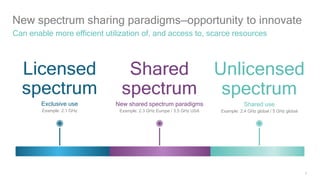
New spectrum sharing paradigms—opportunity to innovate
Can enable more efficient utilization of, and access to, scarce resources
Licensed
spectrum
Exclusive use
Example: 2.1 GHz
Shared
spectrum
New shared spectrum paradigms
Example: 2.3 GHz Europe / 3.5 GHz USA
Unlicensed
spectrum
Shared use
Example: 2.4 GHz global / 5 GHz global
3
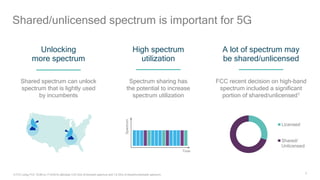
Shared/unlicensed spectrum is important for 5G
1) FCC ruling FCC 16-89 on 7/14/2016 allocated 3.25 GHz of licensed spectrum and 7.6 GHz of shared/unlicensed spectrum.
Shared spectrum can unlock
spectrum that is lightly used
by incumbents
Unlocking
more spectrum
High spectrum
utilization
A lot of spectrum may
be shared/unlicensed
Spectrum sharing has
the potential to increase
spectrum utilization
FCC recent decision on high-band
spectrum included a significant
portion of shared/unlicensed1
Licensed
Shared/
Unlicensed
Time
Spectrum
4
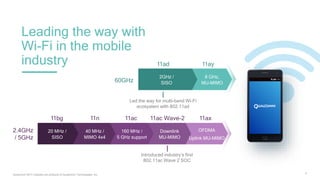
2.4GHz
/ 5GHz
60GHz
11ad 11ay
2GHz /
SISO
8 GHz,
MU-MIMO
Led the way for multi-band Wi-Fi
ecosystem with 802.11ad
11bg 11n 11ac 11ac Wave-2 11ax
20 MHz /
SISO
40 MHz /
MIMO 4x4
160 MHz /
5 GHz support
Downlink
MU-MIMO
OFDMA
Uplink MU-MIMO
Introduced industry’s first
802.11ac Wave 2 SOC
Leading the way with
Wi-Fi in the mobile
industry
Qualcomm Wi-Fi chipsets are products of Qualcomm Technologies, Inc.
5
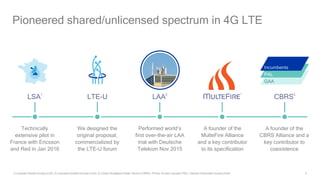
Pioneered shared/unlicensed spectrum in 4G LTE
1) Licensed Shared Access (LSA); 2) Licensed-Assisted Access (LAA); 3) Citizen Broadband Radio Service (CBRS), Priority Access Licenses (PAL), General Authorized Access (GAA)
Technically
extensive pilot in
France with Ericsson
and Red in Jan 2016
LSA1
We designed the
original proposal,
commercialized by
the LTE-U forum
LTE-U
Performed world’s
first over-the-air LAA
trial with Deutsche
Telekom Nov 2015
LAA2
A founder of the
MulteFire Alliance
and a key contributor
to its specification
A founder of the
CBRS Alliance and a
key contributor to
coexistence
CBRS3
Incumbents
PAL
GAA
6
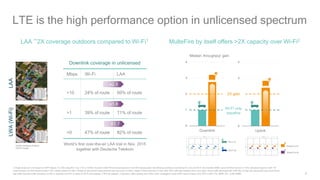
LTE is the high performance option in unlicensed spectrum
1) Single small cell, LAA based on 3GPP release 13; LWA using 802.11ac; LTE on 10 MHz channel in 2600 MHz licensed spectrum with 4W transmit power; the following conditions are identical for LAA and Wi-Fi: 2x2 downlink MIMO, same 20 MHz channel in 5 GHz unlicensed spectrum with 1W
transmit power. terminal transmit power 0.2W, mobility speed 6-8 mph; 2 Based on geo-binned measurements over test route; 2) Indoor, single 20 MHz channel in 5 GHz, 80%-20% traffic split between down- and uplink, bursty traffic generated with 4 Mb files arriving with exponential inter arrival times,
high traffic load with buffer occupancy at 50% in downlink and 20% in uplink for Wi-Fi only baseline, 4 APs per operator, 2 operators, office building size 120m x 50m, propagation model 3GPP indoor hotspot (InH), Wi-Fi is 802.11ac, MIMO 2x2, no MU-MIMO
LAA ~2X coverage outdoors compared to Wi-Fi1 MulteFire by itself offers >2X capacity over Wi-Fi2
World’s first over-the-air LAA trial in Nov. 2015
together with Deutsche Telekom
LWA(Wi-Fi)LAA
©2009 GeoBasis-DE/BKG,
©2016 Google
7
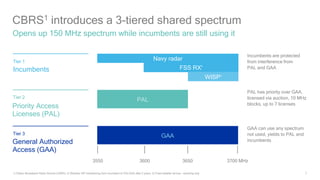
CBRS1 introduces a 3-tiered shared spectrum
Opens up 150 MHz spectrum while incumbents are still using it
1) Citizen Broadband Radio Service (CBRS); 2) Wireless ISP transitioning from incumbent to PAL/GAA after 5 years; 3) Fixed satellite service – receiving only
Incumbents are protected
from interference from
PAL and GAA
PAL has priority over GAA,
licensed via auction, 10 MHz
blocks, up to 7 licenses
GAA can use any spectrum
not used, yields to PAL and
incumbents
Incumbents
Priority Access
Licenses (PAL)
General Authorized
Access (GAA)
Tier 1
Tier 2
Tier 3
Navy radar
FSS RX3
PAL
WISP2
3550 3600 3700 MHz3650
GAA
8
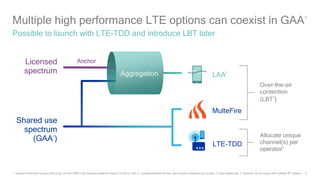
Multiple high performance LTE options can coexist in GAA1
Possible to launch with LTE-TDD and introduce LBT later
1. General Authorized Access (GAA) is tier 3 in the CBRS 3-tier licensing model for shared 3.5 GHz in USA; 2. Licensed-Assisted Access, also includes enhanced LAA (eLAA); 3. Listen before talk; 4. Channels can be reused with sufficient RF isolation
LTE-TDD
Licensed
spectrum
Shared use
spectrum
(GAA1
)
LAA2
Anchor
Over-the-air
contention
(LBT3
)
Allocate unique
channel(s) per
operator4
MulteFire
Aggregation
9
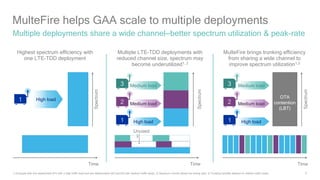
MulteFire helps GAA scale to multiple deployments
Multiple deployments share a wide channel—better spectrum utilization & peak-rate
1) Example with one deployment (#1) with a high traffic load and two deployments (#2 and #3) with medium traffic loads; 2) Spectrum cannot always be evenly split; 3) Trunking benefits depend on relative traffic loads.
Highest spectrum efficiency with
one LTE-TDD deployment
MulteFire brings trunking efficiency
from sharing a wide channel to
improve spectrum utilization1,3
1 OTA
contention
(LBT)
Time Time
Spectrum
Spectrum
High load
2
3
1
Medium load
High load
Medium load
Multiple LTE-TDD deployments with
reduced channel size, spectrum may
become underutilized1, 2
Time
Spectrum
Unused
2
3
1
Medium load
High load
Medium load
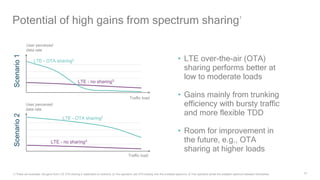
101) These are examples, the gains from LTE OTA sharing is dependent on scenario; 2) Two operators use OTA sharing over the available spectrum; 3) Two operators divide the available spectrum between themselves.
Potential of high gains from spectrum sharing1
LTE - no sharing3
LTE - OTA sharing2
Traffic load
Scenario2
LTE - no sharing3
LTE - OTA sharing2
User perceived
data rate
Scenario1
• LTE over-the-air (OTA)
sharing performs better at
low to moderate loads
• Gains mainly from trunking
efficiency with bursty traffic
and more flexible TDD
• Room for improvement in
the future, e.g., OTA
sharing at higher loads
Traffic load
User perceived
data rate
11
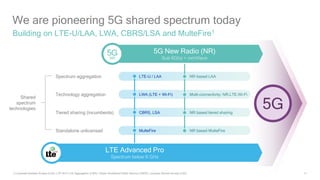
We are pioneering 5G shared spectrum today
Building on LTE-U/LAA, LWA, CBRS/LSA and MulteFire1
1) Licensed-Assisted Access (LAA), LTE Wi-Fi Link Aggregation (LWA), Citizen Broadband Radio Service (CBRS), Licensed Shared Access (LSA)
Tiered sharing (incumbents)
Spectrum aggregation
Technology aggregation
Standalone unlicensed MulteFire
LTE-U / LAA
LWA (LTE + Wi-Fi)
CBRS, LSA
NR based MulteFire
NR based LAA
Multi-connectivity: NR,LTE,Wi-Fi
NR based tiered sharing
5G New Radio (NR)
Sub 6Ghz + mmWave
LTE Advanced Pro
Spectrum below 6 GHz
Shared
spectrum
technologies
12
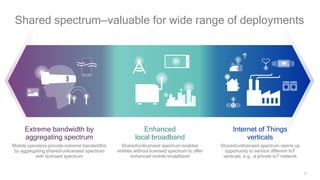
Shared spectrum—valuable for wide range of deployments
Enhanced
local broadband
Shared/unlicensed spectrum enables
entities without licensed spectrum to offer
enhanced mobile broadband
Internet of Things
verticals
Shared/unlicensed spectrum opens up
opportunity to service different IoT
verticals, e.g., a private IoT network
Extreme bandwidth by
aggregating spectrum
Mobile operators provide extreme bandwidths
by aggregating shared/unlicensed spectrum
with licensed spectrum
13
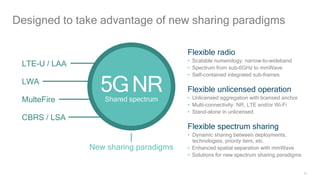
Designed to take advantage of new sharing paradigms
Flexible radio
• Scalable numerology: narrow-to-wideband
• Spectrum from sub-6GHz to mmWave
• Self-contained integrated sub-frames
Flexible unlicensed operation
• Unlicensed aggregation with licensed anchor
• Multi-connectivity: NR, LTE and/or Wi-Fi
• Stand-alone in unlicensed
Flexible spectrum sharing
• Dynamic sharing between deployments,
technologies, priority tiers, etc.
• Enhanced spatial separation with mmWave
• Solutions for new spectrum sharing paradigms
5GNRShared spectrum
LTE-U / LAA
LWA
MulteFire
CBRS / LSA
New sharing paradigms
14
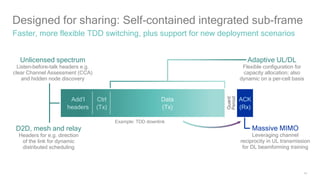
Unlicensed spectrum
Listen-before-talk headers e.g.
clear Channel Assessment (CCA)
and hidden node discovery
Designed for sharing: Self-contained integrated sub-frame
Faster, more flexible TDD switching, plus support for new deployment scenarios
D2D, mesh and relay
Headers for e.g. direction
of the link for dynamic
distributed scheduling
Adaptive UL/DL
Flexible configuration for
capacity allocation; also
dynamic on a per-cell basis
Massive MIMO
Leveraging channel
reciprocity in UL transmission
for DL beamforming training
Guard
Period
Add’l
headers
ACK
(Rx)
Ctrl
(Tx)
Data
(Tx)
Example: TDD downlink
15
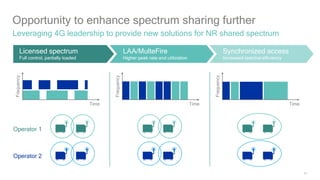
Opportunity to enhance spectrum sharing further
Leveraging 4G leadership to provide new solutions for NR shared spectrum
Operator 1
Frequency
Time
Operator 2
LAA/MulteFire
Higher peak rate and utilization
Licensed spectrum
Full control, partially loaded
Synchronized access
Increased spectral efficiency
Frequency
Time
Frequency
Time
16
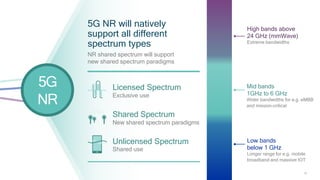
5G NR will natively
support all different
spectrum types
NR shared spectrum will support
new shared spectrum paradigms
Low bands
below 1 GHz
Longer range for e.g. mobile
broadband and massive IOT
Mid bands
1GHz to 6 GHz
Wider bandwidths for e.g. eMBB
and mission-critical
High bands above
24 GHz (mmWave)
Extreme bandwidths
Licensed Spectrum
Exclusive use
Shared Spectrum
New shared spectrum paradigms
Unlicensed Spectrum
Shared use
5G
NR
Follow us on:
For more information, visit us at:
www.qualcomm.com & www.qualcomm.com/blog
Nothing in these materials is an offer to sell any of the components or devices referenced herein.
©2016 Qualcomm Technologies, Inc. and/or its affiliated companies. All Rights Reserved.
Qualcomm is a trademark of Qualcomm Incorporated, registered in the United States and other countries. Other products and brand names
may be trademarks or registered trademarks of their respective owners.
References in this presentation to “Qualcomm” may mean Qualcomm Incorporated, Qualcomm Technologies, Inc., and/or other subsidiaries
or business units within the Qualcomm corporate structure, as applicable. Qualcomm Incorporated includes Qualcomm’s licensing business,
QTL, and the vast majority of its patent portfolio. Qualcomm Technologies, Inc., a wholly-owned subsidiary of Qualcomm Incorporated,
operates, along with its subsidiaries, substantially all of Qualcomm’s engineering, research and development functions, and substantially all
of its product and services businesses, including its semiconductor business, QCT.
Thank you

5G Shared Spectrum

  • 1.
    5G Shared Spectrum QualcommTechnologies, Inc. September 2016 #whywait @Qualcomm
  • 2.
    2 New spectrum sharingparadigms—opportunity to innovate Can enable more efficient utilization of, and access to, scarce resources Licensed spectrum Exclusive use Example: 2.1 GHz Shared spectrum New shared spectrum paradigms Example: 2.3 GHz Europe / 3.5 GHz USA Unlicensed spectrum Shared use Example: 2.4 GHz global / 5 GHz global
  • 3.
    3 Shared/unlicensed spectrum isimportant for 5G 1) FCC ruling FCC 16-89 on 7/14/2016 allocated 3.25 GHz of licensed spectrum and 7.6 GHz of shared/unlicensed spectrum. Shared spectrum can unlock spectrum that is lightly used by incumbents Unlocking more spectrum High spectrum utilization A lot of spectrum may be shared/unlicensed Spectrum sharing has the potential to increase spectrum utilization FCC recent decision on high-band spectrum included a significant portion of shared/unlicensed1 Licensed Shared/ Unlicensed Time Spectrum
  • 4.
    4 2.4GHz / 5GHz 60GHz 11ad 11ay 2GHz/ SISO 8 GHz, MU-MIMO Led the way for multi-band Wi-Fi ecosystem with 802.11ad 11bg 11n 11ac 11ac Wave-2 11ax 20 MHz / SISO 40 MHz / MIMO 4x4 160 MHz / 5 GHz support Downlink MU-MIMO OFDMA Uplink MU-MIMO Introduced industry’s first 802.11ac Wave 2 SOC Leading the way with Wi-Fi in the mobile industry Qualcomm Wi-Fi chipsets are products of Qualcomm Technologies, Inc.
  • 5.
    5 Pioneered shared/unlicensed spectrumin 4G LTE 1) Licensed Shared Access (LSA); 2) Licensed-Assisted Access (LAA); 3) Citizen Broadband Radio Service (CBRS), Priority Access Licenses (PAL), General Authorized Access (GAA) Technically extensive pilot in France with Ericsson and Red in Jan 2016 LSA1 We designed the original proposal, commercialized by the LTE-U forum LTE-U Performed world’s first over-the-air LAA trial with Deutsche Telekom Nov 2015 LAA2 A founder of the MulteFire Alliance and a key contributor to its specification A founder of the CBRS Alliance and a key contributor to coexistence CBRS3 Incumbents PAL GAA
  • 6.
    6 LTE is thehigh performance option in unlicensed spectrum 1) Single small cell, LAA based on 3GPP release 13; LWA using 802.11ac; LTE on 10 MHz channel in 2600 MHz licensed spectrum with 4W transmit power; the following conditions are identical for LAA and Wi-Fi: 2x2 downlink MIMO, same 20 MHz channel in 5 GHz unlicensed spectrum with 1W transmit power. terminal transmit power 0.2W, mobility speed 6-8 mph; 2 Based on geo-binned measurements over test route; 2) Indoor, single 20 MHz channel in 5 GHz, 80%-20% traffic split between down- and uplink, bursty traffic generated with 4 Mb files arriving with exponential inter arrival times, high traffic load with buffer occupancy at 50% in downlink and 20% in uplink for Wi-Fi only baseline, 4 APs per operator, 2 operators, office building size 120m x 50m, propagation model 3GPP indoor hotspot (InH), Wi-Fi is 802.11ac, MIMO 2x2, no MU-MIMO LAA ~2X coverage outdoors compared to Wi-Fi1 MulteFire by itself offers >2X capacity over Wi-Fi2 World’s first over-the-air LAA trial in Nov. 2015 together with Deutsche Telekom LWA(Wi-Fi)LAA ©2009 GeoBasis-DE/BKG, ©2016 Google
  • 7.
    7 CBRS1 introduces a3-tiered shared spectrum Opens up 150 MHz spectrum while incumbents are still using it 1) Citizen Broadband Radio Service (CBRS); 2) Wireless ISP transitioning from incumbent to PAL/GAA after 5 years; 3) Fixed satellite service – receiving only Incumbents are protected from interference from PAL and GAA PAL has priority over GAA, licensed via auction, 10 MHz blocks, up to 7 licenses GAA can use any spectrum not used, yields to PAL and incumbents Incumbents Priority Access Licenses (PAL) General Authorized Access (GAA) Tier 1 Tier 2 Tier 3 Navy radar FSS RX3 PAL WISP2 3550 3600 3700 MHz3650 GAA
  • 8.
    8 Multiple high performanceLTE options can coexist in GAA1 Possible to launch with LTE-TDD and introduce LBT later 1. General Authorized Access (GAA) is tier 3 in the CBRS 3-tier licensing model for shared 3.5 GHz in USA; 2. Licensed-Assisted Access, also includes enhanced LAA (eLAA); 3. Listen before talk; 4. Channels can be reused with sufficient RF isolation LTE-TDD Licensed spectrum Shared use spectrum (GAA1 ) LAA2 Anchor Over-the-air contention (LBT3 ) Allocate unique channel(s) per operator4 MulteFire Aggregation
  • 9.
    9 MulteFire helps GAAscale to multiple deployments Multiple deployments share a wide channel—better spectrum utilization & peak-rate 1) Example with one deployment (#1) with a high traffic load and two deployments (#2 and #3) with medium traffic loads; 2) Spectrum cannot always be evenly split; 3) Trunking benefits depend on relative traffic loads. Highest spectrum efficiency with one LTE-TDD deployment MulteFire brings trunking efficiency from sharing a wide channel to improve spectrum utilization1,3 1 OTA contention (LBT) Time Time Spectrum Spectrum High load 2 3 1 Medium load High load Medium load Multiple LTE-TDD deployments with reduced channel size, spectrum may become underutilized1, 2 Time Spectrum Unused 2 3 1 Medium load High load Medium load
  • 10.
    101) These areexamples, the gains from LTE OTA sharing is dependent on scenario; 2) Two operators use OTA sharing over the available spectrum; 3) Two operators divide the available spectrum between themselves. Potential of high gains from spectrum sharing1 LTE - no sharing3 LTE - OTA sharing2 Traffic load Scenario2 LTE - no sharing3 LTE - OTA sharing2 User perceived data rate Scenario1 • LTE over-the-air (OTA) sharing performs better at low to moderate loads • Gains mainly from trunking efficiency with bursty traffic and more flexible TDD • Room for improvement in the future, e.g., OTA sharing at higher loads Traffic load User perceived data rate
  • 11.
    11 We are pioneering5G shared spectrum today Building on LTE-U/LAA, LWA, CBRS/LSA and MulteFire1 1) Licensed-Assisted Access (LAA), LTE Wi-Fi Link Aggregation (LWA), Citizen Broadband Radio Service (CBRS), Licensed Shared Access (LSA) Tiered sharing (incumbents) Spectrum aggregation Technology aggregation Standalone unlicensed MulteFire LTE-U / LAA LWA (LTE + Wi-Fi) CBRS, LSA NR based MulteFire NR based LAA Multi-connectivity: NR,LTE,Wi-Fi NR based tiered sharing 5G New Radio (NR) Sub 6Ghz + mmWave LTE Advanced Pro Spectrum below 6 GHz Shared spectrum technologies
  • 12.
    12 Shared spectrum—valuable forwide range of deployments Enhanced local broadband Shared/unlicensed spectrum enables entities without licensed spectrum to offer enhanced mobile broadband Internet of Things verticals Shared/unlicensed spectrum opens up opportunity to service different IoT verticals, e.g., a private IoT network Extreme bandwidth by aggregating spectrum Mobile operators provide extreme bandwidths by aggregating shared/unlicensed spectrum with licensed spectrum
  • 13.
    13 Designed to takeadvantage of new sharing paradigms Flexible radio • Scalable numerology: narrow-to-wideband • Spectrum from sub-6GHz to mmWave • Self-contained integrated sub-frames Flexible unlicensed operation • Unlicensed aggregation with licensed anchor • Multi-connectivity: NR, LTE and/or Wi-Fi • Stand-alone in unlicensed Flexible spectrum sharing • Dynamic sharing between deployments, technologies, priority tiers, etc. • Enhanced spatial separation with mmWave • Solutions for new spectrum sharing paradigms 5GNRShared spectrum LTE-U / LAA LWA MulteFire CBRS / LSA New sharing paradigms
  • 14.
    14 Unlicensed spectrum Listen-before-talk headerse.g. clear Channel Assessment (CCA) and hidden node discovery Designed for sharing: Self-contained integrated sub-frame Faster, more flexible TDD switching, plus support for new deployment scenarios D2D, mesh and relay Headers for e.g. direction of the link for dynamic distributed scheduling Adaptive UL/DL Flexible configuration for capacity allocation; also dynamic on a per-cell basis Massive MIMO Leveraging channel reciprocity in UL transmission for DL beamforming training Guard Period Add’l headers ACK (Rx) Ctrl (Tx) Data (Tx) Example: TDD downlink
  • 15.
    15 Opportunity to enhancespectrum sharing further Leveraging 4G leadership to provide new solutions for NR shared spectrum Operator 1 Frequency Time Operator 2 LAA/MulteFire Higher peak rate and utilization Licensed spectrum Full control, partially loaded Synchronized access Increased spectral efficiency Frequency Time Frequency Time
  • 16.
    16 5G NR willnatively support all different spectrum types NR shared spectrum will support new shared spectrum paradigms Low bands below 1 GHz Longer range for e.g. mobile broadband and massive IOT Mid bands 1GHz to 6 GHz Wider bandwidths for e.g. eMBB and mission-critical High bands above 24 GHz (mmWave) Extreme bandwidths Licensed Spectrum Exclusive use Shared Spectrum New shared spectrum paradigms Unlicensed Spectrum Shared use 5G NR
  • 17.
    Follow us on: Formore information, visit us at: www.qualcomm.com & www.qualcomm.com/blog Nothing in these materials is an offer to sell any of the components or devices referenced herein. ©2016 Qualcomm Technologies, Inc. and/or its affiliated companies. All Rights Reserved. Qualcomm is a trademark of Qualcomm Incorporated, registered in the United States and other countries. Other products and brand names may be trademarks or registered trademarks of their respective owners. References in this presentation to “Qualcomm” may mean Qualcomm Incorporated, Qualcomm Technologies, Inc., and/or other subsidiaries or business units within the Qualcomm corporate structure, as applicable. Qualcomm Incorporated includes Qualcomm’s licensing business, QTL, and the vast majority of its patent portfolio. Qualcomm Technologies, Inc., a wholly-owned subsidiary of Qualcomm Incorporated, operates, along with its subsidiaries, substantially all of Qualcomm’s engineering, research and development functions, and substantially all of its product and services businesses, including its semiconductor business, QCT. Thank you