Long Term Evolution(LTE)

    4G Mobile Broadband
LTE Technology in summary


 Technology evolution

 3GPP evolution of the mobile networks
 Technology based three pillars: Flat IP, OFDM, MIMO
 To provide higher data throughput, higher capacity,
  Low latency, at lower cost
LTE Specifications


   Peak LTE throughput
     •   Downlink : 173Mb/s 2x2 MIMO; 326Mb/s 4x4 MIMO for 20 MHz
     •   Uplink: 86Mb/s SIMO
   Spectrum efficiency
     •   Downlink: 3-4 times HSDPA for MIMO (2,2)
     •   Uplink: 2-3 times HSUPA for MIMO(1,2)
   Ultra low latency : wired user experience
     •   Call setup times : < 100ms
     •   Round trip delay : 10ms from UE to server
   Capacity
     •   200 users for 5MHz, 400 users in larger spectrum allocations (active state)
   Mobility
     •   LTE is optimized for low speeds 0-15km/h but mobility is maintained for speeds up
         to 450km/h
     •   Handover between 3G & LTE
   Frequency Spectrum :
     •   Scalable bandwidth : 1.4, 2.5, 5, 10, 15, 20MHz
     •   To cover all frequencies of IMT-2000: 450 MHz to 2.5 GHz
Next Generation Mobile Network
       (NGMN) Alliance


    19 worldwide leading mobile operators
LTE Roadmap
Why LTE ?

 Improved Quality of Experience & New Services
 With LTE delivering even higher peak throughput and much
  lower latency,
 mobile operators (either 3GPP or 3GPP2 based) have a unique
  opportunity to evolve their existing infrastructure to next
  generation wireless networks
 Deliver their subscriber’s Quality of Experience (QoE)
  expectations in terms of real-time services such as Voice Over IP,
  Multi-User Gaming Over IP, High Definition Video On Demand
  and Live TV
 also continue to improve the quality of delivery for all legacy
  applications (e-mail, internet browsing, MMS, etc.
LTE VS Wimax


In terms of technology, WiMAX and LTE are very similar
below are major differences

 Long Term Evolution (LTE) started out as a 3GPP project “focused
  on enhancing the Universal Terrestrial Radio Access (UTRA) and
  optimizing 3GPP’s radio access architecture,” according to the 3GPP
  website
 WiMAX evolved from a Wi-Fi, IP-based background. WiMAX went
  through several stages of development, yet always used the IEEE
  802.16 standard established by the IEEE Standards
 LTE is faster
 WiMAX has more ubiquity
LTE VS Wimax


 LTE is designed to be backwards compatible with GSM and HSPA. This
  means that when a mobile device exceeds the range of an LTE network, it
  can fall back on a 2.5 or 3G network assuming it has the requisite radio
  technologies.
 WiMAX standard of 802.16e known as “Mobile WiMAX” is backwards
  compatible with the previous WiMAX standard of 802.16d, known as “fixed
  WiMAX.”
 LTE require the use of a SIM in order to operate. This will be convenient
  for cellular devices that are already compatible with a SIM, but not for
  laptops and other technological devices without SIM interfaces
 WiMAX does not require a SIM or any other hardware token. Therefore, all
  authentication methods used to identify a customer’s device will be easily
  entered into several devices
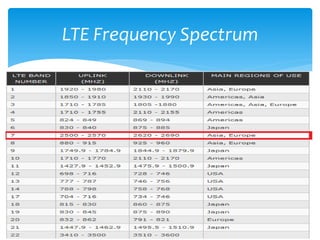
LTE Frequency Spectrum
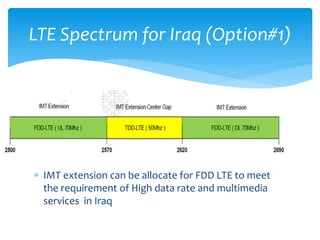
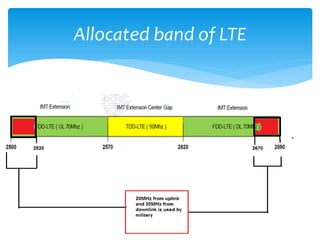
LTE Spectrum for Iraq (Option#1)


 IMT extension can be allocate for FDD LTE to meet
  the requirement of High data rate and multimedia
  services in Iraq
Allocated band of LTE
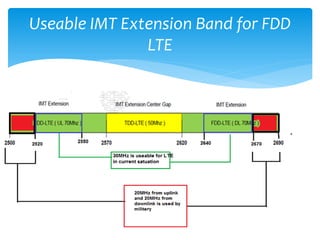
Useable IMT Extension Band for FDD
               LTE
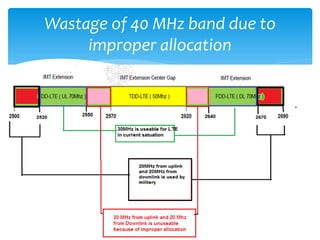
Wastage of 40 MHz band due to
     improper allocation
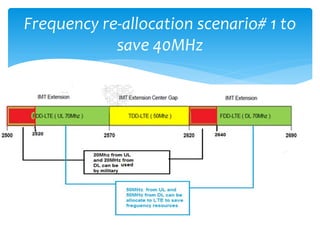
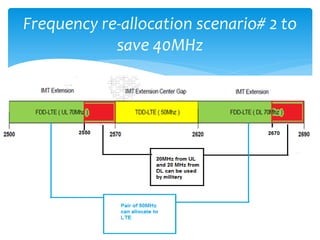
Frequency re-allocation scenario# 1 to
            save 40MHz
Frequency re-allocation scenario# 2 to
            save 40MHz
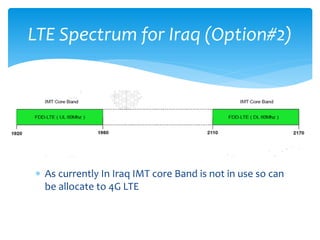
LTE Spectrum for Iraq (Option#2)


 As currently In Iraq IMT core Band is not in use so can
  be allocate to 4G LTE

Long term evolution (lte)

  • 1.
    Long Term Evolution(LTE) 4G Mobile Broadband
  • 2.
    LTE Technology insummary  Technology evolution  3GPP evolution of the mobile networks  Technology based three pillars: Flat IP, OFDM, MIMO  To provide higher data throughput, higher capacity, Low latency, at lower cost
  • 3.
    LTE Specifications  Peak LTE throughput • Downlink : 173Mb/s 2x2 MIMO; 326Mb/s 4x4 MIMO for 20 MHz • Uplink: 86Mb/s SIMO  Spectrum efficiency • Downlink: 3-4 times HSDPA for MIMO (2,2) • Uplink: 2-3 times HSUPA for MIMO(1,2)  Ultra low latency : wired user experience • Call setup times : < 100ms • Round trip delay : 10ms from UE to server  Capacity • 200 users for 5MHz, 400 users in larger spectrum allocations (active state)  Mobility • LTE is optimized for low speeds 0-15km/h but mobility is maintained for speeds up to 450km/h • Handover between 3G & LTE  Frequency Spectrum : • Scalable bandwidth : 1.4, 2.5, 5, 10, 15, 20MHz • To cover all frequencies of IMT-2000: 450 MHz to 2.5 GHz
  • 4.
    Next Generation MobileNetwork (NGMN) Alliance 19 worldwide leading mobile operators
  • 5.
  • 6.
    Why LTE ? Improved Quality of Experience & New Services  With LTE delivering even higher peak throughput and much lower latency,  mobile operators (either 3GPP or 3GPP2 based) have a unique opportunity to evolve their existing infrastructure to next generation wireless networks  Deliver their subscriber’s Quality of Experience (QoE) expectations in terms of real-time services such as Voice Over IP, Multi-User Gaming Over IP, High Definition Video On Demand and Live TV  also continue to improve the quality of delivery for all legacy applications (e-mail, internet browsing, MMS, etc.
  • 7.
    LTE VS Wimax Interms of technology, WiMAX and LTE are very similar below are major differences  Long Term Evolution (LTE) started out as a 3GPP project “focused on enhancing the Universal Terrestrial Radio Access (UTRA) and optimizing 3GPP’s radio access architecture,” according to the 3GPP website  WiMAX evolved from a Wi-Fi, IP-based background. WiMAX went through several stages of development, yet always used the IEEE 802.16 standard established by the IEEE Standards  LTE is faster  WiMAX has more ubiquity
  • 8.
    LTE VS Wimax LTE is designed to be backwards compatible with GSM and HSPA. This means that when a mobile device exceeds the range of an LTE network, it can fall back on a 2.5 or 3G network assuming it has the requisite radio technologies.  WiMAX standard of 802.16e known as “Mobile WiMAX” is backwards compatible with the previous WiMAX standard of 802.16d, known as “fixed WiMAX.”  LTE require the use of a SIM in order to operate. This will be convenient for cellular devices that are already compatible with a SIM, but not for laptops and other technological devices without SIM interfaces  WiMAX does not require a SIM or any other hardware token. Therefore, all authentication methods used to identify a customer’s device will be easily entered into several devices
  • 9.
  • 10.
    LTE Spectrum forIraq (Option#1)  IMT extension can be allocate for FDD LTE to meet the requirement of High data rate and multimedia services in Iraq
  • 11.
  • 12.
    Useable IMT ExtensionBand for FDD LTE
  • 13.
    Wastage of 40MHz band due to improper allocation
  • 14.
  • 15.
  • 16.
    LTE Spectrum forIraq (Option#2)  As currently In Iraq IMT core Band is not in use so can be allocate to 4G LTE