October 26, 2010
Evolution to LTE
INFORMATION PAPER
3GPP Long Term Evolution (LTE)
delivers capacity and data rate
speed, data throughput
enhancements and low latency,
to support new services and
features requiring higher levels of
capability and performance.
Business users and consumers
today browse the Internet or send and receive e-mails
using HSPA-enabled notebooks, or with HSPA
modems and dongles, and send/receive video or
music on 3G/HSPA phones. LTE is the next step in
the user experience, which will enhance more
demanding applications such as interactive TV,
mobile video blogging, advanced games and
professional services. Downlink and uplink data rates
are significantly higher, supported by the necessary
network architecture and technology enhancements.
LTE reduces the cost per Gigabyte of data delivered,
which is essential to address the mass market. The
new system supports a full IP-based network, and
harmonization with other radio access technologies.
LTE standardization – which covers both FDD and
TDD modes, is complete and approved by 3GPP
within Release 8, and is the basis for initial LTE
deployments worldwide.
LTE is on track, attracting global industry support.
Modern infrastructure solutions offer an easy upgrade
path to LTE. With the HSPA mobile broadband eco-
system in place, LTE is the natural migration choice
for GSM/HSPA network operators. As a result of
collaboration between 3GPP, 3GPP2 and IEEE, there
is a roadmap for CDMA operators to evolve to LTE as
their clear mobile broadband system of choice.
The majority of LTE commitments and deployments
are for the paired spectrum (FDD) mode. The LTE
TDD mode for unpaired spectrum is complementary
and key for several markets. LTE TDD also provides
a future-proof evolutionary path for TD-SCDMA,
another 3GPP standard. An LTE TDD demonstration
network is live at the 2010 World Expo, Shanghai with
several leading vendors being involved, with the
results confirming they are ready and that the
technology is ready to go.
The uptake of LTE is a global phenomenon. All
existing 3G technologies can harmonize to LTE. With
LTE we have one single global standard, which in
turn will secure and drive even higher economies of
scale and also simplify roaming.
156 operators in 64 countries are
investing in LTE
 113 LTE network commitments in 46 countries
 43 additional pre-commitment LTE trials
 At least 55 LTE networks are anticipated to be
in commercial service by end 2012
Evolution to LTE report (GSA) – October 26, 2010
GSA believes that LTE will be the choice for many
more operators and be introduced according to
business needs. Several more operators are
testing/trialing LTE and further announcements from
them are expected. Availability of new spectrum,
particularly in the 2.6 GHz and Digital Dividend bands
(700, 800 MHz), is a crucial factor for LTE
deployments in many countries, as well as regulatory
conditions, and will directly determine deployment
and service launch dates in most markets.
Spectrum for LTE deployments
LTE can be deployed in existing 2G and 3G system
spectrum, as well as utilize new spectrum such as 2.6
GHz currently being allocated in many parts of the
world, and the 700 MHz band which was auctioned
as part of the Digital Dividend, starting in the USA.
Initial deployments in Japan are using 800 MHz, 1.5
7 commercial LTE systems are
launched:
TeliaSonera - Norway
TeliaSonera - Sweden
MTS - Uzbekistan
Ucell - Uzbekistan
Mobyland and CenterNet - Poland
MetroPCS - USA
Mobilkom - Austria
Evolution to LTE report (GSA) - October 26, 2010
October 26, 2010
Evolution to LTE
INFORMATION PAPER
GHz and 1.7 GHz depending on the operator, and
according to the local situation. There is also high
interest in opportunities for LTE deployments using
frequencies released by spectrum re-farming, e.g. in
the GSM 900 MHz band and the 1800 MHz band
which are now being relaxed by regulators (e.g. in
Europe) to enable mobile broadband services using
technologies such as LTE. There are high
expectations in Europe and elsewhere to access
additional UHF bands from the Digital Dividend (800
MHz), to enable LTE to be globally deployed
efficiently over large geographical areas, and to
improve in-building coverage.
LTE ensures a smooth evolution from current 3GPP
and 3GPP2 systems, and is a major step towards
IMT-Advanced (i.e. 4G). LTE includes many features
originally considered for a future 4G system and
utilizes a new radio air interface technology -
Orthogonal Frequency Division Multiple Access
(OFDMA) to provide several key benefits, including
significantly increased peak data rates, increased cell
edge performance, reduced latency, scalable
bandwidth, co-existence with GSM/EDGE/UMTS
systems, and lower CAPEX/OPEX costs.
Targets for LTE include:
 Instantaneous downlink peak data rate of at least
100 Mb/s within 20 MHz allocation (5 bps/Hz)
 Instantaneous uplink peak data rate of 50 Mb/s
(2.5 bps/Hz within a 20MHz uplink allocation)
 Downlink: average user throughput per MHz, 3 to
4 times Release 6 HSDPA
 Uplink: average user throughput per MHz, 2-3
times Release 6 Enhanced Uplink
 E-UTRAN optimized for low mobile speed: 0-15
km/h. Higher mobile speed between 15-120 km/h
should be supported with high performance.
Mobility across the cellular network shall be
maintained at speeds 120 km/h-350 km/h (or even
up to 500 km/h depending on the frequency band)
 Spectrum flexibility: scalable to operate in 1.4,
2.5, 5, 10, 15 and 20 MHz allocations: Uplink and
downlink…paired and unpaired
 Co-existence with GERAN/3G on adjacent
channels; with other operators on adjacent
channels; overlapping or adjacent spectrum at
country borders; handover with UTRAN & GERAN
LTE radio network products incorporate several
features to simplify building and management of next-
generation networks. Plug-and-play, self-
configuration and self-optimization simplify and
reduce network rollout and management cost. LTE
will be deployed alongside simplified, IP-based core
and transport networks that are easier to build,
maintain and introduce services on.
The 3GPP core network has also undergone System
Architecture Evolution (SAE) in the same timeframe
as LTE, optimizing it for packet mode and, in
particular, for the IP-Multimedia Subsystem (IMS),
which supports all access technologies, including
fixed wire-line access. This allows:
 Improvements in latency, capacity, throughput
 Simplification of the core network, and
optimization for IP traffic and services, and
expected growth
 Simplified support & handover to non-3GPP
access technologies
The result is the evolved packet system (EPS) that
consists of the core network part, the evolved packet
core (EPC) and the radio network evolution part, the
evolved UTRAN (E-UTRAN), i.e. LTE. The EPS is
also standardized within 3GPP Release 8 (completed
March 2009) and is the baseline for implementations.
LTE TDD Systems
LTE TDD is the perfect choice for providing high
speed mobile broadband access in unpaired
spectrum. It is an integral part of the 3GPP standards
implementing a maximum of commonalities with LTE
FDD and offering comparable performance
characteristics at similarly high spectral efficiency.
LTE TDD is a real complement to LTE FDD. Within
the globally assigned IMT spectrum bands for mobile
(broadband) communication, there are significant
spectrum resources suitable for LTE TDD usage
across a wide range of frequencies. Amongst these,
the largest contiguous bands are at 2.3 GHz (100
MHz) and within the 2.6 GHz band (e.g. 50 MHz
according to the CEPT band plan).
Due to the recognized demand for radio technologies
for unpaired spectrum bands and based on the
commonalities as explained above, LTE TDD will be
able to exploit global economies of scale similar to
LTE FDD. The availability of spectrum and the
October 26, 2010
Evolution to LTE
INFORMATION PAPER
technical pre-requisites allow a short time to market.
Hence, it is likely that LTE TDD will become a globally
accepted technology, and provide an excellent
evolution path for TD-SCDMA and WiMAX™
networks. Furthermore, LTE FDD and LTE TDD have
a clear smooth evolution towards LTE-Advanced.
The growing number of LTE TDD operator
commitments, system maturity, and the expanding
eco-system are detailed further in this report.
Will HSPA+ deployments delay LTE rollout?
Many operators will invest in both HSPA+ and LTE.
GSA sees no evidence of HSPA+ uptake delaying
commitments to deploy LTE. The success of
HSPA/HSPA+ in delivering mobile broadband will fuel
demand to support more customers and for even
higher data throughputs including for new
applications, which LTE delivers. LTE brings the
opportunity for additional spectrum in Digital Dividend
(700, 800 MHz) and 2.6 GHz spectrum, initially giving
comparable throughput capacity and performance,
and will continue to improve and also benefit from
larger bandwidth deployments (up to 20 MHz) and
later evolution to LTE-Advanced.
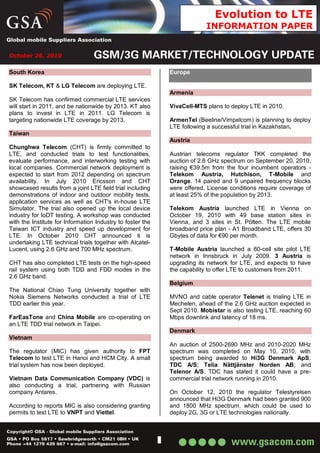
LTE network commitments, trials and plans:
global round-up
Americas
USA
On September 21, 2010 MetroPCS, a regional
carrier, became the first operator to launch LTE in the
United States. MetroPCS also offered the world’s first
commercially available 4G LTE enabled handset, the
Samsung Craft™. Service was launched initially in
Las Vegas, then extended to Dallas/Forth Worth
(launched September 29, 2010) and Detroit (October
20, 2010). The Samsung SCH-R900/Craft is also the
first multi-mode CDMA-LTE handset. LTE network
rollouts are planned for later this year and early 2011
in the remaining MetroPCS U.S. markets, including
Boston, Atlanta, Jacksonville, Los Angeles, New
York, Miami, Orlando, Philadelphia, Sacramento, San
Francisco and Tampa.
Verizon Wireless is deploying LTE in 700 MHz for
commercial launch in Q4 2010. A total of 38 cities
and 110 million people will be covered by end 2010
i.e. 70% of the population. Verizon's LTE network will
additionally cover 60 commercial airports. The LTE
network will cover 200 million people by 2012, and
285 million in 2013, which would equal the current 3G
network coverage. The launch will be supported by
dongles and datacards, with smartphones and tablets
arriving around May 2011.
AT&T Mobility is expected to launch LTE in mid-
2011, and will require that infrastructure supports 700
MHz and AWS spectrum. The company plans to
cover 70-75 million pops by end 2011 and is investing
US$ 700m this year in LTE deployment. Trials are
underway in Baltimore and Dallas. AT&T confirmed
plans to introduce Voice over LTE technology by
2013. As with Verizon's LTE launch this year, voice
service will initially operate over AT&T's 3G network,
which is being upgraded to HSPA+ shortly.
T-Mobile USA is also committed to LTE deployment.
Bay Area Regional Interoperable Communications
System (BayRICS) vision was established by the 10
Bay Area Counties and 3 core cities, of San
Francisco, Oakland, and San Jose in 2006 through
the creation of a strategic plan with the goal of
providing voice and data interoperability throughout
the Bay Area region. BayRICS is a state of the art
communications system-of-systems. Bay Area
Wireless Enhanced Broadband (BayWEB) is the
broadband component of BayRICS which has
acquired 700 MHz in which an LTE-based public
safety system will be deployed. An infrastructure
vendor has been announced (July 2010). The public
safety LTE system will be installed this year and is
targeted to be operational in early 2011.
Cellcom, a US regional carrier serving customers
throughout the Wisconsin and Michigan areas, is
deploying an LTE network. Cellular South acquired
700 MHz spectrum for virtually all of Mississippi and
Tennessee and most of Alabama and plans to deploy
LTE in the future.
CenturyTel will deploy LTE in 700 MHz from 2010.
October 26, 2010
Evolution to LTE
INFORMATION PAPER
Cable operator Cox Communications has confirmed
plans to deploy LTE and completed initial LTE tests in
Phoenix, Arizona and San Diego using AWS and
700MHz spectrum.
Leap Wireless began testing LTE in June 2010
ahead of a planned commercial network deployment.
Aircell will launch LTE in 2011 to boost the capacity
of its in-flight network.
Clearwire Corp. has requested 3GPP to standardize
LTE TDD for operation in the band 2496 – 2690 MHz
and is currently trialling TDD and FDD in Phoenix,
Arizona. Clearwire has reported nearing download
speeds of 50 Mbps using 10 MHz channels for uplink
and downlink, increasing to 90 Mbps using 20 MHz.
The company quoted as saying that the trial showed
true broadband speeds and high-quality, HD-video
would be among new services that will be offered.
As part of a $32.1 million stimulus grant, Commnet
Wireless, LLC will develop and operate an LTE
network in the Navajo Nation. The grant, plus partial
matching funds, will provide broadband infrastructure
access to the Navajo Nation across Arizona, New
Mexico and Utah, enabling fixed and mobile service
for over 30,000 households (c. 135,000 people) and
1,000 businesses in 15 of the largest communities in
the Navajo Nation, including Window Rock, Shiprock,
Kayenta, Chinle, and Tuba City. The project will also
provide high-capacity connectivity on the combined
middle-mile backbone to 49 more tribal communities.
Greenfield operator Lightsquared plans to build the
first US wholesale only LTE network, and has
selected its infrastructure supplier.
Public Service Wireless is deploying a commercial
LTE system in central and south-west Georgia
Texas Energy Network (TEN) plans to deploy a
nationwide LTE wireless broadband network, initially
targeting the oil and gas industries. A demonstration
is planned in New Mexico at end August 2010.
Canada
Rogers Wireless is evaluating LTE technology, and
on October 6, 2010 announced the launch of a
comprehensive LTE trial in the Ottawa area, initially
using AWS spectrum. Rogers is working with the
regulatory, Industry Canada, to secure a development
license to also use 700 MHz spectrum for the trial.
Bell Canada and Telus have launched a joint
HSPA+ network, which will later be upgraded to LTE.
MTS Allstream is deploying HSPA+ which provides
the company with an efficient upgrade path to LTE
Sasktel said its HSPA+ network futureproofs and
positions the company well for future LTE deployment
Shaw Communications has selected its
infrastructure supplier for planned LTE deployment in
current AWS spectrum, as well as future frequency
bands to be auctioned in Canada. Shaw said
commercial launch targets late 2011.
Regulator Industry Canada is preparing to auction
700 MHz and 2.6 GHz spectrum in 2012.
Argentina
Telefonica completed lab trials of LTE in March
2010, achieving a peak DL data speed of 95 Mbps.
Personal has tested LTE in the Puerto Madero area.
Brazil
Anatel will auction 120 MHz of 2.6 GHz spectrum,
expected mid-2013, while giving operators the option
to deploy LTE earlier should they acquire an MMDS
operator who currently holds spectrum. The 2.6 GHz
band had previously been allocated to MMDS
operators for pay TV, and they will keep 70 MHz.
Chile
Entel PCS completed the first LTE trial in Latin
America, at the Universidad de Chile. Movistar
demonstrated LTE at Connect 2009. Regulator Subtel
hopes to launch a 2.6 GHz auction procedure in
December 2010, with up to 140 MHz being granted in
2011. LTE services could be launched in 2012.
Colombia
UNE EPM recently won 50 MHz of spectrum in the
2.6 GHz band and plans to launch mobile broadband
services using LTE technology in 2H 2011.
October 26, 2010
Evolution to LTE
INFORMATION PAPER
Jamaica
Claro is reported to be deploying an LTE system.
Mexico
Telefonica Movistar and Telcel have each
undertaken testing of LTE technology. LTE was also
demonstrated during Campus Party 2010 in Mexico.
The Mexican government plans to auction 700 MHz
and 2.6 GHz. In a Decree published on September 2,
2010 in the Diario Oficial de la Federación, President
Calderon stated that the 700 MHz band should be
freed up for mobile broadband use, and said that
digital TV switchover should be completed by 2015
(this is 6 years ahead of the current plan).
Puerto Rico
According to reports, the first LTE call was completed
by Claro in San Juan on October 12, 2010.
Asia Pacific and Oceania
Australia
Telstra has been trialing LTE since May 2010,
comprizing not only urban, but also rural evaluations
and extensive laboratory trials. Working with 3
vendors, in June 2010 Telstra announced that in one
trial it had successfully achieved network speeds of
100 Mbps over a distance of 75 km in the 2.6 GHz
band. In July, Telstra announced the completion of
another LTE trial in the 1800 MHz band, in Victoria.
The 1800 MHz trial includes tests of throughput using
MIMO antenna configurations as well as several
advanced features including Inter Cell Interference
Coordination to reduce radio network interference
and improve throughput, and Self Organizing
Networks where LTE network technology
automatically optimizes its performance, reducing
operating costs while improving customer service.
Optus announced in July 2010 the successful
demonstration of LTE in 10 MHz of 2100 MHz
spectrum in metropolitan Sydney. During extensive
field testing, using pre-commercial USB dongles,
peak download speeds exceeding 50 Mbps and
upload speeds of 20 Mbps were achieved. A second
phase of testing, utilizing 1800 MHz, is planned.
Vodafone Hutchison Australia (VHA) recently
confirmed results of its LTE1800 trial being conducted
near Newcastle, NSW using 10 MHz of spectrum in
the 1800 MHz band. Further trials are planned.
In June 2010 the Australian Government confirmed it
would release 126 MHz of digital dividend spectrum
(694 – 820 MHz) due to be cleared by end 2013.
China
China Mobile is building its TD-SCDMA network so
that sites and other elements are reusable for LTE
TDD. A trial LTE TDD network at the 2010 World
Expo, Shanghai, realized a peak downlink rate of
over 80 Mbps in 20 MHz carrying uplink and downlink
traffic. The first high-definition LTE TDD video call
including handover has been demonstrated at the
Ministry of Industry and Information Technology
(MIIT) test lab in Beijing.
China Telecom is continuing to invest in CDMA and
plans to launch LTE service. According to recent
reports, the company aims to integrate LTE operation
with CDMA in 17 provinces by the end of 2010.
In Hong Kong SAR, 2 x 15 MHz blocks of 2.6 GHz
spectrum was obtained via auction each by China
Mobile (Peoples Phone), Genius Brand (Hutchison
Telecom/PCCW JV) and CSL Limited.
CSL Limited has completed deployment of an
LTE/DC-HSPA+ network, with DC-HSPA+ over the
entire territory (100% of sites) and LTE all over the
territory in the busiest sites. The company strategy is
for dual mode LTE/DC-HSPA+ devices. Efforts are
focused on accelerated testing of dual mode devices,
to allow commercial launch when CSL determines
that the devices provide satisfactory performance.
CSL Limited has also confirmed to GSA that the
network is ready for commercial service, and full
commercial launch will be announced later. The LTE
network currently uses 2.6 GHz spectrum.
Some 1800 MHz sites have been equipped for LTE
and are used for testing. More 1800 MHz sites will be
converted next year as availability of LTE1800 user
devices improves.
October 26, 2010
Evolution to LTE
INFORMATION PAPER
PCCW is deploying LTE for commercial launch in
2011.
SmarTone-Vodafone plans to deploy LTE re-using
its current GSM spectrum.
India
The BWA auction (which allows use of either LTE
TDD or WiMAX™ in unpaired 2.3 GHz spectrum),
opened with 11 companies bidding for 2 blocks in
each of the 22 circles. The government had earlier
allocated one 20 MHz unpaired spectrum block each
to MTNL and BSNL.
Infotel Broadband (95% owned by Reliance
Industries) was the only pan-India winner. Aircel won
in 8 circles. Tikona Digital won spectrum in 5 circles.
Qualcomm and Bharti Airtel won 4 circles each.
Qualcomm gained spectrum in the key circles of
Delhi, Mumbai, Haryana and Kerala and recently
announced Global Holding Corporation and Tulip
Telecom as initial shareholders for its LTE venture for
network deployment. On October 19, 2010 Nokia
Siemens Networks announced the successful
demonstration in India of a video call over LTE TDD
on commercial hardware. The call was made by
Gurdeep Singh, CEO of Aircel.
Indonesia
Telkomsel, XL Axiata, and Indosat have been
trialling LTE technology and propose to deploy LTE
networks should spectrum become available in 2013.
Japan
LTE operators use 1.5 GHz (DoCoMo and Softbank
Mobile), 1.5 GHz + 800 MHz (KDDI), and 1.7 GHz
(eMobile). DoCoMo plans commercial LTE launch in
December 2010, initially serving Tokyo, Nagoya and
Osaka areas, and later rolling out nationwide. eMobile
also plans to launch LTE in 2010.
KDDI is committed to deploying LTE and will continue
to operate its CDMA network for voice traffic. KDDI
has 20 MHz of spectrum for LTE and is working on
technical interoperability issues to ensure the network
can fall back to CDMA2000 1x for incoming voice
calls during a data session held over LTE. The cellco
is looking to launch LTE commercially in 2012 is
targeting national mobile broadband coverage to
96.5% of the country by end of 2014.
Malaysia
Maxis is trialing LTE in the Klang Valley. In July 2010
LTE with peak download speed of 60-104 Mbps was
demonstrated, using 10 MHz and 20 MHz channels.
Celcom has commenced LTE technical trials
DiGi plans to launch LTE in 2.6 GHz by 2013
WiMAX™ operator Asiaspace is exploring
deployment in the near future of LTE TDD in the 2.3
GHz band.
The regulator, MCMC, plans to allocate blocks of 2.6
GHz spectrum for LTE, and is also consulting on re-
farming 850/900/1800 spectrum. According to press
reports, Packet One Networks (P1) and REDtone are
amongst the operators who have said they will
receive frequencies in the 2.6 GHz band, and they
are in the process of submitting detailed business
plans regarding their proposed use of the spectrum.
Further spectrum allocations to additional operators
are understood to be in process.
New Zealand
Telecom New Zealand is committed to LTE, and will
be making decisions with regards to technology trials
and choices around the end of 2010. Vodafone New
Zealand has confirmed its commitment to LTE. The
Commerce Commission has indicated willingness to
discuss infrastructure sharing for LTE. New spectrum
for LTE is not expected to be available before 2013.
The Philippines
Smart Communications and Globe Telecom have
conducted LTE trials. Piltel is seeking the remaining
3G license in the country to deploy LTE services.
Singapore
StarHub is trialing LTE. M1 has completed a 100
Mbps data call on its trial LTE network. SingTel is
trialing LTE in Singapore, and overseas with carriers
in which it holds stakes i.e. SingTel Optus (Australia),
Telkomsel (Indonesia), Globe Telecom (Philippines).
October 26, 2010
Evolution to LTE
INFORMATION PAPER
South Korea
SK Telecom, KT & LG Telecom are deploying LTE.
SK Telecom has confirmed commercial LTE services
will start in 2011, and be nationwide by 2013. KT also
plans to invest in LTE in 2011. LG Telecom is
targeting nationwide LTE coverage by 2013.
Taiwan
Chunghwa Telecom (CHT) is firmly committed to
LTE, and conducted trials to test functionalities,
evaluate performance, and interworking testing with
local companies. Commercial network deployment is
expected to start from 2012 depending on spectrum
availability. In July 2010 Ericsson and CHT
showcased results from a joint LTE field trial including
demonstrations of indoor and outdoor mobility tests,
application services as well as CHT's in-house LTE
Simulator. The trial also opened up the local device
industry for IoDT testing. A workshop was conducted
with the Institute for Information Industry to foster the
Taiwan ICT industry and speed up development for
LTE. In October 2010 CHT announced it is
undertaking LTE technical trials together with Alcatel-
Lucent, using 2.6 GHz and 700 MHz spectrum.
CHT has also completed LTE tests on the high-speed
rail system using both TDD and FDD modes in the
2.6 GHz band.
The National Chiao Tung University together with
Nokia Siemens Networks conducted a trial of LTE
TDD earlier this year.
FarEasTone and China Mobile are co-operating on
an LTE TDD trial network in Taipei.
Vietnam
The regulator (MIC) has given authority to FPT
Telecom to test LTE in Hanoi and HCM City. A small
trial system has now been deployed.
Vietnam Data Communication Company (VDC) is
also conducting a trial, partnering with Russian
company Antares.
According to reports MIC is also considering granting
permits to test LTE to VNPT and Viettel.
Europe
Armenia
VivaCell-MTS plans to deploy LTE in 2010.
ArmenTel (Beeline/Vimpelcom) is planning to deploy
LTE following a successful trial in Kazakhstan.
Austria
Austrian telecoms regulator TKK completed the
auction of 2.6 GHz spectrum on September 20, 2010,
raising €39.5m from the four incumbent operators -
Telekom Austria, Hutchison, T-Mobile and
Orange. 14 paired and 9 unpaired frequency blocks
were offered. License conditions require coverage of
at least 25% of the population by 2013.
Telekom Austria launched LTE in Vienna on
October 19, 2010 with 49 base station sites in
Vienna, and 3 sites in St. Pölten. The LTE mobile
broadband price plan - A1 Broadband LTE, offers 30
Gbytes of data for €90 per month.
T-Mobile Austria launched a 60-cell site pilot LTE
network in Innsbruck in July 2009. 3 Austria is
upgrading its network for LTE, and expects to have
the capability to offer LTE to customers from 2011.
Belgium
MVNO and cable operator Telenet is trialing LTE in
Mechelen, ahead of the 2.6 GHz auction expected in
Sept 2010. Mobistar is also testing LTE, reaching 60
Mbps downlink and latency of 18 ms.
Denmark
An auction of 2500-2690 MHz and 2010-2020 MHz
spectrum was completed on May 10, 2010, with
spectrum being awarded to Hi3G Denmark ApS;
TDC A/S; Telia Nättjänster Norden AB; and
Telenor A/S. TDC has stated it could have a pre-
commercial trial network running in 2010.
On October 12, 2010 the regulator Telestyrelsen
announced that Hi3G Denmark had been granted 900
and 1800 MHz spectrum, which could be used to
deploy 2G, 3G or LTE technologies nationally.
October 26, 2010
Evolution to LTE
INFORMATION PAPER
Estonia
EMT has established an LTE test network in Tallinn
and made the first data connection in February 2010.
Tele2 Estonia is also undertaking LTE tests.
Finland
2.6 GHz licenses for LTE were awarded in an auction
ending 23 November 2009:
 Elisa obtained a 20-year license for 50 MHz. On
June 2, 2010 Elisa launched a pre-commercial
trial in Helsinki
 TeliaSonera also acquired a 20-year license for
five blocks of 2 x 5 MHz in the 2.6 GHz band and
launched an LTE network on June2, 2010 for pre-
commercial use in the city of Turku. Network
expansion will depend on local market conditions
 DNA obtained 40 MHz of 2.6 GHz spectrum
Elisa considers LTE1800 as a promising option for
many markets since it covers 2x the area compared
to deploying in 2.6 GHz, and would be ready for mass
market only a short time after 2.6 GHz (LTE1800
devices are estimated by Elisa as coming 6-12
months after LTE2600).
France
France Telecom Orange has deployed a trial LTE
network in Paris, initially with 10 MHz bandwidth
supporting both FDD and TDD modes, upgraded to
20 MHz in May 2010. FDD-TDD co-existence tests
are on-going. Service launch is expected in 2012
subject to availability of 2.6 GHz and 800 MHz
spectrum. SFR has awarded an infrastructure
contract to upgrade and expand its 2G/3G networks
and start LTE trials. Bouygues Telecom is trialing
LTE1800 in 10 MHz bandwidth using 2x2 MIMO at a
number of sites in Orléans.
On July 27, 2010 the regulator ARCEP launched a
public consultation on ways of allocating frequencies
in the 800 MHz and 2.6 GHz bands for mobile
broadband services. This consultation builds on
extensive work conducted over several months by
ARCEP, in consultation with all stakeholders.
Submissions were required by September 13, 2010,
after which ARCEP plans to finalize its proposals and
to launch proceedings by end 2010, with a view to
allocating 800 MHz and 2.6 GHz spectrum between
Spring and early Summer 2011.
Germany
After 224 rounds the spectrum auction ended on May
20, 2010 and covered 360 MHz in 4 bands: 800 MHz
(digital dividend), 1800 MHz, 2.1 GHz, 2.6 GHz. All 4
incumbents acquired 2.6 GHz to be used for LTE.
Telefonica O2, Vodafone and Deutsche Telekom
(but not E Plus) additionally acquired 800 MHz
spectrum which they will use for LTE. The 800 MHz
spectrum raised €3.576 billion, i.e. over 81.5% of the
auction’s total value. Vodafone and Deutsche
Telekom are testing and deploying LTE in 800 MHz.
Deutsche Telekom has selected its infrastructure
and services partner and expects to launch LTE800
by end 2010. O2 has announced a pilot LTE network
in Halle, starting network deployment in September
2010 in 2.6 GHz and 800 MHz spectrum. The pilot
network will be operational by end 2010, but it is not
planned to operate it commercially in the first phase.
Vodafone has selected two technology partners and
announced plans to eventually upgrade all base
stations in Germany to LTE. Work started on the LTE
upgrade at the end of September, and by next year
1,500 base stations will incorporate LTE technology.
The company has also launched an LTE-focused
website and hotline for customers.
www.vodafone.de/turbo-internet
O2 deployed an urban pilot network in Munich in
September 2010. Rural pilot networks in
Teutschenthal (near Halle) and Ebersberg (near
Munich) using 800 MHz spectrum will be activated in
November 2010. O2 customers will be able to try out
the LTE network in December 2010. Construction of
the commercial network, comprising up to 1,500 base
stations, and commercialization of the service will
begin across Germany in 2011.
Greece
Cosmote has undertaken basic LTE functionality
tests in 900 MHz and 1800 MHz spectrum and has
requested spectrum for deploying a pilot LTE network
at its technical and network headquarters in the
Marousi and Chalandri areas near to Athens.
October 26, 2010
Evolution to LTE
INFORMATION PAPER
Hungary
Telenor (ex-Pannon) has selected its infrastructure
partner to build a commercial LTE trial network.
Magyar Telekom (T-Mobile) is also trialing LTE. The
National Media and Telecoms Authority has
confirmed that tenders for mobile broadband and
Internet service licenses in the 450 MHz and 900
MHz bands, which may see a new market entrant, will
be held in 2010. Hungary has 3 mobile operators:
Magyar Telekom, Telenor Magyarország, and
Vodafone Hungary.
Ireland
LTE TDD testing has been performed by Ericsson.
Hutchison 3 Ireland is trialing 21 Mbps and 42 Mbps
HSPA+ in 2010 on the way to launching LTE services
by end 2011.
ComReg is now consulting on use of 800 and 900
MHz bands (closes October 15, 2010).
Italy
Telecom Italia has launched the 2nd phase of LTE
testing in Turin. Wind announced its infrastructure
supplier for a commercial LTE network deployment
Jersey
Clear Mobitel announced on September 17, 2010
that the company has been granted a license to test
and develop LTE in the 2.6 GHz band in Jersey.
Kazakhstan
Kcell announced on July 29, 2010 installation of an
LTE base station in Astana to showcase LTE
capabilities, and intends to deploy a commercial LTE
network. On April 26, 2010 Beeline announced
completion of LTE tests in 700 MHz, and in October
2010 announced launch of a live LTE pilot in Amalty.
Latvia
Bite, Tele2 and LMT are reported to be interested in
acquiring 2.6 GHz spectrum, though it may not be
auctioned until 2012 or 2013. Bite plans to trial LTE
in 2011 in 2.6 GHz spectrum. CDMA operator Triatel
is testing LTE in the 800 MHz band.
Lithuania
Omnitel is testing LTE, reaching 52 Mbps peak DL.
Bite Lithuania plans to trial LTE in 2011 in 2.6 GHz
spectrum. 2.6 GHz spectrum may be awarded in
2011.
Moldova
Orange Moldova conducted a 2-day public LTE
demonstration in Chisinau in July 2010.
Netherlands
2.6 GHz spectrum was auctioned in April 2010 and
resulted in spectrum being awarded to incumbents
KPN, Vodafone, T-Mobile, and newcomers Ziggo 4
and Tele2. Tele2 has built a trial network in Diemen
and Amsterdam. The unpaired spectrum was unsold.
Norway
TeliaSonera launched the world’s first LTE networks
in Oslo and Sweden in December 2009 as reported
earlier in this report.
TeleNor is committed to commercial deployment and
is trialing LTE in Oslo.
The regulator NPT has confirmed that 790-862 MHz
spectrum will be allocated for mobile broadband, and
on September 21, 2010 launched a consultation on
the future use of wireless microphones (which
currently often use 800 – 820 MHz).
Poland
On September 7, 2010 the world’s first LTE system in
1800 MHz spectrum (LTE1800) was commercially
launched by Mobyland and CenterNet. The service
uses the maximum standardized 20 MHz bandwidth.
The company is targeting to have 700 base stations
in operation covering over 7 million people by 2010.
Mobyland and CenterNet are also testing LTE TDD
in 2.5 GHz band in Aleksandrów Łódzki and Łódź.
Polish regulator UKE (Urząd Komunikacji
Elektronicznej) has launched a tender process for 2.6
GHz and digital dividend (790-862 MHz) spectrum,
October 26, 2010
Evolution to LTE
INFORMATION PAPER
which will enable operators to deploy LTE. The
auction is expected mid-2011. UOKiK (Office of
Competition and Consumer Protection) has approved
plans by PTK Centertel (Orange) and P4 (Play) to
create a combined LTE network, and this new JV will
be allowed to bid in the forthcoming 2.6 GHz auction.
Portugal
Portugal Telecom has been undertaking trials of
LTE in Portugal (via TMN) and Brazil (via Vivo)
ahead of planned launches. On March 30, 2010 TMN
gave a public demonstration of LTE in Lisbon.
Optimus is replacing its network infrastructure initially
in four regions of central Portugal which could provide
a migration path to LTE.
Vodafone Portugal wants to deploy LTE by end of
2011, the company announced during an LTE
demonstration in Porto in April 2010, subject to the
regulator, ANACOM, releasing more spectrum.
On September 28, 2010 ANACOM approved the draft
decision on the designation and availability of 790-
862 MHz spectrum for providing mobile services.
Allocation before 2015 depends on co-ordination on
technical and geographical conditions, particularly
with Spain and Morocco. This draft decision has been
opened for general consultation, with comments
required by November 3, 2010. Multiple spectrum
band auctions – including 800 MHz, 1800 MHz, 2.1
GHZ and 2.6 GHz, may be conducted in 1H 2011.
Russia
The Communications Ministry has identified four LTE
test regions, and testing should be completed by April
1, 2011.
Five operators - MTS, Vimpelcom, Tele2, Megafon
and Svyazinvest, are reported to be interested in
deploying LTE. 1800 MHz looks to be a promising
band, depending on developments elsewhere,
including how the eco-system develops.
BWA operator Yota has announced plans to shift
from WiMAX™ to LTE TDD and plans to launch the
first LTE base stations in Moscow and St. Petersburg
in 2011. The company plans a transition to LTE in
more cities in the future.
MegaFon and Rostelecom, general partners of the
Sochi 2014 Winter Olympic Games, have
successfully tested their LTE networks close to the
key Sochi site of Roza Khutor. LTE capabilities will be
showcased during the 2014 Games, with full scale
LTE tests commencing n February 2011. Rostelecom
plans to conduct LTE trials in 2.3 - 2.4 GHz spectrum
(LTE TDD) in two other Russian cities this year.
MegaFon showcased an LTE data call at the IX
International Investment Forum in Sochi in
September 2010.
Spain
Telefonica has conducted LTE field tests at its
Madrid Demonstrations Center and is trialing LTE on
its networks in Argentina, Brazil, Czech Republic,
Germany, Mexico, Peru, Slovak Republic, Spain, and
the UK. Vodafone Spain showcased LTE in
Barcelona at the 2010 Mobile World Congress.
The Ministry of Industry, Tourism and Commerce
launched in June 2010 a consultation on the re-
allocation of spectrum in the 2.6 GHz band (also re-
farming of 900 and 1800 MHz) potentially in 2011.
Sweden
TeliaSonera launched the world’s first LTE networks
in Stockholm and Norway (Oslo) in December 2009.
Tele2 Sweden and TeleNor Sweden are jointly
building an LTE network (Net4Mobility). The JV
includes spectrum sharing in 900 MHz and 2.6 GHz.
LTE launch is targeted by end 2010.
Regulator PTS plans to allocate 790–862 MHz for
mobile broadband. PTS is working on the assignment
process. An auction is planned February/March 2011.
Switzerland
Orange has announced plans to enhance coverage
and higher capacities for mobile data and voice
services, including an LTE demo platform for
customers and partners in 2010, and preparations for
LTE introduction (subject to availability of spectrum
and user devices) from 2011. Swisscom has been
running an LTE test network in Grenchen, since
September 2010, and plans commercial launch of
LTE services in 2011.
October 26, 2010
Evolution to LTE
INFORMATION PAPER
Turkey
Turkcell has been trialing LTE technology.
Ukraine
MTS-Ukraine will conduct an LTE trial in 2H 2010.
United Kingdom
O2 has tested LTE in 2.6 GHz spectrum, achieving
peak data throughputs of 135 Mps DL and 64 Mbps
UL in the lab and field, and lower latency. O2 has
been trialing LTE800 in Carlisle since mid 2010.
Clear Mobitel is trialing LTE for rural mobile
broadband access using 800 MHz in Cornwall; 300
businesses are participating. If successful, the
company will seek a license for commercial rollout as
a new market entrant.
Ofcom is expected to auction 800 MHz & 2.6 GHz
spectrum in the UK in late 2011.
Uzbekistan
MTS announced on July 28, 2010 commercial launch
of the first LTE system in the CIS and Central Asia, in
Tashkent and plans significant coverage expansion in
coming months.
Ucell commercially launched LTE in Tashkent in
August 2010.
Middle East and Africa
Bahrain
Zain Bahrain confirmed in August 2009 plans to
deploy LTE, the first announcement in the region.
The company showcased the region’s first LTE call In
March 2010, claiming a download speed of 70 Mbps.
Egypt
Vodafone Egypt is trialing LTE technology and has
achieved 100 Mbps D/L and 47 Mbps U/L speeds.
Jordan
Zain Jordan is planning to trial LTE this year and
commercial launch by 2011. Regulator TRC is inviting
comments from incumbents on future LTE licenses.
Kenya
Safaricom announced in August 2010 that the
company would commence a pre-commitment LTE
trial within next two months using existing spectrum.
Libya
Al Madar announced plans to deploy a LTE network.
Oman
Omantel showcased LTE TDD to visitors to the
Salalah Tourism Festival in July 2010
Saudi Arabia
STC is deploying LTE. Zain commenced deployment
in Q2 2010 in Riyadh in the 2.6 GHz band.
Etisalat completed LTE testing in March 2010.
South Africa
Vodacom is showcasing LTE and reportedly has
1,000 LTE-ready sites, with launch planned “when
handsets become available”.
MTN is trialling LTE in South Africa.
Cell C has also asked regulator ICASA for 2.6 GHz
spectrum.
The lack of suitable spectrum is understood to be a
big restraining factor in rolling out LTE networks.
UAE
Following successful trials, Etisalat plans to
commercially launch LTE service by end 2010.
The company showcased LTE at Gitex Technology
Week in Dubai.
October 26, 2010
Evolution to LTE
INFORMATION PAPER
LTE TDD: summary of network plans,
commitments, trials, deployments
(referencing information contained in this report)
CHINA
LTE TDD is being showcased by China Mobile and
leading industry partners at the World Expo 2010,
Shanghai. The large-scale trial network covers the
whole 5.28 sq.km site, outdoors and in 9 pavilions
and 2 demonstration centers. Several products
supporting the trial network are launched or planned
including WWAN cards, routers and dongles. Key
milestones achieved in the trial include:
 Demonstration of LTE TDD HD video
telephone in single 20 MHz spectrum with
peak downlink speeds of up to 80 Mbps
 Demonstration of VOD, video communication,
and other high-speed mobile broadband apps
 Demonstration of 24-channel video streaming
 Mobile HD video conferencing between the
trial network and another location
 Inter-Operability Test of multiple LTE TDD
USB dongles in a single mobile network cell
China Mobile is establishing 3 further trial LTE TDD
networks separately in Qingdao, Xiamen and Zhuhai.
FRANCE
Orange has deployed a trial LTE network in Paris,
initially with 10 MHz bandwidth supporting both FDD
and TDD modes, upgraded to 20 MHz in May 2010.
FDD-TDD co-existence tests are on-going.
IRELAND
LTE TDD testing has been performed under the
ComReg trial and test license program.
INDIA
India is a key market for LTE TDD following the BWA
spectrum auction. Qualcomm through its JV with local
partners is committed to LTE TDD and anticipates
commercial service from 2011. Some other BWA
spectrum winners are finalizing their technology
choice, so more winners may also choose LTE TDD.
MALAYSIA
WiMAX™ operator Asiaspace currently owns a
license to provide wireless technology services on the
2.3 GHz band, and is exploring the deployment in the
near future of LTE TDD technology.
JAPAN
Softbank Mobile (Japan) is reported to be considering
LTE TDD in 2.5 GHz spectrum it owns.
OMAN
Omantel showcased LTE TDD to visitors to the
Salalah Tourism Festival in July 2010
POLAND
Mobyland and CenterNet are testing LTE TDD in 2.5
GHz band in Aleksandrów Łódzki and Łódź.
RUSSIA
Yota is shifting from WiMAX™ to LTE TDD and plans
to launch the first LTE base stations in Moscow and
St. Petersburg in 2011. The company plans a
transition to LTE in more cities in the future.
Rostelecom plans to conduct LTE trials in 2.3 - 2.4
GHz spectrum (LTE TDD) this year.
TAIWAN
CHT has also completed LTE tests on the high-speed
rail system using both TDD and FDD modes, using
the 2.6GHz band.
The National Chiao Tung University together with
Nokia Siemens Networks conducted a trial of LTE
TDD earlier this year.
FarEasTone and China Mobile are co-operating on
an LTE TDD trial network in Taipei.
USA
Clearwire has requested 3GPP to standardize LTE
TDD for operation in the band 2496 – 2690 MHz and
on August 4, 2010 announced plans for technology
trials to test both LTE TDD and LTE FDD.
October 26, 2010
Evolution to LTE
INFORMATION PAPER
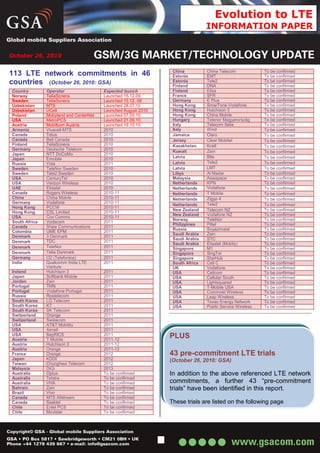
113 LTE network commitments in 46
countries (October 26, 2010: GSA)
Country Operator Expected launch
Norway TeliaSonera Launched 15.12.09
Sweden TeliaSonera Launched 15.12. 09
Uzbekistan MTS Launched 28.07.10
Uzbekistan UCell Launched August 2010
Poland Mobyland and CenterNet Launched 07.09.10
USA MetroPCS Launched 21.09.10
Austria Mobilkom Austria Launched 19.10.10
Armenia Vivacell-MTS 2010
Canada Telus 2010
Canada Bell Canada 2010
Finland TeliaSonera 2010
Germany Deutsche Telekom 2010
Japan NTT DoCoMo 2010
Japan Emobile 2010
Russia Yota 2011
Sweden TeleNor Sweden 2010
Sweden Tele2 Sweden 2010
USA CenturyTel 2010
USA Verizon Wireless 2010
UAE Etisalat 2010
Canada Rogers Wireless 2010-11
China China Mobile 2010-11
Germany Vodafone 2010-11
Hong Kong PCCW 2010-11
Hong Kong CSL Limited 2010-11
USA Cox Comms 2010-11
South Africa Vodacom 2011
Canada Shaw Communications 2011
Colombia UME EPM 2011
Denmark 3 Denmark 2011
Denmark TDC 2011
Denmark TeleNor 2011
Denmark Telia Danmark 2011
Germany O2 (Telefonica) 2011
India Qualcomm India LTE
Venture
2011
Ireland Hutchison 3 2011
Japan Softbank Mobile 2011
Jordan Zain 2011
Portugal TMN 2011
Portugal Vodafone Portugal 2011
Russia Rostelecom 2011
South Korea LG Telecom 2011
South Korea KT 2011
South Korea SK Telecom 2011
Switzerland Orange 2011
Switzerland Swisscom 2011
USA AT&T Mobility 2011
USA Aircell 2011
USA BayRICS 2011
Austria T-Mobile 2011-12
Austria Hutchison 3 2011-12
Austria Orange 2011-12
France Orange 2012
Japan KDDI 2012
Taiwan Chunghwa Telecom 2012
Malaysia DiGi 2013
Australia Optus To be confirmed
Australia Telstra To be confirmed
Australia VHA To be confirmed
Bahrain Zain To be confirmed
Brazil Vivo To be confirmed
Canada MTS Allstream To be confirmed
Canada Sasktel To be confirmed
Chile Entel PCS To be confirmed
Chile Movistar To be confirmed
China China Telecom To be confirmed
Estonia EMT To be confirmed
Estonia Tele2 To be confirmed
Finland DNA To be confirmed
Finland Elisa To be confirmed
France SFR To be confirmed
Germany E Plus To be confirmed
Hong Kong SmarTone-Vodafone To be confirmed
Hong Kong Hutchison 3 To be confirmed
Hong Kong China Mobile To be confirmed
Hungary Telenor Magyarország To be confirmed
Italy Telecom Italia To be confirmed
Italy Wind To be confirmed
Jamaica Claro To be confirmed
Jersey Clear Mobitel To be confirmed
Kazakhstan Kcell To be confirmed
Kuwait Zain To be confirmed
Latvia Bite To be confirmed
Latvia Tele2 To be confirmed
Latvia LMT To be confirmed
Libya Al Madar To be confirmed
Malaysia Asiaspace To be confirmed
Netherlands KPN To be confirmed
Netherlands Vodafone To be confirmed
Netherlands T Mobile To be confirmed
Netherlands Ziggo 4 To be confirmed
Netherlands Tele2 To be confirmed
New Zealand Telecom NZ To be confirmed
New Zealand Vodafone NZ To be confirmed
Norway TeleNor To be confirmed
Philippines Piltel To be confirmed
Russia Svyazinvest To be confirmed
Saudi Arabia Zain To be confirmed
Saudi Arabia STC To be confirmed
Saudi Arabia Etisalat (Mobily) To be confirmed
Singapore M1 To be confirmed
Singapore SingTel To be confirmed
Singapore StarHub To be confirmed
South Africa Cell C To be confirmed
UK Vodafone To be confirmed
USA Cellcom To be confirmed
USA Cellular South To be confirmed
USA Lightsquared To be confirmed
USA T-Mobile USA To be confirmed
USA Commnet Wireless To be confirmed
USA Leap Wireless To be confirmed
USA Texas Energy Network To be confirmed
USA Public Service Wireless To be confirmed
PLUS
43 pre-commitment LTE trials
(October 26, 2010: GSA)
In addition to the above referenced LTE network
commitments, a further 43 “pre-commitment
trials” have been identified in this report.
These trials are listed on the following page
October 26, 2010
Evolution to LTE
INFORMATION PAPER
43 pre-commitment LTE trials
(October 26, 2010: GSA)
Country Operator
Argentina Telefonica
Argentina Personal
Belgium Mobistar
Belgium Telenet
Brazil Telefonica
Czech Republic O2 (Telefonica)
France Bouygues Telecom
Egypt Vodafone
Greece Cosmote
Hungary Magyar Telekom (T-Mobile)
Indonesia Telkomsel
Indonesia XL Axiata
Indonesia Indosat
Latvia Bite
Latvia Triatel
Lithuania Bite
Lithuania Omnitel
Kazakhstan Vimpelcom
Kenya Safaricom
Malaysia Maxis
Malaysia Celcom
Mexico Telcel
Mexico Telefonica
Moldova Orange Moldova
Oman Omantel
Peru Telefonica
Philippines Globe Telecom
Philippines Smart
Puerto Rico Claro
Russia MTS
Russia Vimpelcom
Russia Tele2 Russia
Russia Megafon
Slovak Republic O2 (Telefonica)
South Africa MTN
Spain Telefonica
Turkey Turkcell
UK O2 (Telefonica)
UK Clear Mobitel
Ukraine MTS-Ukraine
USA Clearwire
Vietnam FPT Telecom
Vietnam VDC
Note: Many LTE trials are on-going worldwide. A trial is
usually a scheduled activity prior to planned commercial
deployment. Sometimes an operator has agreed to
undertake a trial but not decided i.e. committed to launch a
commercial service. The above Table lists cases where a
trial is announced but a firm commitment from the operator
for a post-trial commercial rollout has not yet been made.
Voice over LTE – One Voice initiative
Leading operators, network equipment vendors and
handset developers agreed on a common method for
handling voice and SMS traffic over LTE, using 3GPP
specifications for IMS. They formed the One Voice
initiative to promote this solution. The GSMA VoLTE
(Voice over LTE) initiative was formally announced at
the Mobile World Congress on 15th February 2010.
In establishing the VoLTE initiative, GSMA has
adopted the work of the One Voice Initiative as the
basis of the work to lead the global mobile industry
towards a standard way of delivering voice and
messaging services for Long-Term Evolution (LTE).
Using IP Multimedia Subsystem specifications
developed by 3GPP as its basis, GSMA has
expanded upon the original scope of One Voice work
to address the entire end-to-end voice and SMS
ecosystem by also focusing on Roaming and
Interconnect interfaces, in addition the interface
between customer and network.
The work of GSMA VoLTE encompasses:
 The continuity of voice calls when a customer
moves from LTE coverage to an area where
LTE coverage is not available (this is achieved
through Single Radio Voice Call Continuity, or
SR-VCC).
 Optimal Routing of bearers for voice calls
when customers are Roaming.
 The establishment of commercial frameworks
associated with Roaming and Interconnect for
services implemented using VoLTE definitions
 Capabilities associated with the model of
Roaming Hubbing
 A thorough security and fraud threat audit
LTE/SAE Trial Initiative (www.lstiforum.org)
Leading vendors and operators have joined forces
under the LTE/SAE Trial Initiative to demonstrate the
potential of LTE/SAE through joint tests, including
radio performance, interoperability, field tests and full
customer trials.
A Proof of Concept activity consolidated
measurements from leading equipment vendors to
show that the targets for performance are achievable.
In addition to peak rates and minimum latency,
results reveal the 'real world' performance that
operators will be able to offer to end-users.
October 26, 2010
Evolution to LTE
INFORMATION PAPER
Growing LTE eco-system
Mobile phones, computer and consumer electronic
devices including notebooks, netbooks, UMPCs,
gaming devices, cameras, and PMPs will have
embedded LTE connectivity. A huge growth in M2M
applications enabled by LTE is forecast. Since the
LTE standard supports hand-over and roaming to
existing mobile networks, most devices will ensure
ubiquitous mobile broadband coverage from day one.
 Single mode (LTE) and multi mode (LTE/HSPA)
modems are in the market
 The Verizon Wireless LTE launch will be supported
by 700 MHz dongles and datacards, with
smartphones and tablets arriving around May 2011.
 The first LTE phone is launched (on the MetroPCS
network, operating in AWS spectrum)
 Several test equipment manufacturers provide LTE
test platforms and solutions
 The Global Certification Forum, a partnership
between network operators, device manufacturers
and the test industry, has been developing the
global certification scheme for LTE devices since
March 2008 (www.globalcertificationforum.org)
The LTE standard comprizes TDD and FDD modes.
Most equipment is the same for FDD and TDD
modes, as only radio units differ. In addition to the
FDD devices already launched by a number of
suppliers, several leading companies have indicated
early availability of LTE TDD chipsets capable of
operating in 2.3/2.5 GHz spectrum. Some devices
support multi-mode operation e.g. LTE FDD and
TDD, HSPA/HSPA+, EDGE and TD-SCDMA. A
selection of LTE-capable chipsets, platforms and user
devices is listed below:
Supplier Model name Form factor
4M Wireless PS100 UE protocol stack Software
Altair Semi FourGee™ 3100/6200 Chipset
Altair Semi FourGee™ 6150 for TDD Chipset
Beceem BCS500 LTE FDD/TDD and
WiMAX™
Chipset
Continuous
Computing,
picoChip, Cavium
Networks
LTE femtocell reference
design
Chipset
reference
design
Huawei E398 LTE/GSM/HSPA
2.6 GHz, 900 MHz
USB modem
Icera Dual mode HSPA/LTE soft
modem
Chipset
Innofidei LTE TDD Chipset, USB
modem
Infineon SMARTi™ LU LTE / 3G / 2G
multimode RF Transceiver
Chipset
LG LD100 USB modem
LG M13 test device CDMA EV-
DO/LTE dual mode band 13
USB modem
LG LTE handset modem chip Chipset
MediaTek LTE mobile terminal platform
licensing arrangement with
NTT DoCoMo
Chipset
MimoOn mi!MobilePHY™ 3GPP
Release 8 software stack
supporting FDD and TDD
Software
Motorola FDD LTE USB-LTE 7110 USB modem
Nokia RD-3 multi mode USB modem
Qualcomm MDM9200 (WCDMA-HSPA,
HSPA+ and LTE)
Chipset
Qualcomm MDM9600 (CDMA2000 1X,
EV-DO Rev. B, SV-DO, SV-
LTE, WCDMA-HSPA,
HSPA+ and LTE)
Chipset
Qualcomm MSM8960 (CDMA2000 1X,
EV-DO Rev. B, WCDMA-
HSPA, HSPA+ and LTE)
Chipset
Runcom Chipset Chipset
Samsung GT-B3710 (2.6 GHz) USB modem
Samsung GT-B3730 ( LTE/2G/3G) USB modem
Samsung N150 10 inch with Kalmia
LTE chipset
Netbook
Samsung SCH-r900 multi-mode
CDMA-LTE handset
Handset
Sequans SQN3010 LTE TDD being
prepared for sampling
Chipset
Sierra Wireless AirPrime MC7750
LTE, EV-DO, HSPA+
Module
Sierra Wireless AirPrime MC7700
LTE, HSPA+
Module
Sierra Wireless AirPrime MC7710
LTE, HSPA+
Module
ST-Ericsson M700
LTE quad band
Chipset
ST-Ericsson M710 multi mode LTE quad
band
Chipset
Synopsys LTE TDD Model Library Software
Tata Elxsi LTE Femto/Pico eNodeB
solution compliant to 3GPP
Rel 8 & Femto Forum specs
Chipset
reference
design
Toshiba T130 13.3 inch: choice of 4
Intel LTE ULV processors
Notebook
Wavesat Odyssey 9000 family Chipset
ZTE AL600 LTE/UMTS/EV-DO USB modem
ZTE AL620 LTE/UMTS/EDGE USB modem
ZyXEL ZLR-2070S Router
LTE devices and platforms (October 26, 2010: GSA)
October 26, 2010
Evolution to LTE
INFORMATION PAPER
The Roadmap for LTE
Some Industry market forecasts
 Strategy Analytics: the global LTE handset
market will reach 150 million sales units by
2013
 ABI Research: by 2013 operators will spend
over $8.6 billion on LTE base stations
infrastructure
 Juniper Research: LTE enabled netbooks and
tablets will be used by 1 in 5 LTE subscribers
by 2015
 Juniper Research: The number of people who
subscribe to LTE wireless broadband services
is expected to reach 300 million by 2015,
compared with 500,000 this year
 Ericsson: 50 billion connections by 2020.
These devices will be connected via HSPA and
LTE and will be used for both machine-to-
machine applications and consumer devices
LTE-Advanced accepted by ITU for next
generation mobile broadband (IMT-Advanced)
Key requirements of an IMT-Advanced system
3GPP made a formal submission to the ITU in October
2009, proposing that LTE Release 10 & beyond (LTE-
October 26, 2010
Evolution to LTE
INFORMATION PAPER
Advanced) be evaluated as a candidate for IMT-
Advanced. 3GPP plans to complete LTE-Advanced
specifications by 2010/2011.
On October 20, 2010 LTE-Advanced was accepted as
a 4G technology at the Chongqing meeting of ITU-R
Working Party 5D, having successfully completed
Steps 4 through 7 of the IMT-Advanced process in ITU-
R, complying with - or exceeding, the ITU established
criteria in all aspects.
Final ratification of the full IMT-Advanced technology
family will occur at the ITU-R Study Group 5 meeting in
November 2010.
Further reading:
3GPP: www.3gpp.org/LTE-Advanced
LTE-Advanced – Evolving LTE towards IMT-Advanced
www.ericsson.com/res/thecompany/docs/journal_conference_papers/wireless_access/VTC08F_jading.pdf
Beyond Mobile Broadband: What Is LTE-Advanced & What Will It Offer to Your Network
- a presentation on the key drivers and steps towards 4G with 3GPP LTE-Advanced, timelines for standardization
activities, key features and benefits www.gsacom.com/gsm_3g/info_papers.php4
About GSA
GSA (Global mobile Suppliers Association) represents GSM/EDGE/WCDMA-HSPA/LTE suppliers, providing reports, facts,
analysis and information explaining market developments and trends. GSA-organized seminars facilitate enhanced dialog
between operators, members and developer communities.
GSA member organizations: Aeroflex • AnyDATA Inc • Comsys Communication & Signal Processing • Ericsson • mimoOn •
MindTree Ltd • Nokia • Nokia Siemens Networks • Qualcomm • Sony Ericsson • SpiderCloud Wireless • ST-NXP Wireless •
Talking Eye • Telcordia Technologies • Velocent Systems
GSA brings together a global industry community of telecoms professionals including 35,000 registered website users for
dialog, knowledge gathering, and information sharing of key facts, trends and analysis. Register for free downloads of reports,
information papers, maps, charts, etc. at www.gsacom.com/php/register_form.php4
GSA Secretariat
Press: press@gsacom.com
General: info@gsacom.com
Phone: +44 1279 439 667
Website: www.gsacom.com
RSS Feed: www.gsacom.com/rss/gsanews.php4
LinkedIN group: www.linkedin.com/groups?gid=2313721
Twitter: www.twitter.com/gsacom
Facebook: www.facebook.com/pages/Global-mobile-
Suppliers-Association-GSA/123462771012551
dotMobi site: http://gsacom.mobi
ETSI has registered “LTE” as a trademark for the benefit of the 3GPP Partners. GSA is a Market Representation Partner in 3GPP
GSA makes considerable effort to ensure that the content is accurate; however, such content is provided without warranty in currentness,
completeness or correctness. Reproduction of this material for non-commercial use is allowed if the source is stated. For other use please
contact the GSA Secretariat via email to info@gsacom.com

GSA - Evolution to LTE

  • 1.
    October 26, 2010 Evolutionto LTE INFORMATION PAPER 3GPP Long Term Evolution (LTE) delivers capacity and data rate speed, data throughput enhancements and low latency, to support new services and features requiring higher levels of capability and performance. Business users and consumers today browse the Internet or send and receive e-mails using HSPA-enabled notebooks, or with HSPA modems and dongles, and send/receive video or music on 3G/HSPA phones. LTE is the next step in the user experience, which will enhance more demanding applications such as interactive TV, mobile video blogging, advanced games and professional services. Downlink and uplink data rates are significantly higher, supported by the necessary network architecture and technology enhancements. LTE reduces the cost per Gigabyte of data delivered, which is essential to address the mass market. The new system supports a full IP-based network, and harmonization with other radio access technologies. LTE standardization – which covers both FDD and TDD modes, is complete and approved by 3GPP within Release 8, and is the basis for initial LTE deployments worldwide. LTE is on track, attracting global industry support. Modern infrastructure solutions offer an easy upgrade path to LTE. With the HSPA mobile broadband eco- system in place, LTE is the natural migration choice for GSM/HSPA network operators. As a result of collaboration between 3GPP, 3GPP2 and IEEE, there is a roadmap for CDMA operators to evolve to LTE as their clear mobile broadband system of choice. The majority of LTE commitments and deployments are for the paired spectrum (FDD) mode. The LTE TDD mode for unpaired spectrum is complementary and key for several markets. LTE TDD also provides a future-proof evolutionary path for TD-SCDMA, another 3GPP standard. An LTE TDD demonstration network is live at the 2010 World Expo, Shanghai with several leading vendors being involved, with the results confirming they are ready and that the technology is ready to go. The uptake of LTE is a global phenomenon. All existing 3G technologies can harmonize to LTE. With LTE we have one single global standard, which in turn will secure and drive even higher economies of scale and also simplify roaming. 156 operators in 64 countries are investing in LTE  113 LTE network commitments in 46 countries  43 additional pre-commitment LTE trials  At least 55 LTE networks are anticipated to be in commercial service by end 2012 Evolution to LTE report (GSA) – October 26, 2010 GSA believes that LTE will be the choice for many more operators and be introduced according to business needs. Several more operators are testing/trialing LTE and further announcements from them are expected. Availability of new spectrum, particularly in the 2.6 GHz and Digital Dividend bands (700, 800 MHz), is a crucial factor for LTE deployments in many countries, as well as regulatory conditions, and will directly determine deployment and service launch dates in most markets. Spectrum for LTE deployments LTE can be deployed in existing 2G and 3G system spectrum, as well as utilize new spectrum such as 2.6 GHz currently being allocated in many parts of the world, and the 700 MHz band which was auctioned as part of the Digital Dividend, starting in the USA. Initial deployments in Japan are using 800 MHz, 1.5 7 commercial LTE systems are launched: TeliaSonera - Norway TeliaSonera - Sweden MTS - Uzbekistan Ucell - Uzbekistan Mobyland and CenterNet - Poland MetroPCS - USA Mobilkom - Austria Evolution to LTE report (GSA) - October 26, 2010
  • 2.
    October 26, 2010 Evolutionto LTE INFORMATION PAPER GHz and 1.7 GHz depending on the operator, and according to the local situation. There is also high interest in opportunities for LTE deployments using frequencies released by spectrum re-farming, e.g. in the GSM 900 MHz band and the 1800 MHz band which are now being relaxed by regulators (e.g. in Europe) to enable mobile broadband services using technologies such as LTE. There are high expectations in Europe and elsewhere to access additional UHF bands from the Digital Dividend (800 MHz), to enable LTE to be globally deployed efficiently over large geographical areas, and to improve in-building coverage. LTE ensures a smooth evolution from current 3GPP and 3GPP2 systems, and is a major step towards IMT-Advanced (i.e. 4G). LTE includes many features originally considered for a future 4G system and utilizes a new radio air interface technology - Orthogonal Frequency Division Multiple Access (OFDMA) to provide several key benefits, including significantly increased peak data rates, increased cell edge performance, reduced latency, scalable bandwidth, co-existence with GSM/EDGE/UMTS systems, and lower CAPEX/OPEX costs. Targets for LTE include:  Instantaneous downlink peak data rate of at least 100 Mb/s within 20 MHz allocation (5 bps/Hz)  Instantaneous uplink peak data rate of 50 Mb/s (2.5 bps/Hz within a 20MHz uplink allocation)  Downlink: average user throughput per MHz, 3 to 4 times Release 6 HSDPA  Uplink: average user throughput per MHz, 2-3 times Release 6 Enhanced Uplink  E-UTRAN optimized for low mobile speed: 0-15 km/h. Higher mobile speed between 15-120 km/h should be supported with high performance. Mobility across the cellular network shall be maintained at speeds 120 km/h-350 km/h (or even up to 500 km/h depending on the frequency band)  Spectrum flexibility: scalable to operate in 1.4, 2.5, 5, 10, 15 and 20 MHz allocations: Uplink and downlink…paired and unpaired  Co-existence with GERAN/3G on adjacent channels; with other operators on adjacent channels; overlapping or adjacent spectrum at country borders; handover with UTRAN & GERAN LTE radio network products incorporate several features to simplify building and management of next- generation networks. Plug-and-play, self- configuration and self-optimization simplify and reduce network rollout and management cost. LTE will be deployed alongside simplified, IP-based core and transport networks that are easier to build, maintain and introduce services on. The 3GPP core network has also undergone System Architecture Evolution (SAE) in the same timeframe as LTE, optimizing it for packet mode and, in particular, for the IP-Multimedia Subsystem (IMS), which supports all access technologies, including fixed wire-line access. This allows:  Improvements in latency, capacity, throughput  Simplification of the core network, and optimization for IP traffic and services, and expected growth  Simplified support & handover to non-3GPP access technologies The result is the evolved packet system (EPS) that consists of the core network part, the evolved packet core (EPC) and the radio network evolution part, the evolved UTRAN (E-UTRAN), i.e. LTE. The EPS is also standardized within 3GPP Release 8 (completed March 2009) and is the baseline for implementations. LTE TDD Systems LTE TDD is the perfect choice for providing high speed mobile broadband access in unpaired spectrum. It is an integral part of the 3GPP standards implementing a maximum of commonalities with LTE FDD and offering comparable performance characteristics at similarly high spectral efficiency. LTE TDD is a real complement to LTE FDD. Within the globally assigned IMT spectrum bands for mobile (broadband) communication, there are significant spectrum resources suitable for LTE TDD usage across a wide range of frequencies. Amongst these, the largest contiguous bands are at 2.3 GHz (100 MHz) and within the 2.6 GHz band (e.g. 50 MHz according to the CEPT band plan). Due to the recognized demand for radio technologies for unpaired spectrum bands and based on the commonalities as explained above, LTE TDD will be able to exploit global economies of scale similar to LTE FDD. The availability of spectrum and the
  • 3.
    October 26, 2010 Evolutionto LTE INFORMATION PAPER technical pre-requisites allow a short time to market. Hence, it is likely that LTE TDD will become a globally accepted technology, and provide an excellent evolution path for TD-SCDMA and WiMAX™ networks. Furthermore, LTE FDD and LTE TDD have a clear smooth evolution towards LTE-Advanced. The growing number of LTE TDD operator commitments, system maturity, and the expanding eco-system are detailed further in this report. Will HSPA+ deployments delay LTE rollout? Many operators will invest in both HSPA+ and LTE. GSA sees no evidence of HSPA+ uptake delaying commitments to deploy LTE. The success of HSPA/HSPA+ in delivering mobile broadband will fuel demand to support more customers and for even higher data throughputs including for new applications, which LTE delivers. LTE brings the opportunity for additional spectrum in Digital Dividend (700, 800 MHz) and 2.6 GHz spectrum, initially giving comparable throughput capacity and performance, and will continue to improve and also benefit from larger bandwidth deployments (up to 20 MHz) and later evolution to LTE-Advanced. LTE network commitments, trials and plans: global round-up Americas USA On September 21, 2010 MetroPCS, a regional carrier, became the first operator to launch LTE in the United States. MetroPCS also offered the world’s first commercially available 4G LTE enabled handset, the Samsung Craft™. Service was launched initially in Las Vegas, then extended to Dallas/Forth Worth (launched September 29, 2010) and Detroit (October 20, 2010). The Samsung SCH-R900/Craft is also the first multi-mode CDMA-LTE handset. LTE network rollouts are planned for later this year and early 2011 in the remaining MetroPCS U.S. markets, including Boston, Atlanta, Jacksonville, Los Angeles, New York, Miami, Orlando, Philadelphia, Sacramento, San Francisco and Tampa. Verizon Wireless is deploying LTE in 700 MHz for commercial launch in Q4 2010. A total of 38 cities and 110 million people will be covered by end 2010 i.e. 70% of the population. Verizon's LTE network will additionally cover 60 commercial airports. The LTE network will cover 200 million people by 2012, and 285 million in 2013, which would equal the current 3G network coverage. The launch will be supported by dongles and datacards, with smartphones and tablets arriving around May 2011. AT&T Mobility is expected to launch LTE in mid- 2011, and will require that infrastructure supports 700 MHz and AWS spectrum. The company plans to cover 70-75 million pops by end 2011 and is investing US$ 700m this year in LTE deployment. Trials are underway in Baltimore and Dallas. AT&T confirmed plans to introduce Voice over LTE technology by 2013. As with Verizon's LTE launch this year, voice service will initially operate over AT&T's 3G network, which is being upgraded to HSPA+ shortly. T-Mobile USA is also committed to LTE deployment. Bay Area Regional Interoperable Communications System (BayRICS) vision was established by the 10 Bay Area Counties and 3 core cities, of San Francisco, Oakland, and San Jose in 2006 through the creation of a strategic plan with the goal of providing voice and data interoperability throughout the Bay Area region. BayRICS is a state of the art communications system-of-systems. Bay Area Wireless Enhanced Broadband (BayWEB) is the broadband component of BayRICS which has acquired 700 MHz in which an LTE-based public safety system will be deployed. An infrastructure vendor has been announced (July 2010). The public safety LTE system will be installed this year and is targeted to be operational in early 2011. Cellcom, a US regional carrier serving customers throughout the Wisconsin and Michigan areas, is deploying an LTE network. Cellular South acquired 700 MHz spectrum for virtually all of Mississippi and Tennessee and most of Alabama and plans to deploy LTE in the future. CenturyTel will deploy LTE in 700 MHz from 2010.
  • 4.
    October 26, 2010 Evolutionto LTE INFORMATION PAPER Cable operator Cox Communications has confirmed plans to deploy LTE and completed initial LTE tests in Phoenix, Arizona and San Diego using AWS and 700MHz spectrum. Leap Wireless began testing LTE in June 2010 ahead of a planned commercial network deployment. Aircell will launch LTE in 2011 to boost the capacity of its in-flight network. Clearwire Corp. has requested 3GPP to standardize LTE TDD for operation in the band 2496 – 2690 MHz and is currently trialling TDD and FDD in Phoenix, Arizona. Clearwire has reported nearing download speeds of 50 Mbps using 10 MHz channels for uplink and downlink, increasing to 90 Mbps using 20 MHz. The company quoted as saying that the trial showed true broadband speeds and high-quality, HD-video would be among new services that will be offered. As part of a $32.1 million stimulus grant, Commnet Wireless, LLC will develop and operate an LTE network in the Navajo Nation. The grant, plus partial matching funds, will provide broadband infrastructure access to the Navajo Nation across Arizona, New Mexico and Utah, enabling fixed and mobile service for over 30,000 households (c. 135,000 people) and 1,000 businesses in 15 of the largest communities in the Navajo Nation, including Window Rock, Shiprock, Kayenta, Chinle, and Tuba City. The project will also provide high-capacity connectivity on the combined middle-mile backbone to 49 more tribal communities. Greenfield operator Lightsquared plans to build the first US wholesale only LTE network, and has selected its infrastructure supplier. Public Service Wireless is deploying a commercial LTE system in central and south-west Georgia Texas Energy Network (TEN) plans to deploy a nationwide LTE wireless broadband network, initially targeting the oil and gas industries. A demonstration is planned in New Mexico at end August 2010. Canada Rogers Wireless is evaluating LTE technology, and on October 6, 2010 announced the launch of a comprehensive LTE trial in the Ottawa area, initially using AWS spectrum. Rogers is working with the regulatory, Industry Canada, to secure a development license to also use 700 MHz spectrum for the trial. Bell Canada and Telus have launched a joint HSPA+ network, which will later be upgraded to LTE. MTS Allstream is deploying HSPA+ which provides the company with an efficient upgrade path to LTE Sasktel said its HSPA+ network futureproofs and positions the company well for future LTE deployment Shaw Communications has selected its infrastructure supplier for planned LTE deployment in current AWS spectrum, as well as future frequency bands to be auctioned in Canada. Shaw said commercial launch targets late 2011. Regulator Industry Canada is preparing to auction 700 MHz and 2.6 GHz spectrum in 2012. Argentina Telefonica completed lab trials of LTE in March 2010, achieving a peak DL data speed of 95 Mbps. Personal has tested LTE in the Puerto Madero area. Brazil Anatel will auction 120 MHz of 2.6 GHz spectrum, expected mid-2013, while giving operators the option to deploy LTE earlier should they acquire an MMDS operator who currently holds spectrum. The 2.6 GHz band had previously been allocated to MMDS operators for pay TV, and they will keep 70 MHz. Chile Entel PCS completed the first LTE trial in Latin America, at the Universidad de Chile. Movistar demonstrated LTE at Connect 2009. Regulator Subtel hopes to launch a 2.6 GHz auction procedure in December 2010, with up to 140 MHz being granted in 2011. LTE services could be launched in 2012. Colombia UNE EPM recently won 50 MHz of spectrum in the 2.6 GHz band and plans to launch mobile broadband services using LTE technology in 2H 2011.
  • 5.
    October 26, 2010 Evolutionto LTE INFORMATION PAPER Jamaica Claro is reported to be deploying an LTE system. Mexico Telefonica Movistar and Telcel have each undertaken testing of LTE technology. LTE was also demonstrated during Campus Party 2010 in Mexico. The Mexican government plans to auction 700 MHz and 2.6 GHz. In a Decree published on September 2, 2010 in the Diario Oficial de la Federación, President Calderon stated that the 700 MHz band should be freed up for mobile broadband use, and said that digital TV switchover should be completed by 2015 (this is 6 years ahead of the current plan). Puerto Rico According to reports, the first LTE call was completed by Claro in San Juan on October 12, 2010. Asia Pacific and Oceania Australia Telstra has been trialing LTE since May 2010, comprizing not only urban, but also rural evaluations and extensive laboratory trials. Working with 3 vendors, in June 2010 Telstra announced that in one trial it had successfully achieved network speeds of 100 Mbps over a distance of 75 km in the 2.6 GHz band. In July, Telstra announced the completion of another LTE trial in the 1800 MHz band, in Victoria. The 1800 MHz trial includes tests of throughput using MIMO antenna configurations as well as several advanced features including Inter Cell Interference Coordination to reduce radio network interference and improve throughput, and Self Organizing Networks where LTE network technology automatically optimizes its performance, reducing operating costs while improving customer service. Optus announced in July 2010 the successful demonstration of LTE in 10 MHz of 2100 MHz spectrum in metropolitan Sydney. During extensive field testing, using pre-commercial USB dongles, peak download speeds exceeding 50 Mbps and upload speeds of 20 Mbps were achieved. A second phase of testing, utilizing 1800 MHz, is planned. Vodafone Hutchison Australia (VHA) recently confirmed results of its LTE1800 trial being conducted near Newcastle, NSW using 10 MHz of spectrum in the 1800 MHz band. Further trials are planned. In June 2010 the Australian Government confirmed it would release 126 MHz of digital dividend spectrum (694 – 820 MHz) due to be cleared by end 2013. China China Mobile is building its TD-SCDMA network so that sites and other elements are reusable for LTE TDD. A trial LTE TDD network at the 2010 World Expo, Shanghai, realized a peak downlink rate of over 80 Mbps in 20 MHz carrying uplink and downlink traffic. The first high-definition LTE TDD video call including handover has been demonstrated at the Ministry of Industry and Information Technology (MIIT) test lab in Beijing. China Telecom is continuing to invest in CDMA and plans to launch LTE service. According to recent reports, the company aims to integrate LTE operation with CDMA in 17 provinces by the end of 2010. In Hong Kong SAR, 2 x 15 MHz blocks of 2.6 GHz spectrum was obtained via auction each by China Mobile (Peoples Phone), Genius Brand (Hutchison Telecom/PCCW JV) and CSL Limited. CSL Limited has completed deployment of an LTE/DC-HSPA+ network, with DC-HSPA+ over the entire territory (100% of sites) and LTE all over the territory in the busiest sites. The company strategy is for dual mode LTE/DC-HSPA+ devices. Efforts are focused on accelerated testing of dual mode devices, to allow commercial launch when CSL determines that the devices provide satisfactory performance. CSL Limited has also confirmed to GSA that the network is ready for commercial service, and full commercial launch will be announced later. The LTE network currently uses 2.6 GHz spectrum. Some 1800 MHz sites have been equipped for LTE and are used for testing. More 1800 MHz sites will be converted next year as availability of LTE1800 user devices improves.
  • 6.
    October 26, 2010 Evolutionto LTE INFORMATION PAPER PCCW is deploying LTE for commercial launch in 2011. SmarTone-Vodafone plans to deploy LTE re-using its current GSM spectrum. India The BWA auction (which allows use of either LTE TDD or WiMAX™ in unpaired 2.3 GHz spectrum), opened with 11 companies bidding for 2 blocks in each of the 22 circles. The government had earlier allocated one 20 MHz unpaired spectrum block each to MTNL and BSNL. Infotel Broadband (95% owned by Reliance Industries) was the only pan-India winner. Aircel won in 8 circles. Tikona Digital won spectrum in 5 circles. Qualcomm and Bharti Airtel won 4 circles each. Qualcomm gained spectrum in the key circles of Delhi, Mumbai, Haryana and Kerala and recently announced Global Holding Corporation and Tulip Telecom as initial shareholders for its LTE venture for network deployment. On October 19, 2010 Nokia Siemens Networks announced the successful demonstration in India of a video call over LTE TDD on commercial hardware. The call was made by Gurdeep Singh, CEO of Aircel. Indonesia Telkomsel, XL Axiata, and Indosat have been trialling LTE technology and propose to deploy LTE networks should spectrum become available in 2013. Japan LTE operators use 1.5 GHz (DoCoMo and Softbank Mobile), 1.5 GHz + 800 MHz (KDDI), and 1.7 GHz (eMobile). DoCoMo plans commercial LTE launch in December 2010, initially serving Tokyo, Nagoya and Osaka areas, and later rolling out nationwide. eMobile also plans to launch LTE in 2010. KDDI is committed to deploying LTE and will continue to operate its CDMA network for voice traffic. KDDI has 20 MHz of spectrum for LTE and is working on technical interoperability issues to ensure the network can fall back to CDMA2000 1x for incoming voice calls during a data session held over LTE. The cellco is looking to launch LTE commercially in 2012 is targeting national mobile broadband coverage to 96.5% of the country by end of 2014. Malaysia Maxis is trialing LTE in the Klang Valley. In July 2010 LTE with peak download speed of 60-104 Mbps was demonstrated, using 10 MHz and 20 MHz channels. Celcom has commenced LTE technical trials DiGi plans to launch LTE in 2.6 GHz by 2013 WiMAX™ operator Asiaspace is exploring deployment in the near future of LTE TDD in the 2.3 GHz band. The regulator, MCMC, plans to allocate blocks of 2.6 GHz spectrum for LTE, and is also consulting on re- farming 850/900/1800 spectrum. According to press reports, Packet One Networks (P1) and REDtone are amongst the operators who have said they will receive frequencies in the 2.6 GHz band, and they are in the process of submitting detailed business plans regarding their proposed use of the spectrum. Further spectrum allocations to additional operators are understood to be in process. New Zealand Telecom New Zealand is committed to LTE, and will be making decisions with regards to technology trials and choices around the end of 2010. Vodafone New Zealand has confirmed its commitment to LTE. The Commerce Commission has indicated willingness to discuss infrastructure sharing for LTE. New spectrum for LTE is not expected to be available before 2013. The Philippines Smart Communications and Globe Telecom have conducted LTE trials. Piltel is seeking the remaining 3G license in the country to deploy LTE services. Singapore StarHub is trialing LTE. M1 has completed a 100 Mbps data call on its trial LTE network. SingTel is trialing LTE in Singapore, and overseas with carriers in which it holds stakes i.e. SingTel Optus (Australia), Telkomsel (Indonesia), Globe Telecom (Philippines).
  • 7.
    October 26, 2010 Evolutionto LTE INFORMATION PAPER South Korea SK Telecom, KT & LG Telecom are deploying LTE. SK Telecom has confirmed commercial LTE services will start in 2011, and be nationwide by 2013. KT also plans to invest in LTE in 2011. LG Telecom is targeting nationwide LTE coverage by 2013. Taiwan Chunghwa Telecom (CHT) is firmly committed to LTE, and conducted trials to test functionalities, evaluate performance, and interworking testing with local companies. Commercial network deployment is expected to start from 2012 depending on spectrum availability. In July 2010 Ericsson and CHT showcased results from a joint LTE field trial including demonstrations of indoor and outdoor mobility tests, application services as well as CHT's in-house LTE Simulator. The trial also opened up the local device industry for IoDT testing. A workshop was conducted with the Institute for Information Industry to foster the Taiwan ICT industry and speed up development for LTE. In October 2010 CHT announced it is undertaking LTE technical trials together with Alcatel- Lucent, using 2.6 GHz and 700 MHz spectrum. CHT has also completed LTE tests on the high-speed rail system using both TDD and FDD modes in the 2.6 GHz band. The National Chiao Tung University together with Nokia Siemens Networks conducted a trial of LTE TDD earlier this year. FarEasTone and China Mobile are co-operating on an LTE TDD trial network in Taipei. Vietnam The regulator (MIC) has given authority to FPT Telecom to test LTE in Hanoi and HCM City. A small trial system has now been deployed. Vietnam Data Communication Company (VDC) is also conducting a trial, partnering with Russian company Antares. According to reports MIC is also considering granting permits to test LTE to VNPT and Viettel. Europe Armenia VivaCell-MTS plans to deploy LTE in 2010. ArmenTel (Beeline/Vimpelcom) is planning to deploy LTE following a successful trial in Kazakhstan. Austria Austrian telecoms regulator TKK completed the auction of 2.6 GHz spectrum on September 20, 2010, raising €39.5m from the four incumbent operators - Telekom Austria, Hutchison, T-Mobile and Orange. 14 paired and 9 unpaired frequency blocks were offered. License conditions require coverage of at least 25% of the population by 2013. Telekom Austria launched LTE in Vienna on October 19, 2010 with 49 base station sites in Vienna, and 3 sites in St. Pölten. The LTE mobile broadband price plan - A1 Broadband LTE, offers 30 Gbytes of data for €90 per month. T-Mobile Austria launched a 60-cell site pilot LTE network in Innsbruck in July 2009. 3 Austria is upgrading its network for LTE, and expects to have the capability to offer LTE to customers from 2011. Belgium MVNO and cable operator Telenet is trialing LTE in Mechelen, ahead of the 2.6 GHz auction expected in Sept 2010. Mobistar is also testing LTE, reaching 60 Mbps downlink and latency of 18 ms. Denmark An auction of 2500-2690 MHz and 2010-2020 MHz spectrum was completed on May 10, 2010, with spectrum being awarded to Hi3G Denmark ApS; TDC A/S; Telia Nättjänster Norden AB; and Telenor A/S. TDC has stated it could have a pre- commercial trial network running in 2010. On October 12, 2010 the regulator Telestyrelsen announced that Hi3G Denmark had been granted 900 and 1800 MHz spectrum, which could be used to deploy 2G, 3G or LTE technologies nationally.
  • 8.
    October 26, 2010 Evolutionto LTE INFORMATION PAPER Estonia EMT has established an LTE test network in Tallinn and made the first data connection in February 2010. Tele2 Estonia is also undertaking LTE tests. Finland 2.6 GHz licenses for LTE were awarded in an auction ending 23 November 2009:  Elisa obtained a 20-year license for 50 MHz. On June 2, 2010 Elisa launched a pre-commercial trial in Helsinki  TeliaSonera also acquired a 20-year license for five blocks of 2 x 5 MHz in the 2.6 GHz band and launched an LTE network on June2, 2010 for pre- commercial use in the city of Turku. Network expansion will depend on local market conditions  DNA obtained 40 MHz of 2.6 GHz spectrum Elisa considers LTE1800 as a promising option for many markets since it covers 2x the area compared to deploying in 2.6 GHz, and would be ready for mass market only a short time after 2.6 GHz (LTE1800 devices are estimated by Elisa as coming 6-12 months after LTE2600). France France Telecom Orange has deployed a trial LTE network in Paris, initially with 10 MHz bandwidth supporting both FDD and TDD modes, upgraded to 20 MHz in May 2010. FDD-TDD co-existence tests are on-going. Service launch is expected in 2012 subject to availability of 2.6 GHz and 800 MHz spectrum. SFR has awarded an infrastructure contract to upgrade and expand its 2G/3G networks and start LTE trials. Bouygues Telecom is trialing LTE1800 in 10 MHz bandwidth using 2x2 MIMO at a number of sites in Orléans. On July 27, 2010 the regulator ARCEP launched a public consultation on ways of allocating frequencies in the 800 MHz and 2.6 GHz bands for mobile broadband services. This consultation builds on extensive work conducted over several months by ARCEP, in consultation with all stakeholders. Submissions were required by September 13, 2010, after which ARCEP plans to finalize its proposals and to launch proceedings by end 2010, with a view to allocating 800 MHz and 2.6 GHz spectrum between Spring and early Summer 2011. Germany After 224 rounds the spectrum auction ended on May 20, 2010 and covered 360 MHz in 4 bands: 800 MHz (digital dividend), 1800 MHz, 2.1 GHz, 2.6 GHz. All 4 incumbents acquired 2.6 GHz to be used for LTE. Telefonica O2, Vodafone and Deutsche Telekom (but not E Plus) additionally acquired 800 MHz spectrum which they will use for LTE. The 800 MHz spectrum raised €3.576 billion, i.e. over 81.5% of the auction’s total value. Vodafone and Deutsche Telekom are testing and deploying LTE in 800 MHz. Deutsche Telekom has selected its infrastructure and services partner and expects to launch LTE800 by end 2010. O2 has announced a pilot LTE network in Halle, starting network deployment in September 2010 in 2.6 GHz and 800 MHz spectrum. The pilot network will be operational by end 2010, but it is not planned to operate it commercially in the first phase. Vodafone has selected two technology partners and announced plans to eventually upgrade all base stations in Germany to LTE. Work started on the LTE upgrade at the end of September, and by next year 1,500 base stations will incorporate LTE technology. The company has also launched an LTE-focused website and hotline for customers. www.vodafone.de/turbo-internet O2 deployed an urban pilot network in Munich in September 2010. Rural pilot networks in Teutschenthal (near Halle) and Ebersberg (near Munich) using 800 MHz spectrum will be activated in November 2010. O2 customers will be able to try out the LTE network in December 2010. Construction of the commercial network, comprising up to 1,500 base stations, and commercialization of the service will begin across Germany in 2011. Greece Cosmote has undertaken basic LTE functionality tests in 900 MHz and 1800 MHz spectrum and has requested spectrum for deploying a pilot LTE network at its technical and network headquarters in the Marousi and Chalandri areas near to Athens.
  • 9.
    October 26, 2010 Evolutionto LTE INFORMATION PAPER Hungary Telenor (ex-Pannon) has selected its infrastructure partner to build a commercial LTE trial network. Magyar Telekom (T-Mobile) is also trialing LTE. The National Media and Telecoms Authority has confirmed that tenders for mobile broadband and Internet service licenses in the 450 MHz and 900 MHz bands, which may see a new market entrant, will be held in 2010. Hungary has 3 mobile operators: Magyar Telekom, Telenor Magyarország, and Vodafone Hungary. Ireland LTE TDD testing has been performed by Ericsson. Hutchison 3 Ireland is trialing 21 Mbps and 42 Mbps HSPA+ in 2010 on the way to launching LTE services by end 2011. ComReg is now consulting on use of 800 and 900 MHz bands (closes October 15, 2010). Italy Telecom Italia has launched the 2nd phase of LTE testing in Turin. Wind announced its infrastructure supplier for a commercial LTE network deployment Jersey Clear Mobitel announced on September 17, 2010 that the company has been granted a license to test and develop LTE in the 2.6 GHz band in Jersey. Kazakhstan Kcell announced on July 29, 2010 installation of an LTE base station in Astana to showcase LTE capabilities, and intends to deploy a commercial LTE network. On April 26, 2010 Beeline announced completion of LTE tests in 700 MHz, and in October 2010 announced launch of a live LTE pilot in Amalty. Latvia Bite, Tele2 and LMT are reported to be interested in acquiring 2.6 GHz spectrum, though it may not be auctioned until 2012 or 2013. Bite plans to trial LTE in 2011 in 2.6 GHz spectrum. CDMA operator Triatel is testing LTE in the 800 MHz band. Lithuania Omnitel is testing LTE, reaching 52 Mbps peak DL. Bite Lithuania plans to trial LTE in 2011 in 2.6 GHz spectrum. 2.6 GHz spectrum may be awarded in 2011. Moldova Orange Moldova conducted a 2-day public LTE demonstration in Chisinau in July 2010. Netherlands 2.6 GHz spectrum was auctioned in April 2010 and resulted in spectrum being awarded to incumbents KPN, Vodafone, T-Mobile, and newcomers Ziggo 4 and Tele2. Tele2 has built a trial network in Diemen and Amsterdam. The unpaired spectrum was unsold. Norway TeliaSonera launched the world’s first LTE networks in Oslo and Sweden in December 2009 as reported earlier in this report. TeleNor is committed to commercial deployment and is trialing LTE in Oslo. The regulator NPT has confirmed that 790-862 MHz spectrum will be allocated for mobile broadband, and on September 21, 2010 launched a consultation on the future use of wireless microphones (which currently often use 800 – 820 MHz). Poland On September 7, 2010 the world’s first LTE system in 1800 MHz spectrum (LTE1800) was commercially launched by Mobyland and CenterNet. The service uses the maximum standardized 20 MHz bandwidth. The company is targeting to have 700 base stations in operation covering over 7 million people by 2010. Mobyland and CenterNet are also testing LTE TDD in 2.5 GHz band in Aleksandrów Łódzki and Łódź. Polish regulator UKE (Urząd Komunikacji Elektronicznej) has launched a tender process for 2.6 GHz and digital dividend (790-862 MHz) spectrum,
  • 10.
    October 26, 2010 Evolutionto LTE INFORMATION PAPER which will enable operators to deploy LTE. The auction is expected mid-2011. UOKiK (Office of Competition and Consumer Protection) has approved plans by PTK Centertel (Orange) and P4 (Play) to create a combined LTE network, and this new JV will be allowed to bid in the forthcoming 2.6 GHz auction. Portugal Portugal Telecom has been undertaking trials of LTE in Portugal (via TMN) and Brazil (via Vivo) ahead of planned launches. On March 30, 2010 TMN gave a public demonstration of LTE in Lisbon. Optimus is replacing its network infrastructure initially in four regions of central Portugal which could provide a migration path to LTE. Vodafone Portugal wants to deploy LTE by end of 2011, the company announced during an LTE demonstration in Porto in April 2010, subject to the regulator, ANACOM, releasing more spectrum. On September 28, 2010 ANACOM approved the draft decision on the designation and availability of 790- 862 MHz spectrum for providing mobile services. Allocation before 2015 depends on co-ordination on technical and geographical conditions, particularly with Spain and Morocco. This draft decision has been opened for general consultation, with comments required by November 3, 2010. Multiple spectrum band auctions – including 800 MHz, 1800 MHz, 2.1 GHZ and 2.6 GHz, may be conducted in 1H 2011. Russia The Communications Ministry has identified four LTE test regions, and testing should be completed by April 1, 2011. Five operators - MTS, Vimpelcom, Tele2, Megafon and Svyazinvest, are reported to be interested in deploying LTE. 1800 MHz looks to be a promising band, depending on developments elsewhere, including how the eco-system develops. BWA operator Yota has announced plans to shift from WiMAX™ to LTE TDD and plans to launch the first LTE base stations in Moscow and St. Petersburg in 2011. The company plans a transition to LTE in more cities in the future. MegaFon and Rostelecom, general partners of the Sochi 2014 Winter Olympic Games, have successfully tested their LTE networks close to the key Sochi site of Roza Khutor. LTE capabilities will be showcased during the 2014 Games, with full scale LTE tests commencing n February 2011. Rostelecom plans to conduct LTE trials in 2.3 - 2.4 GHz spectrum (LTE TDD) in two other Russian cities this year. MegaFon showcased an LTE data call at the IX International Investment Forum in Sochi in September 2010. Spain Telefonica has conducted LTE field tests at its Madrid Demonstrations Center and is trialing LTE on its networks in Argentina, Brazil, Czech Republic, Germany, Mexico, Peru, Slovak Republic, Spain, and the UK. Vodafone Spain showcased LTE in Barcelona at the 2010 Mobile World Congress. The Ministry of Industry, Tourism and Commerce launched in June 2010 a consultation on the re- allocation of spectrum in the 2.6 GHz band (also re- farming of 900 and 1800 MHz) potentially in 2011. Sweden TeliaSonera launched the world’s first LTE networks in Stockholm and Norway (Oslo) in December 2009. Tele2 Sweden and TeleNor Sweden are jointly building an LTE network (Net4Mobility). The JV includes spectrum sharing in 900 MHz and 2.6 GHz. LTE launch is targeted by end 2010. Regulator PTS plans to allocate 790–862 MHz for mobile broadband. PTS is working on the assignment process. An auction is planned February/March 2011. Switzerland Orange has announced plans to enhance coverage and higher capacities for mobile data and voice services, including an LTE demo platform for customers and partners in 2010, and preparations for LTE introduction (subject to availability of spectrum and user devices) from 2011. Swisscom has been running an LTE test network in Grenchen, since September 2010, and plans commercial launch of LTE services in 2011.
  • 11.
    October 26, 2010 Evolutionto LTE INFORMATION PAPER Turkey Turkcell has been trialing LTE technology. Ukraine MTS-Ukraine will conduct an LTE trial in 2H 2010. United Kingdom O2 has tested LTE in 2.6 GHz spectrum, achieving peak data throughputs of 135 Mps DL and 64 Mbps UL in the lab and field, and lower latency. O2 has been trialing LTE800 in Carlisle since mid 2010. Clear Mobitel is trialing LTE for rural mobile broadband access using 800 MHz in Cornwall; 300 businesses are participating. If successful, the company will seek a license for commercial rollout as a new market entrant. Ofcom is expected to auction 800 MHz & 2.6 GHz spectrum in the UK in late 2011. Uzbekistan MTS announced on July 28, 2010 commercial launch of the first LTE system in the CIS and Central Asia, in Tashkent and plans significant coverage expansion in coming months. Ucell commercially launched LTE in Tashkent in August 2010. Middle East and Africa Bahrain Zain Bahrain confirmed in August 2009 plans to deploy LTE, the first announcement in the region. The company showcased the region’s first LTE call In March 2010, claiming a download speed of 70 Mbps. Egypt Vodafone Egypt is trialing LTE technology and has achieved 100 Mbps D/L and 47 Mbps U/L speeds. Jordan Zain Jordan is planning to trial LTE this year and commercial launch by 2011. Regulator TRC is inviting comments from incumbents on future LTE licenses. Kenya Safaricom announced in August 2010 that the company would commence a pre-commitment LTE trial within next two months using existing spectrum. Libya Al Madar announced plans to deploy a LTE network. Oman Omantel showcased LTE TDD to visitors to the Salalah Tourism Festival in July 2010 Saudi Arabia STC is deploying LTE. Zain commenced deployment in Q2 2010 in Riyadh in the 2.6 GHz band. Etisalat completed LTE testing in March 2010. South Africa Vodacom is showcasing LTE and reportedly has 1,000 LTE-ready sites, with launch planned “when handsets become available”. MTN is trialling LTE in South Africa. Cell C has also asked regulator ICASA for 2.6 GHz spectrum. The lack of suitable spectrum is understood to be a big restraining factor in rolling out LTE networks. UAE Following successful trials, Etisalat plans to commercially launch LTE service by end 2010. The company showcased LTE at Gitex Technology Week in Dubai.
  • 12.
    October 26, 2010 Evolutionto LTE INFORMATION PAPER LTE TDD: summary of network plans, commitments, trials, deployments (referencing information contained in this report) CHINA LTE TDD is being showcased by China Mobile and leading industry partners at the World Expo 2010, Shanghai. The large-scale trial network covers the whole 5.28 sq.km site, outdoors and in 9 pavilions and 2 demonstration centers. Several products supporting the trial network are launched or planned including WWAN cards, routers and dongles. Key milestones achieved in the trial include:  Demonstration of LTE TDD HD video telephone in single 20 MHz spectrum with peak downlink speeds of up to 80 Mbps  Demonstration of VOD, video communication, and other high-speed mobile broadband apps  Demonstration of 24-channel video streaming  Mobile HD video conferencing between the trial network and another location  Inter-Operability Test of multiple LTE TDD USB dongles in a single mobile network cell China Mobile is establishing 3 further trial LTE TDD networks separately in Qingdao, Xiamen and Zhuhai. FRANCE Orange has deployed a trial LTE network in Paris, initially with 10 MHz bandwidth supporting both FDD and TDD modes, upgraded to 20 MHz in May 2010. FDD-TDD co-existence tests are on-going. IRELAND LTE TDD testing has been performed under the ComReg trial and test license program. INDIA India is a key market for LTE TDD following the BWA spectrum auction. Qualcomm through its JV with local partners is committed to LTE TDD and anticipates commercial service from 2011. Some other BWA spectrum winners are finalizing their technology choice, so more winners may also choose LTE TDD. MALAYSIA WiMAX™ operator Asiaspace currently owns a license to provide wireless technology services on the 2.3 GHz band, and is exploring the deployment in the near future of LTE TDD technology. JAPAN Softbank Mobile (Japan) is reported to be considering LTE TDD in 2.5 GHz spectrum it owns. OMAN Omantel showcased LTE TDD to visitors to the Salalah Tourism Festival in July 2010 POLAND Mobyland and CenterNet are testing LTE TDD in 2.5 GHz band in Aleksandrów Łódzki and Łódź. RUSSIA Yota is shifting from WiMAX™ to LTE TDD and plans to launch the first LTE base stations in Moscow and St. Petersburg in 2011. The company plans a transition to LTE in more cities in the future. Rostelecom plans to conduct LTE trials in 2.3 - 2.4 GHz spectrum (LTE TDD) this year. TAIWAN CHT has also completed LTE tests on the high-speed rail system using both TDD and FDD modes, using the 2.6GHz band. The National Chiao Tung University together with Nokia Siemens Networks conducted a trial of LTE TDD earlier this year. FarEasTone and China Mobile are co-operating on an LTE TDD trial network in Taipei. USA Clearwire has requested 3GPP to standardize LTE TDD for operation in the band 2496 – 2690 MHz and on August 4, 2010 announced plans for technology trials to test both LTE TDD and LTE FDD.
  • 13.
    October 26, 2010 Evolutionto LTE INFORMATION PAPER 113 LTE network commitments in 46 countries (October 26, 2010: GSA) Country Operator Expected launch Norway TeliaSonera Launched 15.12.09 Sweden TeliaSonera Launched 15.12. 09 Uzbekistan MTS Launched 28.07.10 Uzbekistan UCell Launched August 2010 Poland Mobyland and CenterNet Launched 07.09.10 USA MetroPCS Launched 21.09.10 Austria Mobilkom Austria Launched 19.10.10 Armenia Vivacell-MTS 2010 Canada Telus 2010 Canada Bell Canada 2010 Finland TeliaSonera 2010 Germany Deutsche Telekom 2010 Japan NTT DoCoMo 2010 Japan Emobile 2010 Russia Yota 2011 Sweden TeleNor Sweden 2010 Sweden Tele2 Sweden 2010 USA CenturyTel 2010 USA Verizon Wireless 2010 UAE Etisalat 2010 Canada Rogers Wireless 2010-11 China China Mobile 2010-11 Germany Vodafone 2010-11 Hong Kong PCCW 2010-11 Hong Kong CSL Limited 2010-11 USA Cox Comms 2010-11 South Africa Vodacom 2011 Canada Shaw Communications 2011 Colombia UME EPM 2011 Denmark 3 Denmark 2011 Denmark TDC 2011 Denmark TeleNor 2011 Denmark Telia Danmark 2011 Germany O2 (Telefonica) 2011 India Qualcomm India LTE Venture 2011 Ireland Hutchison 3 2011 Japan Softbank Mobile 2011 Jordan Zain 2011 Portugal TMN 2011 Portugal Vodafone Portugal 2011 Russia Rostelecom 2011 South Korea LG Telecom 2011 South Korea KT 2011 South Korea SK Telecom 2011 Switzerland Orange 2011 Switzerland Swisscom 2011 USA AT&T Mobility 2011 USA Aircell 2011 USA BayRICS 2011 Austria T-Mobile 2011-12 Austria Hutchison 3 2011-12 Austria Orange 2011-12 France Orange 2012 Japan KDDI 2012 Taiwan Chunghwa Telecom 2012 Malaysia DiGi 2013 Australia Optus To be confirmed Australia Telstra To be confirmed Australia VHA To be confirmed Bahrain Zain To be confirmed Brazil Vivo To be confirmed Canada MTS Allstream To be confirmed Canada Sasktel To be confirmed Chile Entel PCS To be confirmed Chile Movistar To be confirmed China China Telecom To be confirmed Estonia EMT To be confirmed Estonia Tele2 To be confirmed Finland DNA To be confirmed Finland Elisa To be confirmed France SFR To be confirmed Germany E Plus To be confirmed Hong Kong SmarTone-Vodafone To be confirmed Hong Kong Hutchison 3 To be confirmed Hong Kong China Mobile To be confirmed Hungary Telenor Magyarország To be confirmed Italy Telecom Italia To be confirmed Italy Wind To be confirmed Jamaica Claro To be confirmed Jersey Clear Mobitel To be confirmed Kazakhstan Kcell To be confirmed Kuwait Zain To be confirmed Latvia Bite To be confirmed Latvia Tele2 To be confirmed Latvia LMT To be confirmed Libya Al Madar To be confirmed Malaysia Asiaspace To be confirmed Netherlands KPN To be confirmed Netherlands Vodafone To be confirmed Netherlands T Mobile To be confirmed Netherlands Ziggo 4 To be confirmed Netherlands Tele2 To be confirmed New Zealand Telecom NZ To be confirmed New Zealand Vodafone NZ To be confirmed Norway TeleNor To be confirmed Philippines Piltel To be confirmed Russia Svyazinvest To be confirmed Saudi Arabia Zain To be confirmed Saudi Arabia STC To be confirmed Saudi Arabia Etisalat (Mobily) To be confirmed Singapore M1 To be confirmed Singapore SingTel To be confirmed Singapore StarHub To be confirmed South Africa Cell C To be confirmed UK Vodafone To be confirmed USA Cellcom To be confirmed USA Cellular South To be confirmed USA Lightsquared To be confirmed USA T-Mobile USA To be confirmed USA Commnet Wireless To be confirmed USA Leap Wireless To be confirmed USA Texas Energy Network To be confirmed USA Public Service Wireless To be confirmed PLUS 43 pre-commitment LTE trials (October 26, 2010: GSA) In addition to the above referenced LTE network commitments, a further 43 “pre-commitment trials” have been identified in this report. These trials are listed on the following page
  • 14.
    October 26, 2010 Evolutionto LTE INFORMATION PAPER 43 pre-commitment LTE trials (October 26, 2010: GSA) Country Operator Argentina Telefonica Argentina Personal Belgium Mobistar Belgium Telenet Brazil Telefonica Czech Republic O2 (Telefonica) France Bouygues Telecom Egypt Vodafone Greece Cosmote Hungary Magyar Telekom (T-Mobile) Indonesia Telkomsel Indonesia XL Axiata Indonesia Indosat Latvia Bite Latvia Triatel Lithuania Bite Lithuania Omnitel Kazakhstan Vimpelcom Kenya Safaricom Malaysia Maxis Malaysia Celcom Mexico Telcel Mexico Telefonica Moldova Orange Moldova Oman Omantel Peru Telefonica Philippines Globe Telecom Philippines Smart Puerto Rico Claro Russia MTS Russia Vimpelcom Russia Tele2 Russia Russia Megafon Slovak Republic O2 (Telefonica) South Africa MTN Spain Telefonica Turkey Turkcell UK O2 (Telefonica) UK Clear Mobitel Ukraine MTS-Ukraine USA Clearwire Vietnam FPT Telecom Vietnam VDC Note: Many LTE trials are on-going worldwide. A trial is usually a scheduled activity prior to planned commercial deployment. Sometimes an operator has agreed to undertake a trial but not decided i.e. committed to launch a commercial service. The above Table lists cases where a trial is announced but a firm commitment from the operator for a post-trial commercial rollout has not yet been made. Voice over LTE – One Voice initiative Leading operators, network equipment vendors and handset developers agreed on a common method for handling voice and SMS traffic over LTE, using 3GPP specifications for IMS. They formed the One Voice initiative to promote this solution. The GSMA VoLTE (Voice over LTE) initiative was formally announced at the Mobile World Congress on 15th February 2010. In establishing the VoLTE initiative, GSMA has adopted the work of the One Voice Initiative as the basis of the work to lead the global mobile industry towards a standard way of delivering voice and messaging services for Long-Term Evolution (LTE). Using IP Multimedia Subsystem specifications developed by 3GPP as its basis, GSMA has expanded upon the original scope of One Voice work to address the entire end-to-end voice and SMS ecosystem by also focusing on Roaming and Interconnect interfaces, in addition the interface between customer and network. The work of GSMA VoLTE encompasses:  The continuity of voice calls when a customer moves from LTE coverage to an area where LTE coverage is not available (this is achieved through Single Radio Voice Call Continuity, or SR-VCC).  Optimal Routing of bearers for voice calls when customers are Roaming.  The establishment of commercial frameworks associated with Roaming and Interconnect for services implemented using VoLTE definitions  Capabilities associated with the model of Roaming Hubbing  A thorough security and fraud threat audit LTE/SAE Trial Initiative (www.lstiforum.org) Leading vendors and operators have joined forces under the LTE/SAE Trial Initiative to demonstrate the potential of LTE/SAE through joint tests, including radio performance, interoperability, field tests and full customer trials. A Proof of Concept activity consolidated measurements from leading equipment vendors to show that the targets for performance are achievable. In addition to peak rates and minimum latency, results reveal the 'real world' performance that operators will be able to offer to end-users.
  • 15.
    October 26, 2010 Evolutionto LTE INFORMATION PAPER Growing LTE eco-system Mobile phones, computer and consumer electronic devices including notebooks, netbooks, UMPCs, gaming devices, cameras, and PMPs will have embedded LTE connectivity. A huge growth in M2M applications enabled by LTE is forecast. Since the LTE standard supports hand-over and roaming to existing mobile networks, most devices will ensure ubiquitous mobile broadband coverage from day one.  Single mode (LTE) and multi mode (LTE/HSPA) modems are in the market  The Verizon Wireless LTE launch will be supported by 700 MHz dongles and datacards, with smartphones and tablets arriving around May 2011.  The first LTE phone is launched (on the MetroPCS network, operating in AWS spectrum)  Several test equipment manufacturers provide LTE test platforms and solutions  The Global Certification Forum, a partnership between network operators, device manufacturers and the test industry, has been developing the global certification scheme for LTE devices since March 2008 (www.globalcertificationforum.org) The LTE standard comprizes TDD and FDD modes. Most equipment is the same for FDD and TDD modes, as only radio units differ. In addition to the FDD devices already launched by a number of suppliers, several leading companies have indicated early availability of LTE TDD chipsets capable of operating in 2.3/2.5 GHz spectrum. Some devices support multi-mode operation e.g. LTE FDD and TDD, HSPA/HSPA+, EDGE and TD-SCDMA. A selection of LTE-capable chipsets, platforms and user devices is listed below: Supplier Model name Form factor 4M Wireless PS100 UE protocol stack Software Altair Semi FourGee™ 3100/6200 Chipset Altair Semi FourGee™ 6150 for TDD Chipset Beceem BCS500 LTE FDD/TDD and WiMAX™ Chipset Continuous Computing, picoChip, Cavium Networks LTE femtocell reference design Chipset reference design Huawei E398 LTE/GSM/HSPA 2.6 GHz, 900 MHz USB modem Icera Dual mode HSPA/LTE soft modem Chipset Innofidei LTE TDD Chipset, USB modem Infineon SMARTi™ LU LTE / 3G / 2G multimode RF Transceiver Chipset LG LD100 USB modem LG M13 test device CDMA EV- DO/LTE dual mode band 13 USB modem LG LTE handset modem chip Chipset MediaTek LTE mobile terminal platform licensing arrangement with NTT DoCoMo Chipset MimoOn mi!MobilePHY™ 3GPP Release 8 software stack supporting FDD and TDD Software Motorola FDD LTE USB-LTE 7110 USB modem Nokia RD-3 multi mode USB modem Qualcomm MDM9200 (WCDMA-HSPA, HSPA+ and LTE) Chipset Qualcomm MDM9600 (CDMA2000 1X, EV-DO Rev. B, SV-DO, SV- LTE, WCDMA-HSPA, HSPA+ and LTE) Chipset Qualcomm MSM8960 (CDMA2000 1X, EV-DO Rev. B, WCDMA- HSPA, HSPA+ and LTE) Chipset Runcom Chipset Chipset Samsung GT-B3710 (2.6 GHz) USB modem Samsung GT-B3730 ( LTE/2G/3G) USB modem Samsung N150 10 inch with Kalmia LTE chipset Netbook Samsung SCH-r900 multi-mode CDMA-LTE handset Handset Sequans SQN3010 LTE TDD being prepared for sampling Chipset Sierra Wireless AirPrime MC7750 LTE, EV-DO, HSPA+ Module Sierra Wireless AirPrime MC7700 LTE, HSPA+ Module Sierra Wireless AirPrime MC7710 LTE, HSPA+ Module ST-Ericsson M700 LTE quad band Chipset ST-Ericsson M710 multi mode LTE quad band Chipset Synopsys LTE TDD Model Library Software Tata Elxsi LTE Femto/Pico eNodeB solution compliant to 3GPP Rel 8 & Femto Forum specs Chipset reference design Toshiba T130 13.3 inch: choice of 4 Intel LTE ULV processors Notebook Wavesat Odyssey 9000 family Chipset ZTE AL600 LTE/UMTS/EV-DO USB modem ZTE AL620 LTE/UMTS/EDGE USB modem ZyXEL ZLR-2070S Router LTE devices and platforms (October 26, 2010: GSA)
  • 16.
    October 26, 2010 Evolutionto LTE INFORMATION PAPER The Roadmap for LTE Some Industry market forecasts  Strategy Analytics: the global LTE handset market will reach 150 million sales units by 2013  ABI Research: by 2013 operators will spend over $8.6 billion on LTE base stations infrastructure  Juniper Research: LTE enabled netbooks and tablets will be used by 1 in 5 LTE subscribers by 2015  Juniper Research: The number of people who subscribe to LTE wireless broadband services is expected to reach 300 million by 2015, compared with 500,000 this year  Ericsson: 50 billion connections by 2020. These devices will be connected via HSPA and LTE and will be used for both machine-to- machine applications and consumer devices LTE-Advanced accepted by ITU for next generation mobile broadband (IMT-Advanced) Key requirements of an IMT-Advanced system 3GPP made a formal submission to the ITU in October 2009, proposing that LTE Release 10 & beyond (LTE-
  • 17.
    October 26, 2010 Evolutionto LTE INFORMATION PAPER Advanced) be evaluated as a candidate for IMT- Advanced. 3GPP plans to complete LTE-Advanced specifications by 2010/2011. On October 20, 2010 LTE-Advanced was accepted as a 4G technology at the Chongqing meeting of ITU-R Working Party 5D, having successfully completed Steps 4 through 7 of the IMT-Advanced process in ITU- R, complying with - or exceeding, the ITU established criteria in all aspects. Final ratification of the full IMT-Advanced technology family will occur at the ITU-R Study Group 5 meeting in November 2010. Further reading: 3GPP: www.3gpp.org/LTE-Advanced LTE-Advanced – Evolving LTE towards IMT-Advanced www.ericsson.com/res/thecompany/docs/journal_conference_papers/wireless_access/VTC08F_jading.pdf Beyond Mobile Broadband: What Is LTE-Advanced & What Will It Offer to Your Network - a presentation on the key drivers and steps towards 4G with 3GPP LTE-Advanced, timelines for standardization activities, key features and benefits www.gsacom.com/gsm_3g/info_papers.php4 About GSA GSA (Global mobile Suppliers Association) represents GSM/EDGE/WCDMA-HSPA/LTE suppliers, providing reports, facts, analysis and information explaining market developments and trends. GSA-organized seminars facilitate enhanced dialog between operators, members and developer communities. GSA member organizations: Aeroflex • AnyDATA Inc • Comsys Communication & Signal Processing • Ericsson • mimoOn • MindTree Ltd • Nokia • Nokia Siemens Networks • Qualcomm • Sony Ericsson • SpiderCloud Wireless • ST-NXP Wireless • Talking Eye • Telcordia Technologies • Velocent Systems GSA brings together a global industry community of telecoms professionals including 35,000 registered website users for dialog, knowledge gathering, and information sharing of key facts, trends and analysis. Register for free downloads of reports, information papers, maps, charts, etc. at www.gsacom.com/php/register_form.php4 GSA Secretariat Press: press@gsacom.com General: info@gsacom.com Phone: +44 1279 439 667 Website: www.gsacom.com RSS Feed: www.gsacom.com/rss/gsanews.php4 LinkedIN group: www.linkedin.com/groups?gid=2313721 Twitter: www.twitter.com/gsacom Facebook: www.facebook.com/pages/Global-mobile- Suppliers-Association-GSA/123462771012551 dotMobi site: http://gsacom.mobi ETSI has registered “LTE” as a trademark for the benefit of the 3GPP Partners. GSA is a Market Representation Partner in 3GPP GSA makes considerable effort to ensure that the content is accurate; however, such content is provided without warranty in currentness, completeness or correctness. Reproduction of this material for non-commercial use is allowed if the source is stated. For other use please contact the GSA Secretariat via email to info@gsacom.com