Different Generations Of
Mobile Technologies
@3g4gUK
©3G4G
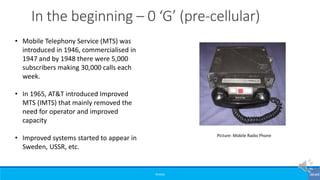
• Mobile Telephony Service (MTS) was
introduced in 1946, commercialised in
1947 and by 1948 there were 5,000
subscribers making 30,000 calls each
week.
• In 1965, AT&T introduced Improved
MTS (IMTS) that mainly removed the
need for operator and improved
capacity
• Improved systems started to appear in
Sweden, USSR, etc.
Picture: Mobile Radio Phone
In the beginning – 0 ‘G’ (pre-cellular)
©3G4G
• MTS – Mobile Telephone Service (USA, 1949 - 1965)
• Post Office Radiophone Service (UK, 1959 - ?)
• IMTS – Improved Mobile Telephone Service (USA, 1965 – ?)
• RCC – Radio Common Carrier (USA , 1960’s – 1980’s)
• OLT – Offentlig Landmobil Telefoni (Norway, 1966 – 1990)
• MTD – Mobile telephony system D (Denmark, 1971 – 1987)
• ARP – Autoradiopuhelin (Finland, 1971 – 2000)
Other 0 ‘G’ (pre-cellular) Systems
©3G4G
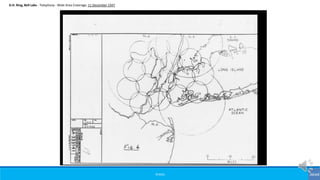
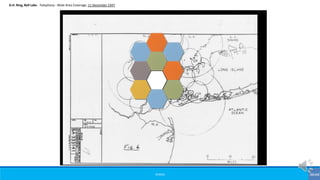
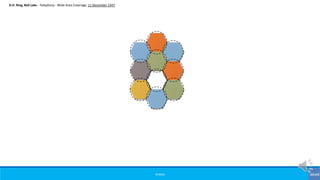
D.H. Ring, Bell Labs - Telephony - Wide Area Coverage, 11 December 1947
©3G4G
D.H. Ring, Bell Labs - Telephony - Wide Area Coverage, 11 December 1947
©3G4G
D.H. Ring, Bell Labs - Telephony - Wide Area Coverage, 11 December 1947
©3G4G
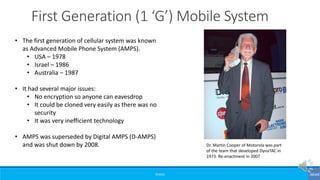
• The first generation of cellular system was known
as Advanced Mobile Phone System (AMPS).
• USA – 1978
• Israel – 1986
• Australia – 1987
• It had several major issues:
• No encryption so anyone can eavesdrop
• It could be cloned very easily as there was no
security
• It was very inefficient technology
• AMPS was superseded by Digital AMPS (D-AMPS)
and was shut down by 2008.
First Generation (1 ‘G’) Mobile System
Dr. Martin Cooper of Motorola was part
of the team that developed DynaTAC in
1973. Re-enactment in 2007
©3G4G
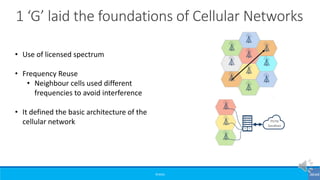
1 ‘G’ laid the foundations of Cellular Networks
• Use of licensed spectrum
• Frequency Reuse
• Neighbour cells used different
frequencies to avoid interference
• It defined the basic architecture of the
cellular network
©3G4G
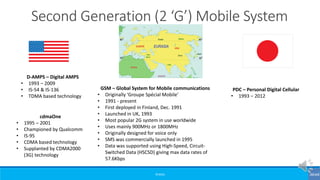
Second Generation (2 ‘G’) Mobile System
D-AMPS – Digital AMPS
• 1993 – 2009
• IS-54 & IS-136
• TDMA based technology
cdmaOne
• 1995 – 2001
• Championed by Qualcomm
• IS-95
• CDMA based technology
• Supplanted by CDMA2000
(3G) technology
PDC – Personal Digital Cellular
• 1993 – 2012
GSM – Global System for Mobile communications
• Originally ‘Groupe Spécial Mobile’
• 1991 - present
• First deployed in Finland, Dec. 1991
• Launched in UK, 1993
• Most popular 2G system in use worldwide
• Uses mainly 900MHz or 1800MHz
• Originally designed for voice only
• SMS was commercially launched in 1995
• Data was supported using High-Speed, Circuit-
Switched Data (HSCSD) giving max data rates of
57.6Kbps
©3G4G
GPRS (2.5 ‘G’) & EDGE (2.75 ‘G’)
General Packet Radio Service (GPRS) was an enhancement added on top of GSM
to allow PS data to be transferred
• Theoretical maximum data rate is 170Kbps but practically its around 40 Kbps
• Always-on data connection with billing based on amount of data transferred
Enhanced-GPRS (E-GPRS) , a.k.a Enhanced Data rates for GSM Evolution (EDGE)
enhances the air interface further to allow for even higher data rates
• Theoretical max data rates of 473.6Kbps but practically data rates would be
100Kbps.
©3G4G
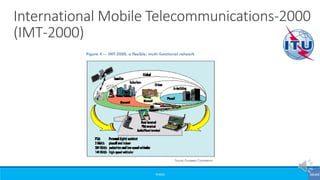
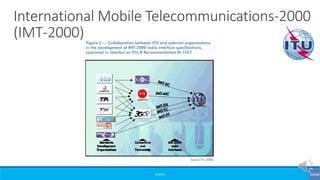
International Mobile Telecommunications-2000
(IMT-2000)
©3G4G
International Mobile Telecommunications-2000
(IMT-2000)
©3G4G
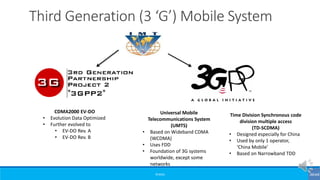
Third Generation (3 ‘G’) Mobile System
CDMA2000 EV-DO
• Evolution Data Optimized
• Further evolved to
• EV-DO Rev. A
• EV-DO Rev. B
Universal Mobile
Telecommunications System
(UMTS)
• Based on Wideband CDMA
(WCDMA)
• Uses FDD
• Foundation of 3G systems
worldwide, except some
networks
Time Division Synchronous code
division multiple access
(TD-SCDMA)
• Designed especially for China
• Used by only 1 operator,
‘China Mobile’
• Based on Narrowband TDD
©3G4G
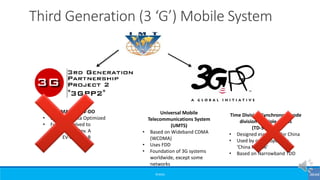
Third Generation (3 ‘G’) Mobile System
CDMA2000 EV-DO
• Evolution Data Optimized
• Further evolved to
• EV-DO Rev. A
• EV-DO Rev. B
Universal Mobile
Telecommunications System
(UMTS)
• Based on Wideband CDMA
(WCDMA)
• Uses FDD
• Foundation of 3G systems
worldwide, except some
networks
Time Division Synchronous code
division multiple access
(TD-SCDMA)
• Designed especially for China
• Used by only 1 operator,
‘China Mobile’
• Based on Narrowband TDD
©3G4G
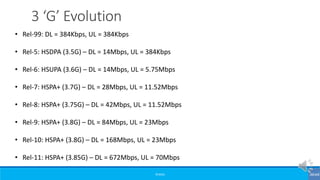
• Rel-99: DL = 384Kbps, UL = 384Kbps
• Rel-5: HSDPA (3.5G) – DL = 14Mbps, UL = 384Kbps
• Rel-6: HSUPA (3.6G) – DL = 14Mbps, UL = 5.75Mbps
• Rel-7: HSPA+ (3.7G) – DL = 28Mbps, UL = 11.52Mbps
• Rel-8: HSPA+ (3.75G) – DL = 42Mbps, UL = 11.52Mbps
• Rel-9: HSPA+ (3.8G) – DL = 84Mbps, UL = 23Mbps
• Rel-10: HSPA+ (3.8G) – DL = 168Mbps, UL = 23Mbps
• Rel-11: HSPA+ (3.85G) – DL = 672Mbps, UL = 70Mbps
3 ‘G’ Evolution
©3G4G
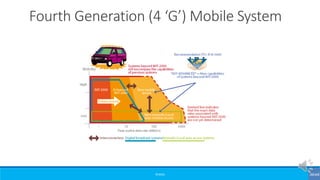
Fourth Generation (4 ‘G’) Mobile System
©3G4G
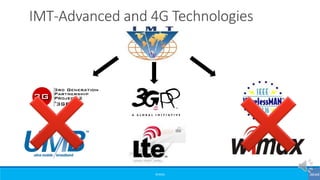
IMT-Advanced and 4G Technologies
©3G4G
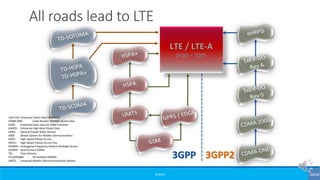
All roads lead to LTE
LTE / LTE-A
(FDD – TDD)
3GPP 3GPP2
1xEV-DO:Enhanced Voice-Data Optimized
CDMA ONE: Code Division Multiple Access One
EDGE: Enhanced Data rates for GSM Evolution
eHRPD: Enhanced High Rate Packet Data
GPRS: General Packet Radio Service
GSM: Global System for Mobile Communications
HSPA: High Speed Packet Access
HSPA+: High Speed Packet Access Plus
OFDMA: Orthogonal Frequency Division Multiple Access
SCDMA: Synchronous CDMA
TD: Time Division
TD-SOFDMA TD Scalable OFDMA
UMTS: Universal Mobile Telecommunication System
©3G4G
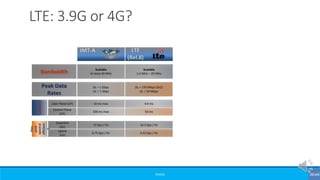
LTE: 3.9G or 4G?
Bandwidth Scalable
At least 40 MHz
Scalable
1.4 MHz – 20 MHz
Max 2x20 (40 MHz)
Scalable
Up to 5x20 (100 MHz)
Peak Data
Rates
DL = 1 Gbps
UL = 1 Gbps
DL = 150 Mbps (2x2)
UL = 50 Mbps
DL = 300 Mbps (2x2)
UL = 100 Mbps (2x2)
DL = 3 Gbps (8x8)
UL = 1.5 Gbps (4x4)
Latency
10 ms max 4.9 ms 4.9 ms 4.9 msUser Plane (UP)
100 ms max 50 ms 50 ms 50 ms
Control Plane
(CP)
Max
peak
spectral
efficienc
y
15 bps / Hz 16.3 bps / Hz 16.8 bps / Hz 30 bps / Hz
Downlink
(DL)
6.75 bps / Hz 4.32 bps / Hz 8.4 bps / Hz 15 bps / Hz
Uplink
(UL)
IMT-A LTE
(Rel.8)
LTE-A
(Rel.10)
LTE-A
©3G4G
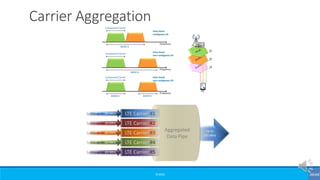
Carrier Aggregation
©3G4G
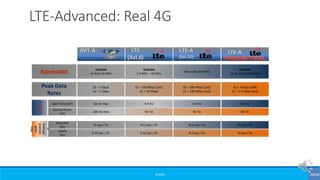
LTE-Advanced: Real 4G
Bandwidth Scalable
At least 40 MHz
Scalable
1.4 MHz – 20 MHz
Max 2x20 (40 MHz)
Scalable
Up to 5x20 (100 MHz)
Peak Data
Rates
DL = 1 Gbps
UL = 1 Gbps
DL = 150 Mbps (2x2)
UL = 50 Mbps
DL = 300 Mbps (2x2)
UL = 100 Mbps (2x2)
DL = 3 Gbps (8x8)
UL = 1.5 Gbps (4x4)
Latency
10 ms max 4.9 ms 4.9 ms 4.9 msUser Plane (UP)
100 ms max 50 ms 50 ms 50 ms
Control Plane
(CP)
Max
peak
spectral
efficienc
y
15 bps / Hz 16.3 bps / Hz 16.8 bps / Hz 30 bps / Hz
Downlink
(DL)
6.75 bps / Hz 4.32 bps / Hz 8.4 bps / Hz 15 bps / Hz
Uplink
(UL)
IMT-A LTE
(Rel.8)
LTE-A
(Rel.10)
LTE-A
©3G4G
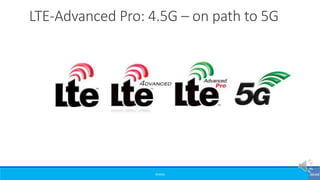
LTE-Advanced Pro: 4.5G – on path to 5G
©3G4G
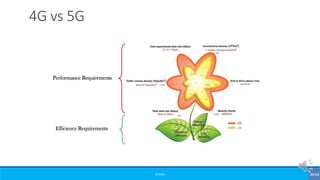
4G vs 5G
©3G4G
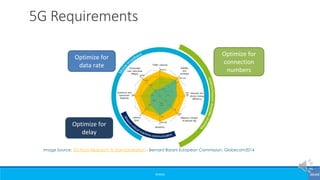
5G Requirements
Optimize for
data rate
Optimize for
connection
numbers
Optimize for
delay
Image Source: 5G-From Research to Standardisation - Bernard Barani European Commission, Globecom2014
©3G4G
Summary: 1G & 2G
1981
©3G4G
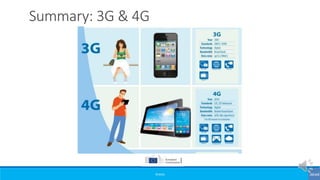
Summary: 3G & 4G
©3G4G
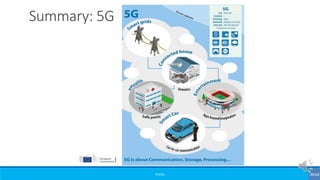
Summary: 5G
Thank You
To learn more, visit:
3G4G Website – http://www.3g4g.co.uk/
3G4G Blog – http://blog.3g4g.co.uk/
3G4G Small Cells Blog – http://smallcells.3g4g.co.uk/
Follow us on Twitter: https://twitter.com/3g4gUK
Follow us on Linkedin: https://www.linkedin.com/company/3g4g
©3G4G

Different Generations Of Mobile Technologies

  • 1.
    Different Generations Of MobileTechnologies @3g4gUK
  • 2.
    ©3G4G • Mobile TelephonyService (MTS) was introduced in 1946, commercialised in 1947 and by 1948 there were 5,000 subscribers making 30,000 calls each week. • In 1965, AT&T introduced Improved MTS (IMTS) that mainly removed the need for operator and improved capacity • Improved systems started to appear in Sweden, USSR, etc. Picture: Mobile Radio Phone In the beginning – 0 ‘G’ (pre-cellular)
  • 3.
    ©3G4G • MTS –Mobile Telephone Service (USA, 1949 - 1965) • Post Office Radiophone Service (UK, 1959 - ?) • IMTS – Improved Mobile Telephone Service (USA, 1965 – ?) • RCC – Radio Common Carrier (USA , 1960’s – 1980’s) • OLT – Offentlig Landmobil Telefoni (Norway, 1966 – 1990) • MTD – Mobile telephony system D (Denmark, 1971 – 1987) • ARP – Autoradiopuhelin (Finland, 1971 – 2000) Other 0 ‘G’ (pre-cellular) Systems
  • 4.
    ©3G4G D.H. Ring, BellLabs - Telephony - Wide Area Coverage, 11 December 1947
  • 5.
    ©3G4G D.H. Ring, BellLabs - Telephony - Wide Area Coverage, 11 December 1947
  • 6.
    ©3G4G D.H. Ring, BellLabs - Telephony - Wide Area Coverage, 11 December 1947
  • 7.
    ©3G4G • The firstgeneration of cellular system was known as Advanced Mobile Phone System (AMPS). • USA – 1978 • Israel – 1986 • Australia – 1987 • It had several major issues: • No encryption so anyone can eavesdrop • It could be cloned very easily as there was no security • It was very inefficient technology • AMPS was superseded by Digital AMPS (D-AMPS) and was shut down by 2008. First Generation (1 ‘G’) Mobile System Dr. Martin Cooper of Motorola was part of the team that developed DynaTAC in 1973. Re-enactment in 2007
  • 8.
    ©3G4G 1 ‘G’ laidthe foundations of Cellular Networks • Use of licensed spectrum • Frequency Reuse • Neighbour cells used different frequencies to avoid interference • It defined the basic architecture of the cellular network
  • 9.
    ©3G4G Second Generation (2‘G’) Mobile System D-AMPS – Digital AMPS • 1993 – 2009 • IS-54 & IS-136 • TDMA based technology cdmaOne • 1995 – 2001 • Championed by Qualcomm • IS-95 • CDMA based technology • Supplanted by CDMA2000 (3G) technology PDC – Personal Digital Cellular • 1993 – 2012 GSM – Global System for Mobile communications • Originally ‘Groupe Spécial Mobile’ • 1991 - present • First deployed in Finland, Dec. 1991 • Launched in UK, 1993 • Most popular 2G system in use worldwide • Uses mainly 900MHz or 1800MHz • Originally designed for voice only • SMS was commercially launched in 1995 • Data was supported using High-Speed, Circuit- Switched Data (HSCSD) giving max data rates of 57.6Kbps
  • 10.
    ©3G4G GPRS (2.5 ‘G’)& EDGE (2.75 ‘G’) General Packet Radio Service (GPRS) was an enhancement added on top of GSM to allow PS data to be transferred • Theoretical maximum data rate is 170Kbps but practically its around 40 Kbps • Always-on data connection with billing based on amount of data transferred Enhanced-GPRS (E-GPRS) , a.k.a Enhanced Data rates for GSM Evolution (EDGE) enhances the air interface further to allow for even higher data rates • Theoretical max data rates of 473.6Kbps but practically data rates would be 100Kbps.
  • 11.
  • 12.
  • 13.
    ©3G4G Third Generation (3‘G’) Mobile System CDMA2000 EV-DO • Evolution Data Optimized • Further evolved to • EV-DO Rev. A • EV-DO Rev. B Universal Mobile Telecommunications System (UMTS) • Based on Wideband CDMA (WCDMA) • Uses FDD • Foundation of 3G systems worldwide, except some networks Time Division Synchronous code division multiple access (TD-SCDMA) • Designed especially for China • Used by only 1 operator, ‘China Mobile’ • Based on Narrowband TDD
  • 14.
    ©3G4G Third Generation (3‘G’) Mobile System CDMA2000 EV-DO • Evolution Data Optimized • Further evolved to • EV-DO Rev. A • EV-DO Rev. B Universal Mobile Telecommunications System (UMTS) • Based on Wideband CDMA (WCDMA) • Uses FDD • Foundation of 3G systems worldwide, except some networks Time Division Synchronous code division multiple access (TD-SCDMA) • Designed especially for China • Used by only 1 operator, ‘China Mobile’ • Based on Narrowband TDD
  • 15.
    ©3G4G • Rel-99: DL= 384Kbps, UL = 384Kbps • Rel-5: HSDPA (3.5G) – DL = 14Mbps, UL = 384Kbps • Rel-6: HSUPA (3.6G) – DL = 14Mbps, UL = 5.75Mbps • Rel-7: HSPA+ (3.7G) – DL = 28Mbps, UL = 11.52Mbps • Rel-8: HSPA+ (3.75G) – DL = 42Mbps, UL = 11.52Mbps • Rel-9: HSPA+ (3.8G) – DL = 84Mbps, UL = 23Mbps • Rel-10: HSPA+ (3.8G) – DL = 168Mbps, UL = 23Mbps • Rel-11: HSPA+ (3.85G) – DL = 672Mbps, UL = 70Mbps 3 ‘G’ Evolution
  • 16.
    ©3G4G Fourth Generation (4‘G’) Mobile System
  • 17.
  • 18.
    ©3G4G All roads leadto LTE LTE / LTE-A (FDD – TDD) 3GPP 3GPP2 1xEV-DO:Enhanced Voice-Data Optimized CDMA ONE: Code Division Multiple Access One EDGE: Enhanced Data rates for GSM Evolution eHRPD: Enhanced High Rate Packet Data GPRS: General Packet Radio Service GSM: Global System for Mobile Communications HSPA: High Speed Packet Access HSPA+: High Speed Packet Access Plus OFDMA: Orthogonal Frequency Division Multiple Access SCDMA: Synchronous CDMA TD: Time Division TD-SOFDMA TD Scalable OFDMA UMTS: Universal Mobile Telecommunication System
  • 19.
    ©3G4G LTE: 3.9G or4G? Bandwidth Scalable At least 40 MHz Scalable 1.4 MHz – 20 MHz Max 2x20 (40 MHz) Scalable Up to 5x20 (100 MHz) Peak Data Rates DL = 1 Gbps UL = 1 Gbps DL = 150 Mbps (2x2) UL = 50 Mbps DL = 300 Mbps (2x2) UL = 100 Mbps (2x2) DL = 3 Gbps (8x8) UL = 1.5 Gbps (4x4) Latency 10 ms max 4.9 ms 4.9 ms 4.9 msUser Plane (UP) 100 ms max 50 ms 50 ms 50 ms Control Plane (CP) Max peak spectral efficienc y 15 bps / Hz 16.3 bps / Hz 16.8 bps / Hz 30 bps / Hz Downlink (DL) 6.75 bps / Hz 4.32 bps / Hz 8.4 bps / Hz 15 bps / Hz Uplink (UL) IMT-A LTE (Rel.8) LTE-A (Rel.10) LTE-A
  • 20.
  • 21.
    ©3G4G LTE-Advanced: Real 4G BandwidthScalable At least 40 MHz Scalable 1.4 MHz – 20 MHz Max 2x20 (40 MHz) Scalable Up to 5x20 (100 MHz) Peak Data Rates DL = 1 Gbps UL = 1 Gbps DL = 150 Mbps (2x2) UL = 50 Mbps DL = 300 Mbps (2x2) UL = 100 Mbps (2x2) DL = 3 Gbps (8x8) UL = 1.5 Gbps (4x4) Latency 10 ms max 4.9 ms 4.9 ms 4.9 msUser Plane (UP) 100 ms max 50 ms 50 ms 50 ms Control Plane (CP) Max peak spectral efficienc y 15 bps / Hz 16.3 bps / Hz 16.8 bps / Hz 30 bps / Hz Downlink (DL) 6.75 bps / Hz 4.32 bps / Hz 8.4 bps / Hz 15 bps / Hz Uplink (UL) IMT-A LTE (Rel.8) LTE-A (Rel.10) LTE-A
  • 22.
  • 23.
  • 24.
    ©3G4G 5G Requirements Optimize for datarate Optimize for connection numbers Optimize for delay Image Source: 5G-From Research to Standardisation - Bernard Barani European Commission, Globecom2014
  • 25.
  • 26.
  • 27.
  • 28.
    Thank You To learnmore, visit: 3G4G Website – http://www.3g4g.co.uk/ 3G4G Blog – http://blog.3g4g.co.uk/ 3G4G Small Cells Blog – http://smallcells.3g4g.co.uk/ Follow us on Twitter: https://twitter.com/3g4gUK Follow us on Linkedin: https://www.linkedin.com/company/3g4g ©3G4G