Creative Thinking ICT Key Skills Project Work Nelli Lau
Summary Definition Creative Methods Creativity – Negative and Positive Attitudes History of Thinking Skills in the UK Edward de Bono References 27 May 2010 Nelli Lau
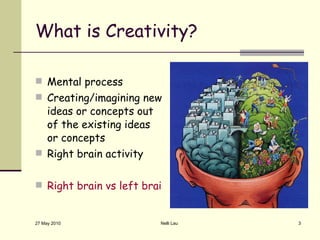
What is Creativity? Mental process Creating/imagining new ideas or concepts out of the existing ideas or concepts Right brain activity Right brain vs left brain creativity test 27 May 2010 Nelli Lau
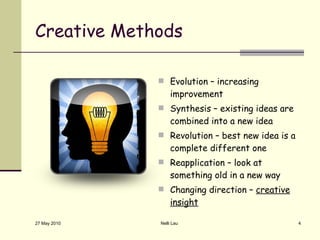
Creative Methods Evolution – increasing improvement Synthesis – existing ideas are combined into a new idea Revolution – best new idea is a complete different one Reapplication – look at something old in a new way Changing direction –  creative   insight 27 May 2010 Nelli Lau
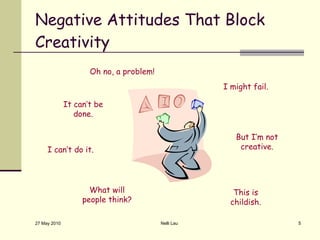
Negative Attitudes That Block Creativity 27 May 2010 Nelli Lau Oh no, a problem! It can’t be done. I can’t do it. But I’m not creative. I might fail. This is childish. What will people think?
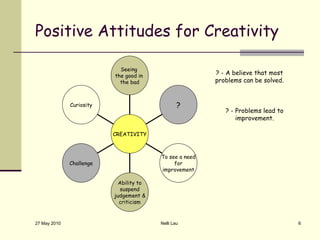
Positive Attitudes for Creativity 27 May 2010 Nelli Lau ? - A believe that most problems can be solved. ? - Problems lead to improvement. Curiosity Challenge Ability to suspend judgement & criticism To see a need for improvement ? Seeing  the good in  the bad CREATIVITY
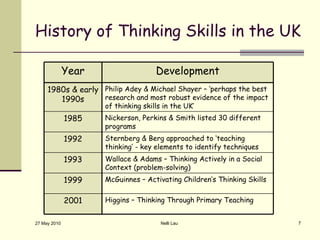
History of Thinking Skills in the UK 27 May 2010 Nelli Lau Year Development 1980s & early 1990s Philip Adey & Michael Shayer – ‘perhaps the best research and most robust evidence of the impact of thinking skills in the UK’  1985 Nickerson, Perkins & Smith listed 30 different programs 1992 Sternberg & Berg approached to ‘teaching thinking’ - key elements to identify techniques 1993 Wallace & Adams – Thinking Actively in a Social Context (problem-solving) 1999 McGuinnes – Activating Children’s Thinking Skills 2001 Higgins – Thinking Through Primary Teaching
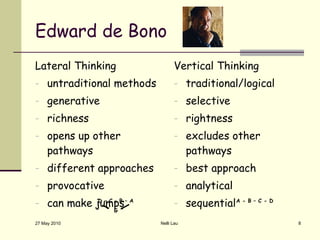
Edward de Bono Lateral Thinking untraditional methods generative richness opens up other pathways different approaches provocative can make jumps Vertical Thinking traditional/logical selective rightness excludes other pathways best approach analytical sequential 27 May 2010 Nelli Lau A - B – C - D D – C – B – A G
References left-brain-right-brain on Flickr - Photo Sharing! Right Brain vs Left Brain Creativity Test at The Art Institute of Vancouver Introduction to Creative Thinking The Standards Site: History of thinking skills development Summernight in Scandinavia on Flickr - Photo Sharing! Think* on Flickr - Photo Sharing! Definition of Think from dictionary. net http://www.randomhouse.com.au/authordatabaselarge/De%20Bono,%20Edward.jpg Edward de Bono – Lateral Thinking  (Penguin, ISNB 978-0-14-013779-8) 27 May 2010 Nelli Lau
Think 1. Judge or regard; look upon; judge;  2. Expect, believe, or suppose;   3. Use or exercise the mind or one's power of reason;  4. Recall knowledge from memory; have a recollection;  5. Imagine or visualize;   6. Focus one's attention on a certain state;   7. Have in mind as a purpose;  8. Decide by pondering, reasoning, or reflecting; 9. Ponder; reflect on, or reason about;  10. Dispose the mind in a certain way;  11. Have or formulate in the mind;

Creative Thinking

  • 1.
    Creative Thinking ICTKey Skills Project Work Nelli Lau
  • 2.
    Summary Definition CreativeMethods Creativity – Negative and Positive Attitudes History of Thinking Skills in the UK Edward de Bono References 27 May 2010 Nelli Lau
  • 3.
    What is Creativity?Mental process Creating/imagining new ideas or concepts out of the existing ideas or concepts Right brain activity Right brain vs left brain creativity test 27 May 2010 Nelli Lau
  • 4.
    Creative Methods Evolution– increasing improvement Synthesis – existing ideas are combined into a new idea Revolution – best new idea is a complete different one Reapplication – look at something old in a new way Changing direction – creative insight 27 May 2010 Nelli Lau
  • 5.
    Negative Attitudes ThatBlock Creativity 27 May 2010 Nelli Lau Oh no, a problem! It can’t be done. I can’t do it. But I’m not creative. I might fail. This is childish. What will people think?
  • 6.
    Positive Attitudes forCreativity 27 May 2010 Nelli Lau ? - A believe that most problems can be solved. ? - Problems lead to improvement. Curiosity Challenge Ability to suspend judgement & criticism To see a need for improvement ? Seeing the good in the bad CREATIVITY
  • 7.
    History of ThinkingSkills in the UK 27 May 2010 Nelli Lau Year Development 1980s & early 1990s Philip Adey & Michael Shayer – ‘perhaps the best research and most robust evidence of the impact of thinking skills in the UK’ 1985 Nickerson, Perkins & Smith listed 30 different programs 1992 Sternberg & Berg approached to ‘teaching thinking’ - key elements to identify techniques 1993 Wallace & Adams – Thinking Actively in a Social Context (problem-solving) 1999 McGuinnes – Activating Children’s Thinking Skills 2001 Higgins – Thinking Through Primary Teaching
  • 8.
    Edward de BonoLateral Thinking untraditional methods generative richness opens up other pathways different approaches provocative can make jumps Vertical Thinking traditional/logical selective rightness excludes other pathways best approach analytical sequential 27 May 2010 Nelli Lau A - B – C - D D – C – B – A G
  • 9.
    References left-brain-right-brain onFlickr - Photo Sharing! Right Brain vs Left Brain Creativity Test at The Art Institute of Vancouver Introduction to Creative Thinking The Standards Site: History of thinking skills development Summernight in Scandinavia on Flickr - Photo Sharing! Think* on Flickr - Photo Sharing! Definition of Think from dictionary. net http://www.randomhouse.com.au/authordatabaselarge/De%20Bono,%20Edward.jpg Edward de Bono – Lateral Thinking (Penguin, ISNB 978-0-14-013779-8) 27 May 2010 Nelli Lau
  • 10.
    Think 1. Judgeor regard; look upon; judge;  2. Expect, believe, or suppose;   3. Use or exercise the mind or one's power of reason; 4. Recall knowledge from memory; have a recollection;  5. Imagine or visualize;   6. Focus one's attention on a certain state;   7. Have in mind as a purpose; 8. Decide by pondering, reasoning, or reflecting; 9. Ponder; reflect on, or reason about; 10. Dispose the mind in a certain way; 11. Have or formulate in the mind;

Editor's Notes

  • #5 Creative insight - an understanding of relationships that sheds light on or helps solve a problem
  • #8 Pioneering work of Feuerstein and Lipman, and Edward de Bono
  • #9 lateral  vertical (complementary) Generative - capable of producing or creating Sequential – consequent, following
  • #10 When you need to reference your work make sure that you state the general website first e.g. Google Website and then you supply the actual website address (highlighting this like you have done in the above slide.