Credit Seminar
Presentation
Presented by
Denadyalan. S {2019507002}
II M.Sc., Agrl Extn
DAE&RS, TNAU, CBE
Advisory committee
Chairman
Members
Dr. P. P. MURUGAN
Professor (Agrl Extn)
Dr. SHIBI SEBASTIAN
Asst Prof (Agrl Extn)
Dr. PATIL SANTOSH GANAPATI
Asst Prof (Agril Stat)
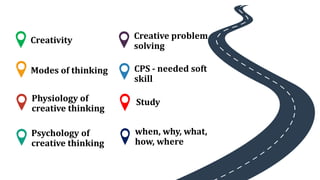
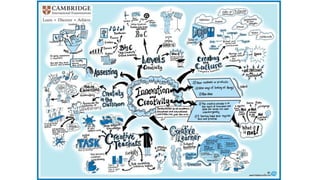
Creativity
Modes of thinking
Physiology of
creative thinking
Psychology of
creative thinking
when, why, what,
how, where
Creative problem
solving
CPS - needed soft
skill
Study
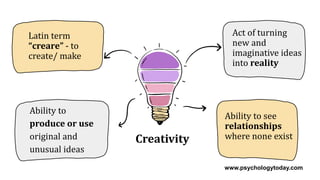
Latin term
“creare” - to
create/ make
Act of turning
new and
imaginative ideas
into reality
Ability to
produce or use
original and
unusual ideas
Creativity
Ability to see
relationships
where none exist
www.psychologytoday.com
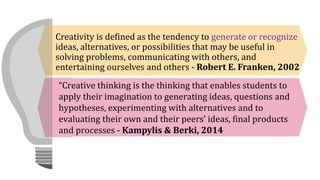
Creativity is defined as the tendency to generate or recognize
ideas, alternatives, or possibilities that may be useful in
solving problems, communicating with others, and
entertaining ourselves and others - Robert E. Franken, 2002
“Creative thinking is the thinking that enables students to
apply their imagination to generating ideas, questions and
hypotheses, experimenting with alternatives and to
evaluating their own and their peers’ ideas, final products
and processes - Kampylis & Berki, 2014
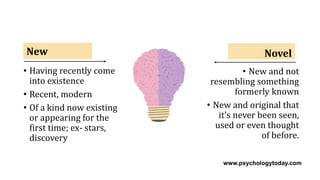
New Novel
• New and not
resembling something
formerly known
• New and original that
it's never been seen,
used or even thought
of before.
• Having recently come
into existence
• Recent, modern
• Of a kind now existing
or appearing for the
first time; ex- stars,
discovery
www.psychologytoday.com
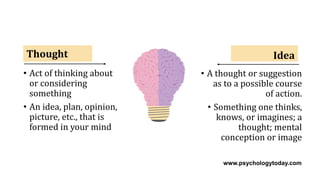
Thought Idea
• A thought or suggestion
as to a possible course
of action.
• Something one thinks,
knows, or imagines; a
thought; mental
conception or image
• Act of thinking about
or considering
something
• An idea, plan, opinion,
picture, etc., that is
formed in your mind
www.psychologytoday.com
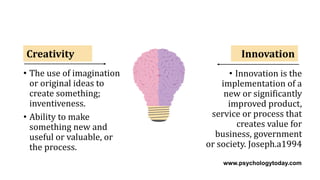
Creativity Innovation
• Innovation is the
implementation of a
new or significantly
improved product,
service or process that
creates value for
business, government
or society. Joseph.a1994
• The use of imagination
or original ideas to
create something;
inventiveness.
• Ability to make
something new and
useful or valuable, or
the process.
www.psychologytoday.com
Modes of Thinking
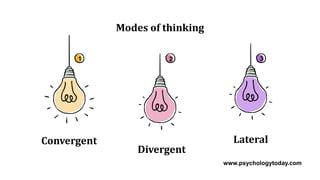
Modes of thinking
1 2 3
Divergent
Convergent Lateral
www.psychologytoday.com
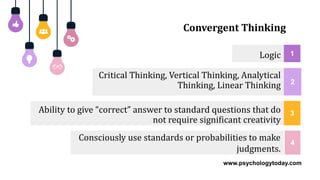
Convergent Thinking
Logic
Ability to give “correct” answer to standard questions that do
not require significant creativity
Consciously use standards or probabilities to make
judgments.
Critical Thinking, Vertical Thinking, Analytical
Thinking, Linear Thinking
1
3
4
2
www.psychologytoday.com
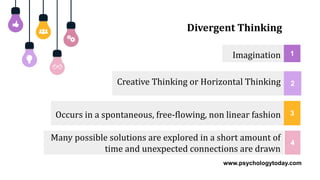
Divergent Thinking
Imagination
Occurs in a spontaneous, free-flowing, non linear fashion
Many possible solutions are explored in a short amount of
time and unexpected connections are drawn
Creative Thinking or Horizontal Thinking
1
3
4
2
www.psychologytoday.com
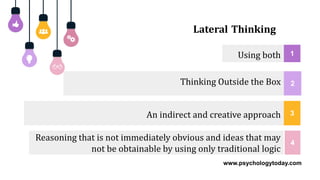
Lateral Thinking
Using both
An indirect and creative approach
Reasoning that is not immediately obvious and ideas that may
not be obtainable by using only traditional logic
Thinking Outside the Box
1
3
4
2
www.psychologytoday.com
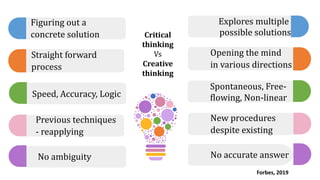
Figuring out a
concrete solution
Straight forward
process
Previous techniques
- reapplying
Speed, Accuracy, Logic
No ambiguity
Opening the mind
in various directions
New procedures
despite existing
Spontaneous, Free-
flowing, Non-linear
No accurate answer
Explores multiple
possible solutions
Critical
thinking
Vs
Creative
thinking
Forbes, 2019
• Divergent thinking takes place in a free-flowing,
spontaneous manner and creates varieties of
possible solutions to a problem.
• If convergent thinking is applied then after, the
very best answer can be picked out from the
multiple solutions resulted due to divergent
thinking.
Forbes, 2019
Exercise
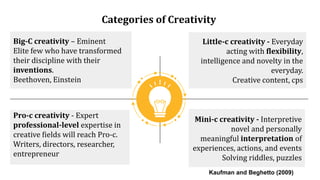
Categories of Creativity
Big-C creativity – Eminent
Elite few who have transformed
their discipline with their
inventions.
Beethoven, Einstein
Pro-c creativity - Expert
professional-level expertise in
creative fields will reach Pro-c.
Writers, directors, researcher,
entrepreneur
Little-c creativity - Everyday
acting with flexibility,
intelligence and novelty in the
everyday.
Creative content, cps
Mini-c creativity - Interpretive
novel and personally
meaningful interpretation of
experiences, actions, and events
Solving riddles, puzzles
Kaufman and Beghetto (2009)
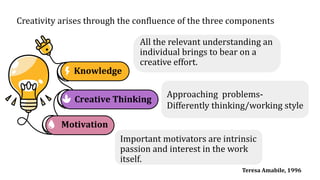
Creativity arises through the confluence of the three components
All the relevant understanding an
individual brings to bear on a
creative effort.
Approaching problems-
Differently thinking/working style
Important motivators are intrinsic
passion and interest in the work
itself.
Knowledge
Creative Thinking
Motivation
Teresa Amabile, 1996
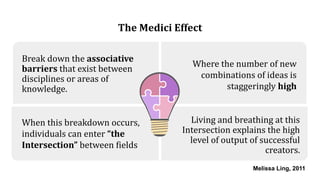
The Medici Effect
Break down the associative
barriers that exist between
disciplines or areas of
knowledge.
Where the number of new
combinations of ideas is
staggeringly high
When this breakdown occurs,
individuals can enter “the
Intersection” between fields
Living and breathing at this
Intersection explains the high
level of output of successful
creators.
Melissa Ling, 2011
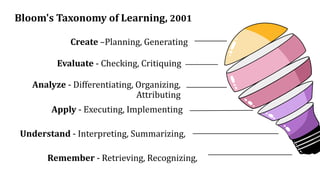
Bloom's Taxonomy of Learning, 2001
Analyze - Differentiating, Organizing,
Attributing
Create –Planning, Generating
Apply - Executing, Implementing
Understand - Interpreting, Summarizing,
Remember - Retrieving, Recognizing,
Evaluate - Checking, Critiquing
Physiology of Creative Thinking
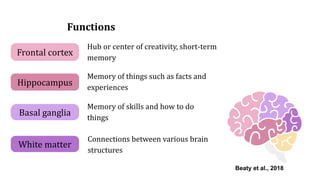
Hub or center of creativity, short-term
memory
Memory of things such as facts and
experiences
Memory of skills and how to do
things
Connections between various brain
structures
Frontal cortex
Hippocampus
Basal ganglia
White matter
Functions
Beaty et al., 2018
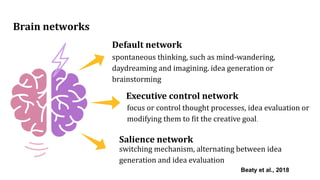
Brain networks
spontaneous thinking, such as mind-wandering,
daydreaming and imagining. idea generation or
brainstorming
focus or control thought processes, idea evaluation or
modifying them to fit the creative goal.
switching mechanism, alternating between idea
generation and idea evaluation
Executive control network
Default network
Salience network
Beaty et al., 2018
Not Weird; but Wired
Psychology of Creative Thinking
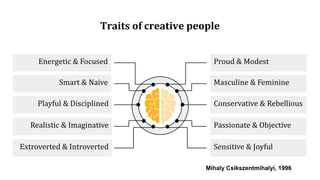
Traits of creative people
Energetic & Focused
Playful & Disciplined
Realistic & Imaginative
Smart & Naive
Extroverted & Introverted
Proud & Modest
Conservative & Rebellious
Passionate & Objective
Masculine & Feminine
Sensitive & Joyful
Mihaly Csikszentmihalyi, 1996
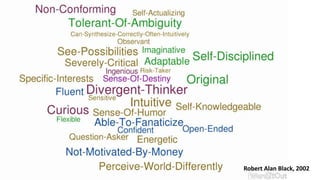
Robert Alan Black, 2002
Creative Problem Solving
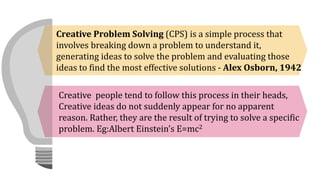
Creative Problem Solving (CPS) is a simple process that
involves breaking down a problem to understand it,
generating ideas to solve the problem and evaluating those
ideas to find the most effective solutions - Alex Osborn, 1942
Creative people tend to follow this process in their heads,
Creative ideas do not suddenly appear for no apparent
reason. Rather, they are the result of trying to solve a specific
problem. Eg:Albert Einstein’s E=mc2
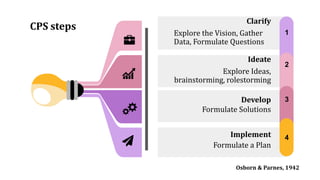
CPS steps
Clarify
Explore the Vision, Gather
Data, Formulate Questions
Implement
Formulate a Plan
Develop
Formulate Solutions
Ideate
Explore Ideas,
brainstorming, rolestorming
1
2
3
4
Osborn & Parnes, 1942
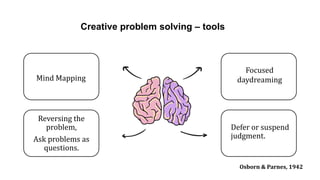
Creative problem solving – tools
Reversing the
problem,
Ask problems as
questions.
Mind Mapping
Defer or suspend
judgment.
Focused
daydreaming
Osborn & Parnes, 1942
BRAIN STORMING
Propose creative solutions to the following questions
How to reduce food being wasted in the mess ?
How the generated waste could be managed ?
CPS - Needed Skill of the Decade
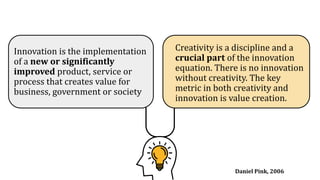
Innovation is the implementation
of a new or significantly
improved product, service or
process that creates value for
business, government or society
Creativity is a discipline and a
crucial part of the innovation
equation. There is no innovation
without creativity. The key
metric in both creativity and
innovation is value creation.
Daniel Pink, 2006
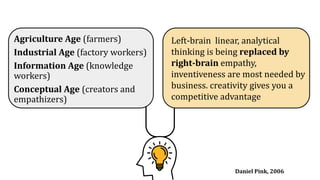
Agriculture Age (farmers)
Industrial Age (factory workers)
Information Age (knowledge
workers)
Conceptual Age (creators and
empathizers)
Left-brain linear, analytical
thinking is being replaced by
right-brain empathy,
inventiveness are most needed by
business. creativity gives you a
competitive advantage
Daniel Pink, 2006
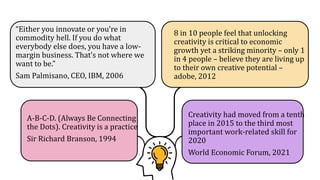
“Either you innovate or you’re in
commodity hell. If you do what
everybody else does, you have a low-
margin business. That’s not where we
want to be.”
Sam Palmisano, CEO, IBM, 2006
Creativity had moved from a tenth
place in 2015 to the third most
important work-related skill for
2020
World Economic Forum, 2021
8 in 10 people feel that unlocking
creativity is critical to economic
growth yet a striking minority – only 1
in 4 people – believe they are living up
to their own creative potential –
adobe, 2012
A-B-C-D. (Always Be Connecting
the Dots). Creativity is a practice
Sir Richard Branson, 1994
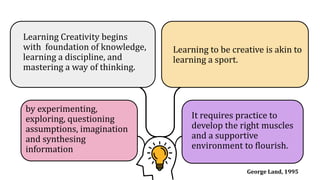
Learning Creativity begins
with foundation of knowledge,
learning a discipline, and
mastering a way of thinking.
It requires practice to
develop the right muscles
and a supportive
environment to flourish.
Learning to be creative is akin to
learning a sport.
by experimenting,
exploring, questioning
assumptions, imagination
and synthesing
information
George Land, 1995
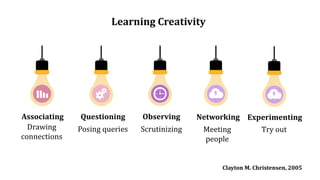
Learning Creativity
Drawing
connections
Posing queries Scrutinizing Meeting
people
Associating Questioning Observing Networking
Try out
Experimenting
Clayton M. Christensen, 2005
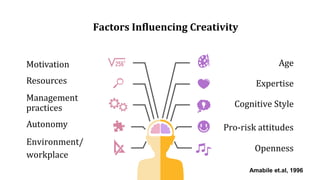
Factors Influencing Creativity
Motivation
Management
practices
Autonomy
Resources
Environment/
workplace
Age
Cognitive Style
Pro-risk attitudes
Expertise
Openness
Amabile et.al, 1996
Study
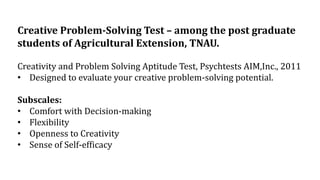
Creative Problem-Solving Test – among the post graduate
students of Agricultural Extension, TNAU.
Creativity and Problem Solving Aptitude Test, Psychtests AIM,Inc., 2011
• Designed to evaluate your creative problem-solving potential.
Subscales:
• Comfort with Decision-making
• Flexibility
• Openness to Creativity
• Sense of Self-efficacy
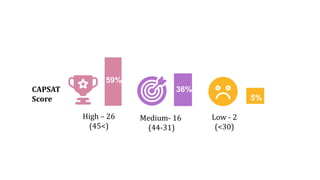
36%
59%
5%
High – 26
(45<)
Medium- 16
(44-31)
Low - 2
(<30)
CAPSAT
Score
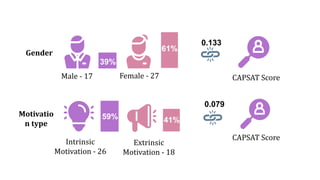
39%
61%
Male - 17 Female - 27
Intrinsic
Motivation - 26
Extrinsic
Motivation - 18
59% 41%
0.133
0.079
CAPSAT Score
CAPSAT Score
Gender
Motivatio
n type
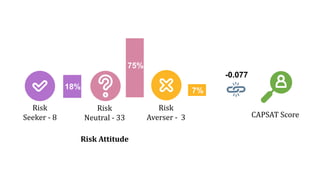
Risk
Seeker - 8
Risk
Neutral - 33
Risk
Averser - 3
18%
75%
7%
CAPSAT Score
Risk Attitude
-0.077
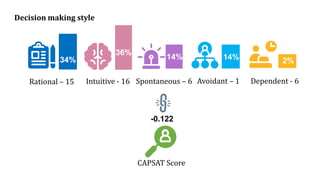
34%
36%
14% 2%
14%
CAPSAT Score
Rational – 15 Intuitive - 16 Spontaneous – 6 Avoidant – 1 Dependent - 6
-0.122
Decision making style
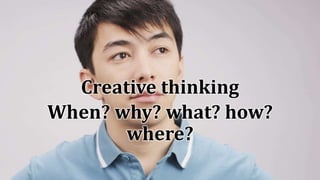
Creative thinking
When? why? what? how?
where?
Reviews
• Lewis Terman's (2004), children those with very high IQ
weren't necessarily creative geniuses. Very few of those
involved in the study demonstrated high levels of artistic
achievement later in life.
• Csikszentmihalyi (1996) notes that studies suggest that there
seems to be a cutoff point at around 120.1
Having higher-than-average intelligence might contribute to
creativity, but having an IQ over 120 does not necessarily lead to
greater creativity
• Seven meta-analyses of individual factors associated with
creativity and innovation.
Emotional intelligence (r = .31), divergent thinking ( r= .27),
openness to experience ( r= .22), creative personality ( r= .21),
intrinsic motivation ( r= .20), positive affect ( r= .19), and androgyny
(r = .19) are related to creativity.
Age (r = .17), intelligence ( r= .17), extraversion ( r= .13), self-
efficacy ( r= .13), and extrinsic motivation (r = .11) were also
moderately associated with innovation.
Pro-risk attitudes (r = .08) and being female (r = .07) were weakly
associated with creativity. - Silvia da Costa et.al, (2015)
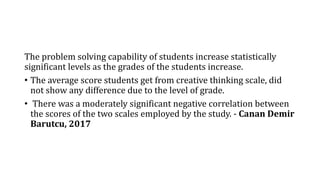
The problem solving capability of students increase statistically
significant levels as the grades of the students increase.
• The average score students get from creative thinking scale, did
not show any difference due to the level of grade.
• There was a moderately significant negative correlation between
the scores of the two scales employed by the study. - Canan Demir
Barutcu, 2017
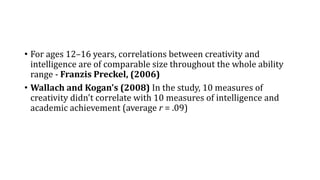
• For ages 12–16 years, correlations between creativity and
intelligence are of comparable size throughout the whole ability
range - Franzis Preckel, (2006)
• Wallach and Kogan's (2008) In the study, 10 measures of
creativity didn't correlate with 10 measures of intelligence and
academic achievement (average r = .09)
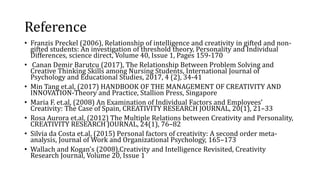
Reference
• Franzis Preckel (2006), Relationship of intelligence and creativity in gifted and non-
gifted students: An investigation of threshold theory, Personality and Individual
Differences, science direct, Volume 40, Issue 1, Pages 159-170
• Canan Demir Barutcu (2017), The Relationship Between Problem Solving and
Creative Thinking Skills among Nursing Students, International Journal of
Psychology and Educational Studies, 2017, 4 (2), 34-41
• Min Tang et.al, (2017) HANDBOOK OF THE MANAGEMENT OF CREATIVITY AND
INNOVATION-Theory and Practice, Stallion Press, Singapore
• Maria F. et.al, (2008) An Examination of Individual Factors and Employees’
Creativity: The Case of Spain, CREATIVITY RESEARCH JOURNAL, 20(1), 21–33
• Rosa Aurora et.al, (2012) The Multiple Relations between Creativity and Personality,
CREATIVITY RESEARCH JOURNAL, 24(1), 76–82
• Silvia da Costa et.al, (2015) Personal factors of creativity: A second order meta-
analysis, Journal of Work and Organizational Psychology, 165–173
• Wallach and Kogan's (2008),Creativity and Intelligence Revisited, Creativity
Research Journal, Volume 20, Issue 1
Creative Thinking & Problem Solving

Creative Thinking & Problem Solving

  • 2.
    Credit Seminar Presentation Presented by Denadyalan.S {2019507002} II M.Sc., Agrl Extn DAE&RS, TNAU, CBE
  • 3.
    Advisory committee Chairman Members Dr. P.P. MURUGAN Professor (Agrl Extn) Dr. SHIBI SEBASTIAN Asst Prof (Agrl Extn) Dr. PATIL SANTOSH GANAPATI Asst Prof (Agril Stat)
  • 4.
    Creativity Modes of thinking Physiologyof creative thinking Psychology of creative thinking when, why, what, how, where Creative problem solving CPS - needed soft skill Study
  • 5.
    Latin term “creare” -to create/ make Act of turning new and imaginative ideas into reality Ability to produce or use original and unusual ideas Creativity Ability to see relationships where none exist www.psychologytoday.com
  • 6.
    Creativity is definedas the tendency to generate or recognize ideas, alternatives, or possibilities that may be useful in solving problems, communicating with others, and entertaining ourselves and others - Robert E. Franken, 2002 “Creative thinking is the thinking that enables students to apply their imagination to generating ideas, questions and hypotheses, experimenting with alternatives and to evaluating their own and their peers’ ideas, final products and processes - Kampylis & Berki, 2014
  • 7.
    New Novel • Newand not resembling something formerly known • New and original that it's never been seen, used or even thought of before. • Having recently come into existence • Recent, modern • Of a kind now existing or appearing for the first time; ex- stars, discovery www.psychologytoday.com
  • 8.
    Thought Idea • Athought or suggestion as to a possible course of action. • Something one thinks, knows, or imagines; a thought; mental conception or image • Act of thinking about or considering something • An idea, plan, opinion, picture, etc., that is formed in your mind www.psychologytoday.com
  • 9.
    Creativity Innovation • Innovationis the implementation of a new or significantly improved product, service or process that creates value for business, government or society. Joseph.a1994 • The use of imagination or original ideas to create something; inventiveness. • Ability to make something new and useful or valuable, or the process. www.psychologytoday.com
  • 10.
  • 11.
    Modes of thinking 12 3 Divergent Convergent Lateral www.psychologytoday.com
  • 12.
    Convergent Thinking Logic Ability togive “correct” answer to standard questions that do not require significant creativity Consciously use standards or probabilities to make judgments. Critical Thinking, Vertical Thinking, Analytical Thinking, Linear Thinking 1 3 4 2 www.psychologytoday.com
  • 13.
    Divergent Thinking Imagination Occurs ina spontaneous, free-flowing, non linear fashion Many possible solutions are explored in a short amount of time and unexpected connections are drawn Creative Thinking or Horizontal Thinking 1 3 4 2 www.psychologytoday.com
  • 14.
    Lateral Thinking Using both Anindirect and creative approach Reasoning that is not immediately obvious and ideas that may not be obtainable by using only traditional logic Thinking Outside the Box 1 3 4 2 www.psychologytoday.com
  • 15.
    Figuring out a concretesolution Straight forward process Previous techniques - reapplying Speed, Accuracy, Logic No ambiguity Opening the mind in various directions New procedures despite existing Spontaneous, Free- flowing, Non-linear No accurate answer Explores multiple possible solutions Critical thinking Vs Creative thinking Forbes, 2019
  • 16.
    • Divergent thinkingtakes place in a free-flowing, spontaneous manner and creates varieties of possible solutions to a problem. • If convergent thinking is applied then after, the very best answer can be picked out from the multiple solutions resulted due to divergent thinking. Forbes, 2019
  • 17.
  • 22.
    Categories of Creativity Big-Ccreativity – Eminent Elite few who have transformed their discipline with their inventions. Beethoven, Einstein Pro-c creativity - Expert professional-level expertise in creative fields will reach Pro-c. Writers, directors, researcher, entrepreneur Little-c creativity - Everyday acting with flexibility, intelligence and novelty in the everyday. Creative content, cps Mini-c creativity - Interpretive novel and personally meaningful interpretation of experiences, actions, and events Solving riddles, puzzles Kaufman and Beghetto (2009)
  • 23.
    Creativity arises throughthe confluence of the three components All the relevant understanding an individual brings to bear on a creative effort. Approaching problems- Differently thinking/working style Important motivators are intrinsic passion and interest in the work itself. Knowledge Creative Thinking Motivation Teresa Amabile, 1996
  • 24.
    The Medici Effect Breakdown the associative barriers that exist between disciplines or areas of knowledge. Where the number of new combinations of ideas is staggeringly high When this breakdown occurs, individuals can enter “the Intersection” between fields Living and breathing at this Intersection explains the high level of output of successful creators. Melissa Ling, 2011
  • 25.
    Bloom's Taxonomy ofLearning, 2001 Analyze - Differentiating, Organizing, Attributing Create –Planning, Generating Apply - Executing, Implementing Understand - Interpreting, Summarizing, Remember - Retrieving, Recognizing, Evaluate - Checking, Critiquing
  • 26.
  • 27.
    Hub or centerof creativity, short-term memory Memory of things such as facts and experiences Memory of skills and how to do things Connections between various brain structures Frontal cortex Hippocampus Basal ganglia White matter Functions Beaty et al., 2018
  • 28.
    Brain networks spontaneous thinking,such as mind-wandering, daydreaming and imagining. idea generation or brainstorming focus or control thought processes, idea evaluation or modifying them to fit the creative goal. switching mechanism, alternating between idea generation and idea evaluation Executive control network Default network Salience network Beaty et al., 2018
  • 29.
  • 30.
  • 31.
    Traits of creativepeople Energetic & Focused Playful & Disciplined Realistic & Imaginative Smart & Naive Extroverted & Introverted Proud & Modest Conservative & Rebellious Passionate & Objective Masculine & Feminine Sensitive & Joyful Mihaly Csikszentmihalyi, 1996
  • 32.
  • 33.
  • 34.
    Creative Problem Solving(CPS) is a simple process that involves breaking down a problem to understand it, generating ideas to solve the problem and evaluating those ideas to find the most effective solutions - Alex Osborn, 1942 Creative people tend to follow this process in their heads, Creative ideas do not suddenly appear for no apparent reason. Rather, they are the result of trying to solve a specific problem. Eg:Albert Einstein’s E=mc2
  • 35.
    CPS steps Clarify Explore theVision, Gather Data, Formulate Questions Implement Formulate a Plan Develop Formulate Solutions Ideate Explore Ideas, brainstorming, rolestorming 1 2 3 4 Osborn & Parnes, 1942
  • 36.
    Creative problem solving– tools Reversing the problem, Ask problems as questions. Mind Mapping Defer or suspend judgment. Focused daydreaming Osborn & Parnes, 1942
  • 37.
    BRAIN STORMING Propose creativesolutions to the following questions How to reduce food being wasted in the mess ? How the generated waste could be managed ?
  • 38.
    CPS - NeededSkill of the Decade
  • 39.
    Innovation is theimplementation of a new or significantly improved product, service or process that creates value for business, government or society Creativity is a discipline and a crucial part of the innovation equation. There is no innovation without creativity. The key metric in both creativity and innovation is value creation. Daniel Pink, 2006
  • 40.
    Agriculture Age (farmers) IndustrialAge (factory workers) Information Age (knowledge workers) Conceptual Age (creators and empathizers) Left-brain linear, analytical thinking is being replaced by right-brain empathy, inventiveness are most needed by business. creativity gives you a competitive advantage Daniel Pink, 2006
  • 41.
    “Either you innovateor you’re in commodity hell. If you do what everybody else does, you have a low- margin business. That’s not where we want to be.” Sam Palmisano, CEO, IBM, 2006 Creativity had moved from a tenth place in 2015 to the third most important work-related skill for 2020 World Economic Forum, 2021 8 in 10 people feel that unlocking creativity is critical to economic growth yet a striking minority – only 1 in 4 people – believe they are living up to their own creative potential – adobe, 2012 A-B-C-D. (Always Be Connecting the Dots). Creativity is a practice Sir Richard Branson, 1994
  • 42.
    Learning Creativity begins withfoundation of knowledge, learning a discipline, and mastering a way of thinking. It requires practice to develop the right muscles and a supportive environment to flourish. Learning to be creative is akin to learning a sport. by experimenting, exploring, questioning assumptions, imagination and synthesing information George Land, 1995
  • 43.
    Learning Creativity Drawing connections Posing queriesScrutinizing Meeting people Associating Questioning Observing Networking Try out Experimenting Clayton M. Christensen, 2005
  • 46.
  • 47.
  • 48.
    Creative Problem-Solving Test– among the post graduate students of Agricultural Extension, TNAU. Creativity and Problem Solving Aptitude Test, Psychtests AIM,Inc., 2011 • Designed to evaluate your creative problem-solving potential. Subscales: • Comfort with Decision-making • Flexibility • Openness to Creativity • Sense of Self-efficacy
  • 49.
    36% 59% 5% High – 26 (45<) Medium-16 (44-31) Low - 2 (<30) CAPSAT Score
  • 50.
    39% 61% Male - 17Female - 27 Intrinsic Motivation - 26 Extrinsic Motivation - 18 59% 41% 0.133 0.079 CAPSAT Score CAPSAT Score Gender Motivatio n type
  • 51.
    Risk Seeker - 8 Risk Neutral- 33 Risk Averser - 3 18% 75% 7% CAPSAT Score Risk Attitude -0.077
  • 52.
    34% 36% 14% 2% 14% CAPSAT Score Rational– 15 Intuitive - 16 Spontaneous – 6 Avoidant – 1 Dependent - 6 -0.122 Decision making style
  • 53.
  • 54.
    Reviews • Lewis Terman's(2004), children those with very high IQ weren't necessarily creative geniuses. Very few of those involved in the study demonstrated high levels of artistic achievement later in life. • Csikszentmihalyi (1996) notes that studies suggest that there seems to be a cutoff point at around 120.1 Having higher-than-average intelligence might contribute to creativity, but having an IQ over 120 does not necessarily lead to greater creativity
  • 55.
    • Seven meta-analysesof individual factors associated with creativity and innovation. Emotional intelligence (r = .31), divergent thinking ( r= .27), openness to experience ( r= .22), creative personality ( r= .21), intrinsic motivation ( r= .20), positive affect ( r= .19), and androgyny (r = .19) are related to creativity. Age (r = .17), intelligence ( r= .17), extraversion ( r= .13), self- efficacy ( r= .13), and extrinsic motivation (r = .11) were also moderately associated with innovation. Pro-risk attitudes (r = .08) and being female (r = .07) were weakly associated with creativity. - Silvia da Costa et.al, (2015)
  • 56.
    The problem solvingcapability of students increase statistically significant levels as the grades of the students increase. • The average score students get from creative thinking scale, did not show any difference due to the level of grade. • There was a moderately significant negative correlation between the scores of the two scales employed by the study. - Canan Demir Barutcu, 2017
  • 57.
    • For ages12–16 years, correlations between creativity and intelligence are of comparable size throughout the whole ability range - Franzis Preckel, (2006) • Wallach and Kogan's (2008) In the study, 10 measures of creativity didn't correlate with 10 measures of intelligence and academic achievement (average r = .09)
  • 58.
    Reference • Franzis Preckel(2006), Relationship of intelligence and creativity in gifted and non- gifted students: An investigation of threshold theory, Personality and Individual Differences, science direct, Volume 40, Issue 1, Pages 159-170 • Canan Demir Barutcu (2017), The Relationship Between Problem Solving and Creative Thinking Skills among Nursing Students, International Journal of Psychology and Educational Studies, 2017, 4 (2), 34-41 • Min Tang et.al, (2017) HANDBOOK OF THE MANAGEMENT OF CREATIVITY AND INNOVATION-Theory and Practice, Stallion Press, Singapore • Maria F. et.al, (2008) An Examination of Individual Factors and Employees’ Creativity: The Case of Spain, CREATIVITY RESEARCH JOURNAL, 20(1), 21–33 • Rosa Aurora et.al, (2012) The Multiple Relations between Creativity and Personality, CREATIVITY RESEARCH JOURNAL, 24(1), 76–82 • Silvia da Costa et.al, (2015) Personal factors of creativity: A second order meta- analysis, Journal of Work and Organizational Psychology, 165–173 • Wallach and Kogan's (2008),Creativity and Intelligence Revisited, Creativity Research Journal, Volume 20, Issue 1