beliefs, code of belief,  commandments,  conclusions credo declaration decrees directive,  doctrine,  dogma finding guidelines, guides,  ideals,  imperative,  judgement laws,  lead,  notion, opinion, perspective, point of view, points position, principles,  pronouncement standards,  statement of belief,  tenets,  tips  values,  beliefs, code of belief,  commandments,  conclusions credo declaration decrees directive,  doctrine,  dogma finding guidelines, guides,  ideals,  imperative,  judgement laws,  lead,  notion, opinion, perspective, point of view, points position, principles,  pronouncement standards,  statement of belief,  tenets,  tips  values,  beliefs, code of belief,  commandments,  conclusions credo declaration decrees directive,  doctrine,  dogma finding guidelines, guides,  ideals,  imperative,  judgement laws,  lead,  notion, opinion, perspective, point of view, points position, principles,  pronouncement standards,  statement of belief,  tenets,  tips  values,  beliefs, code of belief,  commandments,  conclusions credo declaration decrees directive,  doctrine,  dogma finding guidelines, guides,  ideals,  imperative,  judgement laws,  lead,  notion, opinion, perspective, point of view, points position, principles,  pronouncement standards,  statement of belief,  tenets,  tips  values,  Broken Crayons Broken Crayons Creative Thinking  Inside, Outside, Along side, Under, Over, with a New or No Box at All,
“ The guy who invented  the first wheel was weird. The guy invented  the other three was a genius. Sid Caesar
Chapter 6
Chapter 6 How to Be Creative? Creative Tools & Techniques When? Where?
How to be Creative ? ? ? ? ? ? ? ? ? ?
What Is It?
What  M i g h t What Is It? It Be?
What  M i g h t What Is It? It Be? What  M i g h t We Want it to be?
& Convergence Divergence
Tools &  Techniques Creative
Creative  Thinking Tools Check lists Forced Relationships Idea Grids PCP-Pluses/Concerns/Potentials Hits & Misses, Doting, Ranking Value Grid        
Creative Thinking Tools Che cklisting S C A M P E R -  Substitute   -  Combine -  Adapt -  Magnify, Minify -  Put to Other Uses -  Eliminate -  Reverse
Creative Thinking Tools Forced Relationships Animal (a-z) Product -  Aardvark   -  Bear -  Cow -  Dog -  Elephant -  clothing   -  entertainment -  building -  sports -  teaching tools
Creative Thinking Tools Idea  Grid Bread Meat Top’g Veg Fruit Snack Dessert 1. 2. 3. 4. 5. 6. 7. 8. 9. 10. 1. 2. 3. 4. 5. 6. 7. 8. 9. 10. 1. 2. 3. 4. 5. 6. 7. 8. 9. 10. 1. 2. 3. 4. 5. 6. 7. 8. 9. 10. 1. 2. 3. 4. 5. 6. 7. 8. 9. 10. 1. 2. 3. 4. 5. 6. 7. 8. 9. 10. 1. 2. 3. 4. 5. 6. 7. 8. 9. 10.
Creative Thinking Tools Pluses  Concerns  Potentials PCP  Pluses/Concerns/ Potentials
Creative Thinking Tools Idea 1 Idea 2 Idea 3 Idea 4 Idea 5 Idea 6 Idea 1 Idea 2 Idea 3 Idea 4 Idea 5 Idea 6 Idea 1 Idea 2 Idea 3 Idea 4 Idea 5 Idea 6       1 2 3 Hits  &  Misses “ Doting”,   Ranking
Creative Thinking Tools # a. b. c. d. e. 1. 5. 4. 3. 2. 1 5 4 3 2 5 4 3 2 1 5 4 3 2 1 5 4 3 2 1 5 4 3 2 1 * ? Value  Grid
Thinking Tools Divergent & Convergent Creative
Forced Relationships This is an idea generating technique that appears in many books about creative thinking and creative thinking or innovation tools. First Step choose something totally unrelated to the problem or challenge You or your group are working on. Second Step List everything you or your group know about it. (Who? What? When? Where? Why? How?… physical, visual, tactile,…all senses, good and bad) Third Step List everything you or your group know about your problem or challenge. (WWWWWH…and using all the senses) Fourth Step Take items/details/aspects from the first list and FORCE FIT them to features Or details from the second list.  Your goal is to see if the features from The randomly chosen, unrelated thing/animal sparks ideas for improving, Changing, correcting features of the problem.  A traditional example or warm-up for doing this consists of… 1st. Ask the person or group to write everything they know about a canary (or a bird in their country. 2nd. Ask the person or group to write everything they know about the chair they are sitting in. 3rd.  Then I ask them to combine (FORCE FIT or make a FORCED Relationship) one item from the canary list with  The chair’s list with the goal to improve, change, correct the chair design or to generate ideas for designing the ultimate chair. Sample + = Feathers-Soft + chair is hard = make seat soft Yellow + chair is ship gray = add color Divergent Thinking Tool
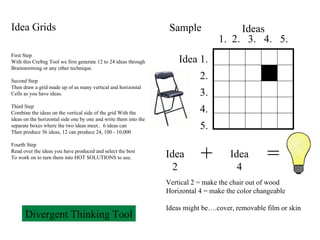
Sample + = Idea 1. 2. 3. 4. 5. Ideas 1.  2.  3.  4.  5. Idea 2 Idea 4 Vertical 2 = make the chair out of wood Horizontal 4 = make the color changeable Ideas might be….cover, removable film or skin Divergent Thinking Tool Idea Grids First Step With this Cre8ng Tool we first generate 12 to 24 ideas through Brainstorming or any other technique. Second Step Then draw a grid made up of as many vertical and horizontal Cells as you have ideas. Third Step Combine the ideas on the vertical side of the grid With the ideas on the horizontal side one by one and write them into the separate boxes where the two ideas meet..  6 ideas can Then produce 36 ideas, 12 can produce 24, 100 - 10,000 Fourth Step Read over the ideas you have produced and select the best To work on to turn them into HOT SOLUTIONS to use.
CHECKLIST S.C.A.M.P.E.R. S.C.A.M.P.E.R. is a form of CHECKLIST.  A CHECKLLIST is a prepared list of words, verbs, questions that you can use that can spark new ideas, change your thinking or your point of view or even you mood and the direction your thinking at the moment and take you into many directions. S.C.A.M.P.E.R. was created by Bob Eberle, teacher/educational consultant in the 1970 s to teach the concept of CHECKLISTING to school children by using a memory device (acronym) that they could easily remember when they needed to generate new ideas or remember existing or past ideas.  It is used as the foundation for Michael Michalko’s excellent Creative Thinking Tools book…THINKERTOYS. First Step Write out the word S.C.A.M.P.E.R. vertically on a piece of paper or on a flip chart/chalkboard or other surface that the group can see. Second Step Write out what the 7 letters stand for. Third Step Then use each of the 7 by asking questions using these verbs to improve/change/revise your challenge or problem to generate potential ideas and solutions. Fourth Step Read over the ideas you have produced and select the best To work on to turn them into HOT SOLUTIONS to use. Sample = Combine - what might we combine with our problem to improve it? Chair - new materials, sound, tastes, textures, arm rest, cushion Eliminate - what might we eliminate to improve the current chair produce a brand new one? Hinges, one of the legs, the back S. = substitute C. = combine A. = adapt, adopt M. = minify, magnify P. = put to other uses E. = eliminate R. = reverse Divergent Thinking Tool
Value Grids This is a logical/left-brain convergent tool that can be used to select ideas to turn into solutions First Step Generate ideas Second Step Select a workable number of ideas you or the group like Third Step Generate a list of values that final solution can be evaluated with. Fourth Step Examine each idea one by one for each value. Or Examine each value one by one comparing the chairs. Fifth Step If one idea ends up better from the analysis than one that you or the group have a strong feeling for then go back and  re-evaluate the weak areas and strengthen or change them. Sample + = Idea A. B. C. D. E. Values 1.  2.  3.  4.  5. Idea B Value 4 Convergent Thinking Tool Idea B  = make the chair out of wood Value 4  = better aesthetics Wood would make it easier to tool, the grain will Give a natural beauty to the chair
PCP-Pluses/Concerns/Potentials Pluses/Concerns/Potentials a convergent thinking tool used for analyzing a list or group of ideas that have been generated by an individual or a group. First Step Narrow down the number of ideas to a comfortable  number (3 to 6) Second Step Then one by one write out 3 lists of thoughts about each idea. Pluses of the ideas Concerns Potentials Third Step Then compare the results. Fourth Step If one idea falls behind the others yet the group seems more excited about it or committed to it, then go over each of the concerns and think of ways to eliminate or strength them with that idea. Sample = Idea 1 Make the chair out of XXX plastic and apply electrical lighting to it. Pluses -  Plastic will be cheaper Lighting will make it more useable The plastic will provide more color options  Concerns -  We have no experience with plastic Electrical wiring will add cost It may be too easily tipped over  Potentials -  Could lead to a product that could be sold anywhere in the world. Could expand our technical capacities Could open up new markets for our other products. Convergent Thinking Tool
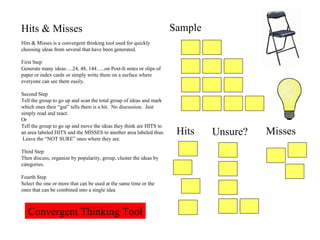
Hits & Misses Hits & Misses is a convergent thinking tool used for quickly choosing ideas from several that have been generated. First Step Generate many ideas….24, 48, 144…..on Post-It notes or slips of paper or index cards or simply write them on a surface where everyone can see them easily. Second Step Tell the group to go up and scan the total group of ideas and mark which ones their “gut” tells them is a hit.  No discussion.  Just simply read and react. Or Tell the group to go up and move the ideas they think are HITS to an area labeled HITS and the MISSES to another area labeled thus.  Leave the “NOT SURE” ones where they are. Third Step Then discuss, organize by popularity, group, cluster the ideas by categories. Fourth Step Select the one or more that can be used at the same time or the ones that can be combined into a single idea Sample Hits Unsure? Misses Convergent Thinking Tool
When to be Creative ? ? ? ? ? ? ? ? ?
When to be Creative ! ! ! ! ! ! ! ! When You  Need to Be ! !
Where to be Creative ? ? ? ? ? ? ? ? ? ?
Where to be Creative ? ? ? ? ? ? ? ? ? ! Where You  Need to Be
Time for some Review & Incubation
Chapter 7
Chapter 7 S.P.R.E.A.D. ng  Creative Thinking  Throughout Your Organization
S.P.R.E.A.D. S P R E A D
Physical Mental Emotional Social S.P.R.E.A.D. S P R E A D
Every aspect & part of your  Organization can be made  more creative. As you develop, expand  and enrich its creativeness EVERYONE will generate more ideas & solutions. CHOOSE TO BE
CREATIVE!
 
Nandri Terima Kasih Thank you lah No worry mate Grazie Abrigado Gracias Origato Danke Merci Gratis Xie xie ni
 
Thank you Thank you lah Termia Kasih Nandri Xie xie ni No worry mate Danke Merci Gratis Grazie Obrigado Gracias Origato
 

D bc-chapter-sixandseven

  • 1.
    beliefs, code ofbelief, commandments, conclusions credo declaration decrees directive, doctrine, dogma finding guidelines, guides, ideals, imperative, judgement laws, lead, notion, opinion, perspective, point of view, points position, principles, pronouncement standards, statement of belief, tenets, tips values, beliefs, code of belief, commandments, conclusions credo declaration decrees directive, doctrine, dogma finding guidelines, guides, ideals, imperative, judgement laws, lead, notion, opinion, perspective, point of view, points position, principles, pronouncement standards, statement of belief, tenets, tips values, beliefs, code of belief, commandments, conclusions credo declaration decrees directive, doctrine, dogma finding guidelines, guides, ideals, imperative, judgement laws, lead, notion, opinion, perspective, point of view, points position, principles, pronouncement standards, statement of belief, tenets, tips values, beliefs, code of belief, commandments, conclusions credo declaration decrees directive, doctrine, dogma finding guidelines, guides, ideals, imperative, judgement laws, lead, notion, opinion, perspective, point of view, points position, principles, pronouncement standards, statement of belief, tenets, tips values, Broken Crayons Broken Crayons Creative Thinking Inside, Outside, Along side, Under, Over, with a New or No Box at All,
  • 2.
    “ The guywho invented the first wheel was weird. The guy invented the other three was a genius. Sid Caesar
  • 3.
  • 4.
    Chapter 6 Howto Be Creative? Creative Tools & Techniques When? Where?
  • 5.
    How to beCreative ? ? ? ? ? ? ? ? ? ?
  • 6.
  • 7.
    What Mi g h t What Is It? It Be?
  • 8.
    What Mi g h t What Is It? It Be? What M i g h t We Want it to be?
  • 9.
  • 10.
    Tools & Techniques Creative
  • 11.
    Creative ThinkingTools Check lists Forced Relationships Idea Grids PCP-Pluses/Concerns/Potentials Hits & Misses, Doting, Ranking Value Grid        
  • 12.
    Creative Thinking ToolsChe cklisting S C A M P E R - Substitute - Combine - Adapt - Magnify, Minify - Put to Other Uses - Eliminate - Reverse
  • 13.
    Creative Thinking ToolsForced Relationships Animal (a-z) Product - Aardvark - Bear - Cow - Dog - Elephant - clothing - entertainment - building - sports - teaching tools
  • 14.
    Creative Thinking ToolsIdea Grid Bread Meat Top’g Veg Fruit Snack Dessert 1. 2. 3. 4. 5. 6. 7. 8. 9. 10. 1. 2. 3. 4. 5. 6. 7. 8. 9. 10. 1. 2. 3. 4. 5. 6. 7. 8. 9. 10. 1. 2. 3. 4. 5. 6. 7. 8. 9. 10. 1. 2. 3. 4. 5. 6. 7. 8. 9. 10. 1. 2. 3. 4. 5. 6. 7. 8. 9. 10. 1. 2. 3. 4. 5. 6. 7. 8. 9. 10.
  • 15.
    Creative Thinking ToolsIdea Grid Bread Meat Top’g Veg Fruit Snack Dessert 1. 2. 3. 4. 5. 6. 7. 8. 9. 10. 1. 2. 3. 4. 5. 6. 7. 8. 9. 10. 1. 2. 3. 4. 5. 6. 7. 8. 9. 10. 1. 2. 3. 4. 5. 6. 7. 8. 9. 10. 1. 2. 3. 4. 5. 6. 7. 8. 9. 10. 1. 2. 3. 4. 5. 6. 7. 8. 9. 10. 1. 2. 3. 4. 5. 6. 7. 8. 9. 10.
  • 16.
    Creative Thinking ToolsPluses Concerns Potentials PCP Pluses/Concerns/ Potentials
  • 17.
    Creative Thinking ToolsIdea 1 Idea 2 Idea 3 Idea 4 Idea 5 Idea 6 Idea 1 Idea 2 Idea 3 Idea 4 Idea 5 Idea 6 Idea 1 Idea 2 Idea 3 Idea 4 Idea 5 Idea 6       1 2 3 Hits & Misses “ Doting”, Ranking
  • 18.
    Creative Thinking Tools# a. b. c. d. e. 1. 5. 4. 3. 2. 1 5 4 3 2 5 4 3 2 1 5 4 3 2 1 5 4 3 2 1 5 4 3 2 1 * ? Value Grid
  • 19.
    Creative Thinking Tools# a. b. c. d. e. 1. 5. 4. 3. 2. 1 5 4 3 2 5 4 3 2 1 5 4 3 2 1 5 4 3 2 1 5 4 3 2 1 * ? Value Grid
  • 20.
    Thinking Tools Divergent& Convergent Creative
  • 21.
    Forced Relationships Thisis an idea generating technique that appears in many books about creative thinking and creative thinking or innovation tools. First Step choose something totally unrelated to the problem or challenge You or your group are working on. Second Step List everything you or your group know about it. (Who? What? When? Where? Why? How?… physical, visual, tactile,…all senses, good and bad) Third Step List everything you or your group know about your problem or challenge. (WWWWWH…and using all the senses) Fourth Step Take items/details/aspects from the first list and FORCE FIT them to features Or details from the second list. Your goal is to see if the features from The randomly chosen, unrelated thing/animal sparks ideas for improving, Changing, correcting features of the problem. A traditional example or warm-up for doing this consists of… 1st. Ask the person or group to write everything they know about a canary (or a bird in their country. 2nd. Ask the person or group to write everything they know about the chair they are sitting in. 3rd. Then I ask them to combine (FORCE FIT or make a FORCED Relationship) one item from the canary list with The chair’s list with the goal to improve, change, correct the chair design or to generate ideas for designing the ultimate chair. Sample + = Feathers-Soft + chair is hard = make seat soft Yellow + chair is ship gray = add color Divergent Thinking Tool
  • 22.
    Sample + =Idea 1. 2. 3. 4. 5. Ideas 1. 2. 3. 4. 5. Idea 2 Idea 4 Vertical 2 = make the chair out of wood Horizontal 4 = make the color changeable Ideas might be….cover, removable film or skin Divergent Thinking Tool Idea Grids First Step With this Cre8ng Tool we first generate 12 to 24 ideas through Brainstorming or any other technique. Second Step Then draw a grid made up of as many vertical and horizontal Cells as you have ideas. Third Step Combine the ideas on the vertical side of the grid With the ideas on the horizontal side one by one and write them into the separate boxes where the two ideas meet.. 6 ideas can Then produce 36 ideas, 12 can produce 24, 100 - 10,000 Fourth Step Read over the ideas you have produced and select the best To work on to turn them into HOT SOLUTIONS to use.
  • 23.
    CHECKLIST S.C.A.M.P.E.R. S.C.A.M.P.E.R.is a form of CHECKLIST. A CHECKLLIST is a prepared list of words, verbs, questions that you can use that can spark new ideas, change your thinking or your point of view or even you mood and the direction your thinking at the moment and take you into many directions. S.C.A.M.P.E.R. was created by Bob Eberle, teacher/educational consultant in the 1970 s to teach the concept of CHECKLISTING to school children by using a memory device (acronym) that they could easily remember when they needed to generate new ideas or remember existing or past ideas. It is used as the foundation for Michael Michalko’s excellent Creative Thinking Tools book…THINKERTOYS. First Step Write out the word S.C.A.M.P.E.R. vertically on a piece of paper or on a flip chart/chalkboard or other surface that the group can see. Second Step Write out what the 7 letters stand for. Third Step Then use each of the 7 by asking questions using these verbs to improve/change/revise your challenge or problem to generate potential ideas and solutions. Fourth Step Read over the ideas you have produced and select the best To work on to turn them into HOT SOLUTIONS to use. Sample = Combine - what might we combine with our problem to improve it? Chair - new materials, sound, tastes, textures, arm rest, cushion Eliminate - what might we eliminate to improve the current chair produce a brand new one? Hinges, one of the legs, the back S. = substitute C. = combine A. = adapt, adopt M. = minify, magnify P. = put to other uses E. = eliminate R. = reverse Divergent Thinking Tool
  • 24.
    Value Grids Thisis a logical/left-brain convergent tool that can be used to select ideas to turn into solutions First Step Generate ideas Second Step Select a workable number of ideas you or the group like Third Step Generate a list of values that final solution can be evaluated with. Fourth Step Examine each idea one by one for each value. Or Examine each value one by one comparing the chairs. Fifth Step If one idea ends up better from the analysis than one that you or the group have a strong feeling for then go back and re-evaluate the weak areas and strengthen or change them. Sample + = Idea A. B. C. D. E. Values 1. 2. 3. 4. 5. Idea B Value 4 Convergent Thinking Tool Idea B = make the chair out of wood Value 4 = better aesthetics Wood would make it easier to tool, the grain will Give a natural beauty to the chair
  • 25.
    PCP-Pluses/Concerns/Potentials Pluses/Concerns/Potentials aconvergent thinking tool used for analyzing a list or group of ideas that have been generated by an individual or a group. First Step Narrow down the number of ideas to a comfortable number (3 to 6) Second Step Then one by one write out 3 lists of thoughts about each idea. Pluses of the ideas Concerns Potentials Third Step Then compare the results. Fourth Step If one idea falls behind the others yet the group seems more excited about it or committed to it, then go over each of the concerns and think of ways to eliminate or strength them with that idea. Sample = Idea 1 Make the chair out of XXX plastic and apply electrical lighting to it. Pluses - Plastic will be cheaper Lighting will make it more useable The plastic will provide more color options Concerns - We have no experience with plastic Electrical wiring will add cost It may be too easily tipped over Potentials - Could lead to a product that could be sold anywhere in the world. Could expand our technical capacities Could open up new markets for our other products. Convergent Thinking Tool
  • 26.
    Hits & MissesHits & Misses is a convergent thinking tool used for quickly choosing ideas from several that have been generated. First Step Generate many ideas….24, 48, 144…..on Post-It notes or slips of paper or index cards or simply write them on a surface where everyone can see them easily. Second Step Tell the group to go up and scan the total group of ideas and mark which ones their “gut” tells them is a hit. No discussion. Just simply read and react. Or Tell the group to go up and move the ideas they think are HITS to an area labeled HITS and the MISSES to another area labeled thus. Leave the “NOT SURE” ones where they are. Third Step Then discuss, organize by popularity, group, cluster the ideas by categories. Fourth Step Select the one or more that can be used at the same time or the ones that can be combined into a single idea Sample Hits Unsure? Misses Convergent Thinking Tool
  • 27.
    When to beCreative ? ? ? ? ? ? ? ? ?
  • 28.
    When to beCreative ! ! ! ! ! ! ! ! When You Need to Be ! !
  • 29.
    Where to beCreative ? ? ? ? ? ? ? ? ? ?
  • 30.
    Where to beCreative ? ? ? ? ? ? ? ? ? ! Where You Need to Be
  • 31.
    Time for someReview & Incubation
  • 32.
  • 33.
    Chapter 7 S.P.R.E.A.D.ng Creative Thinking Throughout Your Organization
  • 34.
  • 35.
    Physical Mental EmotionalSocial S.P.R.E.A.D. S P R E A D
  • 36.
    Every aspect &part of your Organization can be made more creative. As you develop, expand and enrich its creativeness EVERYONE will generate more ideas & solutions. CHOOSE TO BE
  • 37.
  • 38.
  • 39.
    Nandri Terima KasihThank you lah No worry mate Grazie Abrigado Gracias Origato Danke Merci Gratis Xie xie ni
  • 40.
  • 41.
    Thank you Thankyou lah Termia Kasih Nandri Xie xie ni No worry mate Danke Merci Gratis Grazie Obrigado Gracias Origato
  • 42.