Techniques
IN ORGANIZING INFORMATION
Techniques
are approaches or methods you as a writer
may use to organize the information you
have gathered, to accomplish your desired
aim in writing and to improve your writing
craft.
A. Brainstorming
is a group activity technique by which efforts are made to
find a conclusion for a specific problem by gathering a list of
ideas spontaneously contributed by its members.
The term was popularized by Alex Faickney Osborn in the
1953 book Applied Imagination (Wikipedia.org).
He developed this technique when he got frustrated that his
employees could not come up with useful techniques as they
worked individually.
4 Brainstorming Tips by Mark Nichol
1. Cubing
◦In this strategy, a topic or idea is examined in six viewpoints:
a.What is the topic?
b.What is it like or unlike?
c. What does it make you think of?
d.What constituent parts is it made of?
e.How can it be used?
f. How can you support or oppose it?
2. Free Writing
◦In this technique, just keep on writing and not
minding errors in spelling or grammar. Have a
quantitative goal like coming up with 500 words or
more.
◦The objective here is just to write what comes to
your mind. Then review what you have written
later, and hopefully choose a topic from what you
have written that would interest you.
3. Listing
As the term states, list down what comes to your
mind. If your intention is to come up with topics to a
write about, enumerate them. An important
reminder in using this technique is not to list your
ideas in outline form because an outline will require
you to organize items and your thoughts which is a
principle contrary to brainstorming.
4. Mapping
Mapping, also known as clustering and webbing, is a
graphic form of listing that simply involves jotting
down ideas on a large writing surface and then
making connections by associating similarly themed
ideas with color-coded circles of underlines of
distinct patterns and then indicating other
relationships by linking with lines.
Brainstorming Techniques
Time Travel. How would you deal with this if you were in a
different time period? 10 years ago? 100 years ago? 1,000 years
ago? 10,000 years ago? How about in the future? 10 years
later? 100 years later? 1,000 years later? 10,000 years later?
Gap Filling. Identify your current spot – Point A – and your end
goal – Point B. What is the gap that exists between A and B?
What are all the things you need to fill up this gap? List them
down and find out what it takes to get them.
Mind Map. Great tool to work out as many ideas as you can in
hierarchical tree and cluster format. Start off with your goal in
the center, branch out into the major sub-topics, continue to
branch out into as many sub-sub-topics as needed.
SWOT Analysis. Do a SWOT of your situation – What are the
Strengths? Weaknesses? Opportunities? Threats? The analysis
will open you up to ideas you may not be aware before.
Brain Writing. Get a group of people and have them write their
ideas on their own sheet of paper. After 10 minutes, rotate the
sheets to different people and build off what the others wrote
on their paper. Continue until everyone has written on everyone
else’s sheet.
Trigger Method. Brainstorm on as many ideas as possible. Then
select the best ones and brainstorm on those ideas as ‘trigger’
more ideas. Repeat until you find the best solution.
B. Graphic Organizers
A graphic organizer, also known as knowledge map, concept
map, story map, cognitive organizer, advance organizer, or
concept diagram, is a communication tool that uses visual
symbols to express knowledge, concepts, thoughts, or ideas,
and the relationship between them.
The main purpose of a graphic organizer is to provide a
visual aid to facilitate learning and instruction
(Wikipedia.com)
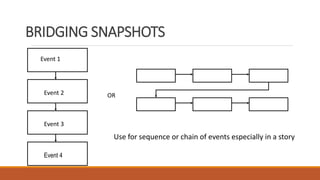
BRIDGING SNAPSHOTS
Event 1
Event 2
Event 3
Event 4
OR
Use for sequence or chain of events especially in a story
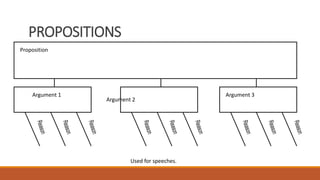
PROPOSITIONS
Proposition
Argument 1 Argument 3
Reason
Reason
Reason
Reason
Reason
Reason
Reason
Reason
Reason
Used for speeches.
Argument 2
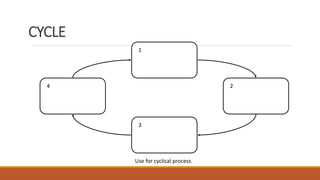
CYCLE
Use for cyclical process.
1
2
3
4
CAUSE AND EFFECT
CLASSIFY AND ANALYZE
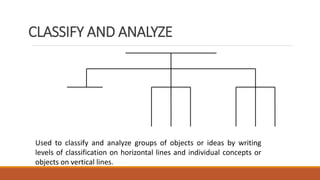
Used to classify and analyze groups of objects or ideas by writing
levels of classification on horizontal lines and individual concepts or
objects on vertical lines.
CLASSIFY AND ANALYZE
Used to classify and analyze groups of objects or ideas by writing levels of
classification on horizontal lines and individual concepts or objects on vertical lines.
PART-WHOLE
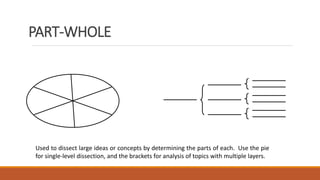
Used to dissect large ideas or concepts by determining the parts of each. Use the pie
for single-level dissection, and the brackets for analysis of topics with multiple layers.
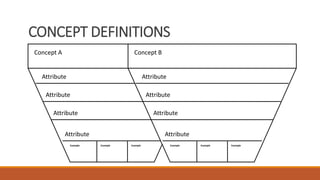
CONCEPT DEFINITIONS
Concept A
Attribute
Attribute
Attribute
Attribute
Example Example Example
Concept B
Attribute
Attribute
Attribute
Attribute
Example Example Example
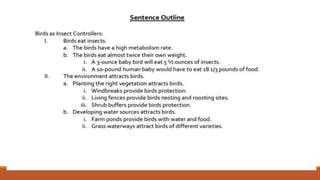
Outline
General plan of what you intend to write. You classify each
information and its connection to your topic or subject.
The sorted information may now be grouped according to
content. From the grouped information, you can already
provide headings – main and subheadings – which are
parallel in structure. Parallel in structure means that if you
want to use phrases for subheadings, use phrases all
throughout. This type of outline is the topic outline.
Techniques in arranging information

Techniques in arranging information

  • 1.
  • 2.
    Techniques are approaches ormethods you as a writer may use to organize the information you have gathered, to accomplish your desired aim in writing and to improve your writing craft.
  • 3.
    A. Brainstorming is agroup activity technique by which efforts are made to find a conclusion for a specific problem by gathering a list of ideas spontaneously contributed by its members. The term was popularized by Alex Faickney Osborn in the 1953 book Applied Imagination (Wikipedia.org). He developed this technique when he got frustrated that his employees could not come up with useful techniques as they worked individually.
  • 4.
    4 Brainstorming Tipsby Mark Nichol 1. Cubing ◦In this strategy, a topic or idea is examined in six viewpoints: a.What is the topic? b.What is it like or unlike? c. What does it make you think of? d.What constituent parts is it made of? e.How can it be used? f. How can you support or oppose it?
  • 5.
    2. Free Writing ◦Inthis technique, just keep on writing and not minding errors in spelling or grammar. Have a quantitative goal like coming up with 500 words or more. ◦The objective here is just to write what comes to your mind. Then review what you have written later, and hopefully choose a topic from what you have written that would interest you.
  • 6.
    3. Listing As theterm states, list down what comes to your mind. If your intention is to come up with topics to a write about, enumerate them. An important reminder in using this technique is not to list your ideas in outline form because an outline will require you to organize items and your thoughts which is a principle contrary to brainstorming.
  • 7.
    4. Mapping Mapping, alsoknown as clustering and webbing, is a graphic form of listing that simply involves jotting down ideas on a large writing surface and then making connections by associating similarly themed ideas with color-coded circles of underlines of distinct patterns and then indicating other relationships by linking with lines.
  • 8.
    Brainstorming Techniques Time Travel.How would you deal with this if you were in a different time period? 10 years ago? 100 years ago? 1,000 years ago? 10,000 years ago? How about in the future? 10 years later? 100 years later? 1,000 years later? 10,000 years later? Gap Filling. Identify your current spot – Point A – and your end goal – Point B. What is the gap that exists between A and B? What are all the things you need to fill up this gap? List them down and find out what it takes to get them. Mind Map. Great tool to work out as many ideas as you can in hierarchical tree and cluster format. Start off with your goal in the center, branch out into the major sub-topics, continue to branch out into as many sub-sub-topics as needed.
  • 9.
    SWOT Analysis. Doa SWOT of your situation – What are the Strengths? Weaknesses? Opportunities? Threats? The analysis will open you up to ideas you may not be aware before. Brain Writing. Get a group of people and have them write their ideas on their own sheet of paper. After 10 minutes, rotate the sheets to different people and build off what the others wrote on their paper. Continue until everyone has written on everyone else’s sheet. Trigger Method. Brainstorm on as many ideas as possible. Then select the best ones and brainstorm on those ideas as ‘trigger’ more ideas. Repeat until you find the best solution.
  • 10.
    B. Graphic Organizers Agraphic organizer, also known as knowledge map, concept map, story map, cognitive organizer, advance organizer, or concept diagram, is a communication tool that uses visual symbols to express knowledge, concepts, thoughts, or ideas, and the relationship between them. The main purpose of a graphic organizer is to provide a visual aid to facilitate learning and instruction (Wikipedia.com)
  • 11.
    BRIDGING SNAPSHOTS Event 1 Event2 Event 3 Event 4 OR Use for sequence or chain of events especially in a story
  • 12.
    PROPOSITIONS Proposition Argument 1 Argument3 Reason Reason Reason Reason Reason Reason Reason Reason Reason Used for speeches. Argument 2
  • 13.
    CYCLE Use for cyclicalprocess. 1 2 3 4
  • 14.
  • 15.
    CLASSIFY AND ANALYZE Usedto classify and analyze groups of objects or ideas by writing levels of classification on horizontal lines and individual concepts or objects on vertical lines.
  • 16.
    CLASSIFY AND ANALYZE Usedto classify and analyze groups of objects or ideas by writing levels of classification on horizontal lines and individual concepts or objects on vertical lines.
  • 17.
    PART-WHOLE Used to dissectlarge ideas or concepts by determining the parts of each. Use the pie for single-level dissection, and the brackets for analysis of topics with multiple layers.
  • 18.
    CONCEPT DEFINITIONS Concept A Attribute Attribute Attribute Attribute ExampleExample Example Concept B Attribute Attribute Attribute Attribute Example Example Example
  • 19.
    Outline General plan ofwhat you intend to write. You classify each information and its connection to your topic or subject. The sorted information may now be grouped according to content. From the grouped information, you can already provide headings – main and subheadings – which are parallel in structure. Parallel in structure means that if you want to use phrases for subheadings, use phrases all throughout. This type of outline is the topic outline.