PORUKARA COLLEGE OF EDUCATION
CHAMPAKULAM
Submitted to,
Ms. Teena Maria Thomas
Submitted by,
Rakhi S
B.Ed, Social Science
WELCOME
TEAM TEACHING
INTRODUCTION
• It provides teacher controlled instructional
experience.
• The two or teachers plan, execute and evaluate
the learning experiences of a group of
students.
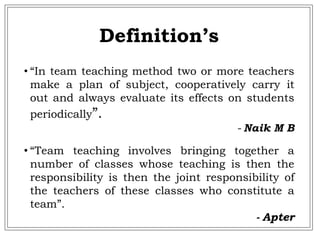
• “In team teaching method two or more teachers
make a plan of subject, cooperatively carry it
out and always evaluate its effects on students
periodically”.
- Naik M B
• “Team teaching involves bringing together a
number of classes whose teaching is then the
responsibility is then the joint responsibility of
the teachers of these classes who constitute a
team”.
- Apter
Definition’s
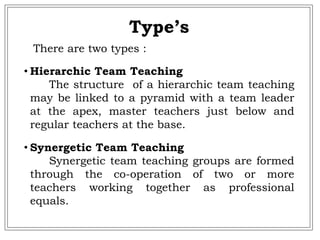
• Hierarchic Team Teaching
The structure of a hierarchic team teaching
may be linked to a pyramid with a team leader
at the apex, master teachers just below and
regular teachers at the base.
• Synergetic Team Teaching
Synergetic team teaching groups are formed
through the co-operation of two or more
teachers working together as professional
equals.
Type’s
There are two types :
OBJECTIVES
• To utilize the better talents and interests of
teachers.
• To increase grouping and scheduling flexibility.
• To improve the quality of instruction.
• To bring more dynamism in time table
construction.
PRINCIPLES
• Size and composition of the group for team teaching
should be appropriate in terms of learning experiences
and purposes of the group.
• Time should be allotted keeping in consideration the
importance of the subject.
• Learning climate should be provided by making
arrangements like laboratory, library, audio, video etc.
• Level of team teaching must be appropriate to the
learners.
• The nature and extent of the supervision of group
activities depends on the purpose of group.
Factors responsible success of team
teaching
• Co-operation among team teachers.
• Availability audio visual aids.
• Need for proper planning
PROCEDURE
• Planning Stage :-
Topic, Objective, initial and terminal behaviour
of learners, teaching aids, teaching strategy,
members of team etc.
• Execution Stage :-
Diagnosing the learner’s previous knowledge,
adopting proper communication strategy,
presentation of lecture by the team.
• Evaluation Stage :-
Evaluating level of performance, diagnosing the
difficulties and give remedial treatment.
• Opportunity for free discussion.
• Development of human relationships.
• Development of professional status of the
teacher.
• Exposure of group to more specialist.
• It will save time and energy.
• Improves the quality of instruction.
ADVANTAGES
LIMITATIONS
• Lack of co-operation among teachers.
• Disregard to the dynamics of small group.
• Traditional conservative attitude.
• Lack of interest.
• Lack of accommodation for larger groups.
• Unrealistic expectations about team
operation.
THANK YOU

Team teaching

  • 1.
    PORUKARA COLLEGE OFEDUCATION CHAMPAKULAM Submitted to, Ms. Teena Maria Thomas Submitted by, Rakhi S B.Ed, Social Science
  • 2.
  • 3.
  • 4.
    INTRODUCTION • It providesteacher controlled instructional experience. • The two or teachers plan, execute and evaluate the learning experiences of a group of students.
  • 5.
    • “In teamteaching method two or more teachers make a plan of subject, cooperatively carry it out and always evaluate its effects on students periodically”. - Naik M B • “Team teaching involves bringing together a number of classes whose teaching is then the responsibility is then the joint responsibility of the teachers of these classes who constitute a team”. - Apter Definition’s
  • 6.
    • Hierarchic TeamTeaching The structure of a hierarchic team teaching may be linked to a pyramid with a team leader at the apex, master teachers just below and regular teachers at the base. • Synergetic Team Teaching Synergetic team teaching groups are formed through the co-operation of two or more teachers working together as professional equals. Type’s There are two types :
  • 7.
    OBJECTIVES • To utilizethe better talents and interests of teachers. • To increase grouping and scheduling flexibility. • To improve the quality of instruction. • To bring more dynamism in time table construction.
  • 8.
    PRINCIPLES • Size andcomposition of the group for team teaching should be appropriate in terms of learning experiences and purposes of the group. • Time should be allotted keeping in consideration the importance of the subject. • Learning climate should be provided by making arrangements like laboratory, library, audio, video etc. • Level of team teaching must be appropriate to the learners. • The nature and extent of the supervision of group activities depends on the purpose of group.
  • 9.
    Factors responsible successof team teaching • Co-operation among team teachers. • Availability audio visual aids. • Need for proper planning
  • 10.
    PROCEDURE • Planning Stage:- Topic, Objective, initial and terminal behaviour of learners, teaching aids, teaching strategy, members of team etc. • Execution Stage :- Diagnosing the learner’s previous knowledge, adopting proper communication strategy, presentation of lecture by the team. • Evaluation Stage :- Evaluating level of performance, diagnosing the difficulties and give remedial treatment.
  • 11.
    • Opportunity forfree discussion. • Development of human relationships. • Development of professional status of the teacher. • Exposure of group to more specialist. • It will save time and energy. • Improves the quality of instruction. ADVANTAGES
  • 12.
    LIMITATIONS • Lack ofco-operation among teachers. • Disregard to the dynamics of small group. • Traditional conservative attitude. • Lack of interest. • Lack of accommodation for larger groups. • Unrealistic expectations about team operation.
  • 13.