Team-Teaching:Creating Individualized Attention and Personal Learning EnvironmentsPresented by: Kara GazarekKara.Gazarek@ocps.net
What is it?What do you understand by the term “Team-teaching”?  Through discussion come up with an agreed definition.Are there different types of Team-teaching?Brainstorm different models of team teaching
Learn: What is Team-Teaching?Team teaching is a teaching relationship where teachers together set goals for a unit, prepare individual lesson plans, teach students, and assess the students’ learning. Teachers work in a coactive and coordinated fashion in which they use techniques that allow students of varying abilities to achieve their potential.
There are many ways that teachers can work together to make the lesson easier to understand for all students.
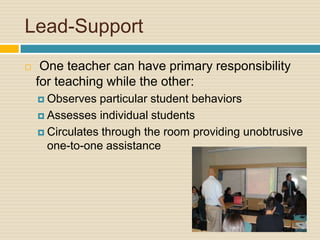
Lead-Support One teacher can have primary responsibility for teaching while the other:Observes particular student behaviorsAssesses individual studentsCirculates through the room providing unobtrusive one-to-one assistance
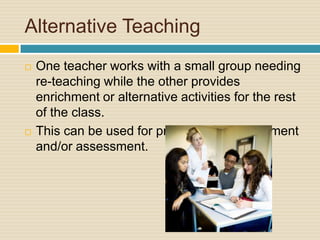
Alternative TeachingOne teacher works with a small group needing re-teaching while the other provides enrichment or alternative activities for the rest of the class.This can be used for pre-teaching, enrichment and/or assessment.
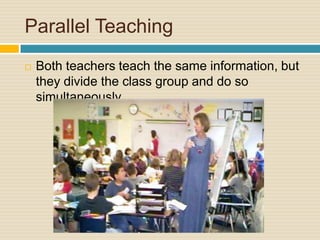
Parallel TeachingBoth teachers teach the same information, but they divide the class group and do so simultaneously.
Station TeachingTeachers divide content and students, each then teaches the content to one group and subsequently repeats the instruction for the other group.Sometimes there is another “station” for independent work or computer work.
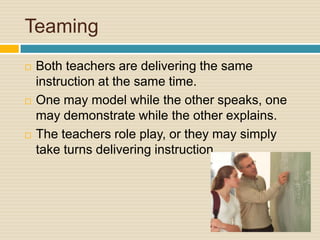
TeamingBoth teachers are delivering the same instruction at the same time. One may model while the other speaks, one may demonstrate while the other explains. The teachers role play, or they may simply take turns delivering instruction.
Implementation SuggestionsDuring the planning process, discuss your views on teaching and learning, especially who your target group of students is going to beDiscuss behavior management and other practices so you can come to an agreementLet parents know about the benefits of co-teachingAgree to be equal partners:Plan ways to talk out disagreementsProceed slowly in designing, implementing, and evaluating the co-teaching process

Team-Teaching

  • 1.
    Team-Teaching:Creating Individualized Attentionand Personal Learning EnvironmentsPresented by: Kara GazarekKara.Gazarek@ocps.net
  • 2.
    What is it?Whatdo you understand by the term “Team-teaching”? Through discussion come up with an agreed definition.Are there different types of Team-teaching?Brainstorm different models of team teaching
  • 3.
    Learn: What isTeam-Teaching?Team teaching is a teaching relationship where teachers together set goals for a unit, prepare individual lesson plans, teach students, and assess the students’ learning. Teachers work in a coactive and coordinated fashion in which they use techniques that allow students of varying abilities to achieve their potential.
  • 4.
    There are manyways that teachers can work together to make the lesson easier to understand for all students.
  • 5.
    Lead-Support One teachercan have primary responsibility for teaching while the other:Observes particular student behaviorsAssesses individual studentsCirculates through the room providing unobtrusive one-to-one assistance
  • 6.
    Alternative TeachingOne teacherworks with a small group needing re-teaching while the other provides enrichment or alternative activities for the rest of the class.This can be used for pre-teaching, enrichment and/or assessment.
  • 7.
    Parallel TeachingBoth teachersteach the same information, but they divide the class group and do so simultaneously.
  • 8.
    Station TeachingTeachers dividecontent and students, each then teaches the content to one group and subsequently repeats the instruction for the other group.Sometimes there is another “station” for independent work or computer work.
  • 9.
    TeamingBoth teachers aredelivering the same instruction at the same time. One may model while the other speaks, one may demonstrate while the other explains. The teachers role play, or they may simply take turns delivering instruction.
  • 10.
    Implementation SuggestionsDuring theplanning process, discuss your views on teaching and learning, especially who your target group of students is going to beDiscuss behavior management and other practices so you can come to an agreementLet parents know about the benefits of co-teachingAgree to be equal partners:Plan ways to talk out disagreementsProceed slowly in designing, implementing, and evaluating the co-teaching process

Editor's Notes

  • #4 Beginning course details and/or books/materials needed for a class/project.
  • #5 A schedule design for optional periods of time/objectives.
  • #6 Introductory notes.
  • #7 Objectives for instruction and expected results and/or skills developed from learning.