Did you know that there are five models
for Co-Teaching? They are: (1) “One
Teach, One Assist, (2) Station Teaching,
(3) Parallel Teaching, (4) Alternative
Teaching, and (5) Team Teaching.
One Teach, One Assist
You can practice the first one by
picking up a pointer and pointing to
the states as the teacher talks to the
class.
By standing next to the map and
pointing you are helping the teacher
maintain eye contact with his/her
students and control of the class.
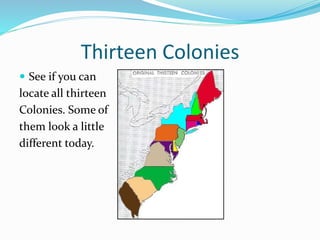
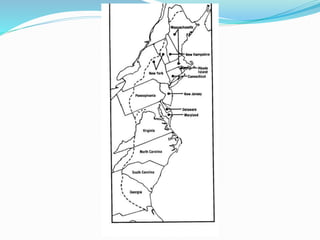
Thirteen Colonies
 See if you can
locate all thirteen
Colonies. Some of
them look a little
different today.
Station Teaching
 This method breaks the students into two or
three work stations.
 It requires careful collaboration with the
teacher in order to know the objective well
and who will provide what assistance to
which work station.
 It is important to develop the student
without stressing the staff.
Parallel Teaching
 Method (3) might be accomplished if you and the
teacher work in small groups, teaching the same
lesson.
 Perhaps you could spend a few minutes working
on the state capitals while the teacher talks about
the role each colony played in the American
Revolution.
 Then you switch places with the other group and
you talk about the role each colony played with
your group.
Alternative Teaching
 This method allows the teacher to teach the class while
the para works with a small group of students to teach
or re-teach a lesson.
 It provides a better foundation for some students and
reinforces a lesson for others who are not ready to
move on to the next lesson.
 This could be really effective if you are using a special
reading program, doing math using manipulatives, or
using computer based programs/games.
Team Teaching
 The teacher and para teach and tutor
together in this method.
 This gives each student access to both
teacher and para at the same time.
 The teacher can teach and the para can
paraphrase –or- the paraprofessional can
read and the teacher can expand on the text.
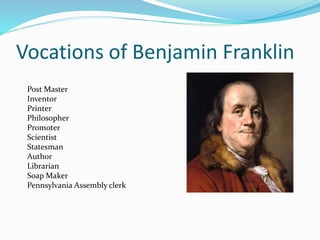
Vocations of Benjamin Franklin
Post Master
Inventor
Printer
Philosopher
Promoter
Scientist
Statesman
Author
Librarian
Soap Maker
Pennsylvania Assembly clerk
Supportive Co-Teaching
 One teaches and the moves among the students.
 The supportive role watches and listens for students
who are struggling or are having a hard time staying on
task.
 Great way to get students to interact and mentor one
another
 Be careful not to hover and thwart interaction or make
students dependent on you.
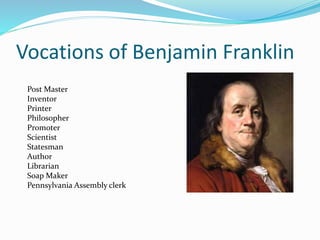
Vocations of Benjamin Franklin
Post Master
Inventor
Printer
Philosopher
Promoter
Scientist
Statesman
Author
Librarian
Soap Maker
Pennsylvania Assembly clerk
Inside Inclusion: Methods of Co-Teaching

Inside Inclusion: Methods of Co-Teaching

  • 1.
    Did you knowthat there are five models for Co-Teaching? They are: (1) “One Teach, One Assist, (2) Station Teaching, (3) Parallel Teaching, (4) Alternative Teaching, and (5) Team Teaching.
  • 2.
    One Teach, OneAssist You can practice the first one by picking up a pointer and pointing to the states as the teacher talks to the class. By standing next to the map and pointing you are helping the teacher maintain eye contact with his/her students and control of the class.
  • 3.
    Thirteen Colonies  Seeif you can locate all thirteen Colonies. Some of them look a little different today.
  • 4.
    Station Teaching  Thismethod breaks the students into two or three work stations.  It requires careful collaboration with the teacher in order to know the objective well and who will provide what assistance to which work station.  It is important to develop the student without stressing the staff.
  • 5.
    Parallel Teaching  Method(3) might be accomplished if you and the teacher work in small groups, teaching the same lesson.  Perhaps you could spend a few minutes working on the state capitals while the teacher talks about the role each colony played in the American Revolution.  Then you switch places with the other group and you talk about the role each colony played with your group.
  • 6.
    Alternative Teaching  Thismethod allows the teacher to teach the class while the para works with a small group of students to teach or re-teach a lesson.  It provides a better foundation for some students and reinforces a lesson for others who are not ready to move on to the next lesson.  This could be really effective if you are using a special reading program, doing math using manipulatives, or using computer based programs/games.
  • 7.
    Team Teaching  Theteacher and para teach and tutor together in this method.  This gives each student access to both teacher and para at the same time.  The teacher can teach and the para can paraphrase –or- the paraprofessional can read and the teacher can expand on the text.
  • 8.
    Vocations of BenjaminFranklin Post Master Inventor Printer Philosopher Promoter Scientist Statesman Author Librarian Soap Maker Pennsylvania Assembly clerk
  • 9.
    Supportive Co-Teaching  Oneteaches and the moves among the students.  The supportive role watches and listens for students who are struggling or are having a hard time staying on task.  Great way to get students to interact and mentor one another  Be careful not to hover and thwart interaction or make students dependent on you.
  • 10.
    Vocations of BenjaminFranklin Post Master Inventor Printer Philosopher Promoter Scientist Statesman Author Librarian Soap Maker Pennsylvania Assembly clerk

Editor's Notes

  • #3 If you wanted to study the Original Thirteen Colonies you might start by naming them: (1) Georgia, (2) South Carolina, (3) North Carolina, (4) Virginia, (5) Maryland, (6) Pennsylvania, (7) New Jersey, (8) Rhode Island (9) Delaware, (10) New York, (11) Connecticut, (12) Massachusetts, and (13) New Hampshire. If the Para has a “cheat sheet” he/she can be prepared to assist the students using hints such as “one starts with a ‘P” or “the name is two words”.
  • #8 The key to this method is that both team members must know the material and there has to be a clear objective in mind. When team members have worked together and are comfortable, the para simply follows the teacher’s lead. When the lesson is over, the para is prepared to re-teach as outlined in Method 4.
  • #11 (1) He became the Postmaster of all the colonies, (2) he apprenticed to be a Printer and owned his own shop, (3) Philosopher – wrote many witty sayings, such as “A penny saved is a penny earned”, (4) Promoter – raised money for Phildelphis\a’s first hospital, (5) Scientist – studied thunderstorms, earthquakes, climatic changes, rock formations, and natural springs, (6) Inventor – even invented some medical instruments, (7) Statesman – continental congress, president of Penn. Supreme Executive Council, (8) Author – “Every Man His Own Doctor”, (9) Soap maker – apprenticed under his father, (10) Librarian – started a library in Philadelphia, (11) Pennsylvania Assembly clerk – kept minutes and filed papers