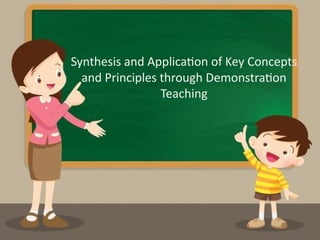
Synthesis and Application of Key Concepts
and Principles through Demonstration
Teaching
What is
Teaching?
• A process of interacting
• Stands for pedagogy, training and
nurturing
THE TEACHER
• A key factor in any teaching –
learning process.
• Constructs well designed plan
to achieve to objectives of the
lesson.
• Prepares learning environment.
THE LEARNER
• He is an embodied spirit.
• Most important element of teaching.
• The natural characteristics of learners are: age, maturity,
grade level, health, abilities, family background,
experiences and motivation and his /her culture including
values, attitudes and traditions which influence the teaching
– learning process to a very large extent.
What is
Micro-Teaching?
Micro teaching is one of the innovations
in the field of technology of teaching.
It is one of the teacher training
techniques and it is not one of the
method
Origin of micro teaching Micro teaching
originated in 1961 at Stanford University(USA)
Micro teaching was the demonstration lesson
used at Stanford University until 1961 The
demonstration lesson involves a student
presenting a lesson to a small group of fellow
students while the rest of the class looks on.
Micro teaching as it was called for the first time in
1963 (Allen and Ryan).
Characteristics of Micro-teaching:
It is a new experience or innovation in the field
of teacher education, more specifically in
student-teachers. Only one teaching skill is
considered at a time. Not important to subject
content, they should concentrate only teaching
skill.
Steps in Micro-teaching
• Step 1: To provide the knowledge and
awareness of teaching a particular skill is
defined to trainees in terms of teaching
behavior.
• Step 2: The student teachers observe a
demonstration lesson given by the teacher
educator.
• Step 3: The student teachers prepare micro
lesson plan and which he can practice a
particular teaching skill with the help of his/her
teacher educator.
• Step 4: The student teachers present the micro
lesson to small group of pupils (5 to 7 students).
This activity observed by the teacher educators,
student teacher, and video tape.
• Step 5: Discussion of the lesson base on the feedback, if
student teachers commit any mistake during his/her
practice of micro lesson. This session is called evaluation
session.
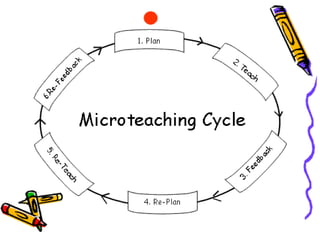
• Step 6: The student teachers re-plan the lesson in order to
practice the small skill effectively in the light of the
discussion and suggestion.
• Step 7: The student teachers re-planned lesson is re-
taught to another small group of students of same class
for the same duration to practice the same skill.
• Step 8: The teaching is now followed by
discussion of suggestions and encouragement
to the teaching performance. The feed-back is
again providing to the trainee.
• Step 9: The same process repeated until
master in particular skill.
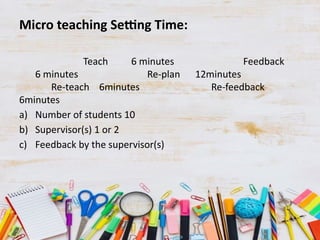
Micro teaching Setting Time:
Teach 6 minutes Feedback
6 minutes Re-plan 12minutes
Re-teach 6minutes Re-feedback
6minutes
a) Number of students 10
b) Supervisor(s) 1 or 2
c) Feedback by the supervisor(s)
Comparison between Micro-Teaching and
Traditional Teaching S.No Micro-Teaching
Traditional Teaching
Advantages of micro-teaching
• Micro-teaching reduces the complexity of
classroom teaching.
• It is foundation of teaching, especially student
teachers.
• It is real classroom teaching.
• It is best way to improve teaching skill among
student teachers.
“All arrangements that include
two or more faculty in some
level of collaboration in the
planning and delivery of a
course”
Davis (1995)
• The plan of the teaching methods, the
time and the process are kept flexible so
that the necessary changes in the
program of the team teaching can be
brought about according to the teaching
objectives and abilities of the teachers.
CHARACTERISTICS OF TEAM TEACHING
1. The plan of team-teaching is flexible.
2. The teachers decide their activities themselves in the team teaching.
3. In team teaching, the entire responsibility does not fall on one
teacher only but it is shared by others too. Hence, this method is
based on collective responsibility.
4. In the team- teaching various aspects of any topic if one subject is
taught by two or more teachers turn by turn
5. In the team-teaching process, the needs of the pupils, and schools
and existing resources and also considered.
6. Team spirit of teachers is bound to benefit the students to the
maximum.
7. It is economical in the sense that it results in more work in less time.
Objectives of Team Teaching
• To improve quality of instruction.
• To exploit talents and expertise of teachers.
• To utilize resources of school.
• To understand importance of cooperation and
group work among teachers.
• To develop the sense of shared responsibility.
• To increase flexibility in grouping and scheduling as
the team teaching groups students according to
their interests and aptitudes in the subject.
Principles of Team Teaching
1. Allocation of duties to teachers on the basis of their interests,
qualifications and personality characteristics.
2. Having varying size of the group according to the purpose of the
team teaching.
3. Allotment of time according to the importance of the subject.
4. Providing appropriate learning environment by making arrangement
of laboratory, good library, workshop etc.
5. Providing appropriate learning behavior to each learner within the
group.
6. Exercising constructive supervision on the activities of the group.
7. Keeping the level of team teaching appropriate to the level of leaner.
Advantages of Team Teaching
For faculties:
• Learn about teaching
• Improve their own teaching skills
• Have opportunities to socialize graduate students into the world of teaching
• Step out of their comfort zone
• Have opportunities for creative assignments
• Become informed and encouraged in interdisciplinary research
• Avoid the lonely, repetitive, fragmented experience of solo teaching
• Gain new insights into their disciplines
• Build collegial relationships
• Foster respect
Advantages of Team Teaching
For students:
• Deepen students’ analytical abilities
• Help to build bridges of understanding across disciplines for both faculty and
students
• Build greater curricular coherence for students
• Create a greater sense of academic community
• Provide explicit structures for academic and social engagement (this is
particularly necessary at commuter campuses)
• Improve student-teacher relationships
• Make classes more interesting and challenging because of the novelty
• Improve student learning outcomes, retention rates, interpersonal skills,
communication skills, analysis and judgment, and diversity
Disadvantages of Team Teaching
For Faculty:
• Lack of sufficient time for collaborative work exists
• Lack of training in group dynamics exists
• Problems with overlapping roles exist
• Territorial and status conflicts exist
• One discipline dominates the process
• Insufficient funding and inadequate logistics are provided
• Individual autonomy is lost
For Student:
• Students report that team teaching is ineffective when
• Instructors are not flexible in addressing students’ learning styles
• Confusion about learning expectations exists
• Disparity in evaluation exists
Suggested Best Practices for Faculty
Team teaching works well when faculty Plan together
Identify sources of information on team teaching
Talk to others with experience
Become acquainted with each others’ styles
Communicate (i.e., clearly define expectations)
Plan alternating, interjecting strategies
Attend each others’ classes
Support each other
Apply common grading standards
Attend all staff meetings
Let the students speak
Be willing to be surprised
What is Individual Teaching?
Individualized learning, or individualized
instruction, is a method of teaching in which
content, instructional technology, and pace of
learning are based upon the abilities and interest
of each learner. Individualized instruction refers
to the use of strategies ,resources and
assessments to meet the needs of one particular
learner.
Requirements of individualize Instructions:
1. Each students learn differently
2. All students are talented in different ways.
3. Educating children with special needs.
4. It is to meet the unique educational needs of the
child
5. Teaching requires differentiated and
individualized instruction in order to reach all
students
6. Careful and continuous assessment of individual
progress can be carried out.
Principles of Individualized Instruction
Strategy
• Make the students clear about the key points
and generalization to make sure that all
learners gain a powerful and strong
understanding so that they can have a good
foundation for their future learning.
• Use assessment as a teaching tool
• Emphasize and stress more on critical and
Steps
o Assessment of the student’s background, needs and
interests.
o Selection of appropriate subject matter.
o Determining the teaching strategies to meet the
needs and interests.
o Constant monitoring of progress
o Undertaking revisions/alternatives wherever needed.
o Comprehensive education including qualitative and
quantitative records.
Advantages
Student-Centric
Meeting the needs and interests of diverse learners.
Provides the opportunity for students to learn at their own pace, in
their own way, and be successful.
Recognizes students’ varying background knowledge, readiness,
language, preferences in learning, interests, and to react
responsively
 Maximizes each student’s growth and individual success by
meeting each student where he or she is, and assisting in the
learning process.
Helps in providing for the uniqueness of each child in terms of
his/her particular learning style, talents and potential,
Disadvantages
• Time constraints and chopped- up schedules
are an obstacle.
• Class size and teaching load are two of the
biggest constraints.
• Teacher Preparedness.
Question:
• Why do we need different
types of Strategy and
Techniques in Teaching
Elementary pupils?
Prepared by: Alimen, Rica Mae E.
BEED 2-A

Comprehensive DEMONtrationssTEACHING.pdf

  • 1.
    Synthesis and Applicationof Key Concepts and Principles through Demonstration Teaching
  • 2.
  • 3.
    • A processof interacting • Stands for pedagogy, training and nurturing
  • 4.
    THE TEACHER • Akey factor in any teaching – learning process. • Constructs well designed plan to achieve to objectives of the lesson. • Prepares learning environment.
  • 5.
    THE LEARNER • Heis an embodied spirit. • Most important element of teaching. • The natural characteristics of learners are: age, maturity, grade level, health, abilities, family background, experiences and motivation and his /her culture including values, attitudes and traditions which influence the teaching – learning process to a very large extent.
  • 6.
  • 7.
    Micro teaching isone of the innovations in the field of technology of teaching. It is one of the teacher training techniques and it is not one of the method
  • 8.
    Origin of microteaching Micro teaching originated in 1961 at Stanford University(USA) Micro teaching was the demonstration lesson used at Stanford University until 1961 The demonstration lesson involves a student presenting a lesson to a small group of fellow students while the rest of the class looks on. Micro teaching as it was called for the first time in 1963 (Allen and Ryan).
  • 9.
    Characteristics of Micro-teaching: Itis a new experience or innovation in the field of teacher education, more specifically in student-teachers. Only one teaching skill is considered at a time. Not important to subject content, they should concentrate only teaching skill.
  • 11.
    Steps in Micro-teaching •Step 1: To provide the knowledge and awareness of teaching a particular skill is defined to trainees in terms of teaching behavior. • Step 2: The student teachers observe a demonstration lesson given by the teacher educator.
  • 12.
    • Step 3:The student teachers prepare micro lesson plan and which he can practice a particular teaching skill with the help of his/her teacher educator. • Step 4: The student teachers present the micro lesson to small group of pupils (5 to 7 students). This activity observed by the teacher educators, student teacher, and video tape.
  • 13.
    • Step 5:Discussion of the lesson base on the feedback, if student teachers commit any mistake during his/her practice of micro lesson. This session is called evaluation session. • Step 6: The student teachers re-plan the lesson in order to practice the small skill effectively in the light of the discussion and suggestion. • Step 7: The student teachers re-planned lesson is re- taught to another small group of students of same class for the same duration to practice the same skill.
  • 14.
    • Step 8:The teaching is now followed by discussion of suggestions and encouragement to the teaching performance. The feed-back is again providing to the trainee. • Step 9: The same process repeated until master in particular skill.
  • 15.
    Micro teaching SettingTime: Teach 6 minutes Feedback 6 minutes Re-plan 12minutes Re-teach 6minutes Re-feedback 6minutes a) Number of students 10 b) Supervisor(s) 1 or 2 c) Feedback by the supervisor(s)
  • 16.
    Comparison between Micro-Teachingand Traditional Teaching S.No Micro-Teaching Traditional Teaching
  • 18.
    Advantages of micro-teaching •Micro-teaching reduces the complexity of classroom teaching. • It is foundation of teaching, especially student teachers. • It is real classroom teaching. • It is best way to improve teaching skill among student teachers.
  • 20.
    “All arrangements thatinclude two or more faculty in some level of collaboration in the planning and delivery of a course” Davis (1995)
  • 21.
    • The planof the teaching methods, the time and the process are kept flexible so that the necessary changes in the program of the team teaching can be brought about according to the teaching objectives and abilities of the teachers.
  • 22.
    CHARACTERISTICS OF TEAMTEACHING 1. The plan of team-teaching is flexible. 2. The teachers decide their activities themselves in the team teaching. 3. In team teaching, the entire responsibility does not fall on one teacher only but it is shared by others too. Hence, this method is based on collective responsibility. 4. In the team- teaching various aspects of any topic if one subject is taught by two or more teachers turn by turn 5. In the team-teaching process, the needs of the pupils, and schools and existing resources and also considered. 6. Team spirit of teachers is bound to benefit the students to the maximum. 7. It is economical in the sense that it results in more work in less time.
  • 23.
    Objectives of TeamTeaching • To improve quality of instruction. • To exploit talents and expertise of teachers. • To utilize resources of school. • To understand importance of cooperation and group work among teachers. • To develop the sense of shared responsibility. • To increase flexibility in grouping and scheduling as the team teaching groups students according to their interests and aptitudes in the subject.
  • 24.
    Principles of TeamTeaching 1. Allocation of duties to teachers on the basis of their interests, qualifications and personality characteristics. 2. Having varying size of the group according to the purpose of the team teaching. 3. Allotment of time according to the importance of the subject. 4. Providing appropriate learning environment by making arrangement of laboratory, good library, workshop etc. 5. Providing appropriate learning behavior to each learner within the group. 6. Exercising constructive supervision on the activities of the group. 7. Keeping the level of team teaching appropriate to the level of leaner.
  • 27.
    Advantages of TeamTeaching For faculties: • Learn about teaching • Improve their own teaching skills • Have opportunities to socialize graduate students into the world of teaching • Step out of their comfort zone • Have opportunities for creative assignments • Become informed and encouraged in interdisciplinary research • Avoid the lonely, repetitive, fragmented experience of solo teaching • Gain new insights into their disciplines • Build collegial relationships • Foster respect
  • 28.
    Advantages of TeamTeaching For students: • Deepen students’ analytical abilities • Help to build bridges of understanding across disciplines for both faculty and students • Build greater curricular coherence for students • Create a greater sense of academic community • Provide explicit structures for academic and social engagement (this is particularly necessary at commuter campuses) • Improve student-teacher relationships • Make classes more interesting and challenging because of the novelty • Improve student learning outcomes, retention rates, interpersonal skills, communication skills, analysis and judgment, and diversity
  • 29.
    Disadvantages of TeamTeaching For Faculty: • Lack of sufficient time for collaborative work exists • Lack of training in group dynamics exists • Problems with overlapping roles exist • Territorial and status conflicts exist • One discipline dominates the process • Insufficient funding and inadequate logistics are provided • Individual autonomy is lost For Student: • Students report that team teaching is ineffective when • Instructors are not flexible in addressing students’ learning styles • Confusion about learning expectations exists • Disparity in evaluation exists
  • 30.
    Suggested Best Practicesfor Faculty Team teaching works well when faculty Plan together Identify sources of information on team teaching Talk to others with experience Become acquainted with each others’ styles Communicate (i.e., clearly define expectations) Plan alternating, interjecting strategies Attend each others’ classes Support each other Apply common grading standards Attend all staff meetings Let the students speak Be willing to be surprised
  • 31.
  • 32.
    Individualized learning, orindividualized instruction, is a method of teaching in which content, instructional technology, and pace of learning are based upon the abilities and interest of each learner. Individualized instruction refers to the use of strategies ,resources and assessments to meet the needs of one particular learner.
  • 33.
    Requirements of individualizeInstructions: 1. Each students learn differently 2. All students are talented in different ways. 3. Educating children with special needs. 4. It is to meet the unique educational needs of the child 5. Teaching requires differentiated and individualized instruction in order to reach all students 6. Careful and continuous assessment of individual progress can be carried out.
  • 34.
    Principles of IndividualizedInstruction Strategy • Make the students clear about the key points and generalization to make sure that all learners gain a powerful and strong understanding so that they can have a good foundation for their future learning. • Use assessment as a teaching tool • Emphasize and stress more on critical and
  • 35.
    Steps o Assessment ofthe student’s background, needs and interests. o Selection of appropriate subject matter. o Determining the teaching strategies to meet the needs and interests. o Constant monitoring of progress o Undertaking revisions/alternatives wherever needed. o Comprehensive education including qualitative and quantitative records.
  • 36.
    Advantages Student-Centric Meeting the needsand interests of diverse learners. Provides the opportunity for students to learn at their own pace, in their own way, and be successful. Recognizes students’ varying background knowledge, readiness, language, preferences in learning, interests, and to react responsively  Maximizes each student’s growth and individual success by meeting each student where he or she is, and assisting in the learning process. Helps in providing for the uniqueness of each child in terms of his/her particular learning style, talents and potential,
  • 37.
    Disadvantages • Time constraintsand chopped- up schedules are an obstacle. • Class size and teaching load are two of the biggest constraints. • Teacher Preparedness.
  • 38.
    Question: • Why dowe need different types of Strategy and Techniques in Teaching Elementary pupils?
  • 39.
    Prepared by: Alimen,Rica Mae E. BEED 2-A