Looking at Interlanguage
Processing
Information Processing: Automaticity,
Restructuring, and U-Shaped Learning
• Automaticity refers to control over one’s
linguistic knowledge.
• Restructuring refers to the changes made to
internalized representations as a result of new
learning.
Integrating new information into one’s developing
L2 system neccesiates changes to parts of the
existing system, thereby restructuring, or
reorganizing, the current system and creating a
(slightly) new L2 system.
• U-Shaped Learning
• The so-called U-shaped learning curve
involves
1. an initial target like production, followed by
2. a decline in performance,
3. which then recovers.
• U-Shaped Learning
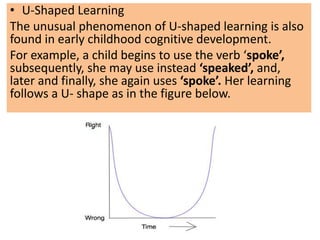
The unusual phenomenon of U-shaped learning is also
found in early childhood cognitive development.
For example, a child begins to use the verb ‘spoke’,
subsequently, she may use instead ‘speaked’, and,
later and finally, she again uses ‘spoke’. Her learning
follows a U- shape as in the figure below.
Psycholinguistic Constructs
• Attention: refers to the concentration of our mental
powers upon an object.
• 3 components of attention are:
1. Alertness (readiness to receive incoming stimuli)
2. Orientation (direction of resources to stimulus)
3. Detection (registration of stimulus)
Detection is the major component and is what drives
learning.
Awareness (through attention) is necessary for noticing.
Psycholinguistic Constructs
Working Memory: Working memory refers to
the structures and processes that humans use to
store and manipulate information.
The major difference between working memory
and short term memory is that working memory
focuses on the manipulation of information,
rather than just storage of information.
Psycholinguistic Constructs
• Syntactic priming: is said to occur when a
previously uttered or comprehended syntactic
structure is repeated, although an alternate
structure is available.
• Priming has been argued to be a fluency-
enhancing vehicle, as it improves communication,
requires less processing effort, and leads to mor
fluent formulations.
Knowledge Types
1. Acquisition-Learning: The former is used in language production, the latter then
checks what is generated by that acquired system to ensure that the forms are
accurate.
2. Declarative-Procedural:
Declarative knowledge involves knowing THAT something is the case - that J is the tenth
letter of the alphabet, that Paris is the capital of France. Declarative knowledge is
conscious; it can often be verbalized. Metalinguistic knowledge, or knowledge about a
linguistic form, is declarative knowledge.
Procedural knowledge involves knowing HOW to do something - ride a bike, for example.
We may not be able to explain how we do it. Procedural knowledge involves implicit
learning, which a learner may not be aware of, and may involve being able to use a
particular form to understand or produce language without necessarily being able to
explain it.
3. Implicit Knowledge-Explicit Knowledge
Explicit knowledge is known as data, as information stored as such in the mind -- "knowing
that." Implicit knowledge is "knowing how" -- knowledge of how to go about doing
something, knowledge that we may or may not be able to describe explicitly. For instance, if
I ask you: "How do you breathe?" you may have no explicit idea how you do it, but you
nonetheless continue breathing. Depending how far along the scale something is, implicit
knowledge may be converted into explicit, and vice versa. This often happens in learning --
we are told in words how to do something, like writing HTML, and these explicit rules are
eventually converted into implicit habits and actions, like instinctively adding "p" tags
before a new idea.
Declarative memory can be seen as forming the basis of explicit knowledge, and procedural
knowledge underlies implicit knowledge.
Apperceived input: Apperception is the process of
understanding by which newly observed qualities of an
object are related to past experiences. In other words,
past experiences relate to the selection of what might be
noticed material. (Schemata)
Why are some aspects of language noticed by a learner,
whereas others are not?
1. Frequency –something frequent in the input is likely
to be noticed.
2. Affect
3. Prior knowledge
• Comprehended Input: The comprehended
input stage is a continuation of the SLA
process when the learner begins to
comprehend input in L2 at a deeper level
resulting in analysis of the semantics and
structural analyses of the L2.
• Comprehended input is controlled by the
learner whereas comprehensible input is
controlled by the speaker.
• Enriched input: 'input where a specific L2
feature occurs with high frequency‘.
• Enhanced input is 'input where the target
feature has been emphasized in some way -
glossing, bolding or underlining'

Looking at-interlanguage-processing99999

  • 1.
  • 2.
    Information Processing: Automaticity, Restructuring,and U-Shaped Learning • Automaticity refers to control over one’s linguistic knowledge. • Restructuring refers to the changes made to internalized representations as a result of new learning. Integrating new information into one’s developing L2 system neccesiates changes to parts of the existing system, thereby restructuring, or reorganizing, the current system and creating a (slightly) new L2 system.
  • 3.
    • U-Shaped Learning •The so-called U-shaped learning curve involves 1. an initial target like production, followed by 2. a decline in performance, 3. which then recovers.
  • 4.
    • U-Shaped Learning Theunusual phenomenon of U-shaped learning is also found in early childhood cognitive development. For example, a child begins to use the verb ‘spoke’, subsequently, she may use instead ‘speaked’, and, later and finally, she again uses ‘spoke’. Her learning follows a U- shape as in the figure below.
  • 5.
    Psycholinguistic Constructs • Attention:refers to the concentration of our mental powers upon an object. • 3 components of attention are: 1. Alertness (readiness to receive incoming stimuli) 2. Orientation (direction of resources to stimulus) 3. Detection (registration of stimulus) Detection is the major component and is what drives learning. Awareness (through attention) is necessary for noticing.
  • 6.
    Psycholinguistic Constructs Working Memory:Working memory refers to the structures and processes that humans use to store and manipulate information. The major difference between working memory and short term memory is that working memory focuses on the manipulation of information, rather than just storage of information.
  • 7.
    Psycholinguistic Constructs • Syntacticpriming: is said to occur when a previously uttered or comprehended syntactic structure is repeated, although an alternate structure is available. • Priming has been argued to be a fluency- enhancing vehicle, as it improves communication, requires less processing effort, and leads to mor fluent formulations.
  • 8.
    Knowledge Types 1. Acquisition-Learning:The former is used in language production, the latter then checks what is generated by that acquired system to ensure that the forms are accurate. 2. Declarative-Procedural: Declarative knowledge involves knowing THAT something is the case - that J is the tenth letter of the alphabet, that Paris is the capital of France. Declarative knowledge is conscious; it can often be verbalized. Metalinguistic knowledge, or knowledge about a linguistic form, is declarative knowledge. Procedural knowledge involves knowing HOW to do something - ride a bike, for example. We may not be able to explain how we do it. Procedural knowledge involves implicit learning, which a learner may not be aware of, and may involve being able to use a particular form to understand or produce language without necessarily being able to explain it. 3. Implicit Knowledge-Explicit Knowledge Explicit knowledge is known as data, as information stored as such in the mind -- "knowing that." Implicit knowledge is "knowing how" -- knowledge of how to go about doing something, knowledge that we may or may not be able to describe explicitly. For instance, if I ask you: "How do you breathe?" you may have no explicit idea how you do it, but you nonetheless continue breathing. Depending how far along the scale something is, implicit knowledge may be converted into explicit, and vice versa. This often happens in learning -- we are told in words how to do something, like writing HTML, and these explicit rules are eventually converted into implicit habits and actions, like instinctively adding "p" tags before a new idea. Declarative memory can be seen as forming the basis of explicit knowledge, and procedural knowledge underlies implicit knowledge.
  • 9.
    Apperceived input: Apperceptionis the process of understanding by which newly observed qualities of an object are related to past experiences. In other words, past experiences relate to the selection of what might be noticed material. (Schemata) Why are some aspects of language noticed by a learner, whereas others are not? 1. Frequency –something frequent in the input is likely to be noticed. 2. Affect 3. Prior knowledge
  • 10.
    • Comprehended Input:The comprehended input stage is a continuation of the SLA process when the learner begins to comprehend input in L2 at a deeper level resulting in analysis of the semantics and structural analyses of the L2. • Comprehended input is controlled by the learner whereas comprehensible input is controlled by the speaker.
  • 11.
    • Enriched input:'input where a specific L2 feature occurs with high frequency‘. • Enhanced input is 'input where the target feature has been emphasized in some way - glossing, bolding or underlining'