Oral Communication Skills &
Classroom Speaking Performance
By
Luis Carlos Lasso Montenegro
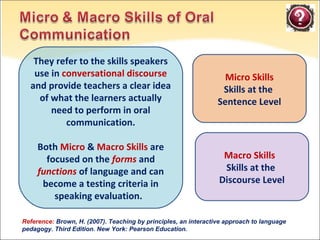
Micro Skills
Skills at the
Sentence Level
They refer to the skills speakers
use in conversational discourse
and provide teachers a clear idea
of what the learners actually
need to perform in oral
communication.
Both Micro & Macro Skills are
focused on the forms and
functions of language and can
become a testing criteria in
speaking evaluation.
Macro Skills
Skills at the
Discourse Level
Reference: Brown, H. (2007). Teaching by principles, an interactive approach to language
pedagogy. Third Edition. New York: Pearson Education.
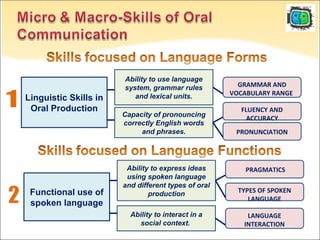
Linguistic Skills in
Oral Production
GRAMMAR AND
VOCABULARY RANGE
FLUENCY AND
ACCURACY
PRONUNCIATION
Ability to use language
system, grammar rules
and lexical units.
Capacity of pronouncing
correctly English words
and phrases.
Functional use of
spoken language
PRAGMATICS
TYPES OF SPOKEN
LANGUAGE
Ability to express ideas
using spoken language
and different types of oral
production
Ability to interact in a
social context.
LANGUAGE
INTERACTION
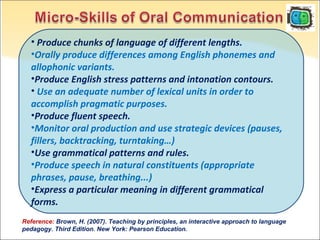
• Produce chunks of language of different lengths.
•Orally produce differences among English phonemes and
allophonic variants.
•Produce English stress patterns and intonation contours.
• Use an adequate number of lexical units in order to
accomplish pragmatic purposes.
•Produce fluent speech.
•Monitor oral production and use strategic devices (pauses,
fillers, backtracking, turntaking…)
•Use grammatical patterns and rules.
•Produce speech in natural constituents (appropriate
phrases, pause, breathing...)
•Express a particular meaning in different grammatical
forms.
Reference: Brown, H. (2007). Teaching by principles, an interactive approach to language
pedagogy. Third Edition. New York: Pearson Education.
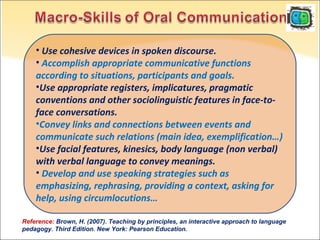
• Use cohesive devices in spoken discourse.
• Accomplish appropriate communicative functions
according to situations, participants and goals.
•Use appropriate registers, implicatures, pragmatic
conventions and other sociolinguistic features in face-to-
face conversations.
•Convey links and connections between events and
communicate such relations (main idea, exemplification…)
•Use facial features, kinesics, body language (non verbal)
with verbal language to convey meanings.
• Develop and use speaking strategies such as
emphasizing, rephrasing, providing a context, asking for
help, using circumlocutions…
Reference: Brown, H. (2007). Teaching by principles, an interactive approach to language
pedagogy. Third Edition. New York: Pearson Education.
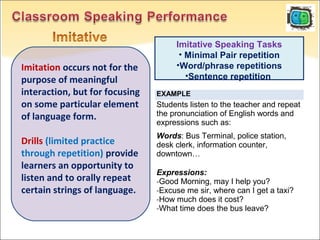
Imitation occurs not for the
purpose of meaningful
interaction, but for focusing
on some particular element
of language form.
Drills (limited practice
through repetition) provide
learners an opportunity to
listen and to orally repeat
certain strings of language.
Imitative Speaking Tasks
• Minimal Pair repetition
•Word/phrase repetitions
•Sentence repetition
EXAMPLE
Students listen to the teacher and repeat
the pronunciation of English words and
expressions such as:
Words: Bus Terminal, police station,
desk clerk, information counter,
downtown…
Expressions:
-Good Morning, may I help you?
-Excuse me sir, where can I get a taxi?
-How much does it cost?
-What time does the bus leave?
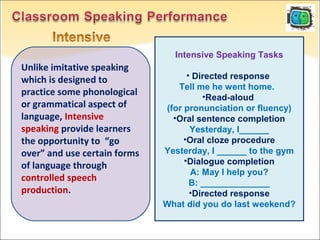
Unlike imitative speaking
which is designed to
practice some phonological
or grammatical aspect of
language, Intensive
speaking provide learners
the opportunity to “go
over” and use certain forms
of language through
controlled speech
production.
Intensive Speaking Tasks
• Directed response
Tell me he went home.
•Read-aloud
(for pronunciation or fluency)
•Oral sentence completion
Yesterday, I______
•Oral cloze procedure
Yesterday, I ______ to the gym
•Dialogue completion
A: May I help you?
B: ______________
•Directed response
What did you do last weekend?
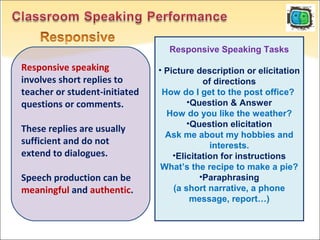
Responsive speaking
involves short replies to
teacher or student-initiated
questions or comments.
These replies are usually
sufficient and do not
extend to dialogues.
Speech production can be
meaningful and authentic.
Responsive Speaking Tasks
• Picture description or elicitation
of directions
How do I get to the post office?
•Question & Answer
How do you like the weather?
•Question elicitation
Ask me about my hobbies and
interests.
•Elicitation for instructions
What’s the recipe to make a pie?
•Paraphrasing
(a short narrative, a phone
message, report…)
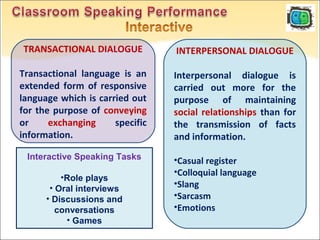
TRANSACTIONAL DIALOGUE
Transactional language is an
extended form of responsive
language which is carried out
for the purpose of conveying
or exchanging specific
information.
Interactive Speaking Tasks
•Role plays
• Oral interviews
• Discussions and
conversations
• Games
INTERPERSONAL DIALOGUE
Interpersonal dialogue is
carried out more for the
purpose of maintaining
social relationships than for
the transmission of facts
and information.
•Casual register
•Colloquial language
•Slang
•Sarcasm
•Emotions
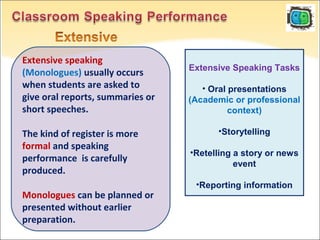
Extensive speaking
(Monologues) usually occurs
when students are asked to
give oral reports, summaries or
short speeches.
The kind of register is more
formal and speaking
performance is carefully
produced.
Monologues can be planned or
presented without earlier
preparation.
Extensive Speaking Tasks
• Oral presentations
(Academic or professional
context)
•Storytelling
•Retelling a story or news
event
•Reporting information
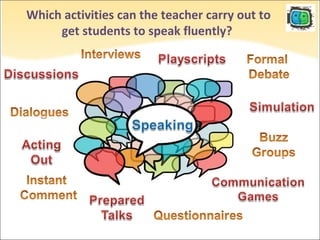
Which activities can the teacher carry out to
get students to speak fluently?
Thanks for your
attention!

Oral skills & classroom speaking performance

  • 1.
    Oral Communication Skills& Classroom Speaking Performance By Luis Carlos Lasso Montenegro
  • 2.
    Micro Skills Skills atthe Sentence Level They refer to the skills speakers use in conversational discourse and provide teachers a clear idea of what the learners actually need to perform in oral communication. Both Micro & Macro Skills are focused on the forms and functions of language and can become a testing criteria in speaking evaluation. Macro Skills Skills at the Discourse Level Reference: Brown, H. (2007). Teaching by principles, an interactive approach to language pedagogy. Third Edition. New York: Pearson Education.
  • 3.
    Linguistic Skills in OralProduction GRAMMAR AND VOCABULARY RANGE FLUENCY AND ACCURACY PRONUNCIATION Ability to use language system, grammar rules and lexical units. Capacity of pronouncing correctly English words and phrases. Functional use of spoken language PRAGMATICS TYPES OF SPOKEN LANGUAGE Ability to express ideas using spoken language and different types of oral production Ability to interact in a social context. LANGUAGE INTERACTION
  • 4.
    • Produce chunksof language of different lengths. •Orally produce differences among English phonemes and allophonic variants. •Produce English stress patterns and intonation contours. • Use an adequate number of lexical units in order to accomplish pragmatic purposes. •Produce fluent speech. •Monitor oral production and use strategic devices (pauses, fillers, backtracking, turntaking…) •Use grammatical patterns and rules. •Produce speech in natural constituents (appropriate phrases, pause, breathing...) •Express a particular meaning in different grammatical forms. Reference: Brown, H. (2007). Teaching by principles, an interactive approach to language pedagogy. Third Edition. New York: Pearson Education.
  • 5.
    • Use cohesivedevices in spoken discourse. • Accomplish appropriate communicative functions according to situations, participants and goals. •Use appropriate registers, implicatures, pragmatic conventions and other sociolinguistic features in face-to- face conversations. •Convey links and connections between events and communicate such relations (main idea, exemplification…) •Use facial features, kinesics, body language (non verbal) with verbal language to convey meanings. • Develop and use speaking strategies such as emphasizing, rephrasing, providing a context, asking for help, using circumlocutions… Reference: Brown, H. (2007). Teaching by principles, an interactive approach to language pedagogy. Third Edition. New York: Pearson Education.
  • 6.
    Imitation occurs notfor the purpose of meaningful interaction, but for focusing on some particular element of language form. Drills (limited practice through repetition) provide learners an opportunity to listen and to orally repeat certain strings of language. Imitative Speaking Tasks • Minimal Pair repetition •Word/phrase repetitions •Sentence repetition EXAMPLE Students listen to the teacher and repeat the pronunciation of English words and expressions such as: Words: Bus Terminal, police station, desk clerk, information counter, downtown… Expressions: -Good Morning, may I help you? -Excuse me sir, where can I get a taxi? -How much does it cost? -What time does the bus leave?
  • 7.
    Unlike imitative speaking whichis designed to practice some phonological or grammatical aspect of language, Intensive speaking provide learners the opportunity to “go over” and use certain forms of language through controlled speech production. Intensive Speaking Tasks • Directed response Tell me he went home. •Read-aloud (for pronunciation or fluency) •Oral sentence completion Yesterday, I______ •Oral cloze procedure Yesterday, I ______ to the gym •Dialogue completion A: May I help you? B: ______________ •Directed response What did you do last weekend?
  • 8.
    Responsive speaking involves shortreplies to teacher or student-initiated questions or comments. These replies are usually sufficient and do not extend to dialogues. Speech production can be meaningful and authentic. Responsive Speaking Tasks • Picture description or elicitation of directions How do I get to the post office? •Question & Answer How do you like the weather? •Question elicitation Ask me about my hobbies and interests. •Elicitation for instructions What’s the recipe to make a pie? •Paraphrasing (a short narrative, a phone message, report…)
  • 9.
    TRANSACTIONAL DIALOGUE Transactional languageis an extended form of responsive language which is carried out for the purpose of conveying or exchanging specific information. Interactive Speaking Tasks •Role plays • Oral interviews • Discussions and conversations • Games INTERPERSONAL DIALOGUE Interpersonal dialogue is carried out more for the purpose of maintaining social relationships than for the transmission of facts and information. •Casual register •Colloquial language •Slang •Sarcasm •Emotions
  • 10.
    Extensive speaking (Monologues) usuallyoccurs when students are asked to give oral reports, summaries or short speeches. The kind of register is more formal and speaking performance is carefully produced. Monologues can be planned or presented without earlier preparation. Extensive Speaking Tasks • Oral presentations (Academic or professional context) •Storytelling •Retelling a story or news event •Reporting information
  • 11.
    Which activities canthe teacher carry out to get students to speak fluently?
  • 12.