Teaching Oral Skills
ANNE LAZARTON
Presented by : SHOHREH TAVASSOLI
„‟ Speaking in a second or foreign language
has often been viewed as the most
demanding of the four skills‟‟(Bailey and
Savage 1994,P.Vii)
What specifically makes speaking in a
second or foreign language difficult?
We had not been prepared for spontaneous
communication and could not cope with all of
its simultaneous demands.
Speaking is an :‟‟activity requiring the
integration of many subsystems ,all these
factors combine to make speaking a second or
foreign language a formidable task for language
learners ,yet for many people ,speaking is seen
as the central skill‟‟( Bailey and Savage
1994,P.Vi-Vii)
In the silent way, student speech is carefully
controlled for structure and content.
In audiolingualism stressed oral skills , speech
production was tightly controlled in order to reinforce
correct habit formation of linguistic rules.
In theory of communicative competence Hymes
1972) and the practice of communicative language
teaching ,the teaching of oral communication skills as
a contextualized sociocultural activity has become the
focal point in many ESL classroom.
Canale & Swains(1980) adaption of Hymes
theory of communicative competence
proposes that the ability to communicative
in a language comprises four dimensions :
 Grammatical competence: ( rule of
phonology ,orthography ,vocabulary , word
formation)
 Sociolinguistic competence: (rules for
the expression and understanding of
appropriate social meaning & grammatical
forms in different context.
 Discourse competence: rule of both
cohesion ,how sentence elements are tied
together via references ,repetition ,
synonymy ,…and coherence :how texts are
constructed.
 Strategic competence: a repertoire of
compensatory strategies that help with a
variety of communication difficulties.
What features of this theoretical approach
are relevant to teaching oral skills?
1. It is no longer acceptable to focus only on
developing the grammatical competence of
students with the number of language
teaching methodologies which were popular
in the past.
Today , teachers are expected to balance a focus on
accuracy with a focus on fluency as well.
According to Hedge(1993,PP.275-276) the term
fluency has two meaning:
„‟The ability to link units of speech together with
facility and without strain or inappropriate
slowness or undue hesitation.‟‟
“ Natural language use’’, which is likely to take
place when speaking activities focus on meaning
and its negotiation , when speaking strategies are
used and over correction is minimized.
2. Multiple skills should be taught whenever
possible , Murphy (1991) believes that oral
skills teacher should always connect
speaking , listening and pronunciation
teaching although the focus in any one class
or activity may highlight one or another.
Oral skill classes may use reading and
writing activities as the basis or follow up
for speaking activities.
‘‟Communication strategies”(Dornyei 1995):
language learners must become component
at using strategies, such as circumlocution,
hesitation devices and appeal for help.
Oral skills teacher should at least advocate
and model their use.
3. Students are encouraged to take
responsibility for their own learning .
In the oral skills classroom ,students should
be allowed and encouraged :
•To initiate communication when possible.
• To determine the content of their responses
or contributions.
• To evaluate their own production and
learning progress.
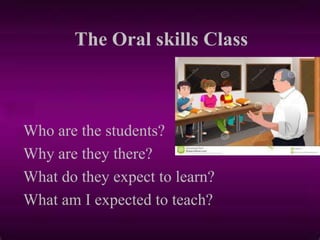
The Oral skills Class
Who are the students?
Why are they there?
What do they expect to learn?
What am I expected to teach?
Level of the students and their perceived
needs: test administration by the institution or by
a diagnostic test given by the teacher.
Information on learner needs : can be obtained
by means of a student information sheet on
which they report the amount of time they spend
speaking English ,their future goals .their goals
for the course and their assessment of their
overall speaking ability , confidence in speaking
English ,their pronunciation ,social conversation
and listening ability.
Oral skills courses for nonacademic adults
focus on survival English and basic
communication functions based on a strong
structural component.
Academic learners will need practice with
different sorts of activities .
Ferris and Tagg (1996a,1996b) suggest that in
general , what academic ESL students need most
is extensive authentic practice in class
participation: taking part in discussion,
interacting with peers and professors , asking and
answering questions.
Activities
Discussions Simulations
Speeches Interviews
Role Plays Information Gap
Conversations Brainstorming
Audio taped Oral Dialogue Journals
Reporting Picture narrating
Storytelling
Story completions
Other Accuracy- Based Activities
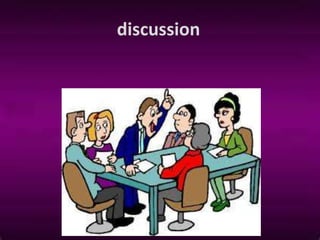
discussion
1. While there is no one‟‟ right way‟‟ to
group students, considerations such as
gender, ethnicity, background,
talkativeness,… may come in to play.
2. Students need to be reminded that each
person should have a specific
responsibility in the discussion, these
decisions should be made by the group
members.
3. Students need to be clear about what they
are to discuss , why they are discussing it ,
and what outcome is expected. they should
be guidance beforehand and follow-up after
hand.
Green Christopher and Lam (1997) believe
that students will be more involved with and
motivated to participate in discussion if they
are allowed to select discussion topics and
evaluate their peers performance.
Speeches
Speeches can be frightening for the speaker and
after a while ,boring for the listener, so it is a
good idea to assign the listeners some
responsibilities during the speeches..
If the speeches are audio taped or videotaped,
some of the language analysis activities can be
used to encourage learners to become aware of
their individual problems with pronunciation,
grammar, vocabulary and fluency.
Categories of performance include:
1. Delivery:
Interaction/rapport with audience
Content and Organization
Language skills.
•2. Impromptu speech
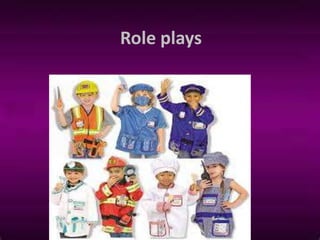
Role plays
Olshtain and Cohen (1991) recommend
several steps for teaching speech acts:
oStudents can listen to and practice
prototypical phrases used in the speech act ,
and then perform a role play as a final
practice.
oThe teacher gives information to the
learners such as who they are and what they
think or feel.
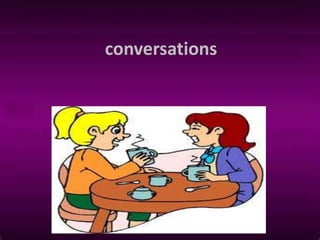
conversations
It is not adequate to have students produce
lots of language ,they must become more
met linguistically aware of the many
features of language in order to become
competent speakers and interlocutors in
English.
Provocative statement are often better than
questions.
Problem solving is often an excellent basis
for conversation.
Encourage active listening
Techniques- conversation
Exploit opportunities for short
spontaneous conversation.
Encourage contributions without
interfering.
Conversation does not to be about serious
issue.
Audio taped Oral Dialogue Journals
•Emphasized fluency and meaning negotiation
rather than accuracy
•Practice with fluency and attention to accuracy
can be accomplished at the same time.
The activities discussed so far have emphasized
fluency and meaning negotiation rather than
accuracy.
Oral dialogue journals are one format where
practice with fluency and attention to accuracy
can be accomplished at the same time.
Remind them that the purpose of the activity is to
work on unplanned speaking, also give them
some guidance as to the expected length of their
responses.
Other Accuracy –Based
Activities
Brown((1994) recommends that if drills are
to be used, they should be short, simple and
snappy , used sparingly and they should lead
to more authentic communication activities.
Wong(1994) recommends an activity called
“two-minute conversations”
Brown(1994) stresses that teachers should
strive for “optimal feedback” which shows
that learner contributions are valued in their
own right rather than representing imperfect
native speaker speech that needs
remediation.
Simulations
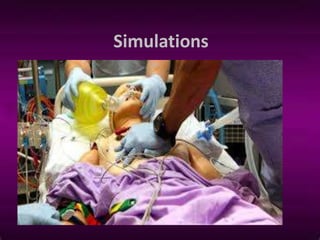
• Simulation are very similar to role- plays
,but what make simulations different than
role-play is that they are more elaborate.
• In Simulation students can bring items to
the class to create realistic environment.
• Such activities motivate the students and
increase the self-confidence of hesitant
the students.
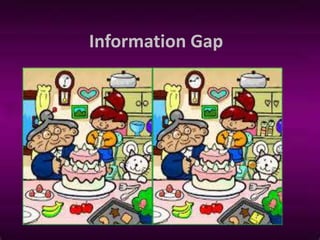
Information Gap
Students are supposed to be working in
pairs.
One students will have the information that
other partner does not have and the partner
will share their information.
These activities are effective because
everybody has the opportunity to talk
extensively in the target language.
Information gap activities serve many
purposes, such as solving a problem or
collecting information. And each partner
plays an important role because the task can
not be completed if the partners do not
provide the information the other needs
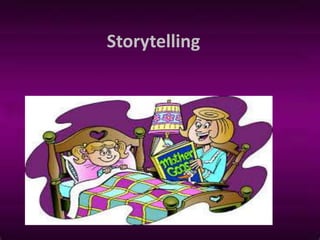
Storytelling
 Students can briefly summarize a tale or
story they heard from somebody
beforehand.
 They may create/imagine their own
stories to tell their classmate.
 Story telling fosters creative thinking, it
also help the students express ideas in the
format of beginning ,development and
ending, including the characters and setting
a story has to have.
Interviews
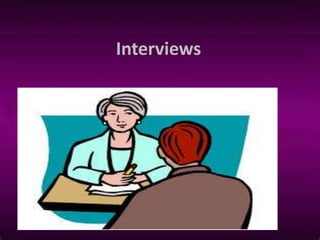
Students can conducts interviews in
selected topics with various peoples .
Conducting interviews with people give
students a chance to practice their speaking
ability not only in class but also outside and
helps them to become socialized, after
interviews each student can present his/her
study in to class.
Story completions
•This is a very enjoyable whole class free
speaking activity for which student sit in a
circle.
•For this activity, the teacher starts to tell a
story, but after a few sentences he/she stops
narrating.
•Then each student starts to narrate from the
point where the previous one stopped, to add
from two or ten sentences.
•Students can add new characters, events,
descriptions and so on.
Reporting
Before coming to class, students are asked
to read a newspaper or magazine and in class
they report to their friends , what they found
as the most interesting news.
Students can also talk about whether they
have experienced anything worth telling
their friends in daily lives before class.
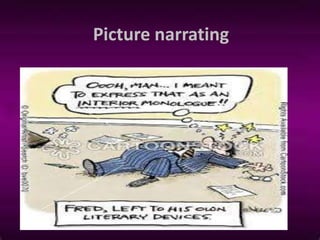
Picture narrating
 This activity is based on several
sequential pictures.
 Students are asked to tell the story taking
place in the sequential pictures by attention
to the criteria provided by the teacher as a
rubric.
 Rubrics can include the vocabulary or
structures(past simple) they need to use
while narrating.
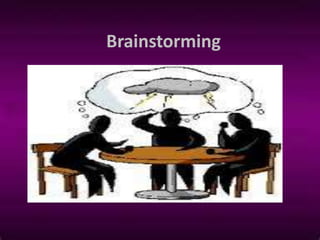
Brainstorming
On a given topic, student can produce
ideas in a limited time, depending on the
context, either individual or groups
brainstorming is effective and learners
generate ideas quickly and freely.
The good characteristics of brainstorming
is that the students are not criticized for
their ideas so the students will be open to
sharing new ideas.
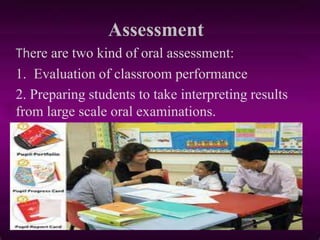
Assessment
There are two kind of oral assessment:
1. Evaluation of classroom performance
2. Preparing students to take interpreting results
from large scale oral examinations.
Brown & Yule (1983)
1. Extended chunks of speech with purpose
and structured and organized should be
elicited.
2. The input given to students whether it be
visual, aural or interactive ,be consist for
all examinees.
3. The result of oral assessment should be
reported using terms that are clearly
defined for and understandable to
students.
2. Oral skills teacher may be confronted is
preparing students to take interpreting
results from large scale oral examinations,
successful performance as a requirement
for admission to universities , as a
minimum standard for teaching
assistantships ,and as a qualification for
various types of employment.
Teaching oral skills, lazarton

Teaching oral skills, lazarton

  • 1.
    Teaching Oral Skills ANNELAZARTON Presented by : SHOHREH TAVASSOLI
  • 2.
    „‟ Speaking ina second or foreign language has often been viewed as the most demanding of the four skills‟‟(Bailey and Savage 1994,P.Vii)
  • 3.
    What specifically makesspeaking in a second or foreign language difficult?
  • 4.
    We had notbeen prepared for spontaneous communication and could not cope with all of its simultaneous demands. Speaking is an :‟‟activity requiring the integration of many subsystems ,all these factors combine to make speaking a second or foreign language a formidable task for language learners ,yet for many people ,speaking is seen as the central skill‟‟( Bailey and Savage 1994,P.Vi-Vii)
  • 5.
    In the silentway, student speech is carefully controlled for structure and content. In audiolingualism stressed oral skills , speech production was tightly controlled in order to reinforce correct habit formation of linguistic rules. In theory of communicative competence Hymes 1972) and the practice of communicative language teaching ,the teaching of oral communication skills as a contextualized sociocultural activity has become the focal point in many ESL classroom.
  • 6.
    Canale & Swains(1980)adaption of Hymes theory of communicative competence proposes that the ability to communicative in a language comprises four dimensions :  Grammatical competence: ( rule of phonology ,orthography ,vocabulary , word formation)  Sociolinguistic competence: (rules for the expression and understanding of appropriate social meaning & grammatical forms in different context.
  • 7.
     Discourse competence:rule of both cohesion ,how sentence elements are tied together via references ,repetition , synonymy ,…and coherence :how texts are constructed.  Strategic competence: a repertoire of compensatory strategies that help with a variety of communication difficulties.
  • 8.
    What features ofthis theoretical approach are relevant to teaching oral skills? 1. It is no longer acceptable to focus only on developing the grammatical competence of students with the number of language teaching methodologies which were popular in the past.
  • 9.
    Today , teachersare expected to balance a focus on accuracy with a focus on fluency as well. According to Hedge(1993,PP.275-276) the term fluency has two meaning: „‟The ability to link units of speech together with facility and without strain or inappropriate slowness or undue hesitation.‟‟ “ Natural language use’’, which is likely to take place when speaking activities focus on meaning and its negotiation , when speaking strategies are used and over correction is minimized.
  • 10.
    2. Multiple skillsshould be taught whenever possible , Murphy (1991) believes that oral skills teacher should always connect speaking , listening and pronunciation teaching although the focus in any one class or activity may highlight one or another. Oral skill classes may use reading and writing activities as the basis or follow up for speaking activities.
  • 11.
    ‘‟Communication strategies”(Dornyei 1995): languagelearners must become component at using strategies, such as circumlocution, hesitation devices and appeal for help. Oral skills teacher should at least advocate and model their use. 3. Students are encouraged to take responsibility for their own learning .
  • 12.
    In the oralskills classroom ,students should be allowed and encouraged : •To initiate communication when possible. • To determine the content of their responses or contributions. • To evaluate their own production and learning progress.
  • 13.
    The Oral skillsClass Who are the students? Why are they there? What do they expect to learn? What am I expected to teach?
  • 14.
    Level of thestudents and their perceived needs: test administration by the institution or by a diagnostic test given by the teacher. Information on learner needs : can be obtained by means of a student information sheet on which they report the amount of time they spend speaking English ,their future goals .their goals for the course and their assessment of their overall speaking ability , confidence in speaking English ,their pronunciation ,social conversation and listening ability.
  • 15.
    Oral skills coursesfor nonacademic adults focus on survival English and basic communication functions based on a strong structural component. Academic learners will need practice with different sorts of activities . Ferris and Tagg (1996a,1996b) suggest that in general , what academic ESL students need most is extensive authentic practice in class participation: taking part in discussion, interacting with peers and professors , asking and answering questions.
  • 16.
    Activities Discussions Simulations Speeches Interviews RolePlays Information Gap Conversations Brainstorming Audio taped Oral Dialogue Journals Reporting Picture narrating Storytelling Story completions Other Accuracy- Based Activities
  • 17.
  • 18.
    1. While thereis no one‟‟ right way‟‟ to group students, considerations such as gender, ethnicity, background, talkativeness,… may come in to play. 2. Students need to be reminded that each person should have a specific responsibility in the discussion, these decisions should be made by the group members.
  • 19.
    3. Students needto be clear about what they are to discuss , why they are discussing it , and what outcome is expected. they should be guidance beforehand and follow-up after hand. Green Christopher and Lam (1997) believe that students will be more involved with and motivated to participate in discussion if they are allowed to select discussion topics and evaluate their peers performance.
  • 20.
    Speeches Speeches can befrightening for the speaker and after a while ,boring for the listener, so it is a good idea to assign the listeners some responsibilities during the speeches.. If the speeches are audio taped or videotaped, some of the language analysis activities can be used to encourage learners to become aware of their individual problems with pronunciation, grammar, vocabulary and fluency.
  • 21.
    Categories of performanceinclude: 1. Delivery: Interaction/rapport with audience Content and Organization Language skills. •2. Impromptu speech
  • 22.
  • 23.
    Olshtain and Cohen(1991) recommend several steps for teaching speech acts: oStudents can listen to and practice prototypical phrases used in the speech act , and then perform a role play as a final practice. oThe teacher gives information to the learners such as who they are and what they think or feel.
  • 24.
  • 25.
    It is notadequate to have students produce lots of language ,they must become more met linguistically aware of the many features of language in order to become competent speakers and interlocutors in English.
  • 26.
    Provocative statement areoften better than questions. Problem solving is often an excellent basis for conversation. Encourage active listening
  • 27.
    Techniques- conversation Exploit opportunitiesfor short spontaneous conversation. Encourage contributions without interfering. Conversation does not to be about serious issue.
  • 28.
    Audio taped OralDialogue Journals •Emphasized fluency and meaning negotiation rather than accuracy •Practice with fluency and attention to accuracy can be accomplished at the same time.
  • 29.
    The activities discussedso far have emphasized fluency and meaning negotiation rather than accuracy. Oral dialogue journals are one format where practice with fluency and attention to accuracy can be accomplished at the same time. Remind them that the purpose of the activity is to work on unplanned speaking, also give them some guidance as to the expected length of their responses.
  • 30.
    Other Accuracy –Based Activities Brown((1994)recommends that if drills are to be used, they should be short, simple and snappy , used sparingly and they should lead to more authentic communication activities. Wong(1994) recommends an activity called “two-minute conversations”
  • 31.
    Brown(1994) stresses thatteachers should strive for “optimal feedback” which shows that learner contributions are valued in their own right rather than representing imperfect native speaker speech that needs remediation.
  • 32.
  • 33.
    • Simulation arevery similar to role- plays ,but what make simulations different than role-play is that they are more elaborate. • In Simulation students can bring items to the class to create realistic environment. • Such activities motivate the students and increase the self-confidence of hesitant the students.
  • 34.
  • 35.
    Students are supposedto be working in pairs. One students will have the information that other partner does not have and the partner will share their information. These activities are effective because everybody has the opportunity to talk extensively in the target language.
  • 36.
    Information gap activitiesserve many purposes, such as solving a problem or collecting information. And each partner plays an important role because the task can not be completed if the partners do not provide the information the other needs
  • 37.
  • 38.
     Students canbriefly summarize a tale or story they heard from somebody beforehand.  They may create/imagine their own stories to tell their classmate.  Story telling fosters creative thinking, it also help the students express ideas in the format of beginning ,development and ending, including the characters and setting a story has to have.
  • 39.
  • 40.
    Students can conductsinterviews in selected topics with various peoples . Conducting interviews with people give students a chance to practice their speaking ability not only in class but also outside and helps them to become socialized, after interviews each student can present his/her study in to class.
  • 41.
  • 42.
    •This is avery enjoyable whole class free speaking activity for which student sit in a circle. •For this activity, the teacher starts to tell a story, but after a few sentences he/she stops narrating. •Then each student starts to narrate from the point where the previous one stopped, to add from two or ten sentences. •Students can add new characters, events, descriptions and so on.
  • 43.
  • 44.
    Before coming toclass, students are asked to read a newspaper or magazine and in class they report to their friends , what they found as the most interesting news. Students can also talk about whether they have experienced anything worth telling their friends in daily lives before class.
  • 45.
  • 46.
     This activityis based on several sequential pictures.  Students are asked to tell the story taking place in the sequential pictures by attention to the criteria provided by the teacher as a rubric.  Rubrics can include the vocabulary or structures(past simple) they need to use while narrating.
  • 47.
  • 48.
    On a giventopic, student can produce ideas in a limited time, depending on the context, either individual or groups brainstorming is effective and learners generate ideas quickly and freely. The good characteristics of brainstorming is that the students are not criticized for their ideas so the students will be open to sharing new ideas.
  • 49.
    Assessment There are twokind of oral assessment: 1. Evaluation of classroom performance 2. Preparing students to take interpreting results from large scale oral examinations.
  • 50.
    Brown & Yule(1983) 1. Extended chunks of speech with purpose and structured and organized should be elicited. 2. The input given to students whether it be visual, aural or interactive ,be consist for all examinees. 3. The result of oral assessment should be reported using terms that are clearly defined for and understandable to students.
  • 51.
    2. Oral skillsteacher may be confronted is preparing students to take interpreting results from large scale oral examinations, successful performance as a requirement for admission to universities , as a minimum standard for teaching assistantships ,and as a qualification for various types of employment.