Classroom Management
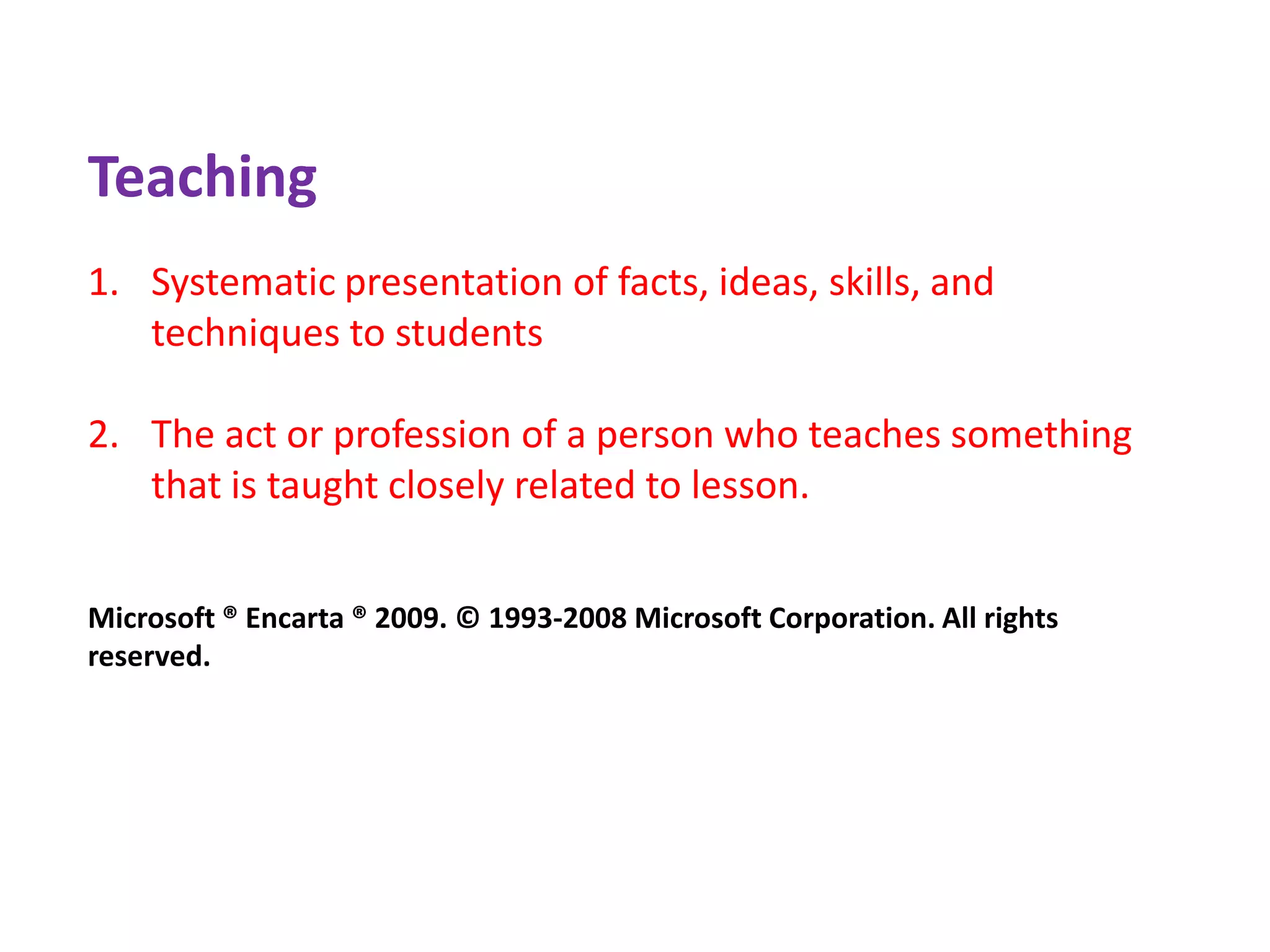
TeachingSystematic presentation of facts, ideas, skills, and techniques to studentsThe act or profession of a person who teaches something that is taught closely related to lesson.Microsoft ® Encarta ® 2009. © 1993-2008 Microsoft Corporation. All rights reserved.
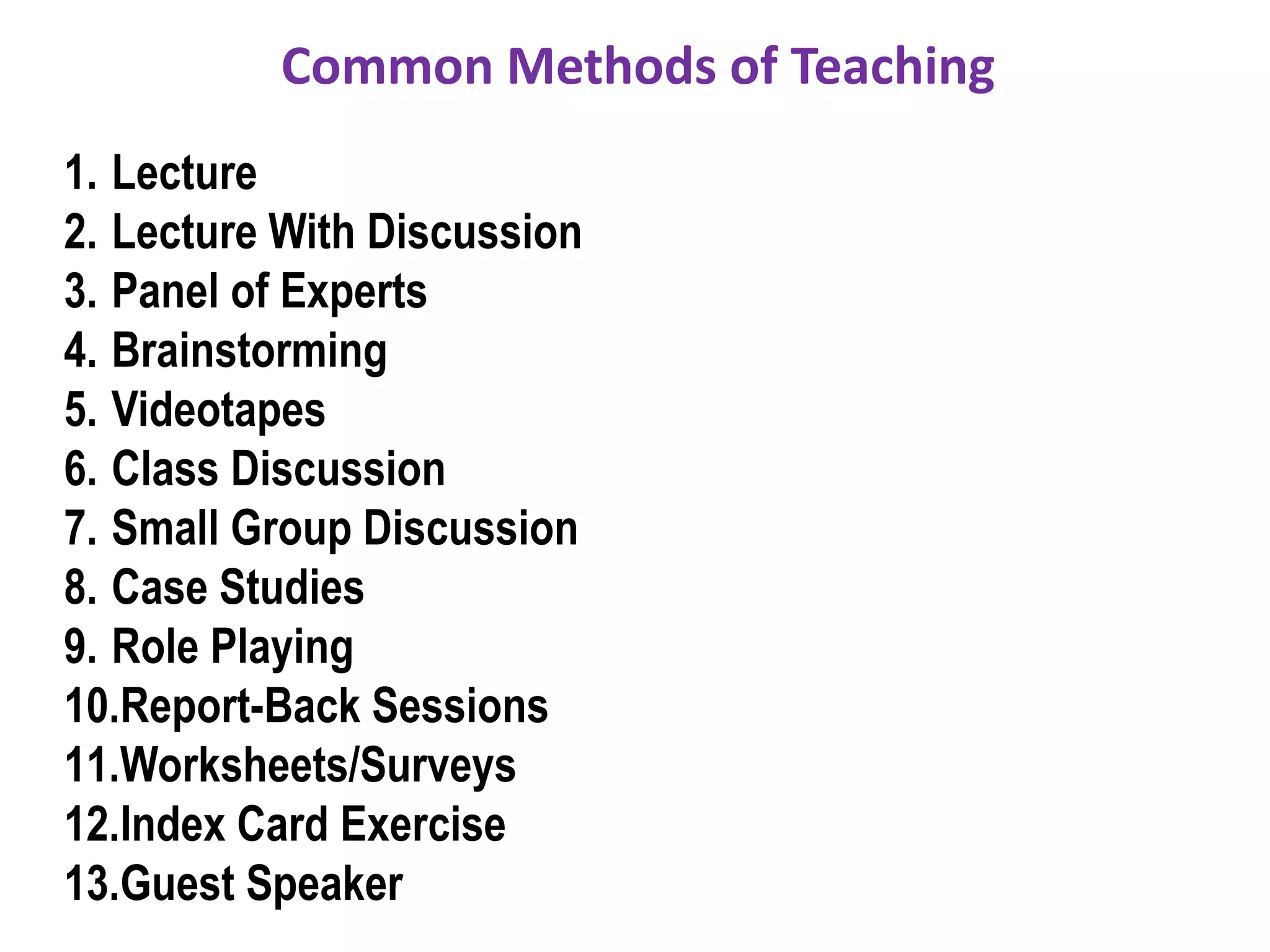
Common Methods of TeachingLectureLecture With DiscussionPanel of ExpertsBrainstormingVideotapesClass DiscussionSmall Group DiscussionCase StudiesRole PlayingReport-Back SessionsWorksheets/SurveysIndex Card ExerciseGuest Speaker
Order & Discipline
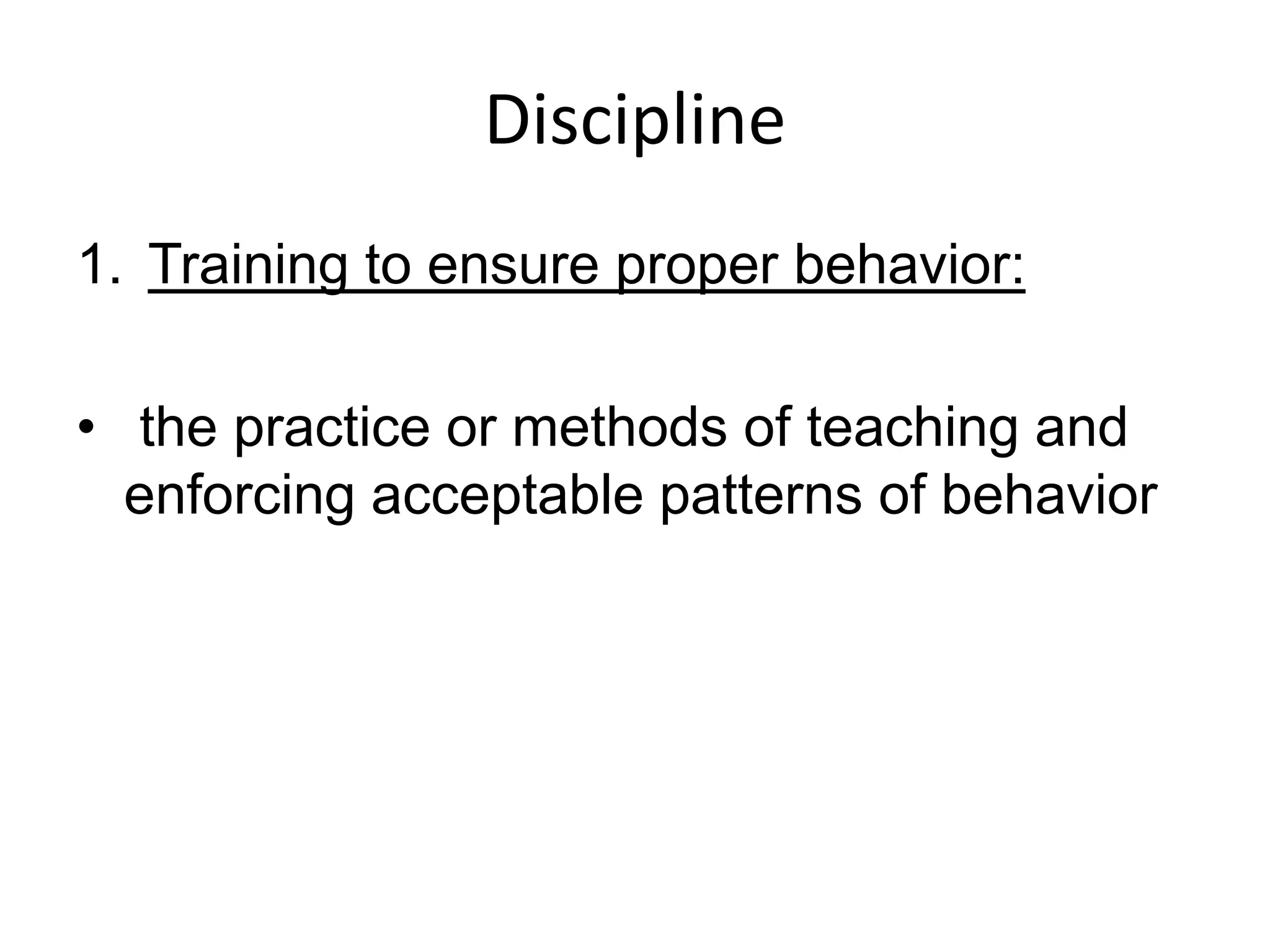
DisciplineTraining to ensure proper behavior: the practice or methods of teaching and enforcing acceptable patterns of behavior
Order and control: a controlled orderly state, especially in a class of school children.
Calm controlled behavior: the ability to behave in a controlled and calm way even in a difficult or stressful situation.
Order instruction: an instruction to do something.E.g: You must finish your homework.
arrangement of items: the way in which several items are arranged, as an indication of their relative importance or size or when each will be dealt with.E.g: “I will announce the winners in reverse order.”
neatness: an organized condition, with items arranged properly, neatly, or harmoniously.E.g: We all need a little order in our lives.
Classroom Management
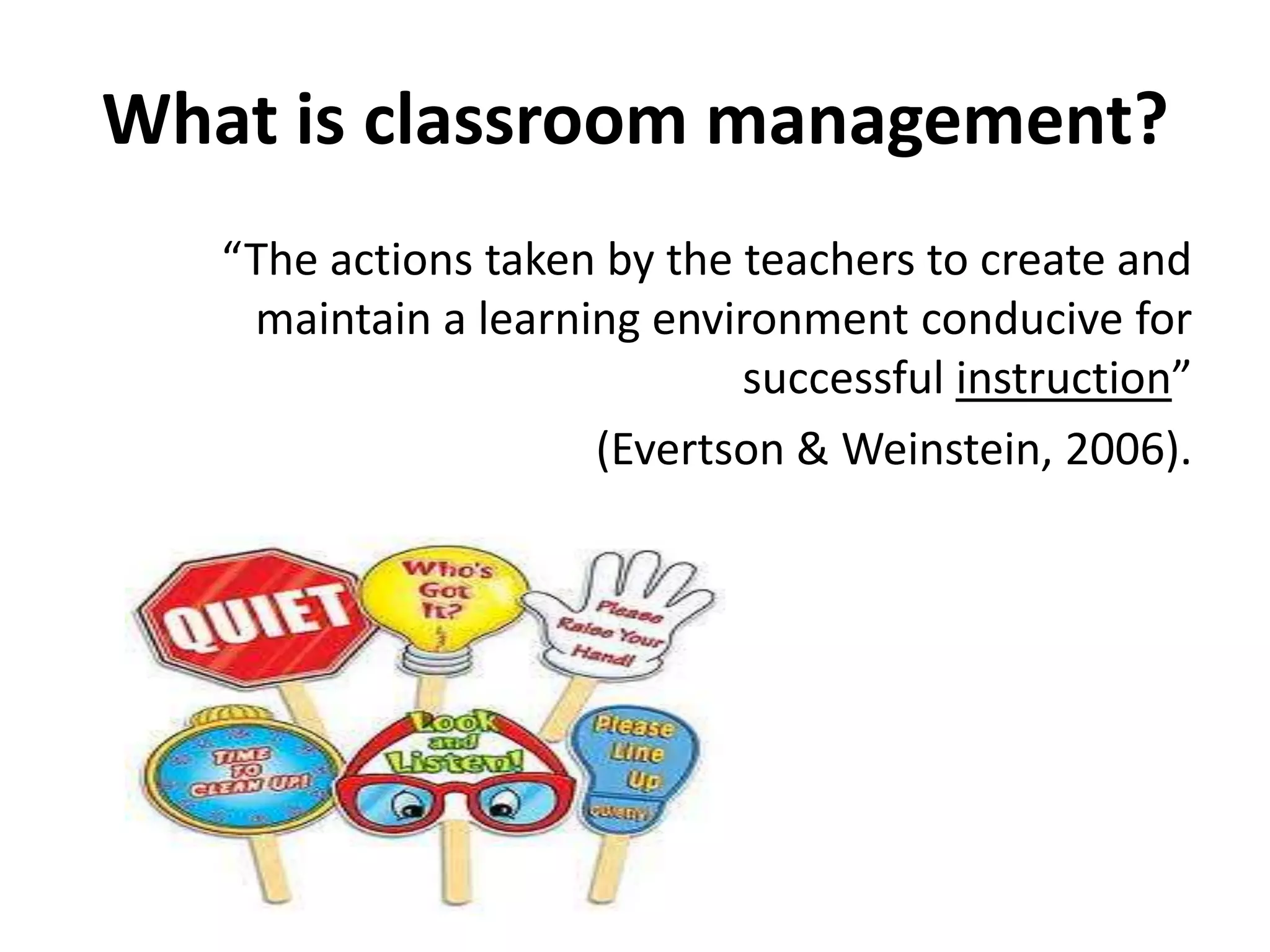
What is classroom management?“The actions taken by the teachers to create and maintain a learning environment conducive for successful instruction”(Evertson & Weinstein, 2006).
Cont.3major types of classroom management includes:Content ManagementConduct ManagementCovenant Management
1. Content Management"Content management occurs when teachers manage space, materials, equipment, the movement of people, and lessons that are part of a curriculum or program of studies" (Froyen & Iverson, 1999, p. 128).E.g. Management of individual/group work, assignment of homework, discussion session.
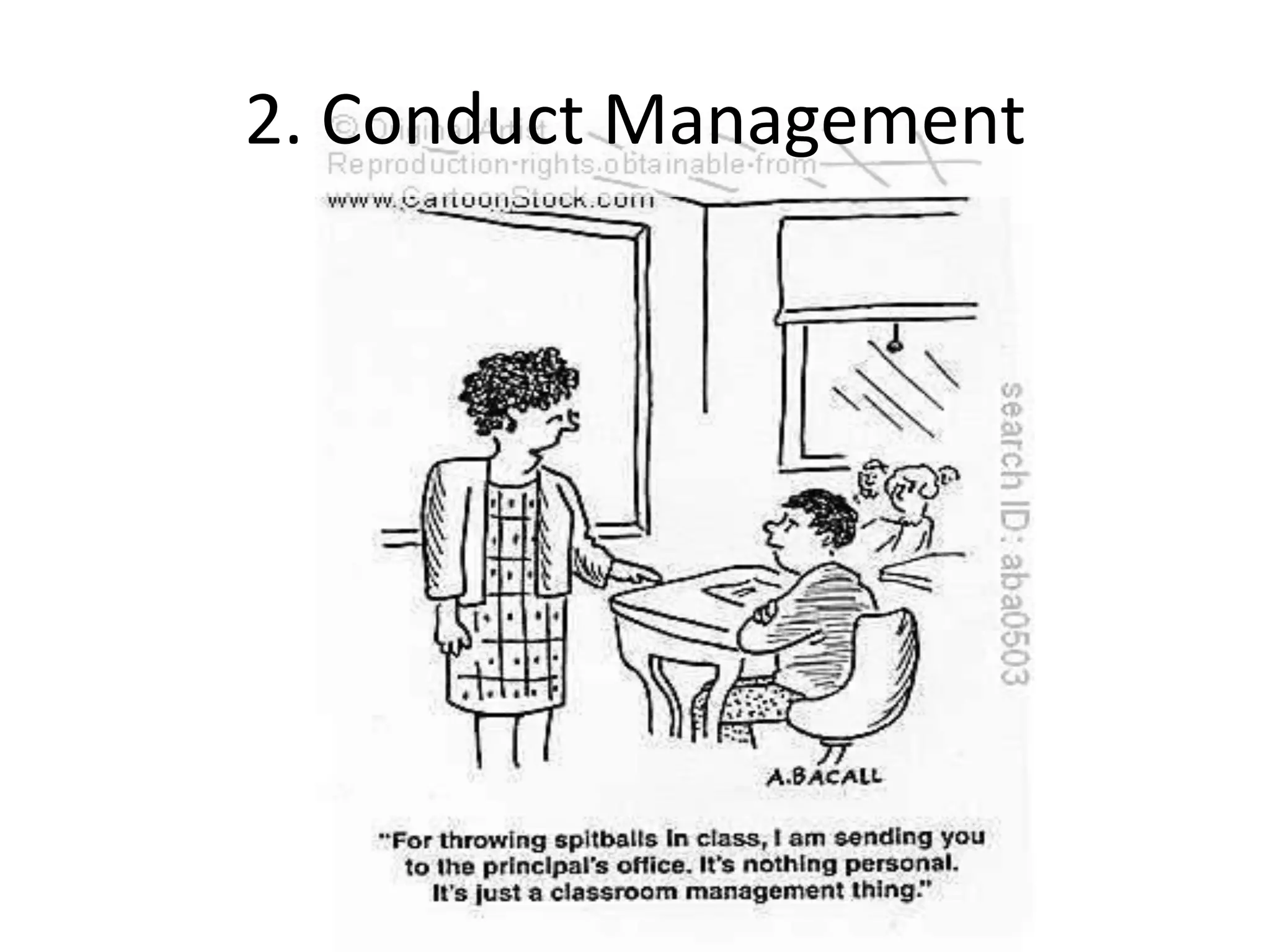
2. Conduct Management
2. Conduct Management"Conduct management refers to the set of procedural skills that teachers employ in their attempt to address and resolve discipline problems in the classroom" (Froyen & Iverson, 1999, p. 181).E.g. Acknowledgment of responsible behaviours, correction of irresponsible and inappropriate behaviour, notification of parents/guardians.
3. Covenant Management"Covenant management focuses on the classroom group as a social system that has its own features that teachers have to take into account when managing interpersonal relationships in the classroom" (Froyen & Iverson, 1999).E.g. Get involved with the student, get a commitment from the student to stick to the plan, do not accept excuses for a failed plan.
ClassroomOrder
Classroom order holds a great significance in teachers lesson conduct. “Teachers use a variety of strategies to maintain order in the classroom” (Taynor, 2003).Classroom order includes the teacher’s teaching methodology, time management, choice of teaching materials and activities.
Cont.Teachers divide class time into four overlapping categories, namely allocated time, instructional time, engaged time, and academic learning time.
Cont.Corporal PunishmentIn Malaysia: Legal corporal punishment of school students for misbehaviour involves striking the student on the buttocks or the palm of the hand in a premeditated ceremony with an implement specially kept for the purpose such as a rattan cane or spanking paddle, or with the open hand.
Cont.Preventative approachInvolves creating a positive classroom community with mutual respect between teacher and student. Teachers using the preventative approach offer warmth, acceptance, and support unconditionally - not based on a student’s behaviour. Fair rules and consequences are established and students are given frequent and consistent feedback regarding their behaviour (Bear, 2008).
Cont.Also involves the use of praise and rewards to inform students about their behaviour rather than as a means of controlling them.Teachers must emphasize the value of the behaviour that is rewarded and also explain to them the specific skills they demonstrated to earn the reward (Bear, 2005).
ReferencesEvertson, C.M. & Weinstein, C.S. (2006). Handbook of Classroom Management: Research, Practice, and Contemporary Issues. New Jersey: Lawrence Erlbaum Associates, Inc.Froyen, L. A., & Iverson, A. M. (1999). Schoolwide and classroom management:  Traynor, P.L. (2003). Factors contributing to teacher choice of classroom order strategies. Retrieved June 29, 2010, from http://findarticles.com/p/articles/mi_qa3673/is_3_123/ai_n28998156/
Classroom ManagementThe orchestration of the learning environment of a group of individuals within a classroom setting.
The process of setting up an activity in class, monitoring it, and following it up.
Different activities require very different types of classroom management. For example, getting students to do a fill-in exercise in their books is very different to setting up a team game.
A key concept in classroom management is classroom dynamics. This is the type of interaction going on in a class:Example: Teacher to group – Here you must ensure that all the students are paying attention to you, and that you are addressing all of them – not just the keen students at the front, or the student who is always daydreaming at the back.Other types of dynamic – Student to Student, Student to Teacher, Group to Teacher, and so on, require different management.Effective Classroom Management ContextsKnow what you want and what you don't want.
Show and tell your students what you want.
When you get what you want, acknowledge (not praise) it.
When you get something else, act quickly and appropriately.InstructionThe purposeful direction of the learning processShould consider individual differences the studentsMarzano, Pickering, and Pollock (2001) suggested nine instructional strategies that are most likely to improve student achievement
Nine Instructional Strategies1) Identifying similarities and differences  - the ability to break a concept into its similar and dissimilar characteristics allows students to understand (and often solve) complex problems by analyzing them in a simpler way.  - either the teacher present, or the students identify them on their own.

Task 3 bq 2.3 week 1

  • 1.
  • 2.
    TeachingSystematic presentation of facts,ideas, skills, and techniques to studentsThe act or profession of a person who teaches something that is taught closely related to lesson.Microsoft ® Encarta ® 2009. © 1993-2008 Microsoft Corporation. All rights reserved.
  • 3.
    Common Methods ofTeachingLectureLecture With DiscussionPanel of ExpertsBrainstormingVideotapesClass DiscussionSmall Group DiscussionCase StudiesRole PlayingReport-Back SessionsWorksheets/SurveysIndex Card ExerciseGuest Speaker
  • 4.
  • 5.
    DisciplineTraining to ensureproper behavior: the practice or methods of teaching and enforcing acceptable patterns of behavior
  • 6.
    Order and control:a controlled orderly state, especially in a class of school children.
  • 7.
    Calm controlled behavior:the ability to behave in a controlled and calm way even in a difficult or stressful situation.
  • 8.
    Order instruction: aninstruction to do something.E.g: You must finish your homework.
  • 9.
    arrangement of items:the way in which several items are arranged, as an indication of their relative importance or size or when each will be dealt with.E.g: “I will announce the winners in reverse order.”
  • 10.
    neatness: an organizedcondition, with items arranged properly, neatly, or harmoniously.E.g: We all need a little order in our lives.
  • 11.
  • 12.
    What is classroommanagement?“The actions taken by the teachers to create and maintain a learning environment conducive for successful instruction”(Evertson & Weinstein, 2006).
  • 13.
    Cont.3major types ofclassroom management includes:Content ManagementConduct ManagementCovenant Management
  • 14.
    1. Content Management"Contentmanagement occurs when teachers manage space, materials, equipment, the movement of people, and lessons that are part of a curriculum or program of studies" (Froyen & Iverson, 1999, p. 128).E.g. Management of individual/group work, assignment of homework, discussion session.
  • 15.
  • 16.
    2. Conduct Management"Conductmanagement refers to the set of procedural skills that teachers employ in their attempt to address and resolve discipline problems in the classroom" (Froyen & Iverson, 1999, p. 181).E.g. Acknowledgment of responsible behaviours, correction of irresponsible and inappropriate behaviour, notification of parents/guardians.
  • 17.
    3. Covenant Management"Covenantmanagement focuses on the classroom group as a social system that has its own features that teachers have to take into account when managing interpersonal relationships in the classroom" (Froyen & Iverson, 1999).E.g. Get involved with the student, get a commitment from the student to stick to the plan, do not accept excuses for a failed plan.
  • 18.
  • 19.
    Classroom order holdsa great significance in teachers lesson conduct. “Teachers use a variety of strategies to maintain order in the classroom” (Taynor, 2003).Classroom order includes the teacher’s teaching methodology, time management, choice of teaching materials and activities.
  • 20.
    Cont.Teachers divide classtime into four overlapping categories, namely allocated time, instructional time, engaged time, and academic learning time.
  • 21.
    Cont.Corporal PunishmentIn Malaysia:Legal corporal punishment of school students for misbehaviour involves striking the student on the buttocks or the palm of the hand in a premeditated ceremony with an implement specially kept for the purpose such as a rattan cane or spanking paddle, or with the open hand.
  • 22.
    Cont.Preventative approachInvolves creatinga positive classroom community with mutual respect between teacher and student. Teachers using the preventative approach offer warmth, acceptance, and support unconditionally - not based on a student’s behaviour. Fair rules and consequences are established and students are given frequent and consistent feedback regarding their behaviour (Bear, 2008).
  • 23.
    Cont.Also involves theuse of praise and rewards to inform students about their behaviour rather than as a means of controlling them.Teachers must emphasize the value of the behaviour that is rewarded and also explain to them the specific skills they demonstrated to earn the reward (Bear, 2005).
  • 24.
    ReferencesEvertson, C.M. &Weinstein, C.S. (2006). Handbook of Classroom Management: Research, Practice, and Contemporary Issues. New Jersey: Lawrence Erlbaum Associates, Inc.Froyen, L. A., & Iverson, A. M. (1999). Schoolwide and classroom management:  Traynor, P.L. (2003). Factors contributing to teacher choice of classroom order strategies. Retrieved June 29, 2010, from http://findarticles.com/p/articles/mi_qa3673/is_3_123/ai_n28998156/
  • 25.
    Classroom ManagementThe orchestrationof the learning environment of a group of individuals within a classroom setting.
  • 26.
    The process ofsetting up an activity in class, monitoring it, and following it up.
  • 27.
    Different activities requirevery different types of classroom management. For example, getting students to do a fill-in exercise in their books is very different to setting up a team game.
  • 28.
    A key conceptin classroom management is classroom dynamics. This is the type of interaction going on in a class:Example: Teacher to group – Here you must ensure that all the students are paying attention to you, and that you are addressing all of them – not just the keen students at the front, or the student who is always daydreaming at the back.Other types of dynamic – Student to Student, Student to Teacher, Group to Teacher, and so on, require different management.Effective Classroom Management ContextsKnow what you want and what you don't want.
  • 29.
    Show and tellyour students what you want.
  • 30.
    When you getwhat you want, acknowledge (not praise) it.
  • 31.
    When you getsomething else, act quickly and appropriately.InstructionThe purposeful direction of the learning processShould consider individual differences the studentsMarzano, Pickering, and Pollock (2001) suggested nine instructional strategies that are most likely to improve student achievement
  • 32.
    Nine Instructional Strategies1)Identifying similarities and differences - the ability to break a concept into its similar and dissimilar characteristics allows students to understand (and often solve) complex problems by analyzing them in a simpler way. - either the teacher present, or the students identify them on their own.
  • 33.
    2) Summarizing andnote taking - promote greater comprehension by asking students to analyze a subject to expose what's essential and then put it in their own words3) Reinforcing effort and providing recognition - teachers must show the connection between effort and achievement - Pause, Prompt, Praise
  • 34.
    4) Homework andpractise - provides students with the opportunity to extend their learning outside the classroom - explain the purpose of the homework and always give feedback on the homework5) Nonlinguistic representation - incorporate words and images using symbols to represent relationships. - can increase brain activity
  • 35.
    6) Cooperative learning - when grouping students, consider a variety of criteria, such as common experiences or interests.7) Setting objectives and provide feedback - provide students with a direction for their learning - make sure feedback is corrective in nature
  • 36.
    8) Generating andtesting hypothesis - ask students to predict what would happen if a certain aspect were changed - whether it is induced or deduced, students should clearly explain their hypotheses and conclusions9) Cues, questions, and advance organizers - help students use what they already know about a topic to enhance further learning