ļ‚ž It is a dimension of effective teaching, and a process through
which an effective classroom environment is created (Good and
Brophy, 1997).
ļ‚ž It focuses on student behaviour, especially discipline problems,
and deals with issues of low learning motivation and poor self-
esteem (Campbell, 1999).
ļ‚ž It refers broadly to all activities that teachers carry out in the
classroom. It aims to promote student involvement and
cooperation (Sanford et al., 1983, cited in Jones and Jones,
2001).
ļ‚ž It emphasizes the educational value of promoting the growth of
students. Its focus is also on proactive and developmental
classroom practices, rather than those with negative features of
control and punishment (McCaslin and Good, 1992).
Some Terms
ļ‚ž Classroom behaviour: This refers to the actions or reactions of
classroom participants. The behavior of an individual is
complex as it is controlled not just by the nervous system but
also by the social context in which she/he participates.
ļ‚ž Discipline: This is the act of responding to misbehaving
students in an effort to restore and maintain order, authority and
control. It is also considered to be a form of training, aimed at
influencing students’ moral and mental development in ways
which promote self-control, self-discipline and self-
management.
ļ‚ž Misbehavior: This refers to behavior that interferes with
teaching, violating the right of other students to learn, and
sometimes makes them feel psychologically uncomfortable and
physically unsafe.
ļ‚žMartin and Sugarman (1993, p.9):
Classroom management concerns "those
activities…that create a positive
classroom climate within which effective
teaching and learning can occur"
ļ‚žGood classroom management creates an
atmosphere that permits activities to be
carried on efficiently and economically
maximizing the time, effort and energy of
both the teacher and the students.
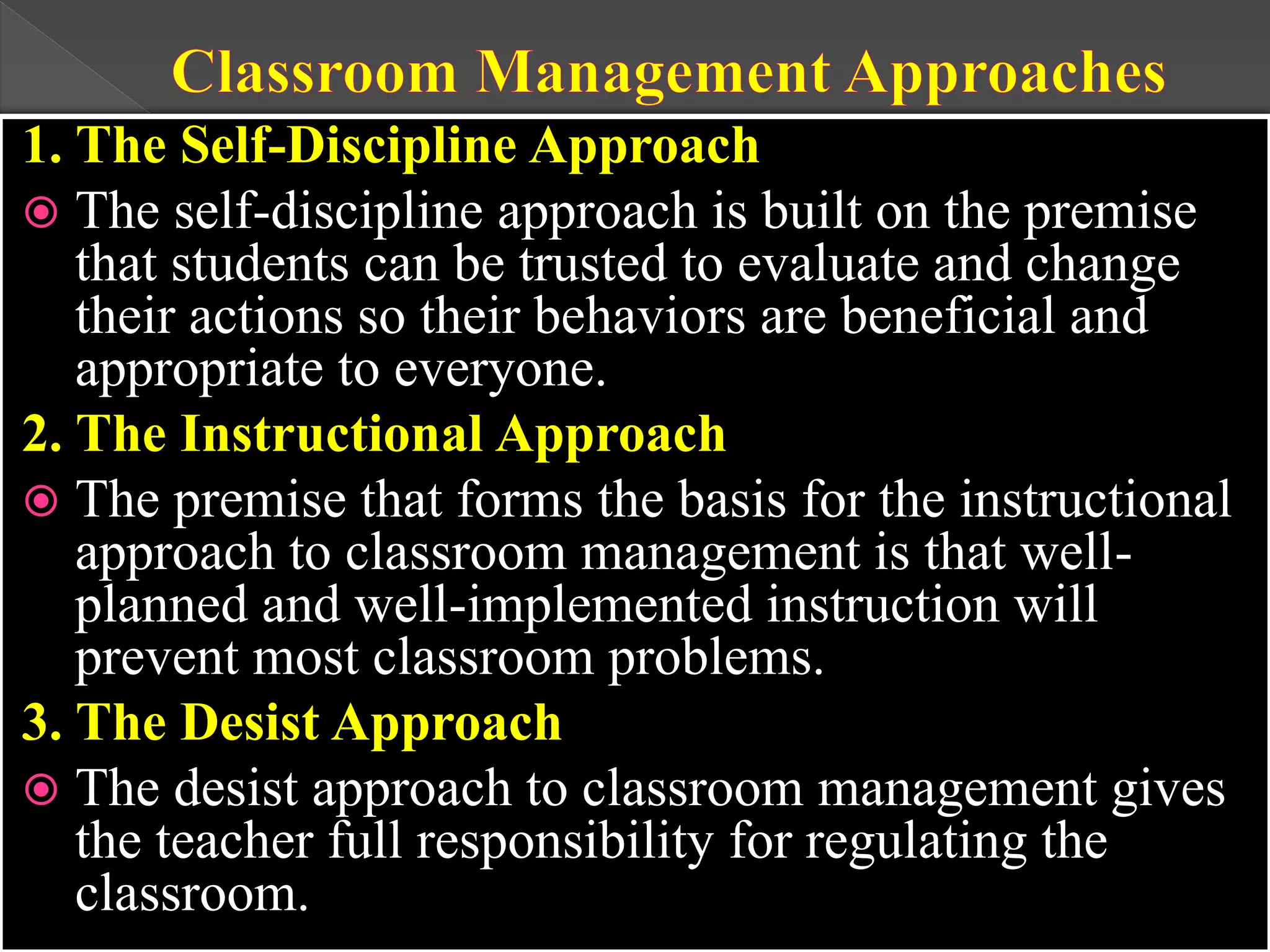
1. The Self-Discipline Approach
ļ‚ž The self-discipline approach is built on the premise
that students can be trusted to evaluate and change
their actions so their behaviors are beneficial and
appropriate to everyone.
2. The Instructional Approach
ļ‚ž The premise that forms the basis for the instructional
approach to classroom management is that well-
planned and well-implemented instruction will
prevent most classroom problems.
3. The Desist Approach
ļ‚ž The desist approach to classroom management gives
the teacher full responsibility for regulating the
classroom.
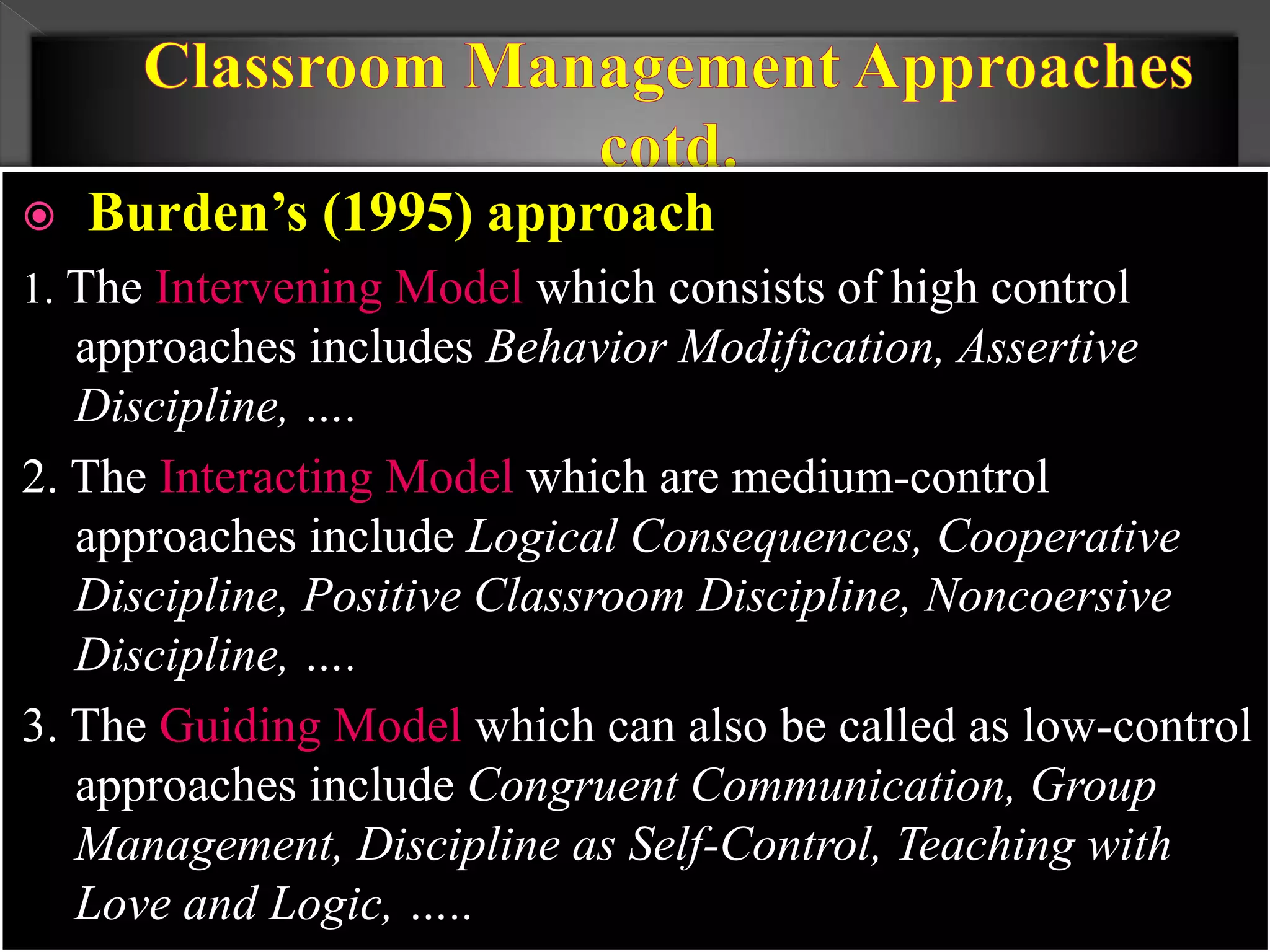
ļ‚ž Burden’s (1995) approach
1. The Intervening Model which consists of high control
approaches includes Behavior Modification, Assertive
Discipline, ….
2. The Interacting Model which are medium-control
approaches include Logical Consequences, Cooperative
Discipline, Positive Classroom Discipline, Noncoersive
Discipline, ….
3. The Guiding Model which can also be called as low-control
approaches include Congruent Communication, Group
Management, Discipline as Self-Control, Teaching with
Love and Logic, …..
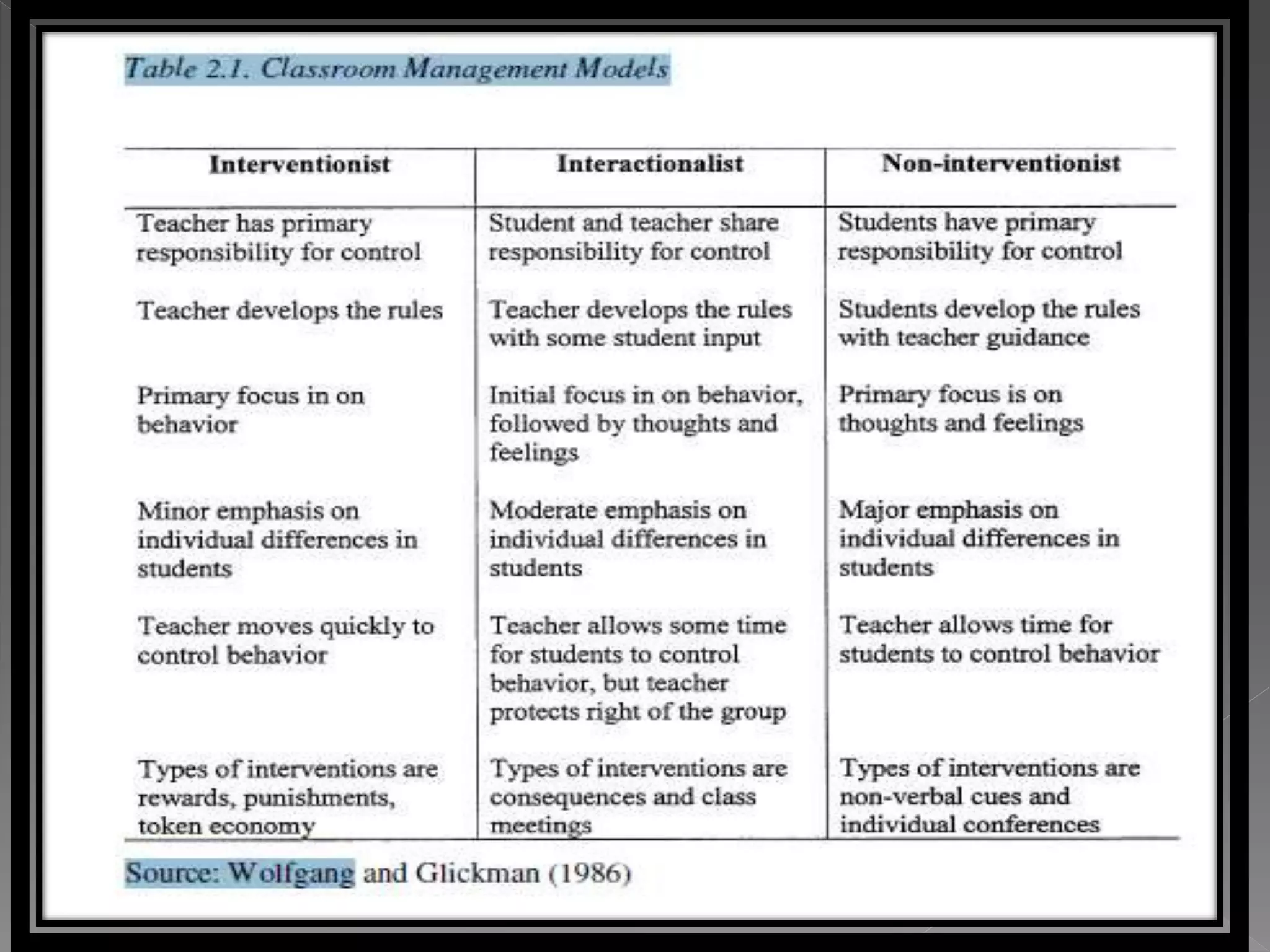
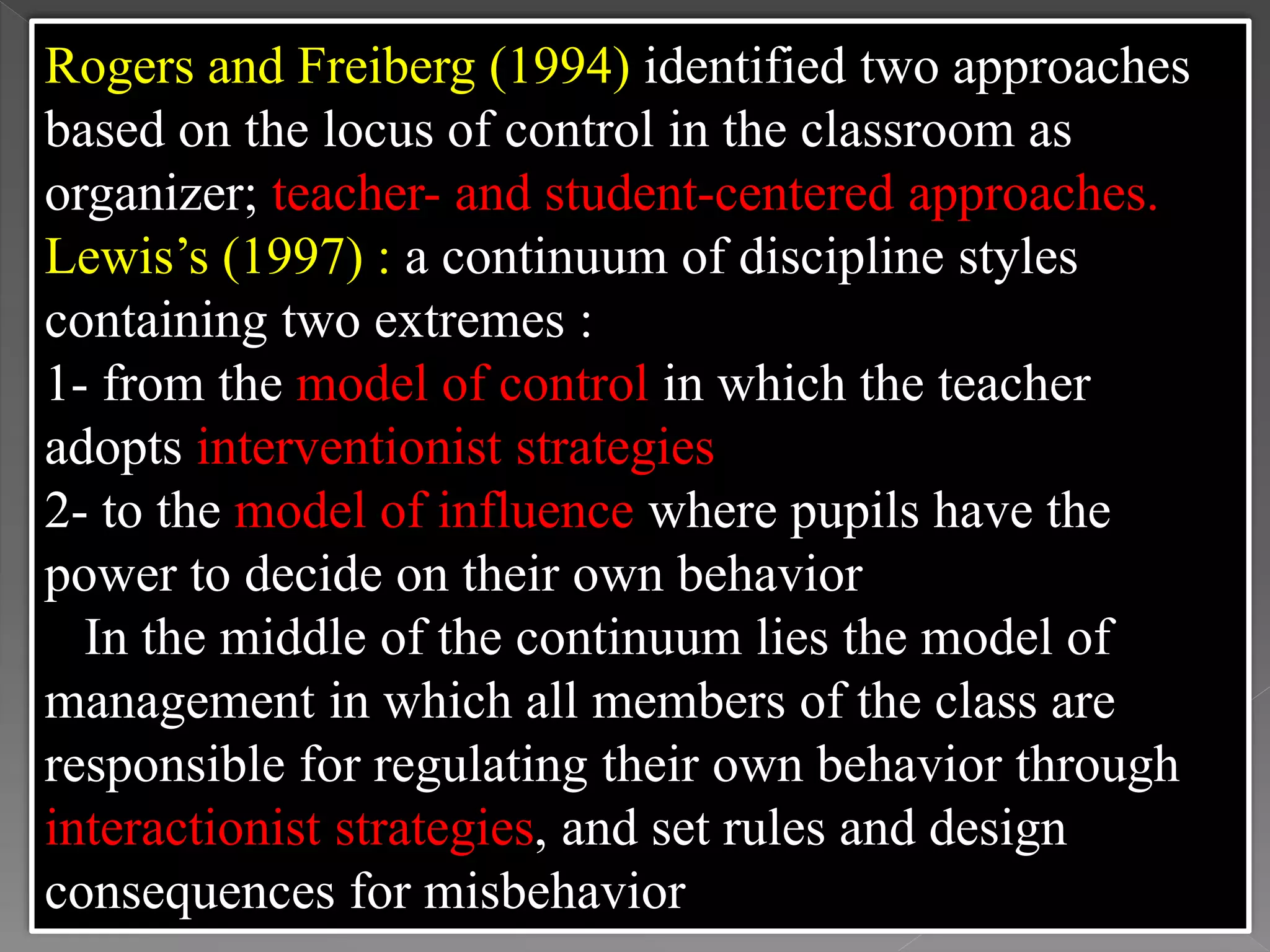
Rogers and Freiberg (1994) identified two approaches
based on the locus of control in the classroom as
organizer; teacher- and student-centered approaches.
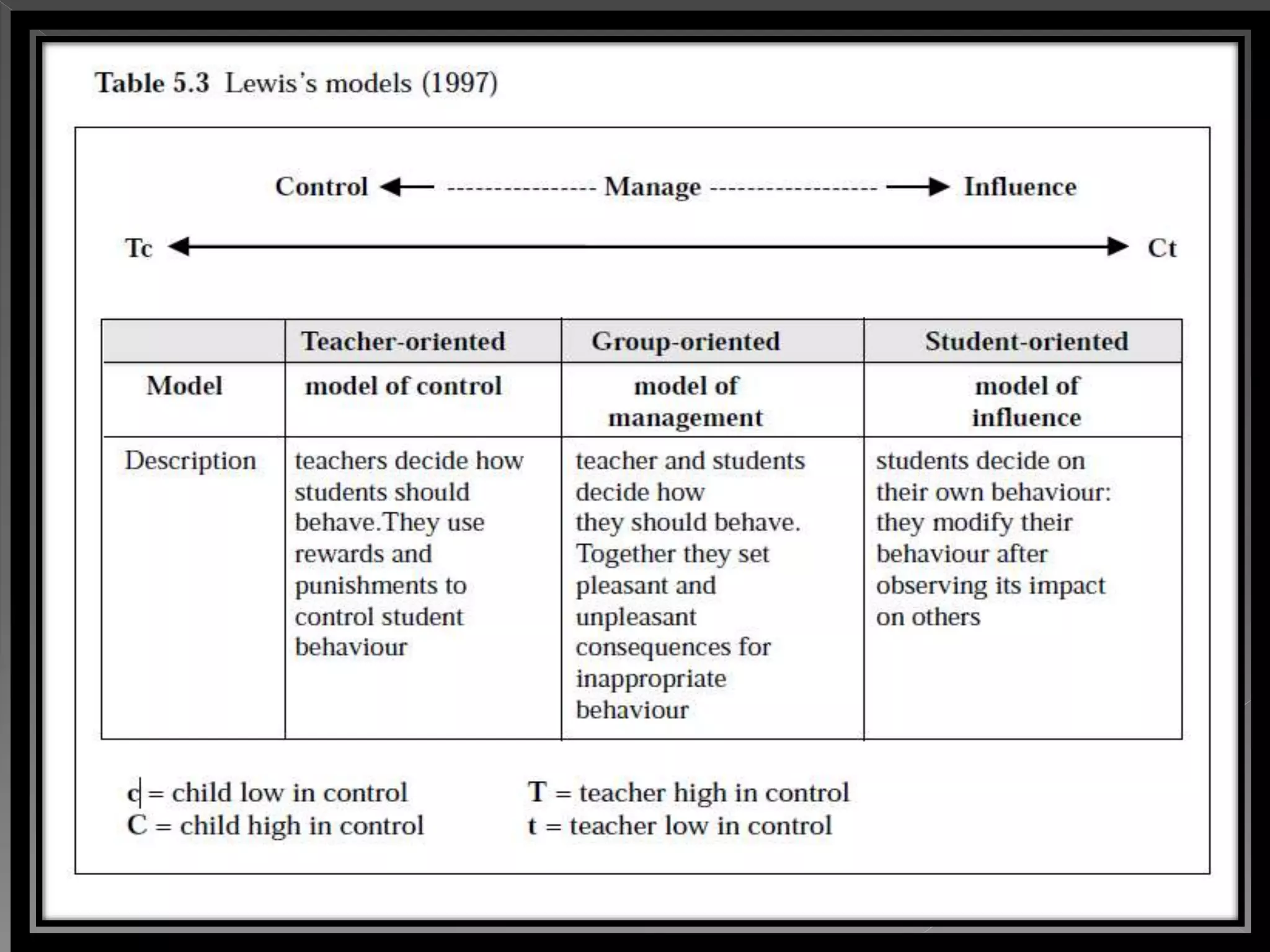
Lewis’s (1997) : a continuum of discipline styles
containing two extremes :
1- from the model of control in which the teacher
adopts interventionist strategies
2- to the model of influence where pupils have the
power to decide on their own behavior
In the middle of the continuum lies the model of
management in which all members of the class are
responsible for regulating their own behavior through
interactionist strategies, and set rules and design
consequences for misbehavior
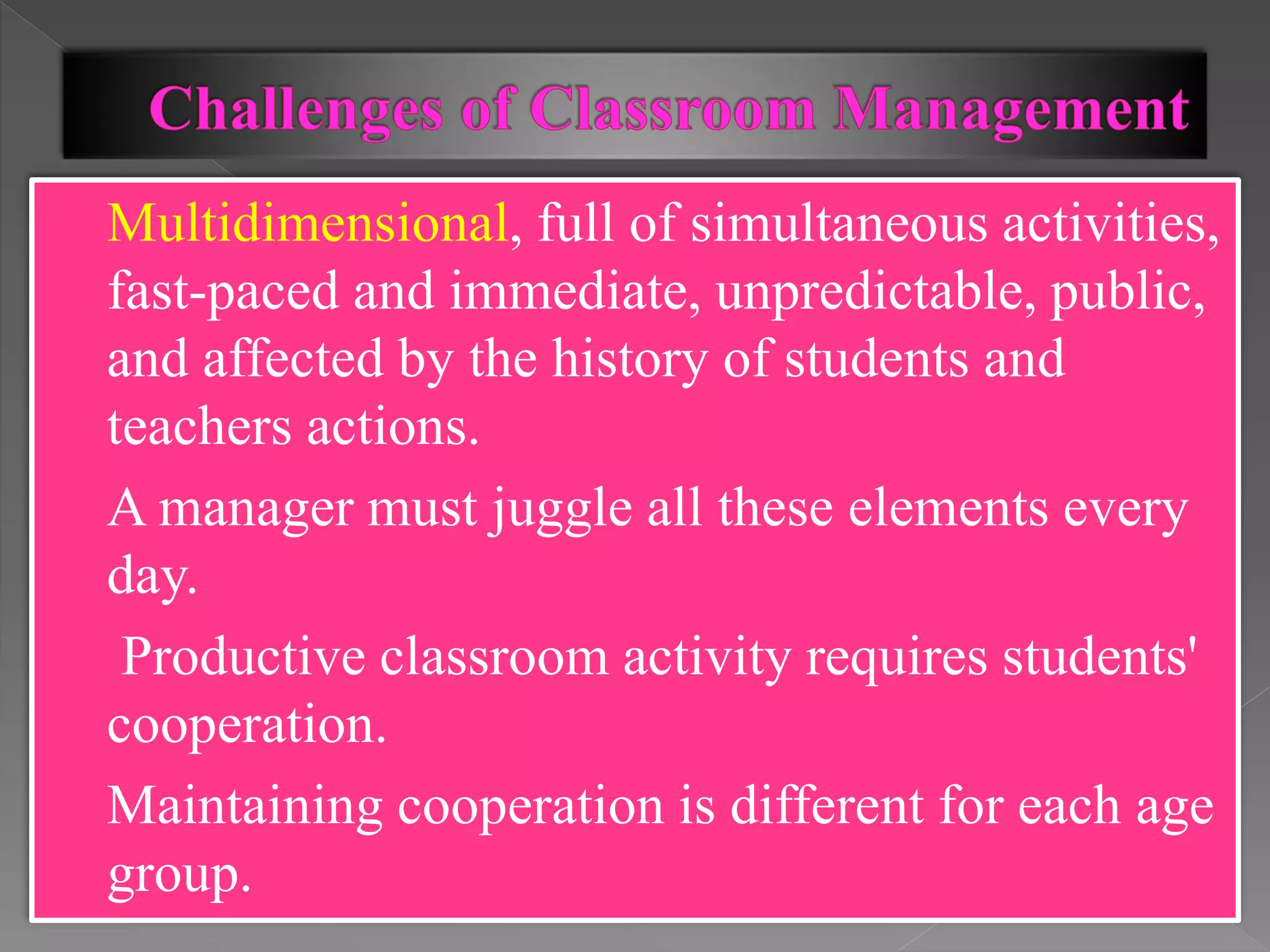
ļ‚ž Multidimensional, full of simultaneous activities,
fast-paced and immediate, unpredictable, public,
and affected by the history of students and
teachers actions.
ļ‚ž A manager must juggle all these elements every
day.
ļ‚ž Productive classroom activity requires students'
cooperation.
ļ‚ž Maintaining cooperation is different for each age
group.
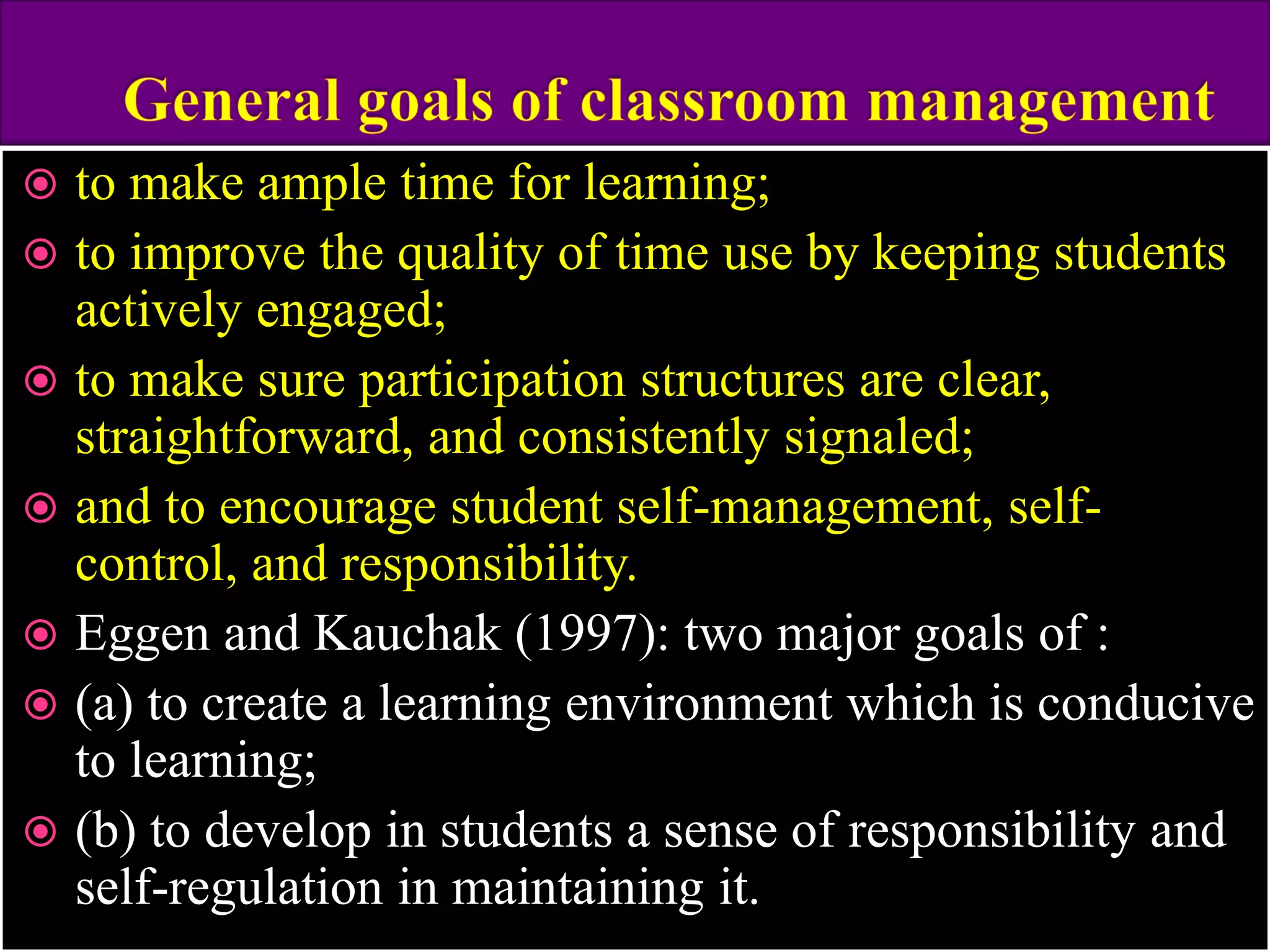
ļ‚ž to make ample time for learning;
ļ‚ž to improve the quality of time use by keeping students
actively engaged;
ļ‚ž to make sure participation structures are clear,
straightforward, and consistently signaled;
ļ‚ž and to encourage student self-management, self-
control, and responsibility.
ļ‚ž Eggen and Kauchak (1997): two major goals of :
ļ‚ž (a) to create a learning environment which is conducive
to learning;
ļ‚ž (b) to develop in students a sense of responsibility and
self-regulation in maintaining it.
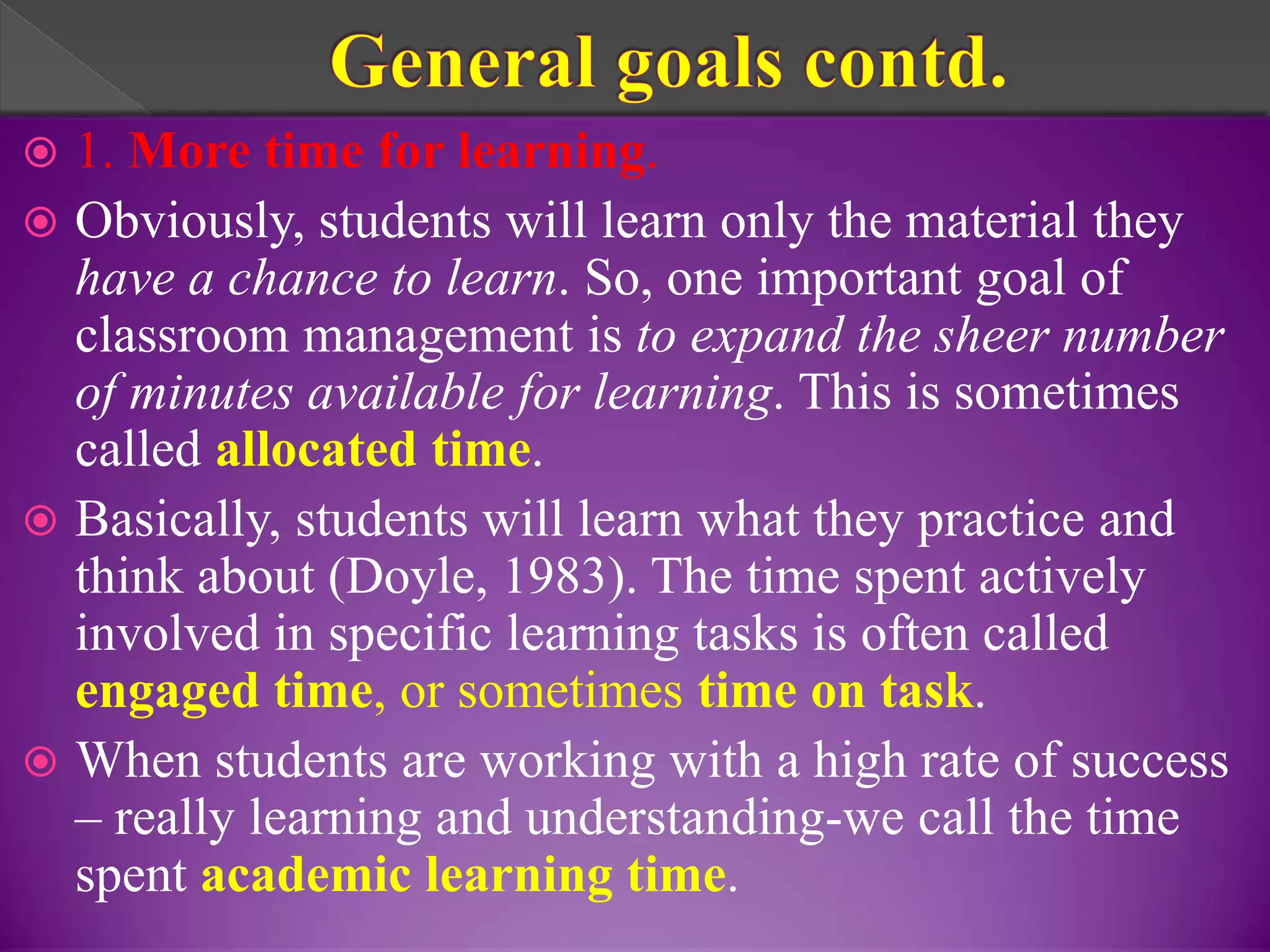
ļ‚ž 1. More time for learning.
ļ‚ž Obviously, students will learn only the material they
have a chance to learn. So, one important goal of
classroom management is to expand the sheer number
of minutes available for learning. This is sometimes
called allocated time.
ļ‚ž Basically, students will learn what they practice and
think about (Doyle, 1983). The time spent actively
involved in specific learning tasks is often called
engaged time, or sometimes time on task.
ļ‚ž When students are working with a high rate of success
– really learning and understanding-we call the time
spent academic learning time.
ļ‚ž 2. Access to learning
ļ‚ž Each classroom activity has its own rules for
participation. Sometimes these rules are clearly
stated by the teacher, but often they are implicit and
unstated. Teacher and students may not even be
aware that they are following different rules for
different activities.
ļ‚ž For example, in a reading group students may have
to raise their hands to make a comment, but in a
show-and-tell circle in the same class they may
simply have to catch the teacher's eye.
ļ‚ž 3. Management for Self-Management.
ļ‚ž The third goal of any management system is to
help students become better able to manage
themselves.
ļ‚ž The movement from demanding obedience to
teaching self-regulation and self-control
ļ‚ž Students learn self-control by making choices
and dealing with the consequences, setting goals
and priorities, managing time, collaborating to
learn, mediating disputes
ļ‚ž First, It is a necessary condition for the creation of a
supportive, respectful learning environment. Effective
teaching and learning can take place only if there is good
order and a positive learning climate in the classroom.
ļ‚ž Second, it is a proactive and developmental way to promote
the growth of students, in terms of their personal, social and
emotional selves.
Classroom Management is maintaining order in the classroom.
So,
- Teachers need to create an environment that promotes learning.
- Teachers are responsible for helping students manage and
direct their own learning.
ļ‚ž Traditional: Preventing Learners’ Misbehavior
1. teachers to maintain order and discipline
2. inappropriate behavior must be stopped
3. Managing the classroom can be the establishment of
order and keeping control
ļ‚ž Recent: Learners’ Engagement
1. preventive measures can enhance self-discipline
2. to create classrooms as engaging as possible
3. teachers need personal plans to deal with misbehavior
in order to minimize the disruption to classroom
teaching and learning
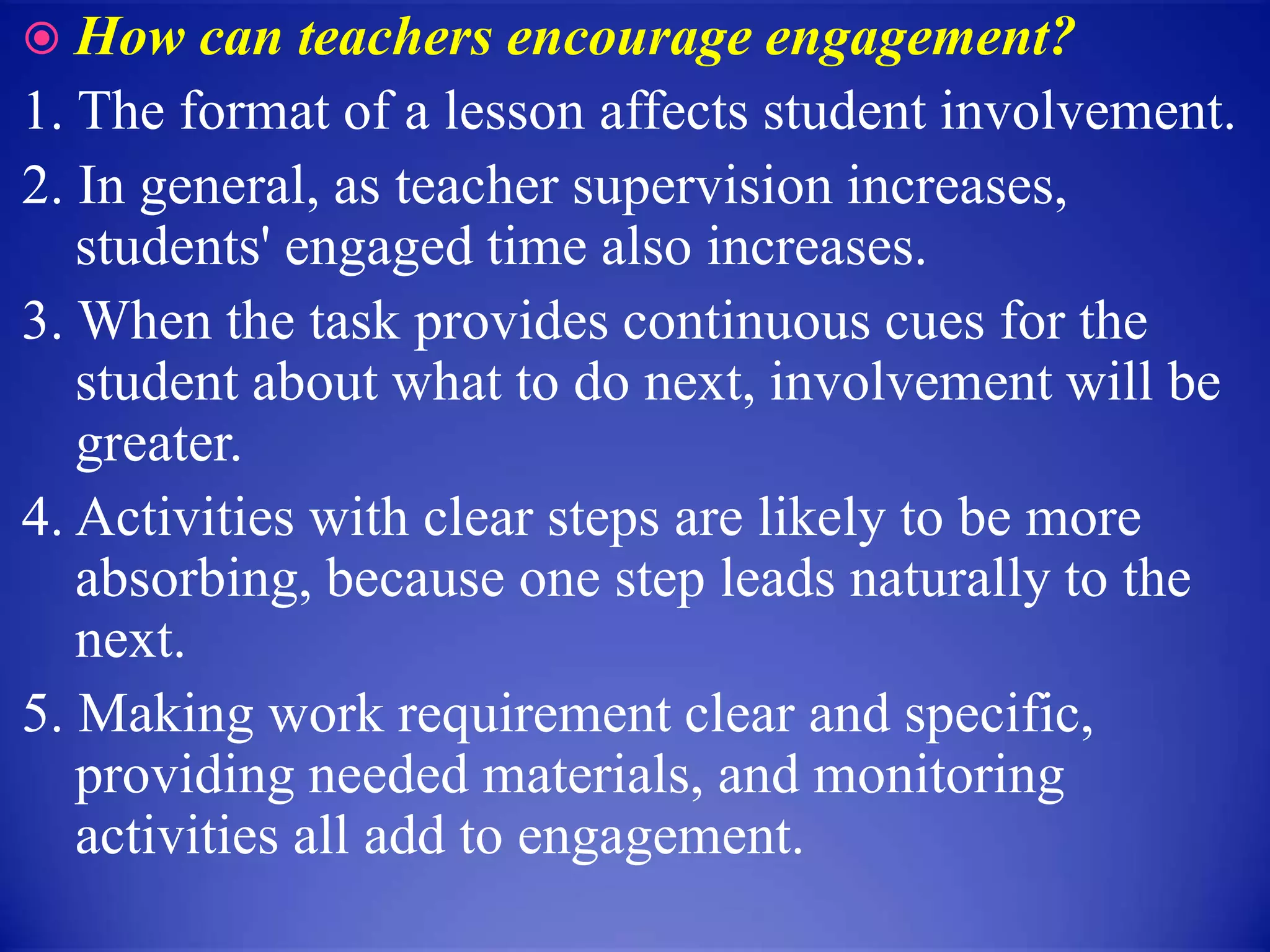
ļ‚ž How can teachers encourage engagement?
1. The format of a lesson affects student involvement.
2. In general, as teacher supervision increases,
students' engaged time also increases.
3. When the task provides continuous cues for the
student about what to do next, involvement will be
greater.
4. Activities with clear steps are likely to be more
absorbing, because one step leads naturally to the
next.
5. Making work requirement clear and specific,
providing needed materials, and monitoring
activities all add to engagement.
ļ‚ž Cooperative Community: Classroom management
begins by establishing a community based on
cooperative learning. At the heart of the community is
the idea of positive interdependence-individuals
working Together to achieve mutual goals.
ļ‚ž Constructive Conflict Resolution: Constructive conflict
resolution is essential in the community because
conflicts are inevitable and even necessary for learning.
ļ‚ž Civic Values: They are understandings and beliefs that
hold the community together. Values are learned
through direct teaching, modeling, literature, group
discussions, and the sharing of concerns.
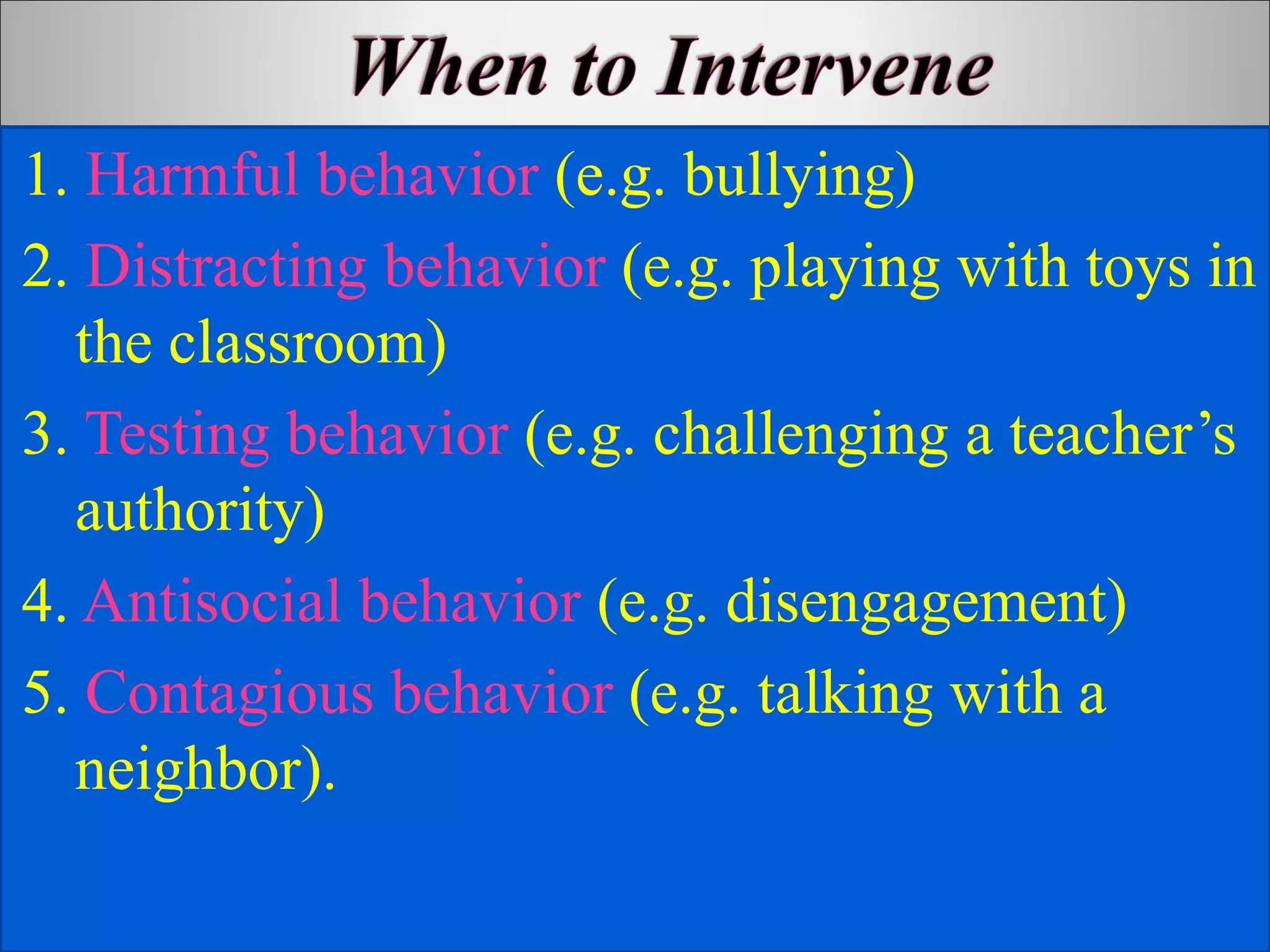
1. Harmful behavior (e.g. bullying)
2. Distracting behavior (e.g. playing with toys in
the classroom)
3. Testing behavior (e.g. challenging a teacher’s
authority)
4. Antisocial behavior (e.g. disengagement)
5. Contagious behavior (e.g. talking with a
neighbor).
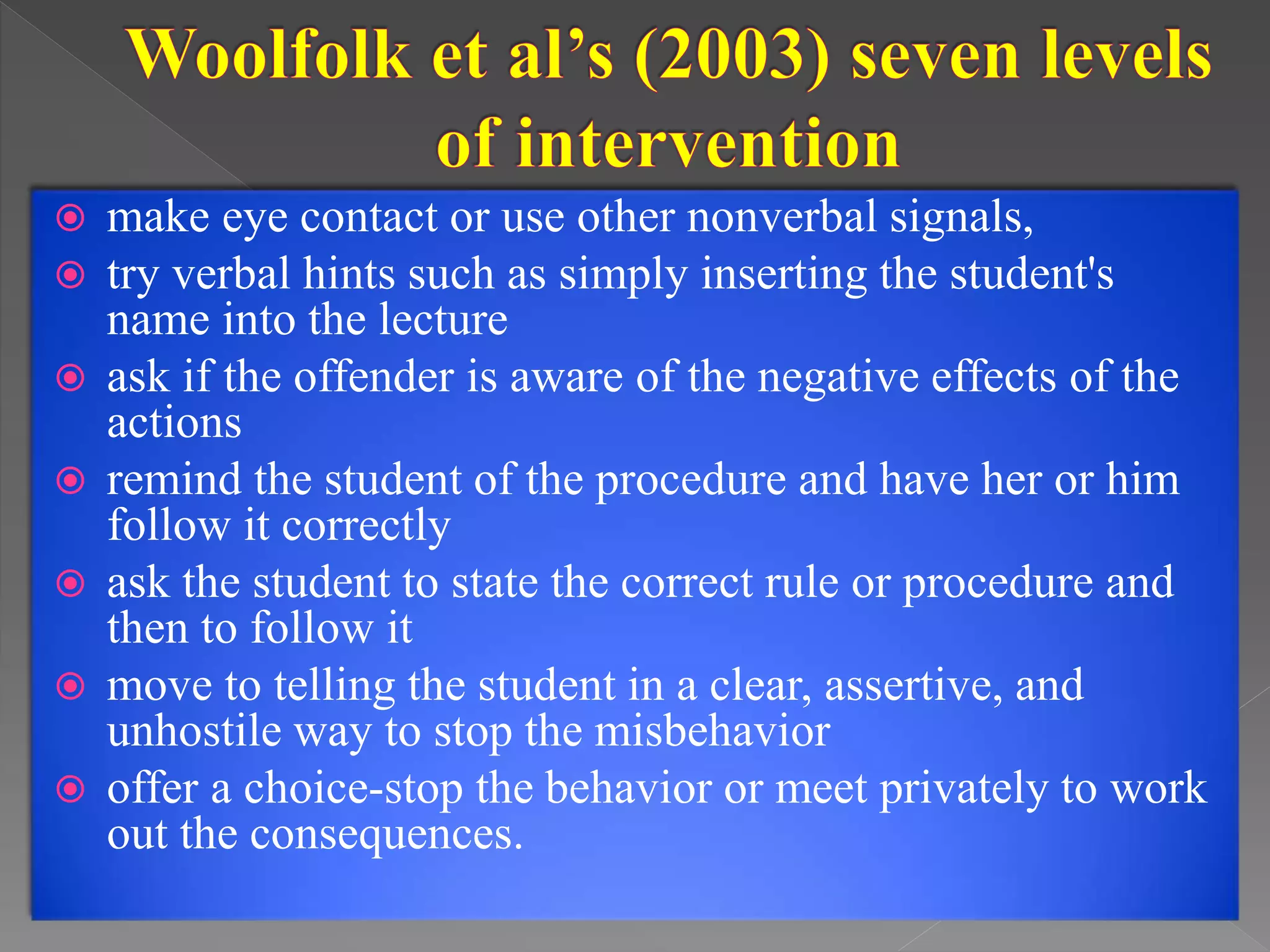
ļ‚ž make eye contact or use other nonverbal signals,
ļ‚ž try verbal hints such as simply inserting the student's
name into the lecture
ļ‚ž ask if the offender is aware of the negative effects of the
actions
ļ‚ž remind the student of the procedure and have her or him
follow it correctly
ļ‚ž ask the student to state the correct rule or procedure and
then to follow it
ļ‚ž move to telling the student in a clear, assertive, and
unhostile way to stop the misbehavior
ļ‚ž offer a choice-stop the behavior or meet privately to work
out the consequences.
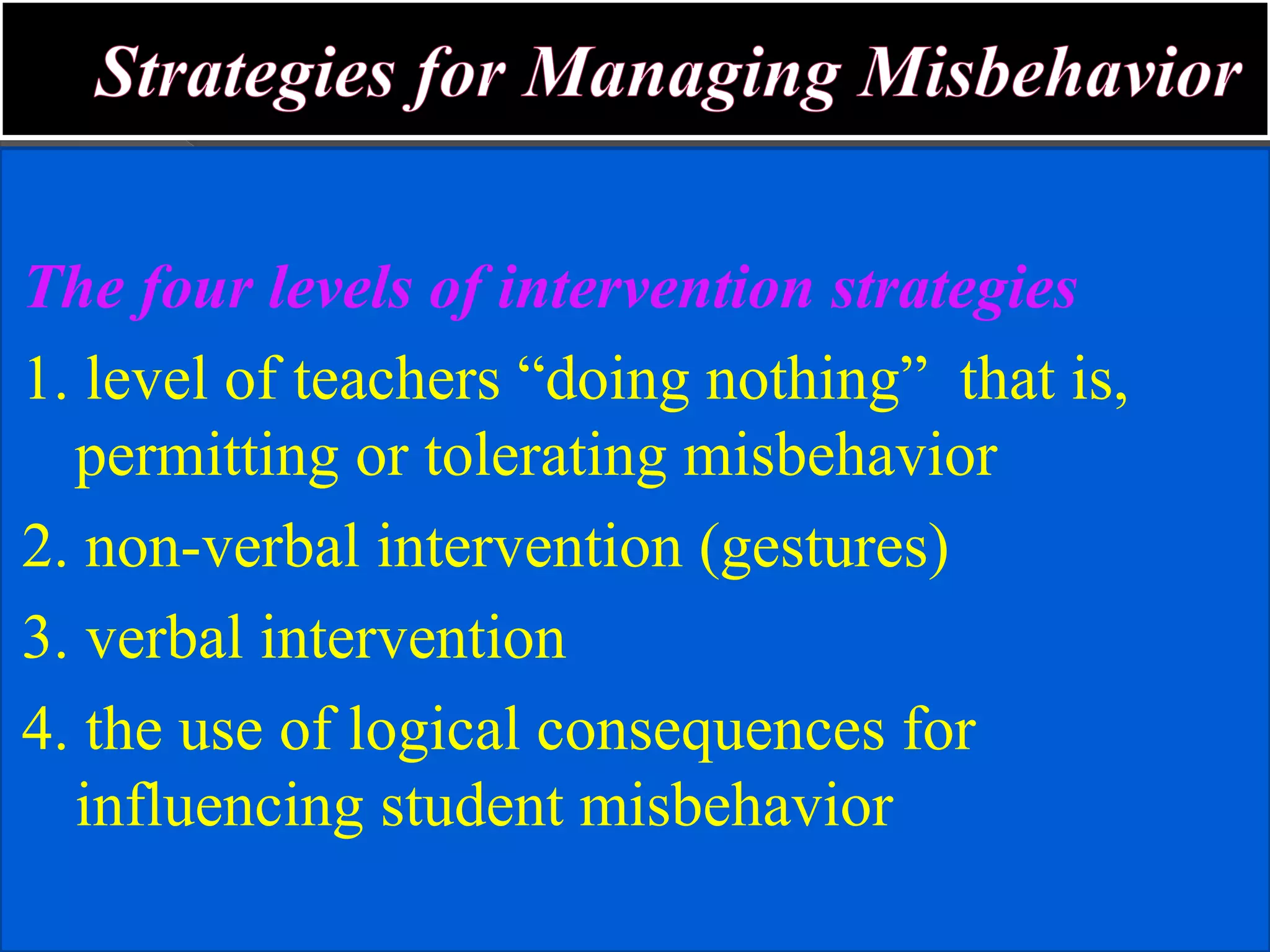
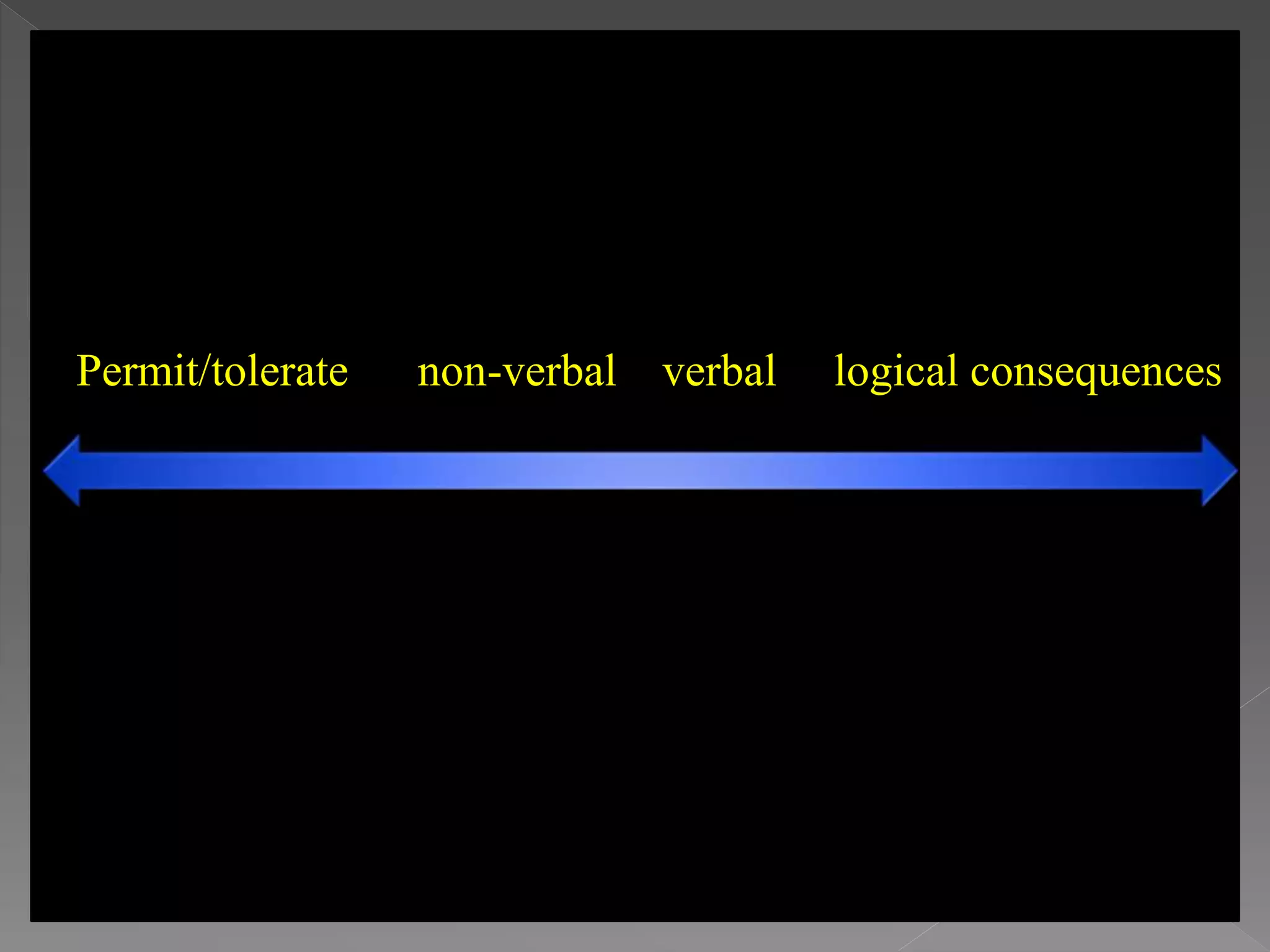
The four levels of intervention strategies
1. level of teachers ā€œdoing nothingā€ that is,
permitting or tolerating misbehavior
2. non-verbal intervention (gestures)
3. verbal intervention
4. the use of logical consequences for
influencing student misbehavior
Permit/tolerate non-verbal verbal logical consequences
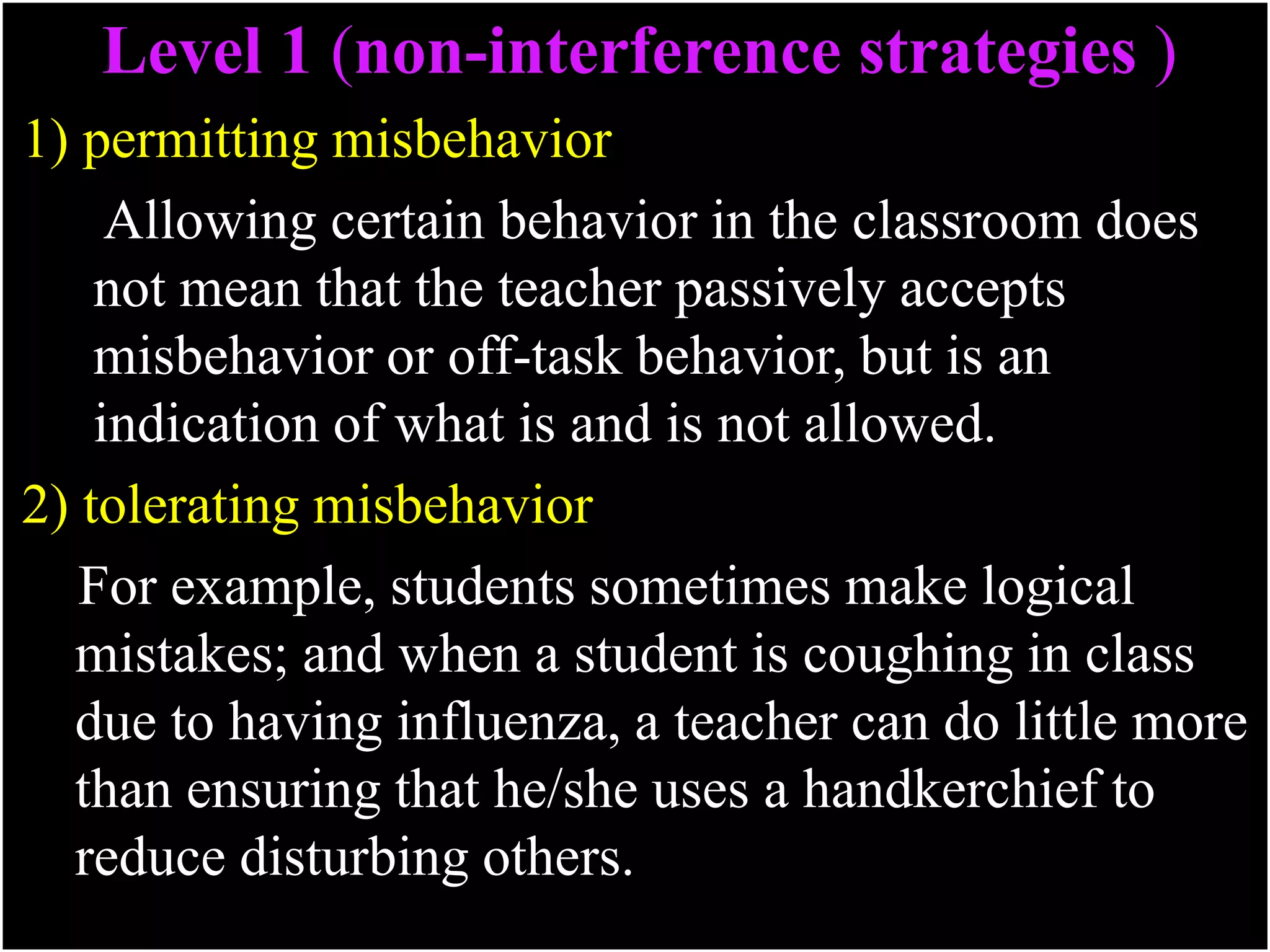
Level 1 (non-interference strategies )
1) permitting misbehavior
Allowing certain behavior in the classroom does
not mean that the teacher passively accepts
misbehavior or off-task behavior, but is an
indication of what is and is not allowed.
2) tolerating misbehavior
For example, students sometimes make logical
mistakes; and when a student is coughing in class
due to having influenza, a teacher can do little more
than ensuring that he/she uses a handkerchief to
reduce disturbing others.
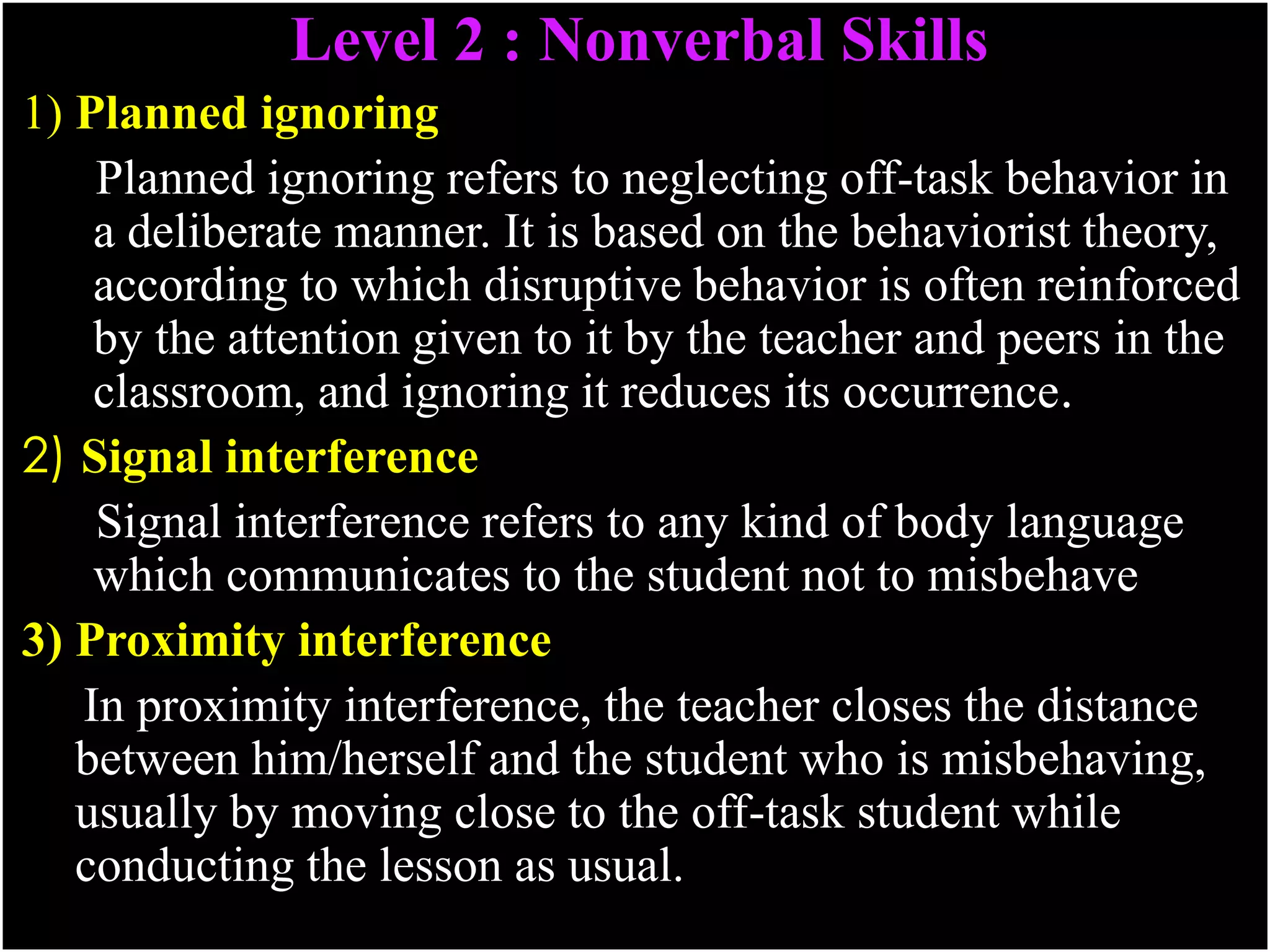
Level 2 : Nonverbal Skills
1) Planned ignoring
Planned ignoring refers to neglecting off-task behavior in
a deliberate manner. It is based on the behaviorist theory,
according to which disruptive behavior is often reinforced
by the attention given to it by the teacher and peers in the
classroom, and ignoring it reduces its occurrence.
2) Signal interference
Signal interference refers to any kind of body language
which communicates to the student not to misbehave
3) Proximity interference
In proximity interference, the teacher closes the distance
between him/herself and the student who is misbehaving,
usually by moving close to the off-task student while
conducting the lesson as usual.
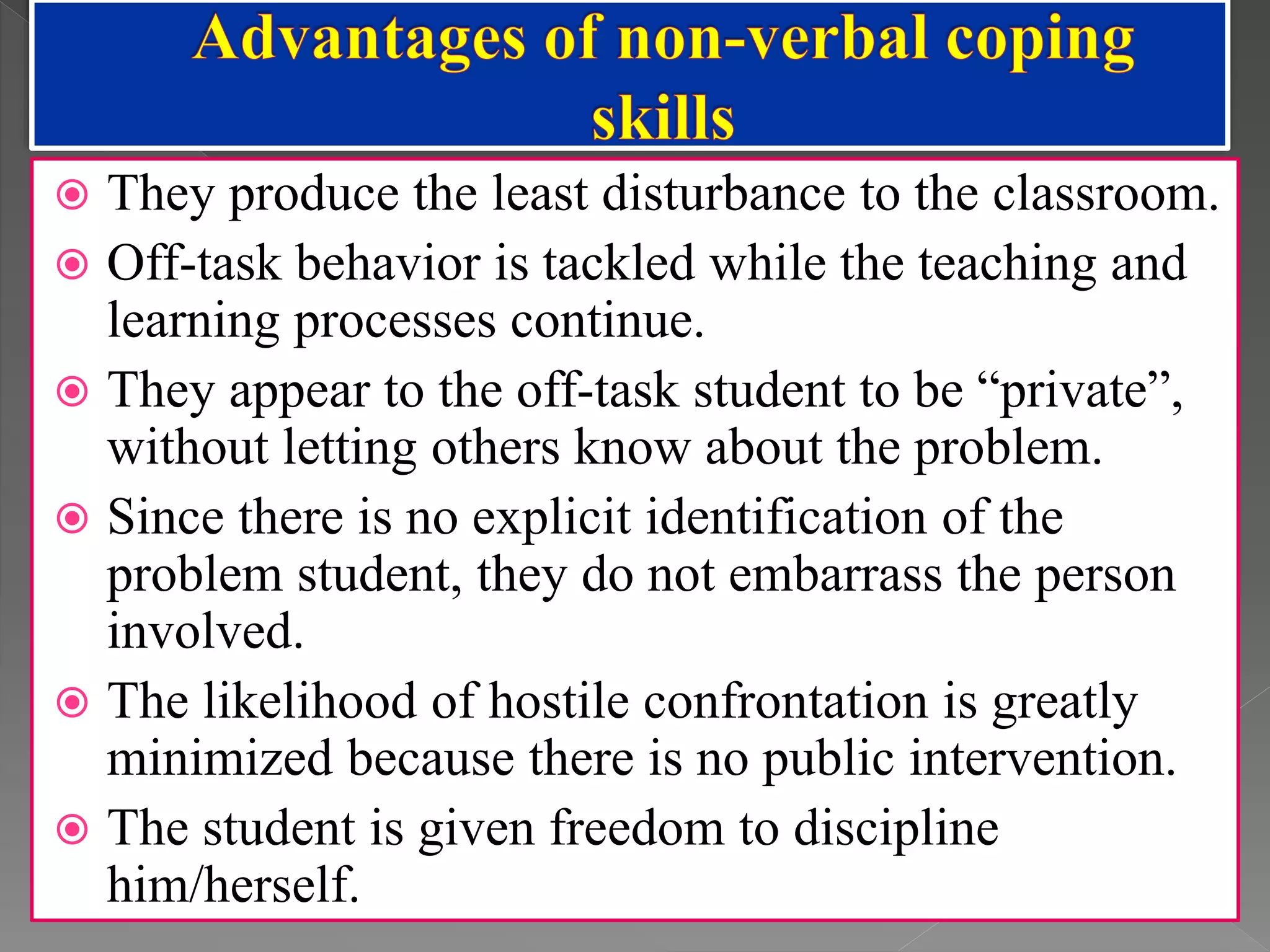
ļ‚ž They produce the least disturbance to the classroom.
ļ‚ž Off-task behavior is tackled while the teaching and
learning processes continue.
ļ‚ž They appear to the off-task student to be ā€œprivateā€,
without letting others know about the problem.
ļ‚ž Since there is no explicit identification of the
problem student, they do not embarrass the person
involved.
ļ‚ž The likelihood of hostile confrontation is greatly
minimized because there is no public intervention.
ļ‚ž The student is given freedom to discipline
him/herself.
Level 3: the use of verbal interference
ļ‚ž Humor for less serious problems
ļ‚ž Verbal intervention +doing some actions for more serious
problems (put away your…..)
1) Praising peers
Teachers often try to stop disruptive behavior by not commenting
on it and instead praising a student or group of pupils exhibiting
the desired behavior, in the hope that the deviant will notice this
and follow their example.
2) Boosting interest
Boosting students’ interest is a useful way for a teacher to show
care and sensitivity and, indirectly, it helps in building up good
relationships.
3) Calling on students
4) Using humor as a tension-breaker
5) Asking questions
6) Requests and demands
Level 4: logical consequences.
ļ‚ž This is the most explicit kind of interference in the
classroom, which not only conveys the seriousness of the
misbehavior to the student but also sends a message to
others that it cannot be tolerated any longer.
ļ‚ž Consequences:
ļ‚ž (a) Natural consequences occur automatically as a result of
a particular behavior. They are inevitable and result directly
from the student’s actions if there is no intervention to
prevent it happening.
ļ‚ž (b) Logical consequences, in contrast, are deliberately
planned and carried out by the teacher.
ļ‚ž (c) Arbitrary consequences imposed by the teacher on
students are not related to the misbehavior and are often
seen by the students as retribution.
Punishment: contrived and coercive
Consequences: the outcomes related to misbehavior
ļ‚ž The passive style can take several forms. Instead of
telling the student directly what to do, the teacher
simply comments on the behavior, asks the student to
think about the appropriate action, or threatens but
never follows trough.
ļ‚ž In a hostile response style, teachers may make "you"
statements that condemn the student with without
stating clearly what the student should be doing. An
assertive response communicates to the students that
the teacher cares too much about them and the process
of learning to allow inappropriate behavior to persist.
ļ‚ž Assertive teachers clearly state what they expect.
Thanks a lot
for your patience &
precious time
Yousefi

Classroom management 1

  • 2.
    ļ‚ž It isa dimension of effective teaching, and a process through which an effective classroom environment is created (Good and Brophy, 1997). ļ‚ž It focuses on student behaviour, especially discipline problems, and deals with issues of low learning motivation and poor self- esteem (Campbell, 1999). ļ‚ž It refers broadly to all activities that teachers carry out in the classroom. It aims to promote student involvement and cooperation (Sanford et al., 1983, cited in Jones and Jones, 2001). ļ‚ž It emphasizes the educational value of promoting the growth of students. Its focus is also on proactive and developmental classroom practices, rather than those with negative features of control and punishment (McCaslin and Good, 1992).
  • 3.
    Some Terms ļ‚ž Classroombehaviour: This refers to the actions or reactions of classroom participants. The behavior of an individual is complex as it is controlled not just by the nervous system but also by the social context in which she/he participates. ļ‚ž Discipline: This is the act of responding to misbehaving students in an effort to restore and maintain order, authority and control. It is also considered to be a form of training, aimed at influencing students’ moral and mental development in ways which promote self-control, self-discipline and self- management. ļ‚ž Misbehavior: This refers to behavior that interferes with teaching, violating the right of other students to learn, and sometimes makes them feel psychologically uncomfortable and physically unsafe.
  • 4.
    ļ‚žMartin and Sugarman(1993, p.9): Classroom management concerns "those activities…that create a positive classroom climate within which effective teaching and learning can occur" ļ‚žGood classroom management creates an atmosphere that permits activities to be carried on efficiently and economically maximizing the time, effort and energy of both the teacher and the students.
  • 5.
    1. The Self-DisciplineApproach ļ‚ž The self-discipline approach is built on the premise that students can be trusted to evaluate and change their actions so their behaviors are beneficial and appropriate to everyone. 2. The Instructional Approach ļ‚ž The premise that forms the basis for the instructional approach to classroom management is that well- planned and well-implemented instruction will prevent most classroom problems. 3. The Desist Approach ļ‚ž The desist approach to classroom management gives the teacher full responsibility for regulating the classroom.
  • 6.
    ļ‚ž Burden’s (1995)approach 1. The Intervening Model which consists of high control approaches includes Behavior Modification, Assertive Discipline, …. 2. The Interacting Model which are medium-control approaches include Logical Consequences, Cooperative Discipline, Positive Classroom Discipline, Noncoersive Discipline, …. 3. The Guiding Model which can also be called as low-control approaches include Congruent Communication, Group Management, Discipline as Self-Control, Teaching with Love and Logic, …..
  • 8.
    Rogers and Freiberg(1994) identified two approaches based on the locus of control in the classroom as organizer; teacher- and student-centered approaches. Lewis’s (1997) : a continuum of discipline styles containing two extremes : 1- from the model of control in which the teacher adopts interventionist strategies 2- to the model of influence where pupils have the power to decide on their own behavior In the middle of the continuum lies the model of management in which all members of the class are responsible for regulating their own behavior through interactionist strategies, and set rules and design consequences for misbehavior
  • 10.
    ļ‚ž Multidimensional, fullof simultaneous activities, fast-paced and immediate, unpredictable, public, and affected by the history of students and teachers actions. ļ‚ž A manager must juggle all these elements every day. ļ‚ž Productive classroom activity requires students' cooperation. ļ‚ž Maintaining cooperation is different for each age group.
  • 11.
    ļ‚ž to makeample time for learning; ļ‚ž to improve the quality of time use by keeping students actively engaged; ļ‚ž to make sure participation structures are clear, straightforward, and consistently signaled; ļ‚ž and to encourage student self-management, self- control, and responsibility. ļ‚ž Eggen and Kauchak (1997): two major goals of : ļ‚ž (a) to create a learning environment which is conducive to learning; ļ‚ž (b) to develop in students a sense of responsibility and self-regulation in maintaining it.
  • 12.
    ļ‚ž 1. Moretime for learning. ļ‚ž Obviously, students will learn only the material they have a chance to learn. So, one important goal of classroom management is to expand the sheer number of minutes available for learning. This is sometimes called allocated time. ļ‚ž Basically, students will learn what they practice and think about (Doyle, 1983). The time spent actively involved in specific learning tasks is often called engaged time, or sometimes time on task. ļ‚ž When students are working with a high rate of success – really learning and understanding-we call the time spent academic learning time.
  • 13.
    ļ‚ž 2. Accessto learning ļ‚ž Each classroom activity has its own rules for participation. Sometimes these rules are clearly stated by the teacher, but often they are implicit and unstated. Teacher and students may not even be aware that they are following different rules for different activities. ļ‚ž For example, in a reading group students may have to raise their hands to make a comment, but in a show-and-tell circle in the same class they may simply have to catch the teacher's eye.
  • 14.
    ļ‚ž 3. Managementfor Self-Management. ļ‚ž The third goal of any management system is to help students become better able to manage themselves. ļ‚ž The movement from demanding obedience to teaching self-regulation and self-control ļ‚ž Students learn self-control by making choices and dealing with the consequences, setting goals and priorities, managing time, collaborating to learn, mediating disputes
  • 15.
    ļ‚ž First, Itis a necessary condition for the creation of a supportive, respectful learning environment. Effective teaching and learning can take place only if there is good order and a positive learning climate in the classroom. ļ‚ž Second, it is a proactive and developmental way to promote the growth of students, in terms of their personal, social and emotional selves. Classroom Management is maintaining order in the classroom. So, - Teachers need to create an environment that promotes learning. - Teachers are responsible for helping students manage and direct their own learning.
  • 16.
    ļ‚ž Traditional: PreventingLearners’ Misbehavior 1. teachers to maintain order and discipline 2. inappropriate behavior must be stopped 3. Managing the classroom can be the establishment of order and keeping control ļ‚ž Recent: Learners’ Engagement 1. preventive measures can enhance self-discipline 2. to create classrooms as engaging as possible 3. teachers need personal plans to deal with misbehavior in order to minimize the disruption to classroom teaching and learning
  • 17.
    ļ‚ž How canteachers encourage engagement? 1. The format of a lesson affects student involvement. 2. In general, as teacher supervision increases, students' engaged time also increases. 3. When the task provides continuous cues for the student about what to do next, involvement will be greater. 4. Activities with clear steps are likely to be more absorbing, because one step leads naturally to the next. 5. Making work requirement clear and specific, providing needed materials, and monitoring activities all add to engagement.
  • 18.
    ļ‚ž Cooperative Community:Classroom management begins by establishing a community based on cooperative learning. At the heart of the community is the idea of positive interdependence-individuals working Together to achieve mutual goals. ļ‚ž Constructive Conflict Resolution: Constructive conflict resolution is essential in the community because conflicts are inevitable and even necessary for learning. ļ‚ž Civic Values: They are understandings and beliefs that hold the community together. Values are learned through direct teaching, modeling, literature, group discussions, and the sharing of concerns.
  • 19.
    1. Harmful behavior(e.g. bullying) 2. Distracting behavior (e.g. playing with toys in the classroom) 3. Testing behavior (e.g. challenging a teacher’s authority) 4. Antisocial behavior (e.g. disengagement) 5. Contagious behavior (e.g. talking with a neighbor).
  • 20.
    ļ‚ž make eyecontact or use other nonverbal signals, ļ‚ž try verbal hints such as simply inserting the student's name into the lecture ļ‚ž ask if the offender is aware of the negative effects of the actions ļ‚ž remind the student of the procedure and have her or him follow it correctly ļ‚ž ask the student to state the correct rule or procedure and then to follow it ļ‚ž move to telling the student in a clear, assertive, and unhostile way to stop the misbehavior ļ‚ž offer a choice-stop the behavior or meet privately to work out the consequences.
  • 21.
    The four levelsof intervention strategies 1. level of teachers ā€œdoing nothingā€ that is, permitting or tolerating misbehavior 2. non-verbal intervention (gestures) 3. verbal intervention 4. the use of logical consequences for influencing student misbehavior
  • 22.
  • 23.
    Level 1 (non-interferencestrategies ) 1) permitting misbehavior Allowing certain behavior in the classroom does not mean that the teacher passively accepts misbehavior or off-task behavior, but is an indication of what is and is not allowed. 2) tolerating misbehavior For example, students sometimes make logical mistakes; and when a student is coughing in class due to having influenza, a teacher can do little more than ensuring that he/she uses a handkerchief to reduce disturbing others.
  • 24.
    Level 2 :Nonverbal Skills 1) Planned ignoring Planned ignoring refers to neglecting off-task behavior in a deliberate manner. It is based on the behaviorist theory, according to which disruptive behavior is often reinforced by the attention given to it by the teacher and peers in the classroom, and ignoring it reduces its occurrence. 2) Signal interference Signal interference refers to any kind of body language which communicates to the student not to misbehave 3) Proximity interference In proximity interference, the teacher closes the distance between him/herself and the student who is misbehaving, usually by moving close to the off-task student while conducting the lesson as usual.
  • 25.
    ļ‚ž They producethe least disturbance to the classroom. ļ‚ž Off-task behavior is tackled while the teaching and learning processes continue. ļ‚ž They appear to the off-task student to be ā€œprivateā€, without letting others know about the problem. ļ‚ž Since there is no explicit identification of the problem student, they do not embarrass the person involved. ļ‚ž The likelihood of hostile confrontation is greatly minimized because there is no public intervention. ļ‚ž The student is given freedom to discipline him/herself.
  • 26.
    Level 3: theuse of verbal interference ļ‚ž Humor for less serious problems ļ‚ž Verbal intervention +doing some actions for more serious problems (put away your…..) 1) Praising peers Teachers often try to stop disruptive behavior by not commenting on it and instead praising a student or group of pupils exhibiting the desired behavior, in the hope that the deviant will notice this and follow their example. 2) Boosting interest Boosting students’ interest is a useful way for a teacher to show care and sensitivity and, indirectly, it helps in building up good relationships. 3) Calling on students 4) Using humor as a tension-breaker 5) Asking questions 6) Requests and demands
  • 27.
    Level 4: logicalconsequences. ļ‚ž This is the most explicit kind of interference in the classroom, which not only conveys the seriousness of the misbehavior to the student but also sends a message to others that it cannot be tolerated any longer. ļ‚ž Consequences: ļ‚ž (a) Natural consequences occur automatically as a result of a particular behavior. They are inevitable and result directly from the student’s actions if there is no intervention to prevent it happening. ļ‚ž (b) Logical consequences, in contrast, are deliberately planned and carried out by the teacher. ļ‚ž (c) Arbitrary consequences imposed by the teacher on students are not related to the misbehavior and are often seen by the students as retribution. Punishment: contrived and coercive Consequences: the outcomes related to misbehavior
  • 28.
    ļ‚ž The passivestyle can take several forms. Instead of telling the student directly what to do, the teacher simply comments on the behavior, asks the student to think about the appropriate action, or threatens but never follows trough. ļ‚ž In a hostile response style, teachers may make "you" statements that condemn the student with without stating clearly what the student should be doing. An assertive response communicates to the students that the teacher cares too much about them and the process of learning to allow inappropriate behavior to persist. ļ‚ž Assertive teachers clearly state what they expect.
  • 29.
    Thanks a lot foryour patience & precious time Yousefi