Principles of Individual
Differences
Kaye Dematera
Definition
“Individual differences stand for the variations
or deviations among individuals in regard to a
single characteristic or a number of
characteristics.”
-Carter B. Good
Types of individual differences
• Physical difference – Difference in acquired
physical characteristics.
• Mental difference - People differ in intellectual
abilities and capacities.
idiot, imbecile, moron, border line, normal, very
superior and genius
Types of individual differences
• Emotional difference - Individuals also differ in
the manner they express their emotions.
• Differences in psychomotor skills - Individuals
are found to differ with regard to
development and acquisition of one or more
types of skills.
Types of individual differences
• Differences in achievement - Differences exist
in achievement and in knowledge among
individuals.
• Differences in interests and aptitudes -
Variations occur among the individuals in
relation to the specific tastes and interests.
Types of individual differences
• Learning Differences - Some learn more easily
and are able to make use of their learning
more comfortably than others.
• Difference in attitudes, beliefs and opinions
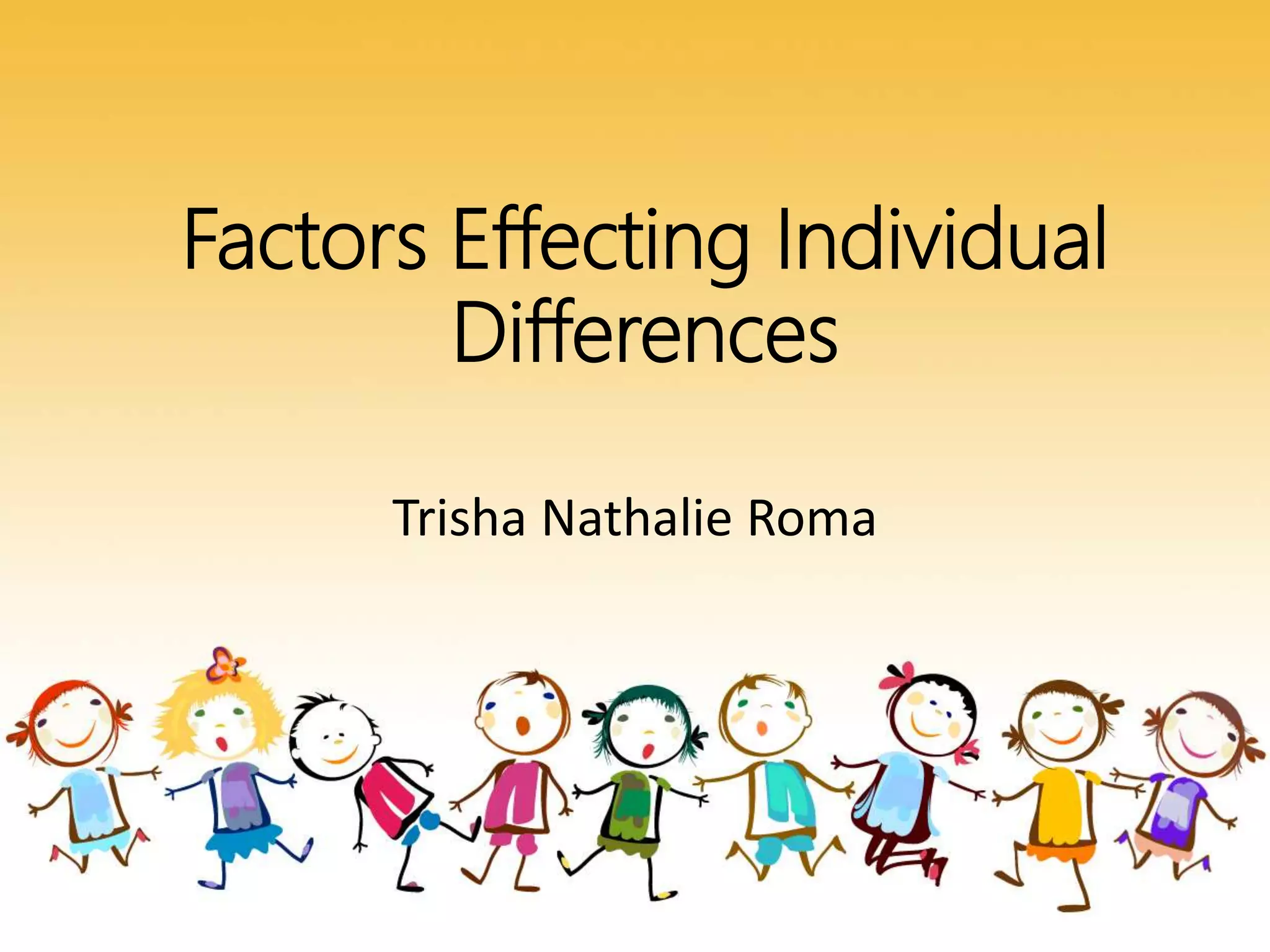
Factors Effecting Individual
Differences
Trisha Nathalie Roma
Factors Effecting Individual Differences
1. Heredity
What occurs naturally as a function of the
genes
2. Environment
What is learned and communicated in
different cultures or other social groups
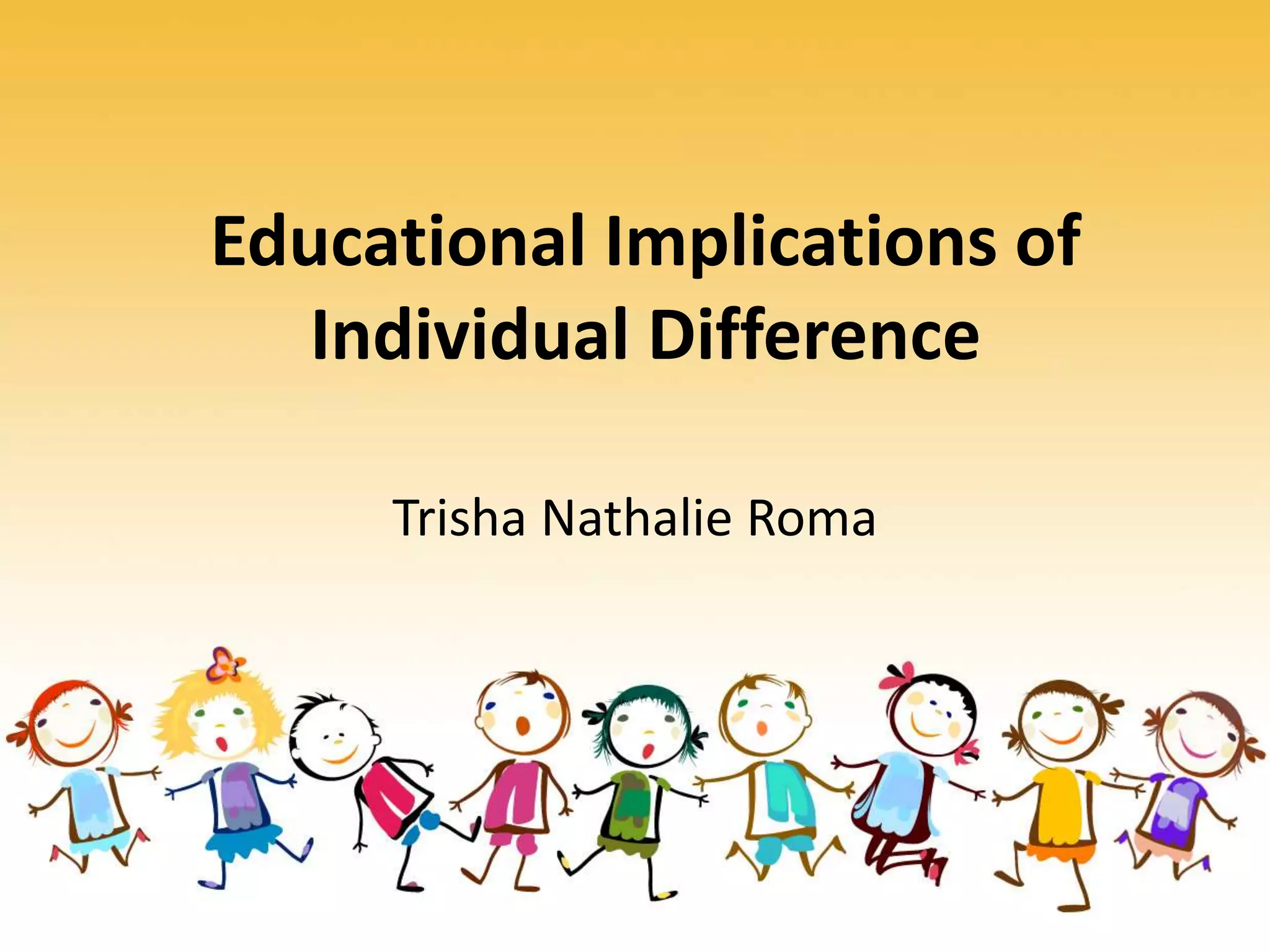
Educational Implications of
Individual Difference
Trisha Nathalie Roma
1. In any group there are individuals who
deviate from the norms of the group.
2. Every teacher should try to have the desired
knowledge of the abilities, capacities, interest,
attributes, aptitudes, and other personality traits
of his pupils and in the light of this knowledge
should render individual guidance to children for
the maximum utilization of their potentialities.
3. It is wrong to expect uniformity in gaining
proficiency or success in a particular field from a group
of students on account of their subnormal intelligence,
previous knowledge , back ground, lack of proper
interest, aptitude and attitude etc. some students lay
behind in one or the other area of achievement.
4. All students cannot be benefited by a particular
method of instruction and a uniform and rigid
curriculum.
Role of Schools in Meeting the
Individual Difference
1. Proper knowledge of the individual’s
potentialities
2. Ability grouping
3. Adjusting curriculum
4. Adjusting the method of teaching.

Principles of Individual Differences

  • 1.
  • 2.
    Definition “Individual differences standfor the variations or deviations among individuals in regard to a single characteristic or a number of characteristics.” -Carter B. Good
  • 3.
  • 4.
    Types of individualdifferences • Physical difference – Difference in acquired physical characteristics. • Mental difference - People differ in intellectual abilities and capacities. idiot, imbecile, moron, border line, normal, very superior and genius
  • 5.
    Types of individualdifferences • Emotional difference - Individuals also differ in the manner they express their emotions. • Differences in psychomotor skills - Individuals are found to differ with regard to development and acquisition of one or more types of skills.
  • 6.
    Types of individualdifferences • Differences in achievement - Differences exist in achievement and in knowledge among individuals. • Differences in interests and aptitudes - Variations occur among the individuals in relation to the specific tastes and interests.
  • 7.
    Types of individualdifferences • Learning Differences - Some learn more easily and are able to make use of their learning more comfortably than others. • Difference in attitudes, beliefs and opinions
  • 8.
  • 9.
    Factors Effecting IndividualDifferences 1. Heredity What occurs naturally as a function of the genes 2. Environment What is learned and communicated in different cultures or other social groups
  • 10.
    Educational Implications of IndividualDifference Trisha Nathalie Roma
  • 11.
    1. In anygroup there are individuals who deviate from the norms of the group. 2. Every teacher should try to have the desired knowledge of the abilities, capacities, interest, attributes, aptitudes, and other personality traits of his pupils and in the light of this knowledge should render individual guidance to children for the maximum utilization of their potentialities.
  • 12.
    3. It iswrong to expect uniformity in gaining proficiency or success in a particular field from a group of students on account of their subnormal intelligence, previous knowledge , back ground, lack of proper interest, aptitude and attitude etc. some students lay behind in one or the other area of achievement. 4. All students cannot be benefited by a particular method of instruction and a uniform and rigid curriculum.
  • 13.
    Role of Schoolsin Meeting the Individual Difference
  • 14.
    1. Proper knowledgeof the individual’s potentialities 2. Ability grouping 3. Adjusting curriculum 4. Adjusting the method of teaching.